
 100% FREE ACCESS
12th Standard Syllabus & Materials
12th Standard
TN 12th Computer Applications மின்னணு தரவு பரிமாற்றம் Sample Question Papers Study Material - QB365 Set A
NEW12th Standard
TN 12th Computer Applications மின் - வணிக பாதுகாப்பு அமைப்புகள் Sample Question Papers Study Material - QB365 Set A
NEW12th Standard
TN 12th Computer Applications மின்னணு செலுத்தல் முறைகள் Sample Question Papers Study Material - QB365 Set A
NEW12th Standard
TN 12th Computer Applications மின் - வணிகம் Sample Question Papers Study Material - QB365 Set A
NEW12th Standard
TN 12th Computer Applications திறந்த மூல கருத்துருக்கள் Sample Question Papers Study Material - QB365 Set A
NEW12th Standard
TN 12th Computer Applications வலையமைப்பு வடமிடல் Sample Question Papers Study Material - QB365 Set A

Published on: 01/03/2021
12th Standard English Medium Economics Reduced Syllabus Three Mark Important Questions - 2021(Public Exam )
Download Tamil Nadu 12th Standard Economics question papers, model tests, one-mark questions, important questions, and public exam papers in PDF format. Free study materials and answer keys for TN State Board students.
Questions + Answers key
Take MCQ Economics Test
1.
Describe Canons of Taxation.
2.
Distinguish between Balance of Trade and Balance of Payments.
3.
Describe the subject matter of International Economics.
4.
Distinguish between money market and capital market.
5.
Specify the functions of IFCI.
6.
What are the functions of NABARD?
7.
Give a brief note on NBFI.
8.
Explain disinflation.
9.
10.
Write the types of inflation
11.
What is money supply?
12.
State the concept of super multiplier.
13.
Explain any three subjective and objective factors influencing the consumption function.
14.
State the propositions of Keynes’s Psychological Law of Consumption
15.
Write any five differences between classicism and Keynesianism.
16.
Explain Keynes’ theory.
17.
Write short note on the implications of Say’s law
18.
19.
List out the uses of national income.
20.
What is the solution to the problem of double counting in the estimation of national income?
21.
Explain briefly NNP at factor cost.
22.
Differentiate between personal and disposable income.
23.
Distinguish between Capitalism and Globalism.
24.
Outline the major merits of capitalism.
25.
Describe the different types of economic systems.
1.
Canon of Ability
1. The Government should impose tax in such a way that the people have to pay taxes according to their ability.
2. Rich person should pay more tax.
Canon of Certainty
1. There is no uncertainty regarding the rate of tax or the time of payment.
Canon of Convenience
1. The method of tax collection and the timing of the tax payment should be convenient to the people.
Canon of Economy
1. The Government should impose only those taxes whose collection costs are very less and cheap.
2.
| S.No |
Balance of Trade |
Balance of Payments |
|---|---|---|
| 1 | Only export and import of commodities are included in BoT |
Export and import of commodities and services are included in BoP |
| 2 | i.e. Movement of goods or visible trade | Trade in both visible and non visible items. |
3.
Pure Theory of Trade
(i) This component explains the causes for foreign trade, composition, direction and volume of trade, determination of the terms of trade and exchange rate, issues related to balance of trade and balance of payments.
Policy Issues
(i) Policy issues such as free trade vs. protection, methods of regulating trade, capital and technology flows, use of taxation, subsidies and dumping, exchange control and convertibility, foreign aid, external borrowings and foreign direct investment, measures of correcting disequilibrium in BoP are covered.
International Cartels and Trade Blocs
(i) Economic integration, cartels, customs unions, monetary unions, trade blocs, economic unions and multinational corporation are covered
International Financial and Trade Regulatory Institutions
(i) Financial institutions like IMF, IBRD, WTO are part of International Economics.
4.
| S. No. |
Money Market |
Capital Market |
|---|---|---|
| (1) | Short term funds are loaned and borrowed | Long term funds are loaned and borrowed |
| (2) | It deals with purchase, sale and transfer of short term credit instruments. | It raises capital by dealing in shares, bonds mortgages and other long term investments. |
| (3) | Commercial banks, acceptance houses, Non Banking Financial Institutions and the Central Bank deals with short term funds | Instruments traded in capital market comprise of equity shares, preference. shares, Debentures, bonds and other long term securities. |
5.
The IFCI does the following functions
(i) Providing long-term loans in rupees and foreign currencies.
(ii) Underwriting of equity, preference and debenture issues.
(iii) Subscribing to equity, preference and debenture issues.
(iv) Guaranteeing the deferred payments for machinery imported from abroad or purchased in India
(v) Guaranteeing of loans raised in foreign currency from foreign financial institutions.
6.
1) NABARD acts as a refinancing institution for all kinds of production and investment credit to agriculture, small-scale industries, cottage and village industries, handicrafts, rural crafts and real artisans to promote integrated rural development.
2) It provides short-term, medium term and long-term credit to state co-operative Banks, RRBs, LDBs and other financial institutions approved by RBI.
3) NABARD gives long-term loans (20 Years) to State Government to enable them to subscribe to the share capital of co-operative credit societies.
4). It gives long-term loans to any institution approved by the Central Government or contribute to the share capital or invests in securities of any institution concerned with agriculture and rural development.
5) NABARD co-ordinates the activities of Central and State Governments, Planning Commission and all India and State level institutions entrusted with the development of small scale industries, village and cottage industries, rural crafts, industries in the tiny and decentralized sectors
6) It has the responsibility to inspect RRBs and CO-operative banks, other than primary co-operative societies.
7) It maintains a Research and Development Fund to promote research in agriculture and rural development
7.
(i) A non-banking financial institution or company is a financial institution that does not have a full banking license or is not supervised by the central bank.
(ii) They receive deposits and give loans.
(iii) They mobilize people's savings and use the funds to finance expenditure on investment activities.
(iv) The undertake borrowing and lending in the money and capital markets.
(v) They are classified into Stock Exchange and Other Financial institutions.
(vi) Under other financial institutions come Finance Companies, Finance Corporations, Chit Funds, Building Societies, Issue Houses, Investment Trusts, Unit Trusts and Insurance Companies.
8.
(i) It is the slowing down the rate of inflation by controlling the amount of credit (bank loan, hire purchase) available to consumers without causing more unemployment.
(ii) It is defined as the process of reversing inflation without creating unemployment or reducing output in the company.
9.
10.
(i) On the basis of speed there are four types of inflation - Creeping inflation, Walking Inflation, Running inflation, Galloping inflation.
(ii) Demand-Pull inflation, Cost-Push inflation.
(iii) On the basis of inducement - currency inflation, credit inflation, deficit induced inflation, profit induced inflation, scarcity induced inflation, tax induced inflation.
11.
(i) Money supply means the total amount of money in an economy.
(ii) It refers to the amount of money which is in circulation in an economy at any given time.
(iii) Money supply determines the price level and interest rates.
(iv) Money supply viewed at a given point of time is a stock and over a period of time it is a flow.
12.
(i) Hicks combined multiplier and accelerator to measure the total effect of initial investment on income.
(ii) Both induced consumption and induced investment are combined.
(iii) Also called leverage effect, it may lead the economy to a very high or low level of income propagation.
\(\mathrm{Y}=\mathrm{C}+\mathrm{I}_{\mathrm{A}}+\mathrm{I}_{\mathrm{P}}\)
Y = aggregate income
C = consumption expenditure
IA = autonomous investment
IB = induced private investment
13.
Motive of precaution
To build a reserve against unforeseen contingencies, (c.g.) accidents
Motive of foresight
The desire to provide for anticipated future needs, (c.g.) Old age
Motive of calculation
The desire to enjoy interest and appreciation.
Income Distribution
According to VKRV Rao if income is equally distributed propensity to consume increases
Price level
When price falls, real income rises; people consume more and save more.
Wage level
Consumption expenditure increases with a rise in wages.
14.
(i) When income incrcases, consumption expenditure also incrcases but by a smaller amount.
(ii) The increased income will be divided in some proportion between consumption expenditure and saving.
(iii) Increase in income always leads to an increase in both consumption and saving.
15.
| S. No: | Keynesianism | Classicism |
| 1. | Short-run equilibrium | Long-run equilibrium |
| 2. | Saving is a vice | Saving is a social virtue. |
| 3. | Money functions as medium of exchange and store of value | Money acts as a medium of exchange |
| 4. | Macro approach to national problems | Micro approach to macro problems |
| 5. | State intervention is advocated | Favoured laissez-faire policy |
16.
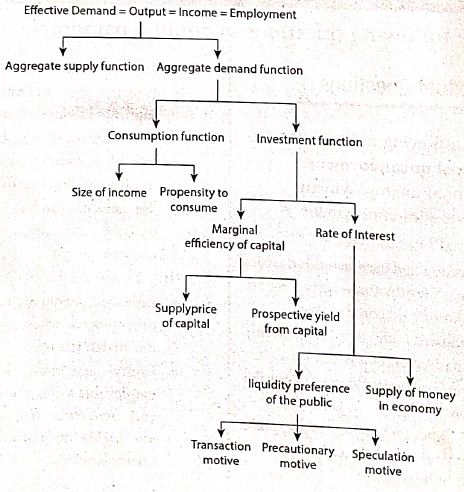
17.
(i) There is no possibility for over production or unemployment.
(ii) If there exist unutilized resources, it is profitable to employ them up to full employment.
(iii) There is automatic price mechanism, so no need for government intervention
(iv) Interest flexibility brings about equality between saving and investment.
(v) Money acts as the medium of exchange.
18.
19.
(i) National income is of great importance for the economy of a country.
(ii) National income helps us to know the relative importance and contribution of each sector. We could find how income is produced, how it is distributed, how much is spent, saved or taxed.
(iii) National income data is used to build economic models in short run and long run.
(iv) Data regarding gross income, output, saving & consumption is used in economic planning.
(v) National income data is used to build economic models in short run and long run.
(vi) It is used to make international comparison, inter - regional comparison and inter - temporal comparison of growth of the economy during different periods.
(vii) If income is equally distributed, the per capita income will reflect the economic welfare of the country.
20.
(i) To avoid double counting, either the value of the final output should be taken into the estimate of GNP or the sum of values added should be taken.
(ii) The value of the final product is derived by the summation of all the values added in the productive process.
(iii) Any commodity which is either raw material or intermediate good should not be included.
(iv) For example, value of cotton enters value of yarn as cost, and value of yarn in cloth and that of cloth in garments.
(v) At every stage only the value which is added should be considered.
21.
(i) It is the total of income payment made to factors of production.
(ii) From the money value of NNP at market price, we deduct indirect tax and add subsidy.
(iii) \(\mathrm{NNP}_{\mathrm{FC}}=\mathrm{NNP}_{\mathrm{MP}}-\) Indirect taxes + Subsidies
22.
| S.No | Personal Income | Disposable Income |
|---|---|---|
| 1 | It is the total income received by the individual before payment of direct taxes in a year | It is the individual's income after the payment of income tax |
| 2 | Disposable income = Personal income - Direct tax |
23.
| S.No. | Capitalism | Globalism |
| 1 | Also called free economy or laissez faire or market economy where the role of the government is minimum | Also called extended capitalism. It connects nations together through international trade |
| 2 | Market determines economic activities within a nation | It aims at global development Manfred |
| 3 | Adam Smith is the father of the capitalism | D. Steger (2002) coined the term |
24.
(i) Automatic working without any government intervention.
(ii) Efficient use of resources.
(iii) Incentives for hard work.
(iv) Production and productivity are high, so there is economic progress.
(v) Consumers sovereignty exist.
(vi) Increased saving and investment leads to higher capital formation.
(vii) Development of new technology.
25.
Capitalism:
(i) The means of production are privately owned.
(ii) Manufacturers produce goods and services with profit motive.
(iii) Individual can take up any occupation and develop any skill. E.g. USA.
Socialism:
(i) All resources are owned and operated by the government.
(ii) Public welfare is the main motive.
(iii) There is equality in the distribution of income and wealth. E.g. China
Mixedism:
(i) Both private and public sectors co-exist and work together.
(ii) Resources are owned by individuals and the government. E.g. India

12th Standard Syllabus & Materials
12th Standard
TN 12th Computer Applications களப்பெயர் முறைமை (DNS) Sample Question Papers Study Material - QB365 Set A
NEW12th Standard
TN 12th Computer Applications வலையமைப்பு எடுத்துக்காட்டுகள் மற்றும் நெறிமுறைகள் Sample Question Papers Study Material - QB365 Set A
NEW12th Standard
TN 12th Computer Applications கணினி வலையமைப்பு ஓர் அறிமுகம் Sample Question Papers Study Material - QB365 Set A
NEW12th Standard
TN 12th Computer Applications PHP-உடன் MySQL-ஐ இணைத்தல் Sample Question Papers Study Material - QB365 Set A



Tamilnadu Stateboard 12th Standard Subjects

Maths

Chemistry

Physics

Biology

Computer Science

Business Maths and Statistics
Economics

Commerce

Accountancy

History

Computer Applications
Biology
Computer Technology
Computer Applications
Computer Science
Business Maths and Statistics
Commerce
Economics
Maths
Chemistry
Physics
Computer Technology
History
Accountancy

Tamil

English

French
Tamilnadu Stateboard Standards
