
 100% FREE ACCESS
12th Standard Syllabus & Materials
12th Standard
TN 12th Computer Applications மின்னணு தரவு பரிமாற்றம் Sample Question Papers Study Material - QB365 Set A
NEW12th Standard
TN 12th Computer Applications மின் - வணிக பாதுகாப்பு அமைப்புகள் Sample Question Papers Study Material - QB365 Set A
NEW12th Standard
TN 12th Computer Applications மின்னணு செலுத்தல் முறைகள் Sample Question Papers Study Material - QB365 Set A
NEW12th Standard
TN 12th Computer Applications மின் - வணிகம் Sample Question Papers Study Material - QB365 Set A
NEW12th Standard
TN 12th Computer Applications திறந்த மூல கருத்துருக்கள் Sample Question Papers Study Material - QB365 Set A
NEW12th Standard
TN 12th Computer Applications வலையமைப்பு வடமிடல் Sample Question Papers Study Material - QB365 Set A

Published on: 13/05/2022
QB365 provides detailed and simple solution for every book back questions in class 12 Economics subject.It will helps to get more idea about question pattern in every book back questions with solution.
latest Book back QuestionsDownload Tamil Nadu 12th Standard Economics question papers, model tests, one-mark questions, important questions, and public exam papers in PDF format. Free study materials and answer keys for TN State Board students.
Questions + Answers key
Take MCQ Economics Test1.
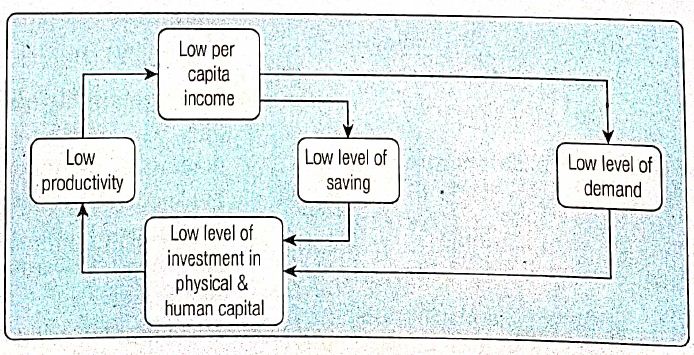
Elucidate major causes of vicious circle of poverty with diagram
2.
What are the causes of water pollution?
3.
Specify the meaning of material balance principle.
4.
Mention any three methods of redemption of public debt.
5.
Point out any three differences between direct tax and indirect tax.
6.
What are the functions of a modern state?
7.
State briefly the functions of SAARC.
8.
What is Multilateral Agreement?
9.
What are trade blocks?
10.
State the objectives of Foreign Direct Investment.
11.
What are import quotas?
12.
Explain the Net Barter Terms of Trade and Gross Barter Terms of Trade.
13.
Describe the subject matter of International Economics.
14.
Distinguish between money market and capital market.
15.
Give a brief note on NBFI.
16.
17.
What are the determinants of money supply?
18.
State the concept of super multiplier.
19.
Explain any three subjective and objective factors influencing the consumption function.
20.
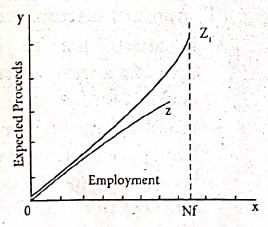
Explain about aggregate supply with the help of diagram.
21.
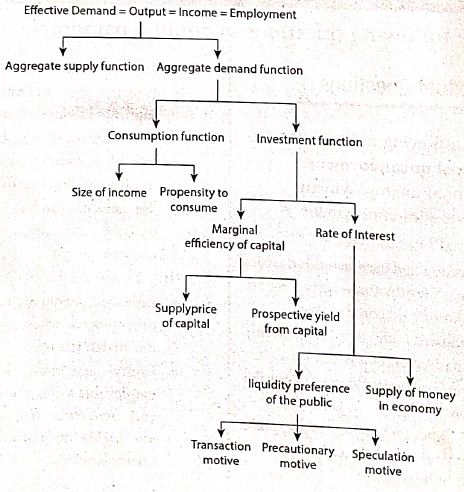
Explain Keynes’ theory.
22.
What is the solution to the problem of double counting in the estimation of national income?
23.
Distinguish between Capitalism and Globalism.
24.
Indicate the demerits of socialism.
25.
Describe the different types of economic systems.
1.
(i) The cause for vicious circle of poverty is demand and supply.
(ii) On the supply side, the low level of real income leads to low level of saving and investment and to deficiency of capital.
(iii) Deficiency of capital leads to low productivity and back to low income.
(iv) On the demand-side, low level of real income leads to low demand so investment is less, therefore deficiency of capital, low productivity and low income.
2.
Discharge of sewage and waste water:
(i) Sewage, garbage and liquid waste of households, agricultural runoff and effluents from factories are discharged into lakes and rivers.
(ii) These wastes contain harmful chemicals and toxins which make the water poisonous for aquatic animals and plants.
Dumping of solid wastes:
(i) The dumping of solid wastes and litters in water bodies cause huge problems.
Discharge of industrial wastes:
(i) Industrial waste contains asbestos, lead, mercury, grease oil and petrochemicals.
Oil Spill:
(i) Sea water gets polluted due to oil spilled from ships and tankers.
Acid Rain:
(i) When the acidic particles caused by air pollution mix with water vapour, it results in acid rain.
Global warming:
(i) The increase in water temperature affects aquatic plants and animals.
Eutrophication:
(i) The increased level of nutrients in water depletes oxygen in water and this negatively affects fish and other aquatic animal population.
3.
(i) The law of conservation of matter and energy, emphasizes that in any production system "what goes in must come out".
(ii) All resources extracted from the environment eventually become unwanted wastes and pollutants.
(iii) Production of output by firms from inputs results in discharge of solid, liquid and gaseous wastes.
(iv) Waste results from consumption activities by households.
(v) Thus material and energy drawn from environment are used for production and consumption and returned back to the environment as wastes.
(vi) \(\mathrm{R}=\mathrm{W}_{1}+\mathrm{W}_{2}\)
(vii) Input = Output
4.
Introduction:
(i) The process of repaying a public debt is called redemption.
(a) Sinking Fund
(i) The Government establishes a separate fund into which every year a fixed amount of money is credited.
(ii) By the time the debt matures, the fund accumulates enough amount to pay off the principal along with interest.
(a) Conversion
(i) An old loan is converted into a new loan.
(ii) A high interest public debt is converted into a low interest public debt.
(c) Budgetary Surplus
(i) When the Government has a surplus budget, it can be used for repaying the debt.
5.
| SI.No | Direct Tax | Indirect Tax |
|---|---|---|
| 1. | Direct tax is levied on person's income and wealth and is paid directly to the government. | It is levied on a person who consumes the goods and services and is paid indirectly to government. |
| 2. | Progressive in nature | Regressive in nature |
| 3. | Falls on the same person. | Falls on different persons. |
| 4. | Burden cannot be shifted. | can be shifted |
| 5. | Tax evasion is possible. | Included in the price of the goods. |
6.
Defence
1. The Government protects the people from external aggression and internal disorder.
2. Through police and military forces it renders protective services.
Judiciary:
1. It provides adequate judicial structure to render justice to all citizens.
Enterprises
1. The regulation and control of private enterprise comes under the government.
Social Welfare:
1. The state provides education, social security, social insurance, health and sanitation for the people.
Infrastructure
1. Modern States build the base for the economic development of the country by creating social and economic infrastructure.
Macro-economic policy
1. The Government follows fiscal policy and monetary policy to achieve macro economic goals.
Social Justice
1. During the process of growth certain sections of the economy gain at the cost of others.
2. Government intervenes with fiscal measures to redistribute income.
Control of Monopoly
1. State intervenes through control of monopolies and restrictive trade practices to curb concentration of economic power.
7.
The main functions of SAARC are as follows.
1) Maintenance of the cooperation in the region.
2) Prevention of common problems associated with the member nations.
3) Ensuring strong relationship among the member nations.
4) Removal of the poverty through various packages of programmes.
5) Prevention of terrorism in the region.
8.
(i) It is a multinational legal or trade agreements between countries.
(ii) It is an agreement between more than two countries but not many.
9.
(i) Trade blocks cover different kinds of arrangements between or among countries for mutual benefit.
(ii) Free Trade Area, Customs Union, Common Market and Economic Union.
10.
FDI has the following objectives.
(i) Sales Expansion
(ii) Acquisition of resources
(iii) Diversification
(iv) Minimization of competitive risk
11.
(i) It is a trade restriction that sets a limit on the quantity of a good that can be imported into a country in a given period of time.
(ii) Quotas are used to benefit the producers of good in that economy.
12.
Net Barter Terms of Trade
1. This was developed by Taussig in 1927.
2. The ratio between the prices of exports and of imports is called net barter terms of trade.
3. Viner calls it commodity terms of trade.
4. \(\mathrm{T}_{\mathrm{n}}=\left(\mathrm{P}_{\mathrm{x}} / \mathrm{P}_{\mathrm{m}}\right) \times 100\)
5. Tn is Net Barter Terms of Trade
6. Px is Index number of export prices
7. Pm is Index number of import prices
8. This measures the gain from International Trade.
9. If Tn is greater than 100, it is terms of trade which means that for a rupee of export, more of imports can be received by a country.
Gross Barter Terms of Trade
1. Developed by Taussig in 1927 as an improvement over the net terms of trade.
2. It is an index of relationship between total physical quantity of imports and the total physical quantity of exports.
\(\mathrm{Tg}=\left(\mathrm{Q}_{\mathrm{m}} / \mathrm{Q}_{\mathrm{x}}\right) \times 100\)
3. Qm is Index of import quantities
4. Qx is Index of export quantities
5. If for a given quantity of export, more quantity of import can be consumed by a country, the terms of trade are favourable.
13.
Pure Theory of Trade
(i) This component explains the causes for foreign trade, composition, direction and volume of trade, determination of the terms of trade and exchange rate, issues related to balance of trade and balance of payments.
Policy Issues
(i) Policy issues such as free trade vs. protection, methods of regulating trade, capital and technology flows, use of taxation, subsidies and dumping, exchange control and convertibility, foreign aid, external borrowings and foreign direct investment, measures of correcting disequilibrium in BoP are covered.
International Cartels and Trade Blocs
(i) Economic integration, cartels, customs unions, monetary unions, trade blocs, economic unions and multinational corporation are covered
International Financial and Trade Regulatory Institutions
(i) Financial institutions like IMF, IBRD, WTO are part of International Economics.
14.
| S. No. |
Money Market |
Capital Market |
|---|---|---|
| (1) | Short term funds are loaned and borrowed | Long term funds are loaned and borrowed |
| (2) | It deals with purchase, sale and transfer of short term credit instruments. | It raises capital by dealing in shares, bonds mortgages and other long term investments. |
| (3) | Commercial banks, acceptance houses, Non Banking Financial Institutions and the Central Bank deals with short term funds | Instruments traded in capital market comprise of equity shares, preference. shares, Debentures, bonds and other long term securities. |
15.
(i) A non-banking financial institution or company is a financial institution that does not have a full banking license or is not supervised by the central bank.
(ii) They receive deposits and give loans.
(iii) They mobilize people's savings and use the funds to finance expenditure on investment activities.
(iv) The undertake borrowing and lending in the money and capital markets.
(v) They are classified into Stock Exchange and Other Financial institutions.
(vi) Under other financial institutions come Finance Companies, Finance Corporations, Chit Funds, Building Societies, Issue Houses, Investment Trusts, Unit Trusts and Insurance Companies.
16.
17.
Currency Deposit Ratio (CDR):
It is the ratio of money held by the public in currency to that they hold in bank deposits.
Reserve deposit Ratio (RDR):
Reserve Money consists of vault cash in banks and deposits of commercial banks with RBI.
Cash Reserve Ratio (CRR):
It is the fraction of deposits the banks must keep with RBI.
Statutory Liquidity Ratio (SLR):
It is the fraction of the total demand and time deposits the commercial bank must keep with itself.
18.
(i) Hicks combined multiplier and accelerator to measure the total effect of initial investment on income.
(ii) Both induced consumption and induced investment are combined.
(iii) Also called leverage effect, it may lead the economy to a very high or low level of income propagation.
\(\mathrm{Y}=\mathrm{C}+\mathrm{I}_{\mathrm{A}}+\mathrm{I}_{\mathrm{P}}\)
Y = aggregate income
C = consumption expenditure
IA = autonomous investment
IB = induced private investment
19.
Motive of precaution
To build a reserve against unforeseen contingencies, (c.g.) accidents
Motive of foresight
The desire to provide for anticipated future needs, (c.g.) Old age
Motive of calculation
The desire to enjoy interest and appreciation.
Income Distribution
According to VKRV Rao if income is equally distributed propensity to consume increases
Price level
When price falls, real income rises; people consume more and save more.
Wage level
Consumption expenditure increases with a rise in wages.
20.
(i) Aggregate supply refers to the value of total output of goods and services produced in an economy in a year ie national product or income.
(ii) The components of aggregate supply are:
(iii) Aggregate (desired) consumption expenditure (C)
(iv) Aggregate (desired) private savings (S)
(v) Net tax payments (T)
(vi) Personal (desired) transfer payments to the foreigners (Rf)
AS = C + S + T + Rf
In this figure 2 aggregate supply curves are drawn for the assumption of fixed money wages and variable wages.
Explanation
(i) Z Curve is linear (fixed money wages)
(ii) Z1 curve is non-linear (wage rate increases with employment)
(iii) When full employment level of Nf is reached output cannot be increased by employing more men.
(iv) So aggregate supply curve becomes inelastic (Vertical straight line).
(v) In reality aggregate supply curve will be like Z1 .
(vi) If prices are high and wages low, the producers will employ more labourers.
(vii) 4YAggregate supply is an important factor in determining the level of economic activity.
21.
22.
(i) To avoid double counting, either the value of the final output should be taken into the estimate of GNP or the sum of values added should be taken.
(ii) The value of the final product is derived by the summation of all the values added in the productive process.
(iii) Any commodity which is either raw material or intermediate good should not be included.
(iv) For example, value of cotton enters value of yarn as cost, and value of yarn in cloth and that of cloth in garments.
(v) At every stage only the value which is added should be considered.
23.
| S.No. | Capitalism | Globalism |
| 1 | Also called free economy or laissez faire or market economy where the role of the government is minimum | Also called extended capitalism. It connects nations together through international trade |
| 2 | Market determines economic activities within a nation | It aims at global development Manfred |
| 3 | Adam Smith is the father of the capitalism | D. Steger (2002) coined the term |
24.
(i) Red tapism and bureaucracy since, approval of many officials is needed.
(ii) Absence of incentive and so productivity is less.
(iii) Limited freedom of choice in the consumption of goods and services.
(iv) The state takes all major decisions. There is concentration and misuse of power.
25.
Capitalism:
(i) The means of production are privately owned.
(ii) Manufacturers produce goods and services with profit motive.
(iii) Individual can take up any occupation and develop any skill. E.g. USA.
Socialism:
(i) All resources are owned and operated by the government.
(ii) Public welfare is the main motive.
(iii) There is equality in the distribution of income and wealth. E.g. China
Mixedism:
(i) Both private and public sectors co-exist and work together.
(ii) Resources are owned by individuals and the government. E.g. India

12th Standard Syllabus & Materials
12th Standard
TN 12th Computer Applications களப்பெயர் முறைமை (DNS) Sample Question Papers Study Material - QB365 Set A
NEW12th Standard
TN 12th Computer Applications வலையமைப்பு எடுத்துக்காட்டுகள் மற்றும் நெறிமுறைகள் Sample Question Papers Study Material - QB365 Set A
NEW12th Standard
TN 12th Computer Applications கணினி வலையமைப்பு ஓர் அறிமுகம் Sample Question Papers Study Material - QB365 Set A
NEW12th Standard
TN 12th Computer Applications PHP-உடன் MySQL-ஐ இணைத்தல் Sample Question Papers Study Material - QB365 Set A



Tamilnadu Stateboard 12th Standard Subjects

Maths

Chemistry

Physics

Biology

Computer Science

Business Maths and Statistics
Economics

Commerce

Accountancy

History

Computer Applications
Biology
Computer Technology
Computer Applications
Computer Science
Business Maths and Statistics
Commerce
Economics
Maths
Chemistry
Physics
Computer Technology
History
Accountancy

Tamil

English

French
Tamilnadu Stateboard Standards



