
 100% FREE ACCESS
12th Standard Syllabus & Materials
12th Standard
TN 12th Maths Applications of Matrices and Determinants Sample Question Papers Study Material - QB365 Set A
NEW12th Standard
TN 12th Computer Applications மின்னணு தரவு பரிமாற்றம் Sample Question Papers Study Material - QB365 Set A
NEW12th Standard
TN 12th Computer Applications மின் - வணிக பாதுகாப்பு அமைப்புகள் Sample Question Papers Study Material - QB365 Set A
NEW12th Standard
TN 12th Computer Applications மின்னணு செலுத்தல் முறைகள் Sample Question Papers Study Material - QB365 Set A
NEW12th Standard
TN 12th Computer Applications மின் - வணிகம் Sample Question Papers Study Material - QB365 Set A
NEW12th Standard
TN 12th Computer Applications திறந்த மூல கருத்துருக்கள் Sample Question Papers Study Material - QB365 Set A

Published on: 13/05/2022
QB365 provides detailed and simple solution for every book back questions in class 12 Economics subject.It will helps to get more idea about question pattern in every book back questions with solution.
latest Book back QuestionsDownload Tamil Nadu 12th Standard Economics question papers, model tests, one-mark questions, important questions, and public exam papers in PDF format. Free study materials and answer keys for TN State Board students.
Questions + Answers key
Take MCQ Economics Test1.
Find the regression equation Y on X and X on Y for the following data:
| Y | 45 | 48 | 50 | 55 | 65 | 70 | 75 | 72 | 80 | 85 |
| X | 25 | 30 | 35 | 30 | 40 | 50 | 45 | 55 | 60 | 65 |
2.
Elucidatethe nature and scope of Statistics.
3.
4.
Explain the importance of sustainable development and its goals.
5.
Briefly explain the relationship between GDP growth and the quality of environment.
6.
7.
State and explain instruments of fiscal policy.
8.
Bring out the merits of indirect taxes over direct taxes.
9.
10.
Bring out the functions of World Bank.
11.
Explain the relationship between Foreign Direct Investment and Economic development.
12.
Discuss the various types of disequilibrium in the balance of payments.
13.
Explain the types of Terms of Trade given by Viner.
14.
Explain briefly the Comparative Cost Theory.
15.
What are the objectives of Monetary Policy? Explain.
16.
Elucidate the functions of Commercial Banks
17.
Describe the phases of Trade cycle.
18.
Explain the functions of money
19.
What are the differences between MEC and MEI.
20.
Explain Keynes psychological law of consumption function with diagram.
21.
Narrate the equilibrium between ADF and ASF with diagram
22.
Describe the types of unemployment.
23.
Discuss the various methods of estimating the national income of a country.
24.
Compare the features of capitalism and socialism.
25.
Discuss the scope of Macro Economics.
1.
| S.No | X | X - X | (X - X)2 | Y | Y - Y | (Y - Y)2 | XY |
| 1 | 45 | -19.5 | 380.25 | 25 | -18.5 | 342.25 | 360.75 |
| 2 | 48 | -16.5 | 272.25 | 30 | -13.5 | 182.25 | 222.75 |
| 3 | 50 | -14.5 | 210.25 | 35 | -8.5 | 72.25 | 123.25 |
| 4 | 55 | -9.5 | 90..25 | 30 | -13.5 | 182.25 | 128.25 |
| 5 | 65 | 0.5 | 0.25 | 40 | -3.5 | 12.25 | -1.75 |
| 6 | 70 | 5.5 | 30.25 | 50 | 6.5 | 42.25 | 35.75 |
| 7 | 75 | 10.5 | 110.25 | 45 | 1.5 | 2.25 | 15.75 |
| 8 | 72 | 7.5 | 56.25 | 55 | 11.5 | 132.25 | 86.25 |
| 9 | 80 | 15.5 | 240.25 | 60 | 16.5 | 272.25 | 255.75 |
| 10 | 85 | 20.5 | 420.25 | 65 | 21.5 | 462.25 | 440.75 |
| 10 | 645 | 1810.50 | 435 | 1702.5 | 1667.5 |
\(\bar{X}=\frac{645}{10}=64.5
\)
\(\sigma x=\sqrt{\frac{\sum(x-\bar{x})^{2}}{n}}
\)
\(=\sqrt{\frac{1810.50}{10}}
\)
\(=\sqrt{181.05}=13.4
\)
\(\bar{\gamma}=\frac{435}{10}=43.5
\)
\(\sigma y=\sqrt{\frac{\sum(y-\bar{y})^{2}}{n}}
\)
\(=\sqrt{\frac{1702.5}{10}}=\sqrt{170.25}=13.05
\)
\(r=\frac{\sum x y^{\prime}}{\sqrt{\sum x^{2}} \sqrt{\sum y^{2}}}
\)
\(=\frac{1667.5}{\sqrt{1810.50} \sqrt{1702.5}}
\)
\(=\frac{1667.5}{42.55 \times 41.25}=\frac{1667}{1755}=0.95
\)
\(\bar{x} =64.5
\)
\(\bar{y} =43.5
\)
\(\sigma y =13.05
\)
\(\sigma x =13.4\)
r =0.95
The regression X on Y is
\(x-\bar{x} =r \times \frac{\sigma x}{\sigma y} \times(y-\bar{y})
\)
\(x-64.5 =0.95 \times\left(\frac{13.4}{13.05}\right) \times y-43.5 \)
x-64.5 =(0.95 x 1.03) x y-43.5
x =0.9785 x (y-43.5)+64.5
x =0.9785 y-42.56+64.5
x =0.9785 y+21.94
The regression Y on X is
\(y-\bar{y}=r \times \frac{v y}{\sigma x} \times(x-\bar{x})
\)
\(y-43.5=0.95 \times \frac{13.05}{13.4} \times x-64.5\)
y=0.95(0.97) x (x-64.5)+43.5
y=0.9215 x (x-64.5)+43.5
y=0.9215 x-59.44 + 43.5
Ans: y=0.9215 x-15.94
2.
Nature of Statistics
(i) Different Statisticians and Economists differ in views about the nature of statistics.
(ii) Some call it a science and some say it is an art
(iii) Tippet considers Statistics both as a science as well as an art.
Scope of statistics
(i) Statistics is applied in every sphere of human activity social and physical.
Statistics and Economics
(i) Statistical data and techniques are immensely useful in solving many economic problems.
Statistics and Firms
(i) Statistics is used in many firms to find whether the product is conforming to specifications or not.
Statistics and Commerce
(i) Market survey helps to find the present conditions and to forecast the likely changes in future.
Statistics and Education
- Statistics is necessary for the formulation of policies to start new course.
- Public and private educational institutions do research and development work to test the past knowledge and evolving knowledge.
Statistics and Planning
(i) In the modern world, a "world of planning" almost all the organisations in the government are using planning for efficient working, for the formulation of policy decisions and execution of the same.
(ii) In India, statistics play an important role in planning both at the central and the state government levels, but the quality of data is highly unscientific.
Statistics and Medicine
(i) t-test is used to compare the efficiency of two medicines.
Statistics and Modern applications
(i) Recent developments in computer and information technology have enabled statistics to integrate their models and thus make statistics a part of decision making procedures of many organisations.
(ii) There are many software packages available for solving simulation problems.
3.
4.
Introduction:
(i) Sustainable development is concerned with the welfare of the present and future generation.
(ii) It aims at satisfying the luxury wants of the rich and the basic necessities of the poor.
Definition:
(i) Sustainable development is development that meets the needs of the present without compromising the ability of future generations to meet their own needs.
Goals:
(i) It is crucial to harmonize three core elements such as economic growth, social inclusion and environmental protection.
(ii) A set of 17 goals for the world's future can be achieved before 2030 with three unanimous principles fixed by United Nations such as Universality, Integration and Transformation.
1) End poverty in all its forms everywhere.
2) End hunger, achieve food security and improved nutrition and promote sustainable agriculture.
3) Ensure healthy lives and promote wellbeing for all at all ages.
4) Ensure inclusive and quality education for all and promote lifelong learning.
5) Achieve gender equality and empower women and girls.
6) Ensure access to water and sanitation for all.
7) Ensure access to affordable, reliable, sustainable and modern energy for all.
8) Promote inclusive and sustainable economic growth, employment and decent work for all.
9) Build resilient infrastructure, promote, sustainable industrialization and foster innovation.
10) Reduce inequality within and among countries.
11) Make cities inclusive, safe, resilient and sustainable.
12) Ensure sustainable consumption and production pattern.
13) Take urgent action to combat climate change and its impacts
14) Conserve and sustainably use the oceans, seas and marine resources.
15) Sustainably manage forests, combat desertification, stop and reverse land degradation, stop biodiversity loss.
16) Promote just, peaceful and inclusive societies.
17) Revitalize the global partnership for sustainable development.
5.
(i) Strong economic growth or high GDP growth leads to excessive use of resources.
(ii) Natural resources are essential inputs for production in many sectors;
(iii) Production and consumption lead to pollution and other pressures on the environments.
(iv) Poor environmental quality affects economic growth and well being by lowering the quantity and quality of resources or due to health impact.
(v) There is the need to balance growth and the sustainability of eco system.
(vi) So we have to ensure our sustainable existence, consume less and curb economic growth.
6.
7.
(i) Fiscal Policy is implemented through fiscal instruments also called 'fiscal tools' or fiscal levers - Government expenditure, taxation and borrowing are the instruments of fiscal policy.
Taxation:
(i) Taxes transfer income from the people to the Government.
(ii) Taxes are direct or indirect.
(iii) An increase in tax reduces disposable income.
(iv) So tax should be raised to control inflation.
(v) During depression, taxes are to be reduced.
Public Expenditure:
(i) Public expenditure raises wages and salaries of the employees and so aggregate demand for goods rises.
(ii) So, public expenditure is raised during recession and reduced during inflation.
Public debt:
(i) When Government borrows by floating a loan, there is transfer of funds from the public to the Government.
(ii) At the time of interest payment and repayment of public debt, funds are transferred from Government to public.
8.
Wider Coverage
(i) All consumers have to pay indirect taxes, but only 2 % pay direct tax.
Equitable
(i) It satisfies the canon of equity when higher tax is imposed on luxuries used by the rich.
Economical
(i) Cost of collection is less as producers and retailers collect tax and pay to government.
(ii) The traders act as honorary tax collectors.
Checks harmful consumption
(i) Government imposes indirect taxes on goods which are harmful to health e.g. tobacco, liquor.
Convenient
(i) Indirect taxes are levied on goods and services.
(ii) When consumers buy, they pay tax along with the price.
(iii) So, they do not feel the pinch of paying tax.
9.
10.
Investment for productive purposes
(i) World Bank helps in reconstruction and development of territories of member nations through investment for productive purposes.
(ii) It encourages the development of productive facilities and resources in less developed countries.
Balanced growth of international trade
(i) Promoting the long range balanced growth of trade at international level and the maintaining equilibrium in BoPs of member nations by encouraging international investment.
Provision of loans and guarantees
(i) Arranging the loans or providing guarantee on loans by various other channels and execute important projects.
Promotion of foreign private investment
(i) This is done by means of guarantees on loans and other investment made by private investors.
(ii) The Bank supplements private investment by providing finance for productive purpose out of its own resources or from borrowed funds.
Technical services
(i) The World Bank facilitates different kinds of technical services to the member countries through Staff College and experts.
11.
1. FDI is an important factor in global
2. Foreign trade and FDI are closely related.
3. In developing countries like India FDI in tie natural resource sector like plantations, increases rade.
4. Foreign production by FDI is useful to substitute foreign trade.
5. FDI is also influenced by the income generated from the trade and regional integration schemes.
6. FDI accelerates the economic growth by facilitating essential imports needed for development programs like capital goods, technical know-how, raw materials, other inputs and even scarce consumer goods.
7. When the export earnings of a country are not sufficient to finance for imports, FDI may be required to fill the trade gap.
8. FDI is encouraged by foreign exchange shortage, desire to create employment and acceleration of the pace of economic development.
9. Many developing countries strongly prefer foreign investment to imports.
12.
Cyclical Disequilibrium
Cyclical Disequilibrium occurs because of:
(i) Two countries may be passing through different phases of business cycle.
(ii) The elasticities of demand may differ between countries.
Secular Disequilibrium
(i) It occurs because of long-run and deep rooted changes in an economy as it advances from one stage of growth to another.
(ii) In the initial stages of development, domestic investment exceeded domestic savings and imports exceeded exports, as it happened in India since $1951.
Structural disequilibrium
(i) Structural changes in line economy may also cause BoP disequibrium
(ii) Structural changes include development of alternative sources of supply, development of better substitutes, exhaustion of protective resources or changes in transport routes and costs.
13.
Single Factoral Terms of Trade
(i) According to Viner, the single factoral terms of trade is an improvement over the commodity terms of trade.
(ii) It represents the ratio of export. price index to the import price index adjusted for changes in the productivity of factors in the production of exports.
\(\mathrm{T}_{\mathrm{f}}=\left(\mathrm{P}_{\mathrm{x}} / \mathrm{P}_{\mathrm{m}}\right) \mathrm{F}_{\mathrm{x}}\)
(iii) Tf is single factoral terms of trade index.
(iv) Fx is productivity in exports.
Double Factoral Terms of Trade
\(\mathrm{T}_{\mathrm{ff}}=\left(\mathrm{P}_{\mathrm{x}} / \mathrm{P}_{\mathrm{m}}\right)\left(\mathrm{F}_{\mathrm{x}} / \mathrm{F}_{\mathrm{m}}\right)\)
(i) It takes into account the productivity in country's exports and productivity of foreign factors.
(ii) Fm is import index (which is measured as index cost in terms of quantity of factors of production employed per unit) of imports.
14.
Introduction
1. David Ricardo formulated comparative cost theory.
2. J. S. Mill, Marshall, Taussig refined it.
Theory
1. Trade can take place even if absolute cost difference is absent but there is comparative cost difference.
Illustration
2. Ricardo's theory is explained with an example of production costs of cloth and wheat in America and India.
(Units of labour needed to produce one unit)
| Country | Cloth | Wheat | Domestic Exchange Ratios |
| America | 100 | 120 | 1 Wheat = 1.2 Cloth |
| India | 90 | 80 | 1 Wheat = 0.88 Cloth |
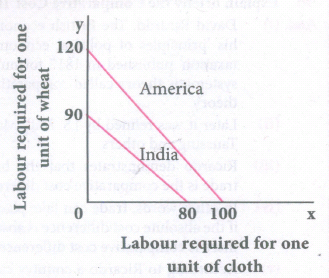
(i) India has absolute advantage in production of both cloth and wheat.
(ii) But, India will produce wheat where she enjoys comparative cost advantage (80 / 120<90 / 100).
(iii) For America the comparative cost disadvantage is lesser in cloth production.
(iv) So America will specialize in cloth production and export it to India in exchange for wheat.
(v) Both nations gains.
(vi) With trade India can get 1 unit of cloth and 1 unit of wheat by using 160 labour units (80+80). With no trade India has to use 170 units of labour (80+90).
(vii) The same explanation applies to America too.
Criticisms
(i) Labour cost is a small portion of the total cost. So the theory based on labour cost is unrealistic,
(ii) Labourers in different countries are not equal in efficiency.
15.
Introduction
(i) Monetary Policy is the macroeconomic policy laid down by the Central Bank towards the management of money, supply and interest rate. It is associated with Milton Friedman
1) Neutrality of Money
(i) Wicksteed, Hayek and Robertson are the chief exponents of neutral money.
(ii) They say that the monetary authority should aim at neutrality of money in the economy.
(iii) Monetary changes cause distortion and disturbances in the proper functioning of the economic system of the leading to all economic fluctuations.
2) Exchange Rate Stability
(i) It is a traditional objective from the Gold Standard period
(ii) When there was disequilibrium in the balance of payment, it was automatically corrected by movements.
(iii) It was popularly known as "Expand Currency and Credit when gold is coming in; Contract currency and credit when gold is going out."
(iv) If there is instability in the exchange rates, it would result in outflow or inflow of gold resulting in unfavorable balance of payments.
3) Price Stability
(i) Crustave Cassel and Keynes suggested price stabilization as a main objective of monetary policy.
(ii) Stable Price creates public confidence, promotes business activity and ensures equitable distribution of income and wealth leading to prosperity and welfare
(iii) Price stability does not mean price rigidity or price stagnation.
(iv) A mild increase in the price level provides a tonic for economic growth.
4) Full Employment
(i) Unemployment was socially dangerous, economically wasteful and morally deplorable.
(ii) Both Keynes' General Theory of Employment, Interest and Money in 1936, the objective of full employment became very important
5) Economic Growth
(i) Economic growth is the process whereby the real per capita income of a country increases
(ii) There is increase in the total physical or real output
(iii) Monetary policy should promote sustained and continuous economic growth by maintaining equilibrium between the total demand for money and total production capacity for creating increase in saving and investment.
(iv) Flexible monetary policy is the best solution.
6) Equilibrium in the Balance of Payments (BoP)
(i) World trade was faster than world liquidity.
(ii) Increasing deficit in BoP reduces the ability of an economy to achieve other objectives.
(iii) Many less developed countries reduce their imports which adversely affects development activities, so monetary authority should make efforts to bring equilibrium in the BoP.
16.
Introduction
The functions of commercial banks are broadly classified into primary, and secondary functions
1) Primary Functions:
Accepting Deposits
Demand Deposits
1. It refers to deposits that can be withdrawn by individuals without any prior notice to the bank.
2. Depositors can withdraw money at any time by writing a withdrawal slip or a cheque or from ATM centres
Time Deposits
1. It refers to deposits that are made for certain committed period of time.
2. It has higher interest.
3. Deposits can be withdrawn only after a specific time period
Advancing Loans
1. Banks grant loans to individuals and businesses in the form of overdraft, cash credit and discounting bills of exchange.
2) Secondary Functions
Agency Functions
1. Commercial banks act as agents of customers by performing various functións.
Collecting Cheques
1. Banks collect cheques and bills of exchange on behalf of their customers through clearing house facilities provided by the central bank.
Collecting Income
1. Banks collect dividends, pension, salaries, rents and interests on investment on behalf of their customers.
2. A credit voucher is sent to customers for information when any income is collected by the bank.
Paying Expenses
1. Telephone bills, insurance premium, school fees and rents can be paid through banks.
2. A debit voucher is sent to customers for information when expenses are paid by the bank.
3) General Utility Functions
Providing Locker Facilities
1. Locker is provided for safe custody of jewellery, shares, debentures and other valuable items.
2. This minimizes the risk of loss due to theft at home.
Issuing Traveller's Cheques
1. Banks issue traveller's cheques to individuals for travelling outside the country.
2. These cheques are safe and easy way to protect money.
Dealing in Foreign Exchange
1. Banks provide foreign exchange to businessmen dealing in exports and imports.
2. But they need to take the permission of the Central Bank for dealing in foreign exchange.
4) Transferring Funds
1. Funds are transferred by means of draft, telephonic transfer and electronic transfer.
5) Letter of Credit
1. Commercial banks issue letters of credit to their customers to certify their credit worthiness.
Underwriting Securities
1. As public have full faith in the credit worthiness of banks, public do not hesitate in buying the securities underwritten by banks.
Electronic Banking
1. It includes services, such as debit cards, credit cards and Internet banking.
6) Other Functions
Money Supply
E.g: A bank lends Rs.5 lakh to an individual and opens a demand deposit in the name of that individual.
1. Bank makes a credit entry of 25 lakh in that account.
2. This leads to creation of demand deposits in that account.
3. Thus, without printing additional money, the supply of money is increased.
Credit Creation
1. It means the multiplication of loans and advances
2. Banks receive deposits from the public and use these deposits to give loans.
3. However, loans offered are many times more than the deposits received by banks.
Collection of Statistics
1. Banks collect and publish statistics relating to trade, commerce and industry and advice customers and public authorities on financial matters.
17.
Boom or Prosperity:
1. The employment and the movement of the economy beyond full employment is the characterized features of boom.
2. There is hectic activity, money wages rise, profits increase, interest rates go up, demand for bank credit increases.
3. There is all round optimism.
Recession:
1. The turning point from boom condition is recession.
2. Failure of a company or bank brings a phase of recession.
3. Investments are drastically reduced, production falls, income and profits decline.
4. There is panic in the stock market and business is dull.
5. Liquidity preference of the people rises and money market becomes tight.
Depression:
1. The level of economic activity becomes extremely low.
2. Firms incur loss and close down resulting in unemployment.
3. Interest rate, profits, wages are low.
4. Agricultural class and wage carners are badly affected.
5. Banks do not lend to businessmen.
6. The extreme point of depression is called as "trough".
7. Keynes said that autonomous investment of the government can help the economy to come out of depression.
Recovery:
1. After depression, recovery sets in the upswing.
2. It begins with the revival of demand for capital goods.
3. The demand slowly picks up and in due course there is more production, profit, income, wages and employment.
4. Recovery may be initiated by innovation or investment or by government.
18.
(i) Primary Functions:
Medium of exchange:
(i) Money has general acceptability and all exchanges take place in terms of money.
(ii) First, money is got through sale of goods or services.
(iii) Later, money is used to buy goods and services.
(iv) Thus, in the modern exchange system money acts as the intermediary in sales and purchases.
Measure of value
(i) Money measures the value of goods and services.
(ii) Prices of all goods and services are expressed in terms of money.
(iii) Since all the values are expressed in terms of money, it is easier to determine the rate of exchange between various types of goods in the community.
(ii) Secondary Functions:
Store of value:
(i) Savings is done in terms of money.
(ii) Money is a store of wealth, as it can be easily converted into other marketable assets such as land, machinery, plant.
Standard of Deferred Payments:
(i) Borrowing and lending is done in money.
Means of Transferring Purchasing Power:
(i) The field of exchange went on extending with growing economic development.
(ii) The exchange of goods is now. extended to distant lands.
(iii) So it is necessary to transfer purchasing power from one place to another.
(iii) Contingent Functions:
Basis of the Credit System:
(i) Business transactions are either in cash or on credit.
(ii) A depositor uses cheques only when there are sufficient funds in his account.
(iii) The commercial banks create credit on the basis of adequate cash reserves.
(iv) Money is at the back of all credit.
Money facilitates distribution of National Income:
(i) Money is used in the distribution of income as rent, wage, interest and profit.
Equalize Marginal Utilities and Marginal Productivities:
(i) Consumer gets maximum utility only if he incurs expenditure on various commodities in such a manner as to equalize marginal utilities accruing from them.
(ii) Here, money plays an important role, because the prices of all commodities are expressed in money.
(iii) Money helps to equalize marginal productivities of various factors of production.
Increases Productivity of Capital:
(i) Money is the most liquid form of capital.
(ii) It can be put to any use.
(iii) So it can be transferred from the less productive to the more productive uses.
(iv) Other Functions:
Maintains Repayment Capacity:
(i) Money has general acceptability.
(ii) To maintain its repayment capacity, every firm has to keep assets in the form of money.
(iii) Firms, banks, insurance companies and governments have to keep some liquid money (i.e., cash) to maintain their repayment capacity.
Represents Generalized
Purchasing Power:
(i) Purchasing power kept in terms of money can be put to any use.
Gives liquidity to Capital:
(i) Money is the most liquid form of capital & so can be put to any use.
19.
| S. No | Marginal Efficiency of Captial (MEC) | Marginal Efficiency of Investment (MEI) |
|---|---|---|
| 1. | It is based on given supply price for capital. | It is based on the induced change in the price due to change in the demand for capital. |
| 2. | It represents the rate of return on all successive unit of capital without regard to existing capital. | It shows the rate of return on just those units of capital over and above the existing capital stock |
| 3. | The capital stock is taken on the X axis of diagram. | The amount of investment is taken on the X axis of diagram. |
| 4. | It is a 'Stock' concept. | It is a 'Flow' concept. |
| 5. | It determines the optimum capital stock in an economy at each level of interest rate. | It determines the net investment of the economy at each interest rate given the capital stock. |
20.
Law
According to Keynes, "men are disposed as a rule and on the average to increase their consumption as their income increases but not by as much as the increáse in their income".
Propositions
1. When income increases, consumption expenditure also increases, but by a smaller amount
(a) When income increases from 120 to 180; consumption also increases from 120 to 170 but the increase in consumption is less than the increase in income, 10 is saved.
2. The increased income will be divided in some proportion between consumption expenditure and saving
(a) When income increases to 180 and 240, it is divided between consumption (170 and 220) and saving (10 and 20)
3. Incrcascs in income always lead to in incrcase in both consumption and saving
(a) Increases in income to 180) and 240; lead to increased consumption 170 and 220; increased saving 10 and 20.
(b) It is clear from the widening area below the C curve and the saving gap between 45o line and C curve.
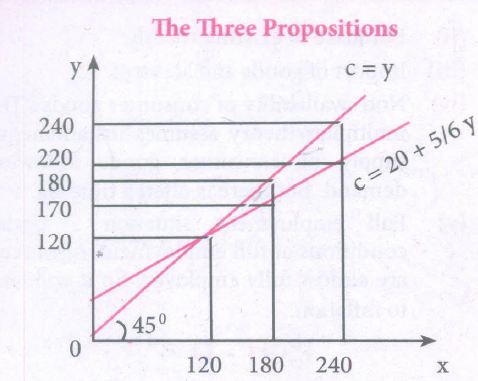
| Y | C | S |
|---|---|---|
| 120 | 120 | 0 |
| 180 | 170 | 10 |
| 240 | 220 | 20 |
21.
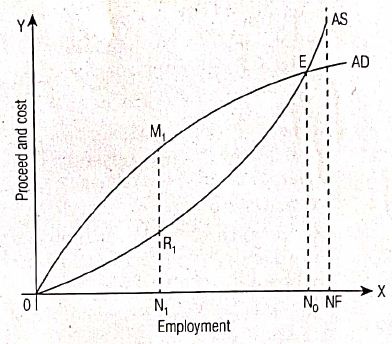
Introduction
Under the Keynes theory of employment, a simple two sector economy consisting of the household sector and the business sector is taken to understand the equilibrium between ADF and ASF.
Explanation
1. AD and AS reach equilibrium at E. The employment level is No
2. At ON1employment, the aggregate supply is N1R1. But the aggregate demand is M1N1.
3. The expected level of profit is M1R1.
4. To attain this level of profit, entrepreneurs will employ more labourers, till they reach point E i.e. ONo.
5. Beyond ONo, the aggregate demand curve is below the aggregate supply curve showing loss.
6. So they will never employ more than ONo labour.
7. The equilibrium level of employment need not be the full employment level (No).
8. The difference between No - N1 is the level of unemployment.
Conclusion
Thus the concept of effective demand becomes significant in explaining the under employment equilibrium.
22.
Cyclical unemployment:
(i) During the downturn phase (recession and depression) of trade cycle, income and output fall leading to cyclical unemployment.
(ii) It is caused by deficiency of effective demand
Structural unemployment:
(i) Unemployment due to massive and deep rooted changes in economic structure leads to structural unemployment.
(ii) Lack of demand for the product or shift in demand to other products cause this type of unemployment.
(iii) (e.g.) rise in demand for mobile phones has adversely affected the demand for cameras, tape recorders
Disguised unemployment:
(i) It occurs in agriculture when more people are there than required. Even if some workers are withdrawn, production does not suffer.
Actual marginal productivity is zero, less or negative.
(i) Seasonal unemployment
1. In agriculture and agro based industries like sugar, production activities are carried out only in some seasons.
2. These industries offer employment only during that season in a year.
3. People remain unemployed during the off season.
4. Seasonal unemployment takes place from demand side also (eg) ice cream industry, holiday resorts
(ii) Frictional unemployment (Temporary unemployment)
1. It arises due to imbalance between supply of labour and demand for labour.
2. It is because of immobility of labour, lack of necessary skills, break down of machinery, shortage of raw materials.
3. The persons who lose jobs and in search of jobs also come under frictional unemployment
(iii) Educated unemployment
1. Educated people are underemployed or unemployed when qualification does not match the job.
2. Faulty education system, lack of employable skills, mass student turnout and preference for white collar jobs are highly responsible for educated unemployment.
23.
Introduction:
(i) Whatever is produced is either used for consumption or for saving. So, national output can be computed at any of three levels, ie., production, income and expenditure.
(ii) Therefore there are three methods to measure national income.
Product Method (inventory method):
(i) This method measures the output of the country. Gross value of output from different sectors like agriculture, industry, trade, commerce is obtained by the summation of all the values added in the productive process.
(ii) In India, the gross value of the farm output is obtained as follows:
(iii) Total production of 64 agriculture commodities is estimated. The output of each crop is measured by multiplying the area sown by the average yield per hectare.
(iv) Total output of each commodity is valued at market prices.
(v) The aggregate value of total output of these 64 commodities is taken to measure the gross value of agricultural output.
(vi) The net value of the agricultural output is measured by making deductions for the cost of seed, manures and fertilizers, market charges.
(vii) Net value of each sector is measured in this way.
(viii) Double counting should be avoided.
(ix) Value of output used for self consumption should be counted but sale and purchase of second hand durable goods should be excluded.
Income Method (Factor Earning Method):
(i) National income is calculated by adding up all the incomes generated while producing national product.
(ii) Enterprises are classified into industrial groups.
(iii) Factor incomes are grouped under labour income (wages, salaries, fringe benefits), capital income (profit, interest, dividend) and mixed income (farming, sole proprietorship).
\(\mathrm{Y}=\mathrm{w}+\mathrm{r}+\mathrm{i}+\pi+(\mathrm{R}-\mathrm{P})\)
(iv) Transfer payment, receipt from sale of second hand goods, windfall gains and corporate profit tax must not be included.
(v) Imputed value of rent for self occupied houses or offices and Imputed value of services provided by owners of production units are to be included.
Expenditure method (outlay method):
(i) The total expenditure incurred by the society in a particular year is added together.
(ii) It includes personal consumption expenditure (C), net domestic investment (I), Government expenditure on consumption (G) and net exports (X-M).
\(\mathrm{GNP}=\mathrm{C}+\mathrm{I}+\mathrm{G}+(\mathrm{X}-\mathrm{M})\)
(iii) Expenditure on second hand goods, purchase of shares and bonds, transfer payments and expenditure on intermediate goods should not be included.
Conclusion:
Output = Income = Expenditure
(i) This is because the three methods are circular in nature. So, if the 3 methods are done correctly this equation must hold.
24.
1. Capitalism and socialism are two extreme and opposite approaches.
2. In capitalism, there is total freedom but in socialism, there is no freedom at all.
3. In capitalism, there is private ownership of means of production but there is public ownership of means of production in socialism.
4. Profit is the driving force behind all economic activities in capitalism but it is social welfare under socialism.
5. Capitalism enjoys free market but in socialism there is central planning.
6. There is unequal income distribution in capitalism but there is equal income distribution in socialism.
7. The major problem in capitalism is inequality but it is inefficiency in socialism.
25.
National Income:
(i) Measurement of national income and its composition by sectors are the basic aspects of macro economic analysis.
(ii) It gives a long term understanding of the growth process of an economy.
Inflation:
(i) Estimating the general price level based on wholesale price, index, consumer price.
Business Cycle:
(i) Cyclical movements can be studied based on aggregate economic variables.
Poverty and Unemployment:
(i) Clear understanding about the magnitude of poverty and unemployment helps allocation of resources and adapting corrective measures.
Economic Growth:
(i) The growth and development of an economy and the factors determining them could be understood only through macro analysis.
Economic Policies:
(i) Macro Economics is used to frame economic policies.
(ii) Economic policies are used to solve the basic problems, to overcome the obstacles and to achieve growth.

12th Standard Syllabus & Materials
12th Standard
TN 12th Computer Applications வலையமைப்பு வடமிடல் Sample Question Papers Study Material - QB365 Set A
NEW12th Standard
TN 12th Computer Applications களப்பெயர் முறைமை (DNS) Sample Question Papers Study Material - QB365 Set A
NEW12th Standard
TN 12th Computer Applications வலையமைப்பு எடுத்துக்காட்டுகள் மற்றும் நெறிமுறைகள் Sample Question Papers Study Material - QB365 Set A
NEW12th Standard
TN 12th Computer Applications கணினி வலையமைப்பு ஓர் அறிமுகம் Sample Question Papers Study Material - QB365 Set A



Tamilnadu Stateboard 12th Standard Subjects

Maths

Chemistry

Physics

Biology

Computer Science

Business Maths and Statistics
Economics

Commerce

Accountancy

History

Computer Applications
Biology
Computer Technology
Computer Applications
Computer Science
Business Maths and Statistics
Commerce
Economics
Maths
Chemistry
Physics
Computer Technology
History
Accountancy

Tamil

English

French
Tamilnadu Stateboard Standards



