
 100% FREE ACCESS
12th Standard Syllabus & Materials
12th Standard
TN 12th Computer Applications மின்னணு தரவு பரிமாற்றம் Sample Question Papers Study Material - QB365 Set A
NEW12th Standard
TN 12th Computer Applications மின் - வணிக பாதுகாப்பு அமைப்புகள் Sample Question Papers Study Material - QB365 Set A
NEW12th Standard
TN 12th Computer Applications மின்னணு செலுத்தல் முறைகள் Sample Question Papers Study Material - QB365 Set A
NEW12th Standard
TN 12th Computer Applications மின் - வணிகம் Sample Question Papers Study Material - QB365 Set A
NEW12th Standard
TN 12th Computer Applications திறந்த மூல கருத்துருக்கள் Sample Question Papers Study Material - QB365 Set A
NEW12th Standard
TN 12th Computer Applications வலையமைப்பு வடமிடல் Sample Question Papers Study Material - QB365 Set A

Published on: 13/05/2022
QB365 provides detailed and simple solution for every Creative Questions in class 12 Economics Subject. It will helps to get more idea about question pattern in every Creative questions with solution.
latest Creative QuestionsDownload Tamil Nadu 12th Standard Economics question papers, model tests, one-mark questions, important questions, and public exam papers in PDF format. Free study materials and answer keys for TN State Board students.
Questions + Answers key
Take MCQ Economics Test1.
What is Currency Deposit Ratio (CDR)?
2.
Write about Money Increases Productivity of Capital in short.
3.
What is Aggregate supply?
4.
Draw the diagram of effective demand
5.
Write any two Criticisms of Say’s Law.
6.
What is Gross Nation Product at Market Price (GNPMP)?
7.
Mention any two statistical problems as Difficulties in Measuring National Income
8.
Compare and contrast the terms nominal GDP and real GDP.
9.
If NNP is dollar 7 trillion, net investment is dollar 500 billion and gross investment is dollar 1 trillion determine the level of GNP.
10.
What is the formula for calculating GDP at Market Price
11.
Give an example of how real GDP could be increased even though no more output is produced
12.
Mention the Factors Affecting MEC:
13.
What is the Meaning of Marginal Efficiency of Capital (MEC)?
14.
Draw the chart depicting various systems of economy
15.
Which are the four components of the macroeconomy?
16.
What is saving?
17.
Write any two long run factors which influencing marginal efficiency of capital?
18.
What is Gross Domestic Product?
19.
What is National Income?
20.
Write the formula for calculating per capita income.
21.
What is creeping inflation?
22.
What are the two equations of Fisher's Quantity Theories of Money?
23.
Write a note on Central Planning?
24.
What are the different models of circular flow of income?
25.
Who is the controll authority of socialistic economy?
1.
It is the ratio of money held by the public in currency to that they hold in bank deposits.
2.
Money is the most liquid form of capital. In other words, capital in the form of money can be put to any use.
3.
The value of total output of goods and services produced in an economy in a year
4.
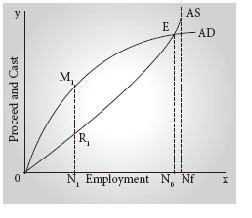
5.
The following are the criticisms against Say’s law:
1. According to Keynes, supply does not create its demand. It is not applicable where demand does not increase as much as production increases.
2. Automatic adjustment process will not remove unemployment. Unemployment can be removed by increase in the rate of investment
6.
Gross National Product at market price is Gross Domestic Product at market price plus net factor income from abroad.
GNPMP is the money value of all final goods and services produced in the domestic territory of a country during a year plus Net factor income from abroad. i.e.,
GNPMP = GDPMP + (X - M)
Where,
GNPMP = Gross National Product at market price
GDPMP = Gross Domestic Product at market price
(X - M) = Net factor income from abroad
7.
1. Accurate and reliable data are not adequate, as farm output in the subsistence sector is not completely informed.
2. Different languages, customs, etc., also create problems in computing estimates.
8.
Nominal GDP measures gross domestic product in current rupees. Real GDP measures gross domestic product by adjusting Nominal GDP for price changes
9.
GNP = NNP + depreciation; depreciation
= gross investment - net investment (dollar 1 trillion - dollar 500 billion)
Therefore GNP = dollar 7 trillion + dollar 500 billion
= dollar 7.5 trillion.
10.
GDPMP = Private Final Consumption + Government Final Consumption Expenditure + Gross Domestic Capital Formation + Net Exports (Exports – Imports)
11.
(i) Real GDP could be increased even though there is no more output produced if output that is currently produced in the home or in the underground economy is included.
(ii) If activities that are currently illegal are declared legal, real GDP could increase
12.
i. The cost of the capital asset
ii. The expected rate of return from during its lifetime
iii. The market rate of interest.
13.
The rate of discount which makes the discounted present value of expected income stream equal to the cost of capital.
14.
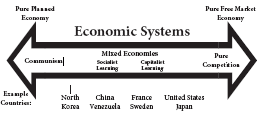
15.
groups: households and firms (the private sector), the government (the public sector), and the rest of the world (the external sector.
16.
(i) Saving is consumption forgone.
(ii) The portion of the income not spent on consumption is saving.
(iii) If saving rises, consumption will fall.
17.
(i) Monetary and fiscal policy
(ii) Technological progress
(iii) Resource availability.
18.
(i) Gross Domestic Product (GDP) is the total value of output (goods and services) produced by the factors of production located within the country's boundary in a year.
(ii) The factors of production may be owned by anyone-citizens or foreigners.
GDP = GNP - Net income earned from abroad
19.
National Income is a measure of the total value of the goods and services (Output) produced by an economy over a period of time (normally a year).
20.
Per capita income = \(\frac{National\ Income}{Population}\)
21.
(i) Creeping inflation is slow-moving and very mild.
(ii) The rise in prices will not be perceptible but spread over a long period.
(iii) This is also known as mild inflation or moderate inflation.
22.
PT = MV + MlVl
\(P=\cfrac { { MV1 }+{ MV 1} }{ T } \)
23.
(i) Planning is an integral part of a socialist economy.
(ii) In socialist economy all decisions are undertaken by the Central Planning Authority.
24.
There are three models of circular flow of income. They are,
(i) Two sector model
(ii) Three sector model
(iii) Four sector model
25.
(i) Central planning authority is the controlling authority in a socialistic economy.
(ii) All the decisions are under taken by the central planning authority.
(iii) It means all factors of production are nationalized and managed by public authority.

12th Standard Syllabus & Materials
12th Standard
TN 12th Computer Applications களப்பெயர் முறைமை (DNS) Sample Question Papers Study Material - QB365 Set A
NEW12th Standard
TN 12th Computer Applications வலையமைப்பு எடுத்துக்காட்டுகள் மற்றும் நெறிமுறைகள் Sample Question Papers Study Material - QB365 Set A
NEW12th Standard
TN 12th Computer Applications கணினி வலையமைப்பு ஓர் அறிமுகம் Sample Question Papers Study Material - QB365 Set A
NEW12th Standard
TN 12th Computer Applications PHP-உடன் MySQL-ஐ இணைத்தல் Sample Question Papers Study Material - QB365 Set A



Tamilnadu Stateboard 12th Standard Subjects

Maths

Chemistry

Physics

Biology

Computer Science

Business Maths and Statistics
Economics

Commerce

Accountancy

History

Computer Applications
Biology
Computer Technology
Computer Applications
Computer Science
Business Maths and Statistics
Commerce
Economics
Maths
Chemistry
Physics
Computer Technology
History
Accountancy

Tamil

English

French
Tamilnadu Stateboard Standards



