
 100% FREE ACCESS
12th Standard Syllabus & Materials
12th Standard
TN 12th Maths Applications of Matrices and Determinants Sample Question Papers Study Material - QB365 Set A
NEW12th Standard
TN 12th Computer Applications மின்னணு தரவு பரிமாற்றம் Sample Question Papers Study Material - QB365 Set A
NEW12th Standard
TN 12th Computer Applications மின் - வணிக பாதுகாப்பு அமைப்புகள் Sample Question Papers Study Material - QB365 Set A
NEW12th Standard
TN 12th Computer Applications மின்னணு செலுத்தல் முறைகள் Sample Question Papers Study Material - QB365 Set A
NEW12th Standard
TN 12th Computer Applications மின் - வணிகம் Sample Question Papers Study Material - QB365 Set A
NEW12th Standard
TN 12th Computer Applications திறந்த மூல கருத்துருக்கள் Sample Question Papers Study Material - QB365 Set A

Published on: 23/06/2021
QB365 provides detailed and simple solution for every Creative Questions in class 12 Economics Subject. It will helps to get more idea about question pattern in every Creative questions with solution.
Download Tamil Nadu 12th Standard Economics question papers, model tests, one-mark questions, important questions, and public exam papers in PDF format. Free study materials and answer keys for TN State Board students.
Questions + Answers key
Take MCQ Economics Test1.
Define a financial intermediary.
2.
What are the All-India Level Institutions for industrial finance?
3.
How NABARD complemented RBI?
4.
List the frequent methods of credit control under selective method.
5.
Write a brief note on Bank Rate Policy.
6.
Comment on RBI as “Lender of last resort"
7.
What is the key difference between GATT and WTO?
8.
What was proposed in The Brettonwoods Conference?
9.
Explain the term “Demand for Money”
10.
Compare and contrast fiat money and commodity money.
11.
What is the meaning of Cash Reserve Ratio (CRR)?
12.
Mention the components of Money Supply in India.
13.
What is Monetary Economics?
14.
Write the latest trend of FDI in India?
15.
What is Foreign Institutional Investment (FII)?
16.
What are the Fixed Exchange Rates?
17.
Double Factoral Terms of Trade
18.
Draw the chart depicting H-O Theorem
19.
List the assumption of Adam smith trade theory.
20.
What are the main objectives of RRB?
21.
What is variable portfolio ceiling?
22.
Name the two ways of deposits that the modern banks create?
23.
What is Trade Cycle?
24.
Write a short note on currency symbol in India.
25.
How does Money facilitate the distribution of National Income?
1.
(i) A financial intermediary is a bank or other institution that serves as a link between lenders and borrowers.
(ii) They typically accept savings deposits from consumers and then lend money to consumers and businesses to finance purchases of goods and services or for investment purposes.
2.
(i) Industrial Finance Corporation of India (IFCI)
(ii) Industrial Credit and Investment Corporation of India (ICICI)
(iii) Industrial Development Bank of India (IDBI)
3.
(i) With the establishment of National Bank for Agriculture and Rural Development (NABARD), all the functions of the RBIrelating to agricultural credit had been taken over and looked after by NABARD since 1982.
(ii) Since then, all activities relating to rural credit are entirely looked after by NABARD.
4.
The following are the frequent methods of credit control under selective method:
1. Rationing of Credit
2. Direct Action
3. Moral Persuasion
4. Method of Publicity
5. Regulation of Consumer’s Credit
6. Regulating the Marginal Requirements on Security Loans
5.
(i) The bank rate is the rate at which the Central Bank of a country is prepared to re-discount the first class securities.
(ii) It means the bank is prepared to advance loans on approved securities to its member banks.
6.
The banks can borrow from the RBI by keeping eligible securities as collateral at the time of need or crisis, when there is no other source.
7.
(i) GATT refers to an international multilateral treaty, signed by 23 nations to promote international trade and remove cross-country trade barriers. On the contrary, WTO is a global body, which superseded GATT and deals with the rules of international trade between member nations.
(ii) While GATT is a simple agreement, there is no institutional existence, but have a small secretariat. Conversely, WTO is a permanent institution along with a secretariat.
8.
The Brettonwoods Conference proposed IMF, World Bank and International Trade Organisation (ITO) in 1944.
9.
(i) Demand for money means the demand to hold money, that is, to keep one’s resources in liquid form instead of in some form of investment.
(ii) It means the desire to hold money in liquid cash as against spending the money.
10.
(i) Fiat money includes items that are designated as money that are intrinsically worthless.
(ii) Commodity money are things like gold or silver which have alternative uses other than money.
(iii) They can be used in dental fillings or as jewelry.
11.
It is the fraction of the deposits the banks must keep with RBI.
12.
M1 = Currency, coins and demand deposits
M2 = M1 + Savings deposits with post office savings banks
M3 = M2 + Time deposits of all commercial and cooperative banks.
M4 = M3 + Total deposits with Post offices.
13.
Monetary Economics is a branch of economics that provides a framework for analyzing money and its functions as a medium of exchange, store of value and unit of account.
14.
(i) FDI inflow in India has increased from$97 million in 1990-91 to$5,535 million in 2004- 2005.
(ii) It amounted to$32,955 million in 2011- 2012.
(iii) UNCTAD’s World Investment Report 2018 reveals that FDI to India declined to$40 billion in 2017 from$44 billion in 2016.
15.
(i) Foreign Institutional Investment (FII) is an investment in hedge funds, insurance companies, pension funds and mutual funds.
(ii) Foreign institutional investment is a common term in the financial sector of India
(iii) For example, a mutual fund in the United States can make investment in an Indiabased company
16.
(i) Countries following the fixed exchange rate (also known as stable exchange rate and pegged exchange rate) system agree to keep their currencies at a fixed rate as determined by the Government.
(ii) Under the gold standard, the value of currencies was fixed in terms of gold
17.
Viner constructed another index called ‘‘Double factoral terms of Trade’’. It is expressed as Tff = (Px / Pm) (Fx / Fm).
18.
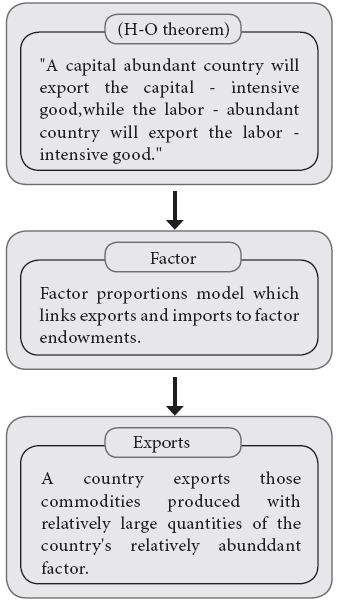
19.
1. There are two countries and two commodities (2 x 2 model).
2. Labour is the only factor of production.
3. Labour units are homogeneous.
4. The cost or price of a commodity is measured by the amount of labour required to produce it.
5. There is no transport cost.
20.
(i) To provide credit and other facilities particularly to small and marginal farmers.
(ii) Agriculture labourers, artisans and small entrepreneurs so as to develop agriculture trade, commerce, industry and other productive activities in the rural areas.
21.
The system by which the central bank fixes ceiling or maximum amount of loans and advances for every commercial bank.
22.
The modern banks create deposits in two ways.
They are
(i) Primary Deposit
(ii) Derived Deposit
23.
The more or less regular upward and downward movement of economic activity over a period of years.
24.
(i) The symbol of Indian rupee came into use on 15th July, 2010.
(ii) India is the 5th Country to accept a unique currency symbol.
25.
Money facilitates the distribution of income asrent, wage, interest and profit.

12th Standard Syllabus & Materials
12th Standard
TN 12th Computer Applications வலையமைப்பு வடமிடல் Sample Question Papers Study Material - QB365 Set A
NEW12th Standard
TN 12th Computer Applications களப்பெயர் முறைமை (DNS) Sample Question Papers Study Material - QB365 Set A
NEW12th Standard
TN 12th Computer Applications வலையமைப்பு எடுத்துக்காட்டுகள் மற்றும் நெறிமுறைகள் Sample Question Papers Study Material - QB365 Set A
NEW12th Standard
TN 12th Computer Applications கணினி வலையமைப்பு ஓர் அறிமுகம் Sample Question Papers Study Material - QB365 Set A



Tamilnadu Stateboard 12th Standard Subjects

Maths

Chemistry

Physics

Biology

Computer Science

Business Maths and Statistics
Economics

Commerce

Accountancy

History

Computer Applications
Biology
Computer Technology
Computer Applications
Computer Science
Business Maths and Statistics
Commerce
Economics
Maths
Chemistry
Physics
Computer Technology
History
Accountancy

Tamil

English

French
Tamilnadu Stateboard Standards



