
 100% FREE ACCESS
12th Standard Syllabus & Materials
12th Standard
TN 12th Computer Applications மின்னணு தரவு பரிமாற்றம் Sample Question Papers Study Material - QB365 Set A
NEW12th Standard
TN 12th Computer Applications மின் - வணிக பாதுகாப்பு அமைப்புகள் Sample Question Papers Study Material - QB365 Set A
NEW12th Standard
TN 12th Computer Applications மின்னணு செலுத்தல் முறைகள் Sample Question Papers Study Material - QB365 Set A
NEW12th Standard
TN 12th Computer Applications மின் - வணிகம் Sample Question Papers Study Material - QB365 Set A
NEW12th Standard
TN 12th Computer Applications திறந்த மூல கருத்துருக்கள் Sample Question Papers Study Material - QB365 Set A
NEW12th Standard
TN 12th Computer Applications வலையமைப்பு வடமிடல் Sample Question Papers Study Material - QB365 Set A

Published on: 23/06/2021
QB365 provides detailed and simple solution for every Creative Questions in class 12 Economics Subject. It will helps to get more idea about question pattern in every Creative questions with solution.
Download Tamil Nadu 12th Standard Economics question papers, model tests, one-mark questions, important questions, and public exam papers in PDF format. Free study materials and answer keys for TN State Board students.
Questions + Answers key
Take MCQ Economics Test1.
Compare the dissimilarities of Repo Rate and Reverse Repo Rate.
2.
Explain Effects on Production of Inflation.
3.
What are the Contingent Functions?
4.
Explain the primary function of money.
5.
Write a note of John Maynard Keynes.
6.
Distinguish between Fictional and Structural unemployment.
7.
What are the steps involved in income method?
8.
Compare and contrast different measures of GDP calculations.
9.
Draw the diagram of Multiplier in an economy.
10.
Explain any three short fun factors of MEC.
11.
State Duesenberry hypothesis.
12.
Given the table, write the proposition for consumptions function (value in crores).
13.
What are the various sources of E-Wastes?
14.
Explain are the Demerits of Capitalism.
15.
Draw the flow chart of Functioning of an Economy Based on Activities
16.
What are the Determinants of Exchange Rates?
17.
What are the general advantages of International Trade?
18.
What are the National Income identities?
19.
What is Per capita income?
20.
Write down the some of the statistical problems?
21.
Write a note on paper currency standard
22.
What are the four measures of Money Supply?
23.
Indicate the demerits of Mixed Economy.
24.
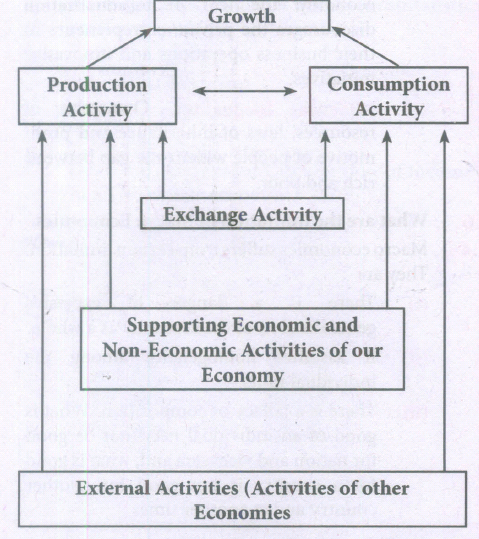
Bring out the functions of an economy with the help of flow chart.
25.
Write any two demerits of capitalism.
1.
| BASIS | REPO RATE | REVERSE REPO RATE |
| Meaning | Repo rate is the rate at which the Central bank of India grants loan to the commercial banks for a short period against government securities | Reverse repo rate is the rate at which the commercial banks grant loan to the Central Bank of India. |
| Purpose | To fulfill the deficiency of funds | To ensure liquidity in the economy |
| Rate | High | Comparatively less. |
| Controls | Inflation | Money supply in the economy |
| Charged on | Repurchase Agreement | Reverse Repurchase Agreement. |
2.
When the inflation is very moderate, it acts as an incentive to traders and producers. The profit due to rising prices encourages and induces business class to increase their investments in production, leading to generation of employment and income.
(i) However, hyper-inflation results in a serious depreciation of the value of money and it discourages savings.
(ii) When the value of money undergoes considerable depreciation, this may even drain out the foreign capital.
(iii) With reduced capital accumulation, the investment will suffer a serious set-back which may have an adverse effect on the volume of production.
3.
(i) Basis of the Credit System: Money is the basis of the Credit System. Business transactions are either in cash or on credit.
(ii) Money facilitates distribution of National Income: The task of distribution of national income was exceedingly complex under the barter system.
(iii) Money helps to Equalize Marginal Utilities and Marginal Productivities: Consumer can obtain maximum utility only if he incurs expenditure on various commodities in such a manner as to equalize marginal utilities accruing from them.
(iv) Money Increases Productivity of Capital: Money is the most liquid form of capital. In other words, capital in the form of money can be put to any use.
4.
(i) Money as a medium of exchange: This is considered as the basic function of money. Money has the quality of general acceptability, and all exchanges take place in terms of money.
(ii) Money as a measure of value: The second important function of money is that it measures the value of goods and services.
5.
(i) John Maynard Keynes was one of the most influential economists of the 20th century.
(ii) He was born in Cambridge in1883. In addition to his work as an economist he held position as civil servant a director of the Bank of England, and leader of British delegation of negotiators at the Bretton Woods conference at points in his career.
(iii) Economic theory based on his idea is known as Keynesian economics, and remain highly influential today, particularly in the field of macroeconomics.
6.
| S.No | Fictional unemployment | Structural unemployment |
| 1 | Frictional unemployment arises due to imbalance between supply of labour and demand for labour | Structural unemployment is due to drastic change in the structure of the society |
| 2. | This is because of immobility of labour, lack of necessary skills, break down of machinery, shortage of raw materials etc. | Lack of demand for the product or shift in demand to other products cause this type of unemployment |
| 3. | The persons who lose jobs and in search of jobs are also included under frictional unemployment | This kind of unemployment results from massive and deep rooted changes in economic structure |
7.
1. The enterprises are classified into various industrial groups.
2. Factor incomes are grouped under labour income, capital income and mixed income.
i) Labour income - Wages and salaries, fringe benefits, employer’s contribution to social security.
ii) Capital income – Profit, interest, dividend and royalty
iii) Mixed income – Farming, sole proprietorship and other professions.
3. National income is calculated as domestic factor income plus net factor incomes from abroad.
8.
| GDP (Expenditure) | GDP (Factor Incomes) | GDP (Value of Output) |
|---|---|---|
| 1. Consumption 2. Government 3. Spending 4. Investment spending 5. Change in value of stocks 6. Exports 7. Imports 8. GDP (Known as aggregate demand) |
(i) Income from People in jobs and in self employment (eg. wages and Salaries) (ii) Profit of private sector business (iii) Rent income from the ownership of land |
(i) Value added from each of the main economic sectors (ii) These sectors are (iii) Primary (iv) Secondary (v) Manufacturing (vi) Quaternary |
| Government spending | Profits of private sector business |
9.
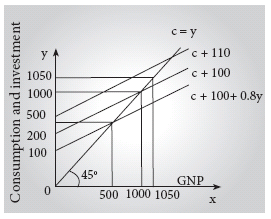
10.
Short - Run Factors
(i) Demand for the product: If the market for a particular good is expected to grow and its costs are likely to fall, the rate of return from investment will be high. If entrepreneurs expect a fall in demand for goods and a rise in cost, the investment will decline.
(ii) Liquid assets:
If the entrepreneurs are holding large volume of working capital, they can take advantage of the investment opportunities that come in their way. The MEC will be high.
(iii) Sudden changes in income:
The MEC is also influenced by sudden changes in income of the entrepreneurs. If the business community gets windfall profits, or tax concession the MEC will be high and hence investment in the country will go up. On the other hand, MEC falls with the decrease in income.
11.
Duesenberry has made two observations regarding the factors affecting consumption.
a) The consumption expenditure depends not only on his current income but also past income and standard of living. As the individuals are accustomed to a particular standard of living, they continue to spend the same amount on consumption even though the current income is reduced.
b) Consumption is influenced by demonstration effect. The consumption standards of low income groups are influenced by the consumption standards of high income groups. In other words, the poor people want to imitate the consumption pattern of rich. This results in spending beyond their income level.
12.
| Income | Consumption | Savings |
| 120 | 120 | 0 |
| 180 | 170 | 10 |
| 240 | 220 | 20 |
Proposition (1):
Income increases by Rs. 60 crores and the increase in consumption is by Rs. 50 crores.
Proposition (2):
The increased income of Rs. 60 crores in each case is divided in some proportion between consumption and saving respectively. (i.e., Rs. 50 crores and Rs. 10 crores).
Proposition (3):
As income increases consumption as well as saving increase. Neither consumption nor saving has fallen.
13.
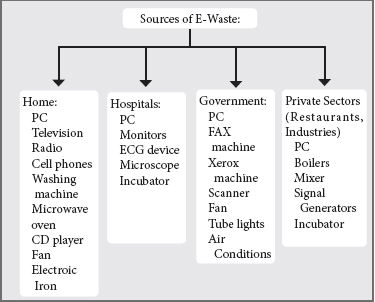
14.
1. Concentration of Wealth and Income: Capitalism causes concentration of wealth and income in a few hands and thereby increases inequalities of income.
2. Wastage of Resources: Large amount of resources are wasted on competitive advertising and duplication of products.
3. Class Struggle: Capitalism leads to class struggle as it divides the society into capitalists and workers.
4. Business Cycle: Free market system leads to frequent violent economic fluctuations and crises.
5. Production of non essential goods: Even the harmful goods are produced if there is possibility to make profit.
15.
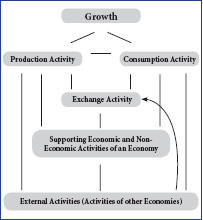
16.
Factors determining exchange rates are,
(i) Differentials in Inflation
(ii) Differential in Interest rates
(iii) Current Account Deficits
(iv) Public Debt
(v) Terms of Trade
(vi) Political and Economic Stability
(vii) Recession
(viii) Speculation
17.
(i) Availability of variety of goods for consumption.
(ii) Generation of more employment opportunities.
(iii) Industrialization of backward nations.
(iv) Improvement in relationship among countries.
(v) Division of Labour and specialisation.
(vi) Expansion in Transport Facilities.
18.
The followings are some of the National Income Identities:
NNP = GNP - Depreciation
NNI = NNP - Indirect taxes
PI = NNI - Retained earnings, corporate taxes and interest on public debt
PDI = PI - Personal taxes
Where,
GNP = Gross National Product
NNP = Net National Product
NNI = Net National Income
PI = Personal Income
PDI = Personal Disposable Income
19.
(i) Per Capita income (or) output per person is an indicator to show the living standards of people in a country.
(ii) If real PCI increases.
(iii) It is considered to be an improvement in the overall living standard of people.
(iv) PCI is arrived at by dividing the GDP by the size of population.
(v) It is also arrived by making some adjustment with GDP
(vi) \(PCI=\frac { GDP }{ Total\ number\ of\ people\ in\ a\ country } \) (or)\(PCI=\frac { National\ Income }{ Total\ Population } \)
20.
(i) Accurate and reliable data are not adequate as farm output in the subsistence sector is not completely informed.
(ii) In animal husbandry there are no authentic production data available.
(iii) Different languages, customs, etc., also create problems in computing estimates.
(iv) People in India are indifferent to the official inquiries. They are in most cases non-cooperative also.
(v) Most of the statistical staff are untrained and inefficient.
(vi) Therefore, national income estimates in our country are not very accurate or adequate.
21.
(i) The paper currency standard reffers to the monetary system in which the paper currency notes issued by the treasury of the Central Bank.
(ii) Paper currency is not convertible into any metal.
(iii) Its value is determined independent of the value of gold or any other commodity.
(iv) It also known as managed currency standard.
22.
M1 = Currency, Coins and demand deposits.
M2 = M1 + Saving deposits with post office savings banks.
M3 M2 + Time deposits of all commercial and cooperative banks.
M4 = M3 + Total deposits with post offices.
M1 and M2 are known as narrow money.
M3 and M4 are known as broad money.
The graduations are in decreasing order of liquidity.
23.
Lack of Co-ordination:
The greatest drawback of Mixedism is lack of co-ordination between public sector and private sector.
Inefficiency:
Most of the public sector enterprises remain inefficient due to lethargic bureaucracy, red tapism and lack of motivation.
Fear of Nationalization:
In mixed economy, the fear of nationalization discourages the private entrepreneurs in their business operations.
24.
Functioning of an Economy based on Activities
25.
i) Class Struggle:
Capitalism leads to class struggle as it divides the society into capitalists and workers.
ii) Business Cycle:
Free Market System leads to frequent violent economic fluctuations and crisis.

12th Standard Syllabus & Materials
12th Standard
TN 12th Computer Applications களப்பெயர் முறைமை (DNS) Sample Question Papers Study Material - QB365 Set A
NEW12th Standard
TN 12th Computer Applications வலையமைப்பு எடுத்துக்காட்டுகள் மற்றும் நெறிமுறைகள் Sample Question Papers Study Material - QB365 Set A
NEW12th Standard
TN 12th Computer Applications கணினி வலையமைப்பு ஓர் அறிமுகம் Sample Question Papers Study Material - QB365 Set A
NEW12th Standard
TN 12th Computer Applications PHP-உடன் MySQL-ஐ இணைத்தல் Sample Question Papers Study Material - QB365 Set A



Tamilnadu Stateboard 12th Standard Subjects

Maths

Chemistry

Physics

Biology

Computer Science

Business Maths and Statistics
Economics

Commerce

Accountancy

History

Computer Applications
Biology
Computer Technology
Computer Applications
Computer Science
Business Maths and Statistics
Commerce
Economics
Maths
Chemistry
Physics
Computer Technology
History
Accountancy

Tamil

English

French
Tamilnadu Stateboard Standards



