
 100% FREE ACCESS
12th Standard Syllabus & Materials
12th Standard
TN 12th Computer Applications மின்னணு தரவு பரிமாற்றம் Sample Question Papers Study Material - QB365 Set A
NEW12th Standard
TN 12th Computer Applications மின் - வணிக பாதுகாப்பு அமைப்புகள் Sample Question Papers Study Material - QB365 Set A
NEW12th Standard
TN 12th Computer Applications மின்னணு செலுத்தல் முறைகள் Sample Question Papers Study Material - QB365 Set A
NEW12th Standard
TN 12th Computer Applications மின் - வணிகம் Sample Question Papers Study Material - QB365 Set A
NEW12th Standard
TN 12th Computer Applications திறந்த மூல கருத்துருக்கள் Sample Question Papers Study Material - QB365 Set A
NEW12th Standard
TN 12th Computer Applications வலையமைப்பு வடமிடல் Sample Question Papers Study Material - QB365 Set A

Published on: 23/06/2021
QB365 provides detailed and simple solution for every Creative Questions in class 12 Economics Subject. It will helps to get more idea about question pattern in every Creative questions with solution.
Download Tamil Nadu 12th Standard Economics question papers, model tests, one-mark questions, important questions, and public exam papers in PDF format. Free study materials and answer keys for TN State Board students.
Questions + Answers key
Take MCQ Economics Test1.
List the Revenue of Union Sources.
2.
Explain the chain of events that results from an expansionary monetary policy.
3.
Distinguish between NBFC and Other Commercial Bank.
4.
What are the functions of the ASEAN?
5.
Compare and contrast the “Planning Commission” and NITI Aayog”.
6.
Consider M = Rs. 1000. M’ = Rs. 500, V = 3, V’ = 2, T = 4000 goods and Find the value of money using Fisher’s quantity theory of
7.
List the problems in defining Money Supply.
8.
Explain the supply of Money and determinants of money supply in India.
9.
Compare and contrast inflation and deflation.
10.
Given the table, calculate GNP, NNP, National Income, Personal Income and Disposable income.
11.
Explain the basic concepts of national income.
12.
Derive the value of the multiplier assuming the basic form of the consumption function as C = a + bY where "a" is autonomous consumption and "b" is the marginal propensity to consume. You may assume a two-sector economy.
13.
State the Relationship between rate of interest and Investment:
14.
State and discuss the Causes of Land Pollution.
15.
Explain the four sector model of economy with chart.
16.
Explain the classification of public expenditure.
17.
Draw the flow chart for correction of Balance Payment Disequilibrium
18.
Explain the any two types of Exchange Rates.
19.
Explain Marginal propensity to consume and multiplier, with the help of a diagram.
20.
What are the determinants of investment function?
21.
Discuss the methods of measuring the National Income by Product Method.
22.
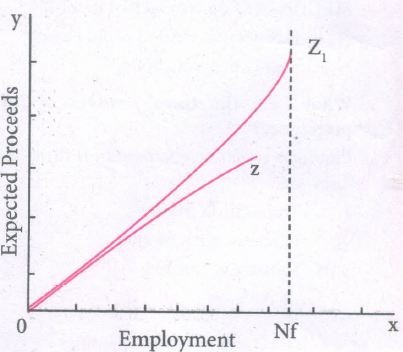
Draw the diagram for Aggregate supply curves diagram.
23.
List out all assumption of say's law of market?
24.
Explain the merits of Mixed Economy.
25.
Explain the merits of socialism.
1.
1. Corporation tax.
2. Currency, coinage and legal tender, foreign exchange.
3. Duties of customs including export duties.
4. Duties of excise on tobacco and certain goods manufactured or produced in India.
5. Estate duty in respect of property other than agricultural land.
6. Fees in respect of any of the matters in the Union List, but not including any fees taken in any Court.
7. Foreign Loans.
8. Lotteries organized by the Government of India or the Government of a State.
9. Post Office Savings Bank.
10. Posts and Telegraphs, telephones, wireless, Broadcasting and other forms of communication.
11. Property of the Union.
12. Public Debt of the Union.
13. Railways.
14. Rates of stamp duty in respect of Bills of Exchange, Cheques, Promissory Notes, etc.
15. Reserve Bank of India.
16. Taxes on income other than agricultural income.
17. Taxes on the capital value of the assets, exclusive of agricultural land of individuals and companies.
18. Taxes other than stamp duties on transactions in stock exchanges and future markets.
19. Taxes on the sale or purchase of newspapers and on advertisements published therein.
20. Terminal taxes on goods or passengers, carried by railways, sea or air.
2.
1. The money supply increases which places downward pressure on the interest rate.
\(\downarrow \)
2. The lower interest rate stimulates planned investment and aggregate output.
\(\downarrow \)
3. This in turn increases the amount of money demand.
\(\downarrow \)
4. This in turn may cause interest rates to fall by less than they otherwise would had there been
\(\downarrow \)
5. No feedback effect from the increased demand for money hence forth.
3.
| BASIS | NBFC | BANK |
| Meaning | An NBFC is a company that provides banking services to people without holding a bank license. | The bank is a government-authorized financial intermediary that aims at providing banking services to the general public. |
| Demand Deposit | Not Accepted | Accepted |
| Payment and Settlement system | Not a part of a system. | Part of the system. |
| Maintenance of Reserve Ratios | Not required | Compulsory |
| Deposit insurance facility | Not available | Available |
| Credit creation | NBFC do not create credit | Banks create credit. |
| Transaction services | Not provided by NBFC. | Provided by banks. |
4.
(i) It facilitates free movement of goods, services and investments within ASEAN by creating a single regional market like the European Union.
(ii) It provides free access to the marketers of one member country to the markets of all other member countries, thus fostering growth in the region.
(iii) It improves business competitiveness between businesses from different countries and also narrow developmental gaps between member countries.
(iv) It paves way for market and investment opportunities for the member nations.
(v) It fosters co-operations in many areas including industry and trade.
5.
I. Classification on the Basis of Benefit:
| BASIS FOR COMPARISON | PLANNING COMMISSION | NITI AAYOG |
|---|---|---|
| POWERS | Enjoyed the powers to allocate funds to ministries and state governments. | To be an advisory body or a think-tank. The powers to allocate funds might be vested in the finance ministry. |
| STATE’S ROLE | States' role was limited to the National Development Council and annual interaction during Plan meetings. | State governments are expected to play a more significant role than they did in the Planning Commission. |
| MEMBERS | The commission reported to National Development Council that had state chief ministers and lieutenant governors | Governing Council has state chief ministers and lieutenant governors |
| CHAIR-PERSON | Had deputy chairperson, a member secretary, and full-time members | New posts of CEO, of secretary rank, and Vice-Chairperson. Will also have five full-time members and two part-time members. Four cabinet ministers will serve as ex-o official members. |
| POLICY FORMULATION | Policy was formed by the commission and states were then consulted about allocation of funds | Consulting states while making policy and deciding on funds allocation. Final policy would be a result of that. |
| FUNDS ALLOCATION | Had power to decide allocation of government funds for various programs at national and state levels | No power to allocate funds |
| APPROVAL OF PROJECTS |
Imposed policies on states and tied allocation of funds with projects it approved. | NITI is a think-tank and does not have the power to impose policies. |
6.
P = \(\frac { MV+{ M }^{ 1 }{ V }^{ 1 } }{ T } \)
P = \(\frac { (1000\times 3)+(500\times 2) }{ 4000 } \)
= Rs. 1 Per good
Value of money (1/p) = 1
If the supply of money is double
P = \(\frac { (2000\times 3)+(1000\times 2) }{ 4000 } \)
= Rs. 2 Per good
Value of money (1/p) = 1/2
Thus, when money supply in doubled, i.e., increases from Rs. 4000 to 8000, the price level is doubled. i.e., from Re. 1 per good to Rs. 2 per good and the value of money is halved, i.e., from 1 to 1/2.
P = \(\frac { (500\times 3)+(250\times 2) }{ 4000 } \)
= Rs. 1 Per good
Value of money (1/p) = 1/2
Thus, when money supply is halved, i.e., decreases from Rs. 4000 to 2000, the price level is halved, i.e., from 1 to 1/2, and the value of money is doubled, i.e., from 1 to
7.
(i) First, in an advanced and more important an evolving-financial system, it was not possible to define the tock of Money in an unambiguous way.
(ii) At least there were a number of different but equally valid definitions of the money supply and there was no strong reason for choosing one in preference to any other.
(iii) As we have seen, money can be defined either narrowly or broadly.
(iv) However, there are or have been within the some institutional context a number of different definitions of the money supply.
(v) The definitions change frequently as does the popularity of one measure over another which partly illustrates the difficulty in trying to pin down the concept.
8.
Money Supply in India
Money supply is a stock variable. RBI publishes information for four alternative
measures of Money supply, namely M1, M2, M3 and M4.
M1 = Currency, coins and demand deposits
M2 = M1 + Savings deposits with post office savings banks
M3 = M2 + Time deposits of all commercial and cooperative banks
M4 = M3 + Total deposits with Post offices.
M1 and M2 are known as narrow money
M3 and M4 are known as broad money
Determinants of Money Supply
1. Currency Deposit Ratio (CDR); It is the ratio of money held by the public in currency to that they hold in bank deposits.
2. Reserve deposit Ratio (RDR); Reserve Money consists of two things (a) vault cash in banks and (b) deposits of commercial banks with RBI.
3. Cash Reserve Ratio (CRR); It is the fraction of the deposits the banks must keep with RBI.
4. Statutory Liquidity Ratio (SLR); It is the fraction of the total demand and time deposits of the commercial banks is the form of specified liquid assets.
9.
| BASIS FOR COMPARISON | INFLATION | DEFLATION |
| Meaning | When the value of money decreases in the international market, then this situation is termed as inflation. | Deflation is a situation, when the value of money increases in the international market. |
| Effects | Increase in the general price level | Decrease in the general price level |
| National income | Does not declines | Declines |
| Gold price | Falls | Rises |
| Classification | Demand pull inflation, cost push inflation and stagflation. |
Debt deflation, money supply side deflation, credit deflation. |
| Good for | Producers | Consumers |
| Consequences | Unequal distribution of income. |
Rise in the level of unemployment. |
| Which is Good | A little bit of inflation is a symbol of economic growth of the country. | Deflation is not good for an economy. |
10.
| Billions of Dollars | |
| GDP | 8,000 |
| Receipts of factor income from the rest of the world | 250 |
| Payment of factor income to the rest of the world | 300 |
| Depreciation | 900 |
| Indirect taxes minus subsidies | 500 |
| Corporate profits minus dividends | 500 |
| Social insurance payments | 700 |
| Personal interest income received from the government and consumers | 300 |
| Transfer payments to persons | 1100 |
| Personal taxes | 1000 |
GNP = 8000 + 250 – 300 = 7950
NNP = 7950 – 900 = 7050
NI = 7050 – 500 = 6550
PI = 6550 – 500 – 700 + 300 + 1100
= 6750
DI = 6750 – 1000
= 5750
11.
The following are some of the concepts used in measuring national income.
1. GDP
2. NNP
3. NNP at factor cost
4. Personal Income
5. Disposable Income
6. Per capita Income
7. Real Income
8. GDP deflator
Gross Domestic Product (GDP)
GDP is the total market value of final and services produced within the country during a year. This is calculated at market prices and is known as GDP at market prices.
Net Domestic Product (NDP)
1. NDP is the value of net output of the economy during the year. Some of the country’s capital equipment wears out or becomes outdated each year during the production process. Gross National Product (GNP)
2. GNP is the total measure of the flow of final goods and services at market value resulting from current production in a country during a year, including net income from abroad.
Net National Product (NNP)(at Market price)
Net National Product refers to the value of the net output of the economy during the year. NNP is obtained by deducting the value of depreciation, or replacement allowance of the capital assets from the GNP.
NNP at Factor cost
NNP refers to the market value of output. Whereas NNP at factor cost is the total of income payment made to factors of production.
Personal Income
Personal income is the total income received by the individuals of a country from all sources before payment of direct taxes in a year. Personal income is never equal to the national income, because the former includes the transfer payments whereas they are not included in national income
Disposable Income
1. Disposable Income is also known as Disposable personal income. It is the individuals income after the payment of income tax. This is the amount available for households for consumption. Per Capita Income.
2. The average income of a person of a country in a particular year is called Per Capita Income. Per capita income is obtained by dividing national income by population.
Real Income
Nominal income is national income expressed in terms of a general price level of a particular year in other words, real income is the buying power of nominal income.
GDP deflator
GDP deflator is an index of price changes of goods and services included in GDP. It is a price index which is calculated by dividing the nominal GDP in a given year by the real GDP for the same year and multiplying it by 100.
12.
Since Y = C + I we can write Y = a + bY + I.
This equation can be rearranged to yield
Y - bY = a + I
Y(1 - b) = a + I
We can then solve for Y in terms of I by dividing through by (1 - b):
Y = (a + I) (1/1 - b)
Now we can see that an increase in I will increase Y by
ΔY = ΔI x (1/1 - b)
Since b D MPC, the expression becomes
ΔY = ΔI x 1/(1 - MPC)
Therefore, the multiplier is 1/1 - MPC or 1/MPS.
13.
(i) Higher interest rates reduce investment, because higher rates increase the cost of borrowing and require investment to have a higher rate of return to be profitable.
(ii) If interest rates rise from 5% to 8 %, then we get a fall in the amount of investment.
(iii) from Rs. 100 cr to Rs. 80 cr.
(iv) If interest rates are increased then it will tend to discourage investment because investment has a higher opportunity cost.
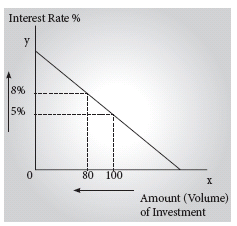
If interest rates are increased then it will tend to discourage investment because investment has a higher opportunity cost.
1. With higher rates, it is more expensive to borrow money from a bank.
2. Saving money in a bank gives a higher rate of return. Therefore, using savings to finance investment has an opportunity cost of lower interest payments.
If interest rates rise, firms will need to gain a better rate of return to justify the cost of borrowing using savings.
14.
i. Deforestation and soil erosion:
Deforestation carried out to create drylands is one of the major concerns. Land that is once converted into the dry or barren land, can never be made fertile again, whatever the magnitude of measures to convert it.
ii. Agricultural activities:
With a growing human and pet animal population, demand for food has increased considerably. Farmers often use highly toxic fertilizers and pesticides to get rid off insects, fungi, and bacteria from their crops. However, the overuse of these chemicals results in contamination and poisoning of land.
iii. Mining activities:
During extraction and mining activities, several land spaces are created beneath the surface.
iv. Landfills:
Each household produces tones of garbage each year due to changing economic lifestyle of the people. Garbage like plastic, paper, cloth, wood, and hospital waste get accumulated. Items that cannot be recycled become a part of the landfills that cause land pollution.
v. Industrialization:
Due to increasing consumerism more industries were developed which led to deforestation. Research and development paved the way for modern fertilizers and chemicals that were highly toxic and led to soil contamination.
vi. Construction activities:
Due to urbanization, a large number of construction activities are taking place. This has resulted in large waste articles like wood, metal, bricks, plastic. These are dumped at the outskirts of urban areas that lead to land pollution.
vii. Nuclear waste:
The leftover radioactive materials, harmful and toxic chemicals affect human health. They are dumped beneath the earth to avoid any casualty.
15.
(i) In a four-sector economy, in addition households, firms and government, a fourth sector namely, external sector is included.
(ii) In the real life, only four-sector economy exists. This model is composed of four sectors namely,
1. Households
2. Firms
3. Government
4. External Sector
The external sector comprises exports and imports. It is illustrated in the Flow Chart
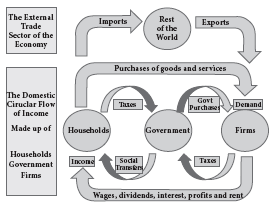
In four-sector economy, expenditure for the entire economy include domestic expenditure (C + I + G) and net exports (X - M). Therefore,
Y = C + I + G + (X - M)
16.
Classification of public expenditure are as follows:
1. Classification on the Basis of Benefit:
(a) Public expenditure benefiting the entire society, e.g., the expenditure on general administration, defense, education, public health, transport.
(b) Public expenditure conferring a special benefit on certain people and at the same time common benefit on the entire community, e.g, administration of justice etc.
(c) Public expenditure directly benefiting particular group of persons and indirectly the entire society, e.g. social security, public welfare, pension, unemployment relief etc. (d) Public expenditure conferring a special benefit on some individuals, e.g., subsidy granted to a particular industry.
2. Classification on the Basis of Function:
(a) Protection Functions: This group includes public expenditure incurred on the security of the citizens, to protect from external invasion and internal disorder, e.g., defence, police, courts etc.
(b) Commercial Functions: This group includes public expenditure incurred on the development of trade and commerce, e.g., development of means of transport and communication etc.
17.
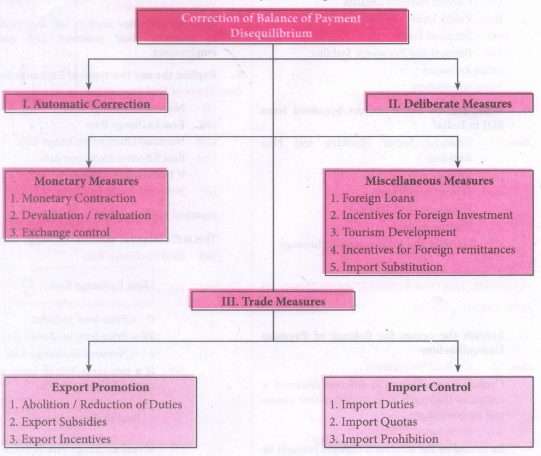
18.
Types of Exchange Rate:
(i) Nominal Exchange Rate
(ii) Real Exchange Rate
(iii) Nominal Effective Exchange Rate
(iv) Real Effective Exchange Rate If 1US Dollar = Rs.75
(i) Nominal Exchange Rate:
Nominal Exchange Rate =\(\cfrac { 75 }{ 1 } \)
This is the bilateral nominal exchange rate.
(ii) Real Exchange Rate:
(1) Real Exchange Rate = \(\cfrac { { eP }_{ r } }{ P } \)
P = Price level in India
PF = Price level in abroad (say US)
e = Nominal Exchange Rate
(2) If a pen costs Rs.50 in India and it costs 5 USD in the US.
\(\therefore \text {Real Exchange Rate}=\cfrac { 75\times 5 }{ 50 } =7.5\)
(3) If real exchange rate is equal to 1, the currencies are at purchasing power parity.
(4) If the price of the pen in US is 0:66 USD, then the real exchange rate
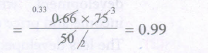
Then it could be said that the USD and Indian rupee are at purchasing power parity.
19.
(i) The propensity to consume refers to the portion of income spent on consumption.
MPC = \(\frac{ΔC}{ΔY}\)
(K) = \(\frac{1}{1-MPC}\)
(ii) The multiplier is the reciprocal of one minus marginal propensity to consume.
(iii) Multiplier is 1/MPS
(iv) The multiplier is therefore define as reciprocal of MPS.
(v) Multiplier is inversely related to MPS and directly with MPC.
Numerically, if MPC is 0.75, MPS is 0.25 and K is 4.
Using formula K = \(\frac{1}{1-MPC}\)
⇒\(\frac{1}{1-0.75}\) = 1/0.25 = 4
∴ Multiplier (K) = 4
| MPC | MPS | K |
|---|---|---|
| 1.00 | 1.00 | 1 |
| 0.10 | 1.90 | 1.11 |
| 0.50 | 0.50 | 2.00 |
| 0.75 | 0.25 | 4.00 |
| 0.90 | 0.10 | 10.00 |
| 1.00 | 0.00 | ∝ |
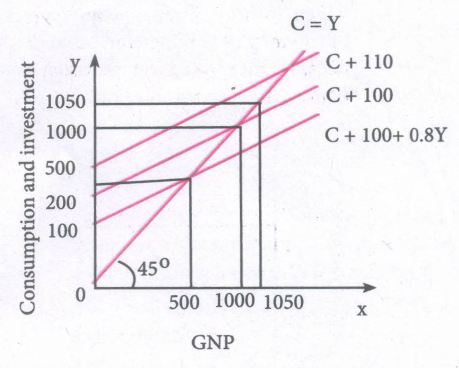
C = 100 + 0.8Y;
I = 10
Y = C + I
= 100 + 0.8 Y +9p00
.JPG)
0.2Y = 1000
∴ Y = 1000
Here, C = 100 + 0.8y
= 100 + 1000 = 900
S = 100 = I
After I is raised by 10, now I = 110
Y = 100 + 0.8y + 110
0.2y = 210
y = \(\frac{210}{0.2}\) = 1050
Here, C = 100 = 0.8 (1050) = 940,
S = 110 = I
(i) It implies the variables in axis-and axis are equal.
(ii) The MPC is assumed to be at 0.8. (C = 100 + 0.8y)
(iii) The aggregate demand (C + I) curve intersects 45° line at point E.
(iv) The new aggregate demand curve is
C + I = 100 + 0.8Y + 100 + 10
Y = \(\frac{210}{0.2}\)
C = 940; S = 110 = Z
20.
(i) The classical economists believed that investment depended exclusively on rate of interest.
(ii) Investment decision depends on a number of factors.
(iii) They are as follows:
(1) Rate of interest
(2) Level of uncertainty
(3) Political environment
(4) Rate of growth of population
(5) Stock of capital goods
(6) Necessity of new products
(7) Level of income of investors
(8) Inventions and innovations
(9) Consumer demand
(10 ) Policy of the state
(11) Available of capital
(12) Liquid assets of the investors
21.
Product Method:
(i) Product method measures the output of the country. It is also called inventory method.
(ii) It is obtained for the entire economy during a year.
(iii) The value obtained is actually the GNP at market prices.
(iv) Care must be taken to avoid double counting.
(v) The value of the final product is derived by the summation of all the values added in the productive process.
(vi) To avoid double counting either the value of the final output should be taken in to the estimate of GNP.
(vii) In India the gross value of the farm output is obtained as follows.
(1) The output of each crop is measured by multiplying the area shown by the average yield per hectare.
(2) The total output of each commodity is valued at market prices.
(3) The net value of the agriculture output is measured by making deductions for the cost of seed, manures and fertilisers etc.,
(4) Net value of the output in these sectors is derived by making deductions for cost of materials used in the process of production and depreciation allowances etc., from gross value of output,
(5) For example, value of cotton enters value of yarn as cost and value of yarn in cloth and that of cloth in garments at every stage value added only should be calculated.
22.
23.
Assumption of the Say's law of market:
(i) No single buyer (or) seller of commodity or an input can affect price.
(ii) Full employment.
(iii) People are motivated by self interest and self-interest determines economic decisions.
(iv) The laissez fair policy is essential for an automatic and self adjusting process full employment.
(v) There will be a perfect competition.
(vi) There is wage - price flexibility.
(vii) Money acts only as a medium of exchange.
(viii) Long run analysis.
(ix) There is no possibility for over production or unemployment.
(x) Unutilized resources used until reaches full employment.
(xi) No Government intervention automatic Price adjustment mechanism operated.
24.
(a) Rapid Economic Growth:
(i) It promotes rapid economic growth.
(ii) Thus both public requirements and private needs are taken care of.
(b) Balanced Economic Growth:
(i) Mixedism promotes balanced growth of the economy.
(ii) It promotes balanced growth between agriculture and industry.
(c) Proper utilization of Resources:
(i) The government can ensure proper utilization of resources.
(ii) The government controls must of the important activities directly.
(d) Economic Equality:
(i) The government uses progressive rates of taxation.
(ii) Income tax to bring about economic equality.
25.
Merits of Socialism:
1. Reduction m Inequalities:
No one is allowed to own and use private property to exploit others.
2. Rational Allocation of Resources:
The central planning authority allocates the resources in a planned manner. Wastages are minimised and investments are made in a pre planned manner.
3. Absence of Class conflicts:
As inequalities are minimum, there is no conflict between rich and poor class. Society functions in a harmonious manner.
4. End of rade Cycles :
Planning authority takes control over production and distribution of goods and services. Therefore, economic fluctuations can be avoided.
5. Promotes Social Welfare:
Absence of exploitation, reduction in economic inequalities, avoidance of trade cycles and increase in productive efficiency help to promote social welfare.

12th Standard Syllabus & Materials
12th Standard
TN 12th Computer Applications களப்பெயர் முறைமை (DNS) Sample Question Papers Study Material - QB365 Set A
NEW12th Standard
TN 12th Computer Applications வலையமைப்பு எடுத்துக்காட்டுகள் மற்றும் நெறிமுறைகள் Sample Question Papers Study Material - QB365 Set A
NEW12th Standard
TN 12th Computer Applications கணினி வலையமைப்பு ஓர் அறிமுகம் Sample Question Papers Study Material - QB365 Set A
NEW12th Standard
TN 12th Computer Applications PHP-உடன் MySQL-ஐ இணைத்தல் Sample Question Papers Study Material - QB365 Set A



Tamilnadu Stateboard 12th Standard Subjects

Maths

Chemistry

Physics

Biology

Computer Science

Business Maths and Statistics
Economics

Commerce

Accountancy

History

Computer Applications
Biology
Computer Technology
Computer Applications
Computer Science
Business Maths and Statistics
Commerce
Economics
Maths
Chemistry
Physics
Computer Technology
History
Accountancy

Tamil

English

French
Tamilnadu Stateboard Standards



