
 100% FREE ACCESS
12th Standard Syllabus & Materials
12th Standard
TN 12th Maths Applications of Matrices and Determinants Sample Question Papers Study Material - QB365 Set A
NEW12th Standard
TN 12th Computer Applications மின்னணு தரவு பரிமாற்றம் Sample Question Papers Study Material - QB365 Set A
NEW12th Standard
TN 12th Computer Applications மின் - வணிக பாதுகாப்பு அமைப்புகள் Sample Question Papers Study Material - QB365 Set A
NEW12th Standard
TN 12th Computer Applications மின்னணு செலுத்தல் முறைகள் Sample Question Papers Study Material - QB365 Set A
NEW12th Standard
TN 12th Computer Applications மின் - வணிகம் Sample Question Papers Study Material - QB365 Set A
NEW12th Standard
TN 12th Computer Applications திறந்த மூல கருத்துருக்கள் Sample Question Papers Study Material - QB365 Set A

Published on: 13/05/2022
QB365 provides detailed and simple solution for every Creative Questions in class 12 Economics Subject. It will helps to get more idea about question pattern in every Creative questions with solution.
latest Creative QuestionsDownload Tamil Nadu 12th Standard Economics question papers, model tests, one-mark questions, important questions, and public exam papers in PDF format. Free study materials and answer keys for TN State Board students.
Questions + Answers key
Take MCQ Economics Test1.
Write the History, Administration and Brief Functions of RBI.
2.
Discuss Cheap and Dear Money policy.
3.
Write anote on “Special Drawing Rights”.
4.
Solve and discuss the following using Marshall “Cash Balance Approach”.
(i) Suppose money supply in cash and bank deposits (M) = Rs. 1,000.
(ii) The total annual national income (R) = 10,000 units.
(iii) The goods (income) which the community wants to hold in money (K), say one-fifth of Y = 2,000 units.
5.
Distinguish between Fisher’s and Cambridge Equation.
6.
Explain the evolution of money.
7.
In each of the following scenarios, classify the individual as frictionally, structurally, or cyclically unemployed. Explain your classification.
(a) There has been a general economic slow down. Because of weak demand, Kumar has lost his portering job at the railway station.
(b) Sathish, a newly qualified dental graduate, is looking for a place to set up practice.
(c) Latha is thrown out of work by the introduction of a more mechanized production process.
(d) Devi, a computer programmer with a large bank, quit her job two months ago in search of a better-paid programming position. She is still looking.
8.
Elaborate various Gains from International Trade?
9.
State the importance of the comparative advantage of international trade.
10.
Consider the following are the only transactions take place in an economy:
(i) Industry A imports goods worth Rs. 100. It sells goods worth Rs. 400 to industry B, goods worth Rs. 200 to industry C, and goods worth Rs. 1,000 for private consumption.
(ii) Industry B sells goods worth Rs. 500 to industry C and goods worth Rs. 800 for private consumption.
(iii) Industry C sells goods worth Rs. 600 to private consumption. and exports goods, valued at Rs. 500.
(iv) Depreciation cost during the year amounts to Rs. 100,
(v) Government realises taxes of the value of Rs. 100. Calculate the following with the help of net value added method from the data given above
(a) GNPMP
(b) GNPFC
(c) NNPMP and
(d) NNPFC
11.
Explain the determinants of Equilibrium Exchange Rate.
12.
Discuss the concept of “Factor Cost”.
13.
Explain the short and long run factors of MEC.
14.
Draw a consumption table where autonomous consumption is Rs.200 and the marginal propensity to consume is .8. Make sure to start with an income level of Rs.0 and increase by Rs.100 each time up to an income level of Rs.400. Without completing the table any further determine the level of income where consumption and income are equal. Prove this algebraically.
15.
Discuss the features of Capitalist economy.
16.
Explain the three sector model of economy with chart.
17.
Write a note on relation between India and World Bank.
18.
State the objectives of SAARC.
19.
Explain the disadvantages of FDI.
20.
What are the factors on which MEC depends? Also give details on the factors which influence MEC.
21.
Explain consumption function with the help of diagram.
22.
Discuss the Iimitations of National Income as an index of economic welfare.
23.
What are the objectives of ARDC? Explain.
24.
Explain the Demerits of capitalism.
25.
Explain other types of inflation (on the basis of inducement).
1.
History:
(i) Formed on April 1, 1935 in accordance with the RBI Act, 1934
(ii) Nationalized on January 1, 1949 (Fully owned by GOI)
(iii) Headquarter moved from Calcutta to Mumbai in 1937
(iv) Osborne Smith was the first Governor of RBI
Administration:
(i) It is the Central Bank/ Regulator for all bank in India
(ii) Also called “Lender of Last Resort”
(iii) Governors and 4 Deputy Governors along with a central board of directors appointed by the GOI.
Functions:
(i) Issues currency
(ii) Banker to the government. {It collects receipts of funds and makes payments on behalf of the government}
(iv) Regulator of Indian Banking system
(v) Custodian of Forex
(vi) Controller of credit
2.
A. Monetary Policy: Expansionary Vs. Contractionary
Expansionary policy
i. Expansionary policy is cheap money policy when a monetary authority uses its tools to stimulate the economy.
ii. An expansionary policy maintains short-term interest rates at a lower than usual rate or increases the total supply of money in the economy more rapidly than usual.
iii. It is traditionally used to try to combat unemployment by lowering interest rates in the hope that less expensive credit will entice businesses into expanding.
iv. This increases aggregate demand (the overall demand for all goods and services in an economy), which boosts short-term growth as measured by gross domestic product (GDP) growth.
The Contractionary
i. The Contractionary monetary policy is dear money policy, which maintains short-term interest rates higher than usual or which slows the rate of growth in the money supply or even shrinks it.
ii. This slows short-term economic growth and lessens inflation.
iii. Contractionary monetary policy can lead to increased unemployment and depressed borrowing and spending by consumers and businesses, which can eventually result in an economic recession if implemented too vigorously.
B. The Two Faces of Monetary Policy
| Cheap Money Policy for Inflation |
Dear Money Policy for Recession |
| 1. Borrowing is easy | 1. Borrowing is difficult |
| 2. Consumers buy more | 2. Consumers buy less |
| 3. Businesses expand | 3. Businesses Postpone expansion |
| 4. More people are employed | 4. Unemployment increases |
| 5. People spend more | 5. Production is reduced |
3.
(i) The IMF has succeeded in establishing a scheme of Special Drawing Rights (SDRs) which is otherwise called ‘Paper Gold’.
(ii) They are a form of international reserves created by the IMF in 1969 to solve the problem of international liquidity.
(iii) They are allocated to the IMF members in proportion to their Fund quotas.
(iv) SDRs are used as a means of payment by Fund members to meet balance of payments deficits and their total reserve position with the Fund.
(v) Thus SDRs act both as an international unit of account and a means of payment.
(vi) All transactions by the Fund in the form of loans and their repayments, its liquid reserves, its capital, etc., are expressed in the SDR.
(vii) The achievements of the fund can be summed up in the words of Haien that ‘Fund is like an International Reserve Bank'.
4.
Marshall’s Equation
1. The Marshall equation is expressed as:
2. M = KPY the price level P = M/KY or the value of money = The reciprocal of price level is 1/P = KY/M the value of money (one rupee) = 2,000 units = (KY/M) = two units of goods, or Prices level P = (M/KY) = 1/2 = 0.50 paise per unit.
3. It is, therefore, clear that the value of money (its purchasing power) is found by dividing the total amount of goods, which the community wants to hold out of the total income (KY), by the amount of the supply of the money held by the public (M), and the price level (P) is found out by dividing the money supply (M) by the amount of goods which the community wants to hold (KY), as the price level is the opposite of the value of money.
5.
| Base of difference | Fisher's Equation | Cambridge's Equation |
| 1. Flow and stock of Money | Fishers's equation gives importance to flow of money | Cambridge's equation stress on stock of money. |
| 2. Natural of Price Level | P represents the average price level of all goods and services. | P represents the price of consumer goods. |
| 3. Stress on Demand Supply | Fisher's viewpoint stress on supply of money | Cambridge's viewpoint stresses on demand of money |
| 4. Time | It is associated with a period of time | It is associated with the point of time |
| 5. Demand of Money |
According to Fisher, the Demand of money is for actual transactions | According to Cambridge ideology, the demand of money is for the storage of money. |
6.
BARTER SYSTEM
(i) Exchange of goods for goods was known as “Barter Exchange” or “Barter System”.
(ii) In a barter system, the commodities and services were directly exchanged for other commodities and services.
(iii) Goods like furs, skins, salt, rice, wheat, utensils, weapons, etc. were commonly used as money.
METALLIC MONEY
(i) Under metallic standard, some kind of metal either gold or silver is used to determine the standard value of the money and currency.
(ii) Standard coins made out of the metal are the principal coins used under the metallic standard.
(iii) These standard coins are full bodied or full weighted legal tender. Their face value is equal to their intrinsic metal value.
GOLD STANDARD
(i) Gold Standard is a system in which the value of the monetary unit or the standard currency is directly linked with gold.
(ii) The monetary unit is defined in terms of a certain weight of gold.
SILVER STANDARD
(i) The silver standard is a monetary system in which the standard economic unit of account is a fixed weight of silver.
(ii) The silver standard is a monetary arrangement in which a country’s Government allows conversion of its currency into fixed amount of silver.
PAPER CURRENCY
The paper currency standard refers to the monetary system in which the paper currency notes issued by the Treasury or the Central Bank or both circulate as unlimited legal tender.
PLASTIC MONEY
(i) The latest type of money is plastic money.
(ii) Plastic money is a term that is used predominantly in reference to the hard plastic cards used every day in place of actual bank notes.
(iii) Plastic money can come in many different forms such as Cash cards, Credit cards, Debit cards, Pre-paid Cash cards, Store cards, Forex cards and Smart cards.
CRYPTO CURRENCIES
Decentralised crypto currencies such as Bitcoin now provide an outlet for Personal Wealth that is beyond restriction and confiscation.
7.
(a) Kumar is cyclically unemployed. He has lost his job as a result of the general economic recession.
(b) Sathish is frictionally unemployed. Job openings exist for him. It is merely a case of tracking down a position.
(c) Latha is structurally unemployed. Unemployment due to technological change in an industry is classified as structural.
(d) Devi, is frictionally unemployed. Job openings exist for her.
8.
Introduction
(i) International trade helps a country to export its surplus goods to other countries and secure a better market for it.
(ii) Similarly, international trade helps a country to import the goods which cannot be produced at all or can be produced at a higher cost.
(iii) The gains from international trade may be categorized under four heads.
I. Efficient Production
International trade enables each participatory country to specialize in the production of goods in which it has absolute or comparative advantages. International specialization offers the following gains.
1. Better utilization of resources.
2. Concentration in the production of goods in which it has a comparative advantage.
3. Saving in time.
4. Perfection of skills in production.
5. Improvement in the techniques of production.
6. Increased production.
7. Higher standard of living in the trading countries
II. Equalization of Prices between Countries
International trade may help to equalize prices in all the trading countries
1. Prices of goods are equalized between the countries (However, in reality it has not happened).
2. The difference is only with regard to the cost of transportation.
3. Prices of factors of production are also equalized (However, in reality it has not happened).
III. Equitable Distribution of Scarce Materials
International trade may help the trading countries to have equitable distribution of scarce resources.
IV. General Advantages of International Trade
1. Availability of variety of goods for consumption.
2. Generation of more employment opportunities.
3. Industrialization of backward nations.
4. Improvement in relationship among countries (However, in reality it has not happened).
5. Division of labour and specialisation.
6. Expansion in transport facilities
9.
(i) The balance of aggregate demand and aggregate supply was first described.
(ii) The cost of goods is determined by the ratio of aggregate demand and supply for them, both domestically and from abroad;
(iii) He theory is true regarding any quantity of goods and any number of countries, as well as for the analysis of trade between different entities.
(iv) In this case, country specialization in some goods depends on the ratio of wage levels in each country;
(v) The theory based the existence of benefits from trade for all countries, taking part in it;
(vi) There become possible to develop foreign economic policy on the scientific foundation.
10.
(A) GNPMP = Sum of net value added by all the industries
(i) value - added by industry A.
= Sale of goods to industry B + Sale of goods to industry C − Value of imports
Sale of goods to consumers = Rs. 400 + Rs. 200 + Rs. 1,000 − Rs. 100
= Rs. 1,590.
(ii) Value - added by industry B
= Sale of goods to industry C + Sale of goods to consumers.− Purchase of goods from industry A
= Rs. 500 + Rs. 800 − Rs. 400
= Rs. 900.
(iii) Value - added by industry C
= Sale of goods to consumers + Exports − (purchase of goods from industry A+purchase of goods from industry B)
= Rs. 600 + Rs. 500 - Rs. 200 - Rs. 500
= Rs. 400.
Gross National Product at market prices, or
GNPMP equals
Rs. 1,500 + Rs. 900 + Rs. 400
= Rs. 2,800
Gross National Product at factor cost or GNPFC equals
GNPMP − Indirect taxes + Subsidies
= Rs. 2,800 − Rs.100 + Rs. 50
= Rs. 2,750.
Net National Product at market prices, or NNPMP equals.
GNPMP − Depreciation
= Rs. 2,800 − Rs. 100
= Rs. 2,700.
Net National Product at factor cost or NNPFC equals
NNPMP - Indirect.taxes + Subsidies
= Rs. 2,700-Rs. 100 + Rs. 50
= 2,650.
as factors of production and include things such as land, labour, capital and entrepreneurship.
1. Producers of goods and services incur a cost for using these factors of production. These costs are ultimately added onto the price of the product.
2. The factor cost refer to the cost of production that is incurred by a firm when producing goods and services.
3. Examples of such production costs include the cost of renting machines, purchasing machinery and land, paying salaries and wages, cost of obtaining capital, and the profit margins that are added by the entrepreneur.
4. The factor cost does not include the taxes that are paid to the government since taxes are not directly involved in the production process and, therefore, are not part of the direct production cost.
5. However, subsidies received are included in the factor cost as subsidies are direct inputs into the production.
11.
Determinants of Exchange Rates
Exchange rates are determined by numerous factors and they are related to the trading relationship between two countries
1. Differentials in Inflation
Inflation and exchange rates are inversely related. A country with a consistently lower inflation rate exhibits a rising currency value, as its purchasing power increases relative to other currencies.
2. Differentials in Interest Rates
There is a high degree of correlation between interest rates, inflation and exchange rates. Central banks can influence over both inflation and exchange rates by manipulating interest rates. Higher interest rates attract foreign capital and cause the exchange rate to rise and vice versa.
3. Current Account Deficits
A deficit in the current account implies excess of payments over receipts. The country resorts to borrowing capital from foreign sources to make up the deficit. Excess demand for foreign currency lowers a country’s exchange rate.
4. Public Debt
Large public debts are driving out foreign investors, because it leads to inflation. As a result, exchange rate will be lower
5. Terms of Trade
A country’s terms of trade also determines the exchange rate. If the price of a country’s exports rises by a greater rate than that of its imports, its terms of trade will improve. Favorable terms of trade imply greater demand for the country’s exports and thus BoP becomes favorable.
6. Political and Economic Stability
If a nation’s political climate is stable and economic performance is good, its currency value will be appreciated by attracting more foreign capital
7. Recession
Interest rates are low during the recession phase. This will decrease inflow of foreign capital. As a result, a currency will be depreciated against other currencies, thereby lowering the exchange rate.
8. Speculation
If a country’s currency value is expected to rise, investors will demand more of that currency in order to make a profit in the near future. This results in appreciation of the exchange rate. Beside the above determinants, relative dominance in the global politics and the power to announce economic sanctions over other countries also determine exchange rates
12.
1. There are a number of inputs that are included into a production process when producing goods and services. These inputs are commonly known as factors of production and include things such as land, labour, capital and entrepreneurship.
2. Producers of goods and services incur a cost for using these factors of production. These costs are ultimately added onto the price of the product.
3. The factor cost refer to the cost of production that is incurred by a firm when producing goods and services.
4. Examples of such production costs include the cost of renting machines, purchasing machinery and land, paying salaries and wages, cost of obtaining capital, and the profit margins that are added by the entrepreneur.
5. The factor cost does not include the taxes that are paid to the government since taxes are not directly involved in the production process and, therefore, are not part of the direct production cost.
6. However, subsidies received are included in the factor cost as subsidies are direct inputs into the production.
13.
a) Short - Run Factors
(i) Demand for the product:
If the market for a particular good is expected to grow and its costs are likely to fall, the rate of return from investment will be high. If entrepreneurs expect a fall in demand for goods and a rise in cost, the investment will decline.
(ii) Liquid assets:
If the entrepreneurs are holding large volume of working capital, they can take advantage of the investment opportunities that come in their way. The MEC will be high.
(iii) Sudden changes in income:
The MEC is also influenced by sudden changes in income of the entrepreneurs. If the business community gets windfall profits, or tax concession the MEC will be high and hence investment in the country will go up. On the other hand, MEC falls with the decrease in income.
(iv) Current rate of investment:
Another factor which influences MEC is the current rate of investment in a particular industry. If in a particular industry, much investment has already taken place and the rate of investment currently going on in that industry is also very large, then the marginal efficiency of capital will be low.
(v) Waves of optimism and pessimism:
The marginal efficiency of capital is also affected by waves of optimism and pessimism in the business cycle. If businessmen are optimistic about future, the MEC will be likely to be high. During periods of pessimism the MEC is under estimated and so will be low.
b) Long - Run Factors
The long run factors which influence the marginal efficiency of capital are as follows
(i) Rate of growth of population:
Marginal efficiency of capital is also influenced by the rate of growth of population. If population is growing at a rapid speed, it is usually believed that the demand of various types of goods will increase. So a rapid rise in the growth of population will increase the marginal efficiency of capital and a slowing down in its rate of growth will discourage investment and thus reduce marginal efficiency of capital.
(ii) Technological progress:
If investment and technological development take place in the industry, the prospects of increase in the net yield brightens up. For example, the development of automobiles in the 20th century has greatly stimulated the rubber industry, the steel and oil industry etc. So we can say that inventions and technological improvements encourage investment in various projects and increase marginal efficiency of capital.
(iii) Monetary and Fiscal policies:
Cheap money policy and liberal tax policy pave the way for greater profit margin and so MEC is likely to be high.
(iv) Political environment:
Political stability, smooth administration, maintenance of law and order help to improve MEC.
(v) Resource availability:
Cheap and abundant supply of natural resources, efficient labour and stock of capital enhance the MEC.
14.
| Income | Consumption |
| Rs.0 | Rs.200 |
| Rs.100 | 280 |
| Rs.200 | 360 |
| Rs.300 | 440 |
| Rs.400 | 520 |
(i) The consumption function is C = 200 + .8Y
(ii) Therefore if C = Y we can write Y = 200 + 8Y.
(iii) After rearranging terms this yields 2Y = 200.
(iv) Solving for Y gives us 1000.
15.
1. Private Ownership of Property and Law of Inheritance: The basic feature of capitalism is that all resources namely, land, capital, machines, mines etc. are owned by private individuals. The owner has the right to own, keep, sell or use these resources according to his will. The property can be transferred to heirs after death.
2. Freedom of Choice and Enterprise: Each individual is free to carry out any occupation or trade at any place and produce any commodity. Similarly, consumers are free to buy any commodity as per their choice
3. Profit Motive: Profit is the driving force behind all economic activities in a capitalistic economy. Each individual and organization produce only those goods which ensure high profit. Advance technology, division of labour, and specialisation are followed. The golden rule for a producer under capitalism is ‘to maximize profit.’
4. Free Competition: There is free competition in both product and factor market. The government or any authority cannot prevent firms from buying or selling in the market. There is competition between buyers and sellers.
5. Price Mechanism: Price mechanism is the heart of any capitalistic economy. All economic activities are regulated through price mechanism i.e, market forces of demand and supply.
6. Role of Government: As the price mechanism regulates economic activity, the government has a limited role in a capitalistic economy. The government provides basic services such as, defense, public health, education, etc.
7. Inequalities of Income: A capitalist society is divided into two classes – ‘haves’ that is those who own property and ‘have-nots’ who do not own property and work for their living. The outcome of this situation is that the rich become richer and poor become poorer. Here, economic inequality goes on increasing.
16.
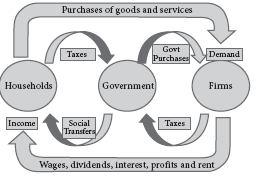
1. In addition to household and firms, inclusion of the government sector makes this model a three-sector model.
2. The government levies taxes on households and firms, purchases goods and services from firms, and receive factors of production from household sector.
3. On the other hand, the government also makes social transfers such as pension, relief, subsidies to the households.
4. Similarly, Government pays the firms for the purchases of goods and services.
5. The Flow Chart illustrates three- sector economy model
Under three sector model, national income
(Y) is obtained by adding Consumption expenditure (C), Investment expenditure (I) and Government expenditure (G).
Therefore Y = C + I + G
17.
India and world Bank:
(i) The name "International Bank for Reconstruction and Development" was first suggested by India to the drafting committee.
(ii) Since then the two have developed close relationship with each other from framing the policies of economic development in India to financing the implementation of these policies.
(iii) The World Bank has given large financial assistance to India for economic development.
iv) Special mention may be made of the assistance World Bank has given to India in the development of infrastructure such as electric power, transport, communication, irrigation projects and steel industry.
(v) The IFC has identified five priority areas, namely, capital market development, direct foreign investment, access to foreign markets, equity investments in new and expanding companies and infrastructure.
(vi) The World Bank has also assisted India in accelerating programmes of poverty alleviation and economic development.
18.
(i) To promote the Welfare of the people of south Asia and improve their quality of life.
(ii) To accelerate economic growth, social progress and cultural development in the region.
(iii) To promote and strengthen collective self reliance among the countries of south Asia.
(iv) To contribute to mutual trust and understanding and appreciation of another's problems.
(v) To strengthen co-operation with other developing countries
(vi) To strengthen co-operation among themselves in international forums on matters of common interest.
(vii) To co-operate with international and regional organisations with similar aims and purpose.
19.
(i) Private foreign capital tends to flow to the high profit areas rather than to the priority sectors.
(ii) The technologies brought in by the foreign investor may not be appropriate to the consumption needs, size of the domestic market etc.
(iii) Foreign investment, sometimes, have unfavorable effect on the Balance of Payments of a country because when the drain of foreign exchange by way of royalty, dividend, etc. is more than the investment made by the foreign concerns.
(iv) Foreign capital sometimes interferes in the national politics.
(v) Foreign investors sometimes engage in unfair and unethical trade practices.
(vi) Often, there are several costs associated with encouraging foreign investment.
(iv) Foreign investment in some cases leads to the destruction.
20.
MEC depends on the following 2 factors :
(1) The prospective yield from a capital asset.
(2) The supply price of a capital asset. The marginal efficiency of capital is influenced by short-run as well as long run factors.
(a) Short - Run factors:
(i) Demand for the product:
If the market for a particular good is expected to grow and its costs are likely to fall, the rate of return from investment will be high.
(ii) Liquid assets:
If the entrepreneurs are holding large volume of working capital, they can take advantage of the investment opportunities that come in their way. The MEC will be high.
(iii) Sudden changes in incomes:
If the business community gets windfall profits, or tax concession the MEC will be high. On the other hand, MEC falls with the decrease in income.
(iv) Current rate of investment:
If in a particular industry, much investment has already taken place and the rate of investment currently going on in that industry is also very large, then the marginal efficiency of capital will be low.
(v) Wales of optimism and pessimism:
If businessmen are optimistic about future, the MEC will be likely to be high. During periods of pessimism the MEC is under estimated and so will be low.
(b) Long - Run Factors:
(i) Rate of growth of population:
If population is growing at a rapid speed, it is usually believed that the demand of various types of goods will increase.
(ii) Technological progress:
If investment and technological development take place in the industry, the prospects of increase in the net yield brightens up.
(iii) Monetary and fiscal policies:
Cheap money policy and liberal tax policy pave the way for greater profit margin and so MEC is likely to be high.
(iv) Political environment :
Political stability, smooth administration, maintenance of law and order help to improve MEC.
(v) Resource avaiqability:
Cheap and abundant supply of natural resources, efficient labour and stock of capital enhance the MEC.
21.
Meaning of consumption function.
(i) Propensity to consume refers to income consumption relationship.
(ii) Consumption function is a "functional relationship between two aggregates viz. total consumption and gross national income."
(iii) C = f(Y)
(iv) C = Consumption
Y = Income
f = Function
(v) Thus the consumption function indicates a functional relationship between C and Y.
(vi) C is the dependent variable and Y is the independent variable. i.e. C is determined by Y.
(vii) Based on the ceteris paribus (other things being same) assumption, as only income consumption relationship is considered.
(viii) All possible influences on consumption are held constant.
(ix) A hypothetical consumption schedule is given in table.
Income - Consumption Schedule (Rs.Cores)
| Income Y | Consumption C | Savings S |
|---|---|---|
| 0 | 20 | -20 |
| 60 | 70 | -10 |
| 120 | 120 | 0 |
| 180 | 170 | 10 |
| 240 | 220 | 20 |
| 300 | 270 | 30 |
| 360 | 320 | 40 |
If we take C = 100 + 0.8Y, then MPC = 0.8
Here if Y = 0, C = 100; if Y = 100, C = 180
If Y = 200, C = 260
If Y =300, C = 340 (MPC = \(\frac{ΔC}{ΔY}\) = 0.8)
In mathematical terms
C = a + b Y or C = 20 + 0.8Y
Where a > 0 and b < 1
C = Consumptiona = Constant or intercept = 20
Y = Income
b = MPC (Marginal prosperity to consume)
8.0 = \(\frac{ΔC}{ΔY}\)
(x) The above table shows that consumption is an increasing function of income because consumption expenditure increases with increase in income.
(xi) When income is zero, people spend out of their past savings on consumption because they must eat in order to live (Autonomous consumption).
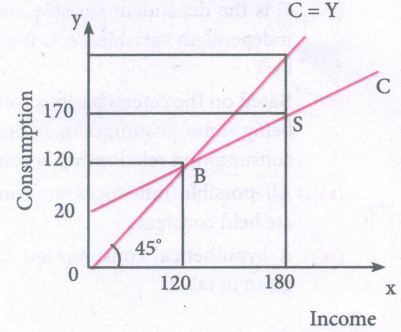
Here, when Y = 120, C = 120 (point B in the diagram)
When Y = 180, C = 170, S = 10 (point S in the diagram)
If oY increases to 360, C = 320, S = 40
(xii) In the diagram, income is measured horizontally.
(xiii) Consumption is measured vertically.
(xiii) In 45 line at all levels income and consumption are equal.
(xv) The consumption function measures not only the amount spent on consumption but also the amount saved.
(xvi) The propensity to save is merely the propensity not to consume.
22.
(i) The economic welfare depends upon the composition of a goods and services provided.
(ii) Higher GDP with greater environmental hazards such as air, water and soil pollution will be little economic welfare.
(iii) The production of war goods will show the increase in national output but not welfare.
(iv) An increase in per capita income may be due to. employment of women and children Dr forcing workers to. work for long hours. But it will not promote economic welfare.
(v) Therefore the physical quality of life index (PQLI) is considered a better indicator of economic welfare.
23.
(i) The agricultural development, an organization is called The Agricultural Refinance Development Corporation.
(ii) It was established by an act of parliament and it started functioning from 1 July, 1953.
(iii) The main aim of ARDC is to bridging the gap in agricultural finance and to extend credit for projects.
Objective of ARDC:
(i) To provide necessary funds by way of refinance to eligible institutions such as the Central land development Banks, State co-operative Banks and Scheduled Banks.
(ii) To subscribe to the debentures floated by the Central land Development Banks, State co-operative Banks, and Scheduled Bank provided they were approved by the RBI.
24.
Demerits of Capitalism:
1. Concentration of Wealth and Income :
Capitalism causes concentration of wealth and income in a few hands and thereby increases inequalities of income.
2. Wastage of Resources Large amount of resources are wasted on competitive advertising and duplication of products.
3. Class Struggle: Capitalism leads to class struggle as it divides the society into capitalists and workers.
4. Business Cycle: Free market system leads to frequent violent economic fluctuations and crises.
5. Production of non essential goods: Even the harmful goods are produced if there is possibility to make profit.
25.
(i) Currency Inflation:
The excess supply of money in circulation causes rise in price level.
(ii) Credit Inflation
When banks are liberal in lending credit, the money supply increases and thereby rising prices.
(iii) Deficit Induced Inflation:
The deficit budget is generally financed through printing of currency by the Central Bank. As a result, prices rise.
(iv) Profit Induced Inflation:
When the firms aim at higher profit, they fix the price with higher margin. So, prices go up.
(v) Scarcity Induced Inflation:
Scarcity of goods happens either due to fall in production (e.g. farm goods) or due to hoarding and black marketing.
(vi) TaxInducedInflation:
(1) Increase in indirect taxes like excise duty, custom duty and sales tax may lead to rise in price.
(2) This is also called taxflation.

12th Standard Syllabus & Materials
12th Standard
TN 12th Computer Applications வலையமைப்பு வடமிடல் Sample Question Papers Study Material - QB365 Set A
NEW12th Standard
TN 12th Computer Applications களப்பெயர் முறைமை (DNS) Sample Question Papers Study Material - QB365 Set A
NEW12th Standard
TN 12th Computer Applications வலையமைப்பு எடுத்துக்காட்டுகள் மற்றும் நெறிமுறைகள் Sample Question Papers Study Material - QB365 Set A
NEW12th Standard
TN 12th Computer Applications கணினி வலையமைப்பு ஓர் அறிமுகம் Sample Question Papers Study Material - QB365 Set A



Tamilnadu Stateboard 12th Standard Subjects

Maths

Chemistry

Physics

Biology

Computer Science

Business Maths and Statistics
Economics

Commerce

Accountancy

History

Computer Applications
Biology
Computer Technology
Computer Applications
Computer Science
Business Maths and Statistics
Commerce
Economics
Maths
Chemistry
Physics
Computer Technology
History
Accountancy

Tamil

English

French
Tamilnadu Stateboard Standards



