
 100% FREE ACCESS
12th Standard Syllabus & Materials
12th Standard
TN 12th Computer Applications மின்னணு தரவு பரிமாற்றம் Sample Question Papers Study Material - QB365 Set A
NEW12th Standard
TN 12th Computer Applications மின் - வணிக பாதுகாப்பு அமைப்புகள் Sample Question Papers Study Material - QB365 Set A
NEW12th Standard
TN 12th Computer Applications மின்னணு செலுத்தல் முறைகள் Sample Question Papers Study Material - QB365 Set A
NEW12th Standard
TN 12th Computer Applications மின் - வணிகம் Sample Question Papers Study Material - QB365 Set A
NEW12th Standard
TN 12th Computer Applications திறந்த மூல கருத்துருக்கள் Sample Question Papers Study Material - QB365 Set A
NEW12th Standard
TN 12th Computer Applications வலையமைப்பு வடமிடல் Sample Question Papers Study Material - QB365 Set A

Published on: 23/06/2021
QB365 provides detailed and simple solution for every Creative Questions in class 12 Economics Subject. It will helps to get more idea about question pattern in every Creative questions with solution.
Download Tamil Nadu 12th Standard Economics question papers, model tests, one-mark questions, important questions, and public exam papers in PDF format. Free study materials and answer keys for TN State Board students.
Questions + Answers key
Take MCQ Economics Test1.
Elucidate various measures of economic development.
2.
Discuss the Non- Economic Factors economic development.
3.
Compare and contrast economic growth and economic development.
4.
Compare and contrast the “Planning Commission” and NITI Aayog”.
5.
Draw the 7 pillars of NITI Aayog.
1.
Economic development is measured on the basis of four criteria
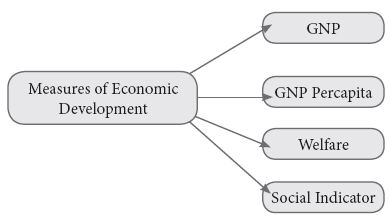
Gross National Product (GNP):
(i) GNP is the total market value of all final goods and services produced within a nation in a particular year, plus income earned by its citizens (including income of those located abroad), minus income of non-residents located in that country.
(ii) GNP is one measure of the economic condition of a country, under the assumption that a higher GNP leads to a higher quality of living, all other things being equal.
GNP per capita:
(i) This relates to increasing in the per capita real income of the economy over the long period
(ii) This indicator of economic growth emphasizes that for economic development the rate of increase in real per capita income should be higher than the growth rate of population.
Welfare:
(i) Economic development is regarded as a process whereby there is an increase in the consumption of goods and services by individuals.
(ii) From the welfare perspective, economic development is defined as a sustained improvement in health, literacy, and standard of living
Social Indicators:
(i) Social indicators are normally referred to as basic and collective needs of the people
(ii) The direct provision of basic needs such as health, education, food, water, sanitation, and housing facilities check social backwardness.
| S/N | Basic need | Indicators |
|---|---|---|
| 1 | Health | Life expectancy at birth |
| 2 | Education | Literacy signifying primary school enrolment as a percent of the population. |
| 3 | Food | Calorie Supply per head |
| 4 | Water supply | Infant mortality and percentage of the population with access to potable water |
| 5 | Sanitation | Infant mortality and percentage of the population with access to sanitation. |
2.
1. Human Resources:
Human resource is named as human capital because of its power to increase productivity and thereby national income. There is a circular relationship between human development and economic growth.
2. Technical Know-how:
As the scientific and technological knowledge advances, more and more sophisticated techniques steadily raise the productivity levels in all sectors. Schumpeter attributed the cause for economic development to innovation.
3. Political Freedom:
The process of development is linked to political freedom. DadabhaiNaoroji explained in his classic work ‘Poverty and Un- British Rule in India’ that the drain of wealth from India under the British rule was the major cause of the increase in poverty in India.
4. Social Organization:
People show interest in the development activity only when they feel that the fruits of development will be fairly distributed.
5. Corruption free administration:
Corruption is a negative factor in the growth process. Unless the countries root-out corruption in their administrative system, the crony capitalists and traders will continue to exploit national resources.
6. A desire for development:
The pace of economic growth in any country depends to a great extent on people’s desire for development
7. Moral, ethical and social values:
These determine the efficiency of the market, according to Douglas C. North. If people are not honest, the market cannot function.
8. Casino Capitalism:
If People spend a larger proportion of their income and time on entertainment liquor and other illegal activities, productive activities may suffer, according to Thomas Piketty.
9. Patrimonial Capitalism:
If the assets are simply passed on to children from their parents, the children would not work hard, because the children do not know the value of the assets.
3.
| BASIS FOR COMPARISON | ECONOMIC GROWTH | ECONOMIC DEVELOPMENT |
|---|---|---|
| MEANING | Economic Growth is the positive change in the real output of the country in a particular span of time. | Economic Development involves a rise in the level of production in an economy along with the advancement of technology, improvement in living standards and so on. |
| CONCEPT | Narrow | Broad |
| SCOPE | Increase in the indicators like GDP, per capita income, etc. | Improvement in life expectancy rate, infant mortality rate, literacy rate, and poverty rates |
| TERM | Short term process | Long term process |
| APPLICABLE TO | Developed Economies | Developing Economies |
| HOW IT CAN BE MEASURED? | Upward movement in national income. | An upward movement in real national income. |
| WHICH KIND OF CHANGES ARE EXPECTED? | Quantitative changes | Qualitative and quantitative change |
| TYPE OF PROCESS | Automatic | Manual |
| WHEN IT ARISES? | In a certain period of time | Continuous process. |
4.
I. Classification on the Basis of Benefit:
| BASIS FOR COMPARISON | PLANNING COMMISSION | NITI AAYOG |
|---|---|---|
| POWERS | Enjoyed the powers to allocate funds to ministries and state governments. | To be an advisory body or a think-tank. The powers to allocate funds might be vested in the finance ministry. |
| STATE’S ROLE | States' role was limited to the National Development Council and annual interaction during Plan meetings. | State governments are expected to play a more significant role than they did in the Planning Commission. |
| MEMBERS | The commission reported to National Development Council that had state chief ministers and lieutenant governors | Governing Council has state chief ministers and lieutenant governors |
| CHAIR-PERSON | Had deputy chairperson, a member secretary, and full-time members | New posts of CEO, of secretary rank, and Vice-Chairperson. Will also have five full-time members and two part-time members. Four cabinet ministers will serve as ex-o official members. |
| POLICY FORMULATION | Policy was formed by the commission and states were then consulted about allocation of funds | Consulting states while making policy and deciding on funds allocation. Final policy would be a result of that. |
| FUNDS ALLOCATION | Had power to decide allocation of government funds for various programs at national and state levels | No power to allocate funds |
| APPROVAL OF PROJECTS |
Imposed policies on states and tied allocation of funds with projects it approved. | NITI is a think-tank and does not have the power to impose policies. |
5.
7 pillars of effective governance:
NITI AAYOG
| Pro-People | Fulfills aspirations of society as well as individuals |
| Pro-Activity | in anticipation response to citizen needs |
| Participation | involvement of citizenry |
| Empowering | Women in all aspects |
| Inclusion of all | SC, ST, OBC, minorities, gareeb, gaon, kisaan |
| Equality | of opportunity for the youth |
| Transparency | making government visible and responsive. |

12th Standard Syllabus & Materials
12th Standard
TN 12th Computer Applications களப்பெயர் முறைமை (DNS) Sample Question Papers Study Material - QB365 Set A
NEW12th Standard
TN 12th Computer Applications வலையமைப்பு எடுத்துக்காட்டுகள் மற்றும் நெறிமுறைகள் Sample Question Papers Study Material - QB365 Set A
NEW12th Standard
TN 12th Computer Applications கணினி வலையமைப்பு ஓர் அறிமுகம் Sample Question Papers Study Material - QB365 Set A
NEW12th Standard
TN 12th Computer Applications PHP-உடன் MySQL-ஐ இணைத்தல் Sample Question Papers Study Material - QB365 Set A



Tamilnadu Stateboard 12th Standard Subjects

Maths

Chemistry

Physics

Biology

Computer Science

Business Maths and Statistics
Economics

Commerce

Accountancy

History

Computer Applications
Biology
Computer Technology
Computer Applications
Computer Science
Business Maths and Statistics
Commerce
Economics
Maths
Chemistry
Physics
Computer Technology
History
Accountancy

Tamil

English

French
Tamilnadu Stateboard Standards



