
 100% FREE ACCESS
12th Standard Syllabus & Materials
12th Standard
TN 12th Maths Applications of Matrices and Determinants Sample Question Papers Study Material - QB365 Set A
NEW12th Standard
TN 12th Computer Applications மின்னணு தரவு பரிமாற்றம் Sample Question Papers Study Material - QB365 Set A
NEW12th Standard
TN 12th Computer Applications மின் - வணிக பாதுகாப்பு அமைப்புகள் Sample Question Papers Study Material - QB365 Set A
NEW12th Standard
TN 12th Computer Applications மின்னணு செலுத்தல் முறைகள் Sample Question Papers Study Material - QB365 Set A
NEW12th Standard
TN 12th Computer Applications மின் - வணிகம் Sample Question Papers Study Material - QB365 Set A
NEW12th Standard
TN 12th Computer Applications திறந்த மூல கருத்துருக்கள் Sample Question Papers Study Material - QB365 Set A

Published on: 23/06/2021
QB365 provides detailed and simple solution for every Creative Questions in class 12 Economics Subject. It will helps to get more idea about question pattern in every Creative questions with solution.
Download Tamil Nadu 12th Standard Economics question papers, model tests, one-mark questions, important questions, and public exam papers in PDF format. Free study materials and answer keys for TN State Board students.
Questions + Answers key
Take MCQ Economics Test1.
Compare and contrast fixed and flexible exchange rates.
2.
Explain Adam Smith’s Theory of Absolute Cost Advantage.
3.
Discuss the state of FDI in India.
4.
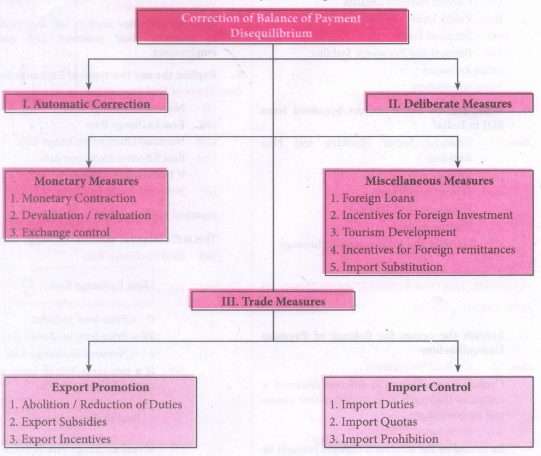
Draw the flow chart for correction of Balance Payment Disequilibrium
5.
Explain the any two types of Exchange Rates.
1.
| BASIS FOR COMPARISON | FIXED EXCHANGE RATE | FLEXIBLE EXCHANGE RATE |
| Meaning | Fixed exchange rate refers to a rate which the government sets and maintains at the same level. | Flexible exchange rate is a rate that varies according to the market forces. |
| Determined by | Government or central bank | Demand and Supply forces |
| Changes in currency price | Devaluation and Revaluation | Depreciation and Appreciation |
| Speculation | Takes place when there is rumor about change in government policy. | Operates to remove external instability by change in Forex rate. |
| Self adjusting mechanism | Operates through variation in supply of money, domestic interest rate and price. | No |
2.
Adam Smith argued that all nations can be benefitted when there is free trade and specialisation in terms of their absolute cost advantage
The Theory
(i) According to Adam Smith, the basis of international trade was absolute cost advantage.
(ii) Trade between two countries would be mutually beneficial when one country produces a commodity at an absolute cost advantage over the other country which in turn produces another commodity at an absolute cost advantage over the first country.
Assumptions
1. There are two countries and two commodities (2 x 2 model).
2. Labour is the only factor of production
3. Labour units are homogeneous
4. The cost or price of a commodity is measured by the amount of labour required to produce it.
5. There is no transport cost.
Illustration
Absolute cost advantage theory can be illustrated with the help of the following example.
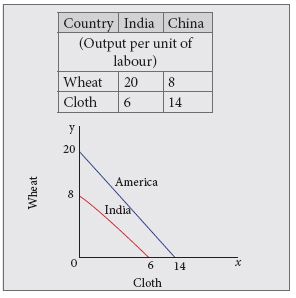
(iii) From the illustration, it is clear that India has an absolute advantage in the production of wheat over China and China has an absolute advantage in the production of cloth over India
(iv) Therefore, India should specialize in the production of wheat and import cloth from China. China should specialize in the production of cloth and import wheat from India
(v) This kind of trade would be mutually beneficial to both India and China.
3.
Introduction
(i) The early 1990s witnessed reforms in the economic policy. This helped to open up Indian markets to FDI
(ii) FDI in India has increased over the years
(iii) In India, FDI has been advantageous in terms of free flow of capital, improved technology, management expertise and access to international markets
The major sectors benefited from FDI in India are:
(i) financial sector (banking and nonbanking)
(ii) insurance
(iii) telecommunication
(iv) hospitality and tourism
(v) pharmaceuticals and
(vi) software and information technology
FDI is not permitted in the industrial sectors like
(i) Arms and ammunition
(ii) atomic energy,
(iii) railways,
(iv) coal and lignite and
(v) mining of iron, manganese, chrome, gypsum, sulphur, gold, diamonds, copper etc.,
Latest trend of FDI in India
i. FDI inflow in India has increased from $97 million in 1990-91 to $5,535 million in 2004-2005.
ii. It amounted to $32,955 million in 2011-2012.
iii. UNCTAD’s World Investment Report 2018 reveals that FDI to India declined to $40 billion in 2017 from $44 billion in 2016
4.
5.
Types of Exchange Rate:
(i) Nominal Exchange Rate
(ii) Real Exchange Rate
(iii) Nominal Effective Exchange Rate
(iv) Real Effective Exchange Rate If 1US Dollar = Rs.75
(i) Nominal Exchange Rate:
Nominal Exchange Rate =\(\cfrac { 75 }{ 1 } \)
This is the bilateral nominal exchange rate.
(ii) Real Exchange Rate:
(1) Real Exchange Rate = \(\cfrac { { eP }_{ r } }{ P } \)
P = Price level in India
PF = Price level in abroad (say US)
e = Nominal Exchange Rate
(2) If a pen costs Rs.50 in India and it costs 5 USD in the US.
\(\therefore \text {Real Exchange Rate}=\cfrac { 75\times 5 }{ 50 } =7.5\)
(3) If real exchange rate is equal to 1, the currencies are at purchasing power parity.
(4) If the price of the pen in US is 0:66 USD, then the real exchange rate
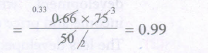
Then it could be said that the USD and Indian rupee are at purchasing power parity.

12th Standard Syllabus & Materials
12th Standard
TN 12th Computer Applications வலையமைப்பு வடமிடல் Sample Question Papers Study Material - QB365 Set A
NEW12th Standard
TN 12th Computer Applications களப்பெயர் முறைமை (DNS) Sample Question Papers Study Material - QB365 Set A
NEW12th Standard
TN 12th Computer Applications வலையமைப்பு எடுத்துக்காட்டுகள் மற்றும் நெறிமுறைகள் Sample Question Papers Study Material - QB365 Set A
NEW12th Standard
TN 12th Computer Applications கணினி வலையமைப்பு ஓர் அறிமுகம் Sample Question Papers Study Material - QB365 Set A



Tamilnadu Stateboard 12th Standard Subjects

Maths

Chemistry

Physics

Biology

Computer Science

Business Maths and Statistics
Economics

Commerce

Accountancy

History

Computer Applications
Biology
Computer Technology
Computer Applications
Computer Science
Business Maths and Statistics
Commerce
Economics
Maths
Chemistry
Physics
Computer Technology
History
Accountancy

Tamil

English

French
Tamilnadu Stateboard Standards



