
 100% FREE ACCESS
12th Standard Syllabus & Materials
12th Standard
TN 12th Computer Applications மின்னணு தரவு பரிமாற்றம் Sample Question Papers Study Material - QB365 Set A
NEW12th Standard
TN 12th Computer Applications மின் - வணிக பாதுகாப்பு அமைப்புகள் Sample Question Papers Study Material - QB365 Set A
NEW12th Standard
TN 12th Computer Applications மின்னணு செலுத்தல் முறைகள் Sample Question Papers Study Material - QB365 Set A
NEW12th Standard
TN 12th Computer Applications மின் - வணிகம் Sample Question Papers Study Material - QB365 Set A
NEW12th Standard
TN 12th Computer Applications திறந்த மூல கருத்துருக்கள் Sample Question Papers Study Material - QB365 Set A
NEW12th Standard
TN 12th Computer Applications வலையமைப்பு வடமிடல் Sample Question Papers Study Material - QB365 Set A

Published on: 23/06/2021
QB365 provides detailed and simple solution for every Creative Questions in class 12 Economics Subject. It will helps to get more idea about question pattern in every Creative questions with solution.
Download Tamil Nadu 12th Standard Economics question papers, model tests, one-mark questions, important questions, and public exam papers in PDF format. Free study materials and answer keys for TN State Board students.
Questions + Answers key
Take MCQ Economics Test1.
Explain the concepts of macro economics.
2.
Explain the four sector model of economy with chart.
3.
Explain the merits of Mixed Economy.
4.
Explain the Demerits of capitalism.
5.
Explain the merits of socialism.
1.
The important concepts used in macro economics are presented below:
(i) Stock and Flow Variables: Variables used in economic analysis are classified as stock and flow. Both stock and flow variables may increase or decrease with time.
(ii) Stock refers to a quantity of a commodity measured at a point of time. In macro economics, money supply, unemployment level, foreign exchange reserves, capital etc are examples of stock variables.
(iii) Flow variables are measured over a period of time. National Income, imports, exports, consumption, production, investment etc are examples of flow variables.
(iv) Economic Models: A model is a simplified representation of real situation. Economists use models to describe economic activities, their relationships and their behaviour. A model is an explanation of how the economy, or part of the economy, works. Most economic models are built with mathematics, graphs and equations, and attempt to explain relationships between economic variables. The commonly used economic models are the supply demand models and circular flow models and Smith models
2.
(i) In a four-sector economy, in addition households, firms and government, a fourth sector namely, external sector is included.
(ii) In the real life, only four-sector economy exists. This model is composed of four sectors namely,
1. Households
2. Firms
3. Government
4. External Sector
The external sector comprises exports and imports. It is illustrated in the Flow Chart
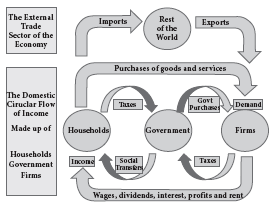
In four-sector economy, expenditure for the entire economy include domestic expenditure (C + I + G) and net exports (X - M). Therefore,
Y = C + I + G + (X - M)
3.
(a) Rapid Economic Growth:
(i) It promotes rapid economic growth.
(ii) Thus both public requirements and private needs are taken care of.
(b) Balanced Economic Growth:
(i) Mixedism promotes balanced growth of the economy.
(ii) It promotes balanced growth between agriculture and industry.
(c) Proper utilization of Resources:
(i) The government can ensure proper utilization of resources.
(ii) The government controls must of the important activities directly.
(d) Economic Equality:
(i) The government uses progressive rates of taxation.
(ii) Income tax to bring about economic equality.
4.
Demerits of Capitalism:
1. Concentration of Wealth and Income :
Capitalism causes concentration of wealth and income in a few hands and thereby increases inequalities of income.
2. Wastage of Resources Large amount of resources are wasted on competitive advertising and duplication of products.
3. Class Struggle: Capitalism leads to class struggle as it divides the society into capitalists and workers.
4. Business Cycle: Free market system leads to frequent violent economic fluctuations and crises.
5. Production of non essential goods: Even the harmful goods are produced if there is possibility to make profit.
5.
Merits of Socialism:
1. Reduction m Inequalities:
No one is allowed to own and use private property to exploit others.
2. Rational Allocation of Resources:
The central planning authority allocates the resources in a planned manner. Wastages are minimised and investments are made in a pre planned manner.
3. Absence of Class conflicts:
As inequalities are minimum, there is no conflict between rich and poor class. Society functions in a harmonious manner.
4. End of rade Cycles :
Planning authority takes control over production and distribution of goods and services. Therefore, economic fluctuations can be avoided.
5. Promotes Social Welfare:
Absence of exploitation, reduction in economic inequalities, avoidance of trade cycles and increase in productive efficiency help to promote social welfare.

12th Standard Syllabus & Materials
12th Standard
TN 12th Computer Applications களப்பெயர் முறைமை (DNS) Sample Question Papers Study Material - QB365 Set A
NEW12th Standard
TN 12th Computer Applications வலையமைப்பு எடுத்துக்காட்டுகள் மற்றும் நெறிமுறைகள் Sample Question Papers Study Material - QB365 Set A
NEW12th Standard
TN 12th Computer Applications கணினி வலையமைப்பு ஓர் அறிமுகம் Sample Question Papers Study Material - QB365 Set A
NEW12th Standard
TN 12th Computer Applications PHP-உடன் MySQL-ஐ இணைத்தல் Sample Question Papers Study Material - QB365 Set A



Tamilnadu Stateboard 12th Standard Subjects

Maths

Chemistry

Physics

Biology

Computer Science

Business Maths and Statistics
Economics

Commerce

Accountancy

History

Computer Applications
Biology
Computer Technology
Computer Applications
Computer Science
Business Maths and Statistics
Commerce
Economics
Maths
Chemistry
Physics
Computer Technology
History
Accountancy

Tamil

English

French
Tamilnadu Stateboard Standards



