
 100% FREE ACCESS
12th Standard Syllabus & Materials
12th Standard
TN 12th Computer Applications மின்னணு தரவு பரிமாற்றம் Sample Question Papers Study Material - QB365 Set A
NEW12th Standard
TN 12th Computer Applications மின் - வணிக பாதுகாப்பு அமைப்புகள் Sample Question Papers Study Material - QB365 Set A
NEW12th Standard
TN 12th Computer Applications மின்னணு செலுத்தல் முறைகள் Sample Question Papers Study Material - QB365 Set A
NEW12th Standard
TN 12th Computer Applications மின் - வணிகம் Sample Question Papers Study Material - QB365 Set A
NEW12th Standard
TN 12th Computer Applications திறந்த மூல கருத்துருக்கள் Sample Question Papers Study Material - QB365 Set A
NEW12th Standard
TN 12th Computer Applications வலையமைப்பு வடமிடல் Sample Question Papers Study Material - QB365 Set A

Published on: 01/03/2021
12th Standard English Medium Economics Syllabus Five Mark Important Questions with Answer key - 2021(Public Exam )
Download Tamil Nadu 12th Standard Economics question papers, model tests, one-mark questions, important questions, and public exam papers in PDF format. Free study materials and answer keys for TN State Board students.
Questions + Answers key
Take MCQ Economics Test
1.
Describe the application of Econometrics in Economics.
2.
Explain the importance of sustainable development and its goals.
3.
Briefly explain the relationship between GDP growth and the quality of environment.
4.
Explain the principles of Federal Finance.
5.
Explain the methods of debt redemption.
6.
Explain the scope of public finance.
7.
8.
Discuss the role of WTO in India’s socio-economic development.
9.
Explain the objectives of IMF.
10.
Explain the relationship between Foreign Direct Investment and Economic development.
11.
Bring out the components of balance of payments account.
12.
13.
Discuss the differences between Internal Trade and International Trade.
14.
What are the objectives of Monetary Policy? Explain.
15.
Explain the role of Commercial Banks in economic development.
16.
Describe the phases of Trade cycle.
17.
Illustrate Fisher’s Quantity theory of money.
18.
What are the differences between MEC and MEI.
19.
Explain the operation of the Accelerator.
20.
Illustrate the working of Multiplier.
21.
Explain Keynes psychological law of consumption function with diagram.
22.
Discuss the importance of social accounting in economic analysis.
23.
Explain the importance of national income
24.
Compare the features among Capitalism, Secularism and Mixedism
25.
1.
Econometrics is the statistical and mathematical analysis of economic relationships, often serving as a basis for economic forecasting. It is used by economists to study relationships between economic variables Econometrics is interesting because it provides the tools to enable us to extract useful information about important economic policy issues from the available data. It is used to understand economic issues and test theories. Without evidence economic theories are abstract and has no bearing on reality. Econometrics is a set of tools we can use to confront theory with real world data. A study' could estimate a key parameter such as the price elasticity of demand for it or econometric techniques could be used to generate forecasts. It is used to develop, estimate and evaluate models which relate economic or financial variables.
2.
Introduction:
(i) Sustainable development is concerned with the welfare of the present and future generation.
(ii) It aims at satisfying the luxury wants of the rich and the basic necessities of the poor.
Definition:
(i) Sustainable development is development that meets the needs of the present without compromising the ability of future generations to meet their own needs.
Goals:
(i) It is crucial to harmonize three core elements such as economic growth, social inclusion and environmental protection.
(ii) A set of 17 goals for the world's future can be achieved before 2030 with three unanimous principles fixed by United Nations such as Universality, Integration and Transformation.
1) End poverty in all its forms everywhere.
2) End hunger, achieve food security and improved nutrition and promote sustainable agriculture.
3) Ensure healthy lives and promote wellbeing for all at all ages.
4) Ensure inclusive and quality education for all and promote lifelong learning.
5) Achieve gender equality and empower women and girls.
6) Ensure access to water and sanitation for all.
7) Ensure access to affordable, reliable, sustainable and modern energy for all.
8) Promote inclusive and sustainable economic growth, employment and decent work for all.
9) Build resilient infrastructure, promote, sustainable industrialization and foster innovation.
10) Reduce inequality within and among countries.
11) Make cities inclusive, safe, resilient and sustainable.
12) Ensure sustainable consumption and production pattern.
13) Take urgent action to combat climate change and its impacts
14) Conserve and sustainably use the oceans, seas and marine resources.
15) Sustainably manage forests, combat desertification, stop and reverse land degradation, stop biodiversity loss.
16) Promote just, peaceful and inclusive societies.
17) Revitalize the global partnership for sustainable development.
3.
(i) Strong economic growth or high GDP growth leads to excessive use of resources.
(ii) Natural resources are essential inputs for production in many sectors;
(iii) Production and consumption lead to pollution and other pressures on the environments.
(iv) Poor environmental quality affects economic growth and well being by lowering the quantity and quality of resources or due to health impact.
(v) There is the need to balance growth and the sustainability of eco system.
(vi) So we have to ensure our sustainable existence, consume less and curb economic growth.
4.
Principle of Independence
(i) A Government should be autonomous and free about the internal financial matters concerned.
(ii) Each Government should have separate sources of revenue, authority to levy taxes, to borrow money and to meet the expenditure.
Principle of Equity
(i) The resources should be distributed among the different states so that each state receives a fair share of revenue.
Principle of Uniformity
(i) Each state should contribute equal tax payments for federal finance.
Principle of Adequacy of Resources
(i) The resources of each Government should be adequate to carry out its functions effectively to meet current and future needs.
(ii) Resources should be elastic to meet the growing needs and unforeseen expenditure.
Principle of Fiscal Access
(i) The Central and State Governments must be able to develop new source of revenue.
Principle of Integration and coordination
(i) There should be perfect coordination among different layers of the financial system.
Principle of Efficiency
(i) The financial system should be well organized and efficiently administered.
(ii) There should be no scope for evasion and fraud.
(iii) Double taxation should be avoided.
Principle of Administrative
Economy
(i) The cost of collection should be at the minimum level and the major portion of revenue should be made available for the other expenditure outlays of the Governments.
Principle of Accountability
(i) Each Government should be accountable to its own legislature for its financial decisions.
5.
Introduction:
(i) The process of repaying a public debt is called redemption.
Sinking Fund
(i) The Government establishes a separate fund into which every year a fixed amount of money is credited.
(ii) By the time the debt matures, the fund accumulates enough amount to pay off the principal along with interest.
Conversion
(i) An old loan is converted into a new loan.
(ii) A high interest public debt is converted into a low interest public debt.
Budgetary Surplus
(i) When the Government has a surplus budget, it can be used for repaying the debt.
Terminal Annuity
(i) Government pays off debt on the basis of terminal annuity in equal annual instalments.
Repudiation
(i) Government does not recognise its obligation to repay the loan.
(ii) But in normal case the Government does not do so; if done it will lose its credibility.
Reduction in Rate of Interest
(i) During financial crisis there is compulsory reduction in the rate of interest.
Capital Levy
(i) When Government imposes levy on the capital assets owned by an individual or any institution, it is called capital levy.
(ii) This levy is imposed on capital assets above a minimum limit on a progressive scale.
(iii) The fund so collected can be used by the Government for paying off war time debt.
6.
Public Finance
(i) Public finance is a study of the financial aspects of Government.
Public Revenue:
(i) Public revenue deals with the methods of raising revenue such as tax and non-tax, the principles of taxation, rates of taxation, impact, incidence and shifting of taxes and their effects.
Public Expenditure
(i) It studies the fundamental principles that govern the Government expenditure, effects of public expenditure and control of public expenditure.
Public Debt
(i) Public debt deals with the methods of raising loans from internal and external sources.
(ii) The burden, effects and redemption of public debt fall under this head.
Financial Administration
(i) This part deals with the Annual master financial plan of the Government, the budget, the various objectives, steps in preparing a public budget passing or sanctioning, allocation, evaluation and auditing.
Fiscal Policy
(i) Taxes, subsidies, public debt and public expenditure are the instruments of fiscal policy.
7.
8.
Introduction:
1. India is the founding member of the WTO.
2. India favours multilateral trade approach and enjoys MFN status.
3. India benefited from WTO on following grounds:
4. By reducing tariff rates on raw materials, components and capital goods, it was able to import more for meeting her developmental needs.
5. India's imports go on increasing.
6. India gets market access in several countries without any bilateral trade agreements.
7. Advanced technology has been obtained at cheaper cost.
8. India is in a better position to get quick redressal from the trade disputes.
9. Indian exporters benefited from wider market information.
9.
(i) To promote international monetary cooperation among the member nations.
(ii) To facilitate faster and balanced growth of international trade.
(iii) To ensure exchange rate stability by curbing competitive exchange depreciations.
(iv) To reduce exchange controls imposed by member nations.
(v) To establish multilateral trade and payment system in respect of current transactions.
(vi) To promote the flow of capital from developed to developing nations.
(vii) To solve the problem of international liquidity.
10.
1. FDI is an important factor in global
2. Foreign trade and FDI are closely related.
3. In developing countries like India FDI in tie natural resource sector like plantations, increases rade.
4. Foreign production by FDI is useful to substitute foreign trade.
5. FDI is also influenced by the income generated from the trade and regional integration schemes.
6. FDI accelerates the economic growth by facilitating essential imports needed for development programs like capital goods, technical know-how, raw materials, other inputs and even scarce consumer goods.
7. When the export earnings of a country are not sufficient to finance for imports, FDI may be required to fill the trade gap.
8. FDI is encouraged by foreign exchange shortage, desire to create employment and acceleration of the pace of economic development.
9. Many developing countries strongly prefer foreign investment to imports.
11.
Introduction
(i) The credit and debit items are shown vertically in the BoP account of a country.
(ii) Horizontally, they are divided into 3 components.
Current Account
(i) It includes all international trade transactions of goods and services, international service transactions (tourism, transportation, royalty fees) and international unilateral transfers (gifts, foreign aid).
Capital Account
(i) Financial transactions consisting of direct investment and purchases of interest bearing financial instruments, non interest bearing demand deposits and gold are included.
Official Reserve Assets Account
(i) Consist of movements of international reserves by governments and official agencies to accommodate imbalances arising from the current and capital accounts.
(ii) The official reserve assets include its gold stock, holdings of its convertible foreign currencies, SDR and its net position in the IMIF.
12.
13.
| S.No |
Internal Trade |
International Trade |
|---|---|---|
| 1 | Trade takes place between different individual and firms within the same nation. | Trade takes place between different individual and firms in different countries. |
| 2 | Labour and capital move freely from one region to another. | Labour and capital do not move easily from one nation to another. |
| 3 | Free flow of goods and services since there are no restrictions. | Goods and services do not easily move from one country to another because of tariff and quota. |
| 4 | There is only one common currency. | There are different currencies. |
| 5 | Physical and geographical conditions of a country are similar. | There are differences in physical and geographical conditions of the two countries. |
| 6 | Trade and financial regulations are same. | Trade and financial regulations, interest rate, trade laws differ between countries. |
| 7 | No difference in political affiliations, customs and habits of the people and government policies. | There are lot of differences in political affiliation, habits, customs of the people and government policies. |
14.
Introduction
(i) Monetary Policy is the macroeconomic policy laid down by the Central Bank towards the management of money, supply and interest rate. It is associated with Milton Friedman
1) Neutrality of Money
(i) Wicksteed, Hayek and Robertson are the chief exponents of neutral money.
(ii) They say that the monetary authority should aim at neutrality of money in the economy.
(iii) Monetary changes cause distortion and disturbances in the proper functioning of the economic system of the leading to all economic fluctuations.
2) Exchange Rate Stability
(i) It is a traditional objective from the Gold Standard period
(ii) When there was disequilibrium in the balance of payment, it was automatically corrected by movements.
(iii) It was popularly known as "Expand Currency and Credit when gold is coming in; Contract currency and credit when gold is going out."
(iv) If there is instability in the exchange rates, it would result in outflow or inflow of gold resulting in unfavorable balance of payments.
3) Price Stability
(i) Crustave Cassel and Keynes suggested price stabilization as a main objective of monetary policy.
(ii) Stable Price creates public confidence, promotes business activity and ensures equitable distribution of income and wealth leading to prosperity and welfare
(iii) Price stability does not mean price rigidity or price stagnation.
(iv) A mild increase in the price level provides a tonic for economic growth.
4) Full Employment
(i) Unemployment was socially dangerous, economically wasteful and morally deplorable.
(ii) Both Keynes' General Theory of Employment, Interest and Money in 1936, the objective of full employment became very important
5) Economic Growth
(i) Economic growth is the process whereby the real per capita income of a country increases
(ii) There is increase in the total physical or real output
(iii) Monetary policy should promote sustained and continuous economic growth by maintaining equilibrium between the total demand for money and total production capacity for creating increase in saving and investment.
(iv) Flexible monetary policy is the best solution.
6) Equilibrium in the Balance of Payments (BoP)
(i) World trade was faster than world liquidity.
(ii) Increasing deficit in BoP reduces the ability of an economy to achieve other objectives.
(iii) Many less developed countries reduce their imports which adversely affects development activities, so monetary authority should make efforts to bring equilibrium in the BoP.
15.
Introduction
(i) Commercial banks are institutions that conduct business with profit motive by accepting public deposits and lending loans.
Capital Formation
(i) Bank mobilize the small savings of the people scattered over a wide area through their network of branches and make it available for productive purposes.
(ii) Attractive schemes of the banks induce the people to save their money
Creation of Credit
(i) Credit creation leads to increased production, employment, sales and prices and thereby there is faster economic development.
Channelizing Funds towards Productive Investment
(i) Pooled savings is allocated to various sectors and productivity increases.
Encouraging Right Industries
(i) Banks give loan to right type of persons.
(ii) Banks grant loans and advances to manufacturers whose products are in great demand.
(iii) Manufacturers introduce new methods of production and assist in raising the national income of the country.
Banks Monetize Debt
(i) Banks transform the loan to be repaid after a certain period into cash, which can be immediately used for business activity.
(ii) Manufacturers and wholesale traders cannot increase their sales without selling goods on credit basis.
(iii) But credit sales may lead to locking up of capital.
(iv) So production is reduced.
(v) As banks are lending money by discounting bills of exchange, business concerns are able to carry out economic activities without gap.
Finance to Government
(i) Government needs finance for promoting industries.
(ii) Banks provide long-term credit to Government by investing their funds in Government securities and short-term finance by purchasing Treasury Bills.
(iii) RBI has given Rs.68,000 crores to the government of India in the year 2018-19.
Employment Generation
(i) Bank's branches are opened frequently and so new employment opportunities are created.
Banks Promote Entrepreneurship
(i) Banks induce new entrepreneurs to take up the well-formulated projects and provision of counseling services like technical and managerial guidance.
(ii) Conclusions Banks provide 100 % credit for worthwhile projects, which is also technically feasible and economically viable.
(iii) Thus commercial banks help for the development of entrepreneurship in the country.
16.
Boom or Prosperity:
1. The employment and the movement of the economy beyond full employment is the characterized features of boom.
2. There is hectic activity, money wages rise, profits increase, interest rates go up, demand for bank credit increases.
3. There is all round optimism.
Recession:
1. The turning point from boom condition is recession.
2. Failure of a company or bank brings a phase of recession.
3. Investments are drastically reduced, production falls, income and profits decline.
4. There is panic in the stock market and business is dull.
5. Liquidity preference of the people rises and money market becomes tight.
Depression:
1. The level of economic activity becomes extremely low.
2. Firms incur loss and close down resulting in unemployment.
3. Interest rate, profits, wages are low.
4. Agricultural class and wage carners are badly affected.
5. Banks do not lend to businessmen.
6. The extreme point of depression is called as "trough".
7. Keynes said that autonomous investment of the government can help the economy to come out of depression.
Recovery:
1. After depression, recovery sets in the upswing.
2. It begins with the revival of demand for capital goods.
3. The demand slowly picks up and in due course there is more production, profit, income, wages and employment.
4. Recovery may be initiated by innovation or investment or by government.
17.
Introduction:
(i) It was first propounded in 1588 by an Italian economist Davanzatti. It was popularised by an Americill economist, Irving Fisher is his book, "The Purchasing Power of Money" in 1911. He gave it a quantitative form in terms of "Equation of Exchange".
Equations:
MV = PT
(i) The Supply of Money = Demand for Money
M = Money Supply
V = Velocity of Money
P = Price level
T = Volume of Transaction.
(ii) The total quantity of money will be equal to the total value of all goods and services bought and sold.
\(P=\frac{M V}{T}\)
(iii) The quantity of money determines the price level and the price level varies directly with the quantity of money provided 'V' and 'T' remain constant.
(iv) Later Fisher extended his exchange to include bank deposits M1 and its velocity V1.
\(P T =M V+M^{\prime} V^{\prime} \)
\(P =\frac{M V+M^{\prime} V^{\prime}}{T}\)
- The price level is determined by
(a) quantity of money in circulation M
(b) velocity of circulation of money V
(c) volume of bank credit money M1
(d) velocity of circulation of credit money V1
(c) Volume of trade ('T')
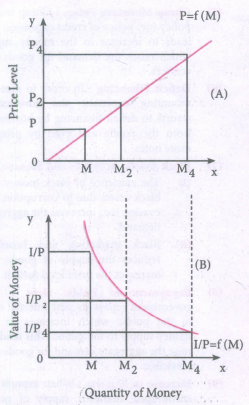
(i) It show's the effect of changes in the quantity of money on the price level.
(ii) When quantity of money is OM1, the price level is OP1.
(iii) When the quantity of money is doubled to OM2, the price level is also doubled to OP2.
(iv) When quantity of money is increased four-fold to OM4, the price level also increases by 4 times to OP4 his relationship is shown by the curve OP = f(M) from the origin at 45o.
Quantity of money
(i) Fig B shows the inverse relation between the quantity of money and the value of money.
(ii) Value of money is taken on the vertical axis.
(iii) When the quantity of money is OM1, the value of money is OI / P1.
(iv) When quantity of money is doubled to OM2, the value of money becomes one half of what it was before (OI / P2)
(v) When quantity of money increases by the four fold to OM4, the value of among is reduced by OI / P4
(vi) This inverse relationship between the quantity of money and the value of money is shown by downward sloping curve 1 / OP= f(M).
18.
| S. No | Marginal Efficiency of Captial (MEC) | Marginal Efficiency of Investment (MEI) |
|---|---|---|
| 1. | It is based on given supply price for capital. | It is based on the induced change in the price due to change in the demand for capital. |
| 2. | It represents the rate of return on all successive unit of capital without regard to existing capital. | It shows the rate of return on just those units of capital over and above the existing capital stock |
| 3. | The capital stock is taken on the X axis of diagram. | The amount of investment is taken on the X axis of diagram. |
| 4. | It is a 'Stock' concept. | It is a 'Flow' concept. |
| 5. | It determines the optimum capital stock in an economy at each level of interest rate. | It determines the net investment of the economy at each interest rate given the capital stock. |
19.
Introduction
A systematic development of the simple accelerator model was made by J.M.Clark, It was further developed by Hicks, Samuelson and Harrod.
Definition
Accelerator coefficient is the ratio between induced investment and an initial change in consumption \(\beta=\frac{\Delta \mathrm{I}}{\Delta \mathrm{C}}\)
Operation
Suppose that in order to produce 1000 consumer goods, 100 machines are needed. Working life of a machine is 10 yrs i.e, every year 10 machines have to be replaced. This is called replacement demand
(i) Suppose that demand for consumer goods rises by 10 % (i.e, from 1000 to 1100)
(ii) This results in increase in demand for 10 more machines
(iii) The total demand for machines is 20 i.e, 10 % increase in demand for consumer goods causes 100 % increase in demand for machine (from 10 to 20 )
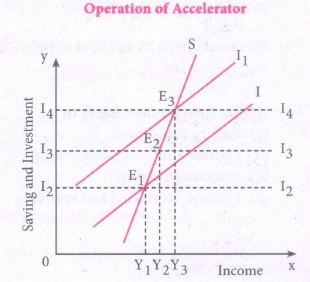
Explanation
(i) SS is the saving curve.
(ii) II is the investment curve.
(iii) At point E1 the economy is in equilibrium with OY1 income.
(iv) S and I are equal at O2.
(v) Now I increased from OI2 to OI4.
(vi) This increases income from OY1 to OY3 at E2 equilibrium.
(vii) If the increase in investment by I2I4 is purely exogenous, then the increase in income by Y1Y3 would be due to multiplier.
(viii) But in this diagram it is assumed that exogenous investment is only by I2I3 and induced investment is by I3I4.
(ix) Therefore, the increase in income by Y1Y2 is due to the multiplier effect and the increase in income by Y2Y3 is due to the accelerator effect.
20.
Introduction
The concept of multiplier Was first developed by R.F. Khan in terms of employment. J.M Keynes redefined it as investment multiplier.
Definition
Multiplier is defined as the ratio of the change in national income to change in investment.
\(K=\Delta Y / \Delta I\)
The value of multiplier depends on MPC.
\(\mathrm{K}=\frac{1}{1-\mathrm{MPC}} \text { since } \mathrm{MPC}+\mathrm{MPS}=1\)
\(k=\frac{1}{N 118}\)
Multiplier is inversely related to MPS and directly with MPC.
If MPC is, 0.75, MPS is 0.25 then K=4.00
\(\frac{1}{1-0.75} \text { or } \frac{1}{0.25}=4\)
| MPC | MPS | k |
| 0.00 | 1.00 | 1 |
| 0.10 | 0.90 | 1.11 |
| 0.50 | 0.50 | 2.00 |
| 0.75 | 0.25 | 4.00 |
Working
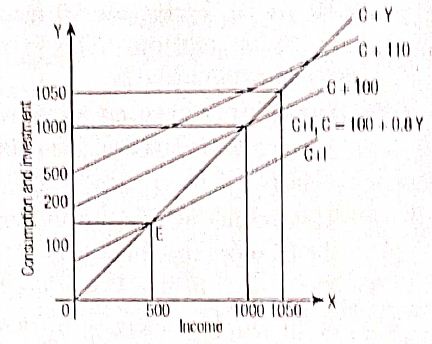
(i) Suppose government undertakes investment expenditure equal to र100 cr on public works.
(ii) Income of labourers and suppliers of materials increases by र100 cr
(iii) If MPC is 0.8 that is 80 %. र80 cr is spent on consumption र20 cr salved
(iv) Suppliers of goods get an income of र80 cr. They spend र64 cr (ie 80% of र80 cr).
(v) In this manner consumption expenditure and increase in income act in a chain like manner.
21.
Law
According to Keynes, "men are disposed as a rule and on the average to increase their consumption as their income increases but not by as much as the increáse in their income".
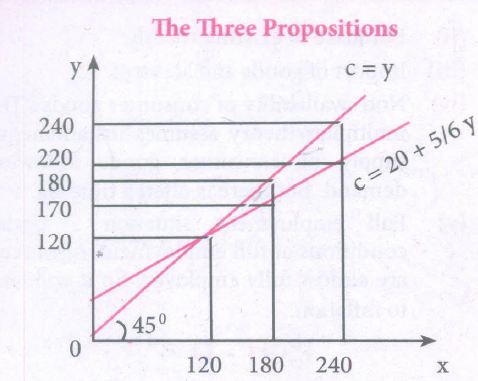
Propositions
1. When income increases, consumption expenditure also increases, but by a smaller amount
(a) When income increases from 120 to 180; consumption also increases from 120 to 170 but the increase in consumption is less than the increase in income, 10 is saved.
2. The increased income will be divided in some proportion between consumption expenditure and saving
(a) When income increases to 180 and 240, it is divided between consumption (170 and 220) and saving (10 and 20)
3. Incrcascs in income always lead to in incrcase in both consumption and saving
(a) Increases in income to 180) and 240; lead to increased consumption 170 and 220; increased saving 10 and 20.
(b) It is clear from the widening area below the C curve and the saving gap between 45o line and C curve.
| Y | C | S |
|---|---|---|
| 120 | 120 | 0 |
| 180 | 170 | 10 |
| 240 | 220 | 20 |
22.
Introduction:
National income can be measured by the social accounting method. Under this method, the transactions among various sectors such as firms, households, government are recorded and their interrelationships traced.
Firms:
undertake productive activities. They employ factors of production to produce goods and services.
Households:
Households are consuming entities. They represent the factors of production, who receive payment for services rendered by them to firms. (i) Households consume the goods produced by the firms. There is a circular flow of money between these two groups.
Government:
The Government sector refers to the economic transactions of public bodies at all levels-centre, state and local. Their purchases may be financed through taxation, public borrowings. The government provides public health, education. They satisfy the collective wants of society. But Post Offices and railways are separated from the Government sector and included as "Firms".
Rest of the world:
It relates to international economic transactions - income, export, import external loan transaction, and allied overseas investment income and payments.
Capital sector:
(i) Capital sector refers to saving and investment activities. It includes the transactions of banks, insurance corporations, financial houses. These are not included under "Firms".
(ii) The economy is also divided into primary, secondary tertiary and quaternary sectors.
Conclusion:
The social accounting framework is useful for economists as well as policy makers, because it represents the major economic flows and statistical relationships among various sectors of the economic system. It is possible to forecast the trends of economy more accurately.
23.
(i) National income is of great importance for the economy of a country.
(ii) National income helps us to know the relative importance and contribution of each sector. We could find how income is produced, how it is distributed, how much is spent, saved or taxed.
(iii) National income data is used to formulate monetary policy, fiscal policy and other policies.
(iv) Data regarding gross income, output, saving and consumption is uscd in economic planning.
(v) National income data is used to build economic models in short run and long run.
(vi) It is used to make international comparison, inter regional comparison and inter temporal comparison of growth of the economy during different periods.
(vii) If income is equally distributed, the per capita income will reflect the economic welfare of the country.
24.
| S.No | Features | Capitalism | Socialism | Mixedism |
|---|---|---|---|---|
| 1. | Ownership of Means of Production | Private Ownership | Public Ownership | Private Ownership and Public Ownership |
| 2. | Economic Motive | Profit | Social Welfare | Social Welfare and Profit Motive |
| 3. | Solution of Central Problems | Free Market System | Central Planning System | Central Planning System and Free Market System |
| 4. | Government Role | Internal Regulation only | Complete Involvement | Limited Role |
| 5. | Income Distribution | Unequal | Equal | Less unequal |
| 6. | Nature of Enterprise | Private Enterprise | Government Enterprise | Both Private and State Enterprises |
| 7. | Economic Freedom | Complete Freedom | Lack of Freedom | Limited Freedom |
| 8 | Major Problem | Inequally | Inefficiency | Inequality and Inefficiency |
25.

12th Standard Syllabus & Materials
12th Standard
TN 12th Computer Applications களப்பெயர் முறைமை (DNS) Sample Question Papers Study Material - QB365 Set A
NEW12th Standard
TN 12th Computer Applications வலையமைப்பு எடுத்துக்காட்டுகள் மற்றும் நெறிமுறைகள் Sample Question Papers Study Material - QB365 Set A
NEW12th Standard
TN 12th Computer Applications கணினி வலையமைப்பு ஓர் அறிமுகம் Sample Question Papers Study Material - QB365 Set A
NEW12th Standard
TN 12th Computer Applications PHP-உடன் MySQL-ஐ இணைத்தல் Sample Question Papers Study Material - QB365 Set A



Tamilnadu Stateboard 12th Standard Subjects

Maths

Chemistry

Physics

Biology

Computer Science

Business Maths and Statistics
Economics

Commerce

Accountancy

History

Computer Applications
Biology
Computer Technology
Computer Applications
Computer Science
Business Maths and Statistics
Commerce
Economics
Maths
Chemistry
Physics
Computer Technology
History
Accountancy

Tamil

English

French
Tamilnadu Stateboard Standards
