
 100% FREE ACCESS
12th Standard Syllabus & Materials
12th Standard
TN 12th Computer Applications மின்னணு தரவு பரிமாற்றம் Sample Question Papers Study Material - QB365 Set A
NEW12th Standard
TN 12th Computer Applications மின் - வணிக பாதுகாப்பு அமைப்புகள் Sample Question Papers Study Material - QB365 Set A
NEW12th Standard
TN 12th Computer Applications மின்னணு செலுத்தல் முறைகள் Sample Question Papers Study Material - QB365 Set A
NEW12th Standard
TN 12th Computer Applications மின் - வணிகம் Sample Question Papers Study Material - QB365 Set A
NEW12th Standard
TN 12th Computer Applications திறந்த மூல கருத்துருக்கள் Sample Question Papers Study Material - QB365 Set A
NEW12th Standard
TN 12th Computer Applications வலையமைப்பு வடமிடல் Sample Question Papers Study Material - QB365 Set A

Published on: 27/02/2021
12th Standard English Medium Maths Reduced Syllabus Annual Exam Model Question Paper - 2021
Download Tamil Nadu 12th Standard Maths question papers, model tests, one-mark questions, important questions, and public exam papers in PDF format. Free study materials and answer keys for TN State Board students.
Questions + Answers key
Take MCQ Maths Test1.
Solve :\(x\frac { dy }{ dx } sin\left( \frac { y }{ x } \right) +x-ysin\left( y\frac { y }{ x } \right) =,y(1)=\frac { \pi }{ 2 } \)
2.
Solve :x2dy+y(x+y)dx=0 given that y=1 when x=1.
3.
Find the area bounded by the curve y=xex and y=xe-x and the line x=1.
4.
Find the area bounded by x=at2,y=2at between the ordinates corresponding to t = 1 and t = 2.
5.
A manufacturer can sell x items at a price of rupees \(\left( 5-\frac { x }{ 100 } \right) \) each. The cost price of x items is Rs.\(\left( \frac { x }{ 5 } +500 \right) \) .Find the numbers of items he should sell to earn maximum profit.
6.
Solve: \(\frac { dy }{ dx } \) = (3x+2y+1)2
7.
The slope of the tangent at p(x,y) on the curve is -\(\left( \frac { y+3 }{ x+2 } \right) \). If the curve passes through the origin, find the equation of the curve.
8.
Show that the area under the curve y = sin x and y = sin 2x between x = 0 and x = \(\frac { \pi }{ 3 } \) and x axis are as 2:3
9.
If \(\left| \overset { \rightarrow }{ A } \right| =\overset { \wedge }{ i } +\overset { \wedge }{ j } +\overset { \wedge }{ k } \) and \(\overset { \wedge }{ i } =\overset { \wedge }{ j } -\overset { \wedge }{ k } \) are two given vector, then find a vector B satisfying the equations \(\overset { \rightarrow }{ A } \times \overset { \rightarrow }{ B } \)= \(\overset { \rightarrow }{ C } \) and \(\overset { \rightarrow }{ A } \).\(\overset { \rightarrow }{ B } \) = 3
10.
If A = \(\left[ \begin{matrix} 0 & 1 & 1 \\ 1 & 0 & 1 \\ 1 & 1 & 0 \end{matrix} \right] \), show that A-1 = \(\frac {1}{2}\) (A2 - 3I).
11.
Find the domain of f(x) = sin-1 \((\frac{|x|-2}{3})+ \) cos-1 \((\frac{1-|x|}{4})\)
12.
If p and q are the roots of the equation I x2+ nx + n = 0, show that \(\sqrt{\frac{p}{q}}+\sqrt{\frac{q}{p}}+\sqrt{\frac{n}{i}}\) = 0
13.
Find the domain of
g(x) = sin−1x + cos−1x
14.
Find the adjoint of the following:
\(\left[ \begin{matrix} 2 & 3 & 1 \\ 3 & 4 & 1 \\ 3 & 7 & 2 \end{matrix} \right] \)
15.
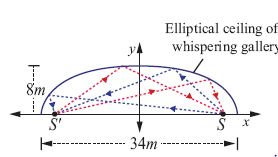
A room 34m long is constructed to be a whispering gallery. The room has an elliptical ceiling, as shown in Figure. If the maximum height of the ceiling is 8 m, determine where the foci are located.
16.
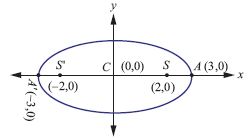
Find the equation of the ellipse with foci (±2, 0), vertices (±3, 0)
17.
If A = \(\left[ \begin{matrix} 3 & 2 \\ 7 & 5 \end{matrix} \right] \) and B = \(\left[ \begin{matrix} -1 & -3 \\ 5 & 2 \end{matrix} \right] \), verify that (AB)-1 = B-1A-1
18.
The complex numbers u, v, and w are related by \(\frac { 1 }{ u } =\frac { 1 }{ v } +\frac { 1 }{ w } \) If v = 3−4i and w = 4+3i, find u in rectangular form.
19.
| p | q | (p ∧ q) ⟶ ¬q |
| T | T | (a) |
| T | F | (b) |
| F | T | (c) |
| F | F | (d) |
Which one of the following is correct for the truth value of (p ∧ q)⟶ ¬p?
| (a) | (b) | (c) | (d) |
| T | T | T | T |
| (a) | (b) | (c) | (d) |
| F | T | T | T |
| (a) | (b) | (c) | (d) |
| F | F | T | T |
| (a) | (b) | (c) | (d) |
| T | T | T | F |
20.
If \(\frac{\Gamma(n+2)}{\Gamma(n)}=90\) then n is
10
5
8
9
21.
The approximate change in the volume V of a cube of side x metres caused by increasing the side by 1% is
0.3xdx m3
0.03x m3
0.03x2 m3
0.03x3 m3
22.
The change in the surface area S = 6x2 of a cube when the edge length varies from xo to xo+ dx is
12 xo+dx
12xo dx
6xo dx
6xo+ dx
23.
If we measure the side of a cube to be 4 cm with an error of 0.1 cm, then the error in our calculation of the volume is
0.4 cu.cm
0.45 cu.cm
2 cu.cm
4.8 cu.cm
24.
Let X have a Bernoulli distribution with mean 0.4, then the variance of (2X - 3) is
0.24
0.48
0.6
0.96
25.
26.
The order and degree of the differential equation \(\frac { { d }^{ 2 }y }{ { dx }^{ 2 } } +{ \left( \frac { dy }{ dx } \right) }^{ 1/3 }+{ x }^{ 1/4 }=0\) are respectively
2, 3
3, 3
2, 6
2, 4
27.
The minimum value of the function |3 - x| + 9 is
0
3
6
9
28.
The number given by the Mean value theorem for the function \(\frac { 1 }{ x } \), x ∈ [1, 9] is
2
2.5
3
3.5
29.
A balloon rises straight up at 10 m/s. An observer is 40 m away from the spot where the balloon left the ground. The rate of change of the balloon's angle of elevation in radian per second when the balloon is 30 metres above the ground.
\(\frac{3}{25} \text { radians } / \mathrm{sec}\)
\(\frac{4}{25} \text { radians } / \mathrm{sec}\)
\(\frac{1}{5} \text { radians } / \mathrm{sec}\)
\(\frac{1}{3} \text { radians } / \mathrm{sec}\)
30.
If AT is the transpose of a square matrix A, then ___________
|A| ≠ |AT|
|A| = |AT|
|A| + |AT| =0
|A| = |AT| only
31.
If A, B and C are invertible matrices of some order, then which one of the following is not true?
adj A = |A|A-1
adj(AB) = (adj A)(adj B)
det A-1 = (det A)-1
(ABC)-1 = C-1B-1A-1
32.
If A = \(\left[ \begin{matrix} 7 & 3 \\ 4 & 2 \end{matrix} \right] \), then 9I2 - A =
A-1
\(\frac { { A }^{ -1 } }{ 2 } \)
3A-1
2A-1
33.
If \(\vec { a } \times (\vec { b } \times \vec { c } )=(\vec { a } \times \vec { b } )\times \vec { c } \) where \(\vec { a } ,\vec { b } ,\vec { c } \) are any three vectors such that \(\vec{b} \cdot \vec{c} \neq 0 \text { and } \vec{a} \cdot \vec{b} \neq 0\), then \(\vec { a } \) and \(\vec { c } \) are
perpendicular
parallel
inclined at an angle \(\frac{\pi}{3}\)
inclined at an angle \(\frac{\pi}{6}\)
34.
35.
36.
If \(\omega \neq 1\) is a cubic root of unity and \(\left| \begin{matrix} 1 & 1 & 1 \\ 1 & { -\omega }^{ 2 }-1 & { \omega }^{ 2 } \\ 1 & { \omega }^{ 2 } & { \omega }^{ 7 } \end{matrix} \right| \) = 3k, then k is equal to
1
-1
\(\sqrt { 3i } \)
\(-\sqrt { 3i } \)
37.
38.
If \(z=\cfrac { \left( \sqrt { 3 } +i \right) ^{ 3 }\left( 3i+4 \right) ^{ 2 } }{ \left( 8+6i \right) ^{ 2 } } \) , then |z| is equal to
0
1
2
3
39.
solve: x dy + y dx = xy dx
40.
Solve : \(\frac { dy }{ dx } =\frac { { e }^{ x }-{ e }^{ -x } }{ { e }^{ x }+{ e }^{ -x } } \)
41.
Find the volume of the solid y=x3,x=0,y=1 is revolved about the y-axis.
42.
If \(w={ e }^{ { x }^{ 2 }+{ y }^{ 2 } }\) ,x=cosθ,y=sinθ, find \(\frac { dw }{ d\theta } \)
43.
If w=exy,x=at2,y=2at, find \(\frac { dw }{ dt } \)
44.
Find the point on the parabola y2=18x at which the ordinate increases at twice the rate of the abscissa.
45.
If of f(x, y) = x2 + y3 + 2xy2 find fxx, fyy, fxy and fyx.
46.
Use differentials to find \(\sqrt{25.2}\)
47.
Find the intervals of increasing and decreasing function for f(x) = x3 + 2x2 - 1.
48.
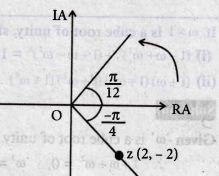
If z = 2−2i, find the rotation of z by θ radians in the counter clockwise direction about the origin when \(\theta =\frac { \pi }{ 3 } \).
1.
\(log|x|=cos\left( \frac { y }{ x } \right) ,x\neq 0\)
2.
\(y=\frac { 2x }{ { 2x }^{ 2-1 } } ,x\neq \pm \frac { 1 }{ \sqrt { 2 } } \)
3.
\(\frac { 2 }{ e } \)
4.
\(\frac { { 56a }^{ 2 } }{ 3 } \)
5.
240
6.
Given \(\frac { dy }{ dx } \) =(3x+2y+1)2
Let z =3x+2y+1
\(\frac { dz }{ dx } =3+2\frac { dy }{ dx } \)
⇒ \(\frac { dz }{ dx } -3=2\frac { dy }{ dx } \)
⇒ \(\frac { dy }{ dx } =\frac { 1 }{ 2 } \left( \frac { dz }{ dx } -3 \right) \)
(1) becomes,
\(\frac { 1 }{ 2 } \left( \frac { dz }{ dx } -3 \right) \) =z2
⇒ \(\frac { dz }{ dx } \)-3 =2z2
⇒ \(\frac { dz }{ dx } \)=2x2+3
⇒ \(\frac { dz }{ 2{ z }^{ 2 }+3 } \) =dx
⇒ \(\frac { 1 }{ 2 } \int { \frac { dz }{ { z }^{ 2 }+\frac { 3 }{ 2 } } } =\int { dx } \)
⇒ \(\frac { 1 }{ 2 } \int { \frac { dz }{ { z }^{ 2 }+\left( \sqrt { \frac { 3 }{ 2 } } \right) ^{ 2 } } } \) =x+c
⇒ \(\frac { 1 }{ 2 } .\frac { 1 }{ \frac { \sqrt { 3 } }{ \sqrt { 2 } } } tan^{ -1 }\left( \frac { 1 }{ \frac { \sqrt { 3 } }{ \sqrt { 2 } } } \right) \) =x+c
⇒ \(\frac { 1 }{ \sqrt { 6 } } tan^{ -1 }\left( \frac { \sqrt { 2 } }{ \sqrt { 3 } } \right) \)= x+c
⇒ \(tan^{ -1 }\left( \frac { \sqrt { 2 } }{ \sqrt { 3 } } \right) =\sqrt { 6 } \) x+c
⇒ \(\frac { \sqrt { 2 } }{ \sqrt { 3 } } .z=tan(\sqrt { 6 } x+c)\)
⇒ \(\frac { \sqrt { 2 } }{ \sqrt { 3 } } (3x+2y+1)=tan(\sqrt { 6 } x+c)\).
7.
Given \(\frac { dy }{ dx } =-\left( \frac { y+3 }{ x+2 } \right) \)
⇒ \(\frac { dy }{ y+3 } =-\frac { dx }{ x+2 } \)
⇒ \(\int { \frac { dy }{ y+3 } } =-\int { \frac { dx }{ x+2 } } \)
⇒ log(y + 3) = -log (x + 2) + log c
⇒ log(y + 3) + log (x + 2) = log c
⇒ log(x + 2) (y + 3) = log c
⇒ (x+2)(y+3) = c ..(1)
Since the curve passes through (0, 0)
(0 + 2)(0 + 3) = c ⇒ c = 6
(1) becomes,
(x + 2)(y + 3) = 6
⇒ xy + 3x + 2y + 6 = 6
⇒ xy + 3x + 2y = 0
8.
Area under the curve y = sin x between x = 0 and x = \(\frac { \pi }{ 3 } \) is
\({ A }_{ 1 }=\int _{ 0 }^{ \frac { \pi }{ 3 } }{ ydx } =\int _{ 0 }^{ \frac { \pi }{ 3 } }{ sinxdx } =-{ \left[ cosx \right] }_{ 0 }^{ \frac { \pi }{ 3 } }\)
\(=-(cos\frac { \pi }{ 3 } -cos0)=-\left( \frac { 1 }{ 2 } -1 \right) \)
\(=-\left( -\frac { 1 }{ 2 } \right) =\frac { 1 }{ 2 } \)
Area under the curve y = sin 2x between x = 0 and \(\frac { \pi }{ 3 } \) is
\({ A }_{ 2 }=\int _{ 0 }^{ \frac { \pi }{ 3 } }{ { sin2 \ x \ dx=-\left[ \frac { cos2 \ x }{ 2 } \right] }_{ 0 }^{ \frac { \pi }{ 3 } } } \)
\(=-\frac { 1 }{ 2 } [cos2\frac { \pi }{ 3 } -cos0]-\frac { 1 }{ 2 } \left[ -\frac { 1 }{ 2 } -1 \right] =-\frac { 1 }{ 2 } \left( -\frac { 3 }{ 2 } \right) =\frac { 3 }{ 4 } \)
\(\therefore \frac { { A }_{ 1 } }{ { A }_{ 2 } } =\frac { \frac { 1 }{ 2 } }{ \frac { 3 }{ 4 } } =\frac { 1 }{ 2 } \times \frac { 4 }{ 3 } =\frac { 2 }{ 3 } \)
∴ A1:A2 =2 : 3
9.
Let \(\overset { \rightarrow }{ B } =x\overset { \wedge }{ i } +y\overset { \wedge }{ j } +z\overset { \wedge }{ k } \)
Given \(\overset { \rightarrow }{ A } \times \overset { \rightarrow }{ B } =\overset { \rightarrow }{ C } \Rightarrow \left| \begin{matrix} \overset { \wedge }{ i } \\ 1 \\ x \end{matrix}\begin{matrix} \overset { \wedge }{ j } \\ 1 \\ y \end{matrix}\begin{matrix} \overset { \wedge }{ k } \\ 1 \\ z \end{matrix} \right| =\overset { \wedge }{ j } -\overset { \wedge }{ k } \)
\(\Rightarrow \overset { \wedge }{ i } (z-y)-\overset { \wedge }{ j } (z-x)+\overset { \wedge }{ k } (y-x)\quad \overset { \wedge }{ j } -\overset { \wedge }{ k } \)
Equating the like components on both sides, we get
z - y = 0 .....(1)
x - y = 1 .....(2)
y - x = -1 .....(3)
Also, \(\overset { \rightarrow }{ A } .\overset { \rightarrow }{ B } =3\Rightarrow \left( \overset { \wedge }{ i } +\overset { \wedge }{ j } +\overset { \wedge }{ k } \right) .\left( x\overset { \wedge }{ i } +y\overset { \wedge }{ j } +z\overset { \wedge }{ k } \right) =3\)
⇒ x + y + z = 3 ....(4)
Solving (1), (2), (3) and (4), we get \(x=\frac { 5 }{ 3 } ,y=\frac { 2 }{ 3 } \)and \(z=\frac { 2 }{ 3 } \)
\(\therefore \overset { \rightarrow }{ B } =\frac { 5 }{ 3 } \overset { \wedge }{ i } +\frac { 2 }{ 3 } \overset { \wedge }{ j } +\frac { 2 }{ 3 } \overset { \wedge }{ k } \)
10.
Given A =\(\left[ \begin{matrix} 0 & 1 & 1 \\ 1 & 0 & 1 \\ 1 & 1 & 0 \end{matrix} \right] \)
|A| = 0-1\(\left| \begin{matrix} 1 & 1 \\ 1 & 0 \end{matrix} \right| +1\left| \begin{matrix} 1 & 0 \\ 1 & 1 \end{matrix} \right| \)
= -1(0-1) + 1(1-0) = 1 + 1 = 2
adj A =\(\left[ \begin{matrix} +\left| \begin{matrix} 0 & 1 \\ 1 & 0 \end{matrix} \right| & -\left| \begin{matrix} 1 & 1 \\ 1 & 0 \end{matrix} \right| & +\left| \begin{matrix} 1 & 0 \\ 1 & 1 \end{matrix} \right| \\ -\left| \begin{matrix} 1 & 1 \\ 1 & 0 \end{matrix} \right| & +\left| \begin{matrix} 0 & 1 \\ 1 & 0 \end{matrix} \right| & -\left| \begin{matrix} 0 & 1 \\ 1 & 1 \end{matrix} \right| \\ +\left| \begin{matrix} 1 & 1 \\ 0 & 1 \end{matrix} \right| & -\left| \begin{matrix} 0 & 1 \\ 1 & 1 \end{matrix} \right| & +\left| \begin{matrix} 0 & 1 \\ 1 & 0 \end{matrix} \right| \end{matrix} \right] ^{ T }\)
=\(\left[ \begin{matrix} (0-1) & -(0-1) & +(1-0) \\ -(0-1) & +(0-1) & -(0-1) \\ +(1+0) & -(0-1) & +(0-1) \end{matrix} \right] ^{ T }\)
=\(\left[ \begin{matrix} -1 & 1 & 1 \\ 1 & -1 & 1 \\ 1 & 1 & -1 \end{matrix} \right] ^{ T }=\left[ \begin{matrix} -1 & 1 & 1 \\ 1 & -1 & 1 \\ 1 & 1 & -1 \end{matrix} \right] \)
∴ A-1 = \(\frac { 1 }{ 2 } \left[ \begin{matrix} -1 & 1 & 1 \\ 1 & -1 & 1 \\ 1 & 1 & -1 \end{matrix} \right] \) ................(1)
Now A2 =\(\left[ \begin{matrix} 0 & 1 & 1 \\ 1 & 0 & 1 \\ 1 & 1 & 0 \end{matrix} \right] \left[ \begin{matrix} 0 & 1 & 1 \\ 1 & 0 & 1 \\ 1 & 1 & 0 \end{matrix} \right] \)
=\(\left[ \begin{matrix} 0+1+1 & 0+0+1 & 0+1+0 \\ 0+0+1 & 1+0+1 & 1+0+0 \\ 0+1+0 & 1+0+0 & 1+1+0 \end{matrix} \right] =\left[ \begin{matrix} 2 & 1 & 1 \\ 1 & 2 & 1 \\ 1 & 1 & 2 \end{matrix} \right] \)
A2- 3I =\(\left[ \begin{matrix} 2 & 1 & 1 \\ 1 & 2 & 1 \\ 1 & 1 & 2 \end{matrix} \right] -3\left[ \begin{matrix} 1 & 0 & 0 \\ 0 & 1 & 0 \\ 0 & 0 & 1 \end{matrix} \right] \)
=\(\left[ \begin{matrix} 2-3 & 1-0 & 1-0 \\ 1-0 & 2-3 & 1-0 \\ 1-0 & 1-0 & 2-3 \end{matrix} \right] =\left[ \begin{matrix} -1 & 1 & 1 \\ 1 & -1 & 1 \\ 1 & 1 & -1 \end{matrix} \right] \) .............(2)
From (1) and (2), it is proved that A-1 = \(\frac{1}{2}\) [A2 - 3I]
11.
f(x) = sin-1 \((\frac{|x|-2}{3})+cos^-1(\frac{1-|x|}{4})\)
From the definition of sin-1
\(-1\le \frac { \left| x \right| -2 }{ 3 } \le 1\)
\(\Rightarrow -3\le \left| x \right| -2\le 3\)
\(\Rightarrow -3+2\le \left| x \right| \le \left| x \right| \le 3+2\)
\(\Rightarrow -1\le \left| x \right| \le 5\)
It reduces to
\(0\le \left| x \right| \le 5\)
\(\Rightarrow 0\le \left| x \right| and\left| x \right| \le 5\)
\(\Rightarrow \left| x \right| \ge 0and-5\le x\le 5\)
From the definition of cos-1x.
\(-1\le \frac { 1-\left| x \right| }{ 4 } \le 1\)
\(\Rightarrow -4\le 1-\left| x \right| \le 4\)
\(\Rightarrow -4-1\le \left| x \right| \le 4-1\)
\(\Rightarrow -5\le -\left| x \right| \le 3\)
\(\Rightarrow -3\le \left| x \right| >5\)
It reduces to
\(0\le \left| x \right| \le 5\)
\(-5\le |x|\le 5\)
From (1) & (2),
Domain is [-5, 5]
12.
Given p, q are the roots of lx2 + nx + n = 0
\(p+q=\frac { -b }{ a } =\frac { -n }{ l } ...(1)\)
\(pq=\frac { c }{ a } =\frac { n }{ l } ...(2)\)
L.H.S
\( \sqrt{\frac{p}{q}}+\sqrt{\frac{q}{p}}+\sqrt{\frac{n}{l}} =\frac{\sqrt{p}}{\sqrt{q}}+\frac{\sqrt{q}}{\sqrt{p}}+\frac{\sqrt{n}}{\sqrt{l}}=\frac{p+q}{\sqrt{p} \sqrt{q}}+\frac{\sqrt{n}}{\sqrt{l}} \)
\( =\frac{-\frac{n}{l}}{\sqrt{p q}}+\frac{\sqrt{n}}{\sqrt{l}}=\frac{-\frac{n}{l}}{\frac{\sqrt{n}}{\sqrt{l}}}+\frac{\sqrt{n}}{\sqrt{l}} \)
\(=\frac{-\frac{n}{l}+\frac{n}{l}}{\sqrt{\frac{n}{l}}}=0\) R.H.S
13.
Given g(x) = sin-1 x + cos-1x
From the definition of sin-1x.
\(-1\le x\le 1\) ...(1)
Also from the definition of cos-1x
\(-1\le x\le 1\) .........(2)
\(\therefore \) From (1) & (2),
Domain ofg(x) = [-1, 1] U [-1, 1]
= [-1, 1]
Hence the domain of g(x) is [-1, 1].
14.
\(\left[ \begin{matrix} 2 & 3 & 1 \\ 3 & 4 & 1 \\ 3 & 7 & 2 \end{matrix} \right] \)
Let A =\(\left( \begin{matrix} 2 & 3 & 1 \\ 3 & 4 & 1 \\ 3 & 7 & 2 \end{matrix} \right) \)
adj A =\(\left( \begin{matrix} +\left| \begin{matrix} 4 & 1 \\ 7 & 2 \end{matrix} \right| & -\left| \begin{matrix} 3 & 1 \\ 3 & 2 \end{matrix} \right| & +\left| \begin{matrix} 3 & 4 \\ 3 & 7 \end{matrix} \right| \\ -\left| \begin{matrix} 3 & 1 \\ 7 & 2 \end{matrix} \right| & +\left| \begin{matrix} 2 & 1 \\ 3 & 2 \end{matrix} \right| & -\left| \begin{matrix} 2 & 3 \\ 3 & 7 \end{matrix} \right| \\ +\left| \begin{matrix} 3 & 1 \\ 4 & 1 \end{matrix} \right| & -\left| \begin{matrix} 2 & 1 \\ 3 & 1 \end{matrix} \right| & +\left| \begin{matrix} 2 & 3 \\ 3 & 4 \end{matrix} \right| \end{matrix} \right) \)
=\(\left[ \begin{matrix} +(8-7)-(6-3)+(21-12) \\ -(6-7)+(4-3)-(14-9) \\ +(3-4)-(2-3)+(8-9) \end{matrix} \right] ^{ T }\)
=\(\left[ \begin{matrix} 1 & -3 & 9 \\ 1 & 1 & -5 \\ -1 & 1 & -1 \end{matrix} \right] ^{ T }\)
adj A =\(\left[ \begin{matrix} 1 & 1 & -1 \\ -3 & 1 & 1 \\ 9 & -5 & -1 \end{matrix} \right] \)
15.
The length a of the semi major axis of the elliptical ceiling is17 m. The height b of the semi minor axis is 8 m. Thus c2 = a2 -b2 = 172 - 82
then c =\(\sqrt { 289-64 } =\sqrt { 225 } =15\)
For the elliptical ceiling the foci are located on either side about 15 m from the centre, along its major axis.
16.
SS′ = 2c and 2c = 4; A'A = 2a = 6
c = 2 and a = 3,
b2 = a2−c2 = 9−4 = 5.
Major axis is along x-axis, since a > b.
Centre (0, 0) and Foci are (±2, 0)
Therefore, equation of the ellipse is \(\frac { { x }^{ 2 } }{ 9 } \frac { { y }^{ 2 } }{ 5 } =1\)
17.
Given A =\(\left[ \begin{matrix} 3 & 2 \\ 7 & 5 \end{matrix} \right] \) and B =\(\left[ \begin{matrix} -1 & -3 \\ 5 & 2 \end{matrix} \right] \)
AB =\(\left[ \begin{matrix} 3 & 2 \\ 7 & 5 \end{matrix} \right] \left[ \begin{matrix} -1 & -3 \\ 5 & 2 \end{matrix} \right] =\left[ \begin{matrix} -3+10 & -9+4 \\ -7+25 & -21+10 \end{matrix} \right] \)
=\(\left[ \begin{matrix} 7 & -5 \\ 18 & -11 \end{matrix} \right] \)
|AB| = -77+90 = 13 ≠ 0 ⇒ (AB)-1 exists
|A| = 15-14 = 1 ≠ 0 ⇒ A-1 exists
|B| = -2+15 = 13 ≠ 0 ⇒ B-1 exists
(AB)-1 = \(\frac { 1 }{ |AB| } adj(AB)=\frac { 1 }{ 13 } \left( \begin{matrix} -11 & 5 \\ -18 & 7 \end{matrix} \right) \) ...............(1)
B-1 = \(\frac { 1 }{ |B| } adj(B)=\frac { 1 }{ 13 } \left( \begin{matrix} 2 & 3 \\ -5 & -1 \end{matrix} \right) \)
A-1 = \(\frac { 1 }{ |A| } \)(adj A)
= \(\frac { 1 }{ 1 } \left( \begin{matrix} 5 & -2 \\ -7 & 3 \end{matrix} \right) =\left( \begin{matrix} 5 & -2 \\ -7 & 3 \end{matrix} \right) \)
∴ B-1A-1 = \(\frac { 1 }{ 13 } \left( \begin{matrix} 2 & 3 \\ -5 & -1 \end{matrix} \right) \left( \begin{matrix} 5 & -2 \\ -7 & 3 \end{matrix} \right) \)
= \(\frac { 1 }{ 13 } \left( \begin{matrix} 10-21 & -4+9 \\ -25+7 & 10-3 \end{matrix} \right) \)
= \(\frac { 1 }{ 13 } \left( \begin{matrix} -11 & 5 \\ -18 & 7 \end{matrix} \right) \) ..............(2)
From (1) or (2) it is proved that
(AB)-1 = B-1 A-1
18.
Given v = 3-4i, w = 4+3i and \(\frac { 1 }{ u } =\frac { 1 }{ v } +\frac { 1 }{ w } \)
∴ \(\frac { 1 }{ u } =\frac { 1 }{ 3-4i } +\frac { 1 }{ 4+3i } \)
= \(\frac { 3+4i }{ (3-4i)(3+4i) } +\frac { 4-3i }{ (4+3i)(4-3i) } \)
= \(\\ \frac { 3+4i }{ 9-(4i)^{ 2 } } +\frac { 4-3i }{ 16-(3i)^{ 2 } } =\frac { 3+4i }{ 9+16 } +\frac { 4-3i }{ 16+9 } \)
= \(\frac { 3+4i }{ 25 } +\frac { 4-3i }{ 25 } =\frac { 3+4i+4-3i }{ 25 } \)
\(\frac { 1 }{ u } =\frac { 7+i }{ 25 } \)
∴ u = \(\frac { 25 }{ 7+i } \times \frac { 7-i }{ 7-i } =\frac { 25(7-i }{ 7^{ 2 }-({ i }^{ 2 }) } \)
= \(\frac { 25(7-i) }{ 49+1 } =\frac { 25(7-i) }{ 50 } =\frac { 1 }{ 2 } \)(7-i)
∴ u = \(\frac { 1 }{ 2 } \)(7-i) or \(\frac { 7 }{ 2 } \) - \(\frac { i }{ 2 } \)
19.
(b)
| (a) | (b) | (c) | (d) |
| F | T | T | T |
20.
(d)
9
21.
\({ f }_{ y }=\frac { 1 }{ 1+\frac { { x }^{ 2 } }{ { y }^{ 2 } } } \left( \frac { -x }{ { y }^{ 2 } } \right) =\frac { -\frac { x }{ { y }^{ 2 } } }{ \frac { { x }^{ 2 }+{ y }^{ 2 } }{ { { x }{ x }^{ 2 } } } } \)
= \(\frac { -x }{ { x }^{ 2 }+{ y }^{ 2 } } \)
\({ f }_{ x }=\frac { 1 }{ 1+\frac { { x }^{ 2 } }{ { { y }^{ 2 } } } } \left( \frac { 1 }{ y } \right) =\frac { \frac { 1 }{ y } }{ \frac { { x }^{ 2 }+{ y }^{ 2 } }{ { { y }^{ 2 } } } } \)
\(=\frac { y }{ { { x }^{ 2 }+{ y }^{ 2 } } } \)
\({ f }_{ xy }=\frac { \partial }{ \partial x } ({ f }_{ y })\)
\({ f }_{ xy }=-\left[ \frac { { (x }^{ 2 }+{ y }^{ 2 })(1)-x{ (2x) } }{ { ({ x }^{ 2 }+{ y }^{ 2 }) }^{ 2 } } \right] \)
\(=-\left[ \frac { { x }^{ 2 }+{ y }^{ 2 }-2{ x }^{ 2 } }{ { ({ x }^{ 2 }+{ y }^{ 2 }) }^{ 2 } } \right] \)
\(=-\left[ \frac { { y }^{ 2 }-{ x }^{ 2 } }{ { ({ x }^{ 2 }+{ y }^{ 2 }) }^{ 2 } } \right] \)
\(=\frac { x^{ 2 }-{ y }^{ 2 } }{ { ({ x }^{ 2 }+{ y }^{ 2 }) }^{ 2 } } \) ...(1)
\({ f }_{ xy }=\frac { \partial }{ \partial y } ({ f }_{ x })\)
\({ f }_{ xy }=\frac { ({ x }^{ 2 }+{ y }^{ 2 })(1)-y(2y) }{ ({ x }^{ 2 }+{ { y }^{ 2 }) }^{ 2 } } \)
\(=\frac { { x }^{ 2 }+{ y }^{ 2 }-2{ y }^{ 2 } }{ ({ x }^{ 2 }+{ { y }^{ 2 }) }^{ 2 } } \)
\(=\frac { { x }^{ 2 }-{ y }^{ 2 } }{ ({ x }^{ 2 }+{ { y }^{ 2 }) }^{ 2 } } \) ...(2)
∴ From (1) and (2), fxy = fyz
22.
(b)
12xo dx
23.
(d)
4.8 cu.cm
24.
(d)
0.96
25.
(b)
26.
(a)
2, 3
27.
(d)
9
28.
(c)
3
29.
(b)
\(\frac{4}{25} \text { radians } / \mathrm{sec}\)
30.
(b)
|A| = |AT|
31.
(b)
adj(AB) = (adj A)(adj B)
32.
(d)
2A-1
33.
(b)
parallel
34.
(a)
35.
(c)
36.
(d)
\(-\sqrt { 3i } \)
37.
(b)
38.
(c)
2
39.
|xy| = cex
40.
y = log |ex+e-x|+c
41.
\(\frac { 3\pi }{ 5 } \)
42.
\(\frac { dw }{ d\theta } =0\)
43.
\(\frac { dw }{ dt } ={ 6a }^{ 2 }{ t }^{ 2 }e^{ 2{ a }^{ 2 } }{ t }^{ 3 }\)
44.
\(\left( \frac { 9 }{ 8 } ,\frac { 9 }{ 2 } \right) \)
45.
Given f(x,y) = x2 + y3 + 2xy2
fx = 3x2 + 2y2
fxx = 6x
fy = 0+ 3y2 + 4xy
= 3y2 + 4xy
fyy = 6y + 4x
fxy = 4y
fyx = 4y
46.
Let y = f(x) = \(\sqrt x\)
Let xo = 25, dx = 25.2 - 25 = 0.2
y = \(\sqrt x\)
dy = \(\frac{1}{2\sqrt{x}}\) dx
dy = \(\frac{1}{2\sqrt{x}}\) (0.2) = 0.02
∴\(\sqrt{25.2}\) = f(x0) + f'(x0) dx
= \(\sqrt{25}\) + 0.02
= 5 + 0.02 = 5.02
47.
f(x) = x3+ 2x2-1
f'(x) = 3x2 + 4x = 0
⇒ x (3x + 4) = 0
⇒ x = 0 or \(\frac { 4 }{ 3 } \)
The possible intervals are \(\left( -\infty ,-\frac { 4 }{ 3 } \right) \left( -\frac { 4 }{ 3 } ,0 \right) \) and (0, ∞).
| Interval | \(\left( -\infty ,-\frac { 4 }{ 3 } \right) \) | \(\left( -\frac { 4 }{ 3 } ,0 \right) \) | (0, ∞) |
| Sign of f'(x) | Say x = -2 3(-2)2+4(-2) = 4 +ve |
say x = -1 3(-1)2+4(-1) = -1 -ve |
say x = 1 3(1)2+4(1) = 7 +ve |
| Monotonicity | Strictly increasing | Strictly decreasing | Strictly increasing |
48.
\(\theta =\frac { \pi }{ 3 } \)
Given z = 2-2i
θ = \(\frac { \pi }{ 3 } \)
Let z = 2-2i = r(cos θ + i sin θ)
r =\(\sqrt { { 2 }^{ 2 }+(-2)^{ 2 } } =\sqrt { 4+4 } =\sqrt { 8 } =2\sqrt { 2 } \)
α = \(\\ tan^{ -1 }\left| \frac { y }{ x } \right| =tan^{ -1 }\left| \frac { -2 }{ 2 } \right| \)
= tan-1(1) = \(\frac { \pi }{ 4 } \)
The complex number 2-2i lie in the IV quadrant
∴ θ = -α = - \(\frac { \pi }{ 4 } \) [∵ x is +ve, y is -ve]
∴ 2-2i = 2\(\sqrt{2}\)\(\left[ cos\left( -\frac { \pi }{ 4 } \right) +isin\left( -\frac { \pi }{ 4 } \right) \right] \)
Z = \(2\sqrt { 2 } { e }^{ -i\frac { \pi }{ 4 } }\) ......... (1) [By uler'e formula]
Th rotation of z by θ radians in the counter clockwise direction about the origin in zeiθ
∴ Rotaton of z is \(z{ e }^{ i\frac { \pi }{ 3 } }\)
= \(2\sqrt { 2 } { e }^{ -i\frac { \pi }{ 4 } }.{ e }^{ i\frac { \pi }{ 3 } }\) [using (1)]
= \(2\sqrt { 2 } \left[ { e }^{ \left( i\frac { \pi }{ 3 } -\frac { \pi }{ 4 } \right) } \right] =2\sqrt { 2 } e^{ i\frac { \pi }{ 12 } }\)

12th Standard Syllabus & Materials
12th Standard
TN 12th Computer Applications களப்பெயர் முறைமை (DNS) Sample Question Papers Study Material - QB365 Set A
NEW12th Standard
TN 12th Computer Applications வலையமைப்பு எடுத்துக்காட்டுகள் மற்றும் நெறிமுறைகள் Sample Question Papers Study Material - QB365 Set A
NEW12th Standard
TN 12th Computer Applications கணினி வலையமைப்பு ஓர் அறிமுகம் Sample Question Papers Study Material - QB365 Set A
NEW12th Standard
TN 12th Computer Applications PHP-உடன் MySQL-ஐ இணைத்தல் Sample Question Papers Study Material - QB365 Set A



Tamilnadu Stateboard 12th Standard Subjects
Maths

Chemistry

Physics

Biology

Computer Science

Business Maths and Statistics

Economics

Commerce

Accountancy

History

Computer Applications
Biology
Computer Technology
Computer Applications
Computer Science
Business Maths and Statistics
Commerce
Economics
Maths
Chemistry
Physics
Computer Technology
History
Accountancy

Tamil

English

French
Tamilnadu Stateboard Standards

