
 100% FREE ACCESS
12th Standard Syllabus & Materials
12th Standard
TN 12th Maths Applications of Matrices and Determinants Sample Question Papers Study Material - QB365 Set A
NEW12th Standard
TN 12th Computer Applications மின்னணு தரவு பரிமாற்றம் Sample Question Papers Study Material - QB365 Set A
NEW12th Standard
TN 12th Computer Applications மின் - வணிக பாதுகாப்பு அமைப்புகள் Sample Question Papers Study Material - QB365 Set A
NEW12th Standard
TN 12th Computer Applications மின்னணு செலுத்தல் முறைகள் Sample Question Papers Study Material - QB365 Set A
NEW12th Standard
TN 12th Computer Applications மின் - வணிகம் Sample Question Papers Study Material - QB365 Set A
NEW12th Standard
TN 12th Computer Applications திறந்த மூல கருத்துருக்கள் Sample Question Papers Study Material - QB365 Set A

Published on: 27/02/2021
12th Standard English Medium Maths Reduced Syllabus Annual Exam Model Question Paper With Answer Key - 2021
Download Tamil Nadu 12th Standard Maths question papers, model tests, one-mark questions, important questions, and public exam papers in PDF format. Free study materials and answer keys for TN State Board students.
Questions + Answers key
Take MCQ Maths Test1.
The slope of the tangent at p(x,y) on the curve is -\(\left( \frac { y+3 }{ x+2 } \right) \). If the curve passes through the origin, find the equation of the curve.
2.
Verify (p ∧ ~p) ∧ (~q ∧ p) is a tautlogy, contradiction or contingency.
3.
On the average, 20% of the products manufactured by ABC Company are found to be defective. If we select 6 of these products at random and X denote the number of defective products find the probability that
(i) two products are defective
(ii) at most one product is defective
(iii) at least two products are defective.
4.
For each of the following functions find the fx, fy, and show that fxy = fyx
f(x, y) = \(\frac { 3x }{ y+sinx \ } \)
5.
Solve the Linear differential equation:
\(\frac { dy }{ dx } +\frac { 3y }{ x } =\frac { 1 }{ { x }^{ 2 } } \), given that y = 2 when x = 1
6.
Write the Taylor series expansion of \(\frac{1}{x}\) about x = 2 by finding the first three non-zero terms.
7.
Find the shortest distance between the following pairs of lines \(\frac { x-3 }{ 3 } =\frac { y-8 }{ -1 } =\frac { z-3 }{ 1 } \)and \(\frac { x+3 }{ -3 } =\frac { y+7 }{ 2 } =\frac { z-6 }{ 4 } \)
8.
Show that \(\left( \frac { i+\sqrt { 3 } }{ -i+\sqrt { 3 } } \right) ^{ 2\omega }+\left( \frac { i-\sqrt { 3 } }{ i+\sqrt { 3 } } \right) ^{ 2\omega }\) = -1
9.
A kho-kho player In a practice session while running realises that the sum of tne distances from the two kho-kho poles from him is always 8m. Find the equation of the path traced by him of the distance between the poles is 6m.
10.
Write the function \(f(x)=\tan ^{-1} \sqrt{\frac{a-x}{a+x}}-a<x<a \)
11.
The sum of three numbers is 20. If we multiply the third number by 2 and add the first number to the result we get 23. By adding second and third numbers to 3 times the first number we get 46. Find the numbers using Cramer's rule.
12.
Solve : (x - 5) (x - 7) (x + 6) (x + 4) = 504
13.
Find the condition that the roots of cubic x3+ ax2+ bx + c = 0 are in the ratio p : q : r.
14.
Verify Rolle ’s Theorem for \(f(x)=\left| x-1 \right| ,O\le x\le 2\)
15.
Find the area of the region enclosed by the curve y = \(\sqrt x\) + 1, the axis of x and the lines x = 0, x = 4.
16.
Find the asymptotes of the following curve \(f(x)=\frac { { x }^{ 2 } }{ { x }^{ 2 }-1 } \)
17.
Determine the order and degree (if exists) of the following differential equations:
\(3\left( \frac { { d }^{ 2 }y }{ { dx }^{ 2 } } \right) ={ \left[ 4+{ \left( \frac { dy }{ dx } \right) }^{ 2 } \right] }^{ \frac { 3 }{ 2 } }\)
18.
If a parabolic reflector is 24 cm in diameter and 6 cm deep, find its locus.
19.
Find the rank of the matrix A =\(\left[ \begin{matrix} 4 \\ 7 \end{matrix}\begin{matrix} 5 \\ -3 \end{matrix}\begin{matrix} -6 \\ 0 \end{matrix}\begin{matrix} 1 \\ 8 \end{matrix} \right] \).
20.
Find the Interval for a for which 3x2+2(a2+1) x+(a2-3a+2) possesses roots of opposite sign.
21.
Determine whether the three vectors \(2\hat { i } +3\hat { j } +\hat { k } \), \(\hat { i } -2\hat { j } +2\hat { k } \) and \(\hat { 3i } +\hat { j } +3\hat { k } \) are coplanar.
22.
Find the principal value of cos−1\(\left( \frac { \sqrt { 3 } }{ 2 } \right) \)
23.
Find the area bounded by the curves y=x3,y=x2 and the ordinates x=1 and x=2.
24.
Find the binomial distribution function for each of the following.
(i) Five fair coins are tossed once and X denotes the number of heads.
(ii) A fair die is rolled 10 times and X denotes the number of times 4 appeared.
25.
Let us assume that the shape of a soap bubble is a sphere. Use linear approximation to approximate the increase in the surface area of a soap bubble as its radius increases from 5 cm to 5.2 cm. Also, calculate the percentage error.
26.
If \(sin\left( { sin }^{ -1 }\frac { 1 }{ 5 } +{ cos }^{ -1 }x \right) =1\) then find the value ofx.
27.
Dot product of a vector with vector \(\overset { \wedge }{ 3i } -5\overset { \wedge }{ k } \), \(2\overset { \wedge }{ i } +7\overset { \wedge }{ j } \) and \(\overset { \wedge }{ i } +\overset { \wedge }{ j } +\overset { \wedge }{ k } \) are respectively -1, 6 and 5. Find the vector.
28.
Solve: x + y + 3z = 4, 2x + 2y + 6z = 7, 2x + y + z = 10.
29.
Find the number of positive integral solutions of (pairs of positive integers satisfying) x2 - y2 = 353702.
30.
Obtain the Cartesian form of the locus of z in in each of the following cases.
|2z - 3 - i| = 3
31.
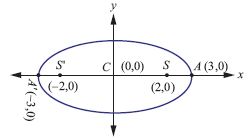
Find the equation of the ellipse with foci (±2, 0), vertices (±3, 0)
32.
33.
Which of the following is a contradiction?
p v q
p ∧ q
q v ~ q
q ∧ ~ q
34.
The value of \(\int _{ 0 }^{ \frac { \pi }{ 3 } } { tan } x \ dx\) __________
-log 2
log 2
-log 3
log 3
35.
If u = yx then \(\frac { \partial u }{ \partial y } \) = ............
xyx-1
yxy-1
0
1
36.
If the rate of increase of s = x3-5x2+ 5x + 8 is twice the rate of increase of x, then one value of x is __________
\(\frac{3}{5}\)
\(\frac{10}{3}\)
\(\frac{3}{10}\)
\(\frac{1}{3}\)
37.
38.
\(\text { The value of } \int_{0}^{\frac{2}{3}} \frac{d x}{\sqrt{4-9 x^{2}}} \text { is }\)
\(\frac{\pi}{6}\)
\(\frac{\pi}{2}\)
\(\frac{\pi}{4}\)
\({\pi}\)
39.
A circular template has a radius of 10 cm. The measurement of radius has an approximate error of 0.02 cm. Then the percentage error in calculating area of this template is
0.2%
0.4%
0.04%
0.08%
40.
The random variable X has the probability density function
\(f(x)=\left\{\begin{array}{lr}
a x+b & 0<x<1 \\
0 & \text { otherwise }
\end{array}\right.\) and \(E(X)=\frac { 7 }{ 12 } \), then a and b are respectively
1 and \(\frac { 1 }{ 2 } \)
\(\frac { 1 }{ 2 } \) and 1
2 and 1
1 and 2
41.
The differential equation representing the family of curves y = Acos(x + B), where A and B are parameters,is
\(\frac { { d }^{ 2 }y }{ { dx }^{ 2 } } -y=0\)
\(\frac { { d }^{ 2 }y }{ { dx }^{ 2 } }+y=0\)
\(\frac { { d }^{ 2 }y }{ { dx }^{ 2 } }=0\)
\(\frac { { d }^{ 2 }x }{ { dy }^{ 2 } }=0\)
42.
The number given by the Rolle's theorem for the functlon x3 - 3x2, x ∈ [0, 3] is
1
\(\sqrt { 2 } \)
\(\frac { 3 }{ 2 } \)
2
43.
\(\frac { 1+e^{ -i\theta } }{ 1+{ e }^{ i\theta } } \) =__________
cosθ + i sinθ
cosθ - i sinθ
sinθ - i cosθ
sinθ + icosθ
44.
If tan-1(3) + tan-1(x) = tan-1(8) then x = ____________
5
\(\frac { 1 }{ 5 } \)
\(\frac { 5 }{ 14 } \)
\(\frac { 14 }{ 5 } \)
45.
Which of the following is not an elementary transformation?
Ri ↔️ Rj
Ri ⟶ 2Ri + Rj
Cj ⟶ Cj + Ci
Ri ⟶ Ri + Cj
46.
If f(x) = 0 has n roots, then f'(x) = 0 has __________ roots
n
n -1
n+1
(n-r)
47.
If A = \(\left[ \begin{matrix} \frac { 3 }{ 5 } & \frac { 4 }{ 5 } \\ x & \frac { 3 }{ 5 } \end{matrix} \right] \) and AT = A−1, then the value of x is
\(\frac { -4 }{ 5 } \)
\(\frac { -3 }{ 5 } \)
\(\frac { 3 }{ 5 } \)
\(\frac { 4 }{ 5 } \)
48.
If a vector \(\vec { \alpha } \) lies in the plane of \(\vec { \beta } \) and \(\vec { \gamma } \), then
\([\vec { \alpha } ,\vec { \beta } ,\vec { \gamma } ]\) = 1
\([\vec { \alpha } ,\vec { \beta } ,\vec { \gamma } ]\) = -1
\([\vec { \alpha } ,\vec { \beta } ,\vec { \gamma } ]\) = 0
\([\vec { \alpha } ,\vec { \beta } ,\vec { \gamma } ]\) = 2
49.
Let C be the circle with centre at(1, 1) and radius = 1. If T is the circle centered at (0, y) passing through the origin and touching the circle C externally, then the radius of T is equal to
\(\frac { \sqrt { 3 } }{ \sqrt { 2 } } \)
\(\frac { \sqrt { 3 } }{ 2 } \)
\(\frac { 1 }{ 2 } \)
\(\frac { 1 }{ 4 } \)
50.
The value of sin-1 (cos x), \(0\le x\le\pi\) is
\(\pi-x\)
\(x-\frac{\pi}{2}\)
\(\frac{\pi}{2}-x\)
\(x-\pi\)
51.
1.
Given \(\frac { dy }{ dx } =-\left( \frac { y+3 }{ x+2 } \right) \)
⇒ \(\frac { dy }{ y+3 } =-\frac { dx }{ x+2 } \)
⇒ \(\int { \frac { dy }{ y+3 } } =-\int { \frac { dx }{ x+2 } } \)
⇒ log(y + 3) = -log (x + 2) + log c
⇒ log(y + 3) + log (x + 2) = log c
⇒ log(x + 2) (y + 3) = log c
⇒ (x+2)(y+3) = c ..(1)
Since the curve passes through (0, 0)
(0 + 2)(0 + 3) = c ⇒ c = 6
(1) becomes,
(x + 2)(y + 3) = 6
⇒ xy + 3x + 2y + 6 = 6
⇒ xy + 3x + 2y = 0
2.
| p | q | ~p | p∧~p) | ~q | (~q)∧p | (p∧~p) ∧ (~q∧p) |
| T | T | F | F | F | F | F |
| T | F | F | F | T | T | F |
| F | T | T | F | F | F | F |
| F | F | T | F | T | F | F |
Since the entries in the last column are F, (p ∧ ~p) ∧ (~q ∧ P) is a contradiction
3.
Given that n = 6
Probability for selecting a defective product is \(\frac { 20 }{ 100 } \) that is \(p=\frac { 1 }{ 5 } \)
Since X denotes the number defective products, X can take on the values 0,1,2,...,6
The probability for defective (success) is \(p-\frac { 1 }{ 5 } \) and for failure \(q=1-p=\frac { 4 }{ 5 } \), and n = 6
Therefore X follows a binomial distribution denoted by \(X\sim B\left( 6,\frac { 1 }{ 5 } \right) \)
This gives \(f(x)=\left( \begin{matrix} 6 \\ x \end{matrix} \right) \left( \cfrac { 1 }{ 5 } \right) ^{ x }\left( \cfrac { 4 }{ 5 } \right) ^{ 6-x }\), x = 0,1,2,...,6,
(i) Probability for two defective products is
\(P(X=2)=f(2)=\left( \begin{matrix} 6 \\ x \end{matrix} \right) \left( \cfrac { 1 }{ 5 } \right) ^{ x }\left( \cfrac { 4 }{ 5 } \right) ^{ 6-x }=15\left( \cfrac { { 4 }^{ 4 } }{ { 5 }^{ 6 } } \right) \)
(ii) Probability for at most one defective products is
P(X ≤1) = P(X = 0) + P(X = 1)
\(-\left( \begin{matrix} 6 \\ 0 \end{matrix} \right) \left( \cfrac { 1 }{ 5 } \right) ^{ 0 }\left( \cfrac { 4 }{ 5 } \right) ^{ 6-0 }+\left( \begin{matrix} 6 \\ 1 \end{matrix} \right) \left( \frac { 1 }{ 5 } \right) ^{ 1 }\left( \cfrac { 4 }{ 5 } \right) ^{ 6-1 }\)
\(-\left( \cfrac { 4 }{ 5 } \right) ^{ 6 }+\left( 6 \right) \left( \cfrac { { 4 }^{ 2 } }{ { 5 }^{ 2 } } \right) =2\left( \cfrac { 4 }{ 5 } \right) ^{ 2 }\)
Probability for at most one defective products is \(2\left( \frac { 4 }{ 5 } \right) ^{ 5 }\)
(iii) Probability for at least two defective products is
P(X≥2)-1-P(X<2) = 1-P(X≤1) = \(1-2\left( \frac { 4 }{ 5 } \right) ^{ 5 }\)
Probability for at least two defective products is \(1-2\left( \frac { 4 }{ 5 } \right) ^{ 5 }\)
4.
Given f(x, y) = \(\frac { 3x }{ y+sinx \ } \)
\({ f }_{ x }=\frac { \partial f }{ \partial x } \)
= \(\frac { (y+sin \ x)(3)-3x(cos \ x) }{ { (y+sin \ x) }^{ 2 } } \)
\(=\frac { 3y+3sin \ x-3x \ cos \ x }{ (y+sin{ x })^{ 2 } } \)
\({ f }_{ yx }=\frac { \partial ^{ 2 }f }{ \partial y\partial x } \)
\(=\frac { (y+{ sinx) }^{ 2 }[3]-(3y+3sinx-3xcosx)(2)(y+sinx)(1) }{ { (y+sinx) }^{ 3 } } \)
= \(\frac { (y+{ sinx) }-[3y+3sinx-6y-6sinx+6xcosx] }{ { (y+sinx) }^{ 4 } } \)
\({ f }_{ yx }=\frac { -3y-3sinx+6xcosx }{ { (y+sinx) }^{ 3 } } \) ......(1)
\({ f }_{ y }={ [3x[-1][y+sinx] }^{ -2 }\)
\(=\frac { -3x }{ (y+sin{ x) }^{ 2 } } \)
\(\therefore { f }_{ xy }=-3\left[ \frac { ({ y+sinx) }^{ 2 }(1)-x(2)(y+sinx)(cosx) }{ { (y+sinx) }^{ 4 } } \right] \)
\({ f }_{ xy }=\frac { -3(y+sinx)[y+sinx-2xcosx] }{ { (y+sinx) }^{ 4 } } \)
\({ f }_{ xy }=\frac { -3(y+sinx-2xcosx) }{ ({ y+sinx })^{ 3 } } \) ...(2)
From (1) and (3)
fxy = fyx
5.
\(\frac { dy }{ dx } +\frac { 3y }{ x } =\frac { 1 }{ { x }^{ 2 } } \), given that y = 2 when x = 1
This is a linear differential equation.
\(\therefore P=\frac { 3 }{ x } ;Q=\frac { 1 }{ { x }^{ 2 } } \)
\(\int { pdx } =3\int { \frac { 1 }{ x } dx=3logx=log{ x }^{ 3 } } \)
\(\therefore I.F.={ e }^{ \int { pdx } }={ e }^{ log{ x }^{ 3 } }={ x }^{ 3 }\)
\(\therefore\) The solution is \({ ye }^{ \int { pdx } }=\int { Q{ e }^{ \int { pdx } }dx+c } \)
\(\Rightarrow { yx }^{ 3 }=\int { \frac { 1 }{ { x }^{ 2 } } .{ x }^{ 3 } } dx+c\)
\(\Rightarrow { yx }^{ 3 }=\int { xdx+c } \)
\(\Rightarrow { yx }^{ 3 }=\frac { { x }^{ 2 } }{ 2 } +c...(1)\)
When x = 1, y = 2
\(\Rightarrow 2{ (1) }^{ 3 }=\frac { 1 }{ 2 } +c\Rightarrow 2-\frac { 1 }{ 2 } =\frac { 3 }{ 2 } \)
\({ yx }^{ 3 }=\frac { { x }^{ 2 } }{ 2 } +\frac { 3 }{ 2 } \)
\({ 2x }^{ 3 }y={ x }^{ 2 }+3\)
6.
Let \(f(x)=\frac{1}{x}\). then the Taylor series of f (x) is
\(f(x)=\sum^{n=\infty}_{n=0}a_{n}(x-2)^{n},\) where \(a_{n}=\frac{f^{(n)}(2)}{n!}\)
Various derivatives of the function f (x) evaluated at x = 2 are given below.
| Functions and its derivatives |
\(\frac{1}{x}\)and its derivatives |
value at x = 2 |
| f(x) | \(\frac{1}{x}\) | \(\frac{1}{2}\) |
| f'(x) | \(-\frac{1}{x^{2}}\) | \(-\frac{1}{4}\) |
| f''(x) | \(\frac{2}{x^{3}}\) | \(\frac{1}{4}\) |
| f'''(x) | \(-\frac{6}{x^{4}}\) | \(-\frac{3}{8}\) |
Substituting these values, we get the required expansion of the function as:
\(\frac{1}{x}=\frac{1}{2}-\frac{1}{4}\frac{(x-2)}{1!}+\frac{1}{4}\frac{(x-2)^{2}}{2!}-\frac{3}{8}\frac{3(x-2)^{3}}{3!}+...\)
which is, \(\frac{1}{x}=\frac{1}{2}-\frac{(x-2)}{4}+\frac{(x-2)^{2}}{8}-\frac{(x-2)^{3}}{16}+...\)
7.
From the line \(\frac { x-3 }{ 3 } =\frac { y-8 }{ -1 } =\frac { z-3 }{ 1 } \), we get
\(\overset { \rightarrow }{ a } =3\overset { \wedge }{ i } +8\overset { \wedge }{ j } +3\overset { \wedge }{ k } \), \(\overset { \rightarrow }{ b } =3\overset { \wedge }{ i } -\overset { \wedge }{ j } +\overset { \wedge }{ k } \)
From the line \(\frac { x+3 }{ -3 } =\frac { y+7 }{ 2 } =\frac { z-6 }{ 4 } \) we get
\(\overset { \rightarrow }{ c } =-3\overset { \wedge }{ i } -7\overset { \wedge }{ j } +6\overset { \wedge }{ k } \) and \(\overset { \rightarrow }{ d } =-3\overset { \wedge }{ i } +2\overset { \wedge }{ j } +4\overset { \wedge }{ k } \)
Since the given lines are not parallel, the shortest distance between the line is
\(d=\left| \frac { \left( \overset { \rightarrow }{ c } -\overset { \rightarrow }{ a } \right) .\left( \overset { \rightarrow }{ b } \times \overset { \rightarrow }{ d } \right) }{ \left| \overset { \rightarrow }{ b } \times \overset { \rightarrow }{ d } \right| } \right| \)
\(\overset { \rightarrow }{ c } -\overset { \rightarrow }{ a } =-6\overset { \wedge }{ i } -15\overset { \wedge }{ j } +3\overset { \wedge }{ k } \)
\(\overset { \rightarrow }{ b } \times \overset { \rightarrow }{ d } =\left| \begin{matrix} \overset { \wedge }{ i } \\ 3 \\ -3 \end{matrix}\begin{matrix} \overset { \wedge }{ j } \\ -1 \\ 2 \end{matrix}\begin{matrix} \overset { \wedge }{ k } \\ 1 \\ 4 \end{matrix} \right| \)
\(=\overset { \wedge }{ i } (-4-2)-\overset { \wedge }{ j } (12+3)+\overset { \wedge }{ k } (6-3)\\ \)
\(=-6\overset { \wedge }{ i } -15\overset { \wedge }{ j } +3\overset { \wedge }{ k } \)
\(\therefore \left| \overset { \rightarrow }{ b } \times \overset { \rightarrow }{ d } \right| =\sqrt { 36+225+9 } \)
\(=\sqrt { 270 } \)
\(\therefore \left( \overset { \rightarrow }{ c } -\overset { \rightarrow }{ a } \right) .\left( \overset { \rightarrow }{ b } \times \overset { \rightarrow }{ d } \right) =\left( -6\overset { \wedge }{ i } -15\overset { \wedge }{ j } +3\overset { \wedge }{ k } \right) .\left( -6\overset { \wedge }{ i } -15\overset { \wedge }{ j } +3\overset { \wedge }{ k } \right) \)
= -6 (-6) + 15 _(15) + 3(3)
= 270 ≠ 0
Since the given lines are neither intersecting, nor parallel they are skew lines
\(\therefore d=\frac { 270 }{ \sqrt { 270 } } =\sqrt { 270 } units\)
8.
LHS = \(\left( \frac { i+\sqrt { 3 } }{ -i+\sqrt { 3 } } \right) ^{ 2\omega }+\left( \frac { i-\sqrt { 3 } }{ i+\sqrt { 3 } } \right) ^{ 2\omega }\)
= \(\left( \frac { \sqrt { 3 } +i }{ \sqrt { 3 } -i } \times \frac { \sqrt { 3 } +i }{ \sqrt { 3 } +i } \right) ^{ 2\omega }+\left( \frac { -\sqrt { 3 } +i }{ \sqrt { 3 } +i } \times \frac { \sqrt { 3 } -i }{ \sqrt { 3 } -1 } \right) ^{ 2\omega }\)
= \(\left( \frac { 3-1+2\sqrt { 3 } i }{ 3+1 } \right) ^{ 2\omega }+\left( \frac { -3+1+2\sqrt { 3 } i }{ 3+1 } \right) ^{ 2\omega }\)
= \(\left( \frac { 2+2\sqrt { 3 } i }{ 4 } \right) ^{ 2\omega }+\left( \frac { -2+2\sqrt { 3 } i }{ 4 } \right) ^{ 2\omega }\)
= \(\left( \frac { 1+\sqrt { 3 } i }{ 2 } \right) ^{ 2\omega }+\left( \frac { -2+2\sqrt { 3 } i }{ 2 } \right) ^{ 2\omega }\)
=\(\left[ -\left( \frac { -1-\sqrt { 3 } i }{ 2 } \right) \right] ^{ 2\omega }+\left[ \frac { -1+\sqrt { 3 } i }{ 2 } \right] ^{ 2\omega }\)
= (-ω2)2ω+(ω)2ω
[∴ ω = \(\frac { -1+i\sqrt { 3 } }{ 2 } \), ω2 = \(\frac { -1-i\sqrt { 3 } }{ 2 } \)]
= ω4ω+ω2ω
= (ω3)133. ω1 + (ω3)66.ω2
= 1.ω+1.ω2 [∴ 1+ω+ω2 = 0 & ω3 = 1]
= ω + ω2
= -1 = RHS
9.
Given F1P + F2P = 8
By the focal property of ellipse
F1P + F2P = 2a
∴ 2a = 8 ⇒ a = 4
and distance between the foci = F1F2 = 6
2ae = 6 ⇒ ae = 3
∴ 4(e) = 3 ⇒ e \(\frac34\)
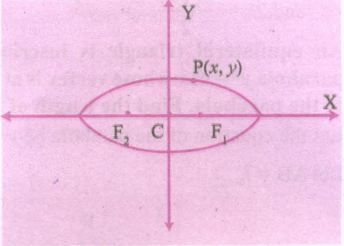
∴ b2 = a2(1- e2)
= \(16\left( { 1-\left( \frac { 3 }{ 4 } \right) }^{ 2 } \right) =16\left( 1-\frac { 9 }{ 10 } \right) =16\left( \frac { 7 }{ 16 } \right) =7\)
∴ The path traced by him is an ellipse and its equation is \(\frac { { x }^{ 2 } }{ { a }^{ 2 } } +\frac { { y }^{ 2 } }{ { b }^{ 2 } } =1\)
⇒ \(\frac { { x }^{ 2 } }{ 16 } -\frac { { y }^{ 2 } }{ 7 } \) = 1
10.
Put \(x=a\ cos\theta\)
\(f(x)={ tan }^{ -1 }\sqrt { \frac { a-acos\theta }{ a+acos\theta } } ={ tan }^{ -1 }\sqrt { \frac { 1-cos\theta }{ 1+cos\theta } }\)
= \({ tan }^{ -1 }\sqrt { \frac { 2{ sin }^{ 2 }\frac { \theta }{ 2 } }{ 2{ cos }^{ 2 }\frac { \theta }{ 2 } } } =tan|tan\frac { \theta }{ 2 } |={ tan }^{ -1 }\left( tan\frac { \theta }{ 2 } \right)\)
= \(\frac { \theta }{ 2 }\) \(\left.\Rightarrow 0<\frac{\theta}{2}<\frac{\pi}{2} \therefore\left|\tan \frac{\theta}{2}\right|=\tan \frac{\theta}{2}\right]\)
\(\frac { 1 }{ 2 } .{ cos }^{ -1 }\left( \frac { x }{ a } \right)\)
11.
Let the required numbers be x, y and z
By the given data,
x + y + z = 20 ....(1)
2z + x = 23 ⇒ x + 2z = 23...(2)
y + z + 3x = 46 ⇒ 3x + y + z = 46..(3)
Δ = \(\left| \begin{matrix} 1 & 1 & 1 \\ 1 & 0 & 2 \\ 3 & 1 & 1 \end{matrix} \right| =1\left| \begin{matrix} 0 & 2 \\ 0 & 1 \end{matrix} \right| -1\left| \begin{matrix} 1 & 2 \\ 1 & 1 \end{matrix} \right| +1\left| \begin{matrix} 1 & 0 \\ 3 & 1 \end{matrix} \right| \)
= -2 + 5 + 1 =4
Δ1 = \(\left| \begin{matrix} 20 & 1 & 1 \\ 23 & 0 & 2 \\ 46 & 1 & 1 \end{matrix} \right| =20\left| \begin{matrix} 0 & 2 \\ 1 & 1 \end{matrix} \right| -1\left| \begin{matrix} 23 & 2 \\ 46 & 1 \end{matrix} \right| +1\left| \begin{matrix} 23 & 0 \\ 46 & 1 \end{matrix} \right| \)
= -40 + 69 + 23 = 52
Δ2 = \(\left| \begin{matrix} 1 & 20 & 1 \\ 1 & 23 & 2 \\ 3 & 46 & 1 \end{matrix} \right| \)
= \(1\left| \begin{matrix} 23 & 2 \\ 46 & 1 \end{matrix} \right| -20\left| \begin{matrix} 1 & 2 \\ 3 & 1 \end{matrix} \right| +1\left| \begin{matrix} 1 & 23 \\ 3 & 46 \end{matrix} \right| \)
= -69 + 100 - 23 = 8
Δ3 = \(\left| \begin{matrix} 1 & 1 & 20 \\ 1 & 2 & 23 \\ 3 & 1 & 46 \end{matrix} \right| \)
= \(1\left| \begin{matrix} 0 & 23 \\ 1 & 46 \end{matrix} \right| -1\left| \begin{matrix} 1 & 23 \\ 3 & 46 \end{matrix} \right| +20\left| \begin{matrix} 1 & 0 \\ 3 & 1 \end{matrix} \right| \)
= -23 + 23 + 20 = 20
∴ x = \(\frac { { \triangle }_{ 1 } }{ \triangle } =\frac { 52 }{ 4 } \) = 13
y = \(\frac { { \triangle }_{ 2 } }{ \triangle } =\frac { 8 }{ 4 } \) = 2 and z =\(\frac { { \triangle }_{ 3 } }{ \triangle } =\frac { 20 }{ 4 } \) = 5
Hence the required numbers are 13, 2 and 5.
12.
(i) 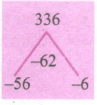
Rearrange the terms as,
(x-5) (x+4) (x-7) (x+6) = 504
{-2, 3, -7, 8}
⇒ (x2 -x - 20) (x2 -x - 42) = 504
Put x2- x = y
⇒ (y-20)(y-42) = 504
⇒ y2-62y+840-504 = 0
⇒ y2-62y+336 = 0
⇒ (y - 56) (y - 6) = 0
⇒ y = 56, 6
Case (i)
When y = 56, x2 - x = 56
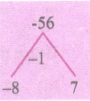
⇒ x2 - x - 56 = 0
⇒ (x - 8)(x + 7) = 0
⇒ x = 8, -7
Case (ii)
When y = 6,
x2- x = 6
x2- x - 6 = 0
⇒ (x - 3)(x + 2) = 0
⇒ x = 3, - 2

Hence the roots are -2, 3, 8, -7
13.
Since two roots are in the ratio p : q : r, we can assume the roots as pλ, qλ and rλ .
Then, we get
Σ1 = pλ + qλ + rλ = -a .....(1)
Σ2 = (pλ)(qλ)+(qλ)(rλ)+(rλ)(pλ) ..........(2)
Σ3 = (pλ)(qλ)(rλ) = -c .....(3)
Now, we get
(1) ⇒ λ = -\(\frac { a }{ p+q+r } \) ..........(4)
(3) ⇒ λ3 = \(\frac { c }{ pqr } \) ...........(5)
Substituting (4) in (5), we get
\(\left( \frac { a }{ p+q+r } \right) ^{ 3 }=-\frac { c }{ pqr } \) ⇒ pqra3 = c(p+q+ r)3.
14.
Rolle’s theorem is not valid.
15.
Given curve is y = \(\sqrt x\) + 1
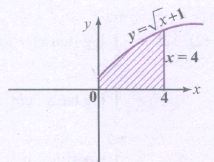
Required area
\(\int _{ 0 }^{ 4 }{ ydx } =\int _{ 0 }^{ 4 }{ (\sqrt { x } +1)dx } \)
\({ \left[ \frac { 2 }{ 3 } { x }^{ \frac { 3 }{ 2 } }+x \right] }_{ 0 }^{ 4 }=\frac { 2 }{ 3 } { (4) }^{ \frac { 3 }{ 2 } }+4\)
\(\frac { 2 }{ 3 } (4)\sqrt { 4 } +4=\frac { 16 }{ 3 } +4\)
\(\frac { 16+12 }{ 3 } =\frac { 28 }{ 3 } \) sq.units
16.
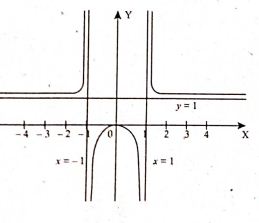
Given \(f(x)=\frac { { x }^{ 2 } }{ { x }^{ 2 }-1 } \)
\(\quad \underset { x\rightarrow 1^{ + } }{ lim } \frac { { x }^{ 2 } }{ { x }^{ 2 }-1 } =\underset { x\rightarrow 1^{ + } }{ lim } \frac { { x }^{ 2 } }{ \left( x+1 \right) \left( x-1 \right) } \)
= \(\underset { h\rightarrow { 0 }^{ + } }{ lim } \frac { \left( 1+h \right) ^{ 2 } }{ \left( 1+h+1 \right) \left( 1+h-1 \right) } \)
= \(\underset { h\rightarrow 0^{ + } }{ lim } \frac { (1+h)^{ 2 } }{ (2+h)(h) } \infty \)
Also \(\underset { x\rightarrow 1^{ - } }{ lim } \frac { { x }^{ 2 } }{ (x+1)/(x-1) } =\underset { h\rightarrow 0^{ + } }{ lim } \frac { \left( 1-h \right) ^{ 2 } }{ \left( 1-h+1 \right) \left( 1-h-1 \right) } \)
= \(\underset { h\rightarrow { 0 }^{ + } }{ lim } \frac { \left( 1-h \right) ^{ 2 } }{ (2-h)(-h) } =-\infty \)
ஃ x = -1 and x = 1are vertical asymptotes,
Also
\(\underset { x-\rightarrow \infty }{ lim } \frac { { x }^{ 2 } }{ { x }^{ 2 }-1 } =\underset { \frac { 1 }{ x } \rightarrow 0 }{ lim } \frac { 1 }{ 1-\frac { 1 }{ { x }^{ 2 } } } =1\)
[Divide numerator and denominator by x2]
ஃ y = 1 is a horizontal asymptote,
17.
The given differential equation is \(3\left( \frac { { d }^{ 2 }y }{ { dx }^{ 2 } } \right) ={ \left[ 4+{ \left( \frac { dy }{ dx } \right) }^{ 2 } \right] }^{ \frac { 3 }{ 2 } }\)Squaring both sides, we get
\(9{ \left( \frac { { d }^{ 2 }y }{ { dx }^{ 2 } } \right) }^{ 2 }={ \left[ 4+{ \left( \frac { dy }{ dx } \right) }^{ 2 } \right] }^{ 3 }\)
In this equation, the highest order derivative is \(\frac { { d }^{ 2 }y }{ { dx }^{ 2 } } \) whose power is 2.
Therefore, the given differential equation is of order 2 and degree 2.
18.
Let AOB be the vertical section of the reflector and m is the mid-point of AB. Let the equation of the parabola be y2 = 4ax A(6, 12) lies on (1)
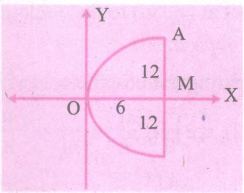
∴ 122 = 4a(6) ⇒ a = 6
∴ Focus is (a, 0) = (b, 0)
Hence focus coincides with m, the mid-point of AB.
19.
A =\(\left[ \begin{matrix} 4 \\ 7 \end{matrix}\begin{matrix} 5 \\ -3 \end{matrix}\begin{matrix} -6 \\ 0 \end{matrix}\begin{matrix} 1 \\ 8 \end{matrix} \right] \)
\(\overset { { R }_{ 2 }\rightarrow { R }_{ 2 }-2{ R }_{ 1 } }{ \longrightarrow } \left[ \begin{matrix} 4 \\ -1 \end{matrix}\begin{matrix} 5 \\ -3 \end{matrix}\begin{matrix} -6 \\ 12 \end{matrix}\begin{matrix} 1 \\ 6 \end{matrix} \right] \)
\(\overset { { R }_{ 1 }\leftrightarrow { R }_{ 2 } }{ \longrightarrow } \left[ \begin{matrix} -1 \\ 4 \end{matrix}\begin{matrix} -3 \\ 5 \end{matrix}\begin{matrix} 12 \\ -6 \end{matrix}\begin{matrix} 6 \\ 1 \end{matrix} \right] \)
\(\overset { { R }_{ 1 }+(-1){ R }_{ 1 } }{ \longrightarrow } \left[ \begin{matrix} 1 \\ 4 \end{matrix}\begin{matrix} 13 \\ 5 \end{matrix}\begin{matrix} -12 \\ -6 \end{matrix}\begin{matrix} 6 \\ 1 \end{matrix} \right] \)
\(\overset { { R }_{ 2 }\rightarrow { R }_{ 2 }-4{ R }_{ 1 } }{ \longrightarrow } \left[ \begin{matrix} 1 \\ 0 \end{matrix}\begin{matrix} 13 \\ -47 \end{matrix}\begin{matrix} -12 \\ 42 \end{matrix}\begin{matrix} -6 \\ 25 \end{matrix} \right] \)
The equivalent row-echelon matrix hats two non zero rows.
∴ \(\rho\) (A) = 2
20.
The quadratic equation 3x2 + 2(a2 + 1)x + (a2 - 3a + 2)
Will have two roots of opposite sign if it has real roots and the product of the roots is negative.
⇒ 4(a2+1)2-12(a2-3a+2)\(\ge\) 0 and \(\frac { { a }^{ 2 }-3a+2 }{ 3 } <0\)
Both of these conditions are true if
⇒ a2-3a+2< 0
⇒ (a-1)(a-2)< 0
⇒ 1<a<2
21.
Let \(\vec { a } \) = \(2\hat { i } +3\hat { j } +\hat { k } \), \(\vec { b } \)= \(\hat { i } -2\hat { j } +2\hat { k } \) and \(\vec { c } \) = \(\hat { 3i } +\hat { j } +3\hat { k } \)
\(\vec { a } ,\vec { b } \) and \(\vec { c } \) are coplanar if \(\vec { a } .(\vec { b } \times \vec { c } )\)
Consider \(\vec { a } .(\vec { b } \times \vec { c } )\)
= \(\left| \begin{matrix} 2 & 3 & 1 \\ 1 & -2 & 2 \\ 3 & 1 & 3 \end{matrix} \right| =2\left| \begin{matrix} -2 & 2 \\ 1 & 3 \end{matrix} \right| -3\left| \begin{matrix} 1 & 2 \\ 3 & 3 \end{matrix} \right| +1\left| \begin{matrix} 1 & -2 \\ 3 & 1 \end{matrix} \right| \)
= 2 (-6- 2) -3 (3 - 6) + 1(1 + 6)
= 2(-8) - 3(-3) + 1(7)
= -16 + 9 + 7
= -16+16
= 0.
Hence, the given vectors are co-planar.
22.
Let cos−1\(\left( \frac { \sqrt { 3 } }{ 2 } \right) \) = y. Then, cos y = \( \frac { \sqrt { 3 } }{ 2 } \)
The range of the principal values of y = cos−1x is [0, \(\pi\)].
So, let us find y in [0, \(\pi\)] such that cos y =\( \frac { \sqrt { 3 } }{ 2 } \)
But, cos\(\frac{\pi}{6}=\frac{\sqrt3}{2} and \frac{\pi}{6}\in[0,\pi]\). Therefore, y = \(\frac{\pi}{6}\)
Thus, the principal value of cos-1 \(\left( \frac { \sqrt { 3 } }{ 2 } \right) is\frac { \pi }{ 6 } \)
23.
\(\frac { 17 }{ 12 } \)
24.
(i) Given that five fair coins are tossed once. Since the coins are fair coins the probability of getting an head in a single coin is
\(p=\frac { 1 }{ 2 } \) and \(q=1-p=\frac { 1 }{ 2 } \)
Let X denote the number of heads that appear in five coins. X is binomial random variable that takes on the values 0, 1, 2, 3, 4 and 5 and \(p=\frac { 1 }{ 2 } \) That is \(X\sim B\left( 5,\cfrac { 1 }{ 2 } \right) \)
Therefore the binomial distribution is
\(f(x)=\left( \begin{matrix} n \\ x \end{matrix} \right) p*\left( 1-p \right) ^{ n-x }\), x = 0, 1, 2,..,n
becomes
\(f(x)=\left( \begin{matrix} 5 \\ x \end{matrix} \right) \left( \cfrac { 1 }{ 2 } \right) ^{ x }\left( \cfrac { 1 }{ 2 } \right) ^{ n-x }\), x = 0, 1, 2,..,5
That is
\(f(x)=\left( \begin{matrix} 5 \\ x \end{matrix} \right) \left( \cfrac { 1 }{ 2 } \right) ^{ n }\), x = 0, 1, 2...,n
(ii) A fair die is rolled ten times and X denotes the number of times 4 appeared. X is binomial
random variable that takes on the values 0, 1, 2, 3,...10 , with n = 10 and \(p=\cfrac { 1 }{ 6 } \). That is \(X\sim B\left( 10,\cfrac { 1 }{ 6 } \right) \)
Probability of getting a four in a die is \(p=\frac { 1 }{ 2 } \) and \(q=1-p=\frac { 5 }{ 6 } \)
Therefore the binomial distribution is
\(f(x)=\left( \begin{matrix} 10 \\ x \end{matrix} \right) \left( \cfrac { 1 }{ 6 } \right) ^{ x }\left( \cfrac { 5 }{ 6 } \right) ^{ 10-x }\) x = 0, 1, 2,...,10
25.
Recall that surface area of a sphere with radius r is given by S(r) = 4\(\pi \)r3. Note that even though we can calculate the exact change using this formula, we shall try to approximate the change using the linear approximation. So, using (4), we have
Change in the surface area = S(5.2) - S(5) ≈ S'(5)(0.2)
= 8\(\pi \)(5)(0.2)
= 8\(\pi \) cm2
Exact calculation of the change in the surface gives
S(5.2) − S(5) = 108.16\(\pi \)-100\(\pi \) = cm2.
Percentage error = relative error \(\times\)100 = \(\frac { 8.16\pi -8\pi }{ 8.16\pi } \)\(\times\)100 = 1.9607%
26.
Given \(sin\left( { sin }^{ -1 }\frac { 1 }{ 5 } +{ cos }^{ -1 }x \right) =1=sin\frac { \pi }{ 2 } \)
\(\left[ \because sin\frac { \pi }{ 2 } =1 \right] \)
\(\Rightarrow { sin }^{ -1 }\frac { 1 }{ 5 } +{ cos }^{ -1 }x={ sin }^{ -1 }\left( sin\left( \frac { \pi }{ 2 } \right) \right) \)
\(\Rightarrow { sin }^{ -1 }\frac { 1 }{ 5 } +{ cos }^{ -1 }x=\frac { \pi }{ 2 } \)
\({ sin }^{ -1 }\frac { 1 }{ 5 } =\frac { \pi }{ 2 } -{ cos }^{ -1 }x{ sin }^{ -1 }x\)
\(\left[ \because { sin }^{ -1 }x+{ cos }^{ -1 }x=\frac { \pi }{ 2 } \right] \)
\(\Rightarrow x=\frac { 1 }{ 5 } \)
27.
Let \(\overset { \rightarrow }{ a } =\overset { \wedge }{ 3i } -5\overset { \wedge }{ k } ,\overset { \rightarrow }{ b } =2\overset { \wedge }{ i } +7\overset { \wedge }{ j } \) and \(\overset { \rightarrow }{ c } =\overset { \wedge }{ i } +\overset { \wedge }{ j } +\overset { \wedge }{ k } \)
Let the required vector be \(\overset { \rightarrow }{ r } =x\overset { \wedge }{ i } +y\overset { \wedge }{ j } +z\overset { \wedge }{ k } \)
Given \(\overset { \rightarrow }{ r } .\overset { \rightarrow }{ a } =-1\)
\(\Rightarrow \left( x\overset { \wedge }{ i } +y\overset { \wedge }{ j } +z\overset { \wedge }{ k } \right) .\left( \overset { \wedge }{ 3i } -5\overset { \wedge }{ k } \right) =-1\)
⇒ 3x - 5z = -1 (1)
\(\overset { \rightarrow }{ r } .\overset { \rightarrow }{ b } =6\)
\(\Rightarrow \left( x\overset { \wedge }{ i } +y\overset { \wedge }{ j } +z\overset { \wedge }{ k } \right) .\left( 2\overset { \wedge }{ i } +7\overset { \wedge }{ j } \right) \)= 2x + 7y = 6 (2)
\(\overset { \rightarrow }{ r } .\overset { \rightarrow }{ i } =5\)
\(\Rightarrow \left( x\overset { \wedge }{ i } +y\overset { \wedge }{ j } +z\overset { \wedge }{ k } \right) .\left( \overset { \wedge }{ i } +\overset { \wedge }{ j } +\overset { \wedge }{ k } \right) \)= x + y + z = 5 (3)
Solving (1), (2) and (3) we get
x = 3, y = 0 and z = 2.
\(\therefore \overset { \rightarrow }{ r } =\overset { \wedge }{ 3i } +2\overset { \wedge }{ k } \)
28.
Augmented matrix [A|B] =\(\left[ \begin{matrix} 1 & 1 & 3 \\ 2 & 2 & 6 \\ 2 & 1 & 1 \end{matrix}|\begin{matrix} 4 \\ 7 \\ 10 \end{matrix} \right] \)
[A|B] \(\overset { { R }_{ 2 }\rightarrow { R }_{ 2 }-2{ R }_{ 1 }\\ { R }_{ 3 }\rightarrow { R }_{ 3 }-2{ R }_{ 1 } }{ \longrightarrow } \left[ \begin{matrix} 1 & 1 & 3 \\ 0 & 0 & 0 \\ 0 & -1 & -5 \end{matrix}|\begin{matrix} 4 \\ -1 \\ 2 \end{matrix} \right] \)
\(\overset { { R }_{ 2 }\leftrightarrow { R }_{ 3 } }{ \longrightarrow } \left[ \begin{matrix} 1 & 1 & 3 \\ 0 & -1 & -5 \\ 0 & 0 & 0 \end{matrix}|\begin{matrix} 4 \\ 2 \\ -1 \end{matrix} \right] \)
Here \(\rho\) (A) = 2 [only 2 two-non zero rows]
And \(\rho\) ([A|B]) = 3 [There are 3 non-zero rows]
∴ \(\rho\) (A) ≠ \(\rho\) ([A|B])
∴ The system is inconsistent.
29.
Since x2- y2 is even, either both x and y are even or both x and y are odd.
In any case both (x + y) and (x - y) are even integers
∴ x2 - y2= (x + y) (x +y) must be divisible by 4 But 4 does not divide 353702
∴ x2 - y2 = 353702 has no positive integral solutions.
30.
We have |2z-3-i| = 3
|2(x + iy)-3 - i| = 3
Squaring on both sides, we get
|(2x - 3) + (2y - 1)i|2 = 9
\(\Rightarrow\) (2x - 3)2 + (2y - 1)2 = 9
\(\Rightarrow\) 4x2 + 4y2 -12x - 4y + 1 = 0, the locus of z in Cartesian form
31.
SS′ = 2c and 2c = 4; A'A = 2a = 6
c = 2 and a = 3,
b2 = a2−c2 = 9−4 = 5.
Major axis is along x-axis, since a > b.
Centre (0, 0) and Foci are (±2, 0)
Therefore, equation of the ellipse is \(\frac { { x }^{ 2 } }{ 9 } \frac { { y }^{ 2 } }{ 5 } =1\)
32.
(a)
33.
(d)
q ∧ ~ q
34.
(b)
log 2
35.
(a)
xyx-1
36.
(d)
\(\frac{1}{3}\)
37.
(c)
38.
(a)
\(\frac{\pi}{6}\)
39.
(b)
0.4%
40.
(a)
1 and \(\frac { 1 }{ 2 } \)
41.
(b)
\(\frac { { d }^{ 2 }y }{ { dx }^{ 2 } }+y=0\)
42.
(d)
2
43.
(b)
cosθ - i sinθ
44.
(b)
\(\frac { 1 }{ 5 } \)
45.
(d)
Ri ⟶ Ri + Cj
46.
(b)
n -1
47.
(a)
\(\frac { -4 }{ 5 } \)
48.
(c)
\([\vec { \alpha } ,\vec { \beta } ,\vec { \gamma } ]\) = 0
49.
(d)
\(\frac { 1 }{ 4 } \)
50.
(c)
\(\frac{\pi}{2}-x\)
51.
(a)

12th Standard Syllabus & Materials
12th Standard
TN 12th Computer Applications வலையமைப்பு வடமிடல் Sample Question Papers Study Material - QB365 Set A
NEW12th Standard
TN 12th Computer Applications களப்பெயர் முறைமை (DNS) Sample Question Papers Study Material - QB365 Set A
NEW12th Standard
TN 12th Computer Applications வலையமைப்பு எடுத்துக்காட்டுகள் மற்றும் நெறிமுறைகள் Sample Question Papers Study Material - QB365 Set A
NEW12th Standard
TN 12th Computer Applications கணினி வலையமைப்பு ஓர் அறிமுகம் Sample Question Papers Study Material - QB365 Set A



Tamilnadu Stateboard 12th Standard Subjects
Maths

Chemistry

Physics

Biology

Computer Science

Business Maths and Statistics

Economics

Commerce

Accountancy

History

Computer Applications
Biology
Computer Technology
Computer Applications
Computer Science
Business Maths and Statistics
Commerce
Economics
Maths
Chemistry
Physics
Computer Technology
History
Accountancy

Tamil

English

French
Tamilnadu Stateboard Standards

