
 100% FREE ACCESS
12th Standard Syllabus & Materials
12th Standard
TN 12th Computer Applications மின்னணு தரவு பரிமாற்றம் Sample Question Papers Study Material - QB365 Set A
NEW12th Standard
TN 12th Computer Applications மின் - வணிக பாதுகாப்பு அமைப்புகள் Sample Question Papers Study Material - QB365 Set A
NEW12th Standard
TN 12th Computer Applications மின்னணு செலுத்தல் முறைகள் Sample Question Papers Study Material - QB365 Set A
NEW12th Standard
TN 12th Computer Applications மின் - வணிகம் Sample Question Papers Study Material - QB365 Set A
NEW12th Standard
TN 12th Computer Applications திறந்த மூல கருத்துருக்கள் Sample Question Papers Study Material - QB365 Set A
NEW12th Standard
TN 12th Computer Applications வலையமைப்பு வடமிடல் Sample Question Papers Study Material - QB365 Set A

Published on: 27/02/2021
12th Standard English Medium Maths Reduced Syllabus Creative Two Mark Questions with Answer key - 2021(Public Exam )
Download Tamil Nadu 12th Standard Maths question papers, model tests, one-mark questions, important questions, and public exam papers in PDF format. Free study materials and answer keys for TN State Board students.
Questions + Answers key
Take MCQ Maths Test1.
Solve : \(\frac { dy }{ dx } =\frac { { e }^{ x }-{ e }^{ -x } }{ { e }^{ x }+{ e }^{ -x } } \)
2.
Form the Differential Equation representing the family of curves y = A cos(x + B) where A and B are parameters.
3.
Find the order and degree of \(\left( \frac { { d }^{ 2 }y }{ { dx }^{ 2 } } \right) ^{ 2 }+cos\left( \frac { dy }{ dx } \right) =0\)
4.
Determine the order and degree of \(\frac { \left[ 1+\left( \frac { dy }{ dx } \right) ^{ 2 } \right] ^{ \frac { 3 }{ 2 } } }{ \frac { { d }^{ 2 }y }{ { dx }^{ 2 } } } =k\)
5.
Find the area bounded by y=cosx,y=x+1,y=0.
6.
Find the area of the region bounded by the curve y=sin x and the ordinate x=0.\(x=\frac { \pi }{ 3 } \)
7.
Find the area bounded by y=x2+2, x-axis, x=1 and x=2.
8.
If \(\int _{ 0 }^{ \infty }{ \frac { { x }^{ 2 }dx }{ \left( { x }^{ 2 }+{ a }^{ 2 } \right) \left( { x }^{ 2 }+{ b }^{ 2 } \right) \left( { x }^{ 2 }+{ c }^{ 2 } \right) } } =\frac { \pi }{ 2(a+b)(b+c)(c+a) } \) then find \(\int _{ 0 }^{ \infty }{ \frac { dx }{ \left( { x }^{ 2 }+4 \right) \left( { x }^{ 2 }+9 \right) } } \)
9.
Without using any kind of computational aid use linear approximation to find the value of e0.1
10.
If w=log(x2+y2),x=cosθ,y=sinθ, find \(\frac { dw }{ d\theta } \)
11.
Determine the domain of convexity of the function y=ex
12.
Prove that the function f(x)=2x2+3x is strictly increasing on \(\left[ -\frac { 1 }{ 2 } ,\frac { 1 }{ 2 } \right] \)
13.
Find the absolute extreme of the function f(x) = x2-2x+2 on the closed interval [0, 3]
14.
Evaluate the following limits, if necessary using L’Hopitalrule
(i) \(\underset { x\rightarrow 2 }{ lim } \cfrac { sin\pi x }{ 2-x } \)
(ii) \(\cfrac { lim }{ x\rightarrow 2 } \cfrac { { x }^{ n }-{ a }^{ n } }{ x-2 } \)
(iii) \(\underset { x\rightarrow \infty }{ lim } \cfrac { sin\frac { 2 }{ x } }{ \frac { 1 }{ x } } \)
(iv) \(\underset { x\rightarrow \infty }{ lim } \cfrac { { x }^{ 2 } }{ { e }^{ x } } \)
15.
Obtain Maclaurin’s Series expansion for e2x.
16.
Verify Rolle ’s Theorem for \(f(x)=\left| x-1 \right| ,O\le x\le 2\)
17.
Find the equation of the tangent to the curve y2=4x+5 and which is parallel to y=2x+7
18.
In the set of integers under the operation * defined by a * b = a + b - 1. Find the identity element.
19.
Find the volume of the solid obtained by revolving the area of the triangle whose sides are x = 4, y = 0 and 3x - 4y = 0 about x - axis
20.
Find the area of the region enclosed by the curve y = \(\sqrt x\) + 1, the axis of x and the lines x = 0, x = 4.
21.
IF u(x, y) = x2 + 3xy + y2, x, y, ∈ R, find tha linear appraoximation for u at (2, 1)
22.
Consider the binary operation ∗ defined on the set A = {a, b, c, d} by the following table:
| * | a | b | c | d |
| a | a | c | b | d |
| b | d | a | b | c |
| c | c | d | a | a |
| d | d | b | a | c |
Is it commutative and associative?
23.
Find the argument of -2
24.
If z =\(\left( \frac { \sqrt { 3 } }{ 2 } +\frac { i }{ 2 } \right) ^{ 107 }+\left( \frac { \sqrt { 3 } }{ 2 } -\frac { i }{ 2 } \right) ^{ 107 }\), then show that Im (z) = 0
25.
Find Re (z) and im (z) if z = 5i11 + 7i3
26.
For the ellipse x2 + 3y2 = a2, find the length of major and minor axis.
27.
If the line y = 3x + 1, touches the parabola y2 = 4ax, find the length of the latus rectum?
28.
Find the equation of tangent to the circle x2 +y2 + 2x - 3y - 8 = 0 at (2, 3).
29.
Evaluate \(sin\left( { cos }^{ -1 }\left( \frac { 3 }{ 5 } \right) \right) \)
30.
If \({ cot }^{ -1 }\left( \frac { 1 }{ 7 } \right) =\theta \) find the value of cos \(\theta \)
31.
Find the number of positive and negative roots of the equation x7 - 6x6 + 7x5 + 5x2+2x+2
32.
Find k if the equations x + 2y + 2z = 0, x - 3y - 3z = 0, 2x + y + kz = 0 have only the trivial solution.
33.
Find the rank of the matrix A =\(\left[ \begin{matrix} 4 \\ 7 \end{matrix}\begin{matrix} 5 \\ -3 \end{matrix}\begin{matrix} -6 \\ 0 \end{matrix}\begin{matrix} 1 \\ 8 \end{matrix} \right] \).
34.
Find value of a for which the sum of the squares of the equation x2 - (a- 2) x - a -1 = 0 assumes the least value.
35.
Show that the system of equations is inconsistent. 2x + 5y= 7, 6x + 15y = 13.
36.
For the matrix A, if A3 = I, then find A-1.
37.
Find the equation of the plane containing the line of intersection of the planes x + y + Z - 6 = 0 and 2x + 3y + 4z + 5 = 0 and passing through the point (1, 1, 1)
38.
Find the parametric form of vector equation of the plane passing through the point (1, -1, 2) having 2, 3, 3 as direction ratios of normal to the plane.
39.
Find the Cartesian equation of a line passing through the points A(2, -1, 3) and B(4, 2, 1)
1.
y = log |ex+e-x|+c
2.
\(\frac { { d }^{ 2 }y }{ { dx }^{ 2 } } +y=0\)
3.
order 2;degree not defined
4.
order – 2 : degree 2
5.
\(\frac { 3 }{ 2 } \)
6.
\(\frac { 1 }{ 2 } \)
7.
\(\frac { 13 }{ 3 } \)
8.
\(\frac { \pi }{ 60 } \)
9.
1.1
10.
\(\frac { { \vartheta }^{ 2 }u }{ \vartheta x\vartheta y } \)
11.
concave upward everywhere
12.
f(x) is strictly increasing \(\left[ -\frac { 1 }{ 2 } ,\frac { 1 }{ 2 } \right] \)
13.
Absolute minimum value = 1,
Absolute maximum value = 6
14.
(i) π
(ii) πX2n-1
(iii) 2
(iv) 0
15.
\({ e }^{ 2x }=1+\frac { 2x }{ 1! } +\frac { \left( 2x \right) ^{ 2 } }{ 2! } +\frac { \left( 3x \right) ^{ 3 } }{ 3! } +...\)
16.
Rolle’s theorem is not valid.
17.
2x – y + 3 = 0
18.
Let a be any element and e be the identity element.
The a * e = e * a = a
a * e = a ⇒ a + e -1 = a ⇒ e-1 = 0 ⇒ e = 1
∴ The identity element is 1
19.
Limits are from 0 to 4
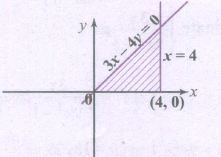
3x - 4y = 0
4y = 3x
\(\Rightarrow y=\frac { 3 }{ 4 } x\)
∴ Required volume = \(\pi \int _{ 0 }^{ 4 }{ { y }^{ 2 }dx } \)
= \(\pi \int _{ 0 }^{ 4 }{ \frac { 9 }{ 16 } { x }^{ 2 }dx } \)
= \(\frac { 9\pi }{ 16 } { \left[ \frac { { x }^{ 3 } }{ 3 } \right] }_{ 0 }^{ 4 }=\frac { 9\pi }{ 16 } \times \frac { 64 }{ 3 } \)
∴ V = \(12\pi \) Cubic units
20.
Given curve is y = \(\sqrt x\) + 1
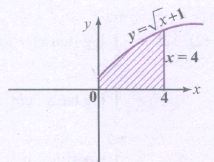
Required area
\(\int _{ 0 }^{ 4 }{ ydx } =\int _{ 0 }^{ 4 }{ (\sqrt { x } +1)dx } \)
\({ \left[ \frac { 2 }{ 3 } { x }^{ \frac { 3 }{ 2 } }+x \right] }_{ 0 }^{ 4 }=\frac { 2 }{ 3 } { (4) }^{ \frac { 3 }{ 2 } }+4\)
\(\frac { 2 }{ 3 } (4)\sqrt { 4 } +4=\frac { 16 }{ 3 } +4\)
\(\frac { 16+12 }{ 3 } =\frac { 28 }{ 3 } \) sq.units
21.
Given u(x, y) = x2 + 3xy + y2
u(xo, yo) = u(2,1)
= 22 + 3(2)(1) + 12
= 4 + 6 + 1 = 11
\(\frac { \partial u }{ \partial x } \) = 2x+ 3y
\({ \left( \frac { \partial u }{ \partial x } \right) }_{ (2,1) }\)= 2 + 3 = 5
\(\frac { \partial u }{ \partial y } \) = 3x+ 2y
\({ \left( \frac { \partial u }{ \partial y } \right) }_{ (2,1) }\) = 6 + 2 = 8
Linear approximation
L(x,y) = U(xo, yo) + \({ \left( \frac { \partial u }{ \partial x } \right) }_{ ({ x }_{ 0 },{ y }_{ 0 }) }\) (x - xo) + \({ \left( \frac { \partial u }{ \partial y} \right) }_{ ({ x }_{ 0 }{ ,y }_{ 0 }) }\)(y - yo)
L (x,y) = 11 + 5 (x - 2) + 8 (y - 1)
= 11 + 5x - 10 + 8y - 8
L(x,y) = 5x + 8y - 7
22.
Given A = {a, b, c, d} and * is defined as follows.
| * | a | b | c | d |
| a | a | c | b | d |
| b | c | d | a | a |
| c | c | d | a | a |
| d | d | b | a | c |
1) Commulative Property:
\(a * b=c\) but \(b \times a=d \Rightarrow a * b \neq b * a\)
\(a * c=b\) but \(c * a=c \Rightarrow a * c \neq c * a\)
\(\therefore\) \(\text { * }\) is not commutative on A..
2) Associative Property:
\((a+b) * c=c * c=a\)
\(a *(b * c)=a * b=c\)
\(\therefore(a * b) * c \neq a *(b * c)\)
\(\text { * }\) is not associative on A.
23.
Let z = -2
z = 2(-1) = 2(cos π + i sin π)
∴ arg(z) = π
24.
Z = \(\left( \frac { \sqrt { 3 } }{ 2 } +\frac { i }{ 2 } \right) ^{ 107 }+\left( \frac { \sqrt { 3 } }{ 2 } -\frac { i }{ 2 } \right) ^{ 107 }\)
\(\bar { z } =\left( \overline { \frac { \sqrt { 3 } }{ 2 } +\frac { i }{ 2 } } \right) ^{ 107 }+\left( \overline { \frac { \sqrt { 3 } }{ 2 } -\frac { i }{ 2 } } \right) ^{ 107 }\)
= \(\left( \frac { \sqrt { 3 } }{ 2 } -\frac { i }{ 2 } \right) ^{ 107 }+\left( \frac { \sqrt { 3 } }{ 2 } +\frac { i }{ 2 } \right) ^{ 107 }\) = z
Since z = \(\bar { z } \), Im(z) = 0
25.
Given z = 5i11 + 7i3
= 5i4 . i4 . i2 . i1 + 7. i2 . i1
= 5(1)(1)(-1)(i) + 7(-1)(i)
= -5i - 7i = -12i
∴ Re(z) = 0 and In(z) = -12
26.
Given equation is x2 + 3y2 = a2
\(\div \) a2 we get, \(\frac { { x }^{ 2 } }{ { a }^{ 2 } } +\frac { { y }^{ 2 } }{ \frac { { a }^{ 2 } }{ 3 } } =1\)
Here a2 and b2 = \(\frac{a^2}{3}\) ⇒ b = \(\frac{a}{\sqrt3}\)
Length of major axis is 2a and
Length of minor axis is 2b = \(\frac { 2a }{ \sqrt { 3 } } \times \frac { \sqrt { 3 } }{ \sqrt { 3 } } =\frac { 2a\sqrt { 3 } }{ 3 } \)
27.
Given equation of tangent is y = 3x + 1
The condition for any line y = mx + c to be a tangent to y2 = 4ax is c = \(\frac{a}{m}\)
1= \(\frac{a}{m}\) ⇒ 1 = \(\frac{a}{m}\) ⇒ a = 3
Length of the latus rectum is 4a = 4(3) = 12 units.
28.
Given circle is x2 +y2 + 2x - 3y - 8 = 0
Equation of tangent is xx1 + yy1 + 1(x + x1) -\(\frac{3}{2}\)
(y + y1) - 8 = 0
AE(2, 3), the tangent is
x(2) + y(3) + x + 2 - \(\frac{3}{2}\) (y + 3) -8 = 0
⇒ 3x + 3y + 2 - \(\frac{3y}{2}\) - \(\frac92\) - 8 = 0
Multiply by 2 we get,
⇒ 6x + 6y + 4 - 3y - 9 - 16 = 0
⇒ 6x + 3y - 21 = 0
29.
Let \({ cos }^{ -1 }\left( \frac { 3 }{ 5 } \right) =\theta \Rightarrow \frac { 3 }{ 5 } =cos\theta \)
\(\therefore sin\theta =\sqrt { 1-{ cos }^{ 2 }\theta } =\sqrt { 1-\frac { 9 }{ 25 } } =\sqrt { \frac { 25-9 }{ 25 } } \)
= \(\sqrt { \frac { 16 }{ 25 } } =\frac { 4 }{ 5 } \)
\(\therefore sin\left( { cos }^{ -1 }\left( \frac { 3 }{ 5 } \right) \right) =\frac { 4 }{ 5 } \)
30.
Given
\({ cot }^{ -1 }\left( \frac { 1 }{ 7 } \right) =0\Rightarrow \theta =\frac { 1 }{ 7 } \)
\(\Rightarrow tan\theta =7\)
\(\Rightarrow sec\theta =\sqrt { 1+{ tan }^{ 2 }\theta } =\sqrt { 1+{ 7 }^{ 2 } } =\sqrt { 50 } =5\sqrt { 2 } \)
\(\Rightarrow cos\theta ={ \frac { 1 }{ 5\sqrt { 2 } } }\)
31.
Let p(x) = x7-6x6+7x5+5x2+2x+2
It has only one change of sign. Now,
p(-x) = (-x)7 -6(-x)6 +7(-x)5 +5(-x)2 +2(-x)+2
= -x7 -6x6 -7x5 + 5x2 - 2x + 2
It has two, change of sign.
Hence, p(x) has one positive root and has at least two negative roots.
32.
Matrix form of the given system of equations is
\(\left[ \begin{matrix} 1 & 2 & 2 \\ 1 & -3 & -3 \\ 2 & 1 & k \end{matrix} \right] \left[ \begin{matrix} x \\ y \\ z \end{matrix} \right] =\left[ \begin{matrix} 0 \\ 0 \\ 0 \end{matrix} \right] \)
AX = B where A =\(\left[ \begin{matrix} 1 & 2 & 2 \\ 1 & -3 & -3 \\ 2 & 1 & k \end{matrix} \right] \)
Homogeneous system of equations has trivial solution only if |A| ≠ 0.
∴ \(\left[ \begin{matrix} 1 & 2 & 2 \\ 1 & -3 & -3 \\ 2 & 1 & k \end{matrix} \right] \) ≠ 0
Expanding along R1,
\(1\left| \begin{matrix} -3 & -3 \\ 1 & k \end{matrix} \right| -2\left| \begin{matrix} 1 & -3 \\ 2 & k \end{matrix} \right| +2\left| \begin{matrix} 1 & -3 \\ 2 & 1 \end{matrix} \right| \neq 0\)
⇒ 1 (-3k + 3) - 2 (k + 6) + 2 (1 + 6) ≠ 0
⇒ -3k + 3 -2k - 12 + 14 ≠ 0
⇒ -5k + 5 ≠ 0
⇒ -5k ≠ -5 ⇒ k ≠ \(\frac { -5 }{ -5 } \) =1
⇒ k ≠ 1
33.
A =\(\left[ \begin{matrix} 4 \\ 7 \end{matrix}\begin{matrix} 5 \\ -3 \end{matrix}\begin{matrix} -6 \\ 0 \end{matrix}\begin{matrix} 1 \\ 8 \end{matrix} \right] \)
\(\overset { { R }_{ 2 }\rightarrow { R }_{ 2 }-2{ R }_{ 1 } }{ \longrightarrow } \left[ \begin{matrix} 4 \\ -1 \end{matrix}\begin{matrix} 5 \\ -3 \end{matrix}\begin{matrix} -6 \\ 12 \end{matrix}\begin{matrix} 1 \\ 6 \end{matrix} \right] \)
\(\overset { { R }_{ 1 }\leftrightarrow { R }_{ 2 } }{ \longrightarrow } \left[ \begin{matrix} -1 \\ 4 \end{matrix}\begin{matrix} -3 \\ 5 \end{matrix}\begin{matrix} 12 \\ -6 \end{matrix}\begin{matrix} 6 \\ 1 \end{matrix} \right] \)
\(\overset { { R }_{ 1 }+(-1){ R }_{ 1 } }{ \longrightarrow } \left[ \begin{matrix} 1 \\ 4 \end{matrix}\begin{matrix} 13 \\ 5 \end{matrix}\begin{matrix} -12 \\ -6 \end{matrix}\begin{matrix} 6 \\ 1 \end{matrix} \right] \)
\(\overset { { R }_{ 2 }\rightarrow { R }_{ 2 }-4{ R }_{ 1 } }{ \longrightarrow } \left[ \begin{matrix} 1 \\ 0 \end{matrix}\begin{matrix} 13 \\ -47 \end{matrix}\begin{matrix} -12 \\ 42 \end{matrix}\begin{matrix} -6 \\ 25 \end{matrix} \right] \)
The equivalent row-echelon matrix hats two non zero rows.
∴ \(\rho\) (A) = 2
34.
Let ∝, β are the roots of the equation
Sum of the roots \(\alpha +\beta =\frac { -b }{ a } \)
\(=\frac { [-(a-2)] }{ 1 } =a-2\)
Product of the roots \(=\alpha \beta =\frac { c }{ a } \)
\(=\frac { -(a+1) }{ 1 } =-(a+1)\)
we have \({ \alpha }^{ 2 }{ \beta }^{ 2 }=({ \alpha +\beta ) }^{ 2 }-2\alpha \beta \)
\(={ (a-2) }^{ 2 }+2(a+1)\)
\(={ a }^{ 2 }-4a+4+2a+2\)
\(=(a-1{ ) }^{ 2 }+5\)
Thus \(\\ { \alpha }^{ 2 }+{ \beta }^{ 2 }\) is least if a = 1
35.
Agumented matrix
[A|B] \(\left[ \begin{matrix} 2 & 5 \\ 6 & 15 \end{matrix}|\begin{matrix} 7 \\ 13 \end{matrix} \right] \overset { { R }_{ 2 }\rightarrow { R }_{ 2 }-3{ R }_{ 1 } }{ \longrightarrow } \left[ \begin{matrix} 2 & 5 \\ 0 & 0 \end{matrix}|\begin{matrix} 7 \\ -8 \end{matrix} \right] \)
Here \(\rho\) (A) = 2 and \(\rho\)([A|B]) = 3
∴ \(\rho\) (a) ≠ \(\rho\) ([AIB])
Hence the system is inconsistent.
36.
Given A3 = 1
Pre multiply by A-1 we get,
A-1. A3 = A-1. I
⇒ (A-1. A) A2 = A-1 [∵ A-1 I = A-1]
⇒ I. A2 = A-1 I∵ A-1. A = I]
⇒ A2 = A-1 [∵ I. A2 = A2]
∴ A-1 = A2
37.
The equation of the required plane through the intersection of the given planes is
( x + y + z - 6 ) + λ (2x + 3y + 4z + 5) = 0 ......(1)
This passes through (1, 1, 1)
∴ ( 1+ 1 + z - 6) + λ (2 + 3+ 4 + 5) = 0
⇒ -3 +14λ = 0 \(\Rightarrow \lambda =\frac { 3 }{ 14 } \)
Substituting \(\lambda =\frac { 3 }{ 14 } \) in (1) we get
( x + y + z - 6 )+\(\frac { 3 }{ 14 } \) (2x + 3y + 4z + 5) = 0
⇒ 14( x + y + z - 6 ) +3 (2 + 3+ 4 + 5) = 0
⇒ 20x + 23y + 26z - 69 = 0
38.
Since the plane passing through the point \(\overset { \rightarrow }{ a } =\overset { \wedge }{ i } -\overset { \wedge }{ j } +2\overset { \wedge }{ k } \) and is normal to the vector \(\overset { \rightarrow }{ n } =2\overset { \wedge }{ i } +3\overset { \wedge }{ j } +2\overset { \wedge }{ k } \)
the vector equation of the plane is \(\overset { \rightarrow }{ r } .\overset { \rightarrow }{ n } =\overset { \rightarrow }{ a } .\overset { \rightarrow }{ n } \)
\(\Rightarrow { \overset { \rightarrow }{ r } }.\left( 2\overset { \wedge }{ i } +3\overset { \wedge }{ j } +2\overset { \wedge }{ k } \right) =\left( \overset { \wedge }{ i } -\overset { \wedge }{ j } +2\overset { \wedge }{ k } \right) .\left( 2\overset { \wedge }{ i } +3\overset { \wedge }{ j } +2\overset { \wedge }{ k } \right) \)
\(\Rightarrow { \overset { \rightarrow }{ r } }.\left( 2\overset { \wedge }{ i } +3\overset { \wedge }{ j } +2\overset { \wedge }{ k } \right) \)= 2 - 3 + 4 = 3
\(\therefore { \overset { \rightarrow }{ r } }.\left( 2\overset { \wedge }{ i } +3\overset { \wedge }{ j } +2\overset { \wedge }{ k } \right) \)= 3
39.
Given (x1, y1, z1) is (2, -1, 3) (x2, y2, z2) is (4, 2, 1)
Cartesian equation of a line passing through two points is \(\frac { x-{ x }_{ 1 } }{ { x }_{ 2 }-{ x }_{ 1 } } =\frac { y-{ y }_{ 1 } }{ { y }_{ 2 }-{ y }_{ 1 } } =\frac { z-{ z }_{ 1 } }{ { z }_{ 2 }-{ z }_{ 1 } } \)
\(\Rightarrow \frac { x-2 }{ 2 } =\frac { y+1 }{ 3 } =\frac { z-3 }{ -2 } \)

12th Standard Syllabus & Materials
12th Standard
TN 12th Computer Applications களப்பெயர் முறைமை (DNS) Sample Question Papers Study Material - QB365 Set A
NEW12th Standard
TN 12th Computer Applications வலையமைப்பு எடுத்துக்காட்டுகள் மற்றும் நெறிமுறைகள் Sample Question Papers Study Material - QB365 Set A
NEW12th Standard
TN 12th Computer Applications கணினி வலையமைப்பு ஓர் அறிமுகம் Sample Question Papers Study Material - QB365 Set A
NEW12th Standard
TN 12th Computer Applications PHP-உடன் MySQL-ஐ இணைத்தல் Sample Question Papers Study Material - QB365 Set A



Tamilnadu Stateboard 12th Standard Subjects
Maths

Chemistry

Physics

Biology

Computer Science

Business Maths and Statistics

Economics

Commerce

Accountancy

History

Computer Applications
Biology
Computer Technology
Computer Applications
Computer Science
Business Maths and Statistics
Commerce
Economics
Maths
Chemistry
Physics
Computer Technology
History
Accountancy

Tamil

English

French
Tamilnadu Stateboard Standards

