
 100% FREE ACCESS
12th Standard Syllabus & Materials
12th Standard
TN 12th Maths Applications of Matrices and Determinants Sample Question Papers Study Material - QB365 Set A
NEW12th Standard
TN 12th Computer Applications மின்னணு தரவு பரிமாற்றம் Sample Question Papers Study Material - QB365 Set A
NEW12th Standard
TN 12th Computer Applications மின் - வணிக பாதுகாப்பு அமைப்புகள் Sample Question Papers Study Material - QB365 Set A
NEW12th Standard
TN 12th Computer Applications மின்னணு செலுத்தல் முறைகள் Sample Question Papers Study Material - QB365 Set A
NEW12th Standard
TN 12th Computer Applications மின் - வணிகம் Sample Question Papers Study Material - QB365 Set A
NEW12th Standard
TN 12th Computer Applications திறந்த மூல கருத்துருக்கள் Sample Question Papers Study Material - QB365 Set A

Published on: 27/02/2021
12th Standard English Medium Maths Reduced Syllabus Five Mark Important Questions - 2021(Public Exam )
Download Tamil Nadu 12th Standard Maths question papers, model tests, one-mark questions, important questions, and public exam papers in PDF format. Free study materials and answer keys for TN State Board students.
Questions + Answers key
Take MCQ Maths Test1.
Find the area of the region in the first quadrant bounded by the parabola y2 = 4x, the line x + y = 3 and y-axis.
2.
Evaluate the following integrals as the limits of sums.
\(\int _{ 1 }^{ 2 }{( 4x^2-1)dx } \)
3.
Find the intervals of monotonicity and local extrema of the function \(f(x)=\frac{1}{1+x^{2}}\)
4.
Discuss the monotonicity and local extrema of the function \(f(x)=log(1+x)-\frac{x}{1+x},x>-1\) and hence find the domain where, \(log(1+x)>\frac{x}{1+x}\)
5.
Write the Maclaurin series expansion of the following function:
cos2 x
6.
A ladder 17 metre long is leaning against the wall. The base of the ladder is pulled away from the wall at a rate of 5 m/s. When the base of the ladder is 8 metres from the wall.
(i) How fast is the top of the ladder moving down the wall?
(ii) At what rate, the area of the triangle formed by the ladder, wall and the floor is changing?
7.
8.
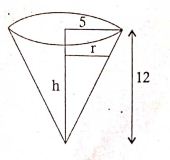
Salt is poured from a conveyer belt at a rate of 30 cubic metre per minute forming a conical pile with a circular base whose height and diameter of base are always equal. How fast is the height of the pile increasing when the pile is 10 metre high?
9.
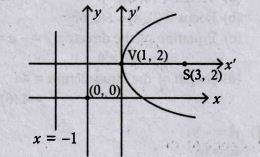
Find the vertex, focus, equation of directrix and length of the latus rectum of the following: y2−4y−8x+12 = 0
10.
If \(\vec { a } =\vec { i } -\vec { j } ,\vec { b } =\hat { i } -\hat { j } -4\hat { k } ,\vec { c } =3\hat { j } -\hat { k } \) and \(\vec { d } =2\hat { i } +5\hat { j } +\hat { k } \)
(i) \((\vec { a } \times \vec { b } )\times (\vec { c } \times \vec { d } )=[\vec { a } ,\vec { b } ,\vec { d } ]\vec { c } -[\vec { a } ,\vec { b } ,\vec { c } ]\vec { d } \)
11.
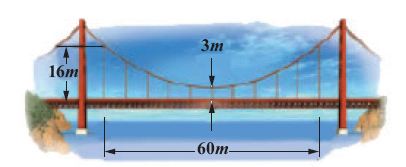
Parabolic cable of a 60m portion of the roadbed of a suspension bridge are positioned as shown below. Vertical Cables are to be spaced every 6m along this portion of the roadbed. Calculate the lengths of first two of these vertical cables from the vertex.
12.
At a water fountain, water attains a maximum height of 4 m at horizontal distance of 0.5 m from its origin. If the path of water is a parabola, find the height of water at a horizontal distance of 0.75 m from the point of origin.
13.
Find the value of k for which the equations
kx - 2y + z = 1, x - 2ky + z = -2, x - 2y + kz = 1 have
(i) no solution
(ii) unique solution
(iii) infinitely many solution
14.
Test for consistency and if possible, solve the following systems of equations by rank method.
2x - y + z = 2, 6x - 3y + 3z = 6, 4x - 2y + 2z = 4
15.
Solve the equation z3+ 27 = 0
16.
Find the equations of tangents to the hyperbola \(\frac { { x }^{ 2 } }{ 16 } -\frac { { y }^{ 2 } }{ 64 } \) = 1 which are parallel to10x − 3y + 9 = 0.
17.
Solve \(tan^{ -1 }\left( \frac { x-1 }{ x-2 } \right) +tan^{ -1 }\left( \frac { x+1 }{ x+2 } \right) =\frac { \pi }{ 4 } \)
18.
If A = \(\left[ \begin{matrix} -4 & 4 & 4 \\ -7 & 1 & 3 \\ 5 & -3 & -1 \end{matrix} \right] \) and B = \(\left[ \begin{matrix} 1 & -1 & 1 \\ 1 & -2 & -2 \\ 2 & 1 & 3 \end{matrix} \right] \), find the products AB and BA and hence solve the system of equations x - y + z = 4, x - 2y - 2z = 9, 2x + y + 3z = 1.
19.
Solve the following system of equations, using matrix inversion method:
2x1 + 3x2 + 3x3 = 5, x1 - 2x2 + x3 = -4, 3x1 - x2 - 2x3 = 3.
20.
Find the equation of the ellipse whose eccentricity is \(\frac { 1 }{ 2 } \), one of the foci is(2, 3) and a directrix is x = 7. Also find the length of the major and minor axes of the ellipse.
21.
Solve the equation (x-2) (x-7) (x-3) (x+2)+19 = 0
22.
Solve the equation x3− 9x2+14x + 24 = 0 if it is given that two of its roots are in the ratio 3:2.
23.
24.
Find the equations of the tangents to the curve y = 1 + x3 for which the tangent is orthogonal with the line x +12y = 12.
25.
Find the asymptotes of the following curve \(f(x)=\frac { { x }^{ 2 } }{ { x }^{ 2 }-1 } \)
1.
First, we find the points of intersection of x + y = 3 and y2 − 4x:
x + y = 3 ⇒ y = 3− x.
\(\therefore\) y2 = 4x ⇒ (3 -x)2 = 4x
⇒ x2 −10x + 9 = 0
⇒ x = 1, x = 9 .
\(\therefore\) x = 1 in x + y = 3 \(\Rightarrow\) y = 2, and x = 9 in x + y = 3 ⇒ y = −6 .
\(\therefore\) (1, 2) and (9,−6) are the points of intersection.
The line x + y = 3 meets the y -axis at (0, 3).
The required area is sketched
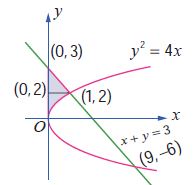
Viewing in the direction of y -axis, on the right bounding curve is given by
\(x=\begin{cases} \frac { { y }^{ 2 } }{ 4 } ,0\le y\le 2 \\ 3-y,2\le y\le 3 \end{cases}\)
\(\therefore A=\int _{ 0 }^{ 2 }{ xdy+\int _{ 2 }^{ 3 }{ xdy } =\int _{ 0 }^{ 2 }{ \frac { { y }^{ 2 } }{ 4 } dy+\int _{ 2 }^{ 3 }{ (3-y) } dy } } \)
\(={ \left( \frac { { y }^{ 3 } }{ 12 } \right) }_{ 0 }^{ 2 }+{ \left( 3y-\frac { { y }^{ 3 } }{ 2 } \right) }_{ 2 }^{ 3 }=\left( \frac { 8 }{ 12 } -0 \right) +\left( 9-\frac { 9 }{ 2 } \right) -\left( 6-\frac { 4 }{ 2 } \right) =\frac { 7 }{ 6 } \)
2.
Here a = 1, b = 2,f(x) = 4x2-1
\(\therefore f(a+(b-a)\frac { r }{ n } )=f(1+1(\frac { r }{ n } ))\)
\(=f\left( 1+\frac { r }{ n } \right) \)
\(=4{ \left( 1+\frac { r }{ n } \right) }^{ 2 }-1=4\left( 1+\frac { { r }^{ 2 } }{ { n }^{ 2 } } +\frac { 2r }{ n } \right) -1\)
\(=4+\frac { { 4r }^{ 2 } }{ { n }^{ 2 } } +\frac { 8r }{ n } -1=3+\frac { { 4r }^{ 2 } }{ { n }^{ 2 } } +\frac { 8r }{ n } \)
\(\int _{ a }^{ b }{ f(x)dx= } \underset { n\rightarrow \infty }{ lim } \frac { b-a }{ n } \sum _{ r=1 }^{ n }{ f } \left( a+(b-a)\frac { r }{ n } \right) \)
\(\therefore \int _{ 1 }^{ 2 }{ ({ 4x }^{ 2 }-1)dx } =\underset { n\rightarrow \infty }{ lim } \frac { 1 }{ n } \sum _{ r=1 }^{ n }{ \left( 3+\frac { { 4r }^{ 2 } }{ { n }^{ 2 } } +\frac { 8r }{ n } \right) } \)
\(=\underset { n\rightarrow \infty }{ lim } \left[ \frac { 1 }{ n } \sum _{ r=1 }^{ n }{ 3+\frac { 1 }{ n } } \sum _{ r=1 }^{ n }{ \frac { { 4r }^{ 2 } }{ { n }^{ 2 } } } +\frac { 1 }{ n } \sum _{ r=1 }^{ n }{ \frac { 8r }{ n } } \right] \)
\(=\left[ \underset { n\rightarrow \infty }{ lim } \frac { 1 }{ n } .3n+\frac { 1 }{ n } \frac { 4 }{ { n }^{ 2 } } ({ 1 }^{ 2 }+{ 2 }^{ 2 }+...+{ n }^{ 2 })+\frac { 1 }{ n } .\frac { 8 }{ n } (1+2+3....+n) \right] \)\(=\underset { n\rightarrow \infty }{ lim } \left[ 3+\frac { 4 }{ { n }^{ 3 } } \frac { n(n+1)(2+1) }{ 6 } +\frac { 8 }{ { n }^{ 2 } } \frac { n(n+1) }{ 2 } \right] \)
\(\left[ \because \sum { r } =\frac { n(n+1) }{ 2 } \sum { { r }^{ 2 }=\frac { n(n+1)(2n+1) }{ 6 } } \right] \)
\(=\underset { n\rightarrow \infty }{ lim } \left[ 3+\frac { 4 }{ { n }^{ 3 } } \frac { { n }^{ 3 }(1+\frac { 1 }{ n } )(2+\frac { 1 }{ n } ) }{ 6 } +\frac { 8 }{ { n }^{ 2 } } \frac { { n }^{ 2 }(1+\frac { 1 }{ n } ) }{ 2 } \right] \)
\(=[3+\frac { 2 }{ 3 } (1+0)(2+0)+4(1+0)]\)
\([\because when\quad n\rightarrow \infty ,1/n\rightarrow 0]\)
\(=3+\frac { 4 }{ 3 } +4=\frac { 9+4+12 }{ 3 } =\frac { 25 }{ 3 } \)
\(\therefore \int _{ 1 }^{ 2 }{ (4{ x }^{ 2 }-1)dx=\frac { 25 }{ 3 } } \)
3.
The given function is defined and is differentiable at all \(x\in (-\infty, \infty) \). As
\(f(x)=\frac{1}{1+x^{2}}\).
We have \(f'(x)=-\frac{2x}{(1+x^{2})^{2}}\)
The stationary points are given by \(-\frac{2x}{(1+x^{2})^{2}}=0\) that is x = 0
Hence the intervals of monotonicity are \((-\infty,0)\) and \((0,\infty)\)
On the interval \((-\infty,0)\) the function strictly increases because f'(x) > 0 in that interval.
The function f(x) strictly decreases in the interval \((0,\infty)\) because f'(x) < 0 in that interval.
Since f′(x) changes from positive to negative when passing through x = 0, the first derivative test tells us there is local maximum at x = 0 and the local maximum value is f (0) = 1.
4.
We have,
\(f(x)=log(1+x)-\frac{x}{1+x}\)
Therefore, \(f'(x)=\frac{1}{1+x}-\frac{1}{(1+x)^{2}}\)
= \(\frac{x}{(1+x)^{2}}\).
Hence, f′(x) is \(\begin{cases} <0 \ when-1
Therefore f (x) is strictly increasing for x > 0 and strictly decreasing for x < 0. Since f′(x) changes from negative to positive when passing through x = 0, the first derivative test tells us there is a local minimum at x = 0 which is f (0) = 0. Further, for x > 0, f(x) > f (0) = 0 gives
\(log(1+x)-\frac{x}{1+x}>0 \Rightarrow log(1+x)>\frac{x}{1+x}\).
5.
Let (x) = cos2 x
fI(x) = 2cos x (- sin x)
= - sin 2x ⇒ fl(0) = 0
fIl(x) = - 2 cos 2x ⇒ fIl(0) = -2
fIII(x) = + 4 sin 2 x ⇒ fIII(0) = 0
fIV(x) = 8 cos 2 x ⇒ fIV(0) = 8
fV(x) = -16 sin 2x ⇒ fV(0) = 0
fVI(x) = - 32 cos 2x ⇒ fVI(0) = -32
∴ Maclaurin's series
\(f(x)=f(0)+\frac { { f }^{ 1 }(0) }{ 1! } x+\frac { { f }^{ II }(0) }{ 2! } { x }^{ 2 }+\frac { { f }^{ III }(0) }{ 3! } { x }^{ 3 }+\) .......
∴ cos x = 1 - \(\frac { 2{ x }^{ 2 } }{ 2! } +\frac { 8{ x }^{ 4 } }{ 4! } +\frac { { 32x }^{ 6 } }{ 6! } \) + ...
= 1 - \(\frac { 2{ x }^{ 2 } }{ 2! } +\frac { { 2 }^{ 3 }{ x }^{ 4 } }{ 4! } +\frac { { { 2 }^{ 5 }x }^{ 6 } }{ 6! } \)+ ...
6.
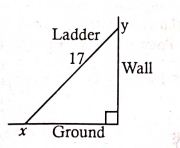
Let AB be the position of the ladder at any time t such that OA = x and OB = y
Then OA2 + OB2 = AB2
⇒ x2 + y2 = 172
Given \(\frac { dx }{ dt } \) = 5 and x = 8
When x = 8, 82 + y2 = 172
⇒ y2 = 289 - 64 = 225
⇒ y = 15
Differentiating (1) with respect to 't' we get,
\(2x\frac { dx }{ dt } +2y\frac { dy }{ dt } =0\)
⇒ 8(5) + 15 \(\frac { dy }{ dt } \) = 0 [∵ x = 8, \(\frac { dx }{ dt } \) = 15, y = 15]
⇒ 40 + 15\(\frac { dy }{ dt } \) = 0
⇒ \(\frac { dy }{ dt } =\frac { -40 }{ 15 } =\frac { -8 }{ 3 } \) m/sec
∴ The rate of top of the ladder moving down the wall is \(\frac{-8}{3}\) m/sec
(ii) The ladder, the wall and the floor forms a right angled triangle.
Area = \(\frac12\)xy
Differentiating with respect to 't' we get,
\(\frac { dA }{ dt } =\frac { 1 }{ 2 } \left[ x\frac { dy }{ dx } +y\frac { dx }{ dt } \right] \)
\(=\frac { 1 }{ 2 } \left[ 8\left( -\frac { 8 }{ 3 } \right) +15(5) \right] \)
= \(\frac { 1 }{ 2 } \left[ \frac { -64 }{ 3 } +75 \right] =\frac { 1 }{ 2 } \)
= \(\frac { 1 }{ 2 } \left[ \frac { -64+225 }{ 3 } \right] =\frac { 1 }{ 2 } \left( \frac { 161 }{ 3 } \right) \)
= \(\frac { dA }{ dt } \) = 26.83 sq.m/sec
7.
8.
Let h and r be the height and the base radius. Therefore h = 2r. Let V be the volume of the salt cone.
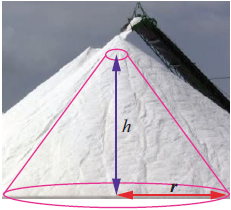
\(V=\frac{1}{3}\pi r^{2}h=\frac{1}{12}\pi h^{3}; \frac{dV}{dt}=30\) mtr3 / min.
Hence, \(\frac{dV}{dt}=\frac{1}{4}\pi h^{2}\frac{dh}{dt}\)
Therefore, \(\frac{dh}{dt}=4 \frac{dV}{dt}.\frac{1}{\pi h^{2}}\)
That is, \(\frac{dh}{dt}=4\times30\times \frac{1}{100 \pi}\)
=\(\frac{6}{5\pi}\) mtr / min.
9.
y2 - 4y - 8x + 12 = 0
y2-4y = 8x-12
Adding 4 both sides, we get,
y - 4y + 4 = 8x - 12 + 4 = 8x - 8
⇒ (y - 2)2 = 8(x - 1)
This is a right open parabola and latus
rectum is 4a = 8 ⇒ a = 2.
(a) Vertex is (1, 2) ⇒ h = 1, k = 2
(b) focus is (h + a, 0 + k)
⇒ (1 + 2, 0 + 2)
⇒ (3, 2)
(c) Equation of directrix is x = h - a
⇒ x = 1-2
⇒ x = -1
(d) Length of latus rectum is 4a = 8 units.
10.
By definition,
\(\vec { a } \times \vec { b } =\left| \begin{matrix} \hat { i } & \hat { j } & \hat { k } \\ 1 & -1 & 0 \\ 1 & -1 & -4 \end{matrix} \right| =4\hat { i } +4\hat { j } ,\vec { c } \times \vec { d } =\left| \begin{matrix} \hat { i } & \hat { j } & \hat { k } \\ 0 & 3 & -1 \\ 2 & 5 & 1 \end{matrix} \right| =8\hat { i } -2\hat { j } -6\hat { k } \)
\((\vec { a } \times \vec { b } )(\vec { c } \times \vec { d } )=\left| \begin{matrix} \hat { i } & \hat { j } & \hat { k } \\ 4 & 4 & 0 \\ 8 & -2 & -6 \end{matrix} \right| =-24\hat { i } +24\hat { j } -40\hat { k } \) ..............(1)
On the other hand, we have
\([\vec { a }, \vec { b }, \vec { d } ]\vec { c } -[\vec { a } ,\vec { b } ,\vec { c } ]\vec { d } =28(3\vec { j } -\vec { k } )-12(2\hat { i } +5\hat { j } +\hat { k } )=-24\hat { i } +24\hat { j } -40\hat { k } \) ..............(2)
Therefore, from equations (1) and (2), identity (i) is verified.
The verification of identity (ii) is left as an exercise to the reader
11.
Let the of the parbola be x2 = 4ay (1)
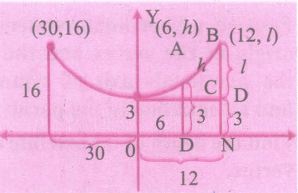
Since (30, 16) is a point on (1),
we get 302 = 4 \(\times\) a \(\times\) 16
⇒ a = \(\frac { 30\times 30 }{ 4\times 16 } =\frac { 225 }{ 16 } \)
∴ becomes, x2 = \({ x }^{ 2 }=\frac { 4\times 225 }{ 16 } y=\frac { 225 }{ 4 } y\)
Let AC = h m and BD = lm
∴ A(6, h) is a point on the parabola [∵ OD = 6]
∴ \({ 6 }^{ 2 }=\frac { 225 }{ 4 } \times h\)
⇒ \(h=\frac { 36\times 4 }{ 225 } \Rightarrow h=0.52\)
∴ AD = 3 + h = 3 + 0.52 = 3.52 m
Also (12, 1) is a point on the parabola
[∵ ON = 6 + 6 = 12]
∴ \({ 12 }^{ 2 }=\frac { 225 }{ 4 } \times l\)
⇒ l = \(\frac { 12\times 12\times 4 }{ 225 } =\frac { 576 }{ 225 } =2.08\) = 5.08 m
Hence the length of first two vertical cables are 3.52 m and 5.08 m.
12.

Let the equation of the parabola be
(x - h)2 = -4a(y - k).
Here the vertex is (0.5, 4)
Equation of the parabola is (x - 0.5)2
= -4a(y-4) ...(1)
O(0, 0) is a point on the parabola
(0 - 0.5)2 = -4a (0 - 4)
⇒ \({ \left( \frac { -1 }{ 2 } \right) }^{ 2 }=-4a(-4)\)
⇒ \(\frac { 1 }{ 4 } =16a\Rightarrow a=\frac { 1 }{ 64 } \)
∴ (1) becomes as (x - 0.5)2 = \(-4\times \frac { 1 }{ 64 } (y-4)\)
Also D(0.75, y1) is a point on the parabola
∴ (0.75 - 0.5)2 = \(\frac { -1 }{ 16 } ({ y }_{ 1 }-4)\)
⇒ \({ \left( \frac { 1 }{ 4 } \right) }^{ 2 }=\frac { -1 }{ 6 } ({ y }_{ 1 }-4)\)
\(\Rightarrow \frac{1}{\not 16}=\frac{1}{\not16}\left(y_{1}-4\right)\)
⇒ 1 = -y1 + 4
⇒ y1 = -1 + 4 = 3m
Height of the water at a horizontal distance of 0.75m is 3m
13.
kx-2y+z = 1, -2ky+z = -2, x-2y+k = 1
The matrix form of the system is AX = B where
\(\left[ \begin{matrix} k & -2 & 1 \\ 1 & -2k & 1 \\ 1 & -2 & k \end{matrix} \right] ,X=\left[ \begin{matrix} x \\ y \\ z \end{matrix} \right] ,B=\left[ \begin{matrix} 1 \\ -2 \\ 1 \end{matrix} \right] \)
Applying elementary row operation on the augment matrix [A|B] we get
[A|B] =\(\left[ \begin{matrix} k & -2 & 1 \\ 1 & -2k & 1 \\ 1 & -2 & k \end{matrix}|\begin{matrix} 1 \\ -2 \\ 1 \end{matrix} \right] \overset { { R }_{ 1 }\leftrightarrow { R }_{ 3 } }{ \longrightarrow } \left[ \begin{matrix} 1 & -2 & k \\ 1 & -2k & 1 \\ k & -2 & k \end{matrix}|\begin{matrix} 1 \\ -2 \\ 1 \end{matrix} \right] \)
\(\overset { { R }_{ 2 }\rightarrow { R }_{ 2 }+{ R }_{ 1 }\\ { R }_{ 3 }\rightarrow { R }_{ 3 }-k{ R }_{ 1 } }{ \longrightarrow } \left[ \begin{matrix} 1 & -2 & k \\ 1 & -2k+2 & k \\ 0 & -2+2k & 1-k^{ 2 } \end{matrix}|\begin{matrix} 1 \\ - \\ 1-k \end{matrix} \right] \)
\(\overset { { R }_{ 3 }\rightarrow { R }_{ 3 }+{ R }_{ 2 } }{ \longrightarrow } \left[ \begin{matrix} 1 & -2 & k \\ 0 & -2k+2 & k \\ 0 & 0 & 1-k^{ 2 } \end{matrix}|\begin{matrix} 1 \\ -3 \\ 1-k \end{matrix} \right] \)
\(\rightarrow \left[ \begin{matrix} 1 & -2 & k \\ 0 & -2k+2 & 1-k \\ 0 & 0 & { k }^{ 2 }-k+2 \end{matrix}\begin{matrix} 1 \\ -3 \\ -k-2 \end{matrix} \right] \)
\(\rightarrow \left[ \begin{matrix} 1 & -2 & k \\ 0 & -2k+2 & 1-k \\ 0 & 0 & (k+2)(1-k) \end{matrix}|\begin{matrix} 1 \\ -3 \\ -k-2 \end{matrix} \right] \).........(1)
Case (i): when k = 1
\([A|B]\rightarrow \left[ \begin{matrix} 1 & -2 & 1 \\ 0 & 0 & 0 \\ 0 & 0 & 0 \end{matrix}\begin{matrix} 1 \\ -3 \\ -3 \end{matrix} \right] \overset { { R }_{ 3 }\rightarrow { R }_{ 3 }-{ R }_{ 2 } }{ \longrightarrow } \left[ \begin{matrix} 1 & -2 & 1 \\ 0 & 0 & 0 \\ 0 & 0 & 0 \end{matrix}|\begin{matrix} 1 \\ -3 \\ 0 \end{matrix} \right] \)
Here \(\rho \)(A) = 3 and \(\rho \)[A|B] = 3
So, \(\rho \)(A) ≠ \(\rho \)[A|B] ⇒ The system has no solution
Case (ii): when k ≠ 2, k ≠ -2
\(\left[ \begin{matrix} 1 & -2 & k \\ 0 & -2k+2 & 1-k \\ 0 & 0 & not\quad zero \end{matrix}|\begin{matrix} 1 \\ -3 \\ not\quad zero \end{matrix} \right] \)
⇒ \(\rho \)(A) = 3 and \(\rho \)[A|B] = 3
so, \(\rho \)(A) =\(\rho \)[A|B] = 3 = the number of unknowns Hence, the system has unique solution.
Case (iii): when k = -2
\(\rho [A|B]\rightarrow \left[ \begin{matrix} 1 \\ 1 \\ 0 \end{matrix}\begin{matrix} -2 \\ 6 \\ 0 \end{matrix}\begin{matrix} -2 \\ 3 \\ 0 \end{matrix}\begin{matrix} 1 \\ -3 \\ 0 \end{matrix} \right] \)
Here \(\rho \) (A) = 2 and \(\rho \)[A|B] = 2
∴ \(\rho \)(A) = \(\rho \)[A|B] = 2<3 the number of unknowns so the system is consistent with infinitely many solutions.
14.
2x - y + z = 2, 6x - 3y + 3z = 6, 4x - 2y + 2z = 4
The matrix form of the given system is AX = B where
A =\(\left[ \begin{matrix} 2 & -1 & 1 \\ 6 & -3 & 3 \\ 4 & -2 & 2 \end{matrix} \right] \)
\(X=\left[ \begin{matrix} x \\ y \\ z \end{matrix} \right] B=\left[ \begin{matrix} 2 \\ 6 \\ 4 \end{matrix} \right] \)
Applying elementary row operations on the augment matrix [A|B], we get,
[A|B] =\(\left[ \begin{matrix} 2 & -1 & 1 \\ 6 & -3 & 3 \\ 4 & -2 & 2 \end{matrix}|\begin{matrix} 2 \\ 6 \\ 4 \end{matrix} \right] \overset { { R }_{ 2 }\rightarrow { R }_{ 2 }-3{ R }_{ 1 }\\ { R }_{ 3 }\rightarrow { R }_{ 3 }-2{ R }_{ 1 } }{ \longrightarrow } \left[ \begin{matrix} 2 & -1 & 1 \\ 0 & 0 & 0 \\ 0 & 0 & 0 \end{matrix}|\begin{matrix} 2 \\ 0 \\ 0 \end{matrix} \right] \)
Here \(\rho \)(A) = 1 [∵ only one non zero row]
and \(\rho \)[A|B] = 1 [∵ only one-zero row]
∴ \(\rho \)(A) =\(\rho \)(A|B] = 1< 3 the given system is consistent and has two parameter family of solutions.
So, z = t and y = s where, t \(\in \)R
Writing the equivalent equations from the rowechelon matrix, we get
2x-y+z = 2 .............(1)
y = s
z = t
Substituting (2) and (3) In (1) we get
2x-s+t = 2
⇒ 2x-s+t = 2
⇒ x = \(\frac{1}{2}\)[s-t+2]
∴ Solution set is {\(\frac{1}{2}\)(s-t+2),s,t} here s, t \(\in \) R.
15.
z3 = -27 = (-1 \(\times\) 3)3 = -1 \(\times\) 33
z = \((-1)^{ \frac { 1 }{ 3 } }\times 3^{ 3\times \frac { 1 }{ 3 } }=(-1)^{ \frac { 1 }{ 3 } }\)\(\times\) 3
∴ z = 3\(\left[ cos\pi +isin\pi \right] ^{ \frac { 1 }{ 3 } }\)
[∵ cos π = -1 and sin π = 0]
= 3\(\left[ cos\frac { 1 }{ 3 } (2k\pi +\pi )isin\frac { 1 }{ 3 } (2k\pi +\pi ) \right] \)
k = 0, 1, 2
When k = 0,
z = 3\(\left[ cos\frac { 1 }{ 3 } (\pi )isin\frac { 1 }{ 3 } (\pi ) \right] =3cos\frac { \pi }{ 3 } \)
When k = 1
z = 3\(\left[ cos\frac { 1 }{ 3 } (3\pi )isin\frac { 1 }{ 3 } (3\pi ) \right] \)
= 3[cos π + i sin π] = 3(-1+0)
When k = 2
z = 3\(\left[ cos\frac { 1 }{ 3 } (5\pi )isin\frac { 1 }{ 3 } (5\pi ) \right] =3\left[ cos5\frac { \pi }{ 3 } \right] \)
Hence, the roots are 3 cis\(\frac { \pi }{ 3 } \), -3, 3 c is 5\(\frac { \pi }{ 3 } \)
16.
Given equation of hyperbola is \(\frac { { x }^{ 2 } }{ 16 } -\frac { { y }^{ 2 } }{ 64 } =1\)
Let y = mx + c be the required tangent
⇒ a2 = 16 and b2 = 64
The tangents are parallel to 10x - 3y + 9 = 0.
∴ Slope of tangent (m)
= Slope of the line 10x - 3y + 9 = 0.
∴ m = \(\frac{-co - efficient of \ x}{co - efficient of \ y}\)= \(\frac { -10 }{ -3 } =\frac { 10 }{ 3 } \)
The condition for y = mx + c to be a tangent to the hyperbola is c2 = a2m2 - b2
⇒ \({ c }^{ 2 }=16\left( \frac { 100 }{ 9 } \right) -64=\frac { 1600-64\times 9 }{ 9 } \)
⇒ \(\frac { 1024 }{ 9 } \Rightarrow c=\pm \frac { 32 }{ 3 } \)
∴ The required tangents are
y = \(\frac { 10 }{ 3 } x+\frac { 32 }{ 3 } \) or \(y=\frac { 10x }{ 3 } -\frac { 32 }{ 3 } \)
⇒ 3y = 10x + 32 or 3y = 10x - 32
⇒ 10x−3y+32 = 0, or 10x+3y−32 = 0
17.
Now, \(tan^{ -1 }\left( \frac { x-1 }{ x-2 } \right) +tan^{ -1 }\left( \frac { x+1 }{ x+2 } \right) =tan^{ -1 }\left[ \frac { \frac { x-1 }{ x-2 } +\frac { x+1 }{ x+2 } }{ 1-\frac { x-1 }{ x-2 } \left( \frac { x+1 }{ x+2 } \right) } \right] =\frac { \pi }{ 4 } \)
Thus, \(\frac { \frac { x-1 }{ x-2 } +\frac { x+1 }{ x+2 } }{ 1-\frac { x-1 }{ x-2 } \left( \frac { x+1 }{ x+2 } \right) } \) = 1, which on simplification gives 2x2−4 = −3
Thus, x2 = \(\frac{1}{2}\)gives x = \(\pm \frac { 1 }{ \sqrt { 2 } } \)
18.
We find AB = \(\left[ \begin{matrix} -4 & 4 & 4 \\ -7 & 1 & 3 \\ 5 & -3 & -1 \end{matrix} \right] \left[ \begin{matrix} 1 & -1 & 1 \\ 1 & -2 & -2 \\ 2 & 1 & 3 \end{matrix} \right] =\left[ \begin{matrix} -4+4+8 & 4-8+4 & -4-8+12 \\ -7+1+6 & 7-2+3 & -7-2+9 \\ 5-3-2 & -5+6-1 & 5+6-3 \end{matrix} \right] \)
= \(\left[ \begin{matrix} 8 & 0 & 0 \\ 0 & 8 & 0 \\ 0 & 0 & 8 \end{matrix} \right] \) = 8I3
and BA = \(\left[ \begin{matrix} 1 & -1 & 1 \\ 1 & -2 & -2 \\ 2 & 1 & 3 \end{matrix} \right] \left[ \begin{matrix} -4 & 4 & 4 \\ -7 & 1 & 3 \\ 5 & -3 & -1 \end{matrix} \right] =\left[ \begin{matrix} -4+7+5 & 4-1-3 & 4-3-1 \\ -4+14-10 & 4-2+6 & 4-6+2 \\ -8-7+15 & 8+1-9 & 8+3-3 \end{matrix} \right] \)
= \(\left[ \begin{matrix} 8 & 0 & 0 \\ 0 & 8 & 0 \\ 0 & 0 & 8 \end{matrix} \right] \) = 8I3
So we get AB = BA = 8I3. That is, (\(\frac { 1 }{ 8 } A\))B = B(\(\frac { 1 }{ 8 } A\)) = I3. Hence, B-1 = \(\frac { 1 }{ 8 } A\).
Writing the given system of equations in matrix form, we get
\(\left[ \begin{matrix} 1 & -1 & 1 \\ 1 & -2 & -2 \\ 2 & 1 & 3 \end{matrix} \right] \left[ \begin{matrix} x \\ y \\ z \end{matrix} \right] =\left[ \begin{matrix} 4 \\ 9 \\ 1 \end{matrix} \right] \).
That is B \(\left[ \begin{matrix} x \\ y \\ z \end{matrix} \right] =\left[ \begin{matrix} 4 \\ 9 \\ 1 \end{matrix} \right] \).
So, \(\left[ \begin{matrix} x \\ y \\ z \end{matrix} \right] ={ B }^{ -1 }\left[ \begin{matrix} 4 \\ 9 \\ 1 \end{matrix} \right] \)
= \(\left( \frac { 1 }{ 8 } A \right) \left[ \begin{matrix} 4 \\ 9 \\ 1 \end{matrix} \right] =\frac { 1 }{ 8 } \left[ \begin{matrix} -4 & 4 & 4 \\ -7 & 1 & 3 \\ 5 & -3 & -1 \end{matrix} \right] \left[ \begin{matrix} 4 \\ 9 \\ 1 \end{matrix} \right] =\frac { 1 }{ 8 } \left[ \begin{matrix} -16+36+4 \\ -28+9+3 \\ 20-27-1 \end{matrix} \right] =\frac { 1 }{ 8 } \left[ \begin{matrix} 24 \\ -16 \\ -8 \end{matrix} \right] =\left[ \begin{matrix} 3 \\ -2 \\ -1 \end{matrix} \right] \)
Hence, the solution is (x = 3, y = -2, z = -1).
19.
The matrix form of the system is AX = B, where
A = \(\left[ \begin{matrix} 2 & 3 & 3 \\ 1 & -2 & 1 \\ 3 & -1 & -2 \end{matrix} \right] \),X = \(\left[ \begin{matrix} { x }_{ 1 } \\ { x }_{ 2 } \\ { x }_{ 3 } \end{matrix} \right] \),B = \(\left[ \begin{matrix} 5 \\ -4 \\ 3 \end{matrix} \right] \).
We find |A| = \(\left| \begin{matrix} 2 & 3 & 3 \\ 1 & -2 & 1 \\ 3 & -1 & -2 \end{matrix} \right| \) = 2(4 + 1) - 3(-2 - 3) + 3(-1 + 6) = 10 + 15 + 15 = 40 ≠ 0.
So, A−1 exists and
A-1 = \(\frac { 1 }{ \left| A \right| } \) (adj A) = \(\frac { 1 }{ 40 } { \left[ \begin{matrix} +\left( 4+1 \right) & -\left( -2-3 \right) & +\left( -1+6 \right) \\ -\left( -6+3 \right) & +\left( -4-9 \right) & -\left( -2-9 \right) \\ +\left( 3+6 \right) & -\left( 2-3 \right) & +\left( -4-3 \right) \end{matrix} \right] }^{ T }=\frac { 1 }{ 40 } \left[ \begin{matrix} 5 & 3 & 9 \\ 5 & -13 & 1 \\ 5 & 11 & -7 \end{matrix} \right] \)
Then, applying X = A−1B, we get
\(\left[ \begin{matrix} { x }_{ 1 } \\ { x }_{ 2 } \\ { x }_{ 3 } \end{matrix} \right] =\frac { 1 }{ 40 } \left[ \begin{matrix} 5 & 3 & 9 \\ 5 & -13 & 1 \\ 5 & 11 & -7 \end{matrix} \right] \left[ \begin{matrix} 5 \\ -4 \\ 3 \end{matrix} \right] =\frac { 1 }{ 40 } \left[ \begin{matrix} 25-12+27 \\ 25+52+3 \\ 25-44-21 \end{matrix} \right] =\frac { 1 }{ 40 } \left[ \begin{matrix} 40 \\ 80 \\ -40 \end{matrix} \right] =\left[ \begin{matrix} 1 \\ 2 \\ -1 \end{matrix} \right] \)
So, the solution is (x1 = 1, x2 = 2, x3 = -1).
20.
By the definition of a conic \(\frac{SP}{PM}\)= e or SP2 = e2PM2
Then, (x−2)2 + (y−3)2 = \(\frac { 1 }{ 4 } \) (x-7)2
3x2+ 4y2−2x − 24y + 3 = 0
\({ 3\left( x-\frac { 1 }{ 3 } \right) }^{ 2 }+4(y-3)^{ 2 }=3\left( \frac { 1 }{ 9 } \right) +4\times 9-3=\frac { 100 }{ 3 } \)
\(\frac { { \left( x-\frac { 1 }{ 3 } \right) }^{ 2 } }{ \frac { 100 }{ 9 } } +\frac { (y-3{ ) }^{ 2 } }{ \frac { 100 }{ 12 } } \) = 1 which is in the standard form.
Therefore, the length of major axis = 2a = 2\(\sqrt { \frac { 100 }{ 9 } = } \frac { 20 }{ 3 } \) and
the length of minor axis = 2b = 2\(\sqrt { \frac { 100 }{ 12 } = } \frac { 10 }{ \sqrt { 3 } } \).
21.
We can solve this fourth degree equation by rewriting it suitably and adopting a technique of substitution. Rewriting the equation as
(x−2)(x−3)(x−7)(x+2)+19 = 0
the given equation becomes
(x2−5x+6)(x2−5x−14)+19 = 0 .
If we take x2 − 5x as y, then the equation becomes (y+6)(y−14)+19 = 0;
that is, y2-8y-65 = 0
Solving this we get solutions y = 13 and y = −5. Substituting this we get two quadratic equations
x2-5x-13 = 0 and x2-5x+5 = 0
which can be solved by usual techniques. The solutions obtained for these two equations together give solutions as \(\frac { 5\pm \sqrt { 77 } }{ 2 } ,\frac { 5\pm \sqrt { 5 } }{ 2 } \).
22.
Let ∝, β, ૪ be the roots of the equation
Given \(\frac { \alpha }{ \beta } =\frac { 3 }{ 2 } \Rightarrow 2\alpha =3\beta \Rightarrow \alpha =\frac { 3 }{ 2 } \beta \)
\(\therefore \frac { 3 }{ 2 } \beta ,\beta ,\gamma \) are the roots of the given equation
Then by Vieta's formula,
\(\frac { 3 }{ 2 } \beta +\beta +\gamma =\frac { -b }{ a } =\frac { -(-9) }{ 1 } =9\)
\(\frac { 5 }{ 2 } \beta +\gamma =9\Rightarrow \gamma =9-\frac { 5 }{ 2 } \beta \)
\(\Rightarrow \gamma =\frac { 18-5\beta }{ 2 } ...(2)\)
Also \(\frac { 3 }{ 2 } \beta (\beta )+\beta \gamma +\left( \frac { 3 }{ 2 } \beta \right) \gamma =\frac { c }{ a } =\frac { 14 }{ 1 } =14\)
\(\Rightarrow \frac { 3 }{ 2 } { \beta }^{ 2 }+\frac { 5 }{ 2 } \beta \left( \frac { 18-5\beta }{ 2 } \right) =14\ [using\ (2)]\)
\(\Rightarrow \frac { 3 }{ 2 } { \beta }^{ 2 }+\frac { 90\beta }{ 4 } -\frac { 25{ \beta }^{ 2 } }{ 4 } =14\)
Multiplying by \(4,6{ \beta }^{ 2 }+90{ \beta }-25{ \beta }^{ 2 }=56\)
\(19{ \beta }^{ 2 }-90{ \beta }+56=0\)
\(\Rightarrow ({ \beta }-4)(19{ \beta }-14)=0\)
\(\Rightarrow { \beta }=4\)
\({ \beta }=\frac { 14 }{ 19 } \)
When \(\beta\) = 4, the other roots are \(\frac { 3 }{ 2 } (4),4,\frac { 18-5 }{ 2 } (4)\)
\(\Rightarrow 6,4,-1\)
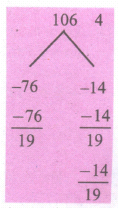
When \(\\ \beta =\frac { 14 }{ 19 } ,\) the other roots are \(\frac { 3 }{ 2 } \beta ,\beta \frac { 18-5\beta }{ 2 } [by(2)]\)
\(\Rightarrow \frac { 3 }{ 2 } \left( \frac { 14 }{ 19 } \right) ,\frac { 14 }{ 19 } ,\frac { 18-5\left( \frac { 14 }{ 19 } \right) }{ 2 } \Rightarrow \frac { 21 }{ 19 } ,\frac { 14 }{ 19 } ,\frac { 136 }{ 19 } \)
23.
24.
Given equation of the curve is y = 1 + x3 and the line is x + 12y = 12
Slope of the tangent to the curve
m1 = \(\frac { dy }{ dx } \) = 3 x2 and the
Slope of the line = m2
= \(\frac{-1}{2}\) \(\left[ \because m=\frac { co-efficient\ of\ x }{ co-efficient\ of\ y } \right] \)
Since the slope of the tangent to the curve and the line are orthogonal, m1 m2 = - 1.
∴ 3x2\(\left( \frac { -1 }{ 2 } \right) \) = -1
⇒ \(\frac{x^2}{4}\) = 1
⇒ x2 = 4
⇒ x = ±2
When x = 2, y = 1 + 23 = 9
When x = -2, y = 1+ (-2)3
= 1-8 = -7
∴ Equation of the tangent at (2, 9) is
y-9 = 12(x-2) [∵ m1 = 3x2 = 3(2)2 = 12]
∴ y - 9 = 12x - 24
∴ 12x - y = 15
Equation of the tangent at (-2, -7) is
y+7= 12(x + 2)
⇒ y + 7 = 12x + 24
⇒ 12x-y+17 = 0
25.
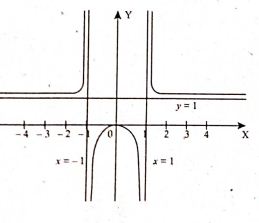
Given \(f(x)=\frac { { x }^{ 2 } }{ { x }^{ 2 }-1 } \)
\(\quad \underset { x\rightarrow 1^{ + } }{ lim } \frac { { x }^{ 2 } }{ { x }^{ 2 }-1 } =\underset { x\rightarrow 1^{ + } }{ lim } \frac { { x }^{ 2 } }{ \left( x+1 \right) \left( x-1 \right) } \)
= \(\underset { h\rightarrow { 0 }^{ + } }{ lim } \frac { \left( 1+h \right) ^{ 2 } }{ \left( 1+h+1 \right) \left( 1+h-1 \right) } \)
= \(\underset { h\rightarrow 0^{ + } }{ lim } \frac { (1+h)^{ 2 } }{ (2+h)(h) } \infty \)
Also \(\underset { x\rightarrow 1^{ - } }{ lim } \frac { { x }^{ 2 } }{ (x+1)/(x-1) } =\underset { h\rightarrow 0^{ + } }{ lim } \frac { \left( 1-h \right) ^{ 2 } }{ \left( 1-h+1 \right) \left( 1-h-1 \right) } \)
= \(\underset { h\rightarrow { 0 }^{ + } }{ lim } \frac { \left( 1-h \right) ^{ 2 } }{ (2-h)(-h) } =-\infty \)
ஃ x = -1 and x = 1are vertical asymptotes,
Also
\(\underset { x-\rightarrow \infty }{ lim } \frac { { x }^{ 2 } }{ { x }^{ 2 }-1 } =\underset { \frac { 1 }{ x } \rightarrow 0 }{ lim } \frac { 1 }{ 1-\frac { 1 }{ { x }^{ 2 } } } =1\)
[Divide numerator and denominator by x2]
ஃ y = 1 is a horizontal asymptote,

12th Standard Syllabus & Materials
12th Standard
TN 12th Computer Applications வலையமைப்பு வடமிடல் Sample Question Papers Study Material - QB365 Set A
NEW12th Standard
TN 12th Computer Applications களப்பெயர் முறைமை (DNS) Sample Question Papers Study Material - QB365 Set A
NEW12th Standard
TN 12th Computer Applications வலையமைப்பு எடுத்துக்காட்டுகள் மற்றும் நெறிமுறைகள் Sample Question Papers Study Material - QB365 Set A
NEW12th Standard
TN 12th Computer Applications கணினி வலையமைப்பு ஓர் அறிமுகம் Sample Question Papers Study Material - QB365 Set A



Tamilnadu Stateboard 12th Standard Subjects
Maths

Chemistry

Physics

Biology

Computer Science

Business Maths and Statistics

Economics

Commerce

Accountancy

History

Computer Applications
Biology
Computer Technology
Computer Applications
Computer Science
Business Maths and Statistics
Commerce
Economics
Maths
Chemistry
Physics
Computer Technology
History
Accountancy

Tamil

English

French
Tamilnadu Stateboard Standards

