
 100% FREE ACCESS
12th Standard Syllabus & Materials
12th Standard
TN 12th Computer Applications மின்னணு தரவு பரிமாற்றம் Sample Question Papers Study Material - QB365 Set A
NEW12th Standard
TN 12th Computer Applications மின் - வணிக பாதுகாப்பு அமைப்புகள் Sample Question Papers Study Material - QB365 Set A
NEW12th Standard
TN 12th Computer Applications மின்னணு செலுத்தல் முறைகள் Sample Question Papers Study Material - QB365 Set A
NEW12th Standard
TN 12th Computer Applications மின் - வணிகம் Sample Question Papers Study Material - QB365 Set A
NEW12th Standard
TN 12th Computer Applications திறந்த மூல கருத்துருக்கள் Sample Question Papers Study Material - QB365 Set A
NEW12th Standard
TN 12th Computer Applications வலையமைப்பு வடமிடல் Sample Question Papers Study Material - QB365 Set A

Published on: 27/02/2021
12th Standard English Medium Maths Reduced Syllabus Five Mark Important Questions With Answer Key - 2021(Public Exam )
Download Tamil Nadu 12th Standard Maths question papers, model tests, one-mark questions, important questions, and public exam papers in PDF format. Free study materials and answer keys for TN State Board students.
Questions + Answers key
Take MCQ Maths Test1.
Solve : \(\frac { dy }{ dx } =-\frac { x+ycos }{ 1+sinx } \) .Also find the domain of the function.
2.
Solve : \(\frac { dy }{ dx } =\left( { sin }^{ 2 }x{ cos }^{ 2 }x+{ xe }^{ x } \right) dx\)
3.
AOB is the positive quadrant of the ellipse \(\frac { { x }^{ 2 } }{ { a }^{ 2 } } +\cfrac { { y }^{ 2 } }{ { b }^{ 2 } } =1\) where OA=a and OB=b.Find the area between the arc AB and chord AB of the elipse.
4.
Find the area of the curve y2=(x-5)2(x-6) between
(i) x=5 and x=6
(ii) x=6 and x=7
5.
If the curves 4x=y2 and 4xy=k cut at right angles show that k2=512.
6.
Verify (p ∧ ~p) ∧ (~q ∧ p) is a tautlogy, contradiction or contingency.
7.
Find the area of the region bounded between the curves y = sin x and y = cos x and the lines x = 0 and x = \(\pi\)
8.
The mean and standard deviation of a binomial variate X are respectively 6 and 2.
Find
(i) the probability mass function
(ii) P(X = 3)
(iii) P(X\(\ge \)2).
9.
Evaluate: \(\int _{ 0 }^{ \frac { \pi }{ 2 } }{ (\sqrt { tan\ x } +\sqrt { cot\ x } )dx } \)
10.
Find the intervals of monotonicity and local extrema of the function f(x) = x log x + 3x.
11.
Assume that the rate at which radioactive nuclei decay is proportional to the number of such nuclei that are present in a given sample. In a certain sample 10% of the original number of radioactive nuclei have undergone disintegration in a period of 100 years. What percentage of the original radioactive nuclei will remain after 1000 years?
12.
Solve the following differential equations
(x2+y2)dy = xy dx. It is given that y(1) = 1 and y(x0) = e. Find the value of x0.
13.
A camera is accidentally knocked off an edge of a cliff 400 ft high. The camera falls a distance of s = 16t2 in t seconds.
(i) How long does the camera fall before it hits the ground?
(ii) What is the average velocity with which the camera falls during the last 2 seconds?
(iii) What is the instantaneous velocity of the camera when it hits the ground?
14.
Prove that \({ tan }^{ -1 }\left( \frac { 1-x }{ 1+x } \right) -{ tan }^{ -1 }\left( \frac { 1-y }{ 1+y } \right) ={ sin }^{ -1 }\left( \frac { y-x }{ \sqrt { 1+{ x }^{ 2 } } .\sqrt { 1+{ y }^{ 2 } } } \right)\)
15.
Show that the equations -2x + y + z = a, x - 2y + z = b, x + y -2z = c are consistent only if a + b + c = 0.
16.
On lighting a rocket cracker it gets projected in a parabolic path and reaches a maximum height of 4 m when it is 6 m away from the point of projection. Finally it reaches the ground 12 m away from the starting point. Find the angle of projection.
17.
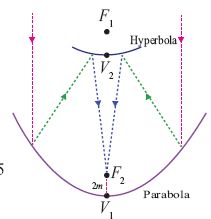
Certain telescopes contain both parabolic mirror and a hyperbolic mirror. In the telescope shown in figure the parabola and hyperbola share focus F1 which is 14m above the vertex of the parabola. The hyperbola’s second focus F2 is 2m above the parabola’s vertex. The vertex of the hyperbolic mirror is 1m below F1. Position a coordinate system with the origin at the centre of the hyperbola and with the foci on the y-axis. Then find the equation of the hyperbola.
18.
If a1, a2, a3, ... an is an arithmetic progression with common difference d, prove that tan\( \left[ tan^{ -1 }\left( \frac { d }{ 1+{ a }_{ 1 }{ a }_{ 2 } } \right) +tan^{ -1 }\left( \frac { d }{ 1+{ a }_{ 2 }{ a }_{ 3 } } \right) +....tan^{ -1 }\left( \frac { d }{ 1+{ a }_{ n }{ a }_{ n-1 } } \right) \right] =\frac { { a }_{ n }-{ a }_{ 1 } }{ 1+{ a }_{ 1 }{ a }_{ n } } \)
19.
Find the equation of the ellipse whose eccentricity is \(\frac { 1 }{ 2 } \), one of the foci is(2, 3) and a directrix is x = 7. Also find the length of the major and minor axes of the ellipse.
20.
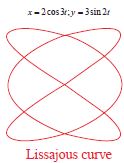
Find the equation of the tangent and normal to the Lissajous curve given by x = 2cos 3t and y = 3sin 2t, t ∈ R
21.
Find the asymptotes of the following curves \(f(x)=\frac { 3x }{ \sqrt { { x }^{ 2 }+2 } } \)
1.
\(y=\frac { 2x-{ x }^{ 2 } }{ 2(1+sinx) } ,x\neq n\pi +(-1)^{ n }\frac { \pi }{ 2 } ,\)∀ n ε Z
2.
\(y=-\frac { 1 }{ 2 } { cos }^{ 2 }x+\frac { { cos }^{ 5 }x }{ 5 } +{ xe }^{ x }-{ e }^{ x }+c\)
3.
\(\frac { ab\left( \pi -2 \right) }{ 4 } \)
4.
(i) not exist sq.units.
(ii) \(\frac { 32 }{ 15 } \)
5.
100 m / s, t = 4 sec, 200 m / s, −100 m / s
6.
| p | q | ~p | p∧~p) | ~q | (~q)∧p | (p∧~p) ∧ (~q∧p) |
| T | T | F | F | F | F | F |
| T | F | F | F | T | T | F |
| F | T | T | F | F | F | F |
| F | F | T | F | T | F | F |
Since the entries in the last column are F, (p ∧ ~p) ∧ (~q ∧ P) is a contradiction
7.
Equation of the given curves are y = sin x ..(1)
Y = cos x ...(2)
from (1) and (2), sin x = cos x
y = sin x
| x | 0 | \(\pi\)/2 |
| y | 0 | 1 |
y = cos x
| x | 0 | \(\pi\)/2 |
| y | 1 | 0 |
\(\Rightarrow x=\frac { \pi }{ 4 } \)
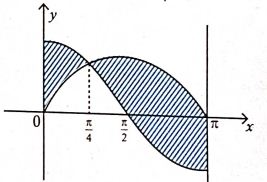
\(\therefore \) Required area = \(2\int _{ \frac { \pi }{ 4 } }^{ \frac { 3\pi }{ 4 } }{ (sinx-cosx)dx } \)
[\(\because\) the area is symmetrical about X - axis]
\(=2{ \left[ -cosx-sinx \right] }_{ \frac { \pi }{ 4 } }^{ \frac { 3\pi }{ 4 } }\)
\(=-2\left[ \left( cos\frac { 3\pi }{ 4 } +sin\frac { 3\pi }{ 4 } \right) -\left( cos\frac { \pi }{ 4 } +sin\frac { \pi }{ 4 } \right) \right] \)
= -2\(\left[ \left( -\frac { 1 }{ \sqrt { 2 } } +\frac { 1 }{ \sqrt { 2 } } \right) -\left( \frac { 1 }{ \sqrt { 2 } } +\frac { 1 }{ \sqrt { 2 } } \right) \right] \)
[cos 135o = cos(180o- 45) = -cos 45o sin135o = sin(180o- 45) = -sin 45o]
\(=-2\left[ \frac { -2 }{ \sqrt { 2 } } \right] =\frac { 4 }{ \sqrt { 2 } } \times \frac { \sqrt { 2 } }{ \sqrt { 2 } } =\frac { 4\sqrt { 2 } }{ 2 } =2\sqrt { 2 } \)
8.
X~ B(n, p)
Given mean np = 6
\(S.D=\sqrt { npq } =2\)
\(\Rightarrow npq=4\)
\( \rightarrow \frac { npq }{ np } =\frac { 4 }{ 6 } =\frac { 2 }{ 3 } \)
\(\Rightarrow q=\frac { 2 }{ 3 } \)
\(\Rightarrow 1-P=\frac { 2 }{ 3 } \)
\(\Rightarrow 1-\frac { 2 }{ 3 } =P\)
\(\therefore P=\frac { 1 }{ 3 } \)
\(n\times \frac { 1 }{ 3 } =6\Rightarrow n=18\)
(i) The probability mass function
P(X = x) nCx px (1 - p )n-x,
X = 0,1,2, ... , n
\(\therefore P(X=x)=\ ^{18}{ C }_{ x }\left( \frac { 1 }{ 3 } \right) ^{ x }\left( \frac { 2 }{ 3 } \right) ^{ 18-x }\)
x=0,1,2...,8
(ii) \(P(X=3)=\ ^{ 18}{C }_{ 3 }\left( \frac { 1 }{ 3 } \right) ^{ 3 }\left( \frac { 2 }{ 3 } \right) ^{ 18-3 }\)
= \(^{ 18}{C }_{ 3 }\left( \frac { 1 }{ 3 } \right) ^{ 3 }\left( \frac { 2 }{ 3 } \right) ^{ 15 }\)
(iii) P(X ≥ 2)
P(X ≥ 2) 1 -P(X < 2)
= 1 - [P(X = 0) + P(X = 1)]
= \(1-\left[ ^{18}{ C }_{ 0 }\left( \frac { 1 }{ 3 } \right) ^{ 0 }\left( \frac { 2 }{ 3 } \right) ^{ 18 }+^{ 18}{C }_{ 1 }\left( \frac { 1 }{ 3 } \right) ^{ 1 }\left( \frac { 2 }{ 3 } \right) ^{ 17 } \right] \)
= \(1-\left[ \left( \frac { 2 }{ 3 } \right) ^{ 18 }+6\left( \frac { 2 }{ 3 } \right) ^{ 17 } \right] \)
= \(1-\left( \frac { 2 }{ 3 } \right) ^{ 17 }\left[ \frac { 2 }{ 3 } +6 \right] \)
= \(1-\left( \frac { 2 }{ 3 } \right) ^{ 17 }\left( \frac { 20 }{ 3 } \right) \)
= \(1-\frac { 20 }{ 3 } \left( \frac { 2 }{ 3 } \right) ^{ 17 }\)
9.
Let I = \(\int _{ 0 }^{ \frac { \pi }{ 2 } }{ (\sqrt { tan\ x } +\sqrt { cot\ x } )dx } \) Then we get
\(I=\int _{ 0 }^{ \frac { \pi }{ 2 } }{ \left( \sqrt { \frac { sinx }{ cosx } } +\sqrt { \frac { cosx }{ sinx } } \right) dx } =\int _{ 0 }^{ \frac { \pi }{ 2 } }{ \frac { sinx+cosx }{ \sqrt { sinxcosx } } dx } =\sqrt { 2 } \int _{ 0 }^{ \frac { \pi }{ 2 } }{ \frac { sinx+cosx }{ \sqrt { 2sinxcosx } } dx } \)
\(=\sqrt { 2 } \int _{ 0 }^{ \frac { \pi }{2 } }{ \frac { (sinx+cosx)dx }{ \sqrt { 1-sinx-cosx{ ) }^{ 2 } } } } \)
Put u = sin x − cos x
Then, du = (cos x + sin x)dx .
When x = 0, u = −1
When x =\(\frac{\pi}{2}\), u = 1
\(\therefore I=\sqrt { 2 } \int _{ -1 }^{ 1 }{ \frac { du }{ \sqrt { 1-{ u }^{ 2 } } } =\sqrt { 2 } { [{ sin }^{ -1 }u] }_{ -1 }^{ 1 }=\sqrt { 2 } \left[ { sin }^{ -1 }(1)-{ sin }^{ -1 }(-1)) \right] } =\pi \sqrt { 2 } \)
10.
The given function is defined and is differentiable at all \(x \in(0, \infty)\)
f(x) = x log x + 3x.
Therefore f'(x) = log x+1+3 = 4 + log x.
The stationary points are given by 4 + log x = 0
That is x = e-4
Hence the intervals of monotonicity are (0, e-4) and \((e^{-4}, \infty)\)
At \(x=e^{-5}\in(0,e^{-4})\), f'(e-5) = -1<0 and hence in the interval (0, e-4) -the function is strictly decreasing.
At \(x=e^{-3}\in(0,e^{-4})\), f'(e-3) = 1>0 and hence strictly increasing in the interval \((e^{-4}, \infty)\).
Since f′(x) changes from negative to positive when passing through x = e−4, the first derivative test tells us there is a local minimum at x = e-4 and it is f(e-4) = -e-4.
11.
Let there be N radioactive nuclei in a sample at any time t and let No be the initial number of radioactive nuclei.
Then \(\frac{dN}{dt}\infty N\)
\(\Rightarrow \frac { dN }{ dt } =-\lambda N\)
Where \(\lambda>0\) is a constant
\(\Rightarrow \frac { dN }{ N } =-\lambda dt\)
\(\int { \frac { dN }{ N } } =-\lambda dt\)
\(\int { \frac { dN }{ N } =-\lambda \int { dt } } \)
\(\Rightarrow log\ N=-\lambda t+C\ ...(1)\)
\(T\quad t=0,\ we\ have\ N={ N }_{ 0 }\)
\(\therefore log{ N }_{ 0 }=0+C\)
\(\Rightarrow C=log{ N }_{ 0 }\)
\(\therefore\)(1) becomes, log N = -\(\lambda t+log{ N }_{ 0 }\)
\(\Rightarrow log\frac { N }{ { N }_{ 0 } } =-\lambda t\quad ...(2)\)
It is given that 10% of the original number of nuclei have undergone disintegration in a period of 100 years.
Whent= 100 \(N={ N }_{ 0 }-\frac { 10 }{ 100 } \times { N }_{ 0 }=\frac { { 9N }_{ 0 } }{ 10 } \)
Substituting in (2) we get
\(log\quad \frac { 9 }{ 10 } =-100\lambda \)
\(\Rightarrow \lambda =-\frac { 1 }{ 100 } log\frac { 9 }{ 10 } \)
Substituting in (2) we get,
\(log\frac { N }{ { N }_{ 0 } } =\left( \frac { 1 }{ 100 } log\frac { 9 }{ 10 } \right) t\)
when t = 1000,
\(log\frac { N }{ { N }_{ 0 } } =\frac { 1 }{ 100 } log\left( \frac { 9 }{ 10 } \right) \times 1000\)
\(=10log\left( \frac { 9 }{ 10 } \right) \)
\(\Rightarrow log\frac { N }{ { N }_{ 0 } } ={ \left( \frac { 9 }{ 10 } \right) }^{ 10 }\)
\(\Rightarrow \frac { N }{ { N }_{ 0 } } ={ \left( \frac { 9 }{ 10 } \right) }^{ 10 }\)
\(\Rightarrow \frac { N }{ { N }_{ 0 } } \times 100={ \left( \frac { 9 }{ 10 } \right) }^{ 10 }\times 100=\frac { { 9 }^{ 10 } }{ { 10 }^{ 8 } } \)
Hence, \(\frac { { 9 }^{ 10 } }{ { 10 }^{ 8 } } \%\) of radioactive nuclei will remain after 1000 years,
12.
(x2+y2)dy = xy dx
\(\frac { dy }{ dx } =\frac { xy }{ { x }^{ 2 }+{ y }^{ 2 } } ...(1)\)
\(\therefore put=vx\Rightarrow \frac { dy }{ dx } =v+x\frac { dv }{ dx } \)
\(\therefore\)(1) becomes,
\(v+x\frac { dv }{ dx } =\frac { xvx }{ { x }^{ 2 }+{ v }^{ 2 }{ x }^{ 2 } } \)
\(=\frac { { x }^{ 2 }v }{ { x }^{ 2 }(1+{ v }^{ 2 }) } =\frac { v }{ 1+{ v }^{ 2 } } \)
\(x\frac { dv }{ dx } =\frac { v }{ 1+{ v }^{ 2 } } v=\frac { v-v-{ v }^{ 3 } }{ 1+{ v }^{ 2 } } =\frac { -{ v }^{ 3 } }{ 1+{ v }^{ 2 } } \)
Separating the variables we get,
\(\frac { 1+{ v }^{ 2 } }{ { v }^{ 3 } } dv=\frac { -dx }{ x } \)
\(\Rightarrow \frac { 1 }{ { v }^{ 3 } } +\frac { { v }^{ 2 } }{ { v }^{ 3 } } dv=\frac { -dx }{ x } \)
\(\Rightarrow \int { { v }^{ -3 }dv } +\int { \frac { dv }{ v } =-\int { \frac { dx }{ x } } } \)
\(\Rightarrow \frac { { v }^{ -2 } }{ -2 } +log\ v=-logx+logc\)
\(\Rightarrow -\frac { 1 }{ 2{ v }^{ 2 } } +log\ v=-log\ x+log\quad c\)
\(\Rightarrow \frac { 1 }{ 2{ v }^{ 2 } } -log\ v=logx-logc\)
\(\Rightarrow \frac { 1 }{ 2{ v }^{ 2 } } =logv+logx-logc\)
\(\Rightarrow \frac { 1 }{ 2{ v }^{ 2 } } =logv+logx-logc\)
\(\Rightarrow \frac { 1 }{ 2{ v }^{ 2 } } =log\left( \frac { vx }{ c } \right) \)
\(\Rightarrow \frac { { x }^{ 2 } }{ 2{ y }^{ 2 } } =log\left( \frac { y }{ c } \right) \Rightarrow { e }^{ \frac { { x }^{ 2 } }{ { e }^{ 2{ y }^{ 2 } } } }=\frac { y }{ c } \)
\(\Rightarrow y={ ce }^{ \frac { { x }^{ 2 } }{ 2{ y }^{ 2 } } } ...(2)\)
Given y(1) = 1
\(1={ ce }^{ \frac { 1 }{ 2 } }\Rightarrow 1=c\sqrt { e } \)
\(\Rightarrow c=\frac { 1 }{ \sqrt { e } } \)
\(\therefore\)(2) becomes,
\(y=\frac { 1 }{ \sqrt { e } } { e }^{ \frac { { x }^{ 2 } }{ 2{ y }^{ 2 } } }\)
\(Also\ y({ x }_{ 0 })=e\Rightarrow e=\frac { 1 }{ \sqrt { e } } { e }^{ \frac { { x }_{ 0 }^{ 2 } }{ 2{ e }^{ 2 } } }\)
\(\Rightarrow e\sqrt { e } ={ e }^{ \frac { { x }_{ 0 }^{ 2 } }{ 2{ e }^{ 2 } } }\)
\(\Rightarrow \frac { { x }_{ 0 }^{ 2 } }{ 2{ e }^{ 2 } } =log\quad e\sqrt { e } =log{ e }^{ \frac { 3 }{ 2 } }\)
\(\Rightarrow \frac { { x }_{ 0 }^{ 2 } }{ 2{ e }^{ 2 } } =\frac { 3 }{ 2 } { log }_{ e }^{ e }=\frac { 3 }{ 2 } (1)\)
\(\left[ \because { log }_{ e }^{ e }=1 \right] \)
\(\Rightarrow { x }_{ 0 }^{ 2 }=\frac { 3 }{ 2 } (2{ e }^{ 2 })={ 3e }^{ 2 }\)
\(\Rightarrow { x }_{ 0 }=\pm \sqrt { 3{ e }^{ 2 } } =\pm \sqrt { 3 } .e\)
\(\therefore { x }_{ 0 }=\pm \sqrt { 3 } .e\)
13.
Given s (t) = 16t2, height = 400 ft.
⇒ t2 = \(\frac { 400 }{ 16 } =\frac { 100 }{ 4 } \)
t2 = 25
t = 5 sec
(ii) Average velocity = \(\frac { ds }{ dt } \) = 32 t
When t = 2 sec
Average in the last
2 sec = \(\frac { V \ at \ t=3+V \ at \ t=5 }{ 2 } \)
= \(\frac { 32(3)+32(5) }{ 2 } \)
= \(\frac { 96+160 }{ 2 } =\frac { 256 }{ 2 } \)
= 128 f/sec
(iii) Instantaneous Velocity
=\(\frac { ds }{ dt } \) = 32t
When t = 5 sec
Velocity = \(\frac { ds }{ dt } \) = 32(5)
= 160 ft/sec
14.
LHS =\({ tan }^{ -1 }\left( \frac { 1-x }{ 1+x } \right) -{ tan }^{ -1 }\left( \frac { 1-y }{ 1+y } \right) \)
= tan-1(1) - tan-1 (x) - (tan-1(1) - tan-1(y)
\(\left[ \because { tan }^{ -1 }(\frac { x-y }{ 1+xy } )={ tan }^{ -1 }x-{ tan }^{ -1 }y \right] \)
= tan-1(1) - tan-1 (x) - tan-1(1) + tan-1(y)
= tan-1(y) - tan-1(x)
= \({ tan }^{ -1 }\left( \frac { y-x }{ 1+xy } \right) \)
= \({ sin }^{ -1 }\left( \frac { y-x }{ \sqrt { 1+\left( yx \right) ^{ 2 }+\left( y-x \right) ^{ 2 } } } \right) \)
= \({ sin }^{ -1 }\left( \frac { y-x }{ \sqrt { (1+{ x }^{ 2 })(1+{ x }^{ 2 }) } } \right) \)
RHS
15.
Augmented matrix [A|B] is \(\left[ \begin{matrix} -2 & 1 & 1 \\ 1 & -2 & 1 \\ 1 & 1 & -2 \end{matrix}|\begin{matrix} a \\ b \\ c \end{matrix} \right] \)
[A|B]\(\overset { { R }_{ 1 }\leftrightarrow { R }_{ 2 } }{ \longrightarrow } \left[ \begin{matrix} 1 & -2 & 1 \\ -2 & 1 & 1 \\ 1 & 1 & -2 \end{matrix}|\begin{matrix} b \\ a \\ c \end{matrix} \right] \)
\(\overset { { R }_{ 2 }\rightarrow { R }_{ 2 }+2{ R }_{ 1 }\\ { R }_{ 3 }\rightarrow { R }_{ 3 }+{ R }_{ 1 } }{ \longrightarrow } \left[ \begin{matrix} 1 & -2 & 1 \\ 0 & -3 & 3 \\ 0 & 3 & -3 \end{matrix}|\begin{matrix} b \\ a+2b \\ c-b \end{matrix} \right] \)
\(\overset { { R }_{ 3 }\rightarrow { R }_{ 3 }+{ R }_{ 2 } }{ \longrightarrow } \left[ \begin{matrix} 1 & -2 & 1 \\ 0 & -3 & 3 \\ 0 & 0 & 0 \end{matrix}|\begin{matrix} b \\ c+2b \\ a+b+c \end{matrix} \right] \)
Here \(\rho\) (A) = 2
The given system is consistent only when \(\rho\)([A|B]) = 2\(\rho\)([A|B]) = 2 only if a + b + c = 0 Hence proved.
16.
By taking the vertex; at the origin, the parabola is open downward.
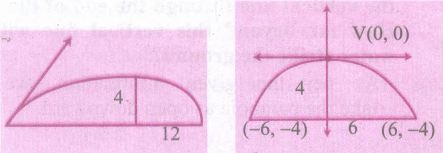
Its equation is x2 = -4ay
It passes through (6, -4)
∴ 36 = -4a(-4) ⇒ 4a = - \(\frac { 36 }{ 4 } \) = 9
∴ (1) becomes, x2 = -9y
To find the slope at (-6, -4)
Differentiating (1) with respect to 'x' we get,
2x = -9\(\frac { dy }{ dx } \)
⇒ \(\frac { dy }{ dx } =\frac { -2x }{ 9 } \)
At (-6, -4), \(\frac { dy }{ dx } =-2\frac { (-6) }{ 9 } =\frac { 12 }{ 9 } =\frac { 4 }{ 3 } \)
∴ \(tan\theta =\frac { 4 }{ 3 } \Rightarrow \theta ={ tan }^{ -1 }\left( \frac { 4 }{ 3 } \right) \)
∴ The angle of projection is tan-1 \(\left( \frac { 4 }{ 3 } \right) \)
17.
Let V1 be the vertex of the parabola and
V2 be the vertex of the hyperbola.
\(\overset { \_ \_ \_ \_ \_ \_ }{ { F }_{ 1 }{ F }_{ 2 } } \) = 14−2 = 12m, 2c = 12, c = 6
The distance of centre to the vertex of the hyperbola is a = 6−1 = 5
b2 = c2 - a2
= 36−25 = 11.
Therefore the equation of the hyperbola is \(\frac { { y }^{ 2 } }{ 25 } -\frac { { x }^{ 2 } }{ 11 } =1\)
18.
Now, \(tan^{ -1 }\left( \frac { d }{ 1+{ a }_{ 1 }{ a }_{ 2 } } \right) =tan^{ -1 }\frac { { a }_{ n }-{ a }_{ 1 } }{ 1+{ a }_{ 1 }{ a }_{ n } } =tan^{ -1 }{ a }_{ 2 }-tan^{ -1 }{ a }_{ 1 }\)
Similarly, \(tan^{ -1 }\left( \frac { d }{ 1+{ a }_{ 1 }{ a }_{ 2 } } \right) =tan^{ -1 }\left( \frac { { a }_{ n }-{ a }_{ 1 } }{ 1+{ a }_{ 1 }{ a }_{ n } } \right) =tan^{ -1 }{ a }_{ 3 }-tan^{ -1 }{ a }_{ 2 }\)
Continuing inductively, we get
\(tan^{ -1 }\left( \frac { d }{ 1+{ a }_{ n }{ a }_{ n-1 } } \right) =tan^{ -1 }\left( \frac { { a }_{ n }-{ a }_{ n-1 } }{ 1+{ a }_{ n }{ a }_{ n-1 } } \right) =tan^{ -1 }{ a }_{ n }-tan^{ -1 }{ a }_{ n-1 }\)
Adding vertically, we get
\(tan^{ -1 }\left( \frac { d }{ 1+{ a }_{ 1 }{ a }_{ 2 } } \right) +tan^{ -1 }\left( \frac { d }{ 1+{ a }_{ 2 }{ a }_{ 3 } } \right) +....+tan^{ -1 }\left( \frac { d }{ 1+{ a }_{ n }{ a }_{ n-1 } } \right) tan[tan^{ -1 }{ a }_{ n }-{ tan }^{ -1 }{ a }_{ 1 }]\\ \)
\(tan\left[ tan^{ -1 }\left( \frac { d }{ 1+{ a }_{ 1 }{ a }_{ 2 } } \right) +tan^{ -1 }\left( \frac { d }{ 1+{ a }_{ 2 }{ a }_{ 3 } } \right) +...+tan^{ -1 }\left( \frac { d }{ 1+{ a }_{ n }{ a }_{ n-1 } } \right) \right] =tan\left[ tan^{ -1 }{ a }_{ n }-tan^{ -1 }a_{ 1 } \right] \)\(=\left[ tan^{ -1 }\left( \frac { { a }_{ n }-{ a }_{ 1 } }{ 1+{ a }_{ 1 }{ a }_{ n } } \right) \right] =\frac { { a }_{ n }-{ a }_{ 1 } }{ 1+{ a }_{ 1 }{ a }_{ n } } \)
19.
By the definition of a conic \(\frac{SP}{PM}\)= e or SP2 = e2PM2
Then, (x−2)2 + (y−3)2 = \(\frac { 1 }{ 4 } \) (x-7)2
3x2+ 4y2−2x − 24y + 3 = 0
\({ 3\left( x-\frac { 1 }{ 3 } \right) }^{ 2 }+4(y-3)^{ 2 }=3\left( \frac { 1 }{ 9 } \right) +4\times 9-3=\frac { 100 }{ 3 } \)
\(\frac { { \left( x-\frac { 1 }{ 3 } \right) }^{ 2 } }{ \frac { 100 }{ 9 } } +\frac { (y-3{ ) }^{ 2 } }{ \frac { 100 }{ 12 } } \) = 1 which is in the standard form.
Therefore, the length of major axis = 2a = 2\(\sqrt { \frac { 100 }{ 9 } = } \frac { 20 }{ 3 } \) and
the length of minor axis = 2b = 2\(\sqrt { \frac { 100 }{ 12 } = } \frac { 10 }{ \sqrt { 3 } } \).
20.
Observe that the given curve is neither a circle nor an ellipse. For your reference the curve is shown in Figure.
Now, \(\frac{dy}{dx}=\frac{\frac{dy}{dt} }{\frac{dx}{dt} } \)
= -\(\frac{6 cos2t}{6sin3t} = -\frac{cos2t}{sin3t} \).
Therefore, the tangent at any point is
\(y-3sin2t= -\frac{cos2t}{sin3t}(x-2cos3t)\)
That is, x cos 2t + y sin 3t = 3sin 2t sin 3t + 2cos 2t cos 3t.
The slope of the normal is the negative of the reciprocal of the tangent which in this case is \(\frac{sin3t}{cos2t}\). Hence, the equation of the normal is \(y-3sin2t=\frac{sin3t}{cos2t}(x-2cos3t)\).
That is, x sin 3t - y cos 2t = 2sin 3t cos3t 3sin 2t cos 2t = sin 6t - \(\frac{3}{2}\) sin 4t.
21.
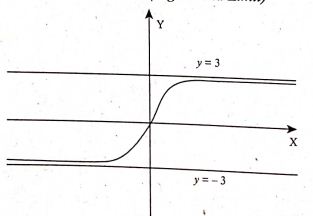
\(f(x)=\frac { 3x }{ \sqrt { { x }^{ 2 }+2 } } \)
\(\underset { x\rightarrow \infty }{ lim } \frac { 3x }{ \sqrt { { x }^{ 2 }+2 } } =\underset { \frac { 1 }{ x } \rightarrow 0 }{ lim } \frac { 3 }{ \sqrt { 1+\frac { 2 }{ { x }^{ 2 } } } } \)
= \(\frac { 3 }{ \sqrt { 1+0 } } =3\)
ஃy = 3 is the horizontal asymptote.
Also \(\underset { x\rightarrow -\infty }{ lim } \frac { 3x }{ \sqrt { { x }^{ 2 }+2 } } =\underset { \frac { 1 }{ x } \rightarrow { 0 }^{ - } }{ lim } \frac { 3 }{ \sqrt { 1+\frac { 2 }{ { x }^{ 2 } } } } =-3\)
ஃ y = -3 is the horizontal asymptote

12th Standard Syllabus & Materials
12th Standard
TN 12th Computer Applications களப்பெயர் முறைமை (DNS) Sample Question Papers Study Material - QB365 Set A
NEW12th Standard
TN 12th Computer Applications வலையமைப்பு எடுத்துக்காட்டுகள் மற்றும் நெறிமுறைகள் Sample Question Papers Study Material - QB365 Set A
NEW12th Standard
TN 12th Computer Applications கணினி வலையமைப்பு ஓர் அறிமுகம் Sample Question Papers Study Material - QB365 Set A
NEW12th Standard
TN 12th Computer Applications PHP-உடன் MySQL-ஐ இணைத்தல் Sample Question Papers Study Material - QB365 Set A



Tamilnadu Stateboard 12th Standard Subjects
Maths

Chemistry

Physics

Biology

Computer Science

Business Maths and Statistics

Economics

Commerce

Accountancy

History

Computer Applications
Biology
Computer Technology
Computer Applications
Computer Science
Business Maths and Statistics
Commerce
Economics
Maths
Chemistry
Physics
Computer Technology
History
Accountancy

Tamil

English

French
Tamilnadu Stateboard Standards

