
 100% FREE ACCESS
12th Standard Syllabus & Materials
12th Standard
TN 12th Maths Applications of Matrices and Determinants Sample Question Papers Study Material - QB365 Set A
NEW12th Standard
TN 12th Computer Applications மின்னணு தரவு பரிமாற்றம் Sample Question Papers Study Material - QB365 Set A
NEW12th Standard
TN 12th Computer Applications மின் - வணிக பாதுகாப்பு அமைப்புகள் Sample Question Papers Study Material - QB365 Set A
NEW12th Standard
TN 12th Computer Applications மின்னணு செலுத்தல் முறைகள் Sample Question Papers Study Material - QB365 Set A
NEW12th Standard
TN 12th Computer Applications மின் - வணிகம் Sample Question Papers Study Material - QB365 Set A
NEW12th Standard
TN 12th Computer Applications திறந்த மூல கருத்துருக்கள் Sample Question Papers Study Material - QB365 Set A

Published on: 27/02/2021
12th Standard English Medium Maths Reduced Syllabus Public Exam Model Question Paper With Answer Key - 2021
Download Tamil Nadu 12th Standard Maths question papers, model tests, one-mark questions, important questions, and public exam papers in PDF format. Free study materials and answer keys for TN State Board students.
Questions + Answers key
Take MCQ Maths Test1.
Let X be a random variable denoting the life time of an electrical equipment having probability density function
\(f(x)=\begin{cases} \begin{matrix} { ke }^{ -2x } & forx>0 \end{matrix} \\ \begin{matrix} 0 & forx\le 0 \end{matrix} \end{cases}\)
Find
(i) the value of k
(ii) Distribution function
(iii) P(X < 2)
(iv) calculate the probability that X is at least for four unit of time
(v) P(X = 3)
2.
Evaluate the following integrals using properties of integration:
\(\int _{ -\frac { \pi }{ 4 } }^{ \frac { \pi }{ 4 } }{ { sin }^{ 2 }xdx } \)
3.
Evaluate the following limit, if necessary use l ’Hôpital Rule
\(\underset { x\rightarrow { 1 }^{ + } }{ lim } \left( \frac { 2 }{ { x }^{ 2 }-1 } -\frac { x }{ x-1 } \right) \)
4.
Evaluate the following limit, if necessary use l ’Hôpital Rule
\(\underset { x\rightarrow 0 }{ lim } \left( \frac { 1 }{ sinx } -\frac { 1 }{ x } \right) \)
5.
Write the Maclaurin series expansion of the following function
cos x
6.
A race car driver is racing at 20th km. If his speed never exceeds 150 km/hr, what is the maximum kilometer he can reach in the next two hours.
7.
Using the Rolle’s theorem, determine the values of x at which the tangent is parallel to the x -axis for the following functions:
\(f(x)=\sqrt{x}-\frac{x}{3}, x\in [0,9]\)
8.
A thermometer was taken from a freezer and placed in a boiling water. It took 22 seconds for the thermometer to raise from −10°C to 100°C. Show that the rate of change of temperature at some time t is 5°C per second.
9.
Prove, using mean value theorem, that \(|sin \alpha-sin\beta|\le |\alpha-\beta|, \alpha, \beta \in R\)
10.
If y = 4x + c is a tangent to the circle x2 + y2 = 9, find c
11.
If x is a continuous random variable then P(x ≥ a) =
\(P(x \ < \ a)\)
\(P(a\le x\le b)\)
\(P\left( x>a \right) \)
\(1-P\left( x\le a-1 \right) \)
12.
In eight throws of a die, 1 or 3 is considered a success. Then the mean number of success is _____________
\(\frac { 8 }{ 3 } \)
\(\frac { 4 }{ 3 } \)
\(\frac { 2 }{ 3 } \)
\(\frac { 5 }{ 3 } \)
13.
14.
If cosx is an integrating factor of the differential equation \(\frac{dy}{dx}+Py= Q\), then P = ___________
-cot x
cot x
tan x
-tan x
15.
If * is defined by a * b = a2 + b2 + ab + 1, then (2 * 3) * 2 is _____________
20
40
400
445
16.
Linear approximation for g(x) = cos x at \(x=\frac{\pi}{2}\) is
\(x+\frac{\pi}{2}\)
\(-x +\frac{\pi}{2}\)
\(x - \frac{\pi}{2}\)
\(-x - \frac{\pi}{2}\)
17.
A random variable X has binomial distribution with n = 25 and p = 0.8 then standard deviation of X is
6
4
3
2
18.
The number of arbitrary constants in the particular solution of a differential equation of third order is
3
2
1
0
19.
20.
The number given by the Mean value theorem for the function \(\frac { 1 }{ x } \), x ∈ [1, 9] is
2
2.5
3
3.5
21.
If A is a non-singular matrix such that A-1 = \(\left[ \begin{matrix} 5 & 3 \\ -2 & -1 \end{matrix} \right] \), then (AT)−1 =
\(\left[ \begin{matrix} -5 & 3 \\ 2 & 1 \end{matrix} \right] \)
\(\left[ \begin{matrix} 5 & 3 \\ -2 & -1 \end{matrix} \right] \)
\(\left[ \begin{matrix} -1 & -3 \\ 2 & 5 \end{matrix} \right] \)
\(\left[ \begin{matrix} 5 & -2 \\ 3 & -1 \end{matrix} \right] \)
22.
If A = \(\left[ \begin{matrix} 2 & 0 \\ 1 & 5 \end{matrix} \right] \) and B = \(\left[ \begin{matrix} 1 & 4 \\ 2 & 0 \end{matrix} \right] \) then |adj (AB)| =
-40
-80
-60
-20
23.
If the direction cosines of a line are \(\frac { 1 }{ c } ,\frac { 1 }{ c } ,\frac { 1 }{ c } \), then
\(c=\pm 3\)
\(c=\pm \sqrt { 3 } \)
c > 0
0 < c < 1
24.
If \(\vec { a } =\hat { i } +\hat { j } +\hat { k } \), \(\vec { b } =\hat { i } +\hat { j } \), \(\vec { c } =\hat { i } \) and \((\vec { a } \times \vec { b } )\times\vec { c } \) = \(\lambda \vec { a } +\mu \vec { b } \), then the value of \(\lambda +\mu \) is
0
1
6
3
25.
If \(\vec { a } \) and \(\vec { b } \) are unit vectors such that \([\vec { a } ,\vec { b },\vec { a } \times \vec { b } ]=\frac { 1}{ 4 } \), then the angle between \(\vec { a } \) and \(\vec { b } \) is
\(\frac { \pi }{ 6 } \)
\(\frac { \pi }{ 4 } \)
\(\frac { \pi }{ 3 } \)
\(\frac { \pi }{ 2 } \)
26.
Tangents are drawn to the hyperbola \(\frac { { x }^{ 2 } }{ 9 } -\frac { { y }^{ 2 } }{ 4 } =1\) parallel to the straight line 2x − y = 1. One of the points of contact of tangents on the hyperbola is
\(\left(\frac{9}{2 \sqrt{2}}, \frac{-1}{\sqrt{2}}\right)\)
\(\left(\frac{-9}{2 \sqrt{2}}, \frac{1}{\sqrt{2}}\right)\)
\(\left(\frac{9}{2 \sqrt{2}}, \frac{1}{\sqrt{2}}\right)\)
\((3 \sqrt{3},-2 \sqrt{2})\)
27.
If \(\cot ^{-1}(\sqrt{\sin \alpha})+\tan ^{-1}(\sqrt{\sin \alpha})=u\), then cos2u is equal to
tan2\(\alpha\)
0
-1
tan2\(\alpha\)
28.
If sin−1x = 2sin−1 \(\alpha\) has a solution, then
\(|\alpha |\le \frac { 1 }{ \sqrt { 2 } } \)
\(|\alpha |\ge \frac { 1 }{ \sqrt { 2 } } \)
\(|\alpha |<\frac { 1 }{ \sqrt { 2 } } \)
\(|\alpha |>\frac { 1 }{ \sqrt { 2 } } \)
29.
If \(\omega \neq 1\) is a cubic root of unity and \(\left| \begin{matrix} 1 & 1 & 1 \\ 1 & { -\omega }^{ 2 }-1 & { \omega }^{ 2 } \\ 1 & { \omega }^{ 2 } & { \omega }^{ 7 } \end{matrix} \right| \) = 3k, then k is equal to
1
-1
\(\sqrt { 3i } \)
\(-\sqrt { 3i } \)
30.
31.
Write the statements in words corresponding to ¬p, p ∧ q , p ∨ q and q ∨ ¬p, where p is ‘It is cold’ and q is ‘It is raining'.
32.
33.
Explain why Lagrange’s mean value theorem is not applicable to the following functions in the respective intervals:
f(x) = \(\frac { x+1 }{ x } \), x ∈ [-1, 2]
34.
Show that y = e−x + mx + n is a solution of the differential equation ex \(\left( \frac { { d }^{ 2 }y }{ { dx }^{ 2 } } \right) \) -1 = 0
35.
For each of the following differential equations, determine its order, degree (if exists)
\(y\left( \frac { dy }{ dx } \right) =\frac { x }{ \left( \frac { dy }{ dx } \right) +{ \left( \frac { dy }{ dx } \right) }^{ 3 } } \)
36.
Show that the system of equations is inconsistent. 2x + 5y= 7, 6x + 15y = 13.
37.
For the matrix A, if A3 = I, then find A-1.
38.
Verify whether the line \(\frac { x-3 }{ -4 } =\frac { y-4 }{ -7 } =\frac { z+3 }{ 12 } \) lies in the plane 5x-y+z = 8.
39.
Find the points on the curve y=2x2-2x2 at which the tangent lines are parallel to the line y=3x-2.
40.
Verify
(i) closure property
(ii) commutative property
(iii) associative property
(iv) existence of identity and
(v) existence of inverse for the operation +5 on Z5 using table corresponding to addition modulo 5.
41.
Two balls are chosen randomly from an urn containing 8 white and 4 black balls. Suppose that we win Rs. 20 for each black ball selected and we lose Rs. 10 for each white ball selected. Find the expected winning amount and variance
42.
A six sided die is marked ‘1’ on one face, ‘2’ on two of its faces, and ‘3’ on remaining three faces. The die is rolled twice. If X denotes the total score in two throws.
(i) Find the probability mass function.
(ii) Find the cumulative distribution function.
(iii) Find P(3 ≤ X< 6)
(iv) Find P(X ≥ 4) .

43.
If X is the random variable with distribution function F(x) given by,
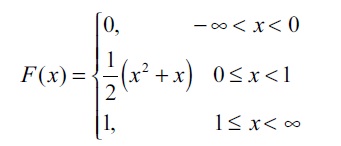
then find (i) the probability density function f(x)
(ii) P(0.3 ≤ X ≤ 0.6)
44.
A random variable X has the following probability mass function.
| x | 1 | 2 | 3 | 4 | 5 |
| f(x) | k2 | 2k2 | 3k2 | 2k | 3k |
Find
(i) the value of k
(ii) P(2 \(\le\) X < 5)
(iii) P(3 < X )
45.
Determine the intervals of concavity of the curve y = 3+ sin x .
46.
Find the intervals of monotonicity and hence find the local extrema for the function \(f(x)=x^{\frac{2}{3}}\).
47.
Assume that the rate at which radioactive nuclei decay is proportional to the number of such nuclei that are present in a given sample. In a certain sample 10% of the original number of radioactive nuclei have undergone disintegration in a period of 100 years. What percentage of the original radioactive nuclei will remain after 1000 years?
48.
In a murder investigation, a corpse was found by a detective at exactly 8 p.m. Being alert, the detective also measured the body temperature and found it to be 70oF. Two hours later, the detective measured the body temperature again and found it to be 60oF. If the room temperature is 50oF, and assuming that the body temperature of the person before death was 98.6oF, at what time did the murder occur? [log(2.43) = 0.88789; log(0.5)=-0.69315]
49.
Solve the Linear differential equation:
\(\left( y-{ e }^{ sin^{ -1 }x } \right) \frac { dx }{ dy } +\sqrt { 1-{ x }^{ 2 } } =0\)
50.
Solve the Linear differential equation:
(2x- 10y3) dy + ydx = 0
51.
If \(\left| \overset { \rightarrow }{ A } \right| =\overset { \wedge }{ i } +\overset { \wedge }{ j } +\overset { \wedge }{ k } \) and \(\overset { \wedge }{ i } =\overset { \wedge }{ j } -\overset { \wedge }{ k } \) are two given vector, then find a vector B satisfying the equations \(\overset { \rightarrow }{ A } \times \overset { \rightarrow }{ B } \)= \(\overset { \rightarrow }{ C } \) and \(\overset { \rightarrow }{ A } \).\(\overset { \rightarrow }{ B } \) = 3
52.
A kho-kho player In a practice session while running realises that the sum of tne distances from the two kho-kho poles from him is always 8m. Find the equation of the path traced by him of the distance between the poles is 6m.
53.
If \({ tan }^{ -1 }\left( \frac { \sqrt { 1+{ x }^{ 2 } } -\sqrt { 1-{ x }^{ 2 } } }{ \sqrt { 1+{ x }^{ 2 } } +\sqrt { 1-{ x }^{ 2 } } } \right) =a\) than prove that x2 = sin 2a
1.
(i) Since f (x) is a probability density function, f (x) ≥ 0 and \(\int _{ - }^{ \infty }{ f(x) } dx=1\)
That is \(\int _{ -\infty }^{ 0 }{ 0dx } +\int _{ 0 }^{ \infty }{ k{ e }^{ -2x }dx } =1\)
\(0+k\left( \frac { { e }^{ -2x } }{ -2 } \right) =1\Rightarrow k\left( \frac { { e }^{ -\infty }-{ e }^{ 0 } }{ -2 } \right) =1\Rightarrow k=2\)
Therefore the probability density function is
\(f\left( x \right) =\begin{cases} \begin{matrix} 2{ e }^{ -2x } & forx>0 \end{matrix} \\ \begin{matrix} 0 & forx \end{matrix}\le 0 \end{cases}\)
(ii) Distribution function
By definition the distribution function \(F(x)=P\left( x\le x \right) =\int _{ -\infty }^{ x }{ f(u) } du\)
When x≤0 \(F(x)=\int _{ -\infty }^{ x }{ F(u) } du=\int _{ -\infty }^{ x }{ odu=0 } \)
When x > 0 \(F(x)=\int _{ -\infty }^{ x }{ f(u) } du\int _{ -\infty }^{ x }{ 0du } +\int _{ 0 }^{ x }{ { 2e }^{ -2x }du\left( \frac { { e }^{ -2x } }{ -2 } \right) } =1-{ e }^{ 2x }\)
This gives \(F(x)=\begin{cases} \begin{matrix} 0 & forx\le 0 \end{matrix} \\ \begin{matrix} 1-{ e }^{ 2x } & forx>0 \end{matrix} \end{cases}\)
(iii) P(X < ) = P(X ≤2 ) = F(2 ) = 1-e2\(\times\)2 (since F(x) is continuous)
(iv) The probability that X is at least equal to four unit of time is
P(X ≥ 4 ) = 1 - P(X < 4 ) = 1- F( 4) = 1 - ( 1-e-2\(\times\)4) = e8
(v) In the continuous case, f (x) at x = a is not the probability that X takes the value a, that is f (x) at x = a is not equal to P( X ) a. If X is continuous type, P(X = a) = 0 for a ∈ R. Therefore P(x = 3) = 0.
2.
Let \(f(x)={ sin }^{ 2 }x\)
\(f(-x)={ (sin(-x)) }^{ 2 }={ sin }^{ 2 }x=f(x)\)
\(\therefore \int _{ -\frac { \pi }{ 4 } }^{ \frac { \pi }{ 4 } }{ { sin }^{ 2 }xdx } =2\int _{ 0 }^{ \frac { \pi }{ 4 } }{ { sin }^{ 2 }xdx } \)
\(cos\ 2x=1-2{ sin }^{ 2 }x\)
\(2{ sin }^{ 2 }x=1-cos2\)
\({ sin }^{ 2 }x=\frac { 1-cos\quad 2x }{ 2 } \)
\(=2\int _{ 0 }^{ \frac { \pi }{ 4 } }{ \left( \frac { 1-cos2x }{ 2 } \right) dx } \)
\(=\frac { 2 }{ 2 } { \left[ x-\frac { sin2x }{ 2 } \right] }_{ 0 }^{ \frac { \pi }{ 4 } }\)
\(=\frac { \pi }{ 4 } -\frac { sin\frac { \pi }{ 4 } }{ 2 } -0+\frac { sin0 }{ 2 } \)
\(\\ =\frac { \pi }{ 4 } -\frac { 1 }{ 2 } =\frac { \pi -2 }{ 4 } \)
3.
\(\underset { x\rightarrow { 1 }^{ + } }{ lim } \left( \frac { 2 }{ { x }^{ 2 }-1 } -\frac { x }{ x-1 } \right) =\underset { x\rightarrow { 1 }^{ + } }{ lim } \left( \frac { 2-x(x+1) }{ { x }^{ 2 }-1 } \right) \)
\(\underset { x\rightarrow { 1 }^{ + } }{ lim } \left( \frac { 2-{ x }^{ 2 }-x }{ { x }^{ 2 }-1 } \right) =\frac { 0 }{ 0 } \)
Form which is indeterminate,
Applying L' Hopital rule we get,
\(\underset { x\rightarrow { 1 }^{ + } }{ lim } \left( \frac { 2-{ x }^{ 2 }-x }{ { x }^{ 2 }-1 } \right) =\frac { 0 }{ 0 } =\frac { -2-1 }{ 2(1) } =\frac { -3 }{ 2 } \)
4.
\(\underset { x\rightarrow 0 }{ lim } \left( \frac { 1 }{ sinx } -\frac { 1 }{ x } \right) =\underset { x\rightarrow 0 }{ lim } \left( \frac { x-sinx }{ xsinx } \right) =\frac { 0 }{ 0 } \) form
Which is indeterminate Applying L' Hopital rule we get,
\(0+\frac { sinx }{ -xsinx+cosx } +cosx=\frac { 0 }{ 2 } =0\)
\(\underset { x\rightarrow { 1 }^{ + } }{ lim } \frac { 1-cosx }{ xcosx+sinx } =\frac { 1-cos0 }{ 0+sin0 } =\frac { 1-1 }{ 0 } =\frac { 0 }{ 0 } \)form
5.
| Function and its derivatives | cos x and its derivatives | Value at x = 0 |
| f(x) | cos x | cos 0 = 1 |
| fI(x) | - sin x | - sin 0 = 0 |
| fII(x) | - cos x | - cos 0 = -1 |
| fIII(x) | sin x | sin 0 = 1 |
| fIV(x) | cos x | cos 0 = 1 |
| fV(x) | - sin x | - sin 0 = 0 |
| fVI(x) | -cos x | - cos 0 = -1 |
\(f(x)=f(0)+\frac { { f }^{ 1 }(0) }{ 1! } x+\frac { { f }^{ II }(0) }{ 2! } { x }^{ 2 }+\frac { { f }^{ III }(0) }{ 3! } { x }^{ 3 }\) + .........
cos x = 1 + 0 - \(\frac { { x }^{ 2 } }{ 2! } +0+\frac { { x }^{ 4 } }{ 4! } +0+\frac { { x }^{ 6 } }{ 6! } +...\)
cos x = 1 - \(\frac { { x }^{ 2 } }{ 2! } +\frac { { x }^{ 4 } }{ 4! } +\frac { { x }^{ 6 } }{ 6! } \)
6.
Let f (t) represents the distance covered at 't' hour.
Given f(0) = 20 and f(2) = ?
Also speed = f' (t) ≥ 150
The distance function is continuous as well as differentiable.
By Lagrange's mean value theorem, there exists c such that
⇒ f'(c) = \(\frac { f(b)-f(a) }{ b-a } \)
⇒ f'(c) = \(\frac{f(2)-20}{2-0}\) ≥ 150 [Man speed is 150 km/hr and f' (c) represents speed]
⇒ \(\frac{f(2)-20}{2-0}\) ≥ 150
⇒ f(2) - 20 ≥ 300
⇒ f(2) ≥ 320
Hence, in the next two hours he can cover 320km.
7.
a) f(x) is continuous in [0, 9]
b) f(x) is differentiable in (0, 9)
c) f(0) = 0
\(f(9)=\sqrt { 9 } -\frac { 9 }{ 3 } =3-3=0\)
∴ f(0) = f(9)
∴ By Rolle's theorem, there exists C ∈ [0, 9] such that f'(c) = 0
⇒ \({ \frac { 1 }{ 2 } c }^{ \frac { 1 }{ 2 } -1 }-\frac { 1 }{ 3 } =0\)
⇒ \({ \frac { 1 }{ 2 } c }^{ \frac { 1 }{ 2 } -1 }=\frac { 1 }{ 3 } \)
⇒ \(\frac { 1 }{ 2\sqrt { c } } =\frac { 1 }{ 3 } \)
⇒ \(\frac { 1 }{ \sqrt { c } } =\frac { 2 }{ 3 } \)
⇒ \(\sqrt { c } =\frac { 2 }{ 3 } \)
Squaring both sides, c = \(\frac94\) ∈ [0, 9]
8.
Let f (t) be the temperature at time t. By the mean value theorem, we have
\(f'(c)=\frac{f(b)-f(a)}{b-a}\)
= \(\frac{100-(-10)}{22}\)
= \(\frac{110}{22}\)
= 5°C per second.
Hence the instantaneous rate of change of temperature at some time t should be 5°C per second.
9.
Let f (x) = sin x which is a differentiable function in any open interval. Consider an interval \([\alpha, \beta]\). Applying the mean value theorem there exists \(c \in (\alpha, \beta)\) such that,
\(\frac{sin \beta - sin \alpha}{\beta-\alpha}=f'(c)=cos(c)\)
Therefore, \(\frac{sin \beta - sin \alpha}{\beta-\alpha}=|cos(c)|\le1\)
Hence, \(|sin\alpha-sin\beta|\le |\alpha-\beta|\)
Remark
If we take \(\beta=0\) in the above problem, we ge \(|sin \alpha|\le |\alpha|\)
10.
The condition for the line y = mx + c to be a tangent to the circle x2 + y2 = a2 is c2 = a2(1 + m2) from
Then \(c=\pm \sqrt { 9\left( 1+16 \right) } \)
\(c=\pm 3\sqrt { 17 } \)
11.
(c)
\(P\left( x>a \right) \)
12.
(a)
\(\frac { 8 }{ 3 } \)
13.
(b)
14.
(d)
-tan x
15.
(d)
445
16.
(b)
\(-x +\frac{\pi}{2}\)
17.
(d)
2
18.
(d)
0
19.
(d)
20.
(c)
3
21.
(d)
\(\left[ \begin{matrix} 5 & -2 \\ 3 & -1 \end{matrix} \right] \)
22.
(b)
-80
23.
(b)
\(c=\pm \sqrt { 3 } \)
24.
(a)
0
25.
(a)
\(\frac { \pi }{ 6 } \)
26.
(c)
\(\left(\frac{9}{2 \sqrt{2}}, \frac{1}{\sqrt{2}}\right)\)
27.
(c)
-1
28.
(a)
\(|\alpha |\le \frac { 1 }{ \sqrt { 2 } } \)
29.
(d)
\(-\sqrt { 3i } \)
30.
(b)
31.
(1) ¬p: It is not cold.
(2) p ∧ q: It is cold and raining.
(3) p ∨ q: It is cold or raining.
(4) q ∨ ¬p: It is raining or it is not cold
Observe that the statement formula ¬ p has only 1 variable p and its truth table has 2 = ( 21 ) rows. Each of the statement formulae p ∧ q and p ∨ q has two variables p and q. The truth table corresponding to each of them has 4 = (22 ) rows. In general, it follows that if a statement formula involves n variables, then its truth table will contain 2n rows.
32.
33.
f(x) = \(\frac { x+1 }{ x } \), x ∈ [-1, 2]
f(0) = undefined
Lagrange's mean value theorem is not applicable since f (x) is not continuous at x = 0
34.
Given y = e−x + mx + n .... (1)
Derentiating cquation (1) wr.t 'x', we get
\(\frac { dx }{ dx } =-e^{ -x }(-1)+m\)
\(\frac { d^{ 2 }y }{ d{ x }^{ 2 } } =-e^{ -x }+m\)
Again differentiating, we get
\(\Rightarrow \frac { d^{ 2 }y }{ d{ x }^{ 2 } } ={ e^{ x } }+0\)
\(\Rightarrow \left( \frac { d^{ 2 }y }{ d{ x }^{ 2 } } \right) =e^x\)
Substituting the value of \(\frac{d^2y}{dx^2}\) in the given differential equation, we get
\(\Rightarrow e^{ x }\left( \frac { d^{ 2 }y }{ d{ x }^{ 2 } } \right) -1=e^x(e^x)-1\\= e^{x-x}-1\\
e^0-1= 1-1=0\)
Thus the solution of the given differential equation ex \(\left( \frac { { d }^{ 2 }y }{ { dx }^{ 2 } } \right) \) -1 = 0
35.
\(y\left( \frac { dy }{ dx } \right) =\frac { x }{ \left( \frac { dy }{ dx } \right) +{ \left( \frac { dy }{ dx } \right) }^{ 3 } } \)
is the given differential equation.
\(\Rightarrow y{ \left( \frac { dy }{ dx } \right) }^{ 2 }+{ \left( \frac { dy }{ dx } \right) }^{ 4 }=x\)
The highest derivative is 1 and its maximum power is 4.
∴ Order 1, degree 4.
36.
Agumented matrix
[A|B] \(\left[ \begin{matrix} 2 & 5 \\ 6 & 15 \end{matrix}|\begin{matrix} 7 \\ 13 \end{matrix} \right] \overset { { R }_{ 2 }\rightarrow { R }_{ 2 }-3{ R }_{ 1 } }{ \longrightarrow } \left[ \begin{matrix} 2 & 5 \\ 0 & 0 \end{matrix}|\begin{matrix} 7 \\ -8 \end{matrix} \right] \)
Here \(\rho\) (A) = 2 and \(\rho\)([A|B]) = 3
∴ \(\rho\) (a) ≠ \(\rho\) ([AIB])
Hence the system is inconsistent.
37.
Given A3 = 1
Pre multiply by A-1 we get,
A-1. A3 = A-1. I
⇒ (A-1. A) A2 = A-1 [∵ A-1 I = A-1]
⇒ I. A2 = A-1 I∵ A-1. A = I]
⇒ A2 = A-1 [∵ I. A2 = A2]
∴ A-1 = A2
38.
Here (x1, y1, z1) = (3, -4, -3) and direction ratios of the given straight line are (a, b, c) = (-4, -7, 12).
Direction ratios of the normal to the given plane are (A, B, C) = (5, -1, 1).
We observe that, the given point (x1, y1, z1) = (3, 4, -3) satisfies the given plane 5x-y+z = 8
Next, aA+bB+cC = (-4)(5)+(-7)(-1)+(12)(1) = -1 \(\neq \) 0.
So, the normal to the plane is not perpendicular to the line.
Hence, the given line does not lie in the plane.
39.
\(\left( -\frac { 2 }{ 3 } ,-\frac { 14 }{ 7 } \right) \) and (2,−2)
40.
It is known that Z5 = {[0], [1], [2], [3], [4]}. The table corresponding to addition modulo 5 is as follows: We take reminders {0,1,2,3,4} to represent the classes {[0], [1], [2], [3], [4]}.
| +5 | 0 | 1 | 2 | 3 | 4 |
| 0 | 0 | 1 | 2 | 3 | 4 |
| 1 | 1 | 2 | 3 | 4 | 0 |
| 2 | 2 | 3 | 4 | 0 | 1 |
| 3 | 3 | 4 | 0 | 1 | 2 |
| 4 | 4 | 0 | 1 | 2 | 3 |
(i) Since each box in the table is filled by exactly one element of Z5, the output a +5 b is unique and hence +5 is a binary operation.
(ii) The entries are symmetrically placed with respect to the main diagonal. So +5 has commutative property
(iii) The table cannot be used directly for the verification of the associative property. So it is to be verified as usual
For instance, (2+53)+5 4 = 0+5 4 = 4(mod 5)
and 2+5(3+54) = 2 +5 2 = 4(mod5)
Hence (2+53)+54 = 2+5(3+54)
Proceeding like this one can verify this for all possible triples and ultimately it can be shown that +5 is associative
(iv) The row headed by 0 and the column headed by 0 are identical. Hence the identity element is 0.
(v) The existence of inverse is guaranteed provided the identity 0 exists in each row and each column. From Table, it is clear that this property is true in this case. The method of finding the inverse of any one of the elements of Z5, say 2 is outlined below.
First find the position of the identity element 0 in the III row headed by 2. Move horizontally along the III row and after reaching 0, move vertically above 0 in the IV column, because 0 is in the III row and IV column. The element reached at the topmost position of IV column is 3. This element 3 is nothing but the inverse of 2, because, 2+5 5+ = 0 (mod5). In this way, the inverse of each and every element of Z5 can be obtained. Note that the inverse of 0 is 0, that of 1 is 4, that of 2 is 3, that of 3 is 2, and, that of 4 is 1.
41.
Let X denote the winning amount. The possible events of selection are
(i) both balls are black, or
(ii) one white and one black or
(iii) both are white
Therefore X is a random variable that can be defined as
X (both are black balls) = Rs. 2(20) = Rs. 40
X (one black and one white ball) = Rs. 20 − Rs. 10 = Rs. 10
X (both are white balls) = (Rs. 20) = - Rs. 20
Therefore X takes on the values 40,10 and −20
Total number of balls n = 12
Total number of ways of selecting 2 balls = \(\left( \begin{matrix} 12 \\ 2 \end{matrix} \right) =\frac { 12\times 11 }{ 1\times 2 } =66\)
Number of ways of selecting 2 black balls = \(\left( \begin{matrix} 4 \\ 2 \end{matrix} \right) =6\)
Number of ways of selecting one black ball and one white ball = \(\left( \begin{matrix} 8 \\ 1 \end{matrix} \right) \left( \begin{matrix} 4 \\ 1 \end{matrix} \right) =32\)
Number of ways of selecting 2 white balls = \(\left( \begin{matrix} 8 \\ 2 \end{matrix} \right) =28\)
| Values of Random Variable X | 40 | 10 | -20 | Total |
| Number of elements in inverse images | 6 | 32 | 28 | 66 |
Probability mass function is
| X | 40 | 10 | -20 | Total |
| f (x) | \(\cfrac { 6 }{ 66 } \) | \(\cfrac { 32 }{ 66 } \) | \(\cfrac { 28 }{ 66 } \) | 1 |
Mean :
\(E(X)\Sigma xf(x)=40.\left( \frac { 6 }{ 66 } \right) +10.\left( \frac { 32 }{ 66 } \right) +\left( -20 \right) .\left( \frac { 28 }{ 66 } \right) =\frac { 4000 }{ 11 } \)
That is expected winning amount is 0
Variance :
\(\Sigma x^{ 2 }=\Sigma { x }^{ 2 }f(x)=40^{ 2 }.\left( \frac { 6 }{ 66 } \right) +10^{ 2 }.\left( \frac { 32 }{ 66 } \right) +\left( -20 \right) ^{ 2 }.\left( \frac { 28 }{ 66 } \right) =\frac { 4000 }{ 11 } \)
(E(X )2 = 02 = 0
This gives \(V(X)=E({ X }^{ 2 })-\left( E(X))^{ 2 } \right) =\frac { 4000 }{ 11 } -0=\frac { 4000 }{ 11 } \)
Therefore E(X ) = 0 and \(V(x)=\frac { 4000 }{ 11 } \)
42.
Since X denotes the total score in two throws, it takes on the values 2, 3, 4, 5 and 6. From the Sample space S, we have

Values of the Random Variable | 2 | 3 | 4 | 5 | 6 | Total |
Number of elements in inverse images | 1 | 4 | 10 | 12 | 9 | 36 |
\(P(X=2)=\frac { 1 }{ 36 }\), \(P(X=3)=\frac { 4 }{ 36 }\)
\(P\left( X=4 \right) =\frac { 10 }{ 36 }\) , \(P(X=5)=\frac { 12 }{ 36 }\) and
\(P(X=6)=\frac { 9 }{ 36 }\)
(i) Probability mass function is

x | 2 | 3 | 4 | 5 | 6 |
f(x) | \(\cfrac { 1 }{ 36 }\) | \(\cfrac { 4 }{ 36 }\) | \(\cfrac { 10 }{ 36 }\) | \(\cfrac { 12}{ 36 }\) | \(\cfrac { 9 }{ 36 }\) |
(ii) Cumulative distribution function By definition of the cumulative distribution function for discrete random variable we have
\(f(x)=P(X\le x)=\underset { x_{ 1 }\le x }{ \Sigma } P(X={ x }_{ 1 })\)
\(P(X=x)= \begin{cases}0, & -\infty<x<\cdots \\ \cdots & \end{cases}\)
\(\begin{aligned} & \left.F(2)=P(X \leq 2)=\sum_{-\infty}^2 P(X=x)=P(X)<2\right)+P(X=2)=0+\frac{1}{36}=\frac{1}{36} \\ & F(3)=P(X \leq 3)=\sum_{-\infty}^3 P(X=x)=P(x<2)+P(X=2)+P(X=3)+P(X=4)=0+\frac{1}{36}+\frac{4}{36}+\frac{10}{36}=\frac{15}{36} \end{aligned}\)
\(\begin{aligned} & F(4)=P(X \leq 3)=\sum_{-\infty}^3 P(X=x)=P(x<2)+P(X=2)+P(X=3)+P(X=4) \\ & 0+\frac{1}{36}+\frac{4}{36}+\frac{10}{36}=\frac{15}{36} \\ & F(5)=P(X \leq 5)=\sum_{-\infty}^5 P(X=x)=P(X<2)+P(X=3)+P(X=4)+P(X=5) \\ & =0+\frac{1}{36}+\frac{4}{36}+\frac{10}{36}+\frac{12}{36}=\frac{27}{36} \end{aligned}\)
\(\begin{aligned} & F(6)=P(X \leq 6)=\sum_{-\infty}^6 P(X=x) \\ & =P(X<2)+P(X=2)+P(X=3)+P(x=4)+P(x=5) P(X=6) \\ & 0+\frac{1}{36}+\frac{4}{36}+\frac{10}{36}+\frac{12}{36}+\frac{9}{36}=1 \end{aligned}\)
Therefore the cumulative distribution function is
\(F(x)= \begin{cases}0, & -\infty<x<2, \\ \frac{1}{36}, & 2 \leq x<3, \\ \frac{5}{36}, & 3 \leq x<4, \\ \frac{15}{36}, & 4 \leq x<5, \\ \frac{27}{36}, & 5 \leq x<6, \\ 1, & 6 \leq x<\infty .\end{cases}\)
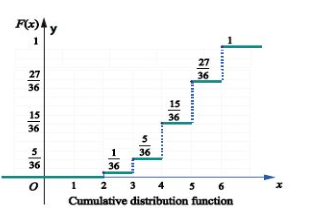
\(\text { (iii) } P(3 \leq X \leq 6)=\sum_{x=3}^5 P\left(X=x_1\right)=P(X=3)+P(X=4)+P(X=5)\)
\(\begin{aligned} & =\frac{4}{36}+\frac{10}{36}+\frac{12}{36}+\frac{26}{36} \\ & \text { (iv) } X \geq 4)=\sum_{x=4}^5 P\left(X=x_1\right) \end{aligned}\)
\(=\frac{10}{36}+\frac{12}{36}+\frac{9}{36}=\frac{31}{36}\)
43.
Given
(i) The probability density function. Differentiating F(x) with respect to 'x' at continuity points of F(x), we get
\(F(x)=\begin{cases} \begin{matrix} 0 & x<0 \end{matrix} \\ \begin{matrix} \frac { 1 }{ 2 } ({ 2x }+1) & 0\le x<1 \end{matrix} \\ \begin{matrix} 1 & x\ge 1 \end{matrix} \end{cases}\)
(ii) \(p(0.3\le X\le 0.6)=\int _{ 0.3 }^{ 0.6 }{ f(x)dx } \)
= \(\int _{ 0.3 }^{ 0.6 }{ \frac { 1 }{ 2 } \left( 2x+1 \right) dx } =\frac { 1 }{ 2 } \left[ \frac { { 2x }^{ 2 } }{ 2 } +x \right] _{ 0.3 }^{ 0.6 }\)
= \(\frac { 1 }{ 2 } \left( { x }^{ 2 }+x \right) _{ 0.3 }^{ 0.6 }=\frac { 1 }{ 2 } \left[ \left( { 0.6 }^{ 2 }+0.6 \right) -\left( { 0.3 }^{ 2 }+0.3 \right) \right] \)
= \(\frac { 1 }{ 2 } \left[ \left( .36.6 \right) \right] -\left( .09+0.3 \right) ]\)
= \(\frac { 1 }{ 2 } \left[ 0.96-.39 \right] =\frac { 0.57 }{ 2 } =0.285\)
= 0.285
44.
Given probability mass function is
| x | 0 | 1 | 2 | 3 | 4 |
| f(x) | \(\frac{1}{36}\) | \(\frac{2}{36}\) | \(\frac{3}{36}\) | \(\frac{2}{36}\) | \(\frac{3}{36}\) |
(i) Since f(x) is a probability mass function.
\(\sum _{ i=1 }^{ 5 }{ f({ x }_{ i }) } =1\)
⇒ k2 + 2k2 + 3k2 + 2k + 3k = 1
⇒ 6k2 + 5k = 1
⇒ 6k2 + 5k - 1 = 0
⇒ (k + 1) (6k - 1) = 0
⇒ k = -1 or ⇒ \(k=\frac { 1 }{ 6 } \)
⇒ \(k=\frac { 1 }{ 6 } \)
(ii) p(2 ≤ x < 5)
= p(x = 2) + p(x = 3) + p(x = 4)
= 2k2 + 3k2 + 2k = 5k2 + 2k
= \(5\left( \frac { 1 }{ 36 } \right) +2\left( \frac { 1 }{ 6 } \right) \)
= \(\frac { 5 }{ 36 } +\frac { 1 }{ 3 } =\frac { 5+12 }{ 36 } \)
= \(\frac { 17 }{ 36 } \)
(iii) p(3 < x) = p(x > 3)
= p(x = 4) + p(x = 5)
= 2k + 3k = 5k
= \(5\left( \frac { 1 }{ 6 } \right) \)
= \(\frac { 5 }{ 6 } \)
45.
The given function is a periodic function with period 2π and hence there will be stationary points and points of inflections in each period interval. We have,
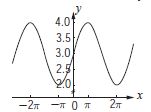
\(\frac { dy }{ dx } =cosx\) and \(\frac { { d }^{ 2 }y }{ { dx }^{ 2 } } =sinx\)
Now,\( \frac { { d }^{ 2 }y }{ { dx }^{ 2 } } =-sinx=0\Rightarrow x=n\pi \)
We now consider an interval, (-π, π ) by splitting into two sub intervals \(\left( -\pi ,0 \right) \) and \(\left( 0,\pi \right) \)
In the interval \(\left( -\pi ,0 \right) ,\frac { { d }^{ 2 }y }{ { dx }^{ 2 } } >0\) and hence the function is concave upward
In the interval \(\left( -\pi ,0 \right) ,\frac { { d }^{ 2 }y }{ { dx }^{ 2 } } <0\) and hence the function is concave downward. Therefore (0,3) is a point of inflection. The general intervals need to be considered to discuss the concavity of the curve are \(\left( n\pi ,\left( n+1 \right) \pi \right) \), where n is any integer which can be discussed as before to conclude that \(\left( n\pi ,3 \right) \) are also points of inflection.
46.
We have , f(x) = \(x^\frac{2}{3}\) then \(f'(x)=\frac{2}{3}x^{-\frac{1}{3}}\)\(=\frac{2}{3x^{\frac{1}{3}}}, f'(x)\ne 0 \forall x \in R\) and f'(x) does not exist at x = 0.
Therefore, there are no stationary points but there is a critical point at x = 0.
| Interval | \((-\infty,0)\) | \((0,\infty)\) |
| Sign of f'(x) | - | + |
| Monotonicity | strictly decreasing | strictly increasing |
| \(\searrow \) | ↗️ |
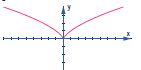
Because f'(x) changes its sign from negative to positive when passing through x = 0 for the function it has a local minimum at x = 0. The local minimum value is f(0) = 0. Note that here the local minimum occurs at a critical point which is not a stationary point.
47.
Let there be N radioactive nuclei in a sample at any time t and let No be the initial number of radioactive nuclei.
Then \(\frac{dN}{dt}\infty N\)
\(\Rightarrow \frac { dN }{ dt } =-\lambda N\)
Where \(\lambda>0\) is a constant
\(\Rightarrow \frac { dN }{ N } =-\lambda dt\)
\(\int { \frac { dN }{ N } } =-\lambda dt\)
\(\int { \frac { dN }{ N } =-\lambda \int { dt } } \)
\(\Rightarrow log\ N=-\lambda t+C\ ...(1)\)
\(T\quad t=0,\ we\ have\ N={ N }_{ 0 }\)
\(\therefore log{ N }_{ 0 }=0+C\)
\(\Rightarrow C=log{ N }_{ 0 }\)
\(\therefore\)(1) becomes, log N = -\(\lambda t+log{ N }_{ 0 }\)
\(\Rightarrow log\frac { N }{ { N }_{ 0 } } =-\lambda t\quad ...(2)\)
It is given that 10% of the original number of nuclei have undergone disintegration in a period of 100 years.
Whent= 100 \(N={ N }_{ 0 }-\frac { 10 }{ 100 } \times { N }_{ 0 }=\frac { { 9N }_{ 0 } }{ 10 } \)
Substituting in (2) we get
\(log\quad \frac { 9 }{ 10 } =-100\lambda \)
\(\Rightarrow \lambda =-\frac { 1 }{ 100 } log\frac { 9 }{ 10 } \)
Substituting in (2) we get,
\(log\frac { N }{ { N }_{ 0 } } =\left( \frac { 1 }{ 100 } log\frac { 9 }{ 10 } \right) t\)
when t = 1000,
\(log\frac { N }{ { N }_{ 0 } } =\frac { 1 }{ 100 } log\left( \frac { 9 }{ 10 } \right) \times 1000\)
\(=10log\left( \frac { 9 }{ 10 } \right) \)
\(\Rightarrow log\frac { N }{ { N }_{ 0 } } ={ \left( \frac { 9 }{ 10 } \right) }^{ 10 }\)
\(\Rightarrow \frac { N }{ { N }_{ 0 } } ={ \left( \frac { 9 }{ 10 } \right) }^{ 10 }\)
\(\Rightarrow \frac { N }{ { N }_{ 0 } } \times 100={ \left( \frac { 9 }{ 10 } \right) }^{ 10 }\times 100=\frac { { 9 }^{ 10 } }{ { 10 }^{ 8 } } \)
Hence, \(\frac { { 9 }^{ 10 } }{ { 10 }^{ 8 } } \%\) of radioactive nuclei will remain after 1000 years,
48.
Let T be the temperature of the body at any time t and with time 0 taken to be 8 p.m. By Newton’s law of cooling \(\frac { dT }{ dt } =k(T-50)or\frac { dT }{ T-50 } =dt\).
Integrating on both sides, we get log |50 −T| = kt + logC or 50 −T = Cekt.
When t = 0, T = 70, and so C = −20
When t = 2,T = 60, we have −10 = −20 ek2.
Thus, \(k=\frac { 1 }{ 2 } log\left( \frac { 1 }{ 2 } \right) \)
Hence, the solution is 50-T = -20e\(\frac{1}{2}\)tlog\((\frac{1}{2})\) or T = 50 + 20\((\frac{1}{2})^\frac{t}{2}\)
Now, we would like to find the value of t, for which T(t) = 98.6 , and t = 2\(\left( \frac { log\left( \frac { 48.6 }{ 20 } \right) }{ log\left( \frac { 1 }{ 2 } \right) } \right) \approx -2.56\)
It appears that the person was murdered at about 5.30 p.m.
49.
\(\left(y-e^{\sin ^{-1} x}\right) \frac{d x}{d y}+\sqrt{1-x^2} =0 \)
\(\left(y-e^{\operatorname{in}{ }^{-1} x}\right) \frac{d x}{d y} =-\sqrt{1-x^2} \)
\(\left(y-e^{\sin ^{-1} x}\right) =-\sqrt{1-x^2} \frac{d y}{d x} \)
\(\div \sqrt{1-x^2} \frac{d y}{d x}+y =e^{\sin ^{-1} x} \)
\(\text { by } \sqrt{1-x^2}, \quad \frac{d y}{d x}+\frac{1}{\sqrt{1-x^2}} y =\frac{e^{\sin ^{-1} x}}{\sqrt{1-x^2}}\)
Thus, the given differential equation is Linear
Here \(\mathrm{P} =\frac{1}{\sqrt{1-x^2}} ; \quad \mathrm{Q}=\frac{e^{\sin ^{-1} x}}{\sqrt{1-x^2}} \)
\(\text { I.F } =e^{\int P d x} \)
\( =e^{\int \frac{1}{\sqrt{1-x^2} d x}}=e^{\sin ^{-1} x}\)
So, the required solution is
\(y \times \text { I.F } =\int \mathrm{Q} \times \mathrm{I} . \mathrm{F} d x+c \)
\(y e^{\sin ^{-1} x} =\int \frac{e^{\sin ^{-1} x}}{\sqrt{1-x^2}} e^{\sin ^{-1} x} d x+c\)
t = sin-1x
50.
\(\mathrm{y} \mathrm{d} x=-\left(2 x-10 \mathrm{y}^3\right) \mathrm{dy} \)
\(y \frac{d x}{d y}=-2 x+10 \mathrm{y}^3 \)
\(\div y, \frac{y}{y} \frac{d x}{d y}+\frac{2}{y} x=\frac{10 y^3}{y} \)
\(\frac{d x}{d y}+\left(\frac{2}{y}\right) x=10 \mathrm{y}^2\)
This is of the form \( \frac{d x}{d y}+P x=Q \)
where \(\mathrm{P}=\frac{2}{y} \quad \mathrm{Q}=10 \mathrm{y}^2 \)
Thus, the given equation is linear. \( I.F =e^{\int p d y}=e^{\int \frac{2}{y} d y}=e^{2 \log y}=\mathrm{y}^2\)
So, the required solution is
\(x \times \text { I.F } =\int(Q \times I . F) d y+c \)
\(x \mathrm{y}^2 =\int 10 y^2 \times y^2 d y+c \)
\(=\int 10 y^4 d y+c \)
\(=\frac{10 y^5}{5}+c=2 \mathrm{y}^5+\mathrm{c}\)
\(x y^2=2 y^5+c\) is a required solution
51.
Let \(\overset { \rightarrow }{ B } =x\overset { \wedge }{ i } +y\overset { \wedge }{ j } +z\overset { \wedge }{ k } \)
Given \(\overset { \rightarrow }{ A } \times \overset { \rightarrow }{ B } =\overset { \rightarrow }{ C } \Rightarrow \left| \begin{matrix} \overset { \wedge }{ i } \\ 1 \\ x \end{matrix}\begin{matrix} \overset { \wedge }{ j } \\ 1 \\ y \end{matrix}\begin{matrix} \overset { \wedge }{ k } \\ 1 \\ z \end{matrix} \right| =\overset { \wedge }{ j } -\overset { \wedge }{ k } \)
\(\Rightarrow \overset { \wedge }{ i } (z-y)-\overset { \wedge }{ j } (z-x)+\overset { \wedge }{ k } (y-x)\quad \overset { \wedge }{ j } -\overset { \wedge }{ k } \)
Equating the like components on both sides, we get
z - y = 0 .....(1)
x - y = 1 .....(2)
y - x = -1 .....(3)
Also, \(\overset { \rightarrow }{ A } .\overset { \rightarrow }{ B } =3\Rightarrow \left( \overset { \wedge }{ i } +\overset { \wedge }{ j } +\overset { \wedge }{ k } \right) .\left( x\overset { \wedge }{ i } +y\overset { \wedge }{ j } +z\overset { \wedge }{ k } \right) =3\)
⇒ x + y + z = 3 ....(4)
Solving (1), (2), (3) and (4), we get \(x=\frac { 5 }{ 3 } ,y=\frac { 2 }{ 3 } \)and \(z=\frac { 2 }{ 3 } \)
\(\therefore \overset { \rightarrow }{ B } =\frac { 5 }{ 3 } \overset { \wedge }{ i } +\frac { 2 }{ 3 } \overset { \wedge }{ j } +\frac { 2 }{ 3 } \overset { \wedge }{ k } \)
52.
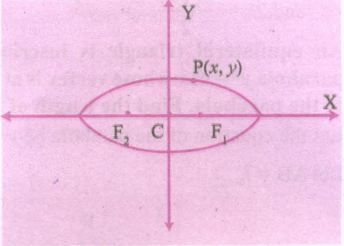
Given F1P + F2P = 8
By the focal property of ellipse
F1P + F2P = 2a
∴ 2a = 8 ⇒ a = 4
and distance between the foci = F1F2 = 6
2ae = 6 ⇒ ae = 3
∴ 4(e) = 3 ⇒ e \(\frac34\)
∴ b2 = a2(1- e2)
= \(16\left( { 1-\left( \frac { 3 }{ 4 } \right) }^{ 2 } \right) =16\left( 1-\frac { 9 }{ 10 } \right) =16\left( \frac { 7 }{ 16 } \right) =7\)
∴ The path traced by him is an ellipse and its equation is \(\frac { { x }^{ 2 } }{ { a }^{ 2 } } +\frac { { y }^{ 2 } }{ { b }^{ 2 } } =1\)
⇒ \(\frac { { x }^{ 2 } }{ 16 } -\frac { { y }^{ 2 } }{ 7 } \) = 1
53.
Given \({ tan }^{ -1 }\left( \frac { \sqrt { 1+{ x }^{ 2 } } -\sqrt { 1-{ x }^{ 2 } } }{ \sqrt { 1+{ x }^{ 2 } } +\sqrt { 1-{ x }^{ 2 } } } \right) =a\)
\(\Rightarrow \frac { \left( \sqrt { 1+{ x }^{ 2 } } -\sqrt { 1-{ x }^{ 2 } } \right) \left( \sqrt { 1+{ x }^{ 2 } } +\sqrt { 1-{ x }^{ 2 } } \right) }{ \left( \sqrt { 1+{ x }^{ 3 } } -\sqrt { 1-{ x }^{ 2 } } \right) \left( \sqrt { 1+{ x }^{ 2 } } +\sqrt { 1-{ x }^{ 2 } } \right) } \)
= \(\frac { tan\alpha +1 }{ tan\alpha -1 } \)
\(\Rightarrow \frac { 2\sqrt { 1+{ x }^{ 2 } } }{ -2\sqrt { 1-{ x }^{ 2 } } } =\frac { tan\alpha +1 }{ tan\alpha -1 } \)
\(\Rightarrow \sqrt { \frac { 1-{ x }^{ 2 } }{ 1+{ x }^{ 2 } } } =\frac { 1-tan\alpha }{ 1+tan\alpha } \)
\(\Rightarrow \sqrt { \frac { 1-{ x }^{ 2 } }{ 1+{ x }^{ 2 } } } =\frac { cos\alpha -sin\alpha }{ cos\alpha +sin\alpha } \)
\(\Rightarrow \frac { 1-{ x }^{ 2 } }{ 1+{ x }^{ 2 } } \left( \frac { cos\alpha -sin\alpha }{ cos\alpha +sin\alpha } \right) ^{ 2 }\)
\(\Rightarrow \frac { 1-{ x }^{ 2 } }{ 1+{ x }^{ 2 } } =\frac { 1-sin2\alpha }{ 1+sin2\alpha } \Rightarrow { x }^{ 2 }=sin2\alpha \)

12th Standard Syllabus & Materials
12th Standard
TN 12th Computer Applications வலையமைப்பு வடமிடல் Sample Question Papers Study Material - QB365 Set A
NEW12th Standard
TN 12th Computer Applications களப்பெயர் முறைமை (DNS) Sample Question Papers Study Material - QB365 Set A
NEW12th Standard
TN 12th Computer Applications வலையமைப்பு எடுத்துக்காட்டுகள் மற்றும் நெறிமுறைகள் Sample Question Papers Study Material - QB365 Set A
NEW12th Standard
TN 12th Computer Applications கணினி வலையமைப்பு ஓர் அறிமுகம் Sample Question Papers Study Material - QB365 Set A



Tamilnadu Stateboard 12th Standard Subjects
Maths

Chemistry

Physics

Biology

Computer Science

Business Maths and Statistics

Economics

Commerce

Accountancy

History

Computer Applications
Biology
Computer Technology
Computer Applications
Computer Science
Business Maths and Statistics
Commerce
Economics
Maths
Chemistry
Physics
Computer Technology
History
Accountancy

Tamil

English

French
Tamilnadu Stateboard Standards

