
 100% FREE ACCESS
12th Standard Syllabus & Materials
12th Standard
TN 12th Computer Applications மின்னணு தரவு பரிமாற்றம் Sample Question Papers Study Material - QB365 Set A
NEW12th Standard
TN 12th Computer Applications மின் - வணிக பாதுகாப்பு அமைப்புகள் Sample Question Papers Study Material - QB365 Set A
NEW12th Standard
TN 12th Computer Applications மின்னணு செலுத்தல் முறைகள் Sample Question Papers Study Material - QB365 Set A
NEW12th Standard
TN 12th Computer Applications மின் - வணிகம் Sample Question Papers Study Material - QB365 Set A
NEW12th Standard
TN 12th Computer Applications திறந்த மூல கருத்துருக்கள் Sample Question Papers Study Material - QB365 Set A
NEW12th Standard
TN 12th Computer Applications வலையமைப்பு வடமிடல் Sample Question Papers Study Material - QB365 Set A

Published on: 27/02/2021
12th Standard English Medium Maths Reduced Syllabus Three Mark Important Questions - 2021(Public Exam )
Download Tamil Nadu 12th Standard Maths question papers, model tests, one-mark questions, important questions, and public exam papers in PDF format. Free study materials and answer keys for TN State Board students.
Questions + Answers key
Take MCQ Maths Test1.
Find the value of the expression in terms of x, with the help of a reference triangle.
tan\(\left( { sin }^{ -1 }\left( x+\frac { 1 }{ 2 } \right) \right) \)
2.
Obtain the Cartesian equation for the locus of z = x + iy in each of the following cases:
|z - 4|2- |z -1 |2 = 16
3.
Obtain the Cartesian form of the locus of z = x + iy in each of the following cases:
Im[(1−i)z+1] = 0
4.
Show that \(\left( \frac { 19-7i }{ 9+i } \right) ^{ 12 }+\left( \frac { 20-5i }{ 7-6i } \right) ^{ 12 }\) is real
5.
Find the adjoint of the following:
\(\frac { 1 }{ 3 } \left[ \begin{matrix} 2 & 2 & 1 \\ -2 & 1 & 2 \\ 1 & -2 & 2 \end{matrix} \right] \)
6.
Find the equation of the hyperbola in each of the cases given below:
passing through (5, −2) and length of the transverse axis along x axis and of length 8 units.
7.
Show that the equation \({ z }^{ 3 }+2\bar { z } =0\) has five solutions
8.
If \(\left| z-\frac { 2 }{ z } \right| =2\) show that the greatest and least value of |z| are \(\sqrt { 3 } +1\) and \(\sqrt { 3 } -1\) respectively.
9.
Find the rank of the following matrices by row reduction method:
\(\left[ \begin{matrix} 1 \\ \begin{matrix} 2 \\ 5 \end{matrix} \end{matrix}\begin{matrix} 1 \\ \begin{matrix} -1 \\ -1 \end{matrix} \end{matrix}\begin{matrix} 1 \\ \begin{matrix} 3 \\ 7 \end{matrix} \end{matrix}\begin{matrix} 3 \\ \begin{matrix} 4 \\ 11 \end{matrix} \end{matrix} \right] \)
10.
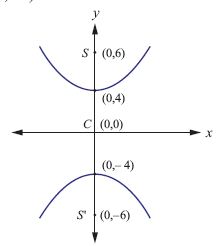
Find the equation of the hyperbola with vertices (0, ±4) and foci(0, ±6).
11.
A circle of area 9π square units has two of its diameters along the lines x + y = 5 and x−y = 1. Find the equation of the circle.
12.
Given A = \(\left[ \begin{matrix} 1 & -1 \\ 2 & 0 \end{matrix} \right] \), B = \(\left[ \begin{matrix} 3 & -2 \\ 1 & 1 \end{matrix} \right] \) and C = \(\left[ \begin{matrix} 1 & 1 \\ 2 & 2 \end{matrix} \right] \), find a matrix X such that A X B = C.
13.
Find the equations of the tangent and normal to the circle x2 + y2 = 25 at P(-3, 4).
14.
The complex numbers u, v, and w are related by \(\frac { 1 }{ u } =\frac { 1 }{ v } +\frac { 1 }{ w } \) If v = 3−4i and w = 4+3i, find u in rectangular form.
15.
For what value of x, the inequality \(\frac { \pi }{ 2 } <{ cos }^{ -1 }(3x-1)<\pi \) holds?
16.
Find tan(tan-1(2019))
17.
Solve the cubic equations: 8x3 - 2x2 - 7x + 3 = 0
18.
The vector equation in parametric form of a line is \(\vec { r } =(3\hat { i } -2\hat { j } +6\hat { k } )+t(2\hat { i } -\hat { j } +3\hat { k } )\). Find
(i) the direction cosines of the straight line
(ii) vector equation in non-parametric form of the line
(iii) Cartesian equations of the line.
19.
Prove that \({ tan }^{ -1 }x+{ tan }^{ -1 }\frac { 2x }{ 1-{ x }^{ 2 } } ={ tan }^{ -1 }\frac { 3x-{ x }^{ 3 } }{ 1-{ 3x }^{ 2 } } ,|x|<\frac { 1 }{ \sqrt { 3 } } \)
20.
Find the equations of the tangent and normal to hyperbola 12x2−9y2 = 108 at \(\theta =\frac { \pi }{ 3 } \) (Hint: use parametric form)
21.
Find the equation of the tangent to the parabola y2 = 16x perpendicular to 2x + 2y + 3 = 0.
22.
A chemist has one solution which is 50% acid and another solution which is 25% acid. How much each should be mixed to make 10 litres of a 40% acid solution? (Use Cramer’s rule to solve the problem).
23.
Solve the cubic equation : 2x3−x2−18x + 9 = 0 if sum of two of its roots vanishes.
24.
If D is the midpoint of the side BC of a triangle ABC, then show by vector method that \({ \left| \vec { AB } \right| }^{ 2 }+{ \left| \vec { AC } \right| }^{ 2 }=2({ \left| \vec { AD} \right| }^{ 2 }+{ \left| \vec { BD } \right| }^{ 2 })\)
25.
Solve the equation 2x3+11x2−9x−18 = 0.
1.
tan\(\left( { sin }^{ -1 }\left( x+\frac { 1 }{ 2 } \right) \right) \)
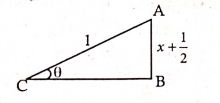
We know that \(sin^{ -1 }\left( x \right) ={ tan }^{ -1 }\left( \frac { x }{ \sqrt { 1-{ x }^{ 2 } } } \right) \) if-1 \(\therefore { sin }^{ -1 }\left( x+\frac { 1 }{ 2 } \right) ={ tan }^{ -1 }\left( \frac { x\frac { 1 }{ 2 } }{ 1-\left( x+\frac { 1 }{ 2 } \right) ^{ 2 } } \right) \)
= \({ tam }^{ -1 }\left( \frac { x+\frac { 1 }{ 2 } }{ \sqrt { 1-{ x }^{ 2 }-\frac { 1 }{ 4 } -x } } \right) \)
= \({ tan }^{ -1 }\left( \frac { x+\frac { 1 }{ 2 } }{ \sqrt { { x }^{ 2 }-x+\frac { 3 }{ 4 } } } \right) \)
\(\therefore tan\left( { sin }^{ -r }\left( x+\frac { 1 }{ 2 } \right) \right) =tan\left( { tan }^{ -1 }\left( \frac { x+\frac { 1 }{ 2 } }{ \sqrt { -{ x }^{ 2 }-x+\frac { 3 }{ 4 } } } \right) \right) \)
= \(\frac { x+\frac { 1 }{ 2 } }{ \sqrt { -{ x }^{ 2 }-x+\frac { 3 }{ 4 } } } =\frac { 2 }{ \frac { \sqrt { { -4x }^{ 2 }-4x+3 } }{ 2 } } \)
\(tan\left( { sin }^{ -1 }\left( x+\frac { 1 }{ 2 } \right) \right) =\frac { 2x+1 }{ \sqrt { 3+4x-{ 4x }^{ 2 } } } \)
2.
|z-4|2-|z-1|2 = 16
|x+iy-4|2 - |x+iy-1|2 = 16
⇒ |(x-4)+iy|2 - |(x-1)+iy2|2 = 16
⇒ [(x-4)2+y2] - [(x-1)2+y2] = 16
⇒ x2-8x+16+y2-[x2-2x+1+y2] = 16
\(\Rightarrow \not x^{2}-8 x+16+\not y^{2}-\not x^{2}+2 x-1-\not y^{2}=16\)
⇒ -6x+15-16 = 0
⇒ -6x-1 = 0
⇒ 6x+1 = 0 Which is the required Cartesian equation.
The locus of the point is a straight line.
3.
Im[(1−i)z + 1] = 0
(1-i)z + 1 = (1-i)( x + iy) +1
= x + iy-ix-i2y+1
= x+iy-ix+y+1
= (x + y + 1) + i(y - x)
∴ Im[(1-i)z + 1] = y-x = 0
⇒ x - y = 0
Hence, the Cartesian equation is x - y = 0
4.
Consider \(\frac { 19-7i }{ 9+i } =\frac { 19-7i }{ 9+i } \times \frac { 9-i }{ 9-i } \)
= \(\frac { 171-19i-63i+7i^{ 2 } }{ (9)^{ 2 }-{ i }^{ 2 } } =\frac { 171-82i-7 }{ 81+1 } \)
= \(\frac { 164-82i }{ 82 } =\frac { 82(2-i) }{ 82 } \) = 2- i
Also \(\frac { 20-5i }{ 7-6i } =\frac { 20-5i }{ 7-6i } \times \frac { 7+6i }{ 7+6i } \)
= \(\frac { 140+120i-35i-30^{ 2 } }{ { 7 }^{ 2 }-(6i)^{ 2 } } \)
\(=\frac{140+85 i+30}{49+36}=\frac{170+85 i}{85}=\frac{\not 85(2+i)}{\not 85}=2+i\)
∴ \(\left( \frac { 19-7i }{ 9+i } \right) ^{ 12 }+\left( \frac { 20-5i }{ 7-6i } \right) ^{ 12 }\) = (2-i)12+(2+i)12
Let z = (2-i)12+(2+i)12
∴ \(\overline { z } \) = \(\overline { (2-i)^{ 12 }+(2+i)^{ 12 } } =\overline { (2-i)^{ 12 } } +\overline { (2+i)^{ 12 } } \)
[∵ \(\overline { { z }_{ 1 }+{ z }_{ 2 } } =\overline { { z }_{ 1 } } +\overline { { z }_{ 2 } } \)]
= (2 + i)12+(2 - i)12= z
∴ \(\overline { z } \) = z ⇒ z is purely real
∴ \(\left( \frac { 19-7i }{ 9+i } \right) ^{ 12 }+\left( \frac { 20-5i }{ 7-6i } \right) ^{ 12 }\) is real.
5.
\(\frac { 1 }{ 3 } \left[ \begin{matrix} 2 & 2 & 1 \\ -2 & 1 & 2 \\ 1 & -2 & 2 \end{matrix} \right] \)
Let A =\(\left[ \begin{matrix} 2 & 2 & 1 \\ -2 & 1 & 2 \\ 1 & -2 & 2 \end{matrix} \right] \) and λ = \(\frac { 1 }{ 3 } \)
Since adj (λA) = λn-1(adj A)
we get adj \(\left( \frac { 1 }{ 3 } \left[ \begin{matrix} 2 & 2 & 1 \\ -2 & 1 & 2 \\ 1 & -2 & 2 \end{matrix} \right] \right) =\left( \frac { 1 }{ 3 } \right) ^{ 2 }\)
adj\(\left( \begin{matrix} 2 & 2 & 1 \\ -2 & 1 & 2 \\ 1 & -2 & 1 \end{matrix} \right) \)
∴ Required adjoint matrix
\(\frac { 1 }{ 9 } \left[ \begin{matrix} +\left| \begin{matrix} 1 & 2 \\ -2 & 2 \end{matrix} \right| & -\left| \begin{matrix} -2 & 2 \\ 1 & 2 \end{matrix} \right| & +\left| \begin{matrix} -2 & 1 \\ 1 & -2 \end{matrix} \right| \\ -\left| \begin{matrix} 2 & 1 \\ -2 & 2 \end{matrix} \right| & +\left| \begin{matrix} 2 & 1 \\ 1 & 2 \end{matrix} \right| & -\left| \begin{matrix} 2 & 2 \\ 1 & -2 \end{matrix} \right| \\ +\left| \begin{matrix} 2 & 1 \\ 1 & 2 \end{matrix} \right| & -\left| \begin{matrix} 2 & 1 \\ -2 & 2 \end{matrix} \right| & +\left| \begin{matrix} 2 & 2 \\ -2 & 1 \end{matrix} \right| \end{matrix} \right] ^{ T }\)
= \(\frac { 1 }{ 9 } \left[ \begin{matrix} (2+4)-(-4-2)+(4-1) \\ -(4+2)+(4-1)+(-4-2) \\ +(4-1)-(4+2)+(2+4) \end{matrix} \right] ^{ T }\)
= \(\frac { 1 }{ 9 } \left[ \begin{matrix} 6 & 6 & 3 \\ -6 & 3 & 6 \\ 3 & -6 & 6 \end{matrix} \right] ^{ T }=\frac { 1 }{ 9 } \left[ \begin{matrix} 6 & -6 & 3 \\ 6 & 3 & -6 \\ 3 & 6 & 6 \end{matrix} \right] \)
= \(\frac { 3 }{ 9 } \left[ \begin{matrix} 2 & -2 & 1 \\ 2 & -1 & -2 \\ 1 & 2 & 2 \end{matrix} \right] \)
[Taking 3 common from each entry]
=\(\frac { 1 }{ 3 } \left[ \begin{matrix} 2 & -2 & 1 \\ 2 & 1 & -2 \\ 1 & 2 & 2 \end{matrix} \right] \).
6.
Passing through (5, -2) length of the transverse axis is a long x-axis and of length 8 units.
2a = 8 ⇒ a = 4
Since the transverse axis is along x-axis, centre is (0, 0)
Equation of the hyperbola is
\(\frac { { x }^{ 2 } }{ 16 } -\frac { { y }^{ 2 } }{ b^{ 2 } } =1\)
Since (5, -2)passes through the parabola,
\(\frac { 25 }{ 16 } -\frac { 4 }{ { b }^{ 2 } } \Rightarrow \frac { 4 }{ { b }^{ 2 } } =\frac { 25 }{ 16 } -1=\frac { 25-16 }{ 16 } =\frac { 9 }{ 16 } \)
∴ \({ b }^{ 2 }=\frac { 16\times 4 }{ 9 } =\frac { 64 }{ 9 } \)
∴ Equation of the hyperbola is
\(\frac { { x }^{ 2 } }{ 16 } -\frac { { y }^{ 2 } }{ \frac { 64 }{ 9 } } =1\Rightarrow \frac { { x }^{ 2 } }{ 16 } -\frac { 9{ y }^{ 2 } }{ 64 } =1\)
7.
Given z3+2\(\overline { z } \) = 0
⇒ z3 = -2\(\overline { z } \)
Taking modulus, |z3| = |-2\(\overline { z } \)|
⇒ |z|3 = 2|z|
⇒ |z| [|z|2-2] = 0
|z| = 0 or |z|2-2 = 0
⇒ |z| = 0
⇒ z = 0 is a solution ....(1)
|z2| = 2
⇒ |z2| = 2 ⇒ (z\(\overline { z } \))2 = 2
⇒ z\(\overline { z } \) = \(\sqrt { 2 } \Rightarrow \overline { z } \frac { \sqrt { 2 } }{ z } \)
Given z + 2\(\overline { z } \) = 0
⇒ z3+2\(\frac { \sqrt { 2 } }{ z } \) = 0
⇒ z4+2\(\sqrt { 2 } \) = 0
If has 4 non-zero solutions
Hence from (1) and (2), z3+2\(\overline { z } \) has 5 solutions.
8.
Given \(\left| z-\frac { 2 }{ z } \right| \) = 2
Consider |z| = \(\left| z-\frac { 2 }{ z } +\frac { 2 }{ z } \right| \)
≤ \(\left| z-\frac { 2 }{ z } \right| +\left| \frac { 2 }{ z } \right| \) [Triangle law of in equality]
|z| ≤ \(\frac { 2|z|+2 }{ |z| } \) [∵ \(\left| z-\frac { 2 }{ z } \right| \) = 2]
≤ \(\frac { 2|z|+2 }{ |z| } \) ⇒ |z|2 ≤ 2|z|+2 ⇒ |z|2-2|z|≤ 2
Adding 1 both sides.
|z|2-2|z|+1 ≤ 2+1
⇒ [|z|-1]2 ≤ 3 ⇒ |z|-1 ≤ ±\(\sqrt { 3 } \)
⇒ |z| ≤ ±\(\sqrt { 3 } \)+1
∴ The greatest value of |z| is \(\sqrt { 3 } \)+1 and the least value pf |z| is 1-\(\sqrt { 3 } \) respectively.
9.
\(\left[ \begin{matrix} 1 \\ \begin{matrix} 2 \\ 5 \end{matrix} \end{matrix}\begin{matrix} 1 \\ \begin{matrix} -1 \\ -1 \end{matrix} \end{matrix}\begin{matrix} 1 \\ \begin{matrix} 3 \\ 7 \end{matrix} \end{matrix}\begin{matrix} 3 \\ \begin{matrix} 4 \\ 11 \end{matrix} \end{matrix} \right] \)
Let A =\(\left[ \begin{matrix} 1 \\ \begin{matrix} 2 \\ 5 \end{matrix} \end{matrix}\begin{matrix} 1 \\ \begin{matrix} -1 \\ -1 \end{matrix} \end{matrix}\begin{matrix} 1 \\ \begin{matrix} 3 \\ 7 \end{matrix} \end{matrix}\begin{matrix} 3 \\ \begin{matrix} 4 \\ 11 \end{matrix} \end{matrix} \right] \)
A =\(\left[ \begin{matrix} 1 \\ 2 \\ 5 \end{matrix}\begin{matrix} 1 \\ -1 \\ -1 \end{matrix}\begin{matrix} 1 \\ 3 \\ 7 \end{matrix}\begin{matrix} 3 \\ 4 \\ 11 \end{matrix} \right] \overset { { R }_{ 2 }\rightarrow { { R } }_{ 2 }-2{ { R } }_{ 1 } }{ \longrightarrow } \left[ \begin{matrix} 1 \\ 0 \\ 5 \end{matrix}\begin{matrix} 1 \\ -3 \\ -1 \end{matrix}\begin{matrix} 1 \\ 1 \\ 7 \end{matrix}\begin{matrix} 3 \\ -2 \\ 11 \end{matrix} \right] \)
\(\overset { { { R } }_{ 3 }\rightarrow { { R } }_{ 3 }-5{ { R } }_{ 1 } }{ \longrightarrow } \left[ \begin{matrix} 1 \\ 0 \\ 0 \end{matrix}\begin{matrix} 1 \\ -3 \\ -6 \end{matrix}\begin{matrix} 1 \\ 1 \\ 2 \end{matrix}\begin{matrix} 3 \\ -2 \\ -4 \end{matrix} \right] \)
\(\overset { { R }_{ 3 }\rightarrow { { R } }_{ 3 }-2{ { R } }_{ 2 } }{ \longrightarrow } \left[ \begin{matrix} 1 \\ 0 \\ 0 \end{matrix}\begin{matrix} 1 \\ -3 \\ 0 \end{matrix}\begin{matrix} 1 \\ 1 \\ 0 \end{matrix}\begin{matrix} 3 \\ -2 \\ 0 \end{matrix} \right] \)
The last equivalent matrix is in row echelon form it ha two non-zero row \(\rho \)(A) = 2
10.
From figure the midpoint of line joining foci is the centre C(0, 0).
Transverse axis is y-axis
AA′ = 2a \(\Rightarrow \) 2a = 8,
SS′ = 2c = 12, c = 6
a = 4
b2 = c2−a2 = 36−16 = 20
Hence the equation of the required hyperbola is \(\frac { { y }^{ 2 } }{ 16 }- \frac { { x }^{ 2 } }{ 20 } =1\)
11.
Area of the circle = 9π sq.units

πr2 = 9π ⇒ r2 ⇒ 9 ⇒ r ⇒ 3
Diameters are x + y = 5 ................(1)
and x - y = 1 .................(2)
We know that centre is the point of intersection of diameters.
∴ To find the centre, solve (1) and (2).
JPG.JPG)
⇒ 2x = 6
⇒ x = 3
∴ (1) ⇒ 3 + y = 5
⇒ y = 5 - 3 = 2
∴ Centre is (3, 2)
Hence, equation of the circle is
(x - h)2 + (y - k)2 = r2
⇒ (x - 3)2 + (y - 2)2 = 32
\(\Rightarrow x^{2}-6 x+9+y^{2}-4 y+4=9\)
⇒ x2 + y2 − 6x − 4y + 4 = 0
12.
Given A =\(\left[ \begin{matrix} 1 & -1 \\ 2 & 0 \end{matrix} \right] \), B =\(\left[ \begin{matrix} 3 & -2 \\ 1 & 1 \end{matrix} \right] \) and C =\(\left[ \begin{matrix} 1 & 1 \\ 2 & 2 \end{matrix} \right] \)
Also, A X B = C
Premultiply by A-1 we get,
(A-1 A) X B = A-1 C
⇒ XB = A-1C [∵ A-1a = 1]
Post Multiply by B-1 we get
(X B) B-1 = (A-1 C) B-1
⇒ X = (A-1 C) B-1
|A| = \(\left| \begin{matrix} 1 & -1 \\ 2 & 0 \end{matrix} \right| \) = 0 + 2 = 2 ≠ 0
∴ A-1 = \(\frac { 1 }{ |A| } adjA=\frac { 1 }{ 2 } \left[ \begin{matrix} 0 & 1 \\ -2 & 1 \end{matrix} \right] \)
|B| = \(\left| \begin{matrix} 3 & -2 \\ 1 & 1 \end{matrix} \right| \) = 3 + 2 = 5 ≠ 0
∴ B-1 = \(\frac { 1 }{ |B| } adjB=\frac { 1 }{ 5 } \left[ \begin{matrix} 1 & 2 \\ -1 & 3 \end{matrix} \right] \)
A-1C = \(\\ \frac { 1 }{ 2 } \left[ \begin{matrix} 0 & 1 \\ -2 & 1 \end{matrix} \right] \left[ \begin{matrix} 1 & 1 \\ 2 & 2 \end{matrix} \right] \)
= \(\frac { 1 }{ 2 } \left[ \begin{matrix} 0+2 & 0+2 \\ -2+2 & -2+2 \end{matrix} \right] \)
=\(\frac { 1 }{ 2 } \left[ \begin{matrix} 2 & 2 \\ 0 & 0 \end{matrix} \right] =\frac { 1 }{ 2 } (2)\left[ \begin{matrix} 1 & 1 \\ 0 & 0 \end{matrix} \right] \)
=\(\left[ \begin{matrix} 1 & 1 \\ 0 & 0 \end{matrix} \right] \)
∴ X = Z(A-1C).B-1
= \(\left[ \begin{matrix} 1 & 1 \\ 0 & 0 \end{matrix} \right] \frac { 1 }{ 5 } \left[ \begin{matrix} 1 & 2 \\ -1 & 3 \end{matrix} \right] =\frac { 1 }{ 5 } \left[ \begin{matrix} 1-1 & 2+3 \\ 0+0 & 0+0 \end{matrix} \right] \)
= \(\frac { 1 }{ 5 } \left[ \begin{matrix} 0 & 5 \\ 0 & 0 \end{matrix} \right] =\frac { 1 }{ 5 } (5)\left[ \begin{matrix} 0 & 1 \\ 0 & 0 \end{matrix} \right] =\frac { 1 }{ 10 }\left[ \begin{matrix} 0 & 1 \\ 0 & 0 \end{matrix} \right] \)
∴ X = \(\frac { 1 }{ 10 } \left[ \begin{matrix} 0 & 1 \\ 0 & 0 \end{matrix} \right] \).
13.
Equation of tangent to the circle at P(x1, y1 ) is xx1 yy1 = a2
That is, x(−3) + y(4) = 25
−3x + 4y = 25
Equation of normal is xy1 - yx1 = 0
That is, 4x + 3y = 0
14.
Given v = 3-4i, w = 4+3i and \(\frac { 1 }{ u } =\frac { 1 }{ v } +\frac { 1 }{ w } \)
∴ \(\frac { 1 }{ u } =\frac { 1 }{ 3-4i } +\frac { 1 }{ 4+3i } \)
= \(\frac { 3+4i }{ (3-4i)(3+4i) } +\frac { 4-3i }{ (4+3i)(4-3i) } \)
= \(\\ \frac { 3+4i }{ 9-(4i)^{ 2 } } +\frac { 4-3i }{ 16-(3i)^{ 2 } } =\frac { 3+4i }{ 9+16 } +\frac { 4-3i }{ 16+9 } \)
= \(\frac { 3+4i }{ 25 } +\frac { 4-3i }{ 25 } =\frac { 3+4i+4-3i }{ 25 } \)
\(\frac { 1 }{ u } =\frac { 7+i }{ 25 } \)
∴ u = \(\frac { 25 }{ 7+i } \times \frac { 7-i }{ 7-i } =\frac { 25(7-i }{ 7^{ 2 }-({ i }^{ 2 }) } \)
= \(\frac { 25(7-i) }{ 49+1 } =\frac { 25(7-i) }{ 50 } =\frac { 1 }{ 2 } \)(7-i)
∴ u = \(\frac { 1 }{ 2 } \)(7-i) or \(\frac { 7 }{ 2 } \) - \(\frac { i }{ 2 } \)
15.
Given \(\frac { \pi }{ 2 } <{ cos }^{ -1 }(3x-1)<\pi \)
\((cos2\frac { \pi }{ 2 } <3x-1\))
\(\Rightarrow 0<3x-1<-1\)
\(0+1<3x<-1+1\)
\(1<3x<0\)
16.
Since tan(tan-1 x) = x, x ∈ R,
We have tan(tan-1(2019)) = 2019
17.
Let f(x) = 8x3- 2x2 - 7x +3 = 0
Here sum of the co-efficients of odd terms = 8 - 7 = 1
and sum of the co-efficients of even terms = -2 +3 = 1
Hence, x = - 1 is a root of f(x)
Let us divide f(x) by (x + 1)
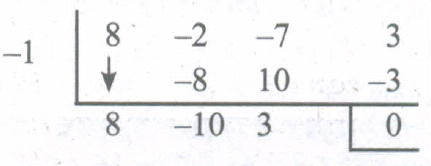
∴ The other factor is 8x2 - 10x + 3
\(\Rightarrow x=\frac { 10\pm \sqrt { 100-4(8)(3) } }{ 2\times 8 } \)
\(\Rightarrow x=\frac { 10\pm \sqrt { 100-96 } }{ 16 } \Rightarrow x=\frac { 10\pm 2 }{ 16 } \)
\(\Rightarrow x=\frac { 12 }{ 16 } \ or \)
\(x=\frac { 8 }{ 16 } \Rightarrow x=\frac { 3 }{ 4 } ,\frac { 1 }{ 2 } \)
∴ The roots are -1, \(\frac{1}{2},\frac{3}{4}\)
18.
Comparing the given equation with equation of a straight line \(\vec { r } =\vec { a } +t\vec { b } \), we have \(\vec { a } =3\hat { i } -2\hat { j } +6\hat { k } \) and \(\vec { b } =3\hat { i } -2\hat { j } +6\hat { k } \). Therefore,
(i) If \(\vec { b } ={ b }_{ 1 }\hat { i } +{ b }_{ 2 }\hat { j } +{ b }_{ 3 }\hat { k } \), then direction ratios of the straight line are \({ b }_{ 1 },{ b }_{ 2 },{ b }_{ 3 }\). Therefore, direction ratios of the given straight line are proportional to 2, −1,3, and hence the direction cosines of the given straight line are \(\frac { 2 }{ \sqrt { 14 } } ,\frac { -1 }{ \sqrt { 14 } } ,\frac { 3 }{ \sqrt { 14 } } \)
(ii) vector equation of the straight line in non-parametric form is given by \((\vec { r } -\vec { a } )\times \vec { b } =\vec { 0 } \), Therefore, \((\vec{r}-(3\hat { i } -2\hat { j } +6\hat { k } )\times(2\hat { i } -\hat { j } +3\hat { k } )=\vec{0}\)
(iii) Here (x1, y1 ,z1 ) = (3, −2,6) and the direction ratios are proportional to 2, −1,3. Therefore, Cartesian equations of the straight line are \(\frac { x-3 }{ 2 } =\frac { y+2 }{ -1 } =\frac { z-6 }{ 3 } \)
19.
\(LHS={ tan }^{ -1 }x+{ tan }^{ -1 }\frac { 2x }{ 1-{ x }^{ 2 } } \)
= \({ tan }^{ -1 }\left( \frac { x+\frac { 2x }{ 1-{ x }^{ 2 } } }{ 1-x\left( \frac { 2x }{ 1-{ x }^{ 2 } } \right) } \right) \)
= \({ tan }^{ -1 }\left( \frac { \frac { x(1-{ x }^{ 2 })+2x }{ 1-{ x }^{ 2 } } }{ \frac { 1-{ x }^{ 2 }-2{ x }^{ 2 } }{ 1-{ x }^{ 2 } } } \right) \)
= \({ tan }^{ -1 }\left( \frac { \frac { x-{ x }^{ 3 }+2x }{ 1-{ x }^{ 2 } } }{ \frac { 1-3x^{ 2 } }{ 1-{ x }^{ 2 } } } \right) \quad \left[ \because |x|<\frac { 1 }{ \sqrt { 3 } } \right] \)
= \({ tan }^{ -1 }\left( \frac { 3x-{ x }^{ 3 } }{ 1-{ x }^{ 2 } } \times \frac { 1-{ x }^{ 2 } }{ 1-{ 3x }^{ 2 } } \right) \)
If 3x2 < 1
⇒ \( |x|<\frac { 1 }{ \sqrt { 3 } }\)
20.
Equation of the hyperbola is 12x2- 9y2 = 108
\(\div 108\) we get, \(\frac { { 12x }^{ 2 } }{ 108 } -\frac { 9{ y }^{ 2 } }{ 108 } =1\)
⇒ \(\frac { { x }^{ 2 } }{ 9 } -\frac { { y }^{ 2 } }{ 12 } =1\)
∴ a2 = 9, b2 = 12
Parametric equation of tangent to the hyperbola is \(\frac { x \ sec\ \theta }{ a } -\frac { y \ tan \ \theta }{ b } =1\)
When \(\theta =\frac { \pi }{ 3 } \), the equation is
\(\frac { xsec\frac { \pi }{ 3 } }{ 3 } -\frac { ytan\frac { \pi }{ 3 } }{ 2\sqrt { 3 } } =1\)
.JPG)
⇒ \(\frac { 4x-3y }{ 6 } =1\) ⇒ 4x - 3y - 6 = 0 is the required equation of tangent.
Parametric equation of normal to the hyperbola is
\(\frac { ax }{ sec\theta } +\frac { by }{ tan\theta } ={ a }^{ 2 }+{ b }^{ 2 }\)
At \(\theta =\frac { \pi }{ 3 } ,\frac { 3x }{ sec\frac { \pi }{ 3 } } +\frac { 2\sqrt { 3 } }{ tan\frac { \pi }{ 3 } } =9+12\)
\(\Rightarrow \frac{3 x}{2}+\frac{2 \sqrt{\not 3} y}{\sqrt{\not 3}}=21\)
⇒ \(\frac { 3x }{ 2 } \) + 2y = 21 ⇒ 3x + 4y = 42
⇒ 3x + 4y - 42 = 0 is the required equation of normal.
21.
Equation of theparabola is y2 = 16x
∴ 4a = 16 ⇒ a = 4
Let y = mx + c ... (1)
be a tangent to the parabola
Since the tangent is perpendicular to
2x + 2y+ 3 =0,
m = \(\frac{-1}{Slope \ of \ the \ line \ 2 x + 2y + 3 = 0}\)
∴ m = \(\frac { -1 }{ \frac { -2 }{ 2 } } =\frac { -1 }{ -1 } \) = 1
[∵ \(Slope=\frac{Co - efficient of \ x}{Co - efficient of \ y}=\frac{-2}{2}\) = -1]
The condition for the line y = mx + c to be a tangent to the parabola is c = \(\frac{a}{m}\)
∴ c = \(\frac14\)= 4
From (1), y = 1(x) + 4 ⇒ x - y + 4 = 0 is the required tangent.
22.
Let the amount of 50% acid be x and the amount of 25% acid be y litre
By the given data, x + y = 10 ..............(1)
and \(x\left( \frac { 50 }{ 100 } \right) +y\left( \frac { 25 }{ 100 } \right) =10\left( \frac { 40 }{ 100 } \right) \)
⇒ 50x + 25y = 400 ⇒ 2x + y = 16 ...............(2)
The matrix from of the equation is \(\left[ \begin{matrix} 1 & 1 \\ 2 & 1 \end{matrix} \right] \left[ \begin{matrix} x \\ y \end{matrix} \right] =\left[ \begin{matrix} 10 \\ 16 \end{matrix} \right] \)
⇒ AX = B where A =\(\left[ \begin{matrix} 1 & 1 \\ 2 & 1 \end{matrix} \right] \)
\(X=\left[ \begin{matrix} x \\ y \end{matrix} \right] ,B=\left[ \begin{matrix} 10 \\ 16 \end{matrix} \right] \)
⇒ X = A-1N |A| = \(\left| \begin{matrix} 1 & 1 \\ 2 & 1 \end{matrix} \right| \) = 1 - 2 = -1
⇒ X = \(\frac { 1 }{ |A| } \)adj A.B
⇒ X= \(-1\left[ \begin{matrix} 1 & -1 \\ -2 & 1 \end{matrix} \right] \left[ \begin{matrix} 10 \\ 16 \end{matrix} \right] \)
= -\(\left[ \begin{matrix} 10-16 \\ -20+16 \end{matrix} \right] \)
⇒ X = -\(\left[ \begin{matrix} -6 \\ -4 \end{matrix} \right] =\left[ \begin{matrix} 6 \\ 4 \end{matrix} \right] \)
Thus, the amount of 50% acid is 6 litre and the amount of 25% acid is 4 litre = 10 litres of 40% acid solution.
23.
Since sum of two of its roots vanishes, let the roots be ∝, -∝ and β
\(\alpha -\alpha +\beta =\frac { -b }{ a } =\frac { 1 }{ 2 } \)
\(\Rightarrow \ \beta =\frac { 1 }{ 2 } \)
Also, \(\alpha \beta \gamma =\frac { -d }{ a } \)
\(\Rightarrow \alpha (-\alpha )(\frac { 1 }{ 2 } )=\frac { -9 }{ 2 } \)
\(\Rightarrow \frac { { \alpha }^{ 2 } }{ 2 } =\frac { 9 }{ 2 } \Rightarrow { \alpha }^{ 2 }=9\Rightarrow \alpha =\pm 3\)
\(\Rightarrow \alpha =3\)
∴ The roots are 3, -3 and \(\frac{1}{2}\).
24.
Let A be the origin, \(\vec { b } \) be the position vector of B and \(\vec {c } \) be the position vector of C .
Now D is the midpoint of BC , and so the position vector of D \(\frac{\vec{b}+\vec{c}}{2}\). There, we get
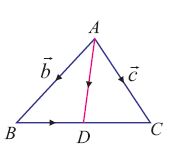
\({ \left| \vec { AD } \right| }^{ 2 }=\vec { AD } .\vec { AD } \)= \(\left( \frac { \vec { b } +\vec { c } }{ 2 } \right) .\left( \frac { \vec { b } +\vec { c } }{ 2 } \right) \)= \(\frac { 1 }{ 4 } ({ \left| \vec { b } \right| }^{ 2 }+{ \left| \vec { c } \right| }^{ 2 }+2\overrightarrow { b } .\vec { c } )\)....(1)
Now, \(\vec { BD } =\vec { AD } -\vec { AB } \) = \(\frac { \vec { b } +\vec { c } }{ 2 } -\vec { b }=\frac { \vec {c } -\vec { b} }{ 2 }\)
Then, we get, =\({ \left| \vec { BD } \right| }^{ 2 }=\vec { BD } .\vec {BD } \) = \(\left( \frac { \vec { c } -\vec { b} }{ 2 } \right) .\left( \frac { \vec { c } -\vec { b} }{ 2 } \right) \) = \(\frac { 1 }{ 4 } ({ \left| \vec { b } \right| }^{ 2 }+{ \left| \vec { c } \right| }^{ 2 }-2\overrightarrow { b } .\vec { c } )\)....(2)
Now, adding (1) and (2), we get
Therefore, \({ \left| \vec { AD } \right| }^{ 2 }+{ \left| \vec { BD } \right| }^{ 2 }=\frac { 1 }{ 4 } ({ \left| \vec { b } \right| }^{ 2 }+{ \left| \vec { c } \right| }^{ 2 }+2\overrightarrow { b } .\vec { c } )+\frac { 1 }{ 4 } ({ \left| \vec { b } \right| }^{ 2 }+{ \left| \vec { c } \right| }^{ 2 }-2\overrightarrow { b } .\vec { c } )=\frac { 1 }{ 2 } ({ \left| \vec { b } \right| }^{ 2 }+{ \left| \vec { c } \right| }^{ 2 })\)
⇒ \({ \left| \vec { AD } \right| }^{ 2 }+{ \left| \vec { BD } \right| }^{ 2 }=\frac { 1 }{ 2 } ({ \left| \vec { AB } \right| }^{ 2 }+{ \left| \vec { AC } \right| }^{ 2 })\)
Hence, \({ \left| \vec { AB } \right| }^{ 2 }+{ \left| \vec { AC } \right| }^{ 2 }=2({ \left| \vec { AD } \right| }^{ 2 }+{ \left| \vec { BD } \right| }^{ 2 })\)
25.
We observe that the sum of the coefficients of the odd powers and that of the even powers are equal.
Hence −1 is a root of the equation.
To find other roots, we divide 2x3+11x2-9x-18 by x+1 and get 2x2+9x-18 as the quotient.
Solving this we get \(\frac{3}{2}\) and -6 as roots.
Thus -6, -1, \(\frac{3}{2}\) are the roots or solutions of the given equation.

12th Standard Syllabus & Materials
12th Standard
TN 12th Computer Applications களப்பெயர் முறைமை (DNS) Sample Question Papers Study Material - QB365 Set A
NEW12th Standard
TN 12th Computer Applications வலையமைப்பு எடுத்துக்காட்டுகள் மற்றும் நெறிமுறைகள் Sample Question Papers Study Material - QB365 Set A
NEW12th Standard
TN 12th Computer Applications கணினி வலையமைப்பு ஓர் அறிமுகம் Sample Question Papers Study Material - QB365 Set A
NEW12th Standard
TN 12th Computer Applications PHP-உடன் MySQL-ஐ இணைத்தல் Sample Question Papers Study Material - QB365 Set A



Tamilnadu Stateboard 12th Standard Subjects
Maths

Chemistry

Physics

Biology

Computer Science

Business Maths and Statistics

Economics

Commerce

Accountancy

History

Computer Applications
Biology
Computer Technology
Computer Applications
Computer Science
Business Maths and Statistics
Commerce
Economics
Maths
Chemistry
Physics
Computer Technology
History
Accountancy

Tamil

English

French
Tamilnadu Stateboard Standards

