
 100% FREE ACCESS
12th Standard Syllabus & Materials
12th Standard
TN 12th Computer Applications மின்னணு தரவு பரிமாற்றம் Sample Question Papers Study Material - QB365 Set A
NEW12th Standard
TN 12th Computer Applications மின் - வணிக பாதுகாப்பு அமைப்புகள் Sample Question Papers Study Material - QB365 Set A
NEW12th Standard
TN 12th Computer Applications மின்னணு செலுத்தல் முறைகள் Sample Question Papers Study Material - QB365 Set A
NEW12th Standard
TN 12th Computer Applications மின் - வணிகம் Sample Question Papers Study Material - QB365 Set A
NEW12th Standard
TN 12th Computer Applications திறந்த மூல கருத்துருக்கள் Sample Question Papers Study Material - QB365 Set A
NEW12th Standard
TN 12th Computer Applications வலையமைப்பு வடமிடல் Sample Question Papers Study Material - QB365 Set A

Published on: 27/02/2021
12th Standard English Medium Maths Reduced Syllabus Three Mark Important Questions With Answer Key- 2021(Public Exam )
Download Tamil Nadu 12th Standard Maths question papers, model tests, one-mark questions, important questions, and public exam papers in PDF format. Free study materials and answer keys for TN State Board students.
Questions + Answers key
Take MCQ Maths Test1.
A coat of paint of thickness 0.2 cm is applied to the faces of a cube whose edge is 10 cm. Use the differentials to find approximately how many cubic centimeters of paint is used to paint this cube. Also calculate the exact amount of paint used to paint this cube.
2.
Evaluate the following definite integrals:
\(\int _{ 0 }^{ 1 }{ \sqrt { \frac { 1-x }{ 1+x } } } dx\)
3.
If f (x) = f (a + x), then \(\int _{ 0 }^{ 2a }{ f(x)dx=2\int _{ 0 }^{ a }{ f(x)dx } } \)
4.
Use linear approximation to find an approximate value of \(\sqrt { 9.2 } \) without using a calculator.
5.
Write down the Taylor series expansion, of the function log x about x =1 upto three nonzero terms for x > 0.
6.
Find the values in the interval \((\frac{1}{2},2)\) satisfied by the Rolle's theorem for the function \(f(x)=x+\frac{1}{x}, x\in[\frac{1}{2},2]\)
7.
Find the equations of tangent and normal to the curve y = x2 + 3x − 2 at the point (1, 2)
8.
Show that \(\left( \frac { 19-7i }{ 9+i } \right) ^{ 12 }+\left( \frac { 20-5i }{ 7-6i } \right) ^{ 12 }\) is real
9.
Find the adjoint of the following:
\(\left[ \begin{matrix} 2 & 3 & 1 \\ 3 & 4 & 1 \\ 3 & 7 & 2 \end{matrix} \right] \)
10.
Find the direction cosines of the straight line passing through the points (5, 6, 7) and (7, 9, 13). Also, find the parametric form of vector equation and Cartesian equations of the straight line passing through two given points.
11.
Find the rank of the matrix \(\left[ \begin{matrix} 2 \\ \begin{matrix} -3 \\ 6 \end{matrix} \end{matrix}\begin{matrix} -2 \\ \begin{matrix} 4 \\ 2 \end{matrix} \end{matrix}\begin{matrix} 4 \\ \begin{matrix} -2 \\ -1 \end{matrix} \end{matrix}\begin{matrix} 3 \\ \begin{matrix} -1 \\ 7 \end{matrix} \end{matrix} \right] \) by reducing it to an echelon form.
12.
For what value of x, the inequality \(\frac { \pi }{ 2 } <{ cos }^{ -1 }(3x-1)<\pi \) holds?
13.
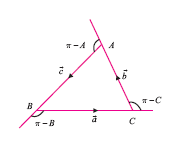
With usual notations, in any triangle ABC, prove the following by vector method.
(i) a2 = b2 + c2 − 2bc cos A
(ii) b2 = c2 + a2 − 2ca cos B
(iii) c2 = a2 + b2 − 2ab cos C
14.
If \(\int _{ 0 }^{ \infty }{ { e }^{ -a{ x }^{ 2 } }{ x }^{ 3 }dx=32,\alpha >0,\ find\ \alpha } \)
15.
For each of the following functions find the gxy, gxx, gyy and gyx.
g(x, y) = x2 + 3xy − 7y + cos(5x)
16.
Let f (x, y) = 0 if xy ≠ 0 and f (x, y) = 1 if xy = 0.
Calculate: \(\frac { \partial f }{ \partial x } (0,0),\frac { \partial f }{ \partial y } (0,0).\)
17.
Find the equations of the tangent and normal to hyperbola 12x2−9y2 = 108 at \(\theta =\frac { \pi }{ 3 } \) (Hint: use parametric form)
18.
If \(cos\alpha +cos\beta +cos\gamma =sin\alpha +sin\beta +sin\gamma =0\) then show that
(i) \(cos3\alpha +cos3\beta +cos3\gamma =3cos(\alpha +\beta +\gamma )\)
(ii) \(sin3\alpha +sin3\beta +sin3\gamma +sin3\gamma =3sin\left( \alpha +\beta +\gamma \right) \)
19.
Find the equation of the tangent and normal to the circle x2+y2−6x+6y−8 = 0 at (2, 2) .
20.
If the equations x2 + px + q = 0 and x2 + p'x + q' = 0 have a common root, show that it must be equal to \(\frac { pq'-p'q }{ q-q' } \) or \(\frac { q-q' }{ p'-p } \).
21.
If \(\vec { a } =\hat { i } -2\hat { j } +3\hat { k } ,\vec { b } =2\hat { i } +\hat { j } -2\hat { k } ,\vec { c } =3\hat { i } +2\hat { j } +\hat { k } \) find
(i) \((\vec { a } \times \vec { b } )\times \vec { c } \)
(ii) \(\vec { a } \times (\vec { b } \times \vec { c } )\)
22.
If \(\vec { a } =\hat { i } -\hat { k } ,\vec { b } =x\hat { i } +\hat { j } +(1-x)\hat { k } ,\vec { c } =y\hat { i } +x\hat { j } +(1+x+y)\hat { k } \) show that \([\vec { a } ,\vec { b } ,\vec { c } ]\) depends on neither x nor y.
23.
Find tan(tan-1(2019))
24.
If zi = 2− i and z2 = -4+3i , find the inverse of z1z2 and \(\frac { { z }_{ 1 } }{ { z }_{ 2 } } \)
1.
Given a = edge of the circle
= 10 cm and da
= 0.2 cm
Volume of cube = a3
Approximate amount of cubic centimeters of paint is used to paint this cube = 3a2 da
= 3(102)(0.2)
= 300 \(\left( \frac { 2 }{ 10 } \right) \) = 60 cm3
Exact amount of paint used = f(x + ∆x) - f(x)
= f(10.2) - f(10)
= 10.23 -103
= 1061.208 - 1000
= 61.208 cm2
2.
I \(=\int _{ 0 }^{ 1 }{ \sqrt { \frac { (1-x)(1-x) }{ (1+x)(1-x) } } } dx\)
\(=\int _{ 0 }^{ 1 }{ \sqrt { \frac { (1-x) 2}{ (1-x)^2 } } } dx\)
\(=\int _{ 0 }^{ 1 }{ \frac { 1-x }{ \sqrt { 1-{ x }^{ 2 } } } } dx\)
Put x = sin u, dx = cosu.du, 0u = sin-1(x)
For x = 0, u = 0 and x = 1, u = \(\frac{\pi}{2}\)
\(=\int _{ 0 }^{ 1 }{ \frac { 1-sin\ u }{ \sqrt { 1-{ sin }^{ 2 }u } } } \times cos u.du\)
\(=\int _{ 0 }^{ 1 } \frac { 1-sin\ u }{cos u} \times cos u.du\)
= \( [u+cos u]^\frac{\pi }{2}_0\)= (\(\frac{\pi}{2}\)+0)-(0+1) = \(\frac{\pi}{2}\) -1
\(=\frac { \pi }{ 2 } -0-1=\frac { \pi }{ 2 } -1\)
3.
We write \(\int _{ 0 }^{ 2a }{ f(x)dx\int _{ 0 }^{ a }{ f(x)dx } } +\int _{ 0 }^{ 2a }{ f(x)dx } \) ....(1)
Consider \(\int _{ 0 }^{ 2a }{ f(x)dx } \)
Substituting x = a + u, we have dx = du ; when x = a, u = 0 and when x = 2a,u = a.
\(\therefore \int _{ 0 }^{ 2a }{ f(x)dx=\int _{ 0 }^{ a }{ f(a+u)du } =\int _{ 0 }^{ a }{ d(u)du } } \), since f(x) = f(a+x)
\(\\ \\ \\ =\int _{ 0 }^{ a }{ f(x)dx } \) ..(2)
Substituting (2) in (1), we get
\(\int _{ 0 }^{ 2a }{ f(x)dx } =2\int _{ 0 }^{ a }{ f(x)dx } \)
4.
We need to find an approximate value of \(\sqrt { 9.2 } \) using linear approximation. Now by (3), we have f(x0+Δx) ≈ f(x0)+f'(x0)Δx. To do this, we have to identify an appropriate function f, a point x0 and Δx. Our choice should be such that the right side of the above approximate equality, should be computable without the help of a calculator. So, we choose
f(x) = \(\sqrt { x,{ x }_{ 0 } } \) = 9 and Δx = 0.2. Then f'(x0) = \(\frac { 1 }{ 2\sqrt { 9 } } \) and hence.
\(\sqrt { 9.2 } \) ≈ f(9) + f'(9)(0.2) = 3+\(\frac { 0.2 }{ 6 } \) = 3.03333
Now if we use a calculator, just to compare, we find \(\sqrt { 9.2 } \) = 3.03315. We see that our approximation is accurate to three decimal places and the error is 3.03315 - 3.03333 = 0.00018. [Also note that one could choose f (x) = \(\sqrt { 1+x,{ x }_{ 0 } } =8\) and Δx = 0.2. So the choice of f and x0 - are not necessarily unique].
So in the above example, the absolute error is 3.03315-3.03333 = -0.00018. Note that the absolute error says how much the error; but it does not say how good the approximation is. For instance, let us consider two simple cases
Case 1 : Suppose that the actual value of something is 5 and its approximated value is 4, then the absolute error is 5 − 4 = 1.
Case 2 : Suppose that the actual value of something is 100 and its approximated value is 95. In this case, the absolute error is 100 − 95 = 5. So the absolute error in the first case is smaller when compared to the second case.
Among these two approximations, which is a better approximation; and why? The absolute error does not give a clear picture about whether an approximation is a good one or not. On the other hand, if we calculate relative error or percentage of error (defined below), it will be easy to see how good an approximation is. If the actual value is zero, then we do know how close our approximate answer is to the actual value. So if the actual value is not zero.
5.
Let f(x) = log x
fl(x) = \(\frac{1}{x}\) = x-1
flI(x) = -1x-2
fIII(x) = 2x-3
fIV(x) = -6 x-4
⇒ f(1) = log 1 = 0
fl(1) = \(\frac11\) = 1
fll(1) = -1
flll(1) = 2
fIV(1) = -6
Taylor series for f(x) at x = 1 is
\(f(x)=f(1)+\frac { { f }^{ 1 }(1) }{ 1! } (x-1)+\frac { { f }^{ II }(1) }{ 2! } ({ x-1) }^{ 2 }+\frac { { f }^{ III }(1) }{ 3! } { (x-1) }^{ 3 }+\).....
log x = \(\frac { 1 }{ 1! } (x-1)+\frac { -1 }{ 2! } { (x-1) }^{ 2 }+\frac { 2 }{ 3! } ({ x-1) }^{ 3 }-\frac { 6 }{ 4! } ({ x-1) }^{ 4 }+..\)
log x = \((x-1)-\frac { 1 }{ 2 } { (x-1) }^{ 2 }+\frac { 1 }{ 3 } { (x-1) }^{ 3 }-\frac { 1 }{ 4 } ({ x-1) }^{ 4 }\)+ ....
6.
We have, f (x) is continuous in \([\frac{1}{2},2 ]\) and differentiable in \((\frac{1}{2},2 )\) with \(f(\frac{1}{2})=\frac{5}{2}=f(2) \).
By the Rolle’s theorem there must exist a \(c \in (\frac{1}{2},2 )\) such that, \(f'(c)=1-\frac{1}{c^{2}}=0 \Rightarrow c^{2}=1 \) gives \(\Rightarrow c=\pm1, \) As \(1\in(\frac{1}{2},2)\) we choose c = 1.
7.
We have, \(\frac{dy}{dx}=2x+3\). Hence at (1, 2), \((\frac{dy}{dx})=5\)
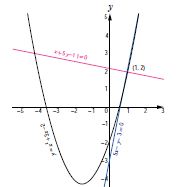
Therefore, the required equation of tangent is.
\((y-2)=5(x-1)\Rightarrow 5x-y-3=0\)
The slope of the normal at the point (1, 2) is -\(\frac{1}{5}\).
therefore, the required equation of normal is
\((y-2)=-\frac{1}{5}(x-1)\Rightarrow x+5y-11=0\)
8.
Consider \(\frac { 19-7i }{ 9+i } =\frac { 19-7i }{ 9+i } \times \frac { 9-i }{ 9-i } \)
= \(\frac { 171-19i-63i+7i^{ 2 } }{ (9)^{ 2 }-{ i }^{ 2 } } =\frac { 171-82i-7 }{ 81+1 } \)
= \(\frac { 164-82i }{ 82 } =\frac { 82(2-i) }{ 82 } \) = 2- i
Also \(\frac { 20-5i }{ 7-6i } =\frac { 20-5i }{ 7-6i } \times \frac { 7+6i }{ 7+6i } \)
= \(\frac { 140+120i-35i-30^{ 2 } }{ { 7 }^{ 2 }-(6i)^{ 2 } } \)
\(=\frac{140+85 i+30}{49+36}=\frac{170+85 i}{85}=\frac{\not 85(2+i)}{\not 85}=2+i\)
∴ \(\left( \frac { 19-7i }{ 9+i } \right) ^{ 12 }+\left( \frac { 20-5i }{ 7-6i } \right) ^{ 12 }\) = (2-i)12+(2+i)12
Let z = (2-i)12+(2+i)12
∴ \(\overline { z } \) = \(\overline { (2-i)^{ 12 }+(2+i)^{ 12 } } =\overline { (2-i)^{ 12 } } +\overline { (2+i)^{ 12 } } \)
[∵ \(\overline { { z }_{ 1 }+{ z }_{ 2 } } =\overline { { z }_{ 1 } } +\overline { { z }_{ 2 } } \)]
= (2 + i)12+(2 - i)12= z
∴ \(\overline { z } \) = z ⇒ z is purely real
∴ \(\left( \frac { 19-7i }{ 9+i } \right) ^{ 12 }+\left( \frac { 20-5i }{ 7-6i } \right) ^{ 12 }\) is real.
9.
\(\left[ \begin{matrix} 2 & 3 & 1 \\ 3 & 4 & 1 \\ 3 & 7 & 2 \end{matrix} \right] \)
Let A =\(\left( \begin{matrix} 2 & 3 & 1 \\ 3 & 4 & 1 \\ 3 & 7 & 2 \end{matrix} \right) \)
adj A =\(\left( \begin{matrix} +\left| \begin{matrix} 4 & 1 \\ 7 & 2 \end{matrix} \right| & -\left| \begin{matrix} 3 & 1 \\ 3 & 2 \end{matrix} \right| & +\left| \begin{matrix} 3 & 4 \\ 3 & 7 \end{matrix} \right| \\ -\left| \begin{matrix} 3 & 1 \\ 7 & 2 \end{matrix} \right| & +\left| \begin{matrix} 2 & 1 \\ 3 & 2 \end{matrix} \right| & -\left| \begin{matrix} 2 & 3 \\ 3 & 7 \end{matrix} \right| \\ +\left| \begin{matrix} 3 & 1 \\ 4 & 1 \end{matrix} \right| & -\left| \begin{matrix} 2 & 1 \\ 3 & 1 \end{matrix} \right| & +\left| \begin{matrix} 2 & 3 \\ 3 & 4 \end{matrix} \right| \end{matrix} \right) \)
=\(\left[ \begin{matrix} +(8-7)-(6-3)+(21-12) \\ -(6-7)+(4-3)-(14-9) \\ +(3-4)-(2-3)+(8-9) \end{matrix} \right] ^{ T }\)
=\(\left[ \begin{matrix} 1 & -3 & 9 \\ 1 & 1 & -5 \\ -1 & 1 & -1 \end{matrix} \right] ^{ T }\)
adj A =\(\left[ \begin{matrix} 1 & 1 & -1 \\ -3 & 1 & 1 \\ 9 & -5 & -1 \end{matrix} \right] \)
10.
Let \(\vec { b } =5\hat { i } +6\hat { j } +7\hat { k } \) and \(\vec { a } =7\hat { i } +9\hat { j } +13\hat { k } \)
The parametric form of vector equation of a straight line passing through two points \(\vec { a } \) and \(\vec { b } \) is
\(\vec { r } =\vec { a } +t(\vec { b } -\vec { a } )\)
∴ \(\vec { r } =(7\hat { i } +9\hat { j } +13\hat { k } )+t(7-5)\hat { i } +(9-6)\hat { j } +(13-7)\hat { k } \)
\(\vec { r } =(7\hat { i } +9\hat { j } +13\hat { k } )+t(2\hat { i } +3\hat { j } +6\hat { k } ),t\in R\)
The Cartesian equation of a straight line passing through two points as
\(\frac { x-{ x }_{ 1 } }{ { x }_{ 2 }-{ x }_{ 1 } } =\frac { y-{ y }_{ 1 } }{ { y }_{ 2 }-{ y }_{ 1 } } =\frac { z-{ z }_{ 1 } }{ { z }_{ 2 }-{ z }_{ 1 } } \) [(x1,y1,z1) is (7,9,13) (x2,y2,z2) is (5,6,7))
\(\frac { x-7 }{ 5-7 } =\frac { y-9 }{ 6-9 } =\frac { z-13 }{ 7-13 } \)
⇒ \(\frac { x-7 }{ -2 } =\frac { y-9 }{ -3 } =\frac { z-13 }{ -6 } \)
= \(\frac { x-7 }{ 2 } =\frac { y-9 }{ 3 } =\frac { z-13 }{ 6 } \)
11.
Let A be the matrix. Performing elementary row operations, we get
A = \(\left[ \begin{matrix} 2 \\ \begin{matrix} -3 \\ 6 \end{matrix} \end{matrix}\begin{matrix} -2 \\ \begin{matrix} 4 \\ 2 \end{matrix} \end{matrix}\begin{matrix} 4 \\ \begin{matrix} -2 \\ -1 \end{matrix} \end{matrix}\begin{matrix} 3 \\ \begin{matrix} -1 \\ 7 \end{matrix} \end{matrix} \right] \)\(\overset { { R }_{ 2 }\longrightarrow 2{ R }_{ 2 } }{ \longrightarrow } \left[ \begin{matrix} 2 \\ \begin{matrix} -6 \\ 6 \end{matrix} \end{matrix}\begin{matrix} -2 \\ \begin{matrix} 8 \\ 2 \end{matrix} \end{matrix}\begin{matrix} 4 \\ \begin{matrix} -4 \\ -1 \end{matrix} \end{matrix}\begin{matrix} 3 \\ \begin{matrix} -2 \\ 7 \end{matrix} \end{matrix} \right] \overset { \begin{matrix} { R }_{ 2 }\longrightarrow { R }_{ 2 }+3{ R }_{ 1 } \\ { R }_{ 3 }\longrightarrow { R }_{ 3 }-3{ R }_{ 1 } \end{matrix} }{ \longrightarrow } \left[ \begin{matrix} 2 \\ \begin{matrix} 0 \\ 0 \end{matrix} \end{matrix}\begin{matrix} -2 \\ \begin{matrix} 2 \\ 8 \end{matrix} \end{matrix}\begin{matrix} 4 \\ \begin{matrix} 8 \\ -13 \end{matrix} \end{matrix}\begin{matrix} 3 \\ \begin{matrix} 7 \\ -2 \end{matrix} \end{matrix} \right] \).
\(\overset { { R }_{ 3 }\longrightarrow { R }_{ 3 }-4{ R }_{ 2 } }{ \longrightarrow } \left[ \begin{matrix} 2 \\ \begin{matrix} 0 \\ 0 \end{matrix} \end{matrix}\begin{matrix} -2 \\ \begin{matrix} 2 \\ 0 \end{matrix} \end{matrix}\begin{matrix} 4 \\ \begin{matrix} 8 \\ -45 \end{matrix} \end{matrix}\begin{matrix} 3 \\ \begin{matrix} 7 \\ -30 \end{matrix} \end{matrix} \right] \overset { { R }_{ 3 }\longrightarrow { R }_{ 3 }\div \left( -15 \right) }{ \longrightarrow } \left[ \begin{matrix} 2 \\ \begin{matrix} 0 \\ 0 \end{matrix} \end{matrix}\begin{matrix} -2 \\ \begin{matrix} 2 \\ 0 \end{matrix} \end{matrix}\begin{matrix} 4 \\ \begin{matrix} 8 \\ 3 \end{matrix} \end{matrix}\begin{matrix} 3 \\ \begin{matrix} 7 \\ 2 \end{matrix} \end{matrix} \right] \).
The last equivalent matrix is in row-echelon form. It has three non-zero rows. So, ρ(A) = 3.
12.
Given \(\frac { \pi }{ 2 } <{ cos }^{ -1 }(3x-1)<\pi \)
\((cos2\frac { \pi }{ 2 } <3x-1\))
\(\Rightarrow 0<3x-1<-1\)
\(0+1<3x<-1+1\)
\(1<3x<0\)
13.
With usual notations in triangle ABC, we have \(\vec { BC } =\vec { a } ,\vec { CA } =\vec { b } \) \(\vec { AB } =\vec { c } \).
Then \(\left| \vec { BC } \right| =a\) , \(\left| \vec { CA } \right| =b\), \(\left| \vec { AB} \right| =c\), and \(\vec { BC } +\vec { CA } +\vec { AB } =\vec { 0 } \)
So, \(\vec { BC } =-\vec { CA } -\vec { AB } \)
Then applying dot product, we get
\(\vec { BC } .\vec { BC } =(-\vec { CA } -\vec { AB } ).(-\vec { CA } -\vec { AB } )\)
⇒ \({ \left| \vec { BC } \right| }^{ 2 }={ \left| \vec { CA } \right| }^{ 2 }+{ \left| \vec { AB } \right| }^{ 2 }+\vec { 2CA } .\vec { AB } \)
⇒ a2 = b2+c2+2bc cos (\(\pi\) - A)
⇒ a2 = b2+c2−2bc cos A.
The results (ii) and (iii) are proved in a similar way.
14.
Given \(\int _{ 0 }^{ \infty }{ { e }^{ -a{ x }^{ 2 } }{ x }^{ 3 }dx=32,\alpha >0} \)
| x | 0 | \(\infty\) |
| t | 0 | \(\infty\) |
\(\Rightarrow \int _{ 0 }^{ \infty }{ { e }^{ { -\alpha x }^{ 2 } } } .{ x }^{ 2 }.dx=32\)
\(put\ t= { x }^{ 2 }\)
\(\Rightarrow dt=2x\ dx\)
\(\\ \Rightarrow \frac { dt }{ 2 } = xdx\)
\( \int _{ 0 }^{ \infty }{ { e }^{ -\alpha t }\frac{dt}{2}} \frac { 1 }{ 2 } \int _{ 0 }^{ \infty }{ { e }^{ -\alpha t }.tdt } \)
\( \frac { 1 }{ 2 } \times\frac{1} { \alpha}^{ 2 } \) ...... (1)
Given \(\int^x_0e^{-ax^2}x^3 dx = 32\)
By (1),
\(\Rightarrow \frac { 1! }{ { \alpha }^{ 2 } } =32\times 2\left[ \because \int _{ 0 }^{ \infty }{ { e }^{ -ax }{ x }^{ n }dx=\frac { n! }{ { a }^{ n+1 } } } \right] \)
\(\frac{1}{2}\times \frac{1}{\alpha^2}= 32 \Rightarrow \frac {1}{\alpha ^2}= 64\\ \alpha ^2 = \frac{1}{64}\)
\(\Rightarrow \alpha =\frac { 1 }{ 8 } \)
15.
Given g (x, y) = x2 + 3xy - 7y + cos(5x)
gx = 2x + 3y - 0 - 5 sin 5x
= 2x + 3y - 5 sin 5x
gy = 0 + 3x (1) - 7 + 0
= 3x - 7
\({ g }_{ xy }=\frac { \partial }{ \partial x } ({ g }_{ y })\) = 3
\({ g }_{ xx }=\frac { \partial }{ \partial x } ({ g }_{ x })\)
= 2(1) + 0 - 5(5) cos (5x)
= 2 - 25 cos (5x)
\({ g }_{ yy }=\frac { \partial }{ \partial y } ({ g }_{ y })=\) 0
\({ g }_{ yx }=\frac { \partial }{ \partial y } ({ g }_{ x })\)
= 0 + 3(1) - 0 = 3
16.
Note that the function f takes value 1 on the x, y-axes and 0 everywhere else on R2. So let us calculate
\(\frac { \partial f }{ \partial x } (0,0)\) = \(\underset { h\longrightarrow 0 }{ lim } \) \(\frac { f\left( 0+h,0 \right) -f(0,0) }{ h } =\underset { h\longrightarrow 0 }{ lim } \frac { 1-1 }{ h } =0;\)
\(\frac { \partial f }{ \partial y } (0,0)\) = \(\underset { k\longrightarrow 0 }{ lim } \) \(\frac { f\left( 0,0+k \right) -f(0,0) }{ k } =\underset { k\longrightarrow 0 }{ lim } \frac { 1-1 }{ k } =0\)
This completes (i).
17.
Equation of the hyperbola is 12x2- 9y2 = 108
\(\div 108\) we get, \(\frac { { 12x }^{ 2 } }{ 108 } -\frac { 9{ y }^{ 2 } }{ 108 } =1\)
⇒ \(\frac { { x }^{ 2 } }{ 9 } -\frac { { y }^{ 2 } }{ 12 } =1\)
∴ a2 = 9, b2 = 12
Parametric equation of tangent to the hyperbola is \(\frac { x \ sec\ \theta }{ a } -\frac { y \ tan \ \theta }{ b } =1\)
When \(\theta =\frac { \pi }{ 3 } \), the equation is
\(\frac { xsec\frac { \pi }{ 3 } }{ 3 } -\frac { ytan\frac { \pi }{ 3 } }{ 2\sqrt { 3 } } =1\)
.JPG)
⇒ \(\frac { 4x-3y }{ 6 } =1\) ⇒ 4x - 3y - 6 = 0 is the required equation of tangent.
Parametric equation of normal to the hyperbola is
\(\frac { ax }{ sec\theta } +\frac { by }{ tan\theta } ={ a }^{ 2 }+{ b }^{ 2 }\)
At \(\theta =\frac { \pi }{ 3 } ,\frac { 3x }{ sec\frac { \pi }{ 3 } } +\frac { 2\sqrt { 3 } }{ tan\frac { \pi }{ 3 } } =9+12\)
\(\Rightarrow \frac{3 x}{2}+\frac{2 \sqrt{\not 3} y}{\sqrt{\not 3}}=21\)
⇒ \(\frac { 3x }{ 2 } \) + 2y = 21 ⇒ 3x + 4y = 42
⇒ 3x + 4y - 42 = 0 is the required equation of normal.
18.
Given cos α + cos β + cos \(\gamma\) = sin α + sin β + sin \(\gamma\)
∴ (cos α + cos β + cos \(\gamma\)) + i(sin α + sin β + sin \(\gamma\)) = 0
⇒ (cos α + i sin α) + (cos β + i sin β) + (cos \(\gamma\)+i sin \(\gamma\)) = 0
⇒ a + b + c = 0 where a = cos α + i sin α, b = cos β + i sin β, c = cos \(\gamma\) + i sin\(\gamma\)
If a + b + c = 0, then a3+b3+c3 = 3abc
∴ (cos α + i sin α)3 + (cos β + i sin β)3 + (cos \(\gamma\) + i sin \(\gamma\))3 = 3[ (cos α + i sin α) + (cos β + i sin β) + (cos \(\gamma\) + i sin \(\gamma\))
= 3[(cos(α + β + \(\gamma\)) + i sin(α + β + \(\gamma\))]
⇒ (cos 3α + cos β + cos \(\gamma\)) + i[sin 3α + sin 3β + sin 3\(\gamma\))]
= 3(cos(α + β + \(\gamma\)) + i sin(α + β + \(\gamma\))
Equating the real and imaginary parts, we get
\(
\cos 3 \alpha+\cos 3 \beta+\cos 3 \gamma=3 \cos (\alpha+\beta+\gamma)
\)
\( \sin 3 \alpha+\sin 3 \beta+\sin 3 \gamma=3 \sin (\alpha+\beta+\gamma)
\)
19.
Equation of the circle is x2 + y2 − 6x + 6y − 8 = 0
∴ Equation of the tangent at (x1, y1) is
xx1 + yy1 - \(\frac 62\) (x + x1) + \(\frac 62\) (y + y1) - 8 = 0
Given (x1, y1) is (2, 2)
Equation of the tangent at (2, 2) is
x(2) + y(2) - 3(x + 2) + 3(y + 2) - 8 = 0
\(\Rightarrow 2 x-2 y-3 x+\not 6+3 y+\not 6-8=0\)
⇒ -x + 5y - 8 = 0
⇒ x − 5y + 8 = 0
Equation of the normal is
yx1 - xy1 + g(y - y1) - f(x - x1) = 0
⇒ y(2) -x(2) - 3(y - 2) -3(x - 2) = 0
∵ 2g = -6
⇒ g = -3
2f = 6
⇒ f = 3
⇒ 2y - 2x - 3y + 6 - 3x + 6 = 0
⇒ -5x - y + 12 = 0
Another method for Normal:
Equation of tangent is perpendicular to normal
x - 5y + 8 = 0
Perpendicular equation be 5x + y + k = 0
At (2, 2)
10 + 2 + k = 0
k = -12
Therefore 5x + y - 12 = 0 be equation of normal.
20.
Given equation are \({ x }^{ 2 }px+q=0\) ............(1)
and \({ x }^{ 2 }+p'x+q'=0\) ..........(2)
Let ∝ be the common root for (1) and (2)
∴ ∝2 + p∝ + q = 0 .........(3)
and ∝2+ p'∝ + q' = 0 .............(4)
Solving (3) and (4) by cross multiplication method we get
p q 1 p
p' q' 1 p'
\(\Rightarrow \frac { { \alpha }^{ 2 } }{ pq'-p'q } =\frac { \alpha }{ q-q' } =\frac { 1 }{ p'-p } \)
consider \(\frac { { \alpha }^{ 2 } }{ pq'-p'q } =\frac { \alpha }{ q-q' } \)
\(\Rightarrow \frac { { \alpha }^{ 2 } }{ \alpha } =\frac { pq'-p'q }{ q-q' } \)
\(\alpha =\frac { pq'-p'q }{ q-q } \)
Consider \(\frac { \alpha }{ q-q' } =\frac { 1 }{ p'-p } \Rightarrow \alpha =\frac { q-q' }{ p'-p } \)
Hence its roots are \(\frac { pq'-p'q }{ q-q' } or\quad \frac { q-q' }{ p'-p } \)
21.
Given \(\vec { a } =\hat { i } -2\hat { j } +3\hat { k } ,\vec { b } =2\hat { i } +\hat { j } +\hat { k } \) and \(\vec { c } =3\hat { i } +2\hat { j } +\hat { k } \)
(i) \((\vec { a } \times \vec { b } )\) = \(\left| \begin{matrix} \hat { i } & \hat { j } & \hat { k } \\ 1 & -2 & 3 \\ 2 & 1 & -2 \end{matrix} \right| \)
= \(\hat { i } \left| \begin{matrix} -2 & 3 \\ 1 & -2 \end{matrix} \right| -j\left| \begin{matrix} 1 & 3 \\ 2 & -2 \end{matrix} \right| +\hat { k } \left| \begin{matrix} 1 & -2 \\ 2 & 1 \end{matrix} \right| \)
= \(\\ \hat { i } \)(4-3)-\(\\ \hat { j } \)(-2-6)+\(\\ \hat { k } \)(1+4)
= \(\hat { i } +8\hat { j } +5\hat { k } \)
\((\vec { a } \times \vec { b } )\times \vec { c } =\left| \begin{matrix} \hat { i } & \hat { j } & \hat { k } \\ 1 & 8 & 5 \\ 3 & 2 & 1 \end{matrix} \right| \)
=\(\hat { i } \left| \begin{matrix} 8 & 5 \\ 2 & 1 \end{matrix} \right| \hat { -j } \left| \begin{matrix} 1 & 5 \\ 3 & 1 \end{matrix} \right| +\hat { k } \left| \begin{matrix} 1 & 8 \\ 3 & 2 \end{matrix} \right| \)
= \(\\ \hat { i } \)(8-10)-\(\\ \hat { j } \)(1-15)+\(\\ \hat { k } \)(2-24)
= \(-2\hat { i } +14\hat { j } -22\hat { k } \)
(ii) \(\vec { a } \times (\vec { b } \times \vec { c } )\)
\(\vec { b } \times \vec { c } \) = \(\left| \begin{matrix} \hat { i } & \hat { j } & \hat { k } \\ 2 & 1 & -2 \\ 3 & 2 & 1 \end{matrix} \right| \)
= \(\hat { i } \left| \begin{matrix} 1 & -2 \\ 2 & 1 \end{matrix} \right| \hat { -j } \left| \begin{matrix} 2 & -2 \\ 3 & 1 \end{matrix} \right| +\hat { k } \left| \begin{matrix} 2 & 1 \\ 3 & 2 \end{matrix} \right| \)
= \(\\ \hat { i } \)(1+4)-\(\\ \hat { j } \)(2+6)+\(\\ \hat { k } \)(4-3) = \(5\hat { i } -8\hat { j } +\hat { k } \)
∴ \(\vec { a } \times (\vec { b } \times \vec { c } )=\left| \begin{matrix} \hat { i } & \hat { j } & \hat { k } \\ 1 & -2 & 3 \\ 5 & -8 & 1 \end{matrix} \right| \)
= \(\hat { i } \left| \begin{matrix} -2 & -3 \\ -8 & 1 \end{matrix} \right| -\hat { j } \left| \begin{matrix} 1 & 3 \\ 5 & 1 \end{matrix} \right| +\hat { k } \left| \begin{matrix} 1 & -2 \\ 5 & -8 \end{matrix} \right| \)
= \(\\ \hat { i } \)(-2-24)-\(\\ \hat { j } \)(1-15)+\(\\ \hat { k } \)(-8-10)
= \(22\hat { i } +14\hat { j } +2\hat { k } \).
22.
Given \(\vec { a } =\hat { i } -\hat { k } ,\vec { b } =x\hat { i } +\hat { j } +(1-x)\hat { k } ,\vec { c } =y\hat { i } +x\hat { j } +(1+x+y)\hat { k } \)
\([\vec { a } ,\vec { b } \vec { c } ]=\vec { a } .(\vec { b } \times \vec { c } )=\left| \begin{matrix} 1 & 0 & -1 \\ x & 1 & 1-x \\ y & x & 1+x-y \end{matrix} \right| \)
= \(1\left| \begin{matrix} 1 & 1-x \\ x & 1+x-y \end{matrix} \right| +0-y\left| \begin{matrix} x & y \\ y & x \end{matrix} \right| \)
= [(1+x-y)-x(1-x)]-[x2-y]
\(=1+\not x-\not y-\not x+\not x^{2}-\not x^{x}+\not y\)
= 1
∴ \([\vec { a } \vec { b } \vec { c } ]\) = 1 for all values of x and y
∴ \([\vec { a } \vec { b } \vec { c } ]\) depends on neither x nor y.
23.
Since tan(tan-1 x) = x, x ∈ R,
We have tan(tan-1(2019)) = 2019
24.
Given z1= 2 - i and z2= -4+3i
z1z2 = (2-i)(-4+3i)
= -8 + 6i + 4i - 3i2
= -8 +10i - 3(-1)
= -8 +10i + 3 = -5 +10i
Inverse of z1z1 is \(\frac { 1 }{ { z }_{ 1 }{ z }_{ 2 } } \)
= \(\frac { 1 }{ -5+10i } \times \frac { -5-10i }{ -5-10i } \)
= \(\frac { -5-10i }{ (-5)^{ 2 }-(10i)^{ 2 } } \)
= \(\frac { -5-10i }{ 25-100i^{ 2 } } \)
= \(\frac { -5-10i }{ 25+100 } \) [∵ i2 = -1]
\(=\frac{\not{5}(-1-2 i)}{\not{5}\langle(2 5)}=\frac{-1-2 i}{25}\)
∴ Inverse of z1z2 is \(\frac { 1 }{ 25 } \) (-1-2i)
Inverse of \(\frac { { z }_{ 1 } }{ { z }_{ 2 } } \) is \(\frac { 1 }{ \frac { { z }_{ 1 } }{ { z }_{ 2 } } } =\frac { { z }_{ 2 } }{ { z }_{ 2 } } \)
∴ Inverse of \(\frac { { z }_{ 1 } }{ { z }_{ 2 } } =\frac { { z }_{ 2 } }{ { z }_{ 1 } } =\frac { -4+3i }{ 2-i } \times \frac { 2+i }{ 2+i } \)
= \(\frac { -4+3i }{ 2-i } \times \frac { 2+i }{ 2+i } \)
= \(\frac { -8-4i+6i+3i^{ 2 } }{ 2^{ 2 }-({ i }^{ 2 }) } \)
= \(\frac { -8+2i-3 }{ 4+1 } =\frac { -11+2i }{ 5 }\)
\( =\frac { 1 }{ 5 } \)(-11 + 2i)
∴ Inverse of \(\frac { { z }_{ 1 } }{ { z }_{ 2 } } \) is \(\frac { -11+2i }{ 5 }\)or \(\frac { 1 }{ 5 } \)(-11 + 2i)

12th Standard Syllabus & Materials
12th Standard
TN 12th Computer Applications களப்பெயர் முறைமை (DNS) Sample Question Papers Study Material - QB365 Set A
NEW12th Standard
TN 12th Computer Applications வலையமைப்பு எடுத்துக்காட்டுகள் மற்றும் நெறிமுறைகள் Sample Question Papers Study Material - QB365 Set A
NEW12th Standard
TN 12th Computer Applications கணினி வலையமைப்பு ஓர் அறிமுகம் Sample Question Papers Study Material - QB365 Set A
NEW12th Standard
TN 12th Computer Applications PHP-உடன் MySQL-ஐ இணைத்தல் Sample Question Papers Study Material - QB365 Set A



Tamilnadu Stateboard 12th Standard Subjects
Maths

Chemistry

Physics

Biology

Computer Science

Business Maths and Statistics

Economics

Commerce

Accountancy

History

Computer Applications
Biology
Computer Technology
Computer Applications
Computer Science
Business Maths and Statistics
Commerce
Economics
Maths
Chemistry
Physics
Computer Technology
History
Accountancy

Tamil

English

French
Tamilnadu Stateboard Standards

