
 100% FREE ACCESS
12th Standard Syllabus & Materials
12th Standard
TN 12th Maths Applications of Matrices and Determinants Sample Question Papers Study Material - QB365 Set A
NEW12th Standard
TN 12th Computer Applications மின்னணு தரவு பரிமாற்றம் Sample Question Papers Study Material - QB365 Set A
NEW12th Standard
TN 12th Computer Applications மின் - வணிக பாதுகாப்பு அமைப்புகள் Sample Question Papers Study Material - QB365 Set A
NEW12th Standard
TN 12th Computer Applications மின்னணு செலுத்தல் முறைகள் Sample Question Papers Study Material - QB365 Set A
NEW12th Standard
TN 12th Computer Applications மின் - வணிகம் Sample Question Papers Study Material - QB365 Set A
NEW12th Standard
TN 12th Computer Applications திறந்த மூல கருத்துருக்கள் Sample Question Papers Study Material - QB365 Set A

Published on: 27/02/2021
12th Standard English Medium Maths Reduced Syllabus Two Mark Important Questions with Answer key - 2021(Public Exam )
Download Tamil Nadu 12th Standard Maths question papers, model tests, one-mark questions, important questions, and public exam papers in PDF format. Free study materials and answer keys for TN State Board students.
Questions + Answers key
Take MCQ Maths Test1.
A commuter train arrives punctually at a station every half hour. Each morning, a student leaves his house to the train station. Let X denote- the amount of time, in minutes that the student waits for the train from the time he reaches the train station. It is known that the pdf of X is
\(f(x)= \begin{cases}\frac{1}{30} & 0<x<30 \\ 0 & \text { elsewhere }\end{cases}\)
Obtain and interpret the expected value of therandom variable X.
2.
If the radius of a sphere, with radius 10 cm, has to decrease by 0 1. cm, approximately how much will its volume decrease?
3.
An urn contains 5 mangoes and 4 apples. Three fruits are taken at randaom. If the number of apples taken is a random variable, then find the values of the random variable and number of points in its inverse images.
4.
Find the asymptotes of the curve \(f(x)=\frac { { 2x }^{ 2 }-8 }{ { x }^{ 2 }-16 } \)
5.
Find the angle of intersection of the curve y = sin x with the positive x -axis.
6.
A person learnt 100 words for an English test. The number of words the person remembers in t days after learning is given by W(t) = 100 × (1− 0.1t)2, 0 ≤ t ≤ 10. What is the rate at which the person forgets the words 2 days after learning?
7.
Find the differential equation of the family of all non-vertical lines in a plane.
8.
Find all values of x such that
-5\(\pi\le x \le 5\pi\) and cos x =1
9.
Find the rank of the following matrices by minor method:
\(\left[ \begin{matrix} 1 & -2 & 3 \\ 2 & 4 & -6 \\ 5 & 1 & -1 \end{matrix} \right] \)
10.
Represent the complex number −1−i
11.
Show that the polynomial 9x9+ 2x5- x4- 7x2+ 2 has at least six imaginary roots.
12.
Which one of the points i, −2 + i, and 3 is farthest from the origin?
13.
Show that cot−1\(\left( \frac { 1 }{ \sqrt { { x }^{ 2 }-1 } } \right) ={ sec }^{ -1 }x,|x|>1\)
14.
Find a polynomial equation of minimum degree with rational coefficients, having 2i+3 as a root.
15.
If y = 4x + c is a tangent to the circle x2 + y2 = 9, find c
16.
Find a matrix A if adj(A) = \(\left[ \begin{matrix} 7 & 7 & -7 \\ -1 & 11 & 7 \\ 11 & 5 & 7 \end{matrix} \right] \).
17.
Find the order and degree of \(\left( \frac { { d }^{ 2 }y }{ { dx }^{ 2 } } \right) ^{ 2 }+cos\left( \frac { dy }{ dx } \right) =0\)
18.
Determine the order and degree of \(\frac { \left[ 1+\left( \frac { dy }{ dx } \right) ^{ 2 } \right] ^{ \frac { 3 }{ 2 } } }{ \frac { { d }^{ 2 }y }{ { dx }^{ 2 } } } =k\)
19.
Find the area enclosed between the parabola y2=4ax and the line x=a, x=9a.
20.
Find the slope of the tangent to the curve \(y=\int _{ 0 }^{ x }{ \frac { dt }{ 1+{ t }^{ 3 } } stx=1 } \)
21.
Evaluate \(\int _{ 0 }^{ 1 }{ \left( \frac { { e }^{ 5logx }-{ e }^{ 4logx } }{ { e }^{ 3logx }-{ e }^{ 2logx } } \right) } \)
22.
Evaluate the following limits, if necessary using L’Hopitalrule
(i) \(\underset { x\rightarrow 2 }{ lim } \cfrac { sin\pi x }{ 2-x } \)
(ii) \(\cfrac { lim }{ x\rightarrow 2 } \cfrac { { x }^{ n }-{ a }^{ n } }{ x-2 } \)
(iii) \(\underset { x\rightarrow \infty }{ lim } \cfrac { sin\frac { 2 }{ x } }{ \frac { 1 }{ x } } \)
(iv) \(\underset { x\rightarrow \infty }{ lim } \cfrac { { x }^{ 2 } }{ { e }^{ x } } \)
23.
Find the equation of the tangent to the curve y2=4x+5 and which is parallel to y=2x+7
24.
Determine the truth value of each of the following statements
(i) If 6 + 2 = 5 , then the milk is white.
(ii) China is in Europe or \(\sqrt3\) is an integer
(iii) It is not true that 5 + 5 = 9 or Earth is a planet
(iv) 11 is a prime number and all the sides of a rectangle are equal
25.
Determine whether ∗ is a binary operation on the sets given below.
a*b = min (a, b) on A = {1, 2, 3, 4, 5}
26.
Let A =\(\begin{bmatrix} 0 & 1 \\ 1 & 1 \end{bmatrix},B=\begin{bmatrix} 1 & 1 \\ 0 & 1 \end{bmatrix}\)be any two boolean matrices of the same type. Find AvB and A\(\wedge\)B.
27.
Find differential dy for each of the following function
y = (3 + sin(2x)) 2/3
28.
Evaluate \(\underset{x\rightarrow 1}{lim}(\frac{x^{2}-3x+2}{x^{2}-4x+3})\).
29.
Express each of the following physical statements in the form of differential equation.
For a certain substance, the rate of change of vapor pressure P with respect to temperature T is proportional to the vapor pressure and inversely proportional to the square of the temperature.
30.
Find the length of the tangent from (2, -3) to the circle x2 + y2 - 8x - 9y + 12 = 0.
31.
Find the principal value of \({sin }^{ -1 }\left( sin\left( -\frac { \pi }{ 3 } \right) \right) \)
32.
Find the modulus and principal argument of the following complex numbers.
\(\sqrt { 3 } \)-i
33.
Show that the following equations represent a circle, and, find its centre and radius
\(\left| 2z+2-4i \right| =2\)
34.
Find the square roots of −6+8i
35.
Find the period and amplitude of y = 4sin(−2x)
36.
Find the rank of the following matrices by minor method:
\(\left[\begin{array}{l} 1 -2 -10 \\ 3 -6 -31 \end{array}\right]\)
37.
Find the intercepts cut off by the plane \(\vec { r } .(6\hat { i } +4\hat { j } -3\hat { k } )\) = 12 on the coordinate axes.
38.
Find the volume of the parallelepiped whose coterminous edges are represented by the vectors \(-6\hat { i } +14\hat { j } +10\hat { k } ,14\hat { i } -10\hat { j } -6\hat { k } \) and \(2\hat { i } +4\hat { j } -2\hat { k } \)
39.
Identify the type of conic section for each of the equations.
2x2 − y2 = 7
40.
Find the volume of the parallelepiped whose coterminus edges are given by the vectors \(\hat { 2i } -\hat { 3j } +\hat { 4k } \), \(\hat { i } +\hat { 2j } -\hat { k } \) and \(\hat {3 i } -\hat { j } +\hat { 2k } \)
41.
Find the following \(\left| \frac { 2+i }{ -1+2i } \right| \)
42.
Find the period and amplitude of y = sin 7x
43.
Determine whether x + y − 1 = 0 is the equation of a diameter of the circle x2 + y2 − 6x + 4y + c = 0 for all possible values of c .
44.
A six sided die is marked '1' on one face, '3' on two of its faces, and '5' on remaining three faces. The die is thrown twice. If X denotes the total score in two throws, find
(i) the probability mass function
(ii) the cumulative distribution function
(iii) P(4 ≤ X < 10)
(iv) P(X ≥ 6)
45.
1.
Expected value = \(\mu=\int_{-\infty}^{\infty} x f(x) d x=\int_{-\infty}^0 x(0) d x+\int_0^{30} \frac{x}{30} d x+\int_{30}^{\infty} x(0) d x\)
\(=\int_0^{30} \frac{x}{30} d x=\frac{1}{60}\left[x^2\right]_0^{30}=15\)
Average delay is 15 minutes.
2.
We know that volume of a sphere is given by V = \(\frac43\) π r3. where r > 0 is the radius. So the differential dV = 4 ㅠr2 dr and hence
Δ ≈ dv = 4π(10)2 (9.9-10) cm3
= 4π102 (-0.1) cm3
= −40π cm3
Note that we have used dr = (9.9 −10) cm, because radius decreases from 10 to 9.9. Again the negative sign in the answer indicates that the volume of the sphere decreases about 40π cm3.
3.
Let X be the random variable of getting apples Given 5 mangoes and 4 apples are in an urn
= {0, 1,2,3}
The sample space consists of 9C3 = 84
X = 0, X (3 mangoes) = 5C3 = 10
X = 1, X (2 mangoes and 1 apples) = 5C2 x 4C1 = 40
X = 2, X (1 mangoes and 2 apples) = 5C1 x 4C2 = 30
X = 3, X (apples) = 4C3 = 4
| Values of random variable | 0 | 1 | 2 | 3 | Total |
| No of points in inverse image | 10 | 40 | 30 | 4 | 84 |
4.
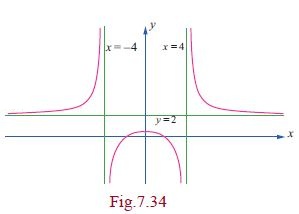
As \(\underset { x\rightarrow -{ 4 }^{ + } }{ lim } \frac { { 2x }^{ 2 }-8 }{ { x }^{ 2 }-16 } =-\infty \ and\ \underset { x\rightarrow { 4 }^{ + } }{ lim } \frac { { 2x }^{ 2 }-8 }{ { x }^{ 2 }-16 } =\infty \)
Therefore x = −4 and x = 4 are vertical asymptotes
As \(\underset { x\rightarrow \infty }{ lim } \frac { { 2x }^{ 2 }-8 }{ { x }^{ 2 }-16 } =\underset { x\rightarrow \infty }{ lim } \frac { 2-\frac { 8 }{ { x }^{ 2 } } }{ 1-\frac { 16 }{ { x }^{ 2 } } } =2\) and \(\underset { x\rightarrow -\infty }{ lim } \frac { { 2x }^{ 2 }-8 }{ { x }^{ 2 }-16 } =\underset { x\rightarrow -\infty }{ lim } \frac { 2-\frac { 8 }{ { x }^{ 2 } } }{ 1-\frac { 16 }{ { x }^{ 2 } } } =2\)
Therefore, y = 2 is a horizontal asymptote.
This can also be obtained by synthetic division
5.
The curve y = sin x intersects the positive x -axis. When y = 0 which gives, x =
\( x=n\pi , n=1,2,3,...\)
Now, \(\frac{dy}{dx}=cos x\). The slpoe \(x=n\pi\) are \(cos(n\pi)=(-1)^{n}\).
Hence, the required angle of intersection is m2 = 0
\(tan \theta = \frac{(-1)^n - 0}{1+((-1)^n(0)} = 1 ∀ n\)
6.
We have,
\(\frac{d}{dt}W(t)=-20\times(1-0.1t)\)
Therefore at t = 2, \(\frac{d}{dt}W(t)=-16\)
That is, the person forgets at the rate of 16 words after 2 days of studying.
7.
General equation of a straight line is
ax + by + c = 0 .......(1)
where a, b, c \(\in\) R.
Since, the lines are non - vertical,we have b \(\neq\) 0
Dividing b' by equation (1),
\(( \frac{a}{b})x+y+(\frac{c}{b}) = 0
\)
\(Ax+y=C = 0, where A = \frac{a}{b}, C = \frac{c}{b}\) .....(2)
Thus, eventhough 3 arbitrary constants (a, b, c) are present in (1), they can be considered as 2 constants only, as above (2).
Differentiating (1) with respect to x
a + b \(\\ \frac { dy }{ dx } =0\)
Differentiating again with respect to 'x' we get,
(b) \(\frac { { d }^{ 2 }y }{ d{ x }^{ 2 } } =0\Rightarrow \frac { { d }^{ 2 }y }{ d{ x }^{ 2 } } =0\quad [\because b\neq 0]\) .....(3)
This is the differential equation of family of all non - vertical lines in a plane.
8.
\(-5\pi \le x\le 5\pi \) and cos x = -1
cos x = -1
\(cosx=cos\pi \) \([\because cos\theta =cos\alpha \Rightarrow 2n\pi +\alpha ,n\varepsilon Z]\)
\(x=2n\pi +\pi ,n\varepsilon Z\quad \)
= \((2n+1)\pi ,n\varepsilon Z\)
\(\Rightarrow But-5\pi \le x\le 5\pi \)
Putting,\(=0,\pm 1,\pm 2\) and -3 we get
\(\Rightarrow x=-5\pi ,-3\pi ,-\pi ,3\pi ,5\pi \)
\(x=(2n+1)\ {\pi},n=0,\pm 1,\pm 2 \) and -3
9.
\(\left[ \begin{matrix} 1 & -2 & 3 \\ 2 & 4 & -6 \\ 5 & 1 & -1 \end{matrix} \right] \)
Let A =\(\left[ \begin{matrix} 1 & -2 & 3 \\ 2 & 4 & -6 \\ 5 & 1 & -1 \end{matrix} \right] \)
A is a matrix of order 3 \(\times\) 3
∴ \(\rho \)(A) ≤ min(3, 3) = 2
The highest order of minor of A is 3
It is \(\left| \begin{matrix} 1 & -2 & 3 \\ 2 & 4 & -6 \\ 5 & 1 & -1 \end{matrix} \right| =1\left| \begin{matrix} 4 & -6 \\ 1 & -1 \end{matrix} \right| +2\left| \begin{matrix} 2 & -6 \\ 5 & -1 \end{matrix} \right| +3\left| \begin{matrix} 2 & 4 \\ 5 & 1 \end{matrix} \right| \)
[Expanded along R1]
= 1(-4+6)+2(-2+30)+3(2-20)
= 1(2)+2(28)+3(-18)
= 2+56-54 = 58-54 = 4 ≠ 0
∴ \(\rho \)(A) = 3
10.
Let −1−i = \(r(cos\ \theta +i\ sin\ \theta )\)
We have r = \(\sqrt { { x }^{ 2 }+{ y }^{ 2 } } =\sqrt { { 1 }^{ 2 }+{ 1 }^{ 2 } } =\sqrt { 1+1 } =\sqrt { 2 } \)
\(\alpha =tan^{ -1 }\left| \frac { y }{ x } \right| =tan^{ -1 }1=\frac { \pi }{ 4 } \)
Since the complex number −1−i lies in the third quadrant, it has the principal value,
\(\theta =\alpha -\pi =\frac { \pi }{ 4 } -\pi =-\frac { 3\pi }{ 4 } \)
Therefore,\(-1-i=\sqrt { 2 } \left( cos\left( \frac { 3\pi }{ 4 } \right) +isin\left( \frac { 3\pi }{ 4 } \right) \right) \)
= \(\sqrt { 2 } \left( cos\frac { 3\pi }{ 4 } -isin\frac { 3\pi }{ 4 } \right) \)
\(-1-i=\sqrt { 2 } \left( cos\left( \frac { 3\pi }{ 4 } +2k\pi \right) -isin\left( \frac { 3\pi }{ 4 } +2k\pi \right) \right) \)
Depending upon the various values of k , we get various alternative polar forms.
11.
Clearly there are 2 sign changes for the given polynomial P(x) and hence number of positive roots of P(x) cannot be more than two. Further, as P(-x) = -9x9- 2x5- x4- 7x2+ 2, there is one sign change for P(-x) and hence the number of negative roots cannot be more than one. Clearly 0 is not a root. So maximum number of real roots is 3 and hence there are atleast six imaginary roots.
12.
The distance between origin to z = i, −2 + i, and 3 are
|z| = |i| = 1
|z| = |−2+i| = \(\sqrt { \left( -2 \right) ^{ 2 }+{ 1 }^{ 2 } } =\sqrt { 5 }\)
|z| = |3| = 3
Since \(1<\sqrt { 5 } <3\), the farthest point from the origin is 3 .
13.
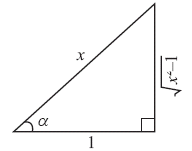
Let cot−1\(\left( \frac { 1 }{ \sqrt { { x }^{ 2 }-1 } } \right) =\alpha \). Then, cot \(\alpha =\frac { 1 }{ \sqrt { { x }^{ 2 }-1 } } \) and α is acute.
We construct a right triangle with the given data.
From the triangle, sec\(\alpha=\frac{x}{1}=x\). Thus, \(\alpha\) = sec-1x
Hence, cot−1\(\left( \frac { 1 }{ \sqrt { { x }^{ 2 }-1 } } \right) ={ sec }^{ -1 }x,|x|>1\)
14.
Given 2i + 3 is a root
∴ Its conjugate 3 - 2i is also a root of the polynomial equation.
∴ Sum of the roots 3 + 2i + 3 - 2i = 6
Product of the roots = (3 + 2i) (3 - 2i)
= 32 + 22 = 9+ 4 = 13
∴ The polynomial equation of minimum degree with rational co-efficients is
x2 - x (sum of the roots) + product of the roots = 0
⇒x2 -x (6) + 13 = 0
⇒ x2- 6x + 13 = 0
15.
The condition for the line y = mx + c to be a tangent to the circle x2 + y2 = a2 is c2 = a2(1 + m2) from
Then \(c=\pm \sqrt { 9\left( 1+16 \right) } \)
\(c=\pm 3\sqrt { 17 } \)
16.
First, we find |adj (A)| = \(\left| \begin{matrix} 7 & 7 & -7 \\ -1 & 11 & 7 \\ 11 & 5 & 7 \end{matrix} \right| \) = 7(77 - 35) - 7(-7 - 77) - 7(-5 - 121) = 1764 > 0
So, we get
A = \(\pm \frac { 1 }{ \sqrt { \left| adjA \right| } } \) adj(adj A) = \(\pm \frac { 1 }{ \sqrt { 1764 } } { \left[ \begin{matrix} +\left( 77-35 \right) & -\left( -7-77 \right) & +\left( -5-121 \right) \\ -\left( 49+35 \right) & +\left( 49+77 \right) & -\left( 35-77 \right) \\ +\left( 49+77 \right) & -\left( 49-7 \right) & +\left( 77+7 \right) \end{matrix} \right] }^{ T }\)
= \(\pm \frac { 1 }{ 42 } { \left[ \begin{matrix} 42 & 84 & -126 \\ -84 & 126 & 42 \\ 126 & -42 & 84 \end{matrix} \right] }^{ T }=\pm \left[ \begin{matrix} 1 & -2 & 3 \\ 2 & 3 & -1 \\ -3 & 1 & 2 \end{matrix} \right] \).
17.
order 2;degree not defined
18.
order – 2 : degree 2
19.
\(\frac { 208{ a }^{ 2 } }{ 3 } \)
20.
\(\frac { 1 }{ 2 } \)
21.
\(\frac { { x }^{ 3 } }{ 3 } +c\)
22.
(i) π
(ii) πX2n-1
(iii) 2
(iv) 0
23.
2x – y + 3 = 0
24.
(i) If 6 + 2 = 5, then the milk is white.
Let p: 6 + 2 = 5 (F)
q: Milk is white (T)
p ➝ q is having the truth value T
(ii) China is in Europe or \(\sqrt3\) is an integer.
p: China is in Europe (F)
q: \(\sqrt3\) is an integer (F)
p v q is having the truth value (F).
(iii) It is not true time 5 + 5 = 9 or Earth is a planet.
Let P: 5 + 5 = 9 is not true (T)
q: Earth is a planet (T
~p ∨ q is having the truth value T
(iv) 11 is a prime number and all the sides of a rectangle are equal.
p:11 is a prime number (T)
q: Allthe sides of arectangle areequal (F)
p ^ q is having the truth value F
25.
a *b = min (a, b) on A = {1,2,3,4, 5} Let a,b ∈A
A = {1,2, 3, 4, 5}
a*b = min {(a, b)}
Now, 1,2 ∈ A \(\Rightarrow\)1 * 2 = 1 ∈ A
3, 5 ∈ A \(\Rightarrow\) 3 * 5 = 3 ∈ A
Hence * is a binary operation on A
26.
Then A∨ B =\(\begin{bmatrix} 0 & 1 \\ 1 & 1 \end{bmatrix}\vee \begin{bmatrix} 1 & 1 \\ 0 & 1 \end{bmatrix}=\begin{bmatrix} 0\vee 1 & 1\vee 1 \\ 1\vee 0 & 1\vee 1 \end{bmatrix}=\begin{bmatrix} 1 & 1 \\ 1 & 1 \end{bmatrix}\)
\(A\wedge B=\begin{bmatrix} 0 & 1 \\ 1 & 1 \end{bmatrix}\wedge \begin{bmatrix} 1 & 1 \\ 0 & 1 \end{bmatrix}=\begin{bmatrix} 0\wedge 1 & 1\wedge 1 \\ 1\wedge 0 & 1\wedge 1 \end{bmatrix}=\begin{bmatrix} 0 & 1 \\ 0 & 1 \end{bmatrix}\)
27.
Given = (3 + sin(2x)) 2/3
Taking differentilas,
dy = \(\frac23\)(3 + sin(2x)) 2/3-1 (cos 2x) (2)dx
dy = \(\frac { 4 }{ 3 } .\frac { cos2x }{ { (3+sin2x) }^{ \frac { 1 }{ 3 } } } dx\)
28.
If we put directly x = 1 we observe that the given function is in an indeterminate form \(\frac{0}{0}\). As the numerator and the denominator functions are polynomials of degree 2 they both are differentiable.
Hence, by an application of the l’Hôpital Rule, we get
\(\underset{x\rightarrow 1}{lim}(\frac{x^{2}-3x+2}{x^{2}-4x+3})=\underset{x\rightarrow 1}{lime}(\frac{2x-3}{2x-4})\)
= \(\frac{1}{2}\)
Note that this limit may also be evaluated through the factorization of the numerator and denominator as \(\frac{x^{2}-3x+2}{x^{2}-4x+3}=\frac{(x-1)(x-2)}{(x-1)(x-3)}\)
29.
Let P represent the vapour pressure and T represent the vapour temperature.
Given \(\frac { dp }{ dt } \alpha \quad p.\frac { 1 }{ { T }^{ 2 } } \)
[∴ Inversely proportional to the square of the temperature]
\(\Rightarrow \frac { dp }{ dt } =\frac { kP }{ { T }^{ 2 } } \) where k is a constant.
30.
Given circle is x2 + y2 - 8x - 9y + 12 = 0
Length of the tangent = \(\sqrt { { 2 }^{ 2 }+({ -3) }^{ 2 }-8(2)-9(-3)+12 } \)
= \(\sqrt { 4+9-16+27+12 } \)
= \(\sqrt { 36 } \) = 6 unit
31.
We know that sin-1: [-1, 1] \(\rightarrow \left[ -\frac { \pi }{ 2 } ,\frac { \pi }{ 2 } \right] \)is given by
sin−1x = y if and only if x = sin y for −1\(\le x\le \) and -\(\frac { \pi }{ 2 } \le y \le \frac { \pi }{ 2 } \). Thus,
\({ sin }^{ -1 }\left( sin\left( -\frac { \pi }{ 3 } \right) \right) \) = -\(\frac{\pi}{3}\), since -\(\frac{\pi}{3}\) \(\in \left[ -\frac { \pi }{ 2 } ,\frac { \pi }{ 2 } \right] \)
32.
\(\sqrt { 3 } -i\)
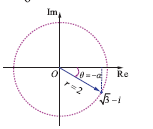
r = 2 and \(-\alpha =\frac { \pi }{ 6 } \)
Since the complex number lies in the fourth quadrant, has the principal value
\(\theta =-\alpha =-\frac { \pi }{ 6 } \)
Therefore, the modulus and principal argument of
\(-\sqrt { 3 } -i\) are 2 and \(\frac { \pi }{ 6 } \)
33.
\(\left| 2z+2-4i \right| =2\)
2|z+1-2i| = 2
⇒ |z-(-1+2i)| = 1
It is of the form |z - z0| = r and so it represents a circle.
Its centre is (-1+2i) and radius is 1.
34.
Let z = -6+8i
|z| =\(\sqrt { (-6)^{ 2 }+8^{ 2 } } \)
= \(\sqrt { 36+64 } =\sqrt { 100 } \) = 10
\(\sqrt { a+ib } =\pm \left( \sqrt { \frac { |z|+a }{ 2 } } +i\frac { b }{ |b| } \sqrt { \frac { |z|-a }{ 2 } } \right) \)
[Here |z| = 10, a = -6, b = 8]
\(\sqrt { -6+8i } \pm \left( \sqrt { \frac { 10-6 }{ 2 } } +i\frac { 8 }{ |8| } \sqrt { \frac { 10+6 }{ 2 } } \right) \)
= \(\pm \left( \sqrt { \frac { 4 }{ 2 } } +i\sqrt { \frac { 16 }{ 2 } } \right) \)
= \(\pm (\sqrt { 2 } +i\sqrt { 8 } )\)
= \(\\ \pm (\sqrt { 2 } +i2\sqrt { 2 } )\)
Aliter :
Square root of -6 + 8i
Let a + ib = - 6 + 8i
a = -6, b = 8
\(|z|=\sqrt{6^{2}+8^{2}}=\sqrt{100}=10\)
\(\sqrt{a+i b}=\pm\left[\sqrt{\frac{\sqrt{a^{2}+b^{2}}+a}{2}}+i \frac{b}{|b|} \sqrt{\frac{\sqrt{a^{2}+b^{2}}-a}{2}}\right]\)
\(=\pm\left[\sqrt{\frac{10-6}{2}}+i \sqrt{\frac{10+6}{2}}\right]\)
\(=\pm[\sqrt{2}+i \quad 2 \sqrt{2}]\)
35.
y = 4 sin (-2x)
The amplitude of sin x is 1
\(\Rightarrow\) amplitude of sin (-2x) is 1
\(\therefore\) Amplitude 4 sin(-2x) is 4 \(\times\) 1 = 4.
The period of sin \((-2x)is2x=2\pi \Rightarrow =\frac { 2\pi }{ 2 } =\pi \)
36.
\(\left[ \begin{matrix} 1 \\ 3 \end{matrix}\begin{matrix} -2 \\ -6 \end{matrix}\begin{matrix} -1 \\ -3 \end{matrix}\begin{matrix} 0 \\ 1 \end{matrix} \right] \)
Let A =\(\left[ \begin{matrix} 1 \\ 3 \end{matrix}\begin{matrix} -2 \\ -6 \end{matrix}\begin{matrix} -1 \\ -3 \end{matrix}\begin{matrix} 0 \\ 1 \end{matrix} \right] \)
A is a matrix of order (2 \(\times\) 4)
∴ \(\rho \)(A) ≤ min(2, 4) = 2
The highest order of minor of A is 2
It is \(\left| \begin{matrix} 1 & -2 \\ 3 & -6 \end{matrix} \right| \) = -6 + 6 = 0
Also, \(\left| \begin{matrix} -1 & 0 \\ -3 & 1 \end{matrix} \right| \) = -1 + 0 = -1 ≠ 0
∴ \(\rho \)(A) = 2
37.
Vector form of the equation of the plane is
\(\vec { r } .(6\hat { i } +4\hat { j } -3\hat { k } )\) = 12
Let \(\vec { r } =x\hat { i } +y\hat { j } +z\hat { k } \)
\(\Rightarrow (x\hat { i } +y\hat { j } +z\hat { k } ).(6\hat { i } +4\hat { j } -3\hat { k } )=12\)
⇒ 6x + 4y - 3z = 0
Dividing by 12, we get
\(\frac { 6x }{ 12 } +\frac { 4y }{ 12 } +\frac { 3z }{ 12 } =1\)
[\(\because \frac { x }{ a } +\frac { y }{ b } +\frac { z }{ c } =1\) is the equation of the plane in intercept form]
⇒ \(\frac { x }{ 2 } +\frac { y }{ 3 } +\frac { z }{ -4 } =1\)
∴ The x-intercepts of the plane is 2, y intercept is 3 and z-intercept is -4.
38.
Let \(\vec { a } =-6\hat { i } +14\hat { j } +10\hat { k } \), \(\vec { b } =14\hat { i } -10\hat { j } -6\hat { k } \) and \(\vec { c } =2\hat { i } +4\hat { j } -2\hat { k } \)
Volume of the parallelepiped having \(\vec { a } ,\vec { b } \) and \(\vec { c } \) as its co-terminus edges is \(\vec { a } .(\vec { b } \times \vec { c } )\).
∴ \(\vec { a } .(\vec { b } \times \vec { c } )=\left| \begin{matrix} -6 & 14 & 10 \\ 14 & -10 & -6 \\ 2 & 4 & -2 \end{matrix} \right| \)
= \(-6\left| \begin{matrix} -10 & -6 \\ 4 & -2 \end{matrix} \right| -14\left| \begin{matrix} 14 & -6 \\ 2 & -2 \end{matrix} \right| +10\left| \begin{matrix} 14 & -10 \\ 2 & 4 \end{matrix} \right| \)
= -6(20 + 24) - 14(-28 + 12) + 10(56 + 20)
= -6(44) -14(-16) + 10(76)
= -264 + 224 + 760 = 720.
∴ Volume of the required parallelepiped = 720 cubic units.
39.
Here A = 2, B = 0, C = -1, F = -7
Here A ≠ C and A and C are of opposite signs.
Hence the given equation represents a hyperbola.
40.
We know that the volume of the parallelepiped whose coterminus edges are \(\vec { a } ,\vec { b } ,\vec { c } \) is given by |\([\vec { a } ,\vec { b } ,\vec { c } ]\)|. Here, \(\vec { a } =\hat { 2i } -\hat { 3j } +\hat { 4k } ,\vec { b } =\hat { i } +\hat { 2j } -\hat { k } ,\vec { c } =\hat { 3i } -\hat { j } +\hat { 2k } \)
Since \([\vec { a } ,\vec { b } ,\vec { c } ]\) = \(\left| \begin{matrix} 2 & -3 & 4 \\ 1 & 2 & -1 \\ 3 & -1 & 2 \end{matrix} \right| =-7\) , the volume of the given parallelepiped is \(\left| -7 \right| =7\) cubic units.
41.
\(\left| \frac { 2+i }{ -1+2i } \right| =\frac { \left| 2+i \right| }{ \left| -1+2i \right| } =\frac { \sqrt { { 2 }^{ 2 }+{ 1 }^{ 2 } } }{ \sqrt { \left( -1 \right) ^{ 2 }+{ 2 }^{ 2 } } } =1\) \(\left( \because \left| \frac { { z }_{ 1 } }{ { z }_{ 2 } } \right| =\left| \frac { { z }_{ 1 } }{ { z }_{ 2 } } \right| ,{ z }_{ 2 }\neq 0 \right) \)
42.
The amplitude of sin x is 1 [Max of sin x curve is 1]
\(\Rightarrow \) amplitude of sin 7x is also 1
If p is the period of the function,
then f(x+p) = f(x)
Since the period of sine function is \(2\pi \)
The period of sin is \(\frac { 2\pi }{ 7 } \)
amplitude = 1
43.
Centre of the circle is (3,-2) which lies on x + y − 1 = 0. So the line x + y − 1 = 0 passes through the centre and therefore the line x + y −1 = 0 is a diameter of the circle for all possible values of c .
44.
Let X be the thrown random variable denotes the total in two the thrown a die.
Sample space S
| I/II | 1 | 3 | 3 | 5 | 5 | 5 |
| 1 | 2 | 4 | 4 | 6 | 6 | 6 |
| 3 | 4 | 6 | 6 | 8 | 8 | 8 |
| 3 | 4 | 6 | 6 | 8 | 8 | 8 |
| 5 | 6 | 8 | 8 | 10 | 10 | 10 |
| 5 | 6 | 8 | 8 | 10 | 10 | 10 |
| 5 | 6 | 8 | 8 | 10 | 10 | 10 |
n (S) = 36
X = {2, 4, 6, 8, 10}
| Values of the random variable | 2 | 4 | 6 | 8 | 10 | Total |
| No. of elements in inverse images | 1 | 4 | 10 | 12 | 9 | 36 |
\(p(x=2)=\cfrac { 1 }{ 36 } \)
\(p(x=4)=\cfrac { 4 }{ 36 } \)
\(p(x=6)=\cfrac { 10 }{ 36 } \)
\(p(x=8)=\cfrac { 12 }{ 36 } \)
\(p(x=10)=\cfrac { 9 }{ 36 } \)
(i) Probability mass function is
| x | 2 | 4 | 6 | 8 | 10 |
| f(x) | \(\\ \cfrac { 1 }{ 36 } \) | \(\cfrac { 4 }{ 36 } \) | \(\cfrac { 10 }{ 36 } \) | \(\cfrac { 12 }{ 36 } \) | \(\cfrac { 9 }{ 36 } \) |
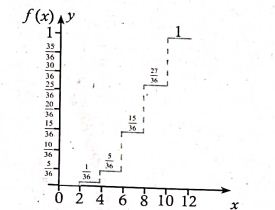
(ii) Cumulative distribution function .
F(x) = p(X ≤ x) = \(\sum_{x_i ≤ x }\)(X = xi)
P(X<2) = 0 for \(\infty\) < x < 2
\(F(2)=\frac { 1 }{ 36 } \)
\(F(4)=\frac { 1 }{ 36 } +\frac { 4 }{ 36 } =\frac { 5 }{ 36 } \)
\(F(6)=\frac { 1 }{ 36 } +\frac { 4 }{ 36 } +\frac { 10 }{ 36 } =\frac { 15 }{ 36 } \)
\(F(8)=\frac { 1 }{ 36 } +\frac { 4 }{ 36 } +\frac { 10 }{ 36 } +\frac { 12 }{ 36 } =\frac { 27 }{ 36 }\)
\(F(10)=\frac { 27 }{ 36 } +\frac { 9 }{ 36 } =\frac { 36 }{ 36 } =1\)
∵ The cumulative distribution function n
\(F(x)=\left\{\begin{array}{lll} 0 & \text { for } & x<2 \\ \frac{1}{36} & \text { for } & x \leq 2 \\ \frac{5}{36} & \text { for } & x \leq 6 \\ \frac{15}{36} & \text { for } & x \leq 8 \\ 1 & \text { for } & x \leq 10 \end{array}\right.\)
(iii) p(4≤ X < 10) = p(x = 4) + p(x = 6) + p(x = 8)
= \(\frac { 4 }{ 36 } +\frac { 10 }{ 36 } +\frac { 12 }{ 36 } +\frac { 26 }{ 36 } =\frac { 13 }{ 18 } \)
(iv) p(x ≥ 6) = p(x = 6) + p(x = 8) + p(x = 10)
= \(\frac { 10 }{ 36 } +\frac { 12 }{ 36 } +\frac { 9 }{ 36 } =\frac { 31 }{ 36 } \)
Sample space = {4 childrens}
45.

12th Standard Syllabus & Materials
12th Standard
TN 12th Computer Applications வலையமைப்பு வடமிடல் Sample Question Papers Study Material - QB365 Set A
NEW12th Standard
TN 12th Computer Applications களப்பெயர் முறைமை (DNS) Sample Question Papers Study Material - QB365 Set A
NEW12th Standard
TN 12th Computer Applications வலையமைப்பு எடுத்துக்காட்டுகள் மற்றும் நெறிமுறைகள் Sample Question Papers Study Material - QB365 Set A
NEW12th Standard
TN 12th Computer Applications கணினி வலையமைப்பு ஓர் அறிமுகம் Sample Question Papers Study Material - QB365 Set A



Tamilnadu Stateboard 12th Standard Subjects
Maths

Chemistry

Physics

Biology

Computer Science

Business Maths and Statistics

Economics

Commerce

Accountancy

History

Computer Applications
Biology
Computer Technology
Computer Applications
Computer Science
Business Maths and Statistics
Commerce
Economics
Maths
Chemistry
Physics
Computer Technology
History
Accountancy

Tamil

English

French
Tamilnadu Stateboard Standards

