
 100% FREE ACCESS
12th Standard Syllabus & Materials
12th Standard
TN 12th Computer Applications மின்னணு தரவு பரிமாற்றம் Sample Question Papers Study Material - QB365 Set A
NEW12th Standard
TN 12th Computer Applications மின் - வணிக பாதுகாப்பு அமைப்புகள் Sample Question Papers Study Material - QB365 Set A
NEW12th Standard
TN 12th Computer Applications மின்னணு செலுத்தல் முறைகள் Sample Question Papers Study Material - QB365 Set A
NEW12th Standard
TN 12th Computer Applications மின் - வணிகம் Sample Question Papers Study Material - QB365 Set A
NEW12th Standard
TN 12th Computer Applications திறந்த மூல கருத்துருக்கள் Sample Question Papers Study Material - QB365 Set A
NEW12th Standard
TN 12th Computer Applications வலையமைப்பு வடமிடல் Sample Question Papers Study Material - QB365 Set A

Published on: 01/06/2021
QB365 provides detailed and simple solution for every book back questions in class 12 Maths subject.It will helps to get more idea about question pattern in every book back questions with solution.
Download Tamil Nadu 12th Standard Maths question papers, model tests, one-mark questions, important questions, and public exam papers in PDF format. Free study materials and answer keys for TN State Board students.
Questions + Answers key
Take MCQ Maths Test1.
A beacon makes one revolution every 10 seconds. It is located on a ship which is anchored 5 km from a straight shore line. How fast is the beam moving along the shore line when it makes an angle of 45° with the shore?
2.
The price of a product is related to the number of units available (supply) by the equation Px + 3P −16x = 234, where P is the price of the product per unit in Rupees(Rs) and x is the number of units. Find the rate at which the price is changing with respect to time when 90 units are available and the supply is increasing at a rate of 15 units/week.
3.
For the function f(x) = x2, x∈ [0, 2] compute the average rate of changes in the subintervals [0, 0.5], [0.5, 1], [1, 1.5], [1.5, 2] and the instantaneous rate of changes at the points x = 0.5,1, 1.5, 2
4.
Find the equations of tangent and normal to the curve y = x2 + 3x − 2 at the point (1, 2)
5.
If the mass m(x) (in kilograms) of a thin rod of length x (in metres) is given by, m(x) = \(\sqrt { 3 } x\) then what is the rate of change of mass with respect to the length when it is x = 3 and x = 27 metres.
6.
A particle moves along a straight line in such a way that after t seconds its distance from the origin is s = 2t2 + 3t metres.
7.
A point moves along a straight line in such a way that after t seconds its distance from the origin is s = 2t2 + 3t metres.
(i) Find the average velocity of the points between t = 3 and t = 6 seconds.
(ii) Find the instantaneous velocities at t = 3 and t = 6 seconds.
8.
A particle moves so that the distance moved is according to the law s(t) = \(s(t)=\frac{t^{3}}{3}-t^{2}+3\). At what time the velocity and acceleration are zero.
9.
A stone is dropped into a pond causing ripples in the form of concentric circles. The radius r of the outer ripple is increasing at a constant rate at 2 cm per second. When the radius is 5 cm find the rate of changing of the total area of the disturbed water?
10.
A particle is fired straight up from the ground to reach a height of s feet in t seconds, where s(t) = 128t −16t2.
(1) Compute the maximum height of the particle reached.
(2) What is the velocity when the particle hits the ground?
1.
Since the beacon makes one revolution (360°) in 10 sec.
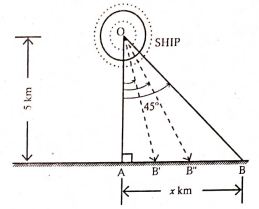
At the point of observation, let 0 be the angle of deviation of the beacon of light from OA.
Let AB x km,when \(\angle\)AOB = 0
\(\frac { d\theta }{ dt } =\frac { 2\pi }{ 10 } \)
\(=\frac { \pi }{ 5 } \) rad /sec.
Let AB = x
Then, tan θ \( =\frac { x }{ 5 } \)
x = 5 tan θ
We know that velocity = \(\frac { dx }{ dt } \)
Differentiating (1) with respect to 't' we get,
\(\frac { dx }{ dt } =5{ sec }^{ 2 }\theta ,\frac { d\theta }{ dt } \)
\(=5({ sec }^{ 2 }{ 45 }^{ o })\left( \frac { \pi }{ 5 } \right) \)
\(=5({ \sqrt { 2 } })^{ 2 }\left( \frac { \pi }{ 5 } \right) \)
\(=5(2)\left( \frac { \pi }{ 5 } \right) \)
= 2π km/sec.
2.
We have, \(P=\frac{234+16x}{x+3}\)
Therefore, \(\frac{dP}{dt}= - \frac{186}{(x+3)^{2}}\times \frac{dx}{dt}\).
Substituting \(x=90, \frac{dx}{dt}=15\) we get\(\frac{dP}{dt}= -\frac{186}{93^{2}}\times 15= -\frac{10}{31}\approx -0.32\) repee/ week.
That is the price is changing, in fact decreasing at the rate of Rs. 0.32 per unit.
3.
The average rate of change in an interval [a, b] is \(\frac { f(b)-f(a) }{ b-a } \) whereas, the instantaneous rate of change at a point x is f′(x) for the given function. They are respectively, b + a and 2x.
| a | b | x | Average rate is \(\frac { f(b)-f(a) }{ b-a } \) = b+a | Instantaneous rate is f'(x) = 2x |
| 0 | 0.5 | 0.5 | 0.5 | 1 |
| 0.5 | 1 | 1 | 1.5 | 2 |
| 1 | 1.5 | 1.5 | 2.5 | 3 |
| 1.5 | 2 | 2 | 3.5 | 4 |
4.
We have, \(\frac{dy}{dx}=2x+3\). Hence at (1, 2), \((\frac{dy}{dx})=5\)
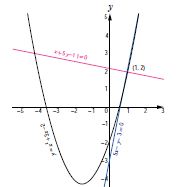
Therefore, the required equation of tangent is.
\((y-2)=5(x-1)\Rightarrow 5x-y-3=0\)
The slope of the normal at the point (1, 2) is -\(\frac{1}{5}\).
therefore, the required equation of normal is
\((y-2)=-\frac{1}{5}(x-1)\Rightarrow x+5y-11=0\)
5.
Given m (x) = \(\sqrt { 3 } x\) = \(\sqrt { 3 } .{ x }^{ \frac { 1 }{ 2 } }\)
Differentiating with respect to 'x' we get,
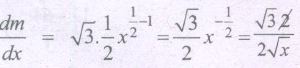
when x = 3, \(\frac { dm }{ dx } =\frac { \sqrt { 3 } }{ 2\sqrt { 3 } } =\frac { 1 }{ 2 } \) Kg/m
when x = 27, \(\frac { dm }{ dx } =\frac { \sqrt { 3 } }{ 2\sqrt { 27 } } \)
\(=\frac{\sqrt{\not 3}}{2(3) \sqrt{\not 3}}=\frac{1}{6} \mathrm{Kg} / \mathrm{m}\)
6.
7.
Given s = 2t2 + 3t
s(3) = 2 \(\times\) 32 + 3 (3)
= 2\(\times\)9+9
= 27 m ....(1)
s(6) = 2\(\times\) 62 + 3 (6)
= 72 + 18 = 90m ... (2)
Average velocity = \(\frac { s(6)-s(3) }{ 6-3 } \)
= \(\frac { 90-27 }{ 3 } \) = 21 m/s
(ii) Instantaneous Velocity V(t) = \(\frac { ds }{ dt } \)
Instantaneous Velocity at t = 3
= V(3) = 15 m/sec
Instantaneous Velocity at t = 6
= V(6) = 27m/sec
8.
Distance moved in time 't' is s = \(\frac{t^{3}}{3}-t^{2}+3\)
Velocity at time 't ' is V = \(\frac{ds}{dt}=t^{2}-2t\)
Acceleration at time 't ' is a(t) = \(\frac{dV}{dt}=2t-2\)
Therefore, the velocity is zero when t2 − 2t = 0, that is t = 0, 2. The acceleration is zero when 2t − 2 = 0 . That is at time at time t = 1
9.
Let r be the radius of the ripple and A be the area of the ripple.
GIven \(\frac { dr }{ dt } \) = 2 cm/sec and r = 5 cm ... (1)
We know A = πr2
Differentiating with respect to 't' we get,
\(\frac { dA }{ dt } \) = π(2r).\(\frac { dr }{ dt } \)
= π(2) (5) (2) [using (1)]
\(\frac { dA }{ dt } \) = 20 πsq.cm/sec.
10.
(i) At the maximum height, the velocity v(t) of the particle is zero.
Now, we find the velocity of the particle at time t.
\(v(t)=\frac{ds}{dt}=128-32t\)
\(v(t)=0 \Rightarrow 128-32t=0 \Rightarrow t=4.\)
After 4 seconds, the particle reaches the maximum height.
The height at t = 4 is s(4) = 128(4) - 16(4)2 = 256 ft.
(ii) When the particle hits the ground then s = 0 .
s = 0 ⇒ 128t −16t2 = 0
⇒ t = 0, 8 seconds.
The particle hits the ground at t = 8 seconds. The velocity when it hits the ground v(8) = –128 ft /s.

12th Standard Syllabus & Materials
12th Standard
TN 12th Computer Applications களப்பெயர் முறைமை (DNS) Sample Question Papers Study Material - QB365 Set A
NEW12th Standard
TN 12th Computer Applications வலையமைப்பு எடுத்துக்காட்டுகள் மற்றும் நெறிமுறைகள் Sample Question Papers Study Material - QB365 Set A
NEW12th Standard
TN 12th Computer Applications கணினி வலையமைப்பு ஓர் அறிமுகம் Sample Question Papers Study Material - QB365 Set A
NEW12th Standard
TN 12th Computer Applications PHP-உடன் MySQL-ஐ இணைத்தல் Sample Question Papers Study Material - QB365 Set A



Tamilnadu Stateboard 12th Standard Subjects
Maths

Chemistry

Physics

Biology

Computer Science

Business Maths and Statistics

Economics

Commerce

Accountancy

History

Computer Applications
Biology
Computer Technology
Computer Applications
Computer Science
Business Maths and Statistics
Commerce
Economics
Maths
Chemistry
Physics
Computer Technology
History
Accountancy

Tamil

English

French
Tamilnadu Stateboard Standards



