
 100% FREE ACCESS
12th Standard Syllabus & Materials
12th Standard
TN 12th Computer Applications மின்னணு தரவு பரிமாற்றம் Sample Question Papers Study Material - QB365 Set A
NEW12th Standard
TN 12th Computer Applications மின் - வணிக பாதுகாப்பு அமைப்புகள் Sample Question Papers Study Material - QB365 Set A
NEW12th Standard
TN 12th Computer Applications மின்னணு செலுத்தல் முறைகள் Sample Question Papers Study Material - QB365 Set A
NEW12th Standard
TN 12th Computer Applications மின் - வணிகம் Sample Question Papers Study Material - QB365 Set A
NEW12th Standard
TN 12th Computer Applications திறந்த மூல கருத்துருக்கள் Sample Question Papers Study Material - QB365 Set A
NEW12th Standard
TN 12th Computer Applications வலையமைப்பு வடமிடல் Sample Question Papers Study Material - QB365 Set A

Published on: 13/05/2022
QB365 provides detailed and simple solution for every book back questions in class 12 Maths subject.It will helps to get more idea about question pattern in every book back questions with solution.
latest Book back QuestionsDownload Tamil Nadu 12th Standard Maths question papers, model tests, one-mark questions, important questions, and public exam papers in PDF format. Free study materials and answer keys for TN State Board students.
Questions + Answers key
Take MCQ Maths Test1.
Evaluate the following limit, if necessary use l ’Hôpital Rule
\(\underset { x\rightarrow \infty }{ lim } { e }^{ -x }\sqrt { x } \)
2.
Evaluate : \(\underset{x\rightarrow 1^{-}}{lim}(\frac{log(1-x)}{cot(\pi x)})\).
3.
Expand sin x in ascending powers x - \(\frac{\pi}{4}\) upto three non-zero terms.
4.
Write down the Taylor series expansion, of the function log x about x =1 upto three nonzero terms for x > 0.
5.
Show that the value in the conclusion of the mean value theorem for
f(x) = Ax2 + Bx + c on any interval [a, b] is \(\frac{a+b}{2}\)
6.
Find the absolute extrem of the following function on the given closed interval
f(x) = x2 -12x + 10; [1, 2]
7.
Determine the intervals of concavity of the curve y = 3+ sin x .
8.
Find the intervals of monotonicity and hence find the local extrema for the function \(f(x)=x^{\frac{2}{3}}\).
9.
10.
Find the asymptotes of the function f(x) = \(\frac{1}{x}\)
1.
\(\underset { x\rightarrow \infty }{ lim } { e }^{ -x }\sqrt { x } =\underset { x\rightarrow \infty }{ lim } \frac { { \sqrt { x } } }{ { e }^{ x } } =\frac { \infty }{ \infty } \)
Which is in indeterminate form. Applying L' Hopital rule we get,
\(\underset { x\rightarrow \infty }{ lim } \frac { \frac { 1 }{ 2 } { x }^{ \frac { 1 }{ 2 } -1 } }{ { e }^{ x } } =\frac { 1 }{ 2 } \underset { x\rightarrow \infty }{ lim } \frac { { x }^{ \frac { 1 }{ 2 } -1 } }{ { e }^{ x } } =\frac { 1 }{ 2 } \underset { x\rightarrow \infty }{ lim } \frac { { e }^{ -x } }{ \sqrt { x } } \)
\(\frac { 1 }{ 2 } \underset { x\rightarrow \infty }{ lim } e^{ -x }\sqrt { \frac { 1 }{ x } } =\frac { 1 }{ 2 } { e }^{ -\infty }(0)=0\) [When x ➝ ∞, \(\frac1x\) ➝ 0 e-∞ = 0]
2.
This is an indeterminate form \(\frac{\infty}{\infty}\) and hence we use the l’Hôpital’s Rule to evaluate.
\(\underset{x\rightarrow 1^{-}}{lim}(\frac{log(1-x)}{cot(\pi x)})=\underset{x\rightarrow1^{-}}{lim}(\frac{-\frac{1}{1-x}}{-\pi cosec^{2}(\pi x)})\) \((\frac{\infty}{\infty})\)
On Simplication,
\(=\underset{x\rightarrow-1}{lim}(\frac{sin^{2}(\pi x)}{\pi (1-x)})\) \((\frac{0}{0})\)
again applying the l’Hôpital Rule
\(= \underset{x\rightarrow 1^{-}}{lim}(\frac{2\pi sin(\pi x). cos(\pi x)}{-\pi})\)
=\(\underset{x\rightarrow -1}{lim}(-2 sin(\pi x).cos (\pi x))\)
= 0.
3.
Let (x) = sin x
fI(x) = cos x
fII(x) = - sin x
fIII(x) = -cos x
⇒ \(f\left( \frac { \pi }{ 4 } \right) =sin\frac { \pi }{ 4 } =\frac { 1 }{ \sqrt { 2 } } \)
\({ f }^{ 1 }\left( \frac { \pi }{ 4 } \right) =cos\frac { \pi }{ 4 } =\frac { 1 }{ \sqrt { 2 } } \)
\({ f }^{ II }\left( \frac { \pi }{ 4 } \right) =sin\frac { \pi }{ 4 } =-\frac { 1 }{ \sqrt { 2 } } \)
\({ f }^{ II }\left( \frac { \pi }{ 4 } \right) =-cos\frac { \pi }{ 4 } =-\frac { 1 }{ \sqrt { 2 } } \)
Taylors' series for f (x) at x = \(\frac { \pi }{ 4 } \) is
\(f(x)=f\left( \frac { \pi }{ 4 } \right) +\frac { { f }^{ I }\left( \frac { \pi }{ 4 } \right) }{ 1! } \left( x-\frac { \pi }{ 4 } \right) +\frac { { f }^{ II }\left( \frac { \pi }{ 4 } \right) }{ 2! } { \left( x-\frac { \pi }{ 4 } \right) }^{ 2 }+\frac { { f }^{ III }\left( \frac { \pi }{ 4 } \right) }{ 3! } { \left( x-\frac { \pi }{ 4 } \right) }^{ 3 }\)+...
\(sinx=\frac { 1 }{ \sqrt { 2 } } +\frac { 1 }{ \sqrt { 2 } } \left( x-\frac { \pi }{ 4 } \right) -\frac { 1 }{ \sqrt { 2 } } \frac { { \left( x-\frac { \pi }{ 4 } \right) }^{ 2 } }{ 2! } -\frac { 1 }{ \sqrt { 2 } } \frac { { \left( x-\frac { \pi }{ 4 } \right) }^{ 3 } }{ 3! } +...\)
\(=\frac { 1 }{ \sqrt { 2 } } \left[ 1+\left( x-\frac { \pi }{ 4 } \right) -\frac { 1 }{ 2! } { \left( x-\frac { \pi }{ 4 } \right) }^{ 2 }-\frac { 1 }{ 3! } { \left( x-\frac { \pi }{ 4 } \right) }^{ 3 }+..... \right] \)
\(sinx=\frac { \sqrt { 2 } }{ 2 } \left[ 1+\frac { 1 }{ 1! } \left( x-\frac { \pi }{ 4 } \right) -\frac { 1 }{ 2! } { \left( x-\frac { \pi }{ 4 } \right) }-\frac { 1 }{ 3! } { \left( x-\frac { \pi }{ 4 } \right) }+..... \right] \)
4.
Let f(x) = log x
fl(x) = \(\frac{1}{x}\) = x-1
flI(x) = -1x-2
fIII(x) = 2x-3
fIV(x) = -6 x-4
⇒ f(1) = log 1 = 0
fl(1) = \(\frac11\) = 1
fll(1) = -1
flll(1) = 2
fIV(1) = -6
Taylor series for f(x) at x = 1 is
\(f(x)=f(1)+\frac { { f }^{ 1 }(1) }{ 1! } (x-1)+\frac { { f }^{ II }(1) }{ 2! } ({ x-1) }^{ 2 }+\frac { { f }^{ III }(1) }{ 3! } { (x-1) }^{ 3 }+\).....
log x = \(\frac { 1 }{ 1! } (x-1)+\frac { -1 }{ 2! } { (x-1) }^{ 2 }+\frac { 2 }{ 3! } ({ x-1) }^{ 3 }-\frac { 6 }{ 4! } ({ x-1) }^{ 4 }+..\)
log x = \((x-1)-\frac { 1 }{ 2 } { (x-1) }^{ 2 }+\frac { 1 }{ 3 } { (x-1) }^{ 3 }-\frac { 1 }{ 4 } ({ x-1) }^{ 4 }\)+ ....
5.
Given f(x) = Ax2 + Bx + C, x ∈ [a, b]
a) f (x) is continuous in [a, b]
b) f(x) is differentiate in (a, b)
c) f(b) = Ab2+ Bb + c,
f(a) = Aa2+ Ba + c
Using mean value theorem, there exists c ∈ [a, b] such that f'(c) = \(\frac { f(b)-f(a) }{ b-a } \)
2Ac + B = \(\frac { (A{ b }^{ 2 }+Bb+C)-(A{ a }^{ 2 }+Ba+C) }{ b-a } \)
\(=\frac{A b^{2}+B b+\not C-A a^{2}-B a-\not C}{b-a}\)
= \(\frac { a(b+a)(b-a)+B(b-a) }{ b-a } \)
\(=\frac{(\not b-a)[\mathrm{A}( b+a)+\mathrm{B}]}{\not b-a}\)
\(2 \mathrm{~A} c+\not \mathbf{B}=\mathrm{A}(a+b)+\not \mathrm{B}\)
⇒ 2Ac = A(a + b)
= \(\frac{a+b}{2}\) ∈ [a, b]
6.
f(x) = x2 -12x + 10; [1, 2]
Given f(x) = x2 -12x + 10 ; [1, 2]
f'(x) = 2x - 12
f'(x) = 0
\(\Rightarrow\) 2x-12 = 0
\(\Rightarrow\) 2x = 12
\(\Rightarrow\) x = 6
\(\therefore\) The critical number is 6
Evaluating f (x) at the end points x = 1,
x = 2 and at the critical number x = 6 we get
f(1) = 12-12(1)+10 = -1
f(2) = 22-12(2)+10 = -10
Absolute maximum f(1) = -1
Absolute minimum f(2) = -10
7.
The given function is a periodic function with period 2π and hence there will be stationary points and points of inflections in each period interval. We have,
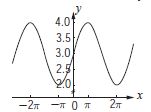
\(\frac { dy }{ dx } =cosx\) and \(\frac { { d }^{ 2 }y }{ { dx }^{ 2 } } =sinx\)
Now,\( \frac { { d }^{ 2 }y }{ { dx }^{ 2 } } =-sinx=0\Rightarrow x=n\pi \)
We now consider an interval, (-π, π ) by splitting into two sub intervals \(\left( -\pi ,0 \right) \) and \(\left( 0,\pi \right) \)
In the interval \(\left( -\pi ,0 \right) ,\frac { { d }^{ 2 }y }{ { dx }^{ 2 } } >0\) and hence the function is concave upward
In the interval \(\left( -\pi ,0 \right) ,\frac { { d }^{ 2 }y }{ { dx }^{ 2 } } <0\) and hence the function is concave downward. Therefore (0,3) is a point of inflection. The general intervals need to be considered to discuss the concavity of the curve are \(\left( n\pi ,\left( n+1 \right) \pi \right) \), where n is any integer which can be discussed as before to conclude that \(\left( n\pi ,3 \right) \) are also points of inflection.
8.
We have , f(x) = \(x^\frac{2}{3}\) then \(f'(x)=\frac{2}{3}x^{-\frac{1}{3}}\)\(=\frac{2}{3x^{\frac{1}{3}}}, f'(x)\ne 0 \forall x \in R\) and f'(x) does not exist at x = 0.
Therefore, there are no stationary points but there is a critical point at x = 0.
| Interval | \((-\infty,0)\) | \((0,\infty)\) |
| Sign of f'(x) | - | + |
| Monotonicity | strictly decreasing | strictly increasing |
| \(\searrow \) | ↗️ |
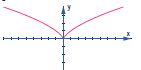
Because f'(x) changes its sign from negative to positive when passing through x = 0 for the function it has a local minimum at x = 0. The local minimum value is f(0) = 0. Note that here the local minimum occurs at a critical point which is not a stationary point.
9.
10.
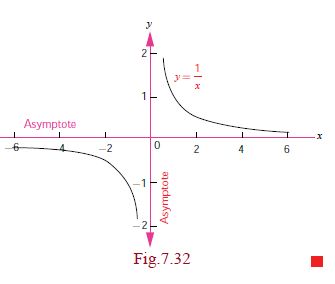
We have,
\(\underset { x\rightarrow { 0 }^{ - } }{ lim } =-\infty \ and\ \underset { x\rightarrow { 0 }^{ x } }{ lim } =\frac { 1 }{ x } =\infty \). Hence, the required vertical asymptote is x = 0 or the y -axis.
As the curve is symmetric with respect to both the axes, y = 0 or the x -axis is also an asymptote.
Hence this (rectangular hyperbola) curve has both the vertical and horizontal asymptotes.

12th Standard Syllabus & Materials
12th Standard
TN 12th Computer Applications களப்பெயர் முறைமை (DNS) Sample Question Papers Study Material - QB365 Set A
NEW12th Standard
TN 12th Computer Applications வலையமைப்பு எடுத்துக்காட்டுகள் மற்றும் நெறிமுறைகள் Sample Question Papers Study Material - QB365 Set A
NEW12th Standard
TN 12th Computer Applications கணினி வலையமைப்பு ஓர் அறிமுகம் Sample Question Papers Study Material - QB365 Set A
NEW12th Standard
TN 12th Computer Applications PHP-உடன் MySQL-ஐ இணைத்தல் Sample Question Papers Study Material - QB365 Set A



Tamilnadu Stateboard 12th Standard Subjects
Maths

Chemistry

Physics

Biology

Computer Science

Business Maths and Statistics

Economics

Commerce

Accountancy

History

Computer Applications
Biology
Computer Technology
Computer Applications
Computer Science
Business Maths and Statistics
Commerce
Economics
Maths
Chemistry
Physics
Computer Technology
History
Accountancy

Tamil

English

French
Tamilnadu Stateboard Standards



