
 100% FREE ACCESS
12th Standard Syllabus & Materials
12th Standard
TN 12th Computer Applications மின்னணு தரவு பரிமாற்றம் Sample Question Papers Study Material - QB365 Set A
NEW12th Standard
TN 12th Computer Applications மின் - வணிக பாதுகாப்பு அமைப்புகள் Sample Question Papers Study Material - QB365 Set A
NEW12th Standard
TN 12th Computer Applications மின்னணு செலுத்தல் முறைகள் Sample Question Papers Study Material - QB365 Set A
NEW12th Standard
TN 12th Computer Applications மின் - வணிகம் Sample Question Papers Study Material - QB365 Set A
NEW12th Standard
TN 12th Computer Applications திறந்த மூல கருத்துருக்கள் Sample Question Papers Study Material - QB365 Set A
NEW12th Standard
TN 12th Computer Applications வலையமைப்பு வடமிடல் Sample Question Papers Study Material - QB365 Set A

Published on: 01/06/2021
QB365 provides detailed and simple solution for every book back questions in class 12 Maths subject.It will helps to get more idea about question pattern in every book back questions with solution.
Download Tamil Nadu 12th Standard Maths question papers, model tests, one-mark questions, important questions, and public exam papers in PDF format. Free study materials and answer keys for TN State Board students.
Questions + Answers key
Take MCQ Maths Test1.
Find the slope of the tangent to the following curves at the respective given points
y = x4 + 2x2 − x at x = 1
2.
Find the principal value of \({sin }^{ -1 }\left( sin\left( \frac { 5\pi }{ 6 } \right) \right) \)
3.
Find the square roots of −6+8i
4.
If \(\vec { a } =\hat { i } -2\hat { j } +3\hat { k }, \vec { b } =2\hat { i } +\hat { j } -2\hat { k }, \vec { c } =3\hat { i } +2\hat { j } +\hat { k } \) find \(\vec { a } .(\vec { b } \times \vec { c } )\).
5.
Identify the type of conic section for each of the equations.
3x2+3y2−4x+3y+10 = 0
6.
Find the following \(\left| \frac { 2+i }{ -1+2i } \right| \)
7.
If x2+2(k+2)x+9k = 0 has equal roots, find k.
8.
Find the principal value of sin-1\(\left( -\frac { 1 }{ 2 } \right) \)(in radians and degrees).
9.
Examine the position of the point (2, 3) with respect to the circle x2 + y2 − 6x − 8y + 12 = 0.
10.
Find the general equation of a circle with centre (-3, -4) and radius 3 units.
11.
If A = \(\left[ \begin{matrix} a & b \\ c & d \end{matrix} \right] \) is non-singular, find A−1.
12.
If α, β, and γ are the roots of the equation x3 + px2 + qx + r = 0, find the value of \(\Sigma \frac { 1 }{ \beta \gamma } \) in terms of the coefficients.
13.
Find the partial derivatives of the following functions at the indicated point
g(x, y) = 3x2 + y2 + 5x + 2, (1, -2)
14.
Evaluate the following limit, if necessary use l ’Hôpital Rule
\(\underset { x\rightarrow \infty }{ lim } \frac { { 2x }^{ 2 }-3 }{ { x }^{ 2 }-5x+3 } \)
15.
Write in polar form of the following complex numbers
\(3-i\sqrt { 3 } \)
16.
If \(\omega \neq 1\) is a cube root of unity, then the show that \(\cfrac { a+b\omega +c{ \omega }^{ 2 } }{ b+c\omega +{ a\omega }^{ 2 } } +\cfrac { a+b\omega +{ c\omega }^{ 2 } }{ c+a\omega +b{ \omega }^{ 2 } } =-1\)
17.
Prove that
\({ tan }^{ -1 }(\frac { 2 }{ 11 }) +{ tan }^{ -1 }(\frac { 7 }{ 24 }) ={ tan }^{ -1 }(\frac { 1 }{ 2 } )\)
18.
Find the rank of the matrix \(\left[ \begin{matrix} 1 & 2 & 3 \\ 2 & 1 & 4 \\ 3 & 0 & 5 \end{matrix} \right] \) by reducing it to a row-echelon form.
19.
If y = 2\(\sqrt2\)x + c is a tangent to the circle x2 + y2 = 16, find the value of c.
20.
Obtain the equation of the circles with radius 5 cm and touching x-axis at the origin in general form.
21.
A 12 metre tall tree was broken into two parts. It was found that the height of the part which was left standing was the cube root of the length of the part that was cut away. Formulate this into a mathematical problem to find the height of the part which was left standing.
22.
Examine for the rational roots of x8- 3x + 1 = 0
23.
If \(\vec { a } =2\hat { i } +3\hat { j } -\hat { k } ,\vec { b } =3\hat { i } +5\hat { j } +2\hat { k } ,\vec { c } =-\hat { i } -2\hat { j } +3\hat { k } \), verify that
(i) \((\vec { a } \times \vec { b } )\times \vec { c } =(\vec { a } .\vec { c } )\times \vec { b } -(\vec { b } .\vec { c } )\vec { a } \)
(ii) \(\vec { a } \times (\vec { b } \times \vec { c } )=(\vec { a } .\vec { c } )\times \vec { b } -(\vec { a } .\vec { b } )\vec { c } \)
24.
Solve tan-1\(\left( \frac { 1-x }{ 1+x } \right) =\frac { 1 }{ 2 } { tan }^{ -1 }\) x for x > 0
25.
Solve: (2x-1) (x+3) (x-2) (2x+3)+20 = 0
1.
Given y = x4 + 2x2 - x
\(\frac { dy }{ dx } \) = 4x3 + 4x - 1
Slope of the tangent at x = 1 is
m = \(\left( \frac { dy }{ dx } \right) \)(x = 1)
= 4(1)3+ 4 (1) - 1
= 4+4-1 = 7
∴ m = 7
2.
We know that sin-1: [-1, 1] \(\rightarrow \left[ -\frac { \pi }{ 2 } ,\frac { \pi }{ 2 } \right] \)is given by
sin−1x = y if and only if x = sin y for −1\(\le x\le \) and -\(\frac { \pi }{ 2 } \le y \le \frac { \pi }{ 2 } \). Thus
\({ sin }^{ -1 }\left( sin\left( \frac { 5\pi }{ 6 } \right) \right) \)= \({ sin }^{ -1 }\left( sin\left( \frac { \pi }{ 6 } \right) \right) \) = \({ sin }^{ -1 }\left( sin\frac { \pi }{ 6 } \right) \), since \(\frac{\pi}{6}\)\(\in \left[ -\frac { \pi }{ 2 } ,\frac { \pi }{ 2 } \right] \)
3.
Let z = -6+8i
|z| =\(\sqrt { (-6)^{ 2 }+8^{ 2 } } \)
= \(\sqrt { 36+64 } =\sqrt { 100 } \) = 10
\(\sqrt { a+ib } =\pm \left( \sqrt { \frac { |z|+a }{ 2 } } +i\frac { b }{ |b| } \sqrt { \frac { |z|-a }{ 2 } } \right) \)
[Here |z| = 10, a = -6, b = 8]
\(\sqrt { -6+8i } \pm \left( \sqrt { \frac { 10-6 }{ 2 } } +i\frac { 8 }{ |8| } \sqrt { \frac { 10+6 }{ 2 } } \right) \)
= \(\pm \left( \sqrt { \frac { 4 }{ 2 } } +i\sqrt { \frac { 16 }{ 2 } } \right) \)
= \(\pm (\sqrt { 2 } +i\sqrt { 8 } )\)
= \(\\ \pm (\sqrt { 2 } +i2\sqrt { 2 } )\)
Aliter :
Square root of -6 + 8i
Let a + ib = - 6 + 8i
a = -6, b = 8
\(|z|=\sqrt{6^{2}+8^{2}}=\sqrt{100}=10\)
\(\sqrt{a+i b}=\pm\left[\sqrt{\frac{\sqrt{a^{2}+b^{2}}+a}{2}}+i \frac{b}{|b|} \sqrt{\frac{\sqrt{a^{2}+b^{2}}-a}{2}}\right]\)
\(=\pm\left[\sqrt{\frac{10-6}{2}}+i \sqrt{\frac{10+6}{2}}\right]\)
\(=\pm[\sqrt{2}+i \quad 2 \sqrt{2}]\)
4.
Given \(\vec { a } =\hat { i } -2\hat { j } +3\hat { k }, \vec { b } =2\hat { i } +\hat { j } -2\hat { k }, \vec { c } =3\hat { i } +2\hat { j } +\hat { k } \)
∴ \(\vec { a } .(\vec { b } \times \vec { c } )=\left| \begin{matrix} 1 & -2 & 3 \\ 2 & 1 & -2 \\ 3 & 2 & 1 \end{matrix} \right| \)
= \(1\left| \begin{matrix} 1 & -2 \\ 2 & 1 \end{matrix} \right| +2\left| \begin{matrix} 2 & -2 \\ 3 & 1 \end{matrix} \right| +3\left| \begin{matrix} 2 & 1 \\ 3 & 2 \end{matrix} \right| \)
= 1(1+4)+2(2+6)+3(4-3)
= 1(5)+2(8)+3(1)
= 5+16+3 = 24
\(\vec { a } .(\vec { b } \times \vec { c } )\) = 24
5.
Here A = 3, B = 0, C = 3, D = -4, E = 3 and F = 10
A = C and B = 0 (No xy term)
Hence, the given equations represents a circle.
6.
\(\left| \frac { 2+i }{ -1+2i } \right| =\frac { \left| 2+i \right| }{ \left| -1+2i \right| } =\frac { \sqrt { { 2 }^{ 2 }+{ 1 }^{ 2 } } }{ \sqrt { \left( -1 \right) ^{ 2 }+{ 2 }^{ 2 } } } =1\) \(\left( \because \left| \frac { { z }_{ 1 } }{ { z }_{ 2 } } \right| =\left| \frac { { z }_{ 1 } }{ { z }_{ 2 } } \right| ,{ z }_{ 2 }\neq 0 \right) \)
7.
Here Δ = b2−4ac = 0 for equal roots. This implies 4(k + 2)2 = 4(9)k. This implies k = 4 or 1.
8.
Let sin-1 \(\left( -\frac { 1 }{ 2 } \right) \) = y. Then sin y = -\(\frac{1}{2}\)
The range of the principal value of sin-1x is \(\left[ -\frac { \pi }{ 2 } ,\frac { \pi }{ 2 } \right] \) and hence, Let us find y \(\in \left[ -\frac { \pi }{ 2 } ,\frac { \pi }{ 2 } \right] \) Such that sin y = -\(\frac{1}{2}\). Clearly, y = -\(\frac{\pi}{6}\)
Thus, the principal value of sin-1\(\left( -\frac { 1 }{ 2 } \right) \) is -\(\frac{\pi}{6}\). This corresponds to -30o.
9.
Taking (x1, y1) as (2, 3), we get
x12 + y12 + 2gx1+ 2fy1+ c = 22 + 32 − 6 × 2 − 8 × 3 + 12
= 4 + 9 - 12 - 24 + 12
= -11\(<\)0.
Therefore the point (2, 3) lies inside the circle, by theorem.
10.
Equation of the circle in standard form is (xr − h)2 + (y − k)2 = r2
\( \Rightarrow (x-(-3))^{2}+(y-(-4))^{2} =3^{2} \)
\( \Rightarrow (x+3)^{2}+(y+4)^{2} =3^{2} \)
\( \Rightarrow x^{2}+y^{2}+6 x+8 y+16 =0 .\)
11.
We first find adj A. By definition, we get adj A = \({ \left[ \begin{matrix} +{ M }_{ 11 } & -{ M }_{ 12 } \\ -{ M }_{ 21 } & +{ M }_{ 22 } \end{matrix} \right] }^{ T }={ \left[ \begin{matrix} d & -c \\ -b & a \end{matrix} \right] }^{ T }=\left[ \begin{matrix} d & -c \\ -c & a \end{matrix} \right] \).
Since A is non-singular, |A| = ad - bc ≠ 0.
As \({ A }^{ -1 }=\frac { 1 }{ \left| A \right| } \) adj A, we get A-1 = \(\frac { 1 }{ ad-bc } \left[ \begin{matrix} d & -b \\ -c & a \end{matrix} \right] \).
12.
Since α, β, and γ are the roots of the equation x3+ px2+ qx + r = 0, we have
Σ1 α + β + γ = -p and Σ3 αβγ = -r
\(\Sigma \frac { 1 }{ \beta \gamma } =\frac { 1 }{ \beta \gamma } +\frac { 1 }{ \gamma \alpha } +\frac { 1 }{ \alpha \beta } =\frac { \alpha +\beta +\gamma }{ \alpha \beta \gamma } =\frac { -p }{ -r } =\frac { p }{ r } \).
13.
Given g(x, y) = 3x2 + y2 + 5x + 2
\(\frac { { \partial }g }{ { \partial x } } \) = 6x + 0+ 5 = 6x + 5
\({ \left( \frac { { \partial }g }{ { \partial x } } \right) }_{ (1,-2) }\) = 6(1) + 5 = 11
\(\frac { { \partial }g }{ { \partial y } } \) = 0 + 2y + 0 + 0 = 2y
\(\therefore { \left( \frac { { \partial }g }{ { \partial y } } \right) }_{ (1,-2) }\) = 2(-2) = -4
14.
\(\underset { x\rightarrow \infty }{ lim } \frac { { 2x }^{ 2 }-3 }{ { x }^{ 2 }-5x+3 } =\frac { 2-\frac { 3 }{ { x }^{ 2 } } }{ 1+\frac { 5 }{ x } +\frac { 3 }{ { x }^{ 2 } } } \)
[Dividing the numerator and denominator by x2]
= \(\frac { 2-0 }{ 1-0+0 } =\frac { 2 }{ 1 } =2\)
15.
\(3-i\sqrt { 3 } \)
Let x + iy = \(3-i\sqrt { 3 } \)
= r(cos θ + i sin θ)
r = \(\\ \sqrt { { x }^{ 2 }+{ y }^{ 2 } } =\sqrt { 3^{ 2 }+(\sqrt { 3 } )^{ 2 } } =\sqrt { 9+3 } \)
= \(\sqrt { 12 } =2\sqrt { 3 } \)
α = \(tan^{ -1 }\left| \frac { y }{ x } \right| =tan^{ -1 }\left| \frac { -\sqrt { 3 } }{ 3 } \right| =tan^{ -1 }\left| \frac { 1 }{ \sqrt { 3 } } \right| =\frac { \pi }{ 6 } \)
Since the complex number \(3-i\sqrt { 3 } \) lies in the IV quadrant, [∵ x ⟶ +ve y ⟶ -ve]
Its principal value θ = -α
⇒ θ = \(\frac { \pi }{ 6 } \)
∴ Its polar form is
\(3-i\sqrt { 3 } \) = 2\(\sqrt { 3 } \)\(\left[ cos\left( 2k\pi -\frac { \pi }{ 6 } \right) +isin\left( 2k\pi -\frac { \pi }{ 6 } \right) \right] ,k\in Z\)
16.
LHS = \(\cfrac { a+b\omega +c{ \omega }^{ 2 } }{ b+c\omega +{ a\omega }^{ 2 } } +\cfrac { a+b\omega +{ c\omega }^{ 2 } }{ c+a\omega +b{ \omega }^{ 2 } } \)
\(\cfrac { a\omega ^{ 3 }+b\omega +c{ \omega }^{ 2 } }{ b+c\omega +{ a\omega }^{ 2 } } +\cfrac { a\omega ^{ 3 }+b\omega ({ \omega }^{ 3 })+{ c\omega }^{ 2 } }{ c+a\omega +b{ \omega }^{ 2 } } \) [∵ ω3 = 1]
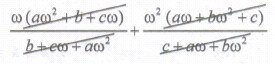
= ω + ω2 = -1 [ ∵ 1 + ω + ω2 = 0]
17.
\({ tan }^{ -1 }(\frac { 2 }{ 11 }) +{ tan }^{ -1 }(\frac { 7 }{ 24 }) ={ tan }^{ -1 }(\frac { 1 }{ 2 } )\)
\(LHS={ tan }^{ -1 }\left( \frac { 2 }{ 11 } \right) +{ tan }^{ -1 }\left( \frac { 7 }{ 24 } \right)\)
= \({ tan }^{ -1 }\left( \frac { \frac { 2 }{ 11 } +\frac { 7 }{ 24 } }{ 1-\left( \frac { 2 }{ 11 } \right) \left( \frac { 7 }{ 24 } \right) } \right)\) \(\left[ \because { tan }^{ -1 }(x)+{ tan }^{ -1 }y={ tan }^{ -1 }\left( \frac { x+y }{ 1-xy } \right) \right]\)
= \({ tan }^{ -1 }\left( \frac { \frac { 48+77 }{ 11\times 24 } }{ \frac { 264-14 }{ 264 } } \right) ={ tan }^{ -1 }\left( \frac { \frac { 125 }{ 264 } }{ \frac { 250 }{ 264 } } \right)\)
\(=\tan ^{-1}\left(\frac{125}{264} \times \frac{264}{250}\right)=\tan ^{-1}\left(\frac{1}{2}\right)\)
= RHS
Hence proved.
18.
Let A = \(\left[ \begin{matrix} 1 & 2 & 3 \\ 2 & 1 & 4 \\ 3 & 0 & 5 \end{matrix} \right] \). Applying elementary row operations, we get
A \(\overset { \begin{matrix} { R }_{ 2 }\longrightarrow { R }_{ 2 }-2{ R }_{ 1 } \\ { R }_{ 3 }\longrightarrow { R }_{ 3 }-3{ R }_{ 1 } \end{matrix} }{ \longrightarrow } \left[ \begin{matrix} 1 & 2 & 3 \\ 0 & -3 & -2 \\ 0 & -6 & -4 \end{matrix} \right] \overset { { R }_{ 3 }\longrightarrow { R }_{ 3 }-2{ R }_{ 2 } }{ \longrightarrow } \left[ \begin{matrix} 1 & 2 & 3 \\ 0 & -3 & -2 \\ 0 & 0 & 0 \end{matrix} \right] \).
The last equivalent matrix is in row-echelon form. It has two non-zero rows. So, ρ(A) = 2.
19.
Given that equation of the circle is
x2 + y2 = 16
⇒ a2 = 16
and equation of the tangent is
y = \( 2\sqrt { 2 } \)x + c
⇒ m = \( 2\sqrt { 2 } \) and c = c
[∵ y = mx + c is the tangent]
The condition for the line y = mx + c is a tangent to the circle x2 +y2 = a2 is
c2 = a2 (1 + m2)
⇒ c2 = 16(1 + \(\left( { \left( 2\sqrt { 2 } \right) }^{ 2 } \right) \)
⇒ c2 = 16(1 + 8)
⇒ c2 = 16(9)
⇒ c = ± 4(3)
⇒ ±12
20.
Given r = 5 cm

Since the circle touches the x axis, its centre is (0, ±5)
Equation of the circle is (x - h)2 + (y - k)2 = r2
⇒ (x - 0)2 + (y ± 5)2 = 25
\(\Rightarrow x^{2}+y^{2}+\not 25 \pm 10 y=\not 25\)
⇒ x2+y2+10y = 0
21.
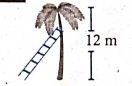
Given that the height of the tree is 12m.
Let x m be the standing part and (12 -x)m be the broken part.
Given \(x=\sqrt [ 3 ]{ 12-x } \)
\(\Rightarrow x=(12-x)^{ \frac { 1 }{ 3 } }\)
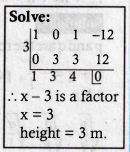
Taking power 3 both sides, we get
⇒ x3 = 12-x
⇒ x3+ x -12 = 0
which is the required mathematical problem.
22.
x8- 3x + 1 = 0
Here an = 1, ao = 1
If \(\frac{p}{q}\) is a root of the polynomial, then as
(p, q) = 1p is a factor of ao = 1 and q is a factor of an = 1
Since 1 has no factors, the given equation has no rational roots.
23.
Given \(\vec { a } =2\hat { i } +3\hat { j } -\hat { k } ,\vec { b } =3\hat { i } +5\hat { j } +2\hat { k } \) and \(\vec { c } =-\hat { i } -2\hat { j } +3\hat { k } \)
Consider \((\vec { a } \times \vec { b } )=\left| \begin{matrix} \hat { i } & \hat { j } & \hat { k } \\ 2 & 3 & -1 \\ 3 & 5 & 2 \end{matrix} \right| \)
= \(\hat { i } \left| \begin{matrix} 3 & -1 \\ 5 & 2 \end{matrix} \right| -\hat { j } \left| \begin{matrix} 2 & -1 \\ 3 & 2 \end{matrix} \right| +\hat { k } \left| \begin{matrix} 2 & 3 \\ 3 & 5 \end{matrix} \right| \)
= \(\\ \hat { i } (6+5)-\hat { j } (4+3)+\hat { k } (10-9)=11\hat { i } -7\hat { j } +\hat { k } \)
∴ LHS = \((\vec { a } \times \vec { b } )\times \vec { c } \)
= \(\left| \begin{matrix} \hat { i } & \hat { j } & \hat { k } \\ 2 & 3 & -1 \\ 3 & 5 & 2 \end{matrix} \right| =\hat { i } \left| \begin{matrix} -7 & 1 \\ -2 & 3 \end{matrix} \right| -\hat { j } \left| \begin{matrix} 11 & 1 \\ -1 & 3 \end{matrix} \right| +\hat { k } \left| \begin{matrix} 11 & -7 \\ -1 & -2 \end{matrix} \right| \)
= \(\hat { i } (-21+2)+\hat { j } (33+1)+\hat { k } (-22-7)\)
= \(-19\hat { i } -34\hat { j } -29\hat { k } \) ..............(1)
For RHS
\(\vec { a } .\vec { i } =(2\hat { i } +3\hat { j } -\hat { k } ).(-\hat { i } -2\hat { j } +3\hat { k } )\)
= -2-6-3 = -11
\(\vec { b } .\vec { c } =(3\hat { i } +5\hat { j } +2\hat { k } ).(-\hat { i } -2\hat { j } +3\hat { k } )\)
= -3-10+6 = -7
∴ RHS = \((\vec { a } .\vec { c } )\vec { b } -(\vec { b } .\vec { c } )\vec { a } \)
= \(-11(3\hat { i } +5\hat { j } +2\hat { k } )+7(2\hat { i } +3\hat { j } -\hat { k } )\)
= \(-33\hat { i } -55\hat { j } -22\hat { k } +14\hat { i } +21\hat { j } -7\hat { k } \)
= \(-19\hat { i } -34\hat { j } -29\hat { k } \) ............... (2)
From (1) & (2), LHS = RHS
Hence \((\vec { a } \times \vec { b } )\times \vec { c } =(\vec { a } .\vec { c } )\vec { b } -(\vec { b } .\vec { c } )\vec { a } \)
(ii) \(\vec { b } \times \vec { c } =\left| \begin{matrix} \hat { i } & \hat { j } & \hat { k } \\ 3 & 5 & 2 \\ -1 & -2 & 3 \end{matrix} \right| \)
= \(\hat { i } \left| \begin{matrix} 5 & 2 \\ -2 & 3 \end{matrix} \right| -\hat { j } \left| \begin{matrix} 3 & 2 \\ -1 & 3 \end{matrix} \right| +\hat { k } \left| \begin{matrix} 3 & 5 \\ -1 & -2 \end{matrix} \right| \)
= \(\hat { i } (15+4)-\hat { j } (9+2)+\hat { k } (-6+5)\)
= \(19\hat { i } -11\hat { j } -\hat { k } \)
∴ \(\vec { a } (\vec { b } \times \vec { c } )=\left| \begin{matrix} \hat { i } & \hat { j } & \hat { k } \\ 2 & 3 & -1 \\ 19 & -11 & -1 \end{matrix} \right| \)
= \(\hat { i } \left| \begin{matrix} 3 & -1 \\ -11 & -1 \end{matrix} \right| -\hat { j } \left| \begin{matrix} 2 & -1 \\ 19 & -1 \end{matrix} \right| +\hat { k } \left| \begin{matrix} 2 & 3 \\ 19 & -11 \end{matrix} \right| \)
= \(\hat { i } (-3-11)-\hat { j } (-2+19)+\hat { k } (-22-57)\)
= \(-14\hat { i } -17\hat { j } -79\hat { k } \) ............(1)
For RHS
\(\vec { a } .\vec { c } =-11\Rightarrow (\vec { a } .\vec { c } )\vec { b } =-11(3\hat { i } +5\hat { j } +2\hat { k } )\)
= -\(33\hat { i } -55\hat { j } -22\hat { k } \)
\(\vec { a } .\vec { b } =(2\hat { i } +3\hat { j } -\hat { k } ).(3\hat { i } +5\hat { j } +2\hat { k } )\)
= 6+15-2 = 19
\((\vec { a } .\vec { b } )\vec { c } =19(-\hat { i } -2\hat { j } +3\hat { k } )=-19\hat { i } -38\hat { j } +57\hat { k } \)
RHS = \((\vec { a } .\vec { c } )\vec { b } -(\vec { a } .\vec { b } )\vec { c } \)
= \(-33\hat { i } -55\hat { j } -22\hat { k } -(-19\hat { i } -38\hat { j } +57\hat { k } )\)
= \(-14\hat { i } -17\hat { j } -79\hat { k } \) ............(2)
From (1) & (2), LHS = RHS
∴ \(\vec { a } \times (\vec { b } \times \vec { c } )=(\vec { a } .\vec { c } )\vec { b } -(\vec { a } .\vec { b } )\vec { c } \)
24.
tan-1 \(\left( \frac { 1-x }{ 1+x } \right) =\frac { 1 }{ 2 } { tan }^{ -1 }\)x gives tan-1 1-tan-1 x = \(\frac{1}{2}\)tan-1x.
Therefore, \(\frac{\pi}{4}=\frac{3}{2}tan^{-1}\)x, which in turn reduces to tan−1 = \(\frac{\pi}{6}\)
Thus, x = tan\(\frac{\pi}{6}=\frac{1}{\sqrt3}\)
25.
Rearrange the terms as
(2x-1)(2x+ 3) (x + 3) (x - 2) + 20 = 0
⇒ (4x2 + 6x - 2x- 3)(x2 - 2x + 3x - 6) + 20 = 0
⇒ (4x2 + 4x - 3) (x2 + x - 6) + 20 = 0
put x2+ x = y
⇒ (4y - 3) (y - 6) + 20 = 0
⇒ 4y2 - 24y - 3y + 18 + 20 = 0
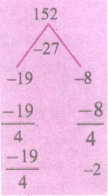
⇒ 4y2-27y +38 = 0
⇒ (y - 2)( 4y - 19) = 0
\(y=2,\frac { 19 }{ 4 } \)
Case (i)
When y = 2
x2+ x = 2
x2 + x - 2 = 0
⇒ (x + 2)(x - 1) = 0
⇒ x = -2, 1
Case (ii)
When \(y=\frac { 19 }{ 4 } ,{ x }^{ 2 }+x=\frac { 19 }{ 4 } \)
\(\Rightarrow { 4x }^{ 2 }+4x=19\)
\(\Rightarrow { 4x }^{ 2 }-4x-19=0\)
\(\Rightarrow x=\frac { -4\pm \sqrt { 16-4(4)(-19) } }{ 8 } \)
\(\Rightarrow x=\frac { -4\pm \sqrt { 16+304 } }{ 8 } \)
\(\Rightarrow x=\frac { -4\pm \sqrt { 320 } }{ 8 } \)
\(\Rightarrow x=\frac { 4\pm 8\sqrt { 5 } }{ 8 } \)
\(\Rightarrow x=\frac { -4(-1\pm 2\sqrt { 5 } ) }{ 8 } \)
\(\frac{-1 \pm 2 \sqrt{5}}{2}\)
Hence the roots are 1, -2, \(\frac{-1 \pm 2 \sqrt{5}}{2}\)

12th Standard Syllabus & Materials
12th Standard
TN 12th Computer Applications களப்பெயர் முறைமை (DNS) Sample Question Papers Study Material - QB365 Set A
NEW12th Standard
TN 12th Computer Applications வலையமைப்பு எடுத்துக்காட்டுகள் மற்றும் நெறிமுறைகள் Sample Question Papers Study Material - QB365 Set A
NEW12th Standard
TN 12th Computer Applications கணினி வலையமைப்பு ஓர் அறிமுகம் Sample Question Papers Study Material - QB365 Set A
NEW12th Standard
TN 12th Computer Applications PHP-உடன் MySQL-ஐ இணைத்தல் Sample Question Papers Study Material - QB365 Set A



Tamilnadu Stateboard 12th Standard Subjects
Maths

Chemistry

Physics

Biology

Computer Science

Business Maths and Statistics

Economics

Commerce

Accountancy

History

Computer Applications
Biology
Computer Technology
Computer Applications
Computer Science
Business Maths and Statistics
Commerce
Economics
Maths
Chemistry
Physics
Computer Technology
History
Accountancy

Tamil

English

French
Tamilnadu Stateboard Standards



