
 100% FREE ACCESS
12th Standard Syllabus & Materials
12th Standard
TN 12th Computer Applications மின்னணு தரவு பரிமாற்றம் Sample Question Papers Study Material - QB365 Set A
NEW12th Standard
TN 12th Computer Applications மின் - வணிக பாதுகாப்பு அமைப்புகள் Sample Question Papers Study Material - QB365 Set A
NEW12th Standard
TN 12th Computer Applications மின்னணு செலுத்தல் முறைகள் Sample Question Papers Study Material - QB365 Set A
NEW12th Standard
TN 12th Computer Applications மின் - வணிகம் Sample Question Papers Study Material - QB365 Set A
NEW12th Standard
TN 12th Computer Applications திறந்த மூல கருத்துருக்கள் Sample Question Papers Study Material - QB365 Set A
NEW12th Standard
TN 12th Computer Applications வலையமைப்பு வடமிடல் Sample Question Papers Study Material - QB365 Set A

Published on: 13/05/2022
QB365 provides detailed and simple solution for every book back questions in class 12 Maths subject.It will helps to get more idea about question pattern in every book back questions with solution.
latest Book back QuestionsDownload Tamil Nadu 12th Standard Maths question papers, model tests, one-mark questions, important questions, and public exam papers in PDF format. Free study materials and answer keys for TN State Board students.
Questions + Answers key
Take MCQ Maths Test1.
Evaluate \(\begin{matrix} lim \\ (x,y)\rightarrow (0,0) \end{matrix}cos=\left( \frac { { e }^{ x }siny }{ y } \right) \), if the limit exists.
2.
Show that \(\int ^\frac{2\pi}{0}_{0}\) g(cos x)dx = 2 \(\int ^{\pi}_{0}\) g(cosx)dx where g(cos x) is a function of cos x
3.
A particle is fired straight up from the ground to reach a height of s feet in t seconds, where s(t) = 128t −16t2.
(1) Compute the maximum height of the particle reached.
(2) What is the velocity when the particle hits the ground?
4.
Evaluate the following if z = 5−2i and w = −1+3i
z2 + 2zw + w2
5.
Show that \(\left( 2+i\sqrt { 3 } \right) ^{ 10 }-\left( 2-i\sqrt { 3 } \right) ^{ 10 }\) is purely imaginary
6.
Prove the following properties z is real if and only if z = \(\bar { z } \)
7.
If α and β are the roots of the quadratic equation 17x2+43x−73 = 0 , construct a quadratic equation whose roots are α + 2 and β + 2.
8.
Evaluate: \(\underset{x\rightarrow \infty}{lim}(\frac{e^{x}}{x^{m}}), m\in N\)
9.
If the mass m(x) (in kilograms) of a thin rod of length x (in metres) is given by, m(x) = \(\sqrt { 3 } x\) then what is the rate of change of mass with respect to the length when it is x = 3 and x = 27 metres.
10.
Find the adjoint of the following:
\(\left[ \begin{matrix} 2 & 3 & 1 \\ 3 & 4 & 1 \\ 3 & 7 & 2 \end{matrix} \right] \)
11.
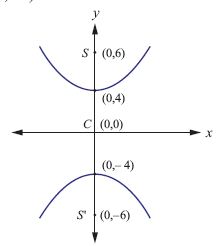
Find the equation of the hyperbola with vertices (0, ±4) and foci(0, ±6).
12.
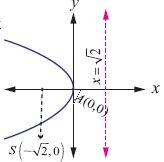
Find the equation of the parabola with focus \(\left( -\sqrt { 2 } ,0 \right) \) and directrix x =\(\sqrt { 2 } \).
13.
Find the domain of cos-1\((\frac{2+sinx}{3})\)
14.
If α, β, and γ are the roots of the polynomial equation ax3+ bx2+ cx + d = 0, find the value of \(\Sigma \frac { \alpha }{ \beta \gamma } \) in terms of the coefficients.
15.
A line 3x+4y+10 = 0 cuts a chord of length 6 units on a circle with centre of the circle (2,1). Find the equation of the circle in general form.
16.
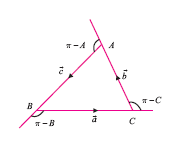
With usual notations, in any triangle ABC, prove the following by vector method.
(i) a2 = b2 + c2 − 2bc cos A
(ii) b2 = c2 + a2 − 2ca cos B
(iii) c2 = a2 + b2 − 2ab cos C
17.
Find the domain of sin−1(2−3x2)
18.
Find the inverse of the matrix \(\left[ \begin{matrix} 2 & -1 & 3 \\ -5 & 3 & 1 \\ -3 & 2 & 3 \end{matrix} \right] \).
19.
A right circular cylinder has radius r =10 cm. and height h = 20 cm. Suppose that the radius of the cylinder is increased from 10 cm to 10. 1 cm and the height does not change. Estimate the change in the volume of the cylinder. Also, calculate the relative error and percentage error.
20.
Does there exist a differentiable function f(x) such that f(0) = -1, f(2) = 4 and f'(x) ≤ 2 for all x. Justify you answer.
21.
\(\vec { a } =2\hat { i } +3\hat { j } -\hat { k } ,\vec { b } =-\hat { i } +2\hat { j } -4\hat { k } ,\vec { c } =\hat { i } +\hat { j } +\hat { k } \) then find the value of \((\vec { a } \times \vec { b } )\times (\vec { c } \times \vec { d } )\).
22.
23.
If G is the centroid of a ΔABC, prove that (area of ΔGAB) = (area of ΔGBC) = (area of ΔGCA) = \(\frac{1}{3}\) (area of ΔABC)
24.
If A = \(\left[ \begin{matrix} 0 & 1 & 1 \\ 1 & 0 & 1 \\ 1 & 1 & 0 \end{matrix} \right] \), show that A-1 = \(\frac {1}{2}\) (A2 - 3I).
25.
If the equations x2 + px + q = 0 and x2 + p'x + q' = 0 have a common root, show that it must be equal to \(\frac { pq'-p'q }{ q-q' } \) or \(\frac { q-q' }{ p'-p } \).
1.
\(\begin{matrix} lim \\ (x,y)\rightarrow (0,0) \end{matrix}cos=\left( \frac { { e }^{ x }siny }{ y } \right) \) = \(cos\left( { e }^{ 0 }\frac { siny }{ y } \right) \)
= cos[(1)(1)] = cos (1) \(\left[ \because \begin{matrix} lim \\ y\rightarrow 0 \end{matrix}\frac { siny }{ y } =1 \right] \)
2.
Take 2a = 2\(\pi\) and f(x) = g(cosx)
Then, f (2a−x) = f(2\(\pi\)-x) = g(cos(2\(\pi\)-x)) = g(cos x) = f(x)
\(\therefore \int _{ 0 }^{ 2a }{ f(x)dx=2 } \int _{ 0 }^{ a }{ f(x)dx } \)
\(\therefore \int _{ 0 }^{ 2\pi }{ g(cosx)dx=2\int _{ 0 }^{ \pi }{ g(cosx)dx } } \)
3.
(i) At the maximum height, the velocity v(t) of the particle is zero.
Now, we find the velocity of the particle at time t.
\(v(t)=\frac{ds}{dt}=128-32t\)
\(v(t)=0 \Rightarrow 128-32t=0 \Rightarrow t=4.\)
After 4 seconds, the particle reaches the maximum height.
The height at t = 4 is s(4) = 128(4) - 16(4)2 = 256 ft.
(ii) When the particle hits the ground then s = 0 .
s = 0 ⇒ 128t −16t2 = 0
⇒ t = 0, 8 seconds.
The particle hits the ground at t = 8 seconds. The velocity when it hits the ground v(8) = –128 ft /s.
4.
z2+ 2zw +w2
(5-2i)2+2(5-2i)(-1+3i)+(-1+3i)2
= 25 + 4i2- 20i + 2 [-5 + 15i + 2i - 6i2] + 1 + 9i2-6i [∴ i2 = -1]
= 25 - 4 - 20i + 2(-5 + 17i + 6) +1-9 -6i
= 21- 20i + 2(1+17i) -8 -6i
= 21- 20i + 2 + 34i -8 -6i
= 15 + 8i
5.
\(\overline { (2-i)^{ 12 }+(2+i)^{ 12 } } =\overline { (2-i)^{ 12 } } +\overline { (2+i)^{ 12 } } \)
\(\left( 2+i\sqrt { 3 } \right) ^{ 10 }-\left( 2-i\sqrt { 3 } \right) ^{ 10 }\)
Now \(\overline { z } \) = \(\overline { (2+\sqrt { 3 } )^{ 10 }-(2-i\sqrt { 3 } )^{ 10 } } \)
\(\overline { z } \) = \(\overline { (2+i\sqrt { 3 } )^{ 10 } } -(2-i\sqrt { 3 } )^{ 10 }\)
[∵ \(\overline { { z }_{ 1 }-{ z }_{ 2 } } =\overline { { z }_{ 1 } } -\overline { { z }_{ 2 } } \)]
= \((2-i\sqrt { 3 } )^{ 10 }-(2+i\sqrt { 3 } )^{ 10 }\)
= -\(\left[ (2-i\sqrt { 3 } )^{ 10 }-(2+i\sqrt { 3 } )^{ 10 } \right] \)
∴ \(\overline { z } \) = -\(\ { z } \) ⇒ z is purely imaginary
Hence \((2-i\sqrt { 3 } )^{ 10 }-(2+i\sqrt { 3 } )^{ 10 }\)is purely imaginary
6.
Prove the following properties
Z is real if and only if z =\(\bar { z } \)
Let z = x+iy
Then \(\bar { z } \) = x+iy
z = \(\bar { z } \)
⇔ x + iy = x-iy
⇔ x + iy - x + iy = 0
⇔ 2iy = 0
⇔ y = 0
[∴ 2 and i are constants]
when y = 0, z = x which is real
∴ z is purely ⇔ z = \(\bar { z } \)
7.
Since α and β are the roots of 17x2+ 43x −73 = 0 , we have α + β =\(\frac { -43 }{ 17 } \) and αβ =\(\frac { -73 }{ 17 } \).
We wish to construct a quadratic equation with roots α + 2 and β + 2. Thus, to construct such a quadratic equation, calculate
the sum of the roots = α + β + 4 = \(\frac { -4 }{ 17 } +4=\frac { 25 }{ 17 } \) and
the product of the roots = αβ + 2(α+β)+4 = \(\frac { -73 }{ 17 } +2\left( \frac { -43 }{ 17 } \right) +4=\frac { -91 }{ 17 } \)
Hence a quadratic equation with required roots is x2-\(\frac { 25 }{ 17 } x-\frac { 91 }{ 17 } \) = 0
Multiplying this equation by 17, gives 17x2−25x−91 = 0
which is also a quadratic equation having roots α + 2 and β + 2
8.
This is an indeterminate of the form \((\frac{\infty}{\infty})\)
To evaluate this limit, we apply l’Hôpital Rule m times
\(\underset{x\rightarrow \infty}{lim}\frac{e^{x}}{x^{m}}=\underset{x\rightarrow \infty}{lim}\frac{e^{x}}{m!} = \infty\)
9.
Given m (x) = \(\sqrt { 3 } x\) = \(\sqrt { 3 } .{ x }^{ \frac { 1 }{ 2 } }\)
Differentiating with respect to 'x' we get,
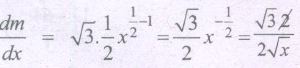
when x = 3, \(\frac { dm }{ dx } =\frac { \sqrt { 3 } }{ 2\sqrt { 3 } } =\frac { 1 }{ 2 } \) Kg/m
when x = 27, \(\frac { dm }{ dx } =\frac { \sqrt { 3 } }{ 2\sqrt { 27 } } \)
\(=\frac{\sqrt{\not 3}}{2(3) \sqrt{\not 3}}=\frac{1}{6} \mathrm{Kg} / \mathrm{m}\)
10.
\(\left[ \begin{matrix} 2 & 3 & 1 \\ 3 & 4 & 1 \\ 3 & 7 & 2 \end{matrix} \right] \)
Let A =\(\left( \begin{matrix} 2 & 3 & 1 \\ 3 & 4 & 1 \\ 3 & 7 & 2 \end{matrix} \right) \)
adj A =\(\left( \begin{matrix} +\left| \begin{matrix} 4 & 1 \\ 7 & 2 \end{matrix} \right| & -\left| \begin{matrix} 3 & 1 \\ 3 & 2 \end{matrix} \right| & +\left| \begin{matrix} 3 & 4 \\ 3 & 7 \end{matrix} \right| \\ -\left| \begin{matrix} 3 & 1 \\ 7 & 2 \end{matrix} \right| & +\left| \begin{matrix} 2 & 1 \\ 3 & 2 \end{matrix} \right| & -\left| \begin{matrix} 2 & 3 \\ 3 & 7 \end{matrix} \right| \\ +\left| \begin{matrix} 3 & 1 \\ 4 & 1 \end{matrix} \right| & -\left| \begin{matrix} 2 & 1 \\ 3 & 1 \end{matrix} \right| & +\left| \begin{matrix} 2 & 3 \\ 3 & 4 \end{matrix} \right| \end{matrix} \right) \)
=\(\left[ \begin{matrix} +(8-7)-(6-3)+(21-12) \\ -(6-7)+(4-3)-(14-9) \\ +(3-4)-(2-3)+(8-9) \end{matrix} \right] ^{ T }\)
=\(\left[ \begin{matrix} 1 & -3 & 9 \\ 1 & 1 & -5 \\ -1 & 1 & -1 \end{matrix} \right] ^{ T }\)
adj A =\(\left[ \begin{matrix} 1 & 1 & -1 \\ -3 & 1 & 1 \\ 9 & -5 & -1 \end{matrix} \right] \)
11.
From figure the midpoint of line joining foci is the centre C(0, 0).
Transverse axis is y-axis
AA′ = 2a \(\Rightarrow \) 2a = 8,
SS′ = 2c = 12, c = 6
a = 4
b2 = c2−a2 = 36−16 = 20
Hence the equation of the required hyperbola is \(\frac { { y }^{ 2 } }{ 16 }- \frac { { x }^{ 2 } }{ 20 } =1\)
12.
Parabola is open left and axis of symmetry as x-axis and vertex (0, 0)
Then the equation of the required parabola is
(y - 0)2 = -4\(\sqrt { 2 } \) (x - 0)
y2 = -4\(\sqrt { 2 } \) x
13.
By definition, the domain of yx = cos-1 x is -1. This leads to \(-1\le\frac{2+sinx}{3}\le1\) which is same as -3\(\le\)2+sinx\(\le\)3
so, -5\(\le sin\ x\le1 \) reduces to -1\(\le sin\ x\le1 \), which gives
-sin-1(1)\(\le x\le sin^-1(1) or -\frac{\pi}{2}\le x\le \frac{\pi}{2}\)
Thus, the domain of cos-1\((\frac{2+sin\ x}{3}) is [-\frac{\pi}{2},\frac{\pi}{2}].\)
14.
Given ∝, β and ૪ are the roots of ax3 + bx2 + cx + d = 0
\(\therefore \alpha +\beta +\gamma =\frac { -b }{ a } \)
\(\alpha \beta +\beta \gamma +\gamma \alpha =\frac { c }{ a } \)
\(\alpha \beta \gamma =\frac { -d }{ a } \)
Now, \(\sum { \frac { \alpha }{ \beta \gamma } } =\frac { \alpha }{ \beta \gamma } +\frac { \beta }{ \gamma \alpha } +\frac { \gamma }{ \alpha \beta } \)
\(=\frac { { \alpha }^{ 2 }+{ \beta }^{ 2 }+{ \gamma }^{ 2 } }{ \alpha \beta \gamma } \)
\(=\frac { { (\alpha +\beta +\gamma ) }^{ 2 }-2(\alpha \beta +\beta \gamma +\gamma \alpha ) }{ \alpha \beta \gamma } \)
\(=\frac { { \left( -\frac { b }{ a } \right) }^{ 2 }-2\left( \frac { c }{ a } \right) }{ -\frac { d }{ a } } \)
\(=\frac { \frac { { b }^{ 2 } }{ { a }^{ 2 } } -\frac { 2c }{ a } }{ -\frac { d }{ a } } \Rightarrow \frac { { b }^{ 2 }-2ac }{ { a }^{ 2 } } \times \frac { -a }{ d } \)
\(\therefore \frac { \sum { \alpha } }{ \beta \gamma } =-\frac { \left( { b }^{ 2 }-2ac \right) }{- ad } =\frac { 2ac-{ b }^{ 2 } }{ ad } \)
15.
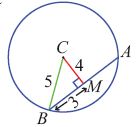
C(2, 1) is the centre and 3x + 4y + 10 = 0 cuts a chord AB on the circle. Let M be the midpoint of AB,
then AM = BM = 3. Now BMC is a right triangle.
So, we have CM = \(\frac { \left| 3\left( 2 \right) +4\left( 1 \right) +10 \right| }{ \sqrt { { 3 }^{ 2 }+{ 4 }^{ 2 } } } =4\)
By Pythagoras theorem BC2 = BM2 + MC2 = 32 + 42 = 25
BC = 5 = radius
Equation of the required circle is
(x−2)2+(y−1) = 52
x2+y2−4x−2y−20 = 0 .
16.
With usual notations in triangle ABC, we have \(\vec { BC } =\vec { a } ,\vec { CA } =\vec { b } \) \(\vec { AB } =\vec { c } \).
Then \(\left| \vec { BC } \right| =a\) , \(\left| \vec { CA } \right| =b\), \(\left| \vec { AB} \right| =c\), and \(\vec { BC } +\vec { CA } +\vec { AB } =\vec { 0 } \)
So, \(\vec { BC } =-\vec { CA } -\vec { AB } \)
Then applying dot product, we get
\(\vec { BC } .\vec { BC } =(-\vec { CA } -\vec { AB } ).(-\vec { CA } -\vec { AB } )\)
⇒ \({ \left| \vec { BC } \right| }^{ 2 }={ \left| \vec { CA } \right| }^{ 2 }+{ \left| \vec { AB } \right| }^{ 2 }+\vec { 2CA } .\vec { AB } \)
⇒ a2 = b2+c2+2bc cos (\(\pi\) - A)
⇒ a2 = b2+c2−2bc cos A.
The results (ii) and (iii) are proved in a similar way.
17.
We know that the domain of sin−1(x) is [-1, 1].
This leads to −1\(\le\)2 - 3x2\(\le\)1, Which implies -3\(\le\) -3x2\(\le\)-1
Now, -3\(\le\) -3x2, gives x2\(\le\)1 and ............(1)
-3\(\le\)-3x2\(\le\)-1, gives x2\(\ge\)\(\frac{1}{2}\) .........(2)
Combining the equations (1) and (2), we get \(\frac{1}{3}\le x^2\le 1\). That is \(\frac{1}{\sqrt3}\le |x|\le1\), Which gives \(x\in[-1,-1\frac{1}{\sqrt3}]\cup[\frac{1}{\sqrt3},1]\)
since a\(\le|x|\le b\) implies x \(\in[-b,-a]\cup[a,b]\).
18.
Let A = \(\left[ \begin{matrix} 2 & -1 & 3 \\ -5 & 3 & 1 \\ -3 & 2 & 3 \end{matrix} \right] \). Then |A| = \(\left| \begin{matrix} 2 & -1 & 3 \\ -5 & 3 & 1 \\ -3 & 2 & 3 \end{matrix} \right| \) = 2(7) + (-12) + 3(-1) = -1 ≠ 0.
Therefore, A−1 exists. Now, we get
adj A = \({ \left[ \begin{matrix} +\left| \begin{matrix} 3 & 1 \\ 2 & 3 \end{matrix} \right| & -\left| \begin{matrix} -5 & 1 \\ -3 & 3 \end{matrix} \right| & +\left| \begin{matrix} -5 & 3 \\ -3 & 2 \end{matrix} \right| \\ -\left| \begin{matrix} -1 & 3 \\ 2 & 3 \end{matrix} \right| & +\left| \begin{matrix} 2 & 3 \\ -3 & 3 \end{matrix} \right| & -\left| \begin{matrix} 2 & -1 \\ -3 & 2 \end{matrix} \right| \\ +\left| \begin{matrix} -1 & 3 \\ 3 & 1 \end{matrix} \right| & -\left| \begin{matrix} 2 & 3 \\ -5 & 1 \end{matrix} \right| & +\left| \begin{matrix} 2 & -1 \\ -5 & 3 \end{matrix} \right| \end{matrix} \right] }^{ T }={ \left[ \begin{matrix} 7 & 12 & -1 \\ 9 & 15 & -1 \\ -10 & -17 & 1 \end{matrix} \right] }^{ T }=\left[ \begin{matrix} 7 & 9 & -10 \\ 12 & 15 & -17 \\ -1 & -1 & 1 \end{matrix} \right] \).
Hence, A-1 = \(\frac { 1 }{ \left| A \right| } \)(adj A) = \(\frac { 1 }{ \left( -1 \right) } \left[ \begin{matrix} 7 & 9 & -10 \\ 12 & 15 & -17 \\ -1 & -1 & 1 \end{matrix} \right] =\left[ \begin{matrix} -7 & -9 & 10 \\ -12 & -15 & 17 \\ 1 & 1 & -1 \end{matrix} \right] \).
19.
Recall that volume of a right circular cylinder is given by V = \(\pi \)r2h where r is the radius and h is the height. So we have V (r) = \(\pi \)r2h = 20\(\pi \)r2
V (10.1) −V (10)≈ \(\frac { dV }{ dr } { { | }_{ r=10 } }\) (10.1 10) = 20\(\pi \)2(10(0.1))
Thus the estimate for the change in the volume is 40 \(\pi \) cm3
Exact calculation of the volume change gives
V (10.1) −V (10) = 2040.2\(\pi \) -2000\(\pi \) = 40.2\(\pi \) cm3.
So relative error = \(\frac { 40.2\pi -40\pi }{ 40.2\pi } \) = \(\frac { 1 }{ 201 } \) = 0.00497 and hence
the percentage error = relative error x 100 = \(\frac { 1 }{ 201 } \)x100 = 0.497%
20.
Given f(0) = -1, f(2) = 4
∴ f(x) is a continuous function in [0,2]
By Lagrange's mean value theorem,
f'(x) = \(\frac { f(b)-f(a) }{ b-a } \) = \(\frac{f(2)-f(0)}{2-0}\)
= \(\frac{4-(-1)}{2}\) = \(\frac{5}{2}\) = 2.5
= 2.5 ∉ [0, 2]
Since f'(x) cannot be 2.5 at any point in [0, 2], there does not exist a differentiable function f(x).
21.
Given \(\vec { a } =2\hat { i } +3\hat { j } -\hat { k } ,\vec { b } =-\hat { i } +2\hat { j } -4\hat { k } ,\vec { c } =\hat { i } +\hat { j } +\hat { k } \)
\(\vec { a } \times \vec { b } =\left| \begin{matrix} \hat { i } & \hat { j } & \hat { k } \\ 2 & 3 & -1 \\ -1 & 2 & -4 \end{matrix} \right| \)
= \(\hat { i } \left| \begin{matrix} 3 & -1 \\ 2 & -4 \end{matrix} \right| -\hat { j } \left| \begin{matrix} 2 & -1 \\ -1 & -4 \end{matrix} \right| +\hat { k } \left| \begin{matrix} 2 & 3 \\ -1 & 2 \end{matrix} \right| \)
= \(\hat { i } (-12+2)-\hat { j } (-8-1)+\hat { k } (4+3)\)
= \(-10\hat { i } +9\hat { j } +7\hat { k } \)
\(\vec { a } \times \vec { c } =\left| \begin{matrix} \hat { i } & \hat { j } & \hat { k } \\ 2 & 3 & -1 \\ 1 & 1 & 1 \end{matrix} \right| =\hat { i } \left| \begin{matrix} 3 & -1 \\ 1 & 1 \end{matrix} \right| -\hat { j } \left| \begin{matrix} 2 & -1 \\ 1 & 1 \end{matrix} \right| +\hat { k } \left| \begin{matrix} 2 & 3 \\ 1 & 1 \end{matrix} \right| \)
= \(\hat { i } (3+1)-\hat { j } (2+1)+\hat { k } (2-3)\)
= \(4\hat { i } -3\hat { j } -\hat { k } \)
∴ \((\vec { a } \times \vec { b } ).(\vec { a } \times \vec { c } )=(-10\hat { i } +9\hat { j } +7\hat { k } ).(4\hat { i } -3\hat { j } -\hat { k } )\)
= -40-27-7 = -74
22.
23.
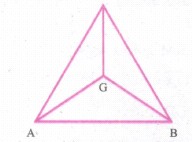
Let the position vector of the vertices of ΔABC be \(\vec { a } \), \(\vec { b } \) and \(\vec { c } \) respectively.
Since G is the centroid of ΔABC, \(\vec { OG } =\frac { \vec { a } +\vec { b } +\vec { c } }{ 3 } \)
Are of ΔGAB, = \(|\vec { AB } \times \vec { AG } |=|(\vec { OB } -\vec { OA } )\times (\vec { OG } -\vec { OA } )|\)
= \(\left| (\vec { b } -\vec { a } )\times \left( \frac { \vec { a } +\vec { b } +\vec { c } }{ 3 } -\vec { a } \right) \right| \)
= \(\left| (\vec { b } -\vec { a } )\times \left( \frac { \vec { a } +\vec { b } +\vec { c } -3\vec { a } }{ 3 } \right) \right| \)
= \(\left| (\vec { b } -\vec { a } )\times \left( \frac { \vec { b } +\vec { c } +2\vec { a } }{ 3 } \right) \right| \)
= \(\frac { 1 }{ 3 } |(\vec { b } -\vec { a } )\times (\vec { a } +\vec { 0 } -2\vec { a } )|\)
= \(\frac { 1 }{ 3 } |\vec { b } \times \vec { b } +\vec { b } \times \vec { c } -2\vec { b } \times \vec { a } -\vec { a } \times \vec { b } -\vec { a } \times \vec { c } +2\vec { a } \times \vec { a } |\)
[∵ cross product is distributive]
= \(\frac { 1 }{ 3 } |\vec { b } \times \vec { c } +2\vec { a } \times \vec { b } -\vec { a } \times \vec { b } +\vec { c } \times \vec { a } |\)
= \(\frac { 1 }{ 3 } |\vec { a } \times \vec { b } +\vec { b } \times \vec { c } +\vec { c } \times \vec { a } |\) \( [\because \vec { b } \times \vec { b } =\vec { 0 } ,\vec { a } \times \vec { a } =\vec { 0 } ,.(1)\vec { a } \times \vec { b } =-\vec { b } \times \vec { a } ]\)
Area of ΔGAC = \(|\vec { CA } \times \vec { AG } |\)
= \(|(\vec { OA } -\vec { OC } )\times (\vec { OG } -\vec { OA } )|\)
\(\left| (\vec { a } -\vec { c } )\times \left( \frac { \vec { a } +\vec { b } +\vec { c } }{ 3 } -\vec { a } \right) \right| \)
= \(\left| (\vec { c } -\vec { a } )\times \left( \frac { \vec { a } +\vec { b } +\vec { c } -3\vec { a } }{ 3 } \right) \right| \)
= \(\frac { 1 }{ 3 } |(\vec { a } -\vec { c } )\times (\vec { b } +\vec { c } -2\vec { a } )|\)
= \(\frac { 1 }{ 3 } |\vec { a } \times \vec { b } +\vec { a } \times \vec { c } -2\vec { a } \times \vec { a } -\vec { c } \times \vec { b } -\vec { c } \times \vec { c } +2\vec { c } \times \vec { a } |\)
= \(\frac { 1 }{ 3 } |\vec { a } \times \vec { b } -\vec { c } \times \vec { a } +\vec { b } \times \vec { c } +2\vec { c } \times \vec { a } |\)
= \(\frac { 1 }{ 3 } |\vec { a } \times \vec { b } +\vec { b } \times \vec { c } +\vec { c } \times \vec { a } |\)
Also area of ΔGBC = \(|\vec { BC } \times \vec { BG } |\)
= \(|\vec { OC } -\vec { OB } )\times (\vec { OG } -\vec { OB } )|\)
= \(\left| (\vec { c } -\vec { a } )\times \left( \frac { \vec { a } +\vec { b } +\vec { c } -\vec { b } }{ 3 } \right) \right| \)
= \(\left| (\vec { c } -\vec { a } )\times \left( \frac { \vec { a } +\vec { b } -2\vec { a } }{ 3 } \right) \right| \)
\(\frac { 1 }{ 3 } |(\vec { c } -\vec { b } )\times (\vec { a } +\vec { c } -2\vec { b } )|\)
= \(\frac { 1 }{ 3 } |\vec { c } \times \vec { a } +\vec { c } \times \vec { c } -2\vec { c } \times \vec { b } -\vec { b } \times \vec { a } -\vec { b } \times \vec { c } +2\vec { b } \times \vec { b } |\)
= \(\frac { 1 }{ 3 } |\vec { c } \times \vec { a } +2\vec { b } \times \vec { c } +\vec { a } \times \vec { b } -\vec { b } \times \vec { c } |\)
\(\frac { 1 }{ 3 } |\vec { c } \times \vec { a } +\vec { b } \times \vec { c } +\vec { a } \times \vec { b } |\)
From (1), (2) and (3),
Area of ΔGAB = Area of ΔGAC = Area of ΔGBC
= \(\frac { 1 }{ 3 } |\vec { a } \times \vec { b } +\vec { b } \times \vec { c } +\vec { c } \times \vec { a } |\)
= \(\frac { 1 }{ 3 } \) Area of ΔABC.
24.
Given A =\(\left[ \begin{matrix} 0 & 1 & 1 \\ 1 & 0 & 1 \\ 1 & 1 & 0 \end{matrix} \right] \)
|A| = 0-1\(\left| \begin{matrix} 1 & 1 \\ 1 & 0 \end{matrix} \right| +1\left| \begin{matrix} 1 & 0 \\ 1 & 1 \end{matrix} \right| \)
= -1(0-1) + 1(1-0) = 1 + 1 = 2
adj A =\(\left[ \begin{matrix} +\left| \begin{matrix} 0 & 1 \\ 1 & 0 \end{matrix} \right| & -\left| \begin{matrix} 1 & 1 \\ 1 & 0 \end{matrix} \right| & +\left| \begin{matrix} 1 & 0 \\ 1 & 1 \end{matrix} \right| \\ -\left| \begin{matrix} 1 & 1 \\ 1 & 0 \end{matrix} \right| & +\left| \begin{matrix} 0 & 1 \\ 1 & 0 \end{matrix} \right| & -\left| \begin{matrix} 0 & 1 \\ 1 & 1 \end{matrix} \right| \\ +\left| \begin{matrix} 1 & 1 \\ 0 & 1 \end{matrix} \right| & -\left| \begin{matrix} 0 & 1 \\ 1 & 1 \end{matrix} \right| & +\left| \begin{matrix} 0 & 1 \\ 1 & 0 \end{matrix} \right| \end{matrix} \right] ^{ T }\)
=\(\left[ \begin{matrix} (0-1) & -(0-1) & +(1-0) \\ -(0-1) & +(0-1) & -(0-1) \\ +(1+0) & -(0-1) & +(0-1) \end{matrix} \right] ^{ T }\)
=\(\left[ \begin{matrix} -1 & 1 & 1 \\ 1 & -1 & 1 \\ 1 & 1 & -1 \end{matrix} \right] ^{ T }=\left[ \begin{matrix} -1 & 1 & 1 \\ 1 & -1 & 1 \\ 1 & 1 & -1 \end{matrix} \right] \)
∴ A-1 = \(\frac { 1 }{ 2 } \left[ \begin{matrix} -1 & 1 & 1 \\ 1 & -1 & 1 \\ 1 & 1 & -1 \end{matrix} \right] \) ................(1)
Now A2 =\(\left[ \begin{matrix} 0 & 1 & 1 \\ 1 & 0 & 1 \\ 1 & 1 & 0 \end{matrix} \right] \left[ \begin{matrix} 0 & 1 & 1 \\ 1 & 0 & 1 \\ 1 & 1 & 0 \end{matrix} \right] \)
=\(\left[ \begin{matrix} 0+1+1 & 0+0+1 & 0+1+0 \\ 0+0+1 & 1+0+1 & 1+0+0 \\ 0+1+0 & 1+0+0 & 1+1+0 \end{matrix} \right] =\left[ \begin{matrix} 2 & 1 & 1 \\ 1 & 2 & 1 \\ 1 & 1 & 2 \end{matrix} \right] \)
A2- 3I =\(\left[ \begin{matrix} 2 & 1 & 1 \\ 1 & 2 & 1 \\ 1 & 1 & 2 \end{matrix} \right] -3\left[ \begin{matrix} 1 & 0 & 0 \\ 0 & 1 & 0 \\ 0 & 0 & 1 \end{matrix} \right] \)
=\(\left[ \begin{matrix} 2-3 & 1-0 & 1-0 \\ 1-0 & 2-3 & 1-0 \\ 1-0 & 1-0 & 2-3 \end{matrix} \right] =\left[ \begin{matrix} -1 & 1 & 1 \\ 1 & -1 & 1 \\ 1 & 1 & -1 \end{matrix} \right] \) .............(2)
From (1) and (2), it is proved that A-1 = \(\frac{1}{2}\) [A2 - 3I]
25.
Given equation are \({ x }^{ 2 }px+q=0\) ............(1)
and \({ x }^{ 2 }+p'x+q'=0\) ..........(2)
Let ∝ be the common root for (1) and (2)
∴ ∝2 + p∝ + q = 0 .........(3)
and ∝2+ p'∝ + q' = 0 .............(4)
Solving (3) and (4) by cross multiplication method we get
p q 1 p
p' q' 1 p'
\(\Rightarrow \frac { { \alpha }^{ 2 } }{ pq'-p'q } =\frac { \alpha }{ q-q' } =\frac { 1 }{ p'-p } \)
consider \(\frac { { \alpha }^{ 2 } }{ pq'-p'q } =\frac { \alpha }{ q-q' } \)
\(\Rightarrow \frac { { \alpha }^{ 2 } }{ \alpha } =\frac { pq'-p'q }{ q-q' } \)
\(\alpha =\frac { pq'-p'q }{ q-q } \)
Consider \(\frac { \alpha }{ q-q' } =\frac { 1 }{ p'-p } \Rightarrow \alpha =\frac { q-q' }{ p'-p } \)
Hence its roots are \(\frac { pq'-p'q }{ q-q' } or\quad \frac { q-q' }{ p'-p } \)

12th Standard Syllabus & Materials
12th Standard
TN 12th Computer Applications களப்பெயர் முறைமை (DNS) Sample Question Papers Study Material - QB365 Set A
NEW12th Standard
TN 12th Computer Applications வலையமைப்பு எடுத்துக்காட்டுகள் மற்றும் நெறிமுறைகள் Sample Question Papers Study Material - QB365 Set A
NEW12th Standard
TN 12th Computer Applications கணினி வலையமைப்பு ஓர் அறிமுகம் Sample Question Papers Study Material - QB365 Set A
NEW12th Standard
TN 12th Computer Applications PHP-உடன் MySQL-ஐ இணைத்தல் Sample Question Papers Study Material - QB365 Set A



Tamilnadu Stateboard 12th Standard Subjects
Maths

Chemistry

Physics

Biology

Computer Science

Business Maths and Statistics

Economics

Commerce

Accountancy

History

Computer Applications
Biology
Computer Technology
Computer Applications
Computer Science
Business Maths and Statistics
Commerce
Economics
Maths
Chemistry
Physics
Computer Technology
History
Accountancy

Tamil

English

French
Tamilnadu Stateboard Standards



