
 100% FREE ACCESS
12th Standard Syllabus & Materials
12th Standard
TN 12th Maths Applications of Matrices and Determinants Sample Question Papers Study Material - QB365 Set A
NEW12th Standard
TN 12th Computer Applications மின்னணு தரவு பரிமாற்றம் Sample Question Papers Study Material - QB365 Set A
NEW12th Standard
TN 12th Computer Applications மின் - வணிக பாதுகாப்பு அமைப்புகள் Sample Question Papers Study Material - QB365 Set A
NEW12th Standard
TN 12th Computer Applications மின்னணு செலுத்தல் முறைகள் Sample Question Papers Study Material - QB365 Set A
NEW12th Standard
TN 12th Computer Applications மின் - வணிகம் Sample Question Papers Study Material - QB365 Set A
NEW12th Standard
TN 12th Computer Applications திறந்த மூல கருத்துருக்கள் Sample Question Papers Study Material - QB365 Set A

Published on: 13/05/2022
QB365 provides detailed and simple solution for every book back questions in class 12 Maths subject.It will helps to get more idea about question pattern in every book back questions with solution.
latest Book back QuestionsDownload Tamil Nadu 12th Standard Maths question papers, model tests, one-mark questions, important questions, and public exam papers in PDF format. Free study materials and answer keys for TN State Board students.
Questions + Answers key
Take MCQ Maths Test1.
Show that ¬(p↔️q) ≡ p↔️¬q
2.
Verify the
(i) closure property,
(ii) commutative property,
(iii) associative property
(iv) existence of identity and
(v) existence of inverse for the arithmetic operation - on Z.
3.
Find the mean and variance of a random variable X , whose probability density function is \(f(x)=\begin{cases} \begin{matrix} { \lambda e }^{ -2x } & for\ge 0 \end{matrix} \\ \begin{matrix} 0 & otherwise \end{matrix} \end{cases}\)
4.
Evaluate: \(\int _{ 0 }^{ \frac { \pi }{ 2 } }{ \frac { cos\theta }{ (1+sin\theta )(2+sin\theta ) } } d\theta \)
5.
The engine of a motor boat moving at 10 m/s is shut off. Given that the retardation at any subsequent time (after shutting off the engine) equal to the velocity at that time. Find the velocity after 2 seconds of switching off the engine.
6.
Solve the Linear differential equation:
\(x\frac { dy }{ dx } +2y-x^2logx=0\)
7.
Solve the Linear differential equation:
\(x\frac { dy }{ dx } +y=xlogx\)
8.
Solve the following differential equations:
\(\frac { dy }{ dx } -x\sqrt { 25-{ x }^{ 2 } } =0\)
9.
Solve the equations
x4+ 3x3- 3x - 1 = 0
10.
Prove that q ➝ p ≡ ¬p ➝ ¬q
11.
Two fair coins are tossed simultaneously (equivalent to a fair coin is tossed twice). Find the probability mass function for number of heads occurred.
12.
Two balls are chosen randomly from an urn containing 6 white and 4 black balls. Suppose that we win Rs. 30 for each black ball selected and we lose Rs. 20 for each white ball selected. If X denotes the winning amount, then find the values of X and number of points in its inverse images.
13.
Suppose a pair of unbiased dice is rolled once. If X denotes the total score of two dice, write down
(i) the sample space
(ii) the values taken by the random variable X,
(iii) the inverse image of 10, and
(iv) the number of elements in inverse image of X.
14.
Evaluate \(\int _{ 0 }^{ x }{ { x }^{ 2 } } \)cos nx dx, where n is a positive integer.
15.
Evaluate :\(\int _{ 0 }^{ 1 }{ \frac { 2x+7 }{ { 5x }^{ 2 }+9 } } dx\)
16.
Solve the following differential equations:
\(sin\frac { dy }{ dx } =a,y(0)=1\)
17.
Find the differential equation of the family of parabolas with vertex at (0, −1) and having axis along the y-axis.
18.
Let \(A=\left( \begin{matrix} 1 & 0 \\ 0 & 1 \\ 1 & 0 \end{matrix}\begin{matrix} 1 & 0 \\ 0 & 1 \\ 0 & 1 \end{matrix} \right) ,B=\left( \begin{matrix} 0 & 1 \\ 1 & 0 \\ 1 & 0 \end{matrix}\begin{matrix} 0 & 1 \\ 1 & 0 \\ 0 & 1 \end{matrix} \right) ,C=\left( \begin{matrix} 1 & 1 \\ 0 & 1 \\ 1 & 1 \end{matrix}\begin{matrix} 0 & 1 \\ 1 & 0 \\ 1 & 1 \end{matrix} \right) \)be any three boolean matrices of the same type.
Find (A∨B)∧C
19.
How many rows are needed for following statement formulae?
\(p \vee \neg t \wedge(p \vee \neg s)\)
20.
The probability that a certain kind of component will survive a electrical test is \(\frac { 3 }{ 4 } \). Find the probability that exactly 3 of the 5 components tested survive.
21.
For the random variable X with the given probability mass function as below, find the mean and variance
\(f(x)= \begin{cases}2(x-1) & 1<x<2 \\ 0 & \text { otherwise }\end{cases}\)\(\)
22.
Show that \(\int _{ 0 }^{ \pi }{ g(sinx)dx=2 } \int _{ 0 }^{ \frac { \pi }{ 2 } }{ g(sinx)dx, } \) where g(sin x) is a function of sin x.
23.
The probability density function of X is \(f(x)= \begin{cases}x & 0<x<1 \\ 2-x & 1 \leq x<2 \\ 0 & \text { otherwise }\end{cases}\) find P(0.2 ≤ X< 0.6)
24.
Solve \(\frac { dy }{ dx } +2y={ e }^{ -x }\)
25.
Find the differential equation of the curve represented by xy = aex + be−x + x2.
1.
| p | q | p↔️q | ~(p↔️q) | ~q | p↔️~q |
| T | T | T | F | F | F |
| T | F | F | T | T | T |
| F | T | F | T | F | T |
| F | F | T | F | T | F |
The entries in column (4) and (6) are identical ~(p↔️q) ≡ p↔️~q
2.
i) Though - is not binary on N; it is binary on Z. To check the validity of any more properties satisfied by – on Z, it is better to check them for some particular simple values.
ii) Take m = 4 , n = 5 and (m− n) = (4 − 5) = −1and (n −m) = (5 − 4) = 1.
Hence (m− n) ≠ (n −m). So the operation - is not commutative on Z.
iii) In order to check the associative property, let us put m = 4, n = 5 and p = 7 in both (m- n) - p and m- (n - p).
(m−n)− p = (4−5)−7 = (−1−7) = −8 …(1)
m−(n− p) = 4−(5−7) = (4+2) = 6 …(2)
From (1) and (2), it follows that (m - n) - p m - (n - p).
Hence – is not associative on Z.
iv) Identity does not exist (why?).
v) Inverse does not exist (why?).
3.
Observe that the given distribution is continuous
By definition \(\mu =E(X)=\int _{ -\infty }^{ \infty }{ xf(x) } dx\) (We can also use integration by parts or Bernoulli’s formula)
= \(\int _{ -\infty }^{ 0 }{ 0\left( \lambda { e }^{ -2x } \right) dx } +\int _{ 0 }^{ \infty }{ x\left( { \lambda e }^{ -\lambda x } \right) } dx\)
= \(0+\lambda \int _{ 0 }^{ \infty }{ x\left( { e }^{ -\lambda x } \right) dx } \)
= \(0+\lambda \left( \frac { 1 }{ { \lambda }^{ 2 } } \right) \) (using Gamma integral for positive integer n,\(\int _{ 0 }^{ \infty }{ { x }^{ n } } { e }^{ -ax }dx=\cfrac { n }{ { a }^{ n+1 } } \))
= \(\frac { 1 }{ \lambda } \)
Variance :
By definition,\(E\left( { X }^{ 2 } \right) =\int _{ -\infty }^{ \infty }{ { x }^{ 2 }f(x) } dx\) (We can also use integration by parts or Bernoulli’s formula)
= \(\int _{ -\infty }^{ 0 }{ 0\left( \lambda { e }^{ -\lambda x } \right) } dx+\int _{ 0 }^{ \infty }{ { x }^{ 2 }\left( \lambda { e }^{ -2x } \right) } dx\)
= \(0+\lambda \int _{ 0 }^{ \infty }{ { x }^{ 2 }\left( { e }^{ -2x } \right) dx } \)
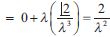 (using Gamma integral for positive integer)
Therefore Var(X ) = E(X2 )- E(X )2
= \(\frac { 2 }{ { \lambda }^{ 2 } } -\left( \frac { 1 }{ \lambda } \right) ^{ 2 }=\frac { 1 }{ { \lambda }^{ 2 } } \)
Hence the mean and variance are respectively \(\frac { 1 }{ \lambda } \) and \(\frac { 1 }{ { \lambda }^{ 2 } } \)
4.
Let I = \(\int _{ 0 }^{ \frac { \pi }{ 2 } }{ \frac { cos\theta }{ (1+sin\theta )(2+sin\theta ) } } d\theta \)
Put u = 1 + sin\(\theta\)
Then, du = cos\(\theta\) d\(\theta\)
When \(\theta\) = 0, u = 1
When \(\theta =\frac{\pi}{2}, u=2\)
\(\therefore I=\int _{ 1 }^{ 2 }{ \frac { du }{ u(1+u) } } =\int _{ 1 }^{ 2 }{ \frac { (1+u)-u }{ u(1+u) } du } =\int _{ 1 }^{ 2 }{ \left( \frac { 1 }{ u } -\frac { 1 }{ 1+u } \right) du=[logu-log(1+u)]_{ 1 }^{ 2 } } \)
\(=(log2-log3)-(log1-log2)=2log2-log3=log\frac { 4 }{ 3 } .\)
5.
Let V be the velocity and the retardation (negative acceleration) be -\(\frac{dv}{dt}\)
Given \(\frac{dv}{dt}\) = -V
Separating the variables,
\(\frac{dv}{v}=-dt\)
\(\Rightarrow \int { \frac { dv }{ v } } =-\int { dt } \)
\(\Rightarrow log\quad v=-t+logC\)
\(\Rightarrow logv-logC=-t\)
\(\Rightarrow log\left( \frac { v }{ { C }_{ v } } \right) =-t\)
\(\Rightarrow ={ e }^{ -t }\)
\(\Rightarrow \frac { v }{ { C }_{ v } } ={ Ce }^{ -t }...(1)\)
Given when t = 0, v = m/sec
\(\therefore\) (1) become 10 = Ce0 \(\Rightarrow\) C = 10
\(\therefore\) (1) v = 10e-t
When t = 2, v = 10e-2
\(\Rightarrow v=\frac { 10 }{ { e }^{ 2 } } \)
6.
\(x\frac { dy }{ dx } +2y=x^2logx\)
Dividing by x we get,
\(\frac { dy }{ dx } +\frac { 2 }{ x } y=xlogx\)
This is a linear differential equation
\(\therefore P=\frac { 2 }{ x } ;Q=logx\)
\(\int { pdx } =\int { \frac { 2 }{ x } } dx=2logx=logx^2\)
\(\therefore I.F={ e }^{ \int { pdx } }={ e }^{ log\ x ^2}=x ^2\)
\(\therefore\) The solution is \({ e }^{ \int { u\ dv} }=uv-\int { vdu}\)
\(u=log\ x;dv=x^3\)
\(du=\frac { 1 }{ x }dx;v=\frac { { x }^{ 4} }{ 4} \)
\({ ye }^{ \int { pdx } }=\int { Q{ e }^{ \int { pdx } }dx+c } \)
\(\Rightarrow { yx }^{ 2 }=\int { xlogx.({ x }^{ 2 })dx } \)
\(\Rightarrow { x }^{ 2 }y=\int { { x }^{ 3 } } log\quad xdx\)
\(\Rightarrow { x }^{ 2 }y=\frac { { x }^{ 4 } }{ 4 } logx-\int { \frac { { x }^{ 4 } }{ 4 } .\frac { 1 }{ x } } dx\)
\(\Rightarrow { x }^{ 2 }y=\frac { { x }^{ 4 } }{ 4 } logx-\frac { 1 }{ 4 } \int { { x }^{ 3 }dx } \)
\(\Rightarrow { x }^{ 2 }y=\frac { { x }^{ 4 } }{ 4 } logx-\frac { { x }^{ 4 } }{ 16 } +c\)
7.
Dividing by x we get,
\(\frac { dy }{ dx } +\frac { 1 }{ x } y=xlogx\)
This is a linear differential equation
\(\therefore P=\frac { 1 }{ x } ;Q=logx\)
\(\int { pdx } =\int { \frac { 1 }{ x } } dx=logx\)
\(I.F={ e }^{ \int { pdx } }={ e }^{ log\quad x }=x\)
\(\therefore\) The solution is \({ e }^{ \int { pdx } }=\int { Q{ e }^{ \int { pdx } }=dx+c } \)
\(u=cos\quad x;dv=x\)
\(du=\frac { 1 }{ x } ,v=\frac { { x }^{ 2 } }{ x } \)
\(\int { udv } =uv-\int { vdu } \)
\(yx=\int { xlogxdx+c } \)
\(\Rightarrow xy=\frac { { x }^{ 2 } }{ x } logx-\int { \frac { { x }^{ 2 } }{ 2 } } .\frac { 1 }{ x } dx\)
\(\Rightarrow xy=\frac { { x }^{ 2 } }{ x } logx-\frac { 1 }{ 2 } \int { xdx } \)
\(\Rightarrow xy=\frac { { x }^{ 2 } }{ x } logx-\frac { 1 }{ 2 } .\frac { { x }^{ 2 } }{ 2 } +c\)
\(\Rightarrow xy=\frac { { 2x }^{ 2 }logx-{ x }^{ 2 }+4c }{ 4 } \)
\(\Rightarrow 4xy=2{ x }^{ 2 }logx-{ x }^{ 2 }+4c\)
8.
\(\Rightarrow \frac { dy }{ dx } -x\sqrt { 25-{ x }^{ 2 } } \)
\(\Rightarrow \frac { dy }{ dx } -x\sqrt { 25-{ x }^{ 2 } } \)dx
put 25 - x2 = t2
⇒ -2x dx = 2t dt
x dx = -dt
Putting in (1),
⇒ x dx = \(\frac{-dt}{2}\)
dy = t \(\times\)(-t) dt
Integrating on both sides,
\(
\int d y =-\int t^2 d t
\)
\(y =\frac{-t^3}{3}+C_1 \Rightarrow 3 y+t^3=3 C_1
\)
\(3 y+\left(25-x^2\right)^{\frac{3}{2}} =C\)
9.
x4+ 3x3- 3x - 1 = 0
Sum of the co-efficients = 1 + 3 - 3.- 1 = 0
⇒x = 1 is a root ⇒(x - 1) is a factor
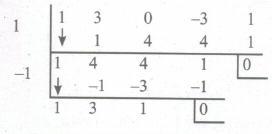
[Using synthetic division]
∴ x = 1, 1 are the roots and the remaining factor
\(\Rightarrow x=\frac { -3\pm \sqrt { 9-4(1)(1) } }{ 2 } \)
\(\Rightarrow x=\frac { -3\pm \sqrt { 5 } }{ 2 } \)
∴ The roots are 1, -1, \(\frac { -3+\sqrt { 5 } }{ 2 } ,\frac { -3-\sqrt { 5 } }{ 2 } \).
10.
| p | q | q ➝ p | ~p | ~q | ~q ➝ ~p |
| T | T | T | F | F | T |
| T | F | T | F | T | T |
| F | T | F | T | F | F |
| F | F | T | T | T | T |
The entries in the columns corresponding q ➝ p and ~p ➝ ~q are identical and hence they are equivalent.
q ➝ p ≡ ~p ➝ ~q
Hence proved
11.
The sample space S = {H,T} \(\times\) {H,T}
That is S = {TT, TH, HT, HH}
Let X be the random variable denoting the number of heads.
Therefore
X (TT ) = 0 , X (TH ) = 1,
X (HT) = 1, and X (HH) = 2 .
Then the random variable X takes on the values 0, 1 and 2
| Values of the Random Variable | 0 | 1 | 2 | Total |
| Number of elements in inverse images | 1 | 2 | 1 | 4 |
The probabilities are given by
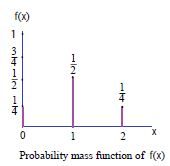
\(f(0)=P(X=0)=\cfrac { 1 }{ 4 } \)
\(f(1)=P(X=1)=\cfrac { 1 }{ 2 } \)
and \(f(2)=P(X=2)=\cfrac { 1 }{ 4 } \)
The function f (x) satisfies the conditions
(i) f (x) ≥ 0 , for x = 0, 1, 2
(ii) \(\underset { x }{ \Sigma } f(x)=\sum _{ x=0 }^{ x=2 }{ f(x) } =f(0)+f(1)+f(2)\)
= \(\cfrac { 1 }{ 4 } +{ \cfrac { 1 }{ 2 } +\cfrac { 1 }{ 4 } =1 }\)
Therefore f (x) is a probability mass function.
The probability mass function is given by
| x | 0 | 1 | 2 |
| f(x) | \(\cfrac { 1 }{ 4 } \) | \(\cfrac { 1 }{ 2 } \) | \(\cfrac { 1 }{ 4 } \) |
(or)
\(f(x)\begin{cases} \begin{matrix} \frac { 1 }{ 4 } & forx=0 \end{matrix} \\ \begin{matrix} \frac { 1 }{ 2 } & forx=1 \end{matrix} \\ \begin{matrix} \frac { 1 }{ 4 } & forx=2 \end{matrix} \end{cases}\)
12.
The possible events of selection are
(i) both balls may be black, or
(ii) one white and one black or
(iii) both are white.
Therefore X is a random variable that take the values,
X (both are black balls) = Rs. 2(30) = Rs. 60
X (one black and one white ball) = Rs. 30 − Rs. 20 = Rs. 10
X (both are white balls) = Rs. 2( − 20) = - Rs. 40
Therefore X takes on the values 60,10, and − 40.
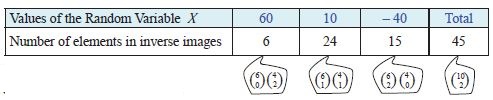
13.
\(S=\left\{\begin{array}{l} (1,1),(1,2),(1,3),(1,4),(1,5),(1,6) \\ (2,1),(2,2),(2,3),(2,4),(2,5),(2,6) \\ (3,1),(3,2),(3,3),(3,4),(3,5),(3,6) \\ (4,1),(4,2),(4,3),(4,4),(4,5),(4,6) \\ (5,1),(5,2),(5,3),(5,4),(5,5),(5,6) \\ (6,1),(6,2),(6,3),(6,4),(6,5),(6,6) \end{array}\right\}\)
(i) The sample space
S = {1, 2, 3, 4, 5, 6}\(\times\){1, 2, 3, 4, 5, 6}
consists of 36 ordered pairs (α, β) where α and β can take any integer value between 1 and 6 as shown. X is assigned to each point (α, β) the sum of the numbers on the dice .
That is X (α, β) = α + β
Therefore
X (1,1) = 1+1 = 2
X (1, 2) = X (2,1) = 3
X (1,3) = X (2,2) = X (3,1)= 4
X (1, 4) = X (2,3) = X (3, 2) X (4,1) = 5
X (1,5) = X (2,4) = X (3,3) = X (4, 2) = X (5,1) = 6
X (1,6) = X (2,5) = X (3, 4) = X (4,3 = X (5, 2) X (6,1) = 7
X (2,6) = X (3,5) = X (4,4) = X (5,3) = X (6,2) = 8
X (3,6) = X (4,5) = X (5,4) X (6,3) = 9
X (4,6) = X (5,5) X (6,4) = 10
X (5,6) = (6,5) = 11
X (6,6) = 12
(ii) Then the random variable X takes on the values 2, 3, 4, 5, 6, 7, 8, 9, 10, 11, 12.
(iii) The inverse images of 10 is {(4, 6), (5, 5), (6, 4)}.
(iv) The number of inverse images are given below
| Values of the random variable | 2 | 3 | 4 | 5 | 6 | 7 | 8 | 9 | 10 | 11 | 12 | Total |
| Number of elements in inverse image | 1 | 2 | 3 | 4 | 5 | 6 | 5 | 4 | 3 | 2 | 1 | 36 |
14.
Taking u = x2 and v = cos nx, and applying the Bernoulli’s formula, we get
\(I=\int _{ 0 }^{ \pi }{ { x }^{ 2 }cos\quad nxdx } ={ \left[ ({ x }^{ 2 })\left( \frac { sin\quad nx }{ n } \right) -(2x)\left( -\frac { cos\ nx }{ { n }^{ 2 } } \right) +(2)\left( -\frac { sin\quad nx }{ { n }^{ 3 } } \right) \right] }_{ 0 }^{ \pi }\)
\(=\frac { 2\pi { (-1) }^{ n } }{ { n }^{ 2 } } \), since cos n\(\pi\) = (-1)n and sin n\(\pi\) = 0
15.
\(\int _{ 0 }^{ 1 }{ \frac { 2x+7 }{ { 5x }^{ 2 }+9 } dx } =\int _{ 0 }^{ 1 }{ \frac { 2x }{ { 5x }^{ 2 }+9 } } +7\int _{ 0 }^{ 1 }{ \frac { dx }{ (5{ x }^{ 2 })+{ 3 }^{ 2 } } =\frac { 1 }{ 5 } } log{ [{ 5x }^{ 2 }+9] }_{ 0 }^{ 1 }+\frac { 7 }{ 5 } \int _{ 0 }^{ 1 }{ \frac { dx }{ { x }^{ 2 }{ \left( \frac { 3 }{ \sqrt { 5 } } \right) }^{ 2 } } } \)
\(=\frac { 1 }{ 5 } [log14-log9]+\frac { 7 }{ 5 } \times \frac { \sqrt { 5 } }{ 3 } { \left[ { tan }^{ -1 }\frac { x }{ \left[ \frac { 3 }{ \sqrt { 5 } } \right] } \right] }_{ 0 }^{ 1 }=\frac { 1 }{ 5 } log\frac { 14 }{ 9 } +\frac { 7 }{ 3\sqrt { 5 } } { tan }^{ -1 }\frac { \sqrt { 5 } }{ 3 } \)
16.
\(sin\left( \frac { dy }{ dx } \right) =a\)
\(\Rightarrow \frac { dy }{ dx } ={ sin }^{ -1 }(a)\)
\(\Rightarrow dy={ sin }^{ -1 }(a)dx\)
\(\Rightarrow \int { dy } ={ sin }^{ -1 }(a)\int { dx } \)
Taking Integration on both sides, we get
\(\Rightarrow \int { dy } ={ sin }^{ -1 }(a)\int { dx } \)
\(\Rightarrow y={ sin }^{ -1 }(a)x+c ...(1)\)
Initial condition:
Since y(0) = 1 we get,
1 = sin-1(a)(0) +C
0 + C ⇒ C = 1
equation (1) ⇒ y = sin-1(a) x + 1
y-1 = sin-1(a) + x
\(\Rightarrow \frac { y-1 }{ x } =sin(a)\Rightarrow sin\left( \frac { y-1 }{ x } \right) =a\)
17.
Equation of family of parabolas with axis as y axis is given by,
(x-0) = 4a(y-k) .... (1)
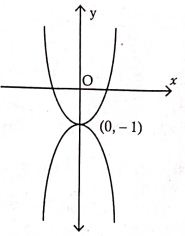
Given: Vertex at (0, - 1).
Putting k = -1 in (1), we get
⇒ x2 = \(\pm\)4a(y + 1) ....(2)
Differentiating with respect to 'x'
2x = \(\pm\)4a\(\left( \frac { dy }{ dx } \right) \) ....(3)
⇒ 4a = \(\frac { 2x }{ \frac { dy }{ dx } } \)
\(\frac{x^2}{2x} = \frac{y+1}{\frac{dt}{dx}}\)
ie) \(x \frac{dy}{dx}-2(y+1) =0\)
This is the required differential equation.
18.
Given \(A=\left( \begin{matrix} 1 & 0 \\ 0 & 1 \\ 1 & 0 \end{matrix}\begin{matrix} 1 & 0 \\ 0 & 1 \\ 0 & 1 \end{matrix} \right) ,B=\left( \begin{matrix} 0 & 1 \\ 1 & 0 \\ 1 & 0 \end{matrix}\begin{matrix} 0 & 1 \\ 1 & 0 \\ 0 & 1 \end{matrix} \right) and\quad C=\left( \begin{matrix} 1 & 1 \\ 0 & 1 \\ 1 & 1 \end{matrix}\begin{matrix} 0 & 1 \\ 1 & 0 \\ 1 & 1 \end{matrix} \right) \)
\(\left( \begin{matrix} 1 & 1 \\ 1 & 1 \\ 1 & 0 \end{matrix}\begin{matrix} 1 & 1 \\ 1 & 1 \\ 0 & 1 \end{matrix} \right) \wedge \left( \begin{matrix} 1 & 1 \\ 0 & 1 \\ 1 & 1 \end{matrix}\begin{matrix} 0 & 1 \\ 1 & 0 \\ 1 & 1 \end{matrix} \right) =\left( \begin{matrix} 1 & 1 \\ 0 & 1 \\ 1 & 0 \end{matrix}\begin{matrix} 0 & 1 \\ 1 & 0 \\ 0 & 1 \end{matrix} \right) \)
19.
p ∨ ¬ t ( p ∨ ¬s) contains 3 variables p, s, and t. Hence the corresponding truth table will contain 23 = 8 rows
20.
Given \(p=\frac { 3 }{ 4 }\)
n = 5
P(X = x) = nCxpx (1-p)n-x
\(P(X=3)={ 5C }_{ 3 }\left( \frac { 3 }{ 4 } \right) ^{ 3 }\left( 1-\frac { 3 }{ 4 } \right) ^{ 2 }\)
\(P(X=3)={ 5C }_{ 2 }\left( \frac { 3 }{ 4 } \right) ^{ 3 }\left( \frac { 1 }{ 4 } \right) ^{ 2 }\) [∵nCr = nCn-r]
\(P(X=3)=\frac{5 \times 4}{2 \times 1} \times \frac{3 \times 3 \times 3}{4 \times 4 \times 4 \times 4 \times 4}\)
= \(\frac { 135 }{ 512 }\)
21.
\(\)\(Mean=E(X)=\int _{ 1 }^{ 2 }{ f(x)dx=\int _{ 1 }^{ 2 }{ 2((x-1)dx } }\)
\(=2\left[\frac{8}{3}-\frac{4}{2}-\frac{1}{3}+\frac{1}{2}\right]\)
\(=2\left(\frac{7}{3}-\frac{3}{2}\right)\)
\(=2 \times \frac{5}{6}\)
\(=\frac{5}{3}\)
\(E({ x }^{ 2 })=\int _{ 1 }^{ 2 }{ { x }^{ 2 }f(x)dx }\)
= \(\int _{ 1 }^{ 2 }{ { x }^{ 2 }.2\left( x-1 \right) } dx\)
= \(2\int _{ 1 }^{ 2 }{ ({ x }^{ 3 }-{ x }^{ 2 })dx }\)
= \(2\left[ \frac { { x }^{ 4 } }{ 4 } -\frac { { x }^{ 3 } }{ 3 } \right] _{ 1 }^{ 2 }\)
= \(2\left[ \left( 4-\frac { 8 }{ 3 } \right) -\left( \frac { 1 }{ 4 } -\frac { 1 }{ 3 } \right) \right]\)
= \(2\left[ \frac { 4 }{ 3 } +\frac { 1 }{ 12 } \right] =2\left[ \frac { 16+1 }{ 12 } \right]\)
= \(\frac { 17 }{ 6 }\)
ஃ Var(X) = E(X2) - [E(X)]2
= \(\frac { 17 }{ 6 } -(\frac{5}{ 3 }^{ 2 })=\frac { 17 }{ 6 } -\frac { 25 }{ 9 }\)
= \(\frac{51-50}{18}\)
= \(\frac{1}{18}\)
22.
We know that \(\int _{ 0 }^{ 2a }{ f(x)dx } =2\int _{ 0 }^{ a }{ f(x) } dx\quad if(2a-x)=f(x)\)
Take 2a = \(\pi\) and f(x) = g(sinx)
Then, f(2a-x) = g(sin(\(\pi\)-x)) = g(sinx) = f(x).
\(\therefore \int _{ 0 }^{ 2a }{ f(x)dx } =2\int _{ 0 }^{ a }{ f(x)dx } \)
\(\int _{ 0 }^{ \pi }{ g(sinx)dx } =2\int _{ 0 }^{ \frac { \pi }{ 2 } }{ g(sinx)dx } \)
23.
P(0.2≤X < 0.6)
= \(\int _{ 0.2 }^{ 0.6 }{ f(x)dx } =\int _{ 0.2 }^{ 0.6 }{ x.dx } =\left[ \frac { { x }^{ 2 } }{ 2 } \right] _{ 0.2 }^{ 0.6 }\)
= 0.18 - 0.02
= 0.16

24.
Given that \(\frac{dy}{dx}+2y\) = e-x
This is a linear differential equation
Here P = 2 ; Q = e−x.
\(\int { pdx } =\int { 2dx } =2x\)
Thus, I.F.\(={ e }^{ \int { pdx } }={ e }^{ 2x }\)
Hence the solution of (1) is \({ ye }^{ \int { pdx } }=\int { { Qe }^{ \int { Pdx } }dx+C } \)
That is, \({ ye }^{ 2x }=\int { { e }^{ -x }{ e }^{ 2x }dx+C } or\quad { ye }^{ 2x }={ e }^{ x }+C\quad or\quad y={ e }^{ -x }+{ Xe }^{ -2x }\) required solution
25.
Given equation of curve is
xy = aex + be−x + x2 ...(1)
where a &b are aribitrary constant. differentiate equation (1) twice successively, because we have two arbitray constant.
\(x \frac{d y}{d x}+y(1)=a \mathrm{e}^{x}-\mathrm{be}^{-x}+2 x\) ...(2)
\(
x \frac{d^{2} y}{d x^{2}}+\frac{d y}{d x}(1)+\frac{d y}{d x}=\mathrm{ae}^{x}+\mathrm{be}^{-x}+2
\)
\( x \frac{d^{2} y}{d x^{2}}+\frac{2 d y}{d x}=\mathrm{ae}^{x}+\mathrm{be}^{-x}+2
\) ...(3)
From (1), we get \(x y-x^{2}=\mathrm{ae}^{x}+\mathrm{be}^{-x}\) ...(4)
Substituting equation (a) in (3), we get
\(\therefore x \frac{d^{2} y}{d x^{2}}+\frac{2 d y}{d x}-x y+x^{2}-2=0\) which is the required differential equaiton.

12th Standard Syllabus & Materials
12th Standard
TN 12th Computer Applications வலையமைப்பு வடமிடல் Sample Question Papers Study Material - QB365 Set A
NEW12th Standard
TN 12th Computer Applications களப்பெயர் முறைமை (DNS) Sample Question Papers Study Material - QB365 Set A
NEW12th Standard
TN 12th Computer Applications வலையமைப்பு எடுத்துக்காட்டுகள் மற்றும் நெறிமுறைகள் Sample Question Papers Study Material - QB365 Set A
NEW12th Standard
TN 12th Computer Applications கணினி வலையமைப்பு ஓர் அறிமுகம் Sample Question Papers Study Material - QB365 Set A



Tamilnadu Stateboard 12th Standard Subjects
Maths

Chemistry

Physics

Biology

Computer Science

Business Maths and Statistics

Economics

Commerce

Accountancy

History

Computer Applications
Biology
Computer Technology
Computer Applications
Computer Science
Business Maths and Statistics
Commerce
Economics
Maths
Chemistry
Physics
Computer Technology
History
Accountancy

Tamil

English

French
Tamilnadu Stateboard Standards



