
 100% FREE ACCESS
12th Standard Syllabus & Materials
12th Standard
TN 12th Computer Applications மின்னணு தரவு பரிமாற்றம் Sample Question Papers Study Material - QB365 Set A
NEW12th Standard
TN 12th Computer Applications மின் - வணிக பாதுகாப்பு அமைப்புகள் Sample Question Papers Study Material - QB365 Set A
NEW12th Standard
TN 12th Computer Applications மின்னணு செலுத்தல் முறைகள் Sample Question Papers Study Material - QB365 Set A
NEW12th Standard
TN 12th Computer Applications மின் - வணிகம் Sample Question Papers Study Material - QB365 Set A
NEW12th Standard
TN 12th Computer Applications திறந்த மூல கருத்துருக்கள் Sample Question Papers Study Material - QB365 Set A
NEW12th Standard
TN 12th Computer Applications வலையமைப்பு வடமிடல் Sample Question Papers Study Material - QB365 Set A

Published on: 01/06/2021
QB365 provides detailed and simple solution for every book back questions in class 12 Maths subject.It will helps to get more idea about question pattern in every book back questions with solution.
Download Tamil Nadu 12th Standard Maths question papers, model tests, one-mark questions, important questions, and public exam papers in PDF format. Free study materials and answer keys for TN State Board students.
Questions + Answers key
Take MCQ Maths Test1.
Evaluate the following:
\(\int _{ 0 }^{ 1 }{ \frac { sin(3{ tan }^{ -1 }x){ tan }^{ -1 }x }{ 1+{ x }^{ 2 } } } dx\)
2.
Find the equations of the tangents to the curve y = 1 + x3 for which the tangent is orthogonal with the line x +12y = 12.
3.
If \(2cos\alpha=x+\frac { 1 }{ x } \) and \(2cos\ \beta =y+\frac { 1 }{ y } \), show that \({ x }^{ m }{ y }^{ n }+\frac { 1 }{ { x }^{ m }{ y }^{ n } } =2cos(m\alpha +n\beta )\)
4.
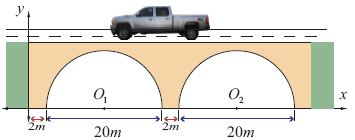
A road bridge over an irrigation canal has two semicircular vents each with a span of 20m and the supporting pillars of width 2m. Use Figure to write the equations that represent the semi-verticular vents
5.
Show that \(\left( \frac { 19+9i }{ 5-3i } \right) ^{ 15 }-\left( \frac { 8+i }{ 1+2i } \right) ^{ 15 }\) is purely imaginary.
6.
If A = \(\left[ \begin{matrix} 4 & 3 \\ 2 & 5 \end{matrix} \right] \), find x and y such that A2 + xA + yI2 = O2. Hence, find A-1.
7.
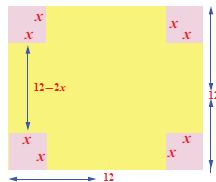
We have a 12 square unit piece of thin material and want to make an open box by cutting small squares from the corners of our material and folding the sides up. The question is, which cut produces the box of maximum volume?
8.
Write the Maclaurin series expansion of the following function:
cos2 x
9.
Find the intervals of monotonicities and hence find the local extremum for the following function:
f(x) = 2x3+ 3x2-12x
10.
A ladder 17 metre long is leaning against the wall. The base of the ladder is pulled away from the wall at a rate of 5 m/s. When the base of the ladder is 8 metres from the wall.
(i) How fast is the top of the ladder moving down the wall?
(ii) At what rate, the area of the triangle formed by the ladder, wall and the floor is changing?
11.
A particle moves along a line according to the law s(t) = 2t3 − 9t2 +12t − 4, where t ≥ 0.
12.
Solve the following system of linear equations by matrix inversion method:
x + y + z − 2 = 0, 6x − 4y + 5z − 31 = 0, 5x + 2y + 2z = 13.
13.
Determine the values of λ for which the following system of equations (3λ − 8)x + 3y + 3z = 0, 3x + (3λ − 8)y + 3z = 0, 3x + 3y + (3λ − 8)z = 0. has a non-trivial solution.
14.
If \(\vec { a } =\vec { i } -\vec { j } ,\vec { b } =\hat { i } -\hat { j } -4\hat { k } ,\vec { c } =3\hat { j } -\hat { k } \) and \(\vec { d } =2\hat { i } +5\hat { j } +\hat { k } \)
(i) \((\vec { a } \times \vec { b } )\times (\vec { c } \times \vec { d } )=[\vec { a } ,\vec { b } ,\vec { d } ]\vec { c } -[\vec { a } ,\vec { b } ,\vec { c } ]\vec { d } \)
15.
A rod of length 1.2 m moves with its ends always touching the coordinate axes. The locus of a point P on the rod, which is 0.3 m from the end in contact with x -axis is an ellipse. Find the eccentricity.
16.
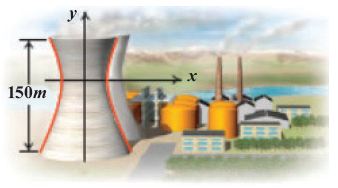
Cross section of a Nuclear cooling tower is in the shape of a hyperbola with equation\(\frac { { x }^{ 2 } }{ { 30 }^{ 2 } } -\frac { { y }^{ 2 } }{ { 44 }^{ 2 } } =1\). The tower is 150 m tall and the distance from the top of the tower to the centre of the hyperbola is half the distance from the base of the tower to the centre of the hyperbola. Find the diameter of the top and base of the tower.
17.
Investigate the values of λ and μ the system of linear equations 2x + 3y + 5z = 9, 7x + 3y - 5z = 8, 2x + 3y + λz = μ, have
(i) no solution
(ii) a unique solution
(iii) an infinite number of solutions.
18.
Solve \(tan^{ -1 }\left( \frac { x-1 }{ x-2 } \right) +tan^{ -1 }\left( \frac { x+1 }{ x+2 } \right) =\frac { \pi }{ 4 } \)
19.
20.
(a) If A = \(\left[ \begin{matrix} -5 & 1 & 3 \\ 7 & 1 & -5 \\ 1 & -1 & 1 \end{matrix} \right] \) and B = \(\left[ \begin{matrix} 1 & 1 & 2 \\ 3 & 2 & 1 \\ 2 & 1 & 3 \end{matrix} \right] \), find the products AB and BA and hence solve the system of equations x + y + 2z = 1, 3x + 2y + z = 7, 2x + y + 3z = 2.
21.
Solve the following system of equations, using matrix inversion method:
2x1 + 3x2 + 3x3 = 5, x1 - 2x2 + x3 = -4, 3x1 - x2 - 2x3 = 3.
22.
Find all zeros of the polynomial x6- 3x5- 5x4 + 22x3- 39x2- 39x + 135, if it is known that 1+2i and \(\sqrt{3}\) are two of its zeros.
23.
Solve : (x - 5) (x - 7) (x + 6) (x + 4) = 504
24.
Find the equation of the circle through the points (1, 0),(-1, 0) , and (0, 1)
25.
Solve the equation x3− 9x2+14x + 24 = 0 if it is given that two of its roots are in the ratio 3:2.
1.
Let \(\int _{ 0 }^{ 1 }{ \frac { sin(3{ tan }^{ -1 }x){ tan }^{ -1 }x }{ 1+{ x }^{ 2 } } } dx\)
\(put\quad { tan }^{ -1 }x=t\Rightarrow \frac { 1 }{ 1+{ x }^{ 2 } } dx=dt\)
\(\Rightarrow \int _{ 0 }^{ \frac { \pi }{ 4 } }{ t\quad sin(3t)dt } =\int _{ 0 }^{ \frac { \pi }{ 4 } }{ tsin3t } dt\)
| x | 0 | 1 |
| t | 0 | \(\frac{\pi}{4}\) |
\(Let\ u=t\ \ v=sin3tdt\)
\(u'=1\ \ { v }_{ 1 }=\frac { -cos3t }{ 3 } \)
\(u'' = 0 \quad { v }_{ 2 }=\frac { -sin3t }{ 9 } \)
Bernoulli's formula:
\(\int { uvdx } =u{ v }_{ 1 }-u'{ v }_{ 2 }\)
\(\int _{ 0 }^{ \frac { \pi }{ 4 } }{ tsin3tdt={ \left[ t\left( \frac { -cos3t }{ 3 } \right) -1\left( \frac { -sin3t }{ 9 } \right) \right] }_{ 0 }^{ \frac { \pi }{ 4 } } } \)
\(=\frac { -1 }{ 9 } { [3tcos3t-sin3t] }_{ 0 }^{ \frac { \pi }{ 4 } }\)
\(=\frac { -1 }{ 9 } \left[ \left( 3\frac { \pi }{ 4 } cos\frac { 3\pi }{ 4 } -sin\frac { 3\pi }{ 4 } \right) -(0-0) \right] \)
\(=\frac { -1 }{ 9 } \left[ \frac { 3\pi }{ 4 } \left( -\frac { 1 }{ \sqrt { 2 } } \right) -\frac { 1 }{ \sqrt { 2 } } \right] \)
\(=\frac { -1 }{ 9 } \left[ \frac { -3\pi -4 }{ 4\sqrt { 2 } } \right] =\frac { 3\pi }{ 36\sqrt { 2 } } +\frac { 4 }{ 36\sqrt { 2 } } \)
\(=\frac { \pi }{ 12\sqrt { 2 } } +\frac { 1 }{ 9\sqrt { 9 } } =\frac { 1 }{ \sqrt { 9 } } \left[ \frac { \pi }{ 12 } +\frac { 1 }{ 9 } \right] \)
2.
Given equation of the curve is y = 1 + x3 and the line is x + 12y = 12
Slope of the tangent to the curve
m1 = \(\frac { dy }{ dx } \) = 3 x2 and the
Slope of the line = m2
= \(\frac{-1}{2}\) \(\left[ \because m=\frac { co-efficient\ of\ x }{ co-efficient\ of\ y } \right] \)
Since the slope of the tangent to the curve and the line are orthogonal, m1 m2 = - 1.
∴ 3x2\(\left( \frac { -1 }{ 2 } \right) \) = -1
⇒ \(\frac{x^2}{4}\) = 1
⇒ x2 = 4
⇒ x = ±2
When x = 2, y = 1 + 23 = 9
When x = -2, y = 1+ (-2)3
= 1-8 = -7
∴ Equation of the tangent at (2, 9) is
y-9 = 12(x-2) [∵ m1 = 3x2 = 3(2)2 = 12]
∴ y - 9 = 12x - 24
∴ 12x - y = 15
Equation of the tangent at (-2, -7) is
y+7= 12(x + 2)
⇒ y + 7 = 12x + 24
⇒ 12x-y+17 = 0
3.
Given 2cos α = x+\(\frac { 1 }{ x } \)
⇒ 2cos α = \(\frac { { x }^{ 2 }+1 }{ x } \)
⇒ x2+1 = 2xcos α
⇒ x2-2x cos α+1 = 0
⇒ \(\frac { 2cos\alpha \pm \sqrt { (-2cos\alpha )^{ 2 }-4(1)(1) } }{ 2 } \)
= \(\frac { 2cos\alpha \pm \sqrt { 4cos^{ 2 }\alpha -4 } }{ 2 } \) \(\left[ \because \frac { b\pm \sqrt { { b }^{ 2 }-4ac } }{ 2a } \right] \)
= \(\frac { 2cos\alpha \pm \sqrt { -sin^{ 2 }\alpha } }{ 2 } \)
= \(\frac { 2cos\alpha \pm isin\alpha }{ 2 } \) [∵ sin2α+cos2α = 1]
⇒ x2 = cos α ± sin α
Also, 2cos β = y+\(\frac { 1 }{ y } \)
⇒ 2cos β = \(\frac { { y }^{ 2 }+1 }{ y } \)
⇒ y2-2y cos β+1 = 0
⇒ \(\frac { 2cos\beta \pm \sqrt { (-2cos^{ 2 }\beta ^{ 2 }-4(1)(1) } }{ 2 } \)
=\(\frac { 2cos\beta \pm \sqrt { 4cos^{ 2 }\beta } -4 }{ 2 } =\frac { 2cos\beta \pm 2isin\beta }{ 2 } \)
⇒ y = cosβ ± i sinβ
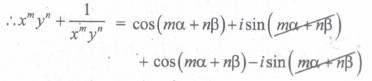
\({ x }^{ m }{ y }^{ n }+\cfrac { 1 }{ { x }^{ m }{ y }^{ n } } =2cos(m\alpha +n\beta )\)
xmyn = (cos α + i sin mα) (cos nβ + i sin nβ)
cos(mα+nβ)+i sin(mα+nβ)
\(\frac { 1 }{ { x }^{ m }{ y }^{ n } } \) = cos(mα+nβ)-i sin(mα+nβ)
= 2cos(mα+nβ)
4.
Let O1 O2 be the centres of the two semi circular vents.
First vent with centre O1 (12, 0) and radius r = 10 yields equation to first semicircle as
(x−12)2+(y− 0)2 = 102
\(\Rightarrow\) x2+y2−24x + 44 = 0, y > 0
Second vent with centre O2 (34, 0) and radius r = 10 yields equation to second vent as
(x−34)2+ y2 = 102
x2+y2− 68x + 1056 = 0, y > 0
5.
Let z =\(\left( \frac { 19+9i }{ 5-3i } \right) ^{ 15 }-\left( \frac { 8+i }{ I+2i } \right) ^{ 15 }\)
Here, \(\frac { 19+9i }{ 5-3i } =\frac { (19+9i)(5+3i) }{ (5-3i)(5+3i) } \)
= \(\frac { (95-27)+i(45+57) }{ { 5 }^{ 2 }+{ 3 }^{ 2 } } =\frac { 68+102i }{ 34 } \)
= 2 + 3i ................(1)
and \(\frac { 8+i }{ 1+2i } =\frac { (8+i)(1-2i) }{ (1+2i)(1-2i) } \)
= \(\frac { (8+2)+i(1-16) }{ { 1 }^{ 2 }+{ 2 }^{ 2 } } =\frac { 10-15i }{ 5 } \)
= 2 - 3i .............. (2)
Now z =\(\left( \frac { 19+9i }{ 5-3i } \right) ^{ 15 }-\left( \frac { 8+i }{ 1+2i } \right) ^{ 15 }\)
⇒ z = (2 + 3i)15 - (2 - 3i)15 (by (1) and (2))
Then by definition, \(\bar { z } =\left( \overline { (2+3i)^{ 15 }-(2-3i)^{ 15 } } \right) \)
= \(\left( \overline { 2+3i } \right) ^{ 15 }-\left( \overline { 2-3i } \right) ^{ 15 }\) (using properties of conjugates)
= (2 - 3i)15 - (2 + 3i)15 = -((2 + 3i)15 - (2-3i)15)
⇒ \(\\ \overline { z } \) = -z
Therefore, \(\left( \frac { 19+9i }{ 5-3i } \right) ^{ 15 }-\left( \frac { 8+i }{ 1+2i } \right) ^{ 15 }\) is purely imaginary.
6.
Since A2 = \(\left[ \begin{matrix} 4 & 3 \\ 2 & 5 \end{matrix} \right] \left[ \begin{matrix} 4 & 3 \\ 2 & 5 \end{matrix} \right] =\left[ \begin{matrix} 22 & 27 \\ 18 & 31 \end{matrix} \right] \).
A2 + xA + yI2 = O2 ⇒ \(\left[ \begin{matrix} 22 & 27 \\ 18 & 31 \end{matrix} \right] +x\left[ \begin{matrix} 4 & 3 \\ 2 & 5 \end{matrix} \right] +y\left[ \begin{matrix} 1 & 0 \\ 0 & 1 \end{matrix} \right] =\left[ \begin{matrix} 0 & 0 \\ 0 & 0 \end{matrix} \right] \)
⇒ \(\left[ \begin{matrix} 22+4x+y & 27+3x \\ 18+2x & 31+5x+y \end{matrix} \right] =\left[ \begin{matrix} 0 & 0 \\ 0 & 0 \end{matrix} \right] \).
So, we get 22 + 4x + y = 0, 31 + 5x + y = 0, 27 + 3x = 0 and 18 + 2x = 0.
Hence x = −9 and y = 14. Then, we get A2 - 9A + 14I2 = O2.
Postmultiplying this equation by A-1, we get A - 9I2 + 14A-1 = O2. Hence, we get
A-1 = \(\frac { 1 }{ 14 } \) (9I2 - A) = \(\frac { 1 }{ 14 } \left( 9\left[ \begin{matrix} 1 & 0 \\ 0 & 1 \end{matrix} \right] -\left[ \begin{matrix} 4 & 3 \\ 2 & 5 \end{matrix} \right] \right) =\frac { 1 }{ 14 } \left[ \begin{matrix} 5 & -3 \\ -2 & 4 \end{matrix} \right] \).
7.
Let x = length of the cut on each side of the little squares.
V = the volume of the folded box.
The length of the base after two cuts along each edge of size x is 12 − 2x. The depth of the box after folding is x, so the volume is V = x \(\times\) (12 - 2x)2 Note that,
when x = 0 or 6, the volume is zero and hence there cannot be a box. Therefore the problem is to maximize, V = x \(\times\) (12 - 2x)2, x ∈ (0, 6)
\(\frac { dV }{ dx } ={ (12-2x) }^{ 2 }-4x(12-2x)\)
= (12 − 2x)(12 − 6x).
\(\frac { dV }{ dx } \) = 0 gives the stationary points x = 2, 6. Since 6 ∉ (0, 6) the only stationary point is at x = 2∈(0, 6). Further, \(\frac { dV }{ dx } \)- changes its sign from postive to negative when passing through x = 2 .
Therefore at x = 2 the volume V is local maximum. The local maximum volume value is V = 128 units. Hence the maximum cut can only be 2 units.
8.
Let (x) = cos2 x
fI(x) = 2cos x (- sin x)
= - sin 2x ⇒ fl(0) = 0
fIl(x) = - 2 cos 2x ⇒ fIl(0) = -2
fIII(x) = + 4 sin 2 x ⇒ fIII(0) = 0
fIV(x) = 8 cos 2 x ⇒ fIV(0) = 8
fV(x) = -16 sin 2x ⇒ fV(0) = 0
fVI(x) = - 32 cos 2x ⇒ fVI(0) = -32
∴ Maclaurin's series
\(f(x)=f(0)+\frac { { f }^{ 1 }(0) }{ 1! } x+\frac { { f }^{ II }(0) }{ 2! } { x }^{ 2 }+\frac { { f }^{ III }(0) }{ 3! } { x }^{ 3 }+\) .......
∴ cos x = 1 - \(\frac { 2{ x }^{ 2 } }{ 2! } +\frac { 8{ x }^{ 4 } }{ 4! } +\frac { { 32x }^{ 6 } }{ 6! } \) + ...
= 1 - \(\frac { 2{ x }^{ 2 } }{ 2! } +\frac { { 2 }^{ 3 }{ x }^{ 4 } }{ 4! } +\frac { { { 2 }^{ 5 }x }^{ 6 } }{ 6! } \)+ ...
9.

Given f(x) = 2.0 + 3x2 - 12x
The given function is defined and differentiable for all x ∈(-∞,∞)
f'(x) = 6x2 + 6x - 12
The stationary points are given by
6x2 + 6x - 12 = 0
\(\Rightarrow\) x2 +x-2 = 0
\(\Rightarrow\) (x + 2)(x - 1) = 0
\(\Rightarrow\) x = -2, 1
Hence the intervals of monotonicity are
(-∞, - 2), (-2, 1) and (1, ∞).
| Intervel | (-∞, - 2) | (-2, 1) | (1, ∞) |
| Sign of f'(x) |
Say x = -3 f'(x) = 6(-3)2+6 (-3) -12 = +ve |
Say x = 0 f'(0) = -12 = -ve |
Say x = 2 f'(x) = 6(2)2+ 6(2)-12 = +ve |
| monotoni city | Strictly increasing | Strictly decreasing | Strictly increasing |
ஃ f(x) is strictly increasing on (-∞, - 2)
(1, ∞) and strictly decreasing on (-2, 1).
Since f'(x) changes from positive to negative at x = -2, there is a local maximum at x = -2
\(\therefore\) f(-2) = 2 (2)3 + 3 (2)2 - 12 (-2)
= 2(-8) + 3(4) + 24
= -16+12+24 = 20
Also f'(x) changes from negative to positive at x = 1, there is a local minimum at x = 1.
ஃ f(1) = 2 (1)3 + 3 (1)2 - 12(1)
= 5 -12 = -7
10.
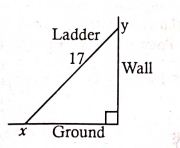
Let AB be the position of the ladder at any time t such that OA = x and OB = y
Then OA2 + OB2 = AB2
⇒ x2 + y2 = 172
Given \(\frac { dx }{ dt } \) = 5 and x = 8
When x = 8, 82 + y2 = 172
⇒ y2 = 289 - 64 = 225
⇒ y = 15
Differentiating (1) with respect to 't' we get,
\(2x\frac { dx }{ dt } +2y\frac { dy }{ dt } =0\)
⇒ 8(5) + 15 \(\frac { dy }{ dt } \) = 0 [∵ x = 8, \(\frac { dx }{ dt } \) = 15, y = 15]
⇒ 40 + 15\(\frac { dy }{ dt } \) = 0
⇒ \(\frac { dy }{ dt } =\frac { -40 }{ 15 } =\frac { -8 }{ 3 } \) m/sec
∴ The rate of top of the ladder moving down the wall is \(\frac{-8}{3}\) m/sec
(ii) The ladder, the wall and the floor forms a right angled triangle.
Area = \(\frac12\)xy
Differentiating with respect to 't' we get,
\(\frac { dA }{ dt } =\frac { 1 }{ 2 } \left[ x\frac { dy }{ dx } +y\frac { dx }{ dt } \right] \)
\(=\frac { 1 }{ 2 } \left[ 8\left( -\frac { 8 }{ 3 } \right) +15(5) \right] \)
= \(\frac { 1 }{ 2 } \left[ \frac { -64 }{ 3 } +75 \right] =\frac { 1 }{ 2 } \)
= \(\frac { 1 }{ 2 } \left[ \frac { -64+225 }{ 3 } \right] =\frac { 1 }{ 2 } \left( \frac { 161 }{ 3 } \right) \)
= \(\frac { dA }{ dt } \) = 26.83 sq.m/sec
11.
Given s (t) = 2t3 − 9t2 + 12t ≥ 0
12.
x+y+z-2 = 0, 6x-4y+5z-31= 0, 5x+2y+2z = 13
The matrix form of the system is
\(\left[ \begin{matrix} 1 & 1 & 1 \\ 6 & -4 & 5 \\ 5 & 2 & 2 \end{matrix} \right] \left[ \begin{matrix} x \\ y \\ z \end{matrix} \right] =\left[ \begin{matrix} 2 \\ 1 \\ 13 \end{matrix} \right] \)
AX = B where A =\(\left[ \begin{matrix} 1 & 1 & 1 \\ 6 & -4 & 5 \\ 5 & 2 & 2 \end{matrix} \right] \)
X =\(\left[ \begin{matrix} x \\ y \\ z \end{matrix} \right] ,B=\left[ \begin{matrix} 2 \\ 31 \\ 13 \end{matrix} \right] \)
⇒ X = A-1B
|A| = \(\left| \begin{matrix} 1 & 1 & 1 \\ 6 & -4 & 5 \\ 5 & 2 & 2 \end{matrix} \right| =1\left| \begin{matrix} -4 & 5 \\ 2 & 2 \end{matrix} \right| -1\left| \begin{matrix} 6 & 5 \\ 5 & 2 \end{matrix} \right| +1\left| \begin{matrix} 6 & -4 \\ 5 & 2 \end{matrix} \right| \)
adj A = \(\left[ \begin{matrix} +\left| \begin{matrix} -4 & 5 \\ 2 & 2 \end{matrix} \right| & -\left| \begin{matrix} 6 & 5 \\ 5 & 2 \end{matrix} \right| & +\left| \begin{matrix} 6 & -4 \\ 5 & 2 \end{matrix} \right| \\ -\left| \begin{matrix} 1 & 1 \\ 2 & 2 \end{matrix} \right| & +\left| \begin{matrix} 1 & 1 \\ 5 & 2 \end{matrix} \right| & -\left| \begin{matrix} 1 & 1 \\ 5 & 2 \end{matrix} \right| \\ +\left| \begin{matrix} 1 & 1 \\ -4 & 5 \end{matrix} \right| & -\left| \begin{matrix} 1 & 1 \\ 6 & 5 \end{matrix} \right| & +\left| \begin{matrix} 1 & 1 \\ 6 & -4 \end{matrix} \right| \end{matrix} \right] ^{ T }\)
=\(\left[ \begin{matrix} +(-8-10) & -(12-25) & +(12+20) \\ -(2-2) & +(2-5) & -(2-5) \\ +(5+4) & -(5-6) & +(-4-6) \end{matrix} \right] ^{ T }\)
=\(\left[ \begin{matrix} -18 & 13 & 32 \\ 0 & -3 & 3 \\ 9 & 1 & -10 \end{matrix} \right] ^{ T }\)
=\(\left[ \begin{matrix} -18 & 0 & 9 \\ 13 & -3 & 1 \\ 32 & 3 & -10 \end{matrix} \right] \)
∴ A-1 = \(\frac { 1 }{ |A| } adjA=\frac { 1 }{ 27 } \left[ \begin{matrix} -18 & 0 & 9 \\ 13 & -3 & 1 \\ 32 & 3 & -10 \end{matrix} \right] \)
∴ X = A-1B
= \(\frac { 1 }{ 27 } \left[ \begin{matrix} -18 & 0 & 9 \\ 13 & -3 & 1 \\ 32 & 3 & -10 \end{matrix} \right] \left[ \begin{matrix} 2 \\ 31 \\ 13 \end{matrix} \right] \)
= \(\frac { 1 }{ 27 } \left[ \begin{matrix} -36 & +0 & +117 \\ 26 & -93 & +13 \\ 64 & +93 & -130 \end{matrix} \right] =\frac { 1 }{ 27 } \left[ \begin{matrix} 81 \\ -54 \\ 27 \end{matrix} \right] =\left[ \begin{matrix} 3 \\ -2 \\ 1 \end{matrix} \right] \)
∴ x = 3, y = -2, z = 1
∴ Solution set is {3, -2, 1}
13.
Here the number of unknowns is 3. So, if the system is consistent and has a non-trivial solution, then the rank of the coefficient matrix is equal to the rank of the augmented matrix and is less than 3.
So the determinant of the coefficient matrix should be 0.
Hence we get
\(\left| \begin{matrix} 3\lambda -8 & 3 & 3 \\ 3 & 3\lambda -8 & 3 \\ 3 & 3 & 3\lambda -8 \end{matrix} \right| \) = 0 or \(\left| \begin{matrix} 3\lambda -2 & 3\lambda -2 & 3\lambda -2 \\ 3 & 3\lambda -8 & 3 \\ 3 & 3 & 3\lambda -8 \end{matrix} \right| \) = 0 (by applying R1 ➝ R1 + R2 + R3)
or (3λ - 2) \(\left| \begin{matrix} 1 & 1 & 1 \\ 3 & 3\lambda -8 & 3 \\ 3 & 3 & 3\lambda -8 \end{matrix} \right| \) = 0 (by taking out (3λ − 2) from R1)
or (3λ - 2) \(\left| \begin{matrix} 1 & 1 & 1 \\ 3 & 3\lambda -11 & 3 \\ 3 & 3 & 3\lambda -11 \end{matrix} \right| \) = 0 (by applying R2 ➝ R2 - 3R1, R3 ➝ R3 - 3R1)
or (3λ - 2)(3λ - 11)2 0. So λ = \(\frac { 2 }{ 3 } \) and λ = \(\frac { 11 }{ 3 } \).
We now give an application of system of linear homogeneous equations to chemistry. You are already aware of balancing chemical reaction equations by inspecting the number of atoms present on both sides.
14.
By definition,
\(\vec { a } \times \vec { b } =\left| \begin{matrix} \hat { i } & \hat { j } & \hat { k } \\ 1 & -1 & 0 \\ 1 & -1 & -4 \end{matrix} \right| =4\hat { i } +4\hat { j } ,\vec { c } \times \vec { d } =\left| \begin{matrix} \hat { i } & \hat { j } & \hat { k } \\ 0 & 3 & -1 \\ 2 & 5 & 1 \end{matrix} \right| =8\hat { i } -2\hat { j } -6\hat { k } \)
\((\vec { a } \times \vec { b } )(\vec { c } \times \vec { d } )=\left| \begin{matrix} \hat { i } & \hat { j } & \hat { k } \\ 4 & 4 & 0 \\ 8 & -2 & -6 \end{matrix} \right| =-24\hat { i } +24\hat { j } -40\hat { k } \) ..............(1)
On the other hand, we have
\([\vec { a }, \vec { b }, \vec { d } ]\vec { c } -[\vec { a } ,\vec { b } ,\vec { c } ]\vec { d } =28(3\vec { j } -\vec { k } )-12(2\hat { i } +5\hat { j } +\hat { k } )=-24\hat { i } +24\hat { j } -40\hat { k } \) ..............(2)
Therefore, from equations (1) and (2), identity (i) is verified.
The verification of identity (ii) is left as an exercise to the reader
15.
Let AB be the rod and P(x1, y1) be a point on the rod such that AP = 0.3 m.
Draw PD ⊥ x-axis and PC ⊥ y - axis.
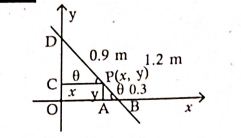
Δ ADP ≅ Δ PCB
∴ \(\frac { PC }{ DA } =\frac { PB }{ AP } =\frac { BC }{ PD } \)
⇒ \(\frac { x_{ 1 } }{ DA } =\frac { 0.9 }{ 0.3 } =\frac { BC }{ { y }_{ 1 } } \)
⇒ \(DA=\frac { 0.3{ x }_{ 1 } }{ 0.9 } =\frac { { x }_{ 1 } }{ 3 } \)
and BC = \(\frac { 0.9{ y }_{ 1 } }{ 0.3 } =\frac { 9 }{ 3 } { y }_{ 1 }=3{ y }_{ 1 }\)
Now OA = OD + DA
= \({ x }_{ 1 }+\frac { { x }_{ 1 } }{ 3 } =\frac { 4{ x }_{ 1 } }{ 3 } \)
OB = OC + BC = y1 + 3y1 = 4y1
But OA2 + OB2 = AB2
⇒ \({ \left( \frac { 4{ x }_{ 1 } }{ 3 } \right) }^{ 2 }+{ \left( 4{ y }_{ 1 } \right) }^{ 2 }={ \left( 1.2 \right) }^{ 2 }\)
⇒ \(\frac { { { x }_{ 1 } }^{ 2 } }{ 9 } +\frac { { { y }_{ 1 } }^{ 2 } }{ 9 } =\frac { 1.44 }{ 16 } =0.09\) ≅ 1
∴ Locus of (x1, y1) is \(\frac { { x }^{ 2 } }{ 9 } +\frac { { y }^{ 2 } }{ 1 } =1\)
Here a2 = 9, b2 = 1
∴ \(e=\sqrt { 1-\frac { { b }^{ 2 } }{ { a }^{ 2 } } } =\sqrt { 1-\frac { 1 }{ 9 } } =\sqrt { \frac { 9-1 }{ 9 } } \)
= \(\sqrt { \frac { 8 }{ 9 } } \)
e = \(\frac { 2\sqrt { 2 } }{ 3 } \)
16.
The cross section of a nuclear cooling tower is in the shape of a hyperbola.
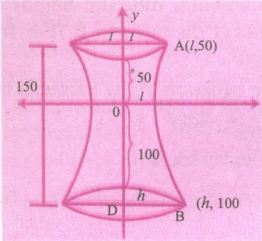
GIven OC = \(\frac12\) OD and CD = 150 m
Its equation is OC = 50 m & OD = 100 m
\(\frac { { x }^{ 2 } }{ { 30 }^{ 2 } } -\frac { { y }^{ 2 } }{ { 44 }^{ 2 } } =1\) ......(1)
Let I be the radius of the top of the tower
∴ A(l, 50) is a point on the hyperbola
∴ \(\frac { { l }^{ 2 } }{ { 30 }^{ 2 } } \frac { { 50 }^{ 2 } }{ { 44 }^{ 2 } } =1\)
⇒ \(\frac { { l }^{ 2 } }{ { 30 }^{ 2 } } =1+\frac { { 50 }^{ 2 } }{ { 44 }^{ 2 } } =\frac { { 44 }^{ 2 }+{ 50 }^{ 2 } }{ { 44 }^{ 2 } } \)
⇒ \({ l }^{ 2 }=\frac { { 30 }^{ 2 } }{ { 44 }^{ 2 } } \) (1936 + 2500)
⇒ l2 = \(\frac { 30 }{ 40 } \sqrt { 4436 } =\frac { 30 }{ 44 } \)(66.60)
⇒ \(\frac { 30 }{ 40 } \sqrt { 4436 } =\frac { 30 }{ 44 } \) = 45.41 m
Radius of the top of the tower is 45.41 m.
Let h be the radius of the base of the tower.
∴ B(h, 100) is a point on the hyperbola
∴ (1) becomes
\(\frac { { h }^{ 2 } }{ { 30 }^{ 2 } } -\frac { { 100 }^{ 2 } }{ { 44 }^{ 2 } } =1\Rightarrow \frac { h^{ 2 } }{ { 30 }^{ 2 } } =1+\frac { { 100 }^{ 2 } }{ { 44 }^{ 2 } } =\frac { { 44 }^{ 2 }+{ 100 }^{ 2 } }{ { 44 }^{ 2 } } \)
⇒ \({ h }^{ 2 }=\frac { { 30 }^{ 2 } }{ { 44 }^{ 2 } } \) (1936 + 10000)
⇒ \({ h }^{ 2 }=\frac { 30 }{ 44 } \sqrt { 11936 } =\frac { 30 }{ 44 } \)(109.25)
⇒ \(h=\frac { 3277.5 }{ 44 } \) = 74.48 m.
Radius of the base of the tower is 74.48 m.
Diameter of the base = 148.96 m
Diameter of the top and base of the tower are 90.82 m and 148.96 m.
17.
2x+3y = 9, 7x+3y-5z = 8, 2x+3y+⋋z = μ
The matrix form of the system is AX = B where
A =\(\left[ \begin{matrix} 2 & 3 & 5 \\ 7 & 3 & -5 \\ 2 & 3 & \lambda \end{matrix} \right] ,X=\left[ \begin{matrix} x \\ y \\ z \end{matrix} \right] ,B=\left[ \begin{matrix} 9 \\ 8 \\ \mu \end{matrix} \right] \)
Applying elementary row operations augmented matrix [A|B] we get
[A|B] =\(\left[ \begin{matrix} 2 & 3 & 5 \\ 7 & 3 & -5 \\ 2 & 3 & \lambda \end{matrix}|\begin{matrix} 9 \\ 8 \\ \mu \end{matrix} \right] \overset { { R }_{ 1 }\leftrightarrow { R }_{ 2 } }{ \longrightarrow } \left[ \begin{matrix} 7 & 3 & -5 \\ 2 & 3 & 5 \\ 2 & 3 & \lambda \end{matrix}|\begin{matrix} 8 \\ 9 \\ \mu \end{matrix} \right] \)
\(\overset { { R }_{ 2 }\rightarrow { R }_{ 2 }-\frac { 2 }{ 7 } { R }_{ 1 }\\ { R }_{ 3 }\rightarrow { R }_{ 3 }-{ R }_{ 2 } }{ \longrightarrow } \left[ \begin{matrix} 7 & 3 & -5 \\ 0 & \frac { 15 }{ 7 } & \frac { 45 }{ 7 } \\ 0 & 0 & \lambda -5 \end{matrix}|\begin{matrix} -8 \\ \frac { 45 }{ 7 } \\ 4-9 \end{matrix} \right] \)
\(\overset { { R }_{ 2 }\rightarrow { R }_{ 2 }\times 7 }{ \longrightarrow } \left[ \begin{matrix} 7 & 3 & -5 \\ 0 & 15 & 45 \\ 0 & 0 & \lambda -5 \end{matrix}|\begin{matrix} -8 \\ 47 \\ \mu -9 \end{matrix} \right] \)
Case (i): when λ = 5
[A|B] =\(\left[ \begin{matrix} 7 & 3 & -5 \\ 0 & 15 & 45 \\ 0 & 0 & 0 \end{matrix}|\begin{matrix} -8 \\ 47 \\ -4 \end{matrix} \right] \)
Here \(\rho \)(A) = 2 and \(\rho \)[A|B] = 3
So, \(\rho \)(A) ≠ \(\rho \)[A|B]
Hence the system is inconsistent and has no solution
Case (ii) : When λ ≠ 5, μ ≠ 9
[A|B] =\(\\ \left[ \begin{matrix} 7 & 3 & -5 \\ 0 & 15 & 45 \\ 0 & 0 & not\quad zero \end{matrix}|\begin{matrix} -8 \\ 47 \\ not\quad zero \end{matrix} \right] \)
Here \(\rho \)(A) = 3 and \(\rho \)[A|B] = 3
∴ \(\rho \)(A) = \(\rho \)[A|B] = 3 = number of unknowns
Hence, the system is consistent with solution
Case (iii) : When λ = 5, μ = 9
[A|B] =\(\left[ \begin{matrix} 7 & 3 & -5 \\ 0 & 15 & 45 \\ 0 & 0 & 0 \end{matrix}|\begin{matrix} -8 \\ 47 \\ 0 \end{matrix} \right] \)
Here \(\rho \)(A) = 2 and \(\rho \)[A|B] = 2
∴ \(\rho \)(A) = \(\rho \)[A|B] = 2
∴ The system is consistent and has infinite number of solutions.
18.
Now, \(tan^{ -1 }\left( \frac { x-1 }{ x-2 } \right) +tan^{ -1 }\left( \frac { x+1 }{ x+2 } \right) =tan^{ -1 }\left[ \frac { \frac { x-1 }{ x-2 } +\frac { x+1 }{ x+2 } }{ 1-\frac { x-1 }{ x-2 } \left( \frac { x+1 }{ x+2 } \right) } \right] =\frac { \pi }{ 4 } \)
Thus, \(\frac { \frac { x-1 }{ x-2 } +\frac { x+1 }{ x+2 } }{ 1-\frac { x-1 }{ x-2 } \left( \frac { x+1 }{ x+2 } \right) } \) = 1, which on simplification gives 2x2−4 = −3
Thus, x2 = \(\frac{1}{2}\)gives x = \(\pm \frac { 1 }{ \sqrt { 2 } } \)
19.
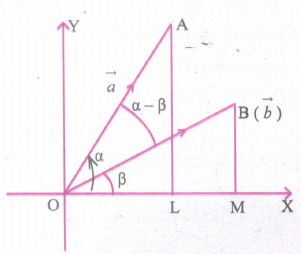
20.
Given A =\(\left[ \begin{matrix} -5 & 1 & 3 \\ 7 & 1 & -5 \\ 1 & -1 & 1 \end{matrix} \right] \), B=\(\left[ \begin{matrix} 1 & 1 & 2 \\ 3 & 2 & 1 \\ 2 & 1 & 3 \end{matrix} \right] \)
AB =\(\left[ \begin{matrix} -5 & 1 & 3 \\ 7 & 1 & -5 \\ 1 & -1 & 1 \end{matrix} \right] \left[ \begin{matrix} 1 & 1 & 2 \\ 3 & 2 & 1 \\ 2 & 1 & 3 \end{matrix} \right] \)
=\(\left[ \begin{matrix} -5+3+6 & -5+2+3 & -10+1+9 \\ 7+3-10 & 7+2-3 & 14+1-15 \\ 1-3+2 & 1-2+1 & 2-1+3 \end{matrix} \right] \)
=\(\left[ \begin{matrix} 4 & 0 & 0 \\ 0 & 4 & 0 \\ 0 & 0 & 4 \end{matrix} \right] \)= 4. I3
BA =\(\left[ \begin{matrix} 1 & 1 & 2 \\ 3 & 2 & 1 \\ 2 & 1 & 3 \end{matrix} \right] \left[ \begin{matrix} -5 & 1 & 3 \\ 7 & 1 & -5 \\ 1 & -1 & 1 \end{matrix} \right] \)
=\(\left[ \begin{matrix} -5+7+2 & 1+1-2 & 3-5+2 \\ -15+14+1 & 3+2-1 & 9-10+1 \\ -10+7+3 & 2+1-3 & 6-5+3 \end{matrix} \right] \)
=\(\left[ \begin{matrix} 4 & 0 & 0 \\ 0 & 4 & 0 \\ 0 & 0 & 4 \end{matrix} \right] \)= 4. I3.
So, we get AB = BA = 4. I3
⇒ \(\left( \frac { 1 }{ 4 } A \right) B=B\left( \frac { 1 }{ 4 } A \right) =1\)
⇒ B-1 = \(\frac { 1 }{ 4 } \) = 1
Writing the given set of equations in matrix form we get,
\(\left[ \begin{matrix} 1 & 1 & 2 \\ 3 & 2 & 1 \\ 2 & 1 & 3 \end{matrix} \right] \left[ \begin{matrix} x \\ y \\ z \end{matrix} \right] =\left[ \begin{matrix} 1 \\ 7 \\ 2 \end{matrix} \right] \)
⇒ \(B=\left[ \begin{matrix} x \\ y \\ z \end{matrix} \right] =\left[ \begin{matrix} 1 \\ 7 \\ 2 \end{matrix} \right] \)
⇒ \(\left[ \begin{matrix} x \\ y \\ z \end{matrix} \right] ={ B }^{ -1 }\left[ \begin{matrix} 1 \\ 7 \\ 2 \end{matrix} \right] =\left[ \frac { 1 }{ 4 } A \right] \left[ \begin{matrix} 1 \\ 7 \\ 2 \end{matrix} \right] \)
= \(\frac { 1 }{ 4 } \left[ \begin{matrix} -5 & 1 & 3 \\ 7 & 1 & -5 \\ 1 & -1 & 1 \end{matrix} \right] \left[ \begin{matrix} 1 \\ 7 \\ 2 \end{matrix} \right] \)
= \(\frac { 1 }{ 4 } \left[ \begin{matrix} -5+7+6 \\ 7+7-10 \\ 1-7+2 \end{matrix} \right] =\frac { 1 }{ 4 } \left[ \begin{matrix} 8 \\ 4 \\ -4 \end{matrix} \right] =\left[ \begin{matrix} 2 \\ 1 \\ -1 \end{matrix} \right] \)
∴ x = 2, y = 1, z = -1
Hence, the solution set is {2, 1, - 1}.
21.
The matrix form of the system is AX = B, where
A = \(\left[ \begin{matrix} 2 & 3 & 3 \\ 1 & -2 & 1 \\ 3 & -1 & -2 \end{matrix} \right] \),X = \(\left[ \begin{matrix} { x }_{ 1 } \\ { x }_{ 2 } \\ { x }_{ 3 } \end{matrix} \right] \),B = \(\left[ \begin{matrix} 5 \\ -4 \\ 3 \end{matrix} \right] \).
We find |A| = \(\left| \begin{matrix} 2 & 3 & 3 \\ 1 & -2 & 1 \\ 3 & -1 & -2 \end{matrix} \right| \) = 2(4 + 1) - 3(-2 - 3) + 3(-1 + 6) = 10 + 15 + 15 = 40 ≠ 0.
So, A−1 exists and
A-1 = \(\frac { 1 }{ \left| A \right| } \) (adj A) = \(\frac { 1 }{ 40 } { \left[ \begin{matrix} +\left( 4+1 \right) & -\left( -2-3 \right) & +\left( -1+6 \right) \\ -\left( -6+3 \right) & +\left( -4-9 \right) & -\left( -2-9 \right) \\ +\left( 3+6 \right) & -\left( 2-3 \right) & +\left( -4-3 \right) \end{matrix} \right] }^{ T }=\frac { 1 }{ 40 } \left[ \begin{matrix} 5 & 3 & 9 \\ 5 & -13 & 1 \\ 5 & 11 & -7 \end{matrix} \right] \)
Then, applying X = A−1B, we get
\(\left[ \begin{matrix} { x }_{ 1 } \\ { x }_{ 2 } \\ { x }_{ 3 } \end{matrix} \right] =\frac { 1 }{ 40 } \left[ \begin{matrix} 5 & 3 & 9 \\ 5 & -13 & 1 \\ 5 & 11 & -7 \end{matrix} \right] \left[ \begin{matrix} 5 \\ -4 \\ 3 \end{matrix} \right] =\frac { 1 }{ 40 } \left[ \begin{matrix} 25-12+27 \\ 25+52+3 \\ 25-44-21 \end{matrix} \right] =\frac { 1 }{ 40 } \left[ \begin{matrix} 40 \\ 80 \\ -40 \end{matrix} \right] =\left[ \begin{matrix} 1 \\ 2 \\ -1 \end{matrix} \right] \)
So, the solution is (x1 = 1, x2 = 2, x3 = -1).
22.
Let f(x) x6-3x5-5x4+22x3-39x2-39x+135
Given (1+2i) is a root \(\Rightarrow\)(-2i) is also a root
Also \(\sqrt3\) is a root \(\Rightarrow\)-\(\sqrt3\) is also a root.
Hence, the factors of f(x) are [x - (1 + 2i)]
[x-(1-2i)] [x\(\sqrt3\)] [x+\(\sqrt3\)]
[(x-1)-2i] [(x-1)+2i] [x-\(\sqrt3\)][x+\(\sqrt3\)]
((x-1)2+22)(x2-3) = (x2-2x+1+4)(x2-3)
\(\Rightarrow\) factor of f(x) is (x2-2x+5)(x2-3)
\(\Rightarrow\)x4-3x2-2x3+6x+5x2-15
\(\Rightarrow\)(x4-3x2-2x3+6x-15) is a factor of f(x)
To find the other factor, let us divide f(x) by
x4 - 2x3 + 2x2 + 6x - 15
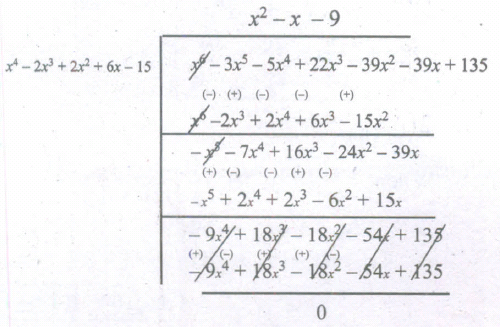
The other factor is x2 - x - 9
\(\Rightarrow x=\frac { 1\pm \sqrt { { (-1) }^{ 2 }-4(1)(-9) } }{ 2 } \left[ \because x=\frac { -b\pm \sqrt { { b }^{ 2 }-4ac } }{ 2a } \right] \)
\(\Rightarrow x=\frac { 1\pm \sqrt { 37 } }{ 2 } \)
Hence the roots are
1 - 2i, 1 + 2i, \(\sqrt { 3 }, -\sqrt { 3 }, \frac { 1+\sqrt { 37 } }{ 2 } ,\frac { 1-\sqrt { 37 } }{ 2 } \).
23.
(i) 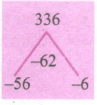
Rearrange the terms as,
(x-5) (x+4) (x-7) (x+6) = 504
{-2, 3, -7, 8}
⇒ (x2 -x - 20) (x2 -x - 42) = 504
Put x2- x = y
⇒ (y-20)(y-42) = 504
⇒ y2-62y+840-504 = 0
⇒ y2-62y+336 = 0
⇒ (y - 56) (y - 6) = 0
⇒ y = 56, 6
Case (i)
When y = 56, x2 - x = 56
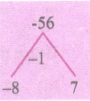
⇒ x2 - x - 56 = 0
⇒ (x - 8)(x + 7) = 0
⇒ x = 8, -7
Case (ii)
When y = 6,
x2- x = 6
x2- x - 6 = 0
⇒ (x - 3)(x + 2) = 0
⇒ x = 3, - 2

Hence the roots are -2, 3, 8, -7
24.
Let the equation of the circle be
x2 + y2 + 2gx + 2fy + c = 0 ........... (1)
(1) passes through (1, 0)
⇒ 1 + 0 + 2g(1) + 2f(0) + c = 0
⇒ 2g + c = -1 ................(2)
(1) passes through (-1, 0)
⇒ (-1)2 + 0 + 2g(-1) + 2f(0)+ c = 0
⇒ -2g + c = -1 ..............(3)
Also (1) passes through (0, 1)
⇒ 0 + 12+ 2g(0) +2f(1) + c = 0
⇒ 2f + c = -1 .................(4)
(2) + (3) ⇒ 2c = -2
⇒ c = -1
Substituting c = -1 in (2), we get
2g-1 = -1
⇒ 2g = 0
⇒ g = 0
Substituting c = -1 in (4) we get,
2f -1 = -1
⇒ 2f = 0
⇒ f = 0
∴ The required equation of the circle
x2 + y2 - 1 = 0
25.
Let ∝, β, ૪ be the roots of the equation
Given \(\frac { \alpha }{ \beta } =\frac { 3 }{ 2 } \Rightarrow 2\alpha =3\beta \Rightarrow \alpha =\frac { 3 }{ 2 } \beta \)
\(\therefore \frac { 3 }{ 2 } \beta ,\beta ,\gamma \) are the roots of the given equation
Then by Vieta's formula,
\(\frac { 3 }{ 2 } \beta +\beta +\gamma =\frac { -b }{ a } =\frac { -(-9) }{ 1 } =9\)
\(\frac { 5 }{ 2 } \beta +\gamma =9\Rightarrow \gamma =9-\frac { 5 }{ 2 } \beta \)
\(\Rightarrow \gamma =\frac { 18-5\beta }{ 2 } ...(2)\)
Also \(\frac { 3 }{ 2 } \beta (\beta )+\beta \gamma +\left( \frac { 3 }{ 2 } \beta \right) \gamma =\frac { c }{ a } =\frac { 14 }{ 1 } =14\)
\(\Rightarrow \frac { 3 }{ 2 } { \beta }^{ 2 }+\frac { 5 }{ 2 } \beta \left( \frac { 18-5\beta }{ 2 } \right) =14\ [using\ (2)]\)
\(\Rightarrow \frac { 3 }{ 2 } { \beta }^{ 2 }+\frac { 90\beta }{ 4 } -\frac { 25{ \beta }^{ 2 } }{ 4 } =14\)
Multiplying by \(4,6{ \beta }^{ 2 }+90{ \beta }-25{ \beta }^{ 2 }=56\)
\(19{ \beta }^{ 2 }-90{ \beta }+56=0\)
\(\Rightarrow ({ \beta }-4)(19{ \beta }-14)=0\)
\(\Rightarrow { \beta }=4\)
\({ \beta }=\frac { 14 }{ 19 } \)
When \(\beta\) = 4, the other roots are \(\frac { 3 }{ 2 } (4),4,\frac { 18-5 }{ 2 } (4)\)
\(\Rightarrow 6,4,-1\)
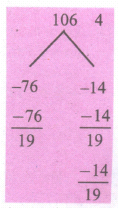
When \(\\ \beta =\frac { 14 }{ 19 } ,\) the other roots are \(\frac { 3 }{ 2 } \beta ,\beta \frac { 18-5\beta }{ 2 } [by(2)]\)
\(\Rightarrow \frac { 3 }{ 2 } \left( \frac { 14 }{ 19 } \right) ,\frac { 14 }{ 19 } ,\frac { 18-5\left( \frac { 14 }{ 19 } \right) }{ 2 } \Rightarrow \frac { 21 }{ 19 } ,\frac { 14 }{ 19 } ,\frac { 136 }{ 19 } \)

12th Standard Syllabus & Materials
12th Standard
TN 12th Computer Applications களப்பெயர் முறைமை (DNS) Sample Question Papers Study Material - QB365 Set A
NEW12th Standard
TN 12th Computer Applications வலையமைப்பு எடுத்துக்காட்டுகள் மற்றும் நெறிமுறைகள் Sample Question Papers Study Material - QB365 Set A
NEW12th Standard
TN 12th Computer Applications கணினி வலையமைப்பு ஓர் அறிமுகம் Sample Question Papers Study Material - QB365 Set A
NEW12th Standard
TN 12th Computer Applications PHP-உடன் MySQL-ஐ இணைத்தல் Sample Question Papers Study Material - QB365 Set A



Tamilnadu Stateboard 12th Standard Subjects
Maths

Chemistry

Physics

Biology

Computer Science

Business Maths and Statistics

Economics

Commerce

Accountancy

History

Computer Applications
Biology
Computer Technology
Computer Applications
Computer Science
Business Maths and Statistics
Commerce
Economics
Maths
Chemistry
Physics
Computer Technology
History
Accountancy

Tamil

English

French
Tamilnadu Stateboard Standards



