
 100% FREE ACCESS
12th Standard Syllabus & Materials
12th Standard
TN 12th Computer Applications மின்னணு தரவு பரிமாற்றம் Sample Question Papers Study Material - QB365 Set A
NEW12th Standard
TN 12th Computer Applications மின் - வணிக பாதுகாப்பு அமைப்புகள் Sample Question Papers Study Material - QB365 Set A
NEW12th Standard
TN 12th Computer Applications மின்னணு செலுத்தல் முறைகள் Sample Question Papers Study Material - QB365 Set A
NEW12th Standard
TN 12th Computer Applications மின் - வணிகம் Sample Question Papers Study Material - QB365 Set A
NEW12th Standard
TN 12th Computer Applications திறந்த மூல கருத்துருக்கள் Sample Question Papers Study Material - QB365 Set A
NEW12th Standard
TN 12th Computer Applications வலையமைப்பு வடமிடல் Sample Question Papers Study Material - QB365 Set A

Published on: 13/05/2022
QB365 provides detailed and simple solution for every book back questions in class 12 Maths subject.It will helps to get more idea about question pattern in every book back questions with solution.
latest Book back QuestionsDownload Tamil Nadu 12th Standard Maths question papers, model tests, one-mark questions, important questions, and public exam papers in PDF format. Free study materials and answer keys for TN State Board students.
Questions + Answers key
Take MCQ Maths Test1.
Let A be Q\{1}. Define ∗ on A by x*y = x + y − xy. Is ∗ binary on A? If so, examine the commutative and associative properties satisfied by ∗ on A.
2.
Let M = \(\left\{ \left( \begin{matrix} x & x \\ x & x \end{matrix} \right) :x\in R-\{ 0\} \right\} \) and let * be the matrix multiplication. Determine whether M is closed under ∗. If so, examine the commutative and associative properties satisfied by ∗ on M.
3.
Verify
(i) closure property
(ii) commutative property
(iii) associative property
(iv) existence of identity and
(v) existence of inverse for the operation +5 on Z5 using table corresponding to addition modulo 5.
4.
Verify
(i) closure property
(ii) commutative property
(iii) associative property
(iv) existence of identity, and
(v) existence of inverse for following operation on the given set m*n = m + n - mn; m, n ∈Z
5.
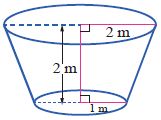
Find, by integration, the volume of the container which is in the shape of a right circular conical frustum.
6.
Father of a family wishes to divide his square field bounded by x = 0, x = 4, y = 4 and y = 0 along the curve y2 = 4x and x2 = 4y into three equal parts for his wife, daughter and son. Is it possible to divide? If so, find the area to be divided among them.
7.
Two balls are chosen randomly from an urn containing 8 white and 4 black balls. Suppose that we win Rs. 20 for each black ball selected and we lose Rs. 10 for each white ball selected. Find the expected winning amount and variance
8.
If X is the random variable with probability density function f(x) given by,
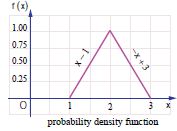
\(f(x)=\begin{cases} \begin{matrix} x-1 & 1\le x<2 \end{matrix} \\ \begin{matrix} -x+3 & 2\le x<3 \end{matrix} \\ \begin{matrix} 0 & Otherwise \end{matrix} \end{cases}\)
find
(i) the distribution function F(x)
(ii) P(1.5 ≤ X ≤ 2.5)
9.
If X is the random variable with probability density function f(x) given by,
\(f(x)=\begin{cases} \begin{matrix} x+1 & -1\le x<0 \end{matrix} \\ \begin{matrix} -x+1 & 0\le x<1 \end{matrix} \\ \begin{matrix} 0 & otherwise \end{matrix} \end{cases}\)
then find
(i) the distribution function F(x)
(ii) P( -0.5 ≤X ≤ 0.5)
10.
Determine the intervals of concavity of the curve f (x) = (x −1)3. (x − 5), x∈R and, points of inflection if any.
11.
A pot of boiling water at 100o C is removed from a stove at time t = 0 and left to cool in the kitchen. After 5 minutes, the water temperature has decreased to 80o C , and another 5 minutes later it has dropped to 65oC. Determine the temperature of the kitchen.
12.
Solve the Linear differential equation:
\(\frac { dy }{ dx } +\frac { 3y }{ x } =\frac { 1 }{ { x }^{ 2 } } \), given that y = 2 when x = 1
13.
A garden is to be laid out in a rectangular area and protected by wire fence. What is the largest possible area of the fenced garden with 40 metres of wire.
14.
Solve the following differential equations
(x2+y2)dy = xy dx. It is given that y(1) = 1 and y(x0) = e. Find the value of x0.
15.
Find the equation of the curve whose slope is \(\frac { y-1 }{ { x }^{ 2 }+x } \) and which passes through the point (1, 0).
16.
A particle moves along a line according to the law s(t) = 2t3 − 9t2 +12t − 4, where t ≥ 0.
17.
A particle moves along a line according to the law s(t) = 2t3 − 9t2 +12t − 4, where t ≥ 0.
(i) At what times the particle changes direction?
(ii) Find the total distance travelled by the particle in the first 4 seconds.
(iii) Find the particle’s acceleration each time the velocity is zero.
18.
Find the inverse of each of the following by Gauss-Jordan method:
\(\left[ \begin{matrix} 1 & 2 & 3 \\ 2 & 5 & 3 \\ 1 & 0 & 8 \end{matrix} \right] \)
19.
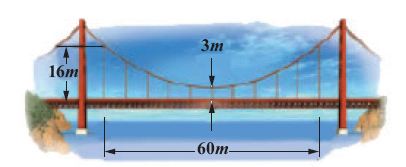
Parabolic cable of a 60m portion of the roadbed of a suspension bridge are positioned as shown below. Vertical Cables are to be spaced every 6m along this portion of the roadbed. Calculate the lengths of first two of these vertical cables from the vertex.
20.
Prove by vector method that sin(α + β ) = sin α cos β + cos α sin β
21.
Prove by vector method that the perpendiculars (altitudes) from the vertices to the opposite sides of a triangle are concurrent.
22.
Determine k and solve the equation 2x3-6x2+3x+k = 0 if one of its roots is twice the sum of the other two roots.
23.
For the ellipse 4x2 + y2 + 24x − 2y + 21 = 0, find the centre, vertices and the foci. Also prove that the length of latus rectum is 2
24.
Evaluate the following:
\(\int _{ 0 }^{ \frac { 1 }{ 2 } }{ \frac { { e }^{ { a\ sin }^{ -1x } }{ sin }^{ -1 }x }{ \sqrt { 1-{ x }^{ 2 } } } dx } \)
25.
Solve (x2 -3y2) dx + 2xydy = 0.
1.
given A = {Q\{1}}
A is defined on A by x*y = x+y-xy
Let x,y ≠ 1
∴ x*y = x + y - xy
Now to prove that x + y - xy ≠ 1
Let us assume that x + y - xy = 1
x+y-xy-1 = 0
(x-1)-y(x-1) = 0
(x-1)(1-y) = 0
x =1 or y = 1 which is a false [∵x, y ≠ 1]
∴ is a binary operation on A.
Commutative property:
Let x,y ∈A ⇒ x, y≠1
∴x*y = x+y-xy
and y*x = y+x-yx
⇒x+y = y*x∀x, y∈A
A has commutative property under *
Associative property:
Let x,y,z ∊A ⇒x,y,z≠1
Consider (x*y)*z = (x+y-xy)*z
= x +y~xy +z- (x +y-xy)z
= x +y-xy+ z-xz- yz + xyz
= x +y+z-xy-yz-zx +xyz ...(1)
= x +y+z - yz - x (y + z - yz)
= x +y +z-yz-zy-xz +xyz ..(2)
From (1) & (2), (x*y)*z = x*(y*z)
A has associative property under *.
2.
Given M = \(\left\{ \left( \begin{matrix} x & x \\ x & x \end{matrix} \right) :x\in R-\{ 0\} \right\} \) and * be the matrix multipilication.
Let A \(=\left( \begin{matrix} x & x \\ x & x \end{matrix} \right) \) and B = \(\left( \begin{matrix} y & y \\ y & y \end{matrix} \right) \in M\)
Where x, y ∈R-{0}.
\(A*B=\left( \begin{matrix} x & x \\ x & x \end{matrix} \right) \left( \begin{matrix} y & y \\ y & y \end{matrix} \right) \)
\(\\ =\left( \begin{matrix} 2xy & 2xy \\ 2xy & 2xy \end{matrix} \right) \in M\)
[∵ 2xy ∈R-{0}]
∴ M is closed under *.
Commutative property:
we know A*B =\(\left( \begin{matrix} 2xy & 2xy \\ 2xy & 2xy \end{matrix} \right) ..(1)\)
Let x,y∈R-{0}
Now B + A \(=\left( \begin{matrix} y & y \\ y & y \end{matrix} \right) \left( \begin{matrix} x & x \\ x & x \end{matrix} \right) \)
\(=\left( \begin{matrix} xy+xy & xy+xy \\ xy+xy & xy+xy \end{matrix} \right) \)
\(=\left( \begin{matrix} 2xy & 2xy \\ 2xy & 2xy \end{matrix} \right) \\ \)
From (1) &(2), A*B = B*A
∴ *has commutative property on M
Associative property:
Let A = \(\left( \begin{matrix} x & x \\ x & x \end{matrix} \right) \)
B =\(\left( \begin{matrix} y & y \\ y & y \end{matrix} \right) \) and
C = \(\left( \begin{matrix} z & z \\ z & z \end{matrix} \right) \)
for x, y, z ∈R-{0}
\((A*B)*C=\left( \begin{matrix} 2xy & 2xy \\ 2xy & 2xy \end{matrix} \right) *\left( \begin{matrix} z & z \\ z & z \end{matrix} \right) \)
\(=\left( \begin{matrix} 2xyz+2xyz & 2xyz+2xyz \\ 2xyz+2xyz & 2xyz+2xyz \end{matrix} \right) \)
\(=\left( \begin{matrix} 4xyz & 4xyz \\ 4xyz & 4xyz \end{matrix} \right) ...(1)\)
Now\(A*(B*C)=A*\left( \begin{matrix} 2yz & 2yz \\ 2yz & 2yz \end{matrix} \right) \)
\(=\left( \begin{matrix} x & x \\ x & x \end{matrix} \right) *\left( \begin{matrix} 2yz & 2yz \\ 2yz & 2yz \end{matrix} \right) \)
\(=\left( \begin{matrix} 4xyz & 4xyz \\ 4xyz & 4xyz \end{matrix} \right) ...(2)\\ \)
From (1)&(2), (a*B)*C = A*B*C)
Since matrix multiplication is associative, this axiom holds good for M.
3.
It is known that Z5 = {[0], [1], [2], [3], [4]}. The table corresponding to addition modulo 5 is as follows: We take reminders {0,1,2,3,4} to represent the classes {[0], [1], [2], [3], [4]}.
| +5 | 0 | 1 | 2 | 3 | 4 |
| 0 | 0 | 1 | 2 | 3 | 4 |
| 1 | 1 | 2 | 3 | 4 | 0 |
| 2 | 2 | 3 | 4 | 0 | 1 |
| 3 | 3 | 4 | 0 | 1 | 2 |
| 4 | 4 | 0 | 1 | 2 | 3 |
(i) Since each box in the table is filled by exactly one element of Z5, the output a +5 b is unique and hence +5 is a binary operation.
(ii) The entries are symmetrically placed with respect to the main diagonal. So +5 has commutative property
(iii) The table cannot be used directly for the verification of the associative property. So it is to be verified as usual
For instance, (2+53)+5 4 = 0+5 4 = 4(mod 5)
and 2+5(3+54) = 2 +5 2 = 4(mod5)
Hence (2+53)+54 = 2+5(3+54)
Proceeding like this one can verify this for all possible triples and ultimately it can be shown that +5 is associative
(iv) The row headed by 0 and the column headed by 0 are identical. Hence the identity element is 0.
(v) The existence of inverse is guaranteed provided the identity 0 exists in each row and each column. From Table, it is clear that this property is true in this case. The method of finding the inverse of any one of the elements of Z5, say 2 is outlined below.
First find the position of the identity element 0 in the III row headed by 2. Move horizontally along the III row and after reaching 0, move vertically above 0 in the IV column, because 0 is in the III row and IV column. The element reached at the topmost position of IV column is 3. This element 3 is nothing but the inverse of 2, because, 2+5 5+ = 0 (mod5). In this way, the inverse of each and every element of Z5 can be obtained. Note that the inverse of 0 is 0, that of 1 is 4, that of 2 is 3, that of 3 is 2, and, that of 4 is 1.
4.
(i) The output m+ n - mn is clearly an integer and hence∗ is a binary operation on Z.
(ii) m*n = m+ n − mn = n + m − nm = n*m, ∀m,n∈Z. So ∗ has commutative property.
(iii) Consider (m*n)*p = (m+ n −m n)* p= (m+ n −mn) + p − (m+ n −m n) p
= m+ n + p −mn −m p − n p + m n p ... (1)
Similarly m*(n*p) = m*(n + p − n p) = m+ (n + p − n p) −m (n + p − n p)
= m+ n + p − n p −m n −mp + m n p ... (2)
From (1) and (2), we see that m*(n*p) = (m*n)*p. Hence * has associative property.
(iv) An integer e is to be found such that
m*e = e*m = m, ∀m∈Z ⇒ m + e - m e = m
⇒e(1-m) = 0 ⇒ e = 0 or m = 1. But m is an arbitrary integer and hence need not be equal to 1. So the only possibility is e = 0. Also m*0 = 0*m = m, ∀m∈Z. Hence 0 is the identity element and hence the existence of identity is assured.
(v) An element m'∈ Z is to be found such that m*m' = m' * m = e = 0, ∀m∈Z.
m*m' = 0 ⇒ m+m'-m m'= 0⇒ m m' = 0 ⇒ \(\frac{m}{m-1}\). when m = 1, m' is not defined.
When m = 2, m' is an integer. But except m = 2, m′ need not be an integer for all values of m. Hence inverse does not exist in Z.
5.
Volume of the right circular conical frustum is obtained by revolving the line y = x between x = a and x = b around the x - axis
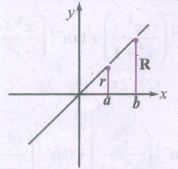
\(\therefore\) Height of the frustum h = b - a
\(\therefore\)Volume \(=\pi \int _{ a }^{ b }{ { x }^{ 2 }dx } =\pi { \left[ \frac { { x }^{ 3 } }{ 3 } \right] }_{ a }^{ b }\)
\(=\frac { \pi }{ 3 } [{ b }^{ 3 }-{ a }^{ 3 }]\)
\(=\frac { \pi }{ 3 } (b-a)({ b }^{ 2 }+ab+{ a }^{ 2 })\)
Now, substitute h = b - a, r = a and R = b we get Volume of the conical frustum
\(\frac { \pi }{ 3 } [h({ R }^{ 2 }+rR+{ r }^{ 2 })]\)
Given h = 2 m, r = 1 m, R = 2 m we get
Required volume \(=\frac { \pi }{ 3 } [2(4+2+1)]\)
\(=\frac { \pi }{ 3 } (14)\)
\(=\frac { 14\pi }{ 3 } \)
6.
Equation of the given curves are y2 = 4x and x2 = 4y
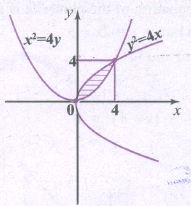
\(\therefore \) Required area \(=\int _{ 0 }^{ 4 }{ \left( \sqrt { 4x } -\frac { { x }^{ 2 } }{ 4 } \right) dx } \)
\(=\int _{ 0 }^{ 4 }{ \left( 2\sqrt { x } -\frac { { x }^{ 2 } }{ 4 } \right) dx } \)
\(={ \left[ \frac { { 2x }^{ \frac { 3 }{ 2 } } }{ \frac { 3 }{ 2 } } \right] }_{ 0 }^{ 4 }{ \left[ \frac { 4 }{ 3 } x\sqrt { x } -\frac { { x }^{ 3 } }{ 12 } \right] }_{ 0 }^{ 4 }\)
\(=\frac { 4 }{ 3 } (4)(2)-\frac { 64 }{ 12 } \)
\(=\frac { 32 }{ 3 } -\frac { 32 }{ 6 } =\frac { 64-32 }{ 6 } =\frac { 32 }{ 6 } \)
\(=\frac { 16 }{ 3 } \) sq.units
Yes the area can be divided into 3 equal parts and the area to the divided among his, wife daughter and son is \(=\frac { 16 }{ 3 } \)sq.units
7.
Let X denote the winning amount. The possible events of selection are
(i) both balls are black, or
(ii) one white and one black or
(iii) both are white
Therefore X is a random variable that can be defined as
X (both are black balls) = Rs. 2(20) = Rs. 40
X (one black and one white ball) = Rs. 20 − Rs. 10 = Rs. 10
X (both are white balls) = (Rs. 20) = - Rs. 20
Therefore X takes on the values 40,10 and −20
Total number of balls n = 12
Total number of ways of selecting 2 balls = \(\left( \begin{matrix} 12 \\ 2 \end{matrix} \right) =\frac { 12\times 11 }{ 1\times 2 } =66\)
Number of ways of selecting 2 black balls = \(\left( \begin{matrix} 4 \\ 2 \end{matrix} \right) =6\)
Number of ways of selecting one black ball and one white ball = \(\left( \begin{matrix} 8 \\ 1 \end{matrix} \right) \left( \begin{matrix} 4 \\ 1 \end{matrix} \right) =32\)
Number of ways of selecting 2 white balls = \(\left( \begin{matrix} 8 \\ 2 \end{matrix} \right) =28\)
| Values of Random Variable X | 40 | 10 | -20 | Total |
| Number of elements in inverse images | 6 | 32 | 28 | 66 |
Probability mass function is
| X | 40 | 10 | -20 | Total |
| f (x) | \(\cfrac { 6 }{ 66 } \) | \(\cfrac { 32 }{ 66 } \) | \(\cfrac { 28 }{ 66 } \) | 1 |
Mean :
\(E(X)\Sigma xf(x)=40.\left( \frac { 6 }{ 66 } \right) +10.\left( \frac { 32 }{ 66 } \right) +\left( -20 \right) .\left( \frac { 28 }{ 66 } \right) =\frac { 4000 }{ 11 } \)
That is expected winning amount is 0
Variance :
\(\Sigma x^{ 2 }=\Sigma { x }^{ 2 }f(x)=40^{ 2 }.\left( \frac { 6 }{ 66 } \right) +10^{ 2 }.\left( \frac { 32 }{ 66 } \right) +\left( -20 \right) ^{ 2 }.\left( \frac { 28 }{ 66 } \right) =\frac { 4000 }{ 11 } \)
(E(X )2 = 02 = 0
This gives \(V(X)=E({ X }^{ 2 })-\left( E(X))^{ 2 } \right) =\frac { 4000 }{ 11 } -0=\frac { 4000 }{ 11 } \)
Therefore E(X ) = 0 and \(V(x)=\frac { 4000 }{ 11 } \)
8.
(i) By definition \(F(x)=\le x)=\int _{ -\infty }^{ x }{ f(u)dx } \)
When x < 1 \(F(x)=P\left( x\le x \right) =\int _{ 1 }^{ x }{ odu+\int _{ 1 }^{ 0 }{ (u-1) } du } \)
When 1 ≤ x < 2 \(F(x)=P(X\le x)=\int _{ -\infty }^{ x }{ odu } =0\)
When 1 ≤ x < 2 \(F(x)=P\left( x\le x \right) =\int _{ 1 }^{ x }{ odu+\int _{ 1 }^{ 0 }{ (u-1) } du } \)
= \(0+\left[ \frac { \left( u-1 \right) ^{ 2 } }{ 2 } \right] =\frac { \left( x-1 \right) ^{ 2 } }{ 2 } \)
When 2 ≤ x <3 \(F(x)=P(X\le x)=\int _{ -\infty }^{ 1 }{ du } +\int _{ 1 }^{ 2 }{ \left( u-1 \right) du } +\int _{ 2 }^{ x }{ \left( 3-u \right) du } \)
= \(0+\left[ \frac { \left( u-1 \right) ^{ 2 } }{ 2 } \right] +\left[ \frac { (3-u)^{ 2 } }{ 2 } \right] \)
= \(\frac { { 1 }^{ 2 }-0 }{ 2 } +\frac { 1-(3-x)^{ 2 } }{ 2 } =1\frac { \left( 3-x \right) ^{ 2 } }{ 2 } \)
When x ≥ 3, \(F(x)=P\left( X\le x \right) =\int _{ -\infty }^{ 1 }{ odu } +\int _{ 1 }^{ 3 }{ (u-1) } +\int _{ 2 }^{ 1 }{ (3-u) } +\int _{ 3 }^{ x }{ odu } \)
= \(\int _{ -\infty }^{ 1 }{ 0du } +\int _{ 1 }^{ 2 }{ (u-1)du } +\int _{ 2 }^{ 3 }{ (3-u) } du+\int _{ 3 }^{ x }{ 0du } \)
= \(0+\left[ \frac { \left( u-1 \right) ^{ 2 } }{ 2 } \right] +\left[ \frac { \left( 3-u \right) ^{ 2 } }{ 2 } \right] _{ 2 }^{ 3 }+0\)
= \(\cfrac { 1 }{ 2 } +\cfrac { 1 }{ 2 } =1\)
These give
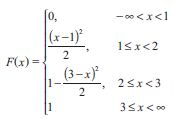
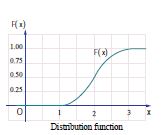
(ii) P(1.5 ≤ X ≤ 2.5) = F(2.5) − F(1.5)
= \(\left( 1-\frac { \left( 3-2.5 \right) ^{ 2 } }{ 2 } \right) -\left( \frac { \left( 1.5-1 \right) ^{ 2 } }{ 2 } \right) \)
= \(\cfrac { 1.75-0.25 }{ 2 } =0.75\)
\(P\left( 1.5\le X\le \right) =\int _{ 1.5 }^{ 2.5 }{ f(x)dx } =\int _{ 1.5 }^{ 2 }{ (x-1) } dx+\int _{ 2 }^{ 2.5 }{ (-x+3) } dx=0.75\)
9.
\(f(x)=\begin{cases} \begin{matrix} x+1 & -1\le x<0 \end{matrix} \\ \begin{matrix} -x+1 & 0\le x<1 \end{matrix} \\ \begin{matrix} 0 & otherwise \end{matrix} \end{cases}\)
(i) Distribution function
Case 1 : x < -1
F(x) = \(\int _{ -\infty }^{ x }{ f(u)du } \) = 0
Case 2 : -1 ≤ x < 0
\(\int _{ -\infty }^{ x }{ f(u)du } \)
= \(\int _{ -\infty }^{ x }{ f(x) } dx=\left[ \frac { { x }^{ 2 } }{ 2 } +x \right] _{ -1 }\)
= \(\left( \frac { {u }^{ 2 } }{ 2 } +u \right)=\frac{x^2}{2}+x -\left( \frac { 1 }{ 2 } +1 \right) \)
= \(\frac { { x }^{ 2 } }{ 2 } +x+\frac { 1 }{ 2 } \)
Case 3 : 0 ≤ x < 1,
\(F(X)=\int _{ 0 }^{ x }{ (-x+1)dx } =\left[ -\frac { { x }^{ 2 } }{ 2 } +x \right] _{ 0 }^{ x }\)
= \(\left( -\frac { { x }^{ 2 } }{ 2 } +x \right) -\left( 0 \right) =\frac { { x }^{ 2 } }{ 2 } +x\)
When 1 ≤ x,
\(F(x)=\int _{ 1 }^{ x }{ f(x)dx } =\int _{ 1 }^{ x }{ 0dx } \)
= \(\therefore F(X)=\begin{cases} \begin{matrix} \frac { { x }^{ 2 } }{ 2 } +x+\frac { 1 }{ 2 } & -1\le x<0 \end{matrix} \\ \begin{matrix} -\frac { { x }^{ 2 } }{ 2 } +x & 0\le x<1 \end{matrix} \\ \begin{matrix} 0 & otherwise \end{matrix} \end{cases}\)
(ii) p(0.5 ≤ X ≤ 0.5)
= \(\int _{ -0.5 }^{ 0.5 }{ f(x)dx } =\int _{ 0.5 }^{ 0 }{ f(x)dx+\int _{ 0 }^{ 0.5 }{ f(x)dx } } \)
= \(\int _{ -0.5 }^{ 0 }{ (x+1) } dx+\int _{ 0 }^{ 0.5 }{ \left( -x+1 \right) } dx\)
= \(\left[ \frac { { x }^{ 2 } }{ 2 } +x \right] _{ -0.5 }^{ 0 }+\left[ \frac { -{ x }^{ 2 } }{ 2 } +x \right] _{ 0 }^{ 0.5 }\)
= \(0-\left( \frac { { 0.5 }^{ 2 } }{ 2 } -0.5 \right) +\left( -\frac { \left( 0.5 \right) ^{ 2 } }{ 2 } +0.5 \right) -0\)
= \(-\left( \frac { .25 }{ 2 } -0.5 \right) +\left( \frac { -0.25 }{ 2 } +0.5 \right) \)
= \(\frac { .25 }{ 2 } +0.5-\frac { 0.25 }{ 2 } +0.5=0.25+1\)
= 0.75
10.
The given function is a polynomial of degree 4. Now,
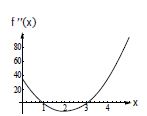
f′(x) = (x −1)3 + 3(x −1)2 . (x − 5)
= 4(x-1)2.(x-4)
f"(x) = 4(x-1)2+2(x-1).(x-4)
= 12(x −1) (x − 3)
Now,
f''(x) = 0 ⇒ x = 1, x = 3
The intervals of concavity are tabulated in the table 7.7.
| Interval | (-∞, 1) | (1, 3) | (3, ∞) |
| Sign of f'(x) | + | - | + |
| Concavity | concave up | concave down | concave up |
 |
 |
 |
The curve is concave upwards on (∞, 1) and (3, ∞) .
The curve is concave downwards on (1, 3) .
As f′′(x) changes its sign when it passes through x = 1 and x = 3, (1, f(1)) = (1, 0) and (3, f(3)) = (3, −16) are points of inflection for the graph y = f(x). This may be observed from the adjoining figure of the curve f′′(x) .
11.
Let T represent the temperature of the boiling water and Tm represents the temperature of the kitchen.
By Newton's law of cooling
\(\Rightarrow \int { \frac { dT }{ T-{ T }_{ m } } =K\int { dt } } \)
\(\Rightarrow log(T-{ T }_{ m })=Kt+logC\)
\(\Rightarrow log(T-{ T }_{ m })-logC=Kt\)
\(\Rightarrow log\left( \frac { T-{ T }_{ m } }{ C } \right) =Kt\)
\(\Rightarrow T-{ T }_{ m }={ Ce }^{ Kt } ...(1)\)
when t=0,T=100
\(\therefore 100-{ T }_{ m }={ Ce }^{ 0 }\)
\(\Rightarrow C=100-{ T }_{ m }\)
\(\Rightarrow becomes,\ T-{ T }_{ m }=(100-{ T }_{ m }){ e }^{ Kt }\)
Also when t = 5, T = 80
\(\therefore 80-{ T }_{ m }=(100-{ T }_{ m }){ e }^{ 5K }\)
\(\Rightarrow { e }^{ 5K }=\frac { 80-{ T }_{ m } }{ 100-{ T }_{ m } } ..(2)\)
When t = 10, T = 65
(2) \(\Rightarrow\) 65 - T = (100-Tm)e10K
= (100-Tm)(e5K)2
\(=(100-{ T }_{ m }){ \left( \frac { 80-{ T }_{ m } }{ 100-{ T }_{ m } } \right) }^{ 2 }\)
[using(2)]
\(\Rightarrow 65-{ T }_{ m }=\frac { { (80-{ T }_{ m } })^{ 2 } }{ 100-{ T }_{ m } } \)
\(\Rightarrow\) 6500-65Tm-100Tm+Tm2 = 6400+Tm2-160Tm
\(\Rightarrow\) 6500-6400 = 165Tm-160Tm
\(\Rightarrow\) 100 = 5Tm
\(\\ \Rightarrow { T }_{ m }=\frac { 100 }{ 5 } ={ 20 }^{ o }C\)
Hence the temperature of the kitchen is 20oC
12.
\(\frac { dy }{ dx } +\frac { 3y }{ x } =\frac { 1 }{ { x }^{ 2 } } \), given that y = 2 when x = 1
This is a linear differential equation.
\(\therefore P=\frac { 3 }{ x } ;Q=\frac { 1 }{ { x }^{ 2 } } \)
\(\int { pdx } =3\int { \frac { 1 }{ x } dx=3logx=log{ x }^{ 3 } } \)
\(\therefore I.F.={ e }^{ \int { pdx } }={ e }^{ log{ x }^{ 3 } }={ x }^{ 3 }\)
\(\therefore\) The solution is \({ ye }^{ \int { pdx } }=\int { Q{ e }^{ \int { pdx } }dx+c } \)
\(\Rightarrow { yx }^{ 3 }=\int { \frac { 1 }{ { x }^{ 2 } } .{ x }^{ 3 } } dx+c\)
\(\Rightarrow { yx }^{ 3 }=\int { xdx+c } \)
\(\Rightarrow { yx }^{ 3 }=\frac { { x }^{ 2 } }{ 2 } +c...(1)\)
When x = 1, y = 2
\(\Rightarrow 2{ (1) }^{ 3 }=\frac { 1 }{ 2 } +c\Rightarrow 2-\frac { 1 }{ 2 } =\frac { 3 }{ 2 } \)
\({ yx }^{ 3 }=\frac { { x }^{ 2 } }{ 2 } +\frac { 3 }{ 2 } \)
\({ 2x }^{ 3 }y={ x }^{ 2 }+3\)
13.
Let x be the length of the garden and y be the breadth of the garden.

Given 2 (x +y) = 40
[ஃ length of the wire = 40 Perimeter = 40 m]
⇒ x + y = 20
⇒ y = 20 - x ...(1)
Let f(x) = xy = x (20 - x2) = 20x- xl2
f'(x) = 20 - 2x
f'(x) = 0
⇒ 20-2x = 0
⇒ 20 = 2x
x = 10
ஃ The critical number is 10
f"(x) = -2
Now f"(10) = -2 < 0
ஃ f(x) is minimum at x = 10
When x = 10, y = 20 -10 = 10
ஃ Area = f(x) = xy
= 10(10) = 100m2
ஃ Largest possible area of the garden = 100 m2
14.
(x2+y2)dy = xy dx
\(\frac { dy }{ dx } =\frac { xy }{ { x }^{ 2 }+{ y }^{ 2 } } ...(1)\)
\(\therefore put=vx\Rightarrow \frac { dy }{ dx } =v+x\frac { dv }{ dx } \)
\(\therefore\)(1) becomes,
\(v+x\frac { dv }{ dx } =\frac { xvx }{ { x }^{ 2 }+{ v }^{ 2 }{ x }^{ 2 } } \)
\(=\frac { { x }^{ 2 }v }{ { x }^{ 2 }(1+{ v }^{ 2 }) } =\frac { v }{ 1+{ v }^{ 2 } } \)
\(x\frac { dv }{ dx } =\frac { v }{ 1+{ v }^{ 2 } } v=\frac { v-v-{ v }^{ 3 } }{ 1+{ v }^{ 2 } } =\frac { -{ v }^{ 3 } }{ 1+{ v }^{ 2 } } \)
Separating the variables we get,
\(\frac { 1+{ v }^{ 2 } }{ { v }^{ 3 } } dv=\frac { -dx }{ x } \)
\(\Rightarrow \frac { 1 }{ { v }^{ 3 } } +\frac { { v }^{ 2 } }{ { v }^{ 3 } } dv=\frac { -dx }{ x } \)
\(\Rightarrow \int { { v }^{ -3 }dv } +\int { \frac { dv }{ v } =-\int { \frac { dx }{ x } } } \)
\(\Rightarrow \frac { { v }^{ -2 } }{ -2 } +log\ v=-logx+logc\)
\(\Rightarrow -\frac { 1 }{ 2{ v }^{ 2 } } +log\ v=-log\ x+log\quad c\)
\(\Rightarrow \frac { 1 }{ 2{ v }^{ 2 } } -log\ v=logx-logc\)
\(\Rightarrow \frac { 1 }{ 2{ v }^{ 2 } } =logv+logx-logc\)
\(\Rightarrow \frac { 1 }{ 2{ v }^{ 2 } } =logv+logx-logc\)
\(\Rightarrow \frac { 1 }{ 2{ v }^{ 2 } } =log\left( \frac { vx }{ c } \right) \)
\(\Rightarrow \frac { { x }^{ 2 } }{ 2{ y }^{ 2 } } =log\left( \frac { y }{ c } \right) \Rightarrow { e }^{ \frac { { x }^{ 2 } }{ { e }^{ 2{ y }^{ 2 } } } }=\frac { y }{ c } \)
\(\Rightarrow y={ ce }^{ \frac { { x }^{ 2 } }{ 2{ y }^{ 2 } } } ...(2)\)
Given y(1) = 1
\(1={ ce }^{ \frac { 1 }{ 2 } }\Rightarrow 1=c\sqrt { e } \)
\(\Rightarrow c=\frac { 1 }{ \sqrt { e } } \)
\(\therefore\)(2) becomes,
\(y=\frac { 1 }{ \sqrt { e } } { e }^{ \frac { { x }^{ 2 } }{ 2{ y }^{ 2 } } }\)
\(Also\ y({ x }_{ 0 })=e\Rightarrow e=\frac { 1 }{ \sqrt { e } } { e }^{ \frac { { x }_{ 0 }^{ 2 } }{ 2{ e }^{ 2 } } }\)
\(\Rightarrow e\sqrt { e } ={ e }^{ \frac { { x }_{ 0 }^{ 2 } }{ 2{ e }^{ 2 } } }\)
\(\Rightarrow \frac { { x }_{ 0 }^{ 2 } }{ 2{ e }^{ 2 } } =log\quad e\sqrt { e } =log{ e }^{ \frac { 3 }{ 2 } }\)
\(\Rightarrow \frac { { x }_{ 0 }^{ 2 } }{ 2{ e }^{ 2 } } =\frac { 3 }{ 2 } { log }_{ e }^{ e }=\frac { 3 }{ 2 } (1)\)
\(\left[ \because { log }_{ e }^{ e }=1 \right] \)
\(\Rightarrow { x }_{ 0 }^{ 2 }=\frac { 3 }{ 2 } (2{ e }^{ 2 })={ 3e }^{ 2 }\)
\(\Rightarrow { x }_{ 0 }=\pm \sqrt { 3{ e }^{ 2 } } =\pm \sqrt { 3 } .e\)
\(\therefore { x }_{ 0 }=\pm \sqrt { 3 } .e\)
15.
Given slope curve
\(\Rightarrow \frac { dy }{ dx } =\frac { y-1 }{ { x }^{ 2 }+x } \) ..... (1)
\(\Rightarrow \frac { dy }{ y-1 } =\frac { dx }{ { x }^{ 2 }+x } \)
\(
\Rightarrow \frac{d y}{y-1}=\frac{d x}{x^2+x}=\frac{d x}{x^2+2\left(\frac{x}{2}\right)+\left(\frac{1}{2}\right)^2-\left(\frac{1}{2}\right)^2}
\)
\(ie) \frac{d y}{y-1}=\frac{d x}{\left(x+\frac{1}{2}\right)^2-\left(\frac{1}{2}\right)^2} \)
Integrating on both sides, we get
\( \int \frac{d y}{\log (y-1)}=\int \frac{d x}{\left(x+\frac{1}{2}\right)^2-\left(\frac{1}{2}\right)^2} \\
\text { ie) } \log (y-1)=\left(\frac{1}{2\left(\frac{1}{2}\right)}\right) \log \left[\frac{\left(x+\frac{1}{2}\right)-\left(\frac{1}{2}\right)}{\left(x+\frac{1}{2}\right)+\left(\frac{1}{2}\right)}\right]+\log C \\
\log (y-1)=\log \left(\frac{x}{x+1}\right)+\log C\\
ie) (y-1)=\frac{C x}{x+1}
\)
\(\Rightarrow log(y-1)=log\left( \frac { cx }{ x+1 } \right) \)
\(\Rightarrow y-1=\frac { cx }{ x+1 } \)
Since the curve passes through (1, 0) we get,
\(0-1=\frac { c }{ 2 } \Rightarrow c=-2\)
\(\Rightarrow y-1=\frac { -2x }{ x+1 } \)
\(\Rightarrow y=1-\frac { -2x }{ x+1 } \)
\(\Rightarrow y=\frac { x+1-2x }{ x+1 } =\frac { 1-x }{ x+1 } \)
\(\therefore y=\frac { 1-x }{ 1+x } \)
16.
17.
Given s (t) = 2t3 − 9t2 + 12t ≥ 0
On differentiating we get
V(t) = 6t2-18t+ 12 ... (1)
= 6 (t2 - 3t+ 2)
= 6 (t - 1) (t - 2)
Now V(t) = 0
⇒ 6 (t-1)(t- 2) = 0
⇒ t = 1, 2
The particle changes direction when V(t) changes its sign.
If 0 ≤ t < 1 then both (t - 1) and (t - 2) < 0
⇒ V(t) > 0
If 1 < t < 2 then (t -1) > 0 and (t - 2) < 0
⇒ V(t) < 0
If t > 2 then both (t - 1) and (t - 2) > 0
⇒ V(t) > 0
∴ The particle changes direction when t = 1 and t = 2 sec.
(ii) Total distance travelled by the particle in the first 4 seconds is |s(0)- s (1)| + |s (1) - s (2)| + |s (2) -s (4)|
s(0) = -4
s(1) = 2(1)3 - 9(1)2 + 12 (1) - 4
= 2 - 9 + 12 - 4 = 1
s (2) = 2 \(\times\) 23 - 9 \(\times\) 22 + 12 \(\times\) 2 - 4
= 16 - 36 + 24 - 4
= 0
s (4) = 2(4)3 - 9(4)2 + 12 (4) - 4
= 128 - 144 + 48 - 4 = 28
∴ Is (0) -s (1)|+ Is (1) -s (2)|+ Is (2) -s(4)|
= |-4 - 1| + |1 - 0| + |0 - 28|
= |-5| + |1| + |0 - 28|
= 5 + 1 + 28 = 34 m
(iii) Given s (t) = 2t3 − 9t2 + 12t ≥ 0
[acceleration = \(\frac { dv }{ dt } \)]
When t = 1,
Acceleration = 12 (1) - 18 = -6 m/sec2
When t = 2
Acceleration = 12 (2) - 18 = 6 m/sec2
18.
\(\left[ \begin{matrix} 1 & 2 & 3 \\ 2 & 5 & 3 \\ 1 & 0 & 8 \end{matrix} \right] \)
Let A =\(\left[ \begin{matrix} 1 & 2 & 3 \\ 2 & 5 & 3 \\ 1 & 0 & 8 \end{matrix} \right] \)
Applying Gauss - Jordan method, we get
[A|I3] =\(\left[ \begin{matrix} 1 & 2 & 3 \\ 2 & 5 & 3 \\ 1 & 0 & 8 \end{matrix}|\begin{matrix} 1 & 0 & 0 \\ 0 & 1 & 0 \\ 0 & 0 & 1 \end{matrix} \right] \)
\(\overset { { R }_{ 2 }\rightarrow { R }_{ 2 }-2{ R }_{ 1 }\\ { R }_{ 3 }\rightarrow { R }_{ 3 }-{ R }_{ 1 } }{ \longrightarrow } \left[ \begin{matrix} 1 & 2 & 3 \\ 0 & 1 & -3 \\ 0 & -2 & 5 \end{matrix}|\begin{matrix} 1 & 0 & 0 \\ -2 & 1 & 0 \\ -1 & 0 & 1 \end{matrix} \right] \)
\(\overset { { R }_{ 1 }\rightarrow { R }_{ 1 }+{ R }_{ 3 } }{ \longrightarrow } \left[ \begin{matrix} 1 & 0 & 8 \\ 0 & 1 & -3 \\ 0 & -2 & 5 \end{matrix}|\begin{matrix} 0 & 0 & 1 \\ -2 & 1 & 0 \\ -1 & 0 & 1 \end{matrix} \right] \)
\(\\ \overset { { R }_{ 3 }\rightarrow { R }_{ 3 }+2{ R }_{ 2 } }{ \longrightarrow } \left[ \begin{matrix} 1 & 0 & 8 \\ 0 & 1 & -3 \\ 0 & 0 & -1 \end{matrix}|\begin{matrix} 0 & 0 & 1 \\ -2 & 1 & 0 \\ -5 & 2 & 1 \end{matrix} \right] \)
\(\overset { { R }_{ 2 }\rightarrow { R }_{ 2 }-3{ R }_{ 3 } }{ \longrightarrow } \left[ \begin{matrix} 1 & 0 & 8 \\ 0 & 1 & 0 \\ 0 & 0 & -1 \end{matrix}|\begin{matrix} 0 & 0 & 1 \\ 13 & -5 & -3 \\ -5 & 2 & 1 \end{matrix} \right] \)
\(\overset { R_{ 1 }\rightarrow { R }_{ 1 }+8R_{ 3 } }{ \longrightarrow } \left[ \begin{matrix} 1 & 0 & 0 \\ 0 & 1 & 0 \\ 0 & 0 & -1 \end{matrix}|\begin{matrix} -40 & 16 & 9 \\ 13 & -5 & -3 \\ -5 & 2 & 1 \end{matrix} \right] \)
\(\overset { { R }_{ 3 }\rightarrow { R }_{ 3 }\times (-1) }{ \longrightarrow } \left[ \begin{matrix} 11 & 0 & 0 \\ 0 & 1 & 0 \\ 0 & 0 & 1 \end{matrix}|\begin{matrix} -40 & 16 & 9 \\ 13 & -5 & -3 \\ 5 & -2 & -1 \end{matrix} \right] \)
So we get A-1 =\(\left[ \begin{matrix} -40 & 16 & 9 \\ 13 & -5 & -3 \\ 5 & -2 & -1 \end{matrix} \right] \).
19.
Let the of the parbola be x2 = 4ay (1)
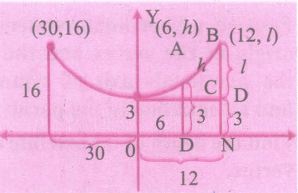
Since (30, 16) is a point on (1),
we get 302 = 4 \(\times\) a \(\times\) 16
⇒ a = \(\frac { 30\times 30 }{ 4\times 16 } =\frac { 225 }{ 16 } \)
∴ becomes, x2 = \({ x }^{ 2 }=\frac { 4\times 225 }{ 16 } y=\frac { 225 }{ 4 } y\)
Let AC = h m and BD = lm
∴ A(6, h) is a point on the parabola [∵ OD = 6]
∴ \({ 6 }^{ 2 }=\frac { 225 }{ 4 } \times h\)
⇒ \(h=\frac { 36\times 4 }{ 225 } \Rightarrow h=0.52\)
∴ AD = 3 + h = 3 + 0.52 = 3.52 m
Also (12, 1) is a point on the parabola
[∵ ON = 6 + 6 = 12]
∴ \({ 12 }^{ 2 }=\frac { 225 }{ 4 } \times l\)
⇒ l = \(\frac { 12\times 12\times 4 }{ 225 } =\frac { 576 }{ 225 } =2.08\) = 5.08 m
Hence the length of first two vertical cables are 3.52 m and 5.08 m.
20.
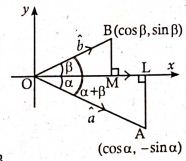
Let \(\hat { a } =\vec { OA } \) and \(\hat { b } =\vec { OB } \) be the unit vectors and which make angles α,β respectively with positive x-axis
Draw AL and BM 丄 to x-axis
Then \(|\vec { OL } |=|\vec { OA } |cos\alpha \Rightarrow \vec { OL } =\vec { |OL| } \hat { i } =cos\alpha \hat { i } \)
\(|\vec { LA } |=|\vec { OB } |\) sin α
⇒ \(\vec { LA } =|\vec { OB } |\hat { j } =sin\alpha (-\hat { j } )=-sin\alpha \hat { j } \)
[\(\vec { LA } \) is in the opp direction of y axis]
\(\hat { a } =\vec { OA } =\vec { OL } +\vec { LA } =cos\alpha \hat { i } -sin\alpha \check { j } \) ..(1)
Similarly \(\hat { b } =\vec { OB } =\vec { OM } +\vec { MB } =cos\beta \hat { i } +sin\beta \hat { j } \) ...(2)
Now \(\hat { a } \times \hat { b } =|\hat { a } ||\hat { b } |sin(\alpha +\beta )\hat { k } =sin(\alpha +\beta )\hat { k } \) ....(3)
[\(|\hat { a } |=|\hat { b } |\) = 1]
Also \(\hat { a } \times \hat { b } =\left| \begin{matrix} \hat { i } & \hat { j } & \hat { k } \\ cos\alpha & -sin\alpha & 0 \\ cos\beta & cos\beta & 0 \end{matrix} \right| \)
= \(\hat { i } (0)-\hat { j } (0)+\hat { k } \)(cosα sinβ + sinα cosβ)
= (sin α cos β + cos α sin β)\(\hat { k } \) .(4)
using (3) and (4), sin(α+β) = sin α cos β + cos α sin β
21.
Consider a triangle ABC in which the two altitudes AD and BE intersect at O. Let CO be produced to meet AB at F. We take O as the origin and let \(\vec { OA } =\vec { a } \), \(\vec { OB } =\vec { b} \) and \(\vec { OC } =\vec { c } \)
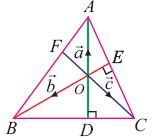
Since \(\vec { AD } \) is perpendicular to \(\vec { BC } \), we have \(\vec { OA } \) is perpendicular to \(\vec { BC } \), and
hence we get \(\vec { OA } \) . \(\vec { BC } \) = 0. That is, \(\vec { a } .(\vec { c } -\vec { b } )=0\), which means
\(\vec { a } .\hat{c}-\hat{a}.\hat{b}=0\)....(1)
Similarly, since \(\vec { BE } \) is perpendicular to \(\vec { CA } \), we have \(\vec { OB } \) is perpendicular to \(\vec { CA } \), and hence we get \(\vec { OB } .\vec { CA } \) = 0.
That is, \(\vec {b } .(\vec {a } -\vec { c } )=0\)
\(\vec { a } .\hat{c}-\hat{b}.\hat{c}=0\).......(2)
Adding equations (1) and (2), gives \(\vec { a } .\hat{c}-\hat{b}.\hat{c}=0\). That is, \(\hat{c}(\hat{a}-\hat{b})=0\)
That is \(\vec { OC } \) . \(\vec { BA } \) = 0.
Therefore, \(\vec { BA } \) is perpendicular to \(\vec { OC} \).
Which implies that \(\vec { CF} \) is perpendicular to \(\vec { AB } \).
Hence, the perpendicular drawn from C to the side AB passes through O. Therefore, the altitudes are concurrent.
22.
Given cubic equation is 2x3-6x2+3x+k = 0
Here, a = 2, b = -6, c = 3, d = k
Let ∝, β, ૪ be the roots
Given ∝ = 2(β+૪) ⇒ \(\frac{\alpha}{2}\) = β+૪ ...(1)
Now, \(\alpha +\beta +\gamma =\frac { -b }{ a } =-\frac { (-6) }{ 2 } =3\)
\(\frac { \alpha }{ 2 } +\alpha =3\Rightarrow \frac { \alpha +2\alpha }{ 2 } =3\Rightarrow \frac { 3\alpha }{ 2 } =3\)
\(\Rightarrow \alpha =2\)
\(\alpha \beta \gamma =\frac { -d }{ a } =\frac { -k }{ 2 } \Rightarrow 2.\beta \gamma =\frac { -k }{ 2 } \)
\(\beta \gamma =\frac { -k }{ 4 } ...(2)\)
Also, \(\alpha \beta +\beta \gamma +\gamma \alpha =\frac { c }{ a } \)
\(2\beta +\beta \gamma +2\gamma =\frac { 3 }{ 2 } \)
\(2(\beta +\gamma )+\beta \gamma =\frac { 3 }{ 2 } \)
\(\alpha \frac { -k }{ 4 } =\frac { 3 }{ 2 } \quad [from(1)\& (2)]\)
Also, \(2-\frac { k }{ 4 } =\frac { 3 }{ 2 } [\because \alpha =2]\)
\(2-\frac { 3 }{ 2 } =\frac { k }{ 4 } \Rightarrow \frac { 1 }{ 2 } =\frac { k }{ 4 } \)
\(\\ k=\frac { 4 }{ 2 } \Rightarrow k=2\)
From(2), \(\beta \gamma =\frac { -k }{ 4 } =\frac { -2 }{ 4 } =\frac { -1 }{ 2 } \)\(\Rightarrow \gamma =\frac { -1 }{ 2\beta } \)
From \((1),\beta +\gamma =\frac { \alpha }{ 2 } =\frac { 2 }{ 2 } =1\)
Substituting \(\gamma =\frac { -1 }{ 2\beta } \) We get
\(\beta -\frac { 1 }{ 2\beta } =1\Rightarrow 2{ \beta }^{ 2 }-1=2\beta \Rightarrow 2\beta -2\beta -1=0\)
\(\beta =\frac { 2\pm \sqrt { 4-4(2)(-1) } }{ 4 } =\frac { 2\pm \sqrt { 4+8 } }{ 4 } \)
\(=\frac { 2\pm \sqrt { 12 } }{ 4 } =\frac { 2\pm 2\sqrt { 3 } }{ 4 } \)
\(\beta =\frac { 1\pm \sqrt { 3 } }{ 2 } \)
Hence the roots are \(2,\frac { 1+\sqrt { 3 } }{ 2 } ,\frac { 1-\sqrt { 3 } }{ 2 } \) and k = 2
23.
Rearranging the terms, the equation of ellipse is 4x2 + 24x + y2− 2y + 21 = 0
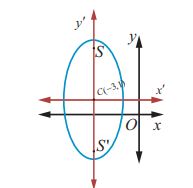
That is, 4(x2 + 6x + 9 − 9) + (y2 − 2y + 1 − 1) + 21 = 0,
4(x + 3)2 − 36 + (y−1)2 −1 + 21 = 0,
4(x + 3)2 + (y − 1)2 = 16,
\(\frac { { \left( x+3 \right) }^{ 2 } }{ 4 } +\frac { { \left( y+1 \right) }^{ 2 } }{ 16 } =1\)
Centre is (-3, 1) a = 4, b = 2, and the major axis is parallel to y-axis c2 = 16−4 = 12
c = ±2\(\sqrt { 3 } \)
Therefore, the foci are (−3, 2\(\sqrt { 3 } \) +1) and (−3, −2\(\sqrt { 3 } \) +1).
Vertices are (3, ±4 +1).
That is the vertices are (3, 5) and (3, -3) and the length of Latus rectum = \(\frac { { 2b }^{ 2 } }{ a } \) = 2 units.
24.
\(put\ t={ sin }^{ -1 }x\Rightarrow dt=\frac { dx }{ \sqrt { 1-{ x }^{ 2 } } } \)
\(\therefore \int _{ 0 }^{ \frac { \pi }{ 4 } }{ { e }^{ at }t\quad dt=\int _{ 0 }^{ \frac { \pi }{ 4 } }{ t } { e }^{ at }dt } \)
\( u=t\ \ v={ e }^{ at }dt\)
\(u'=1\quad { v }_{ 1 }= e ^t\)
\(u'' = 0 \ \ { v }_{ 2 }=e^t\)
\(\int { uvdx } ={ uv }_{ 1 }-u'{ v }_{ 2 }\)
\(\int _{ 0 }^{ \frac { \pi }{ 4 } }{ t{ e }^{ at }dt } ={ \left[ t\frac { { e }^{ at } }{ a } -1\frac { { e }^{ at } }{ { a }^{ 2 } } \right] }_{ 0 }^{ \frac { \pi }{ 4 } }\)
\(dt = \frac{1}{\sqrt 1-x^2}dx\)
I = \(\int ^\frac{\pi}{4}_0 e^t t \ dt\)
\([t e^t-t]^{\frac{\pi}{4}}_0\)
\(=\frac { { e }^{ \frac { \pi }{ 4 } } }{ { a }^{ 2 } } \left( \frac { a\pi }{ 4 } -1 \right) -\frac { { e }^{ 0 } }{ { a }^{ 2 } } (-1)\)
\(=1+ e ^ \frac { \pi }{ 4 } (\frac { \pi }{ 4 }-1) \)
25.
We know that the given equation is homogeneous
Now, we rewrite the given equation as \(\frac { dy }{ dx } =\frac { 3y }{ 2x } -\frac { x }{ 2y } \)
Taking y = vx , we have \(v+x\frac { dv }{ dx } =\frac { 3v }{ 2 } -\frac { 1 }{ 2v } orx\frac { dv }{ dx } =\frac { { v }^{ 2 }-1 }{ 2v }\)
Separating the variables, we obtain \(\frac { 2vdv }{ { v }^{ 2 }-1 } =\frac { dx }{ x } \)
On integration, we get log\(|{ v }^{ 2 }-1|=log|x|+log|C|,\)
Hence, |v2-1| = |Cx|, where C is an arbitrary constant
Now, replace v by\(\frac{y}{x}\) to get \(|\frac { { y }^{ 2 } }{ { x }^{ 2 } } -1|\) = |Cx|.
Thus, we have |y2-x2| = |Cx3|
Hence, y2 − x2 = ±Cx3 (or) y2 − x2 = kx3 gives the general solution

12th Standard Syllabus & Materials
12th Standard
TN 12th Computer Applications களப்பெயர் முறைமை (DNS) Sample Question Papers Study Material - QB365 Set A
NEW12th Standard
TN 12th Computer Applications வலையமைப்பு எடுத்துக்காட்டுகள் மற்றும் நெறிமுறைகள் Sample Question Papers Study Material - QB365 Set A
NEW12th Standard
TN 12th Computer Applications கணினி வலையமைப்பு ஓர் அறிமுகம் Sample Question Papers Study Material - QB365 Set A
NEW12th Standard
TN 12th Computer Applications PHP-உடன் MySQL-ஐ இணைத்தல் Sample Question Papers Study Material - QB365 Set A



Tamilnadu Stateboard 12th Standard Subjects
Maths

Chemistry

Physics

Biology

Computer Science

Business Maths and Statistics

Economics

Commerce

Accountancy

History

Computer Applications
Biology
Computer Technology
Computer Applications
Computer Science
Business Maths and Statistics
Commerce
Economics
Maths
Chemistry
Physics
Computer Technology
History
Accountancy

Tamil

English

French
Tamilnadu Stateboard Standards



