
 100% FREE ACCESS
12th Standard Syllabus & Materials
12th Standard
TN 12th Computer Applications மின்னணு தரவு பரிமாற்றம் Sample Question Papers Study Material - QB365 Set A
NEW12th Standard
TN 12th Computer Applications மின் - வணிக பாதுகாப்பு அமைப்புகள் Sample Question Papers Study Material - QB365 Set A
NEW12th Standard
TN 12th Computer Applications மின்னணு செலுத்தல் முறைகள் Sample Question Papers Study Material - QB365 Set A
NEW12th Standard
TN 12th Computer Applications மின் - வணிகம் Sample Question Papers Study Material - QB365 Set A
NEW12th Standard
TN 12th Computer Applications திறந்த மூல கருத்துருக்கள் Sample Question Papers Study Material - QB365 Set A
NEW12th Standard
TN 12th Computer Applications வலையமைப்பு வடமிடல் Sample Question Papers Study Material - QB365 Set A

Published on: 13/05/2022
QB365 provides detailed and simple solution for every Creative Questions in class 12 Maths Subject. It will helps to get more idea about question pattern in every Creative questions with solution.
latest Creative QuestionsDownload Tamil Nadu 12th Standard Maths question papers, model tests, one-mark questions, important questions, and public exam papers in PDF format. Free study materials and answer keys for TN State Board students.
Questions + Answers key
Take MCQ Maths Test1.
Evaluate : \(\underset { \left( x,y,z \right) \rightarrow \left( -1,0,4 \right) }{ lim } \frac { { x }^{ 2 }-{ ze }^{ zy } }{ 6x+2y-2z } \)
2.
Find the local extrema for the following functions using second derivate test.
(i) x3-x
(ii) \({ x }^{ 3 }-3{ x }^{ 2 }+1,-\frac { 1 }{ 2 } \le x\le 4\)
3.
Find the intervals of monotonicities and find the local extremum for the following functions
i) f(x) = 20 - x - x2
ii) f(x) = x(x-1) (x+1) on [0, 2]
4.
Verify Rolle’s theorem for f(x)=ex sinx,\(0\le x\le \pi \)
5.
The ends of a rod AB which is 5 m long moves along two grooves OX, OY which at the right angles. If A moves at a constant speed of \(\frac { 1 }{ 2 } \) m/sec, what is the speed of B, when it is 4m from O?
6.
Find the equation of normal to the cure y = sin2x at \(\left( \frac { \pi }{ 3 } ,\frac { 3 }{ 4 } \right) \).
7.
Show that the complex numbers 3 + 2i, 5i, -3 + 2i and -i form a square.
8.
Show that the line x + y + 1 = 0 touches the hyperbola \(\frac { { x }^{ 2 } }{ 16 } -\frac { { y }^{ 2 } }{ 15 } \) = 1 and find the co-ordinates of the point of contact
9.
For the hyperbola 3x2 - 6y2 = -18, find the length of transverse and conjugate axes and eccentricity.
10.
Find the equation of the ellipse whose latus rectum is 5 and e = \(\frac { 2 }{ 3 } \)
11.
Find the value of p so that 3x + 4y - p = 0 is a tangent to the circle x2 +y2 - 64 = 0.
12.
Solve: cos(tan-1x) = \(sin\left( { cot }^{ -1 }\frac { 3 }{ 4 } \right) \)
13.
Evaluate \(cos\left[ { cos }^{ -1 }\left( \frac { -\sqrt { 3 } }{ 2 } +\frac { \pi }{ 6 } \right) \right] \)
14.
Evaluate \(cos\left[ { sin }^{ -1 }\frac { 3 }{ 5 } +{ sin }^{ -1 }\frac { 5 }{ 13 } \right] \)
15.
If \(\overset { \rightarrow }{ a } +\overset { \rightarrow }{ b } +\overset { \rightarrow }{ c } =0\) then show that \(\overset { \rightarrow }{ a } \times \overset { \rightarrow }{ b } =\overset { \rightarrow }{ b } \times \overset { \rightarrow }{ c } =\overset { \rightarrow }{ c } \times \overset { \rightarrow }{ a } \)
16.
Find the angle between the line \(\frac { x-2 }{ 3 } =\frac { y-1 }{ -1 } =\frac { z-3 }{ 2 } \) and the plane 3x + 4y + z + 5 = 0
17.
Find the Cartesian form of the equation of the plane \(\overset { \rightarrow }{ r } =\left( s-2t \right) \overset { \wedge }{ i } +\left( 3-t \right) \overset { \wedge }{ j } +\left( 2s+t \right) \overset { \wedge }{ k } \)
18.
Solve: x + y + 3z = 4, 2x + 2y + 6z = 7, 2x + y + z = 10.
19.
Under what conditions will the rank of the matrix \(\left[ \begin{matrix} 1 & 0 & 0 \\ 0 & h-2 & 2 \\ \begin{matrix} 0 \\ 0 \end{matrix} & \begin{matrix} 0 \\ 0 \end{matrix} & \begin{matrix} h+2 \\ 3 \end{matrix} \end{matrix} \right] \) be less than 3?
20.
Solve: 3x+ay = 4, 2x + ay = 2, a ≠ 0 by Cramer's rule.
21.
Solve: 2x+2x-1+2x-2 = 7x+7x-1+7x-2
22.
Solve: \({ tan }^{ -1 }\left( \cfrac { x-1 }{ x-2 } \right) +{ tan }^{ -1 }\left( \cfrac { x+1 }{ x+2 } \right) =\cfrac { \pi }{ 4 } \)
1.
\(\frac { 5 }{ 18 } \)
2.
(i) Local min value = \(\frac { 2 }{ 3\sqrt { 3 } } \) and local max value = \(\frac { 2 }{ 3\sqrt { 3 } } \)
(ii) local min value = −3 and local max.value = 1
3.
(i) f(x) is strictly increasing on\(\left( -\infty ,-\frac { 1 }{ 2 } \right) \) and f(x) is strictly decreasing on \(\left[ -\frac { 1 }{ 2 } ,\infty \right] \) Local maximum value = \(\frac { 81 }{ 4 } \)
(ii) f(x) is strictly decreasing on \(\left( 0,\frac { 1 }{ \sqrt { 2 } } \right) \) and strictly increasing on \(\left( \frac { 1 }{ \sqrt { 2 } } ,2 \right) \)
Local minimum value = \(-\frac { 2 }{ 2\sqrt { 2 } } \)
4.
\(C=\frac { 3\pi }{ 4 } \)
5.
Let OA = x m, OB = y m
Then x2 + y2 = 25
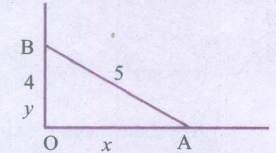
Differentiating, \(2x\frac { dx }{ dt } +2y\frac { dy }{ dt } \) = 0
⇒ \(\frac { dy }{ dx } =-\frac { x }{ y } \frac { dx }{ dt } \)
When \(\frac { dx }{ dt } =\frac { 1 }{ 2 } ,\frac { dy }{ dt } =\frac { -x }{ 2y } \)
When y = 4, x2 = 25-y2
⇒ x =\(\sqrt { 25-16 } \) = 3
Thus \(\frac { dy }{ dt } =-\frac { 3 }{ 2\times 4 } =\frac { -3 }{ 8 } \).
6.
y = sin2x
\(\frac { dy }{ dx } \) = 2 sin x cos x = sin 2x
∴ m = \(\left( \frac { dy }{ dx } \right) _{ \left( \frac { \pi }{ 3 } ,\frac { 3 }{ 4 } \right) }=sin\frac { 2\pi }{ 3 } =\frac { \sqrt { 3 } }{ 2 } \)
∴ Slope of the normal = \(-\frac { 1 }{ m } =-\frac { 2 }{ \sqrt { 3 } } \)
∴ Equation of normal is y-y1 = \(-\frac { 1 }{ m } \)(x-x1)
⇒ \(y-\frac { 3 }{ 4 } =-\frac { 2 }{ \sqrt { 3 } } \left( x-\frac { \pi }{ 3 } \right) \)
⇒ 12\(\sqrt { 3 } \)y-9\(\sqrt { 3 } \) = -24x + 8π [ multiply 12\(\sqrt { 3 } \)]
∴ 24x + 12\(\sqrt { 3 } \)y = 8π + 9\(\sqrt { 3 } \).
7.
AB = |(3+2i) - (0+5i)| = |3-3i|
=\(\sqrt { 9+9 } =\sqrt { 18 } =3\sqrt { 2 } \)
BC = |(0+5i) - (-3+2i)| = |3+3i|
= \(\sqrt { 9+9 } =\sqrt { 18 } =3\sqrt { 2 } \)
CD = |(-3+2i) - (0-i) = |-3+i|
= \(\sqrt { 9+9 } =\sqrt { 18 } =3\sqrt { 2 } \)
DA = |(0-i) - (3+2i)| = |-3-3i|
=\(\sqrt { 9+9 } =\sqrt { 18 } =3\sqrt { 2 } \)
∴ AB = BC = CD = DA
Also AC = |(3+2i) - (-3+2i)|
= |6| = \(\sqrt { 36 } \) = 6
∴ AC = BD
Hence ABCD is a square
8.
Given line is x + y + 1 = 0
⇒ y = -x-1
m = -1, c = -1
Equation of the hyperbola is \(\frac { { x }^{ 2 } }{ 16 } -\frac { { y }^{ 2 } }{ 15 } \) = 1
a2 = 16, b2 = 15
The condition for the line y = mx + c to be a tangent to the hyperbola is c2 = a2m2 - b2
∴ (-1)2 = 16(-1)2 - 15
1 = 16 -15
1 = 1
Since the condition is satisfied, x + y + 1 = 0 touches the hyperbola \(\frac { { x }^{ 2 } }{ 16 } -\frac { { y }^{ 2 } }{ 15 } \) = 1
The point of contact is \(\left( \frac { -{ a }^{ 2 }m }{ c } ,\frac { -{ b }^{ 2 } }{ c } \right) \) = \(\left( \frac { -16(-1) }{ -1 } ,\frac { -15 }{ -1 } \right) \) = (-16, 15)
Hence, the point of contact is (-16, 15)
9.
Given equation of the hyperbola is
3x2 - 6y2 = -18; \(\div \)by (-18) we get \(\frac{y^2}{3}- \frac{x^2}{6}\) = 1
The transverse axis is long y-axis.
Here a2 = 3, b2 = 6
Length of transverse axis is 2a = 2\(\sqrt { 3 } \)
Length of conjugate axis is 2b = 2\(\sqrt { 3 } \)
\(e=\sqrt { 1+\frac { { b }^{ 2 } }{ { a }^{ 2 } } } =\sqrt { 1+\frac { 6 }{ 3 } } =\sqrt { 1+2 } =\sqrt { 3 } \)
10.
Let the equation of the ellipse be \(\frac { { x }^{ 2 } }{ { a }^{ 2 } } +\frac { { y }^{ 2 } }{ { b }^{ 2 } } =1\)
Given e = \(\frac { 2 }{ 3 } \) and \(\frac { 2{ b }^{ 2 } }{ a } \) = 5 ⇒ 2b2 = 5a ...(1)
∴ b2 = a2(1 - e2) = a2 \({ a }^{ 2 }\left( 1-\frac { 4 }{ 9 } \right) ={ a }^{ 2 }\left( \frac { 5 }{ 9 } \right) \)
∴ \({ 2b }^{ 2 }=\frac { 10{ a }^{ 2 } }{ 9 } \) ...(2)
From (1) and (2),
\(\frac { 10{ a }^{ 2 } }{ 9 } \) = 5a ⇒ 10a2 = 45a
10a2 - 45a = 0 ⇒ 5a(2 - 9a) = 0
⇒ a = 0 or a = \(\frac { 9 }{ 2 } \) [∵ a = 0 is not possible]
∴ \({ a }^{ 2 }=\frac { 81 }{ 4 } \)
∴ \(2{ b }^{ 2 }=\frac { 5\times 9 }{ 2 } =\frac { 45 }{ 2 } \Rightarrow { b }^{ 2 }=\frac { 45 }{ 4 } \)
∴ Equation of the ellipse is \(\frac { { x }^{ 2 } }{ \frac { 81 }{ 4 } } +\frac { { y }^{ 2 } }{ \frac { 45 }{ 4 } } =1\)
⇒ \(\frac { 4{ x }^{ 2 } }{ 81 } +\frac { 4{ y }^{ 2 } }{ 45 } =1\)
11.
Equation of circle is x2 + y2 = 64
∴ a2 = 64 ⇒ a = 8
Given line is 3x+ 4y = P
4y = -3x + p
y = \(y=\frac { -3 }{ 4 } x+\frac { p }{ 4 } \)
m = \(\frac { -3 }{ 4 } \) and c = \(\frac { p }{ 4 } \)
The condition for y = mx + c to be a tangent to the circle in c2 = a2(1 + m2).
∴ \({ \left( \frac { p }{ 4 } \right) }^{ 2 }=64\left( 1+\frac { 9 }{ 16 } \right) \)
\(\Rightarrow \frac{p^{2}}{\not 16}=64\left(\frac{16+9}{\not 16}\right) \Rightarrow p^{2}=64(25)\)
\(p=\pm \sqrt { 64(25) } =\pm 8(5)\)
∴ p = ±40
12.
cos (tan-1x) = \(sin\left( { cot }^{ -1 }\frac { 3 }{ 4 } \right) \)
\(\Rightarrow sin\left( { tan }^{ -1 }\frac { 4 }{ 3 } \right) =sin\left( { sin }^{ -1 }\frac { 4 }{ \sqrt { { 3 }^{ 2 }+{ 4 }^{ 2 } } } \right) \)
\(\left[ \because { tan }^{ -1 }x={ sin }^{ -1 }\left( \frac { x }{ \sqrt { 1+{ x }^{ 2 } } } \right) \right] \)
\(\Rightarrow sin\left( { sin }^{ -1 }\left( \frac { 4 }{ 5 } \right) \right) =\frac { 4 }{ 5 } \)
\(\Rightarrow cos\left( { tan }^{ -1 }x \right) =cos\left(- { tan }^{ -1 }x \right) =\frac { 4 }{ 5 } \)
\(\left[ \because cosx=cos(-x) \right] \)
\(\Rightarrow { tan }^{ -1 }x={- tan }^{ -1 }x={ cos }^{ -1 }\left( \frac { 4 }{ 5 } \right) \)
\(\Rightarrow \tan ^{-1} x=-\tan ^{-1} x=\tan ^{-1} \frac{3}{4}\)
\(\left[ \because { cos }^{ -1 }x={ tan }^{ -1 }\sqrt { \frac { 1-{ x }^{ 2 } }{ x } } ;{ cos }^{ -1 }\left( \frac { 4 }{ 5 } \right) ={ tan }^{ -1 }\sqrt { \frac { 1-\frac { 16 }{ 25 } }{ \frac { 4 }{ 5 } } } \right] \)
\(\Rightarrow x=\frac { 3 }{ 4 } ,\frac { 3 }{ 4 } \)
13.
\(cos\left[ { cos }^{ -1 }\left( \frac { -\sqrt { 3 } }{ 2 } +\frac { \pi }{ 6 } \right) \right] \)
= \(cos\left[ \pi -{ cos }^{ -1 }\left( \frac { -\sqrt { 3 } }{ 2 } +\frac { \pi }{ 6 } \right) \right] \)
\(\left[ \because { cos }^{ -1 }\left( -x \right) =\pi -{ cos }^{ -1 }x \right] \)
= \(cos\left[ \pi -\frac { \pi }{ 6 } +\frac { \pi }{ 6 } \right] \)
\(\left[ \because { cos }^{ -1 }\frac { \sqrt { 3 } }{ 2 } =x\Rightarrow \frac { \sqrt { 3 } }{ 2 } =cosx\Rightarrow x=\frac { \pi }{ 6 } \right] \)
= \(cos\pi -1\)
14.
Let \({ sin }^{ -1 }\left( \frac { 3 }{ 5 } \right) =A\Rightarrow \frac { 3 }{ 5 } =sinA\)

\(cosA=\frac { adj }{ hyp } =\frac { 4 }{ 5 } \)
Let \({ sin }^{ -1 }\left( \frac { 5 }{ 13 } \right) =B\Rightarrow sinB=\frac { 5 }{ 13 } \)

\(\Rightarrow cosB=\frac { 12 }{ 13 } \)
\(\therefore cos\left[ { sin }^{ -1 }\frac { 3 }{ 5 } +{ sin }^{ -1 }\frac { 5 }{ 13 } \right] =cos(A+B)\)
= cos A cos B-sin A sin B
= \(\frac { 4 }{ 5 } .\frac { 12 }{ 13 } -\frac { 3 }{ 5 } .\frac { 5 }{ 13 } =\frac { 48 }{ 65 } -\frac { 15 }{ 65 } \)
= \(\frac { 33 }{ 65 } \)
15.
Given \(\overset { \rightarrow }{ a } +\overset { \rightarrow }{ b } +\overset { \rightarrow }{ c } =0\)
\(\overset { \rightarrow }{ a } +\overset { \rightarrow }{ b } \)= -\(\overset { \rightarrow }{ c } \) ... (1)
Taking cross product with \(\overset { \rightarrow }{ a } \) both sides, we get
\(\overset { \rightarrow }{ a } \left( \overset { \rightarrow }{ a } +\overset { \rightarrow }{ b } \right) =-\left( \overset { \rightarrow }{ a } \times \overset { \rightarrow }{ c } \right) \)
\(\overset { \rightarrow }{ a } \times \overset { \rightarrow }{ a } +\overset { \rightarrow }{ a } +\overset { \rightarrow }{ b } =\overset { \rightarrow }{ c } \times \overset { \rightarrow }{ a } \)
\(\left[ \because -\left( \overset { \rightarrow }{ a } \times \overset { \rightarrow }{ c } \right) =\overset { \rightarrow }{ c } \times \overset { \rightarrow }{ a } \right] \)
\(\Rightarrow \overset { \rightarrow }{ a } \times \overset { \rightarrow }{ b } =\overset { \rightarrow }{ c } \times \overset { \rightarrow }{ a } \left( \because \overset { \rightarrow }{ a } \times \overset { \rightarrow }{ a } =\overset { \rightarrow }{ 0 } \right) \)
Taking cross product with \(\overset { \rightarrow }{ b } \) both sides, we get
\(\overset { \rightarrow }{ b } \times \left( \overset { \rightarrow }{ a } +\overset { \rightarrow }{ b } \right) =\overset { \rightarrow }{ b } \times \left( -\overset { \rightarrow }{ c } \right) \)
\(\overset { \rightarrow }{ b } \times \overset { \rightarrow }{ a } +\overset { \rightarrow }{ b } \times \overset { \rightarrow }{ b } =-\overset { \rightarrow }{ b } \times \overset { \rightarrow }{ c } \)
\(-\overset { \rightarrow }{ a } \times \overset { \rightarrow }{ b } =-\overset { \rightarrow }{ b } \times \overset { \rightarrow }{ c } \)
\(\overset { \rightarrow }{ a } \times \overset { \rightarrow }{ b } =\overset { \rightarrow }{ b } \times \overset { \rightarrow }{ c } \)
From (2) and (3) we get
\(\overset { \rightarrow }{ a } \times \overset { \rightarrow }{ b } =\overset { \rightarrow }{ b } \times \overset { \rightarrow }{ c } =\overset { \rightarrow }{ c } \times \overset { \rightarrow }{ a } \)
16.
The given line is parallel to the vector \(\overset { \rightarrow }{ b } =3\overset { \wedge }{ i } -\overset { \wedge }{ j } +2\overset { \wedge }{ k } \) and the given plane is normal to the vector \(\overset { \rightarrow }{ n } =3\overset { \wedge }{ i } +4\overset { \wedge }{ j } +\overset { \wedge }{ k } \)
Let θ be the angle between the line and the plane, then
\(\sin { \theta } =\frac { \overset { \rightarrow }{ b } .\overset { \rightarrow }{ n } }{ \left| \overset { \rightarrow }{ b } \right| \left| \overset { \rightarrow }{ n } \right| } =\frac { 9-4+2 }{ \sqrt { 9+1+4 } .\sqrt { 9+16+1 } } \)
\(=\frac { 7 }{ \sqrt { 14 } .\sqrt { 26 } } =\frac { 7 }{ \sqrt { 2 } \times \sqrt { 7 } \times \sqrt { 26 } } =\frac { \sqrt { 7 } }{ \sqrt { 52 } } \)
\(\therefore \theta ={ sin }^{ -1 }\left( \frac { \sqrt { 7 } }{ \sqrt { 52 } } \right) \)
17.
Let \(\overset { \rightarrow }{ r } =x\overset { \wedge }{ i } +y\overset { \wedge }{ j } +z\overset { \wedge }{ k } \)
\(\therefore x\overset { \wedge }{ i } +y\overset { \wedge }{ j } +z\overset { \wedge }{ k } =\left( s-2t \right) \overset { \wedge }{ i } +\left( 3-t \right) \overset { \wedge }{ j } +\left( 2s+t \right) \overset { \wedge }{ k } \)
Equating the co-efficients of like components both sides,
We get, x = s - 2t
y = 3 - t
z = 2s + t
Eliminating x and t using determinates we get
\(\left| \begin{matrix} x \\ y-3 \\ z \end{matrix}\begin{matrix} 1 \\ 0 \\ 2 \end{matrix}\begin{matrix} -2 \\ -1 \\ 1 \end{matrix} \right| =0\)
⇒ x (0+2) -1(y - 3 + z) -2 (2y - 6 - 0) = 0
⇒ 2x - y + 3 - z- 4y + 12 = 0
⇒ 2x - 5y - z + 15 = 0
18.
Augmented matrix [A|B] =\(\left[ \begin{matrix} 1 & 1 & 3 \\ 2 & 2 & 6 \\ 2 & 1 & 1 \end{matrix}|\begin{matrix} 4 \\ 7 \\ 10 \end{matrix} \right] \)
[A|B] \(\overset { { R }_{ 2 }\rightarrow { R }_{ 2 }-2{ R }_{ 1 }\\ { R }_{ 3 }\rightarrow { R }_{ 3 }-2{ R }_{ 1 } }{ \longrightarrow } \left[ \begin{matrix} 1 & 1 & 3 \\ 0 & 0 & 0 \\ 0 & -1 & -5 \end{matrix}|\begin{matrix} 4 \\ -1 \\ 2 \end{matrix} \right] \)
\(\overset { { R }_{ 2 }\leftrightarrow { R }_{ 3 } }{ \longrightarrow } \left[ \begin{matrix} 1 & 1 & 3 \\ 0 & -1 & -5 \\ 0 & 0 & 0 \end{matrix}|\begin{matrix} 4 \\ 2 \\ -1 \end{matrix} \right] \)
Here \(\rho\) (A) = 2 [only 2 two-non zero rows]
And \(\rho\) ([A|B]) = 3 [There are 3 non-zero rows]
∴ \(\rho\) (A) ≠ \(\rho\) ([A|B])
∴ The system is inconsistent.
19.
Let A = \(\left[ \begin{matrix} 1 & 0 & 0 \\ 0 & h-2 & 2 \\ \begin{matrix} 0 \\ 0 \end{matrix} & \begin{matrix} 0 \\ 0 \end{matrix} & \begin{matrix} h+2 \\ 3 \end{matrix} \end{matrix} \right] \)
The rank of A will be less than 3 if every minor of order 3 vanishes
∴ \(\left| \begin{matrix} 1 & 0 & 0 \\ 0 & h-2 & 0 \\ 0 & 0 & 3 \end{matrix} \right| \) = 0
⇒ 1\(\left| \begin{matrix} h-2 & 0 \\ 0 & 3 \end{matrix} \right| \) + 0 + 0 =0 ⇒ 3(h-2) = 0
⇒ h-2 = 0 ⇒ h = 2
20.
Δ = \(\left| \begin{matrix} 3 & a \\ 2 & a \end{matrix} \right| \) = 3a - 2a = a
Δ1 =\(\left| \begin{matrix} 4 & a \\ 2 & a \end{matrix} \right| \) = 4a - 2a = 2a
Δ2 = \(\left| \begin{matrix} 3 & 4 \\ 2 & 2 \end{matrix} \right| \)= 6 - 8 = -2
\(\therefore x=\frac{\Delta_{1}}{\Delta}=\frac{2 \not a}{\not a}=2=y y=\frac{\Delta_{2}}{\Delta}=\frac{-2}{a}\)
∴ Solution set is {2,\(\frac { -2 }{ a } \)}
21.
The given equation can be written as
\({ 2 }^{ z }\left( 1+\frac { 1 }{ 2 } +\frac { 1 }{ 4 } \right) ={ 7 }^{ x }\left( 1+\frac { 1 }{ 7 } +\frac { 1 }{ 49 } \right) \)
\(\Rightarrow { 2 }^{ x }\left( \frac { 8+4+2 }{ 8 } \right) ={ 7 }^{ x }\left( \frac { 49+7+1 }{ 49 } \right) \)
\(\Rightarrow { 2 }^{ x }\left( \frac { 7 }{ 4 } \right) ={ 7 }^{ x }\left( \frac { 57 }{ 49 } \right) \Rightarrow \frac { 7 }{ 4 } \times \frac { 49 }{ 57 } =\frac { { 7 }^{ x } }{ { 2 }^{ x } } \)
\(\Rightarrow \frac { 7 }{ 4 } \times \frac { 49 }{ 57 } ={ \left( \frac { 7 }{ 4 } \right) }^{ x }\Rightarrow \frac { { 7 }^{ 3 } }{ 4\times 57 } ={ \left( \frac { 7 }{ 4 } \right) }^{ x }\)
\(\Rightarrow xlog\left( \frac { 7 }{ 4 } \right) =3log\ 7-log4-log57\)
\(\Rightarrow x=\frac { 3log7-log4-log57 }{ log\left( \frac { 7 }{ 2 } \right) } \)
22.
\({ tan }^{ -1 }\left( { \frac { x-1 }{ x-2 } } \right) +{ tan }^{ -1 }\left( \frac { x+1 }{ x+2 } \right) =\frac { \pi }{ 4 }\)
\(\Rightarrow { tan }^{ -1 }\left( \cfrac { \frac { x-1 }{ x-2 } +\frac { x+1 }{ x+2 } }{ 1-\left( \frac { x-1 }{ x-2 } \right) \left( \frac { x+1 }{ x+2 } \right) } \right) =\frac { \pi }{ 4 }\)
\(\begin{aligned}
& \Rightarrow\left(\frac{\frac{(x-1)(x+2)+(x+1)(x-2)}{(x-2)(x+2)-(x-1)(x+1)}}{\frac{(x-2)(x+2)}{(x+2)}}\right)=\tan \frac{\pi}{4}=1 \\
& \Rightarrow \quad \frac{x^2+x-2+x^2-x-2}{\left(x^2-4\right)-\left(x^2-1\right)}=1
\end{aligned}\)
\(\Rightarrow \frac { 2{ x }^{ 2 }-4 }{ { x }^{ 2 }-4-{ x }^{ 2 }+1 } =1\)
\(\Rightarrow\) 2x2- 4 = -3
\(\Rightarrow\) 2x2- 4 = -3
\(\Rightarrow\) 2x2 = -3 + 4 = 1
\(\Rightarrow\) \({ x }^{ 2 }=\frac { 1 }{ 2 }\)
\(\Rightarrow\) \(x=\frac { 1 }{ \sqrt { 2 } }\)

12th Standard Syllabus & Materials
12th Standard
TN 12th Computer Applications களப்பெயர் முறைமை (DNS) Sample Question Papers Study Material - QB365 Set A
NEW12th Standard
TN 12th Computer Applications வலையமைப்பு எடுத்துக்காட்டுகள் மற்றும் நெறிமுறைகள் Sample Question Papers Study Material - QB365 Set A
NEW12th Standard
TN 12th Computer Applications கணினி வலையமைப்பு ஓர் அறிமுகம் Sample Question Papers Study Material - QB365 Set A
NEW12th Standard
TN 12th Computer Applications PHP-உடன் MySQL-ஐ இணைத்தல் Sample Question Papers Study Material - QB365 Set A



Tamilnadu Stateboard 12th Standard Subjects
Maths

Chemistry

Physics

Biology

Computer Science

Business Maths and Statistics

Economics

Commerce

Accountancy

History

Computer Applications
Biology
Computer Technology
Computer Applications
Computer Science
Business Maths and Statistics
Commerce
Economics
Maths
Chemistry
Physics
Computer Technology
History
Accountancy

Tamil

English

French
Tamilnadu Stateboard Standards



