
 100% FREE ACCESS
12th Standard Syllabus & Materials
12th Standard
TN 12th Maths Applications of Matrices and Determinants Sample Question Papers Study Material - QB365 Set A
NEW12th Standard
TN 12th Computer Applications மின்னணு தரவு பரிமாற்றம் Sample Question Papers Study Material - QB365 Set A
NEW12th Standard
TN 12th Computer Applications மின் - வணிக பாதுகாப்பு அமைப்புகள் Sample Question Papers Study Material - QB365 Set A
NEW12th Standard
TN 12th Computer Applications மின்னணு செலுத்தல் முறைகள் Sample Question Papers Study Material - QB365 Set A
NEW12th Standard
TN 12th Computer Applications மின் - வணிகம் Sample Question Papers Study Material - QB365 Set A
NEW12th Standard
TN 12th Computer Applications திறந்த மூல கருத்துருக்கள் Sample Question Papers Study Material - QB365 Set A

Published on: 13/05/2022
QB365 provides detailed and simple solution for every Creative Questions in class 12 Maths Subject. It will helps to get more idea about question pattern in every Creative questions with solution.
latest Creative QuestionsDownload Tamil Nadu 12th Standard Maths question papers, model tests, one-mark questions, important questions, and public exam papers in PDF format. Free study materials and answer keys for TN State Board students.
Questions + Answers key
Take MCQ Maths Test1.
Find the equation of the tangent and the normal to the curve \(y=2sin^{ 2 }3x,x=\frac { \pi }{ 6 } \)
2.
Find the intervals of concavity and the points of inflection of f(x)=12x2-2x3-x4.
3.
Find the local maximum and local minimum values for f(x)=12x2-2x2-x4.
4.
Find the intervals for which the function f(x)=2x2-9x2-12x+1 is increasing or decfreasing and find the local extermems.
5.
If f(x)=alogx+bx2+x has exterme at x=1, x=2 then find a and b.
6.
A water tank has a shape of an inverted cone with its axis vertical and vertex lower most. Its semi vertical angle is tan−1(0.5). Water is poured into it at a constant rate of 5 cm3/hr. Find the rate at which the level of the water is rising at that instant when the depth of the water is 4 m.
7.
Find the points on the curve y=2x2-2x2 at which the tangent lines are parallel to the line y=3x-2.
8.
Find the angle of intersection of the curves 2y2 = x3 and y2 = 32x.
9.
Find the vector and Cartesian equation of the plane passing through the point (1,1, -1) and perpendicular to the planes x + 2y + 3z - 7 = 0 and 2x - 3y + 4z = 0
10.
If \(\left| \overset { \rightarrow }{ A } \right| =\overset { \wedge }{ i } +\overset { \wedge }{ j } +\overset { \wedge }{ k } \) and \(\overset { \wedge }{ i } =\overset { \wedge }{ j } -\overset { \wedge }{ k } \) are two given vector, then find a vector B satisfying the equations \(\overset { \rightarrow }{ A } \times \overset { \rightarrow }{ B } \)= \(\overset { \rightarrow }{ C } \) and \(\overset { \rightarrow }{ A } \).\(\overset { \rightarrow }{ B } \) = 3
11.
Verify that arg(1+i) + arg(1-i) = arg[(1+i) (1-i)]
12.
Show that \(\left( \frac { i+\sqrt { 3 } }{ -i+\sqrt { 3 } } \right) ^{ 2\omega }+\left( \frac { i-\sqrt { 3 } }{ i+\sqrt { 3 } } \right) ^{ 2\omega }\) = -1
13.
The foci of a hyperbola coincides with the foci of the ellipse \(\frac { { x }^{ 2 } }{ 25 } +\frac { y^{ 2 } }{ 9 } =1\). Find the equation of the hyperbola if its eccentricity is 2.
14.
An equilateral triangle is inscribed in the parabola y2 = 4ax whose vertex is at the vertex of the parabola. Find the length of its side.
15.
Prove that \({ tan }^{ -1 }\left( \frac { 1-x }{ 1+x } \right) -{ tan }^{ -1 }\left( \frac { 1-y }{ 1+y } \right) ={ sin }^{ -1 }\left( \frac { y-x }{ \sqrt { 1+{ x }^{ 2 } } .\sqrt { 1+{ y }^{ 2 } } } \right)\)
16.
Simplify \({ sin }^{ -1 }\left( \frac { sinx+cosx }{ \sqrt { 2 } } \right) ,\frac { \pi }{ 4 }\)
17.
Show that the points A, B, C with position vector \(2\overset { \wedge }{ i } -\overset { \wedge }{ j } +\overset { \wedge }{ k } ,\overset { \wedge }{ i } -3\overset { \wedge }{ j } -5\overset { \wedge }{ k } \) and \(3\overset { \wedge }{ i } -4\overset { \wedge }{ j } +4\overset { \wedge }{ k } \) respectively are the vector of a right angled, triangle. Also, find the remaining angles of the triangle.
18.
Using Gaussian Jordan method, find the values of λ and μ so that the system of equations 2x - 3y + 5z = 12, 3x + y + λz =μ, x - 7y + 8z = 17 has
(i) unique solution
(ii) infinite solutions and
(iii) no solution.
19.
For what value of λ, the system of equations x + y + z = 1, x + 2y + 4z = λ, x + 4y + 10z = λ2 is consistent.
20.
Solve: \(\frac { 2 }{ x } +\frac { 3 }{ y } +\frac { 10 }{ z } =4,\frac { 4 }{ x } -\frac { 6 }{ y } +\frac { 5 }{ z } =1,\frac { 6 }{ x } +\frac { 9 }{ y } -\frac { 20 }{ z } \) = 2
21.
If the equation x2 + bx + ca = 0 and x2 + cx + ab = 0 have a comnion root and b≠c, then prove that their roots will satisfy the equation x2 + ax + bc = 0.
22.
If a, b, c, d and p are distinct non-zero real numbers such that (a2+b2+c2) p2-2 (ab+bc+cd) p+(b2+c2+d2)≤ 0 then prove that a, b, c, d are in G.P and ad = bc
1.
Equation of tangent is y – 2 = 0
Equation of normal is \(x=\frac { \pi }{ 6 } \)
2.
(−∞,−2)concave downward
(−2,1)concave upward
(1,∞)concave downward
Points of inflections are (−2,48),(1,9)
3.
Local min value =−4
Local max.value = 0
4.
(−∞,−2)decreasing
(−2,−1)increasing
(−1,∞)decreasing
Local maximum value = 6
Local minimum value =5
5.
\(a=2,b=-\frac { 1 }{ 2 } \)
6.
\(\frac { 35 }{ 38 } m/h\)
7.
\(\left( -\frac { 2 }{ 3 } ,-\frac { 14 }{ 7 } \right) \) and (2,−2)
8.
Given 2y2 = x3
⇒ y2 = \(\frac { { x }^{ 3 } }{ 2 } \) ....(1)
⇒ y2 = 32x ...(2)
From (1) & (2),
\(\frac { { x }^{ 3 } }{ 2 } \) = 32x
⇒ x3 = 64x
⇒ x(x2-64) = 0
⇒ x = 0, 8, -8
when x = 0, y = 0
when x = 8, y2= 32(8)
⇒ y = ±16
when x = -8, y2 = 32(-8)
which is not possible
∴ The point are (0, 0) (8, 16) (8, -16)
Differentiating 2y2 = x3, with respect to 'x'
⇒ 4y\(\frac { dy }{ dx } \) = 3x2
⇒ \(\frac { dy }{ dx } =\frac { 3x^{ 2 } }{ 4y } \)
∴ m1 = \(\left( \frac { dy }{ dx } \right) _{ (8,16) }=\frac { 3\times 8\times 8 }{ 4\times 16 } \)= 3
Differentiating y2 = 32x with respect to 'x',
2y\(\frac { dy }{ dx } \) = 32
⇒ \(\frac { dy }{ dx } =\frac { 32 }{ 2y } =\frac { 16 }{ y } \)
∴ m2 =\(\left( \frac { dy }{ dx } \right) _{ (8,16) }=\frac { 16 }{ 16 } \) = 1
Let θ be the angle between the given curves at (8, 16)
∴ tan θ = \(\left| \frac { { m }_{ 1 }-{ m }_{ 2 } }{ 1+{ m }_{ 1 }{ m }_{ 2 } } \right| =\frac { 3-1 }{ 1+3(1) } \)
=\(\frac { 2 }{ 4 } =\frac { 1 }{ 2 } \)
∴ θ = \({ tan }^{ -1 }\left( \frac { 1 }{ 2 } \right) \).
9.
The normal vector to the planes
x + 2y + 3z - 7 = 0, 2x - 3y + 4z = 0 are
\(\overset { \rightarrow }{ b } =\overset { \wedge }{ i } +2\overset { \wedge }{ j } +3\overset { \wedge }{ k } \) and \(\overset { \rightarrow }{ c } =2\overset { \wedge }{ i } -3\overset { \wedge }{ j } +4\overset { \wedge }{ k } \)
∴ The required planes passes through the point \(\overset { \rightarrow }{ a } =\overset { \wedge }{ i } +\overset { \wedge }{ j } +\overset { \wedge }{ k } \) and parallel to two vector 5 namely \(\overset { \rightarrow }{ b } \) and \(\overset { \rightarrow }{ c } \)
∴ The Parametric form of vectors equation of the plans is \(\overset { \rightarrow }{ r } =\overset { \rightarrow }{ a } +s\overset { \rightarrow }{ b } +t\overset { \rightarrow }{ c } \) s, t ∈ R
\(\overset { \rightarrow }{ r } =\left( \overset { \rightarrow }{ i } +\overset { \rightarrow }{ j } -\overset { \rightarrow }{ k } \right) +s\left( \overset { \rightarrow }{ i } +2\overset { \rightarrow }{ j } +3\overset { \rightarrow }{ k } \right) +t\left( 2\overset { \rightarrow }{ i } -3\overset { \rightarrow }{ j } +4\overset { \rightarrow }{ k } \right) ,\)
Cartesian equation is \(\left| \begin{matrix} x-{ x }_{ 1 } \\ { b }_{ 1 } \\ { c }_{ 1 } \end{matrix}\begin{matrix} y-{ { y }_{ 1 } } \\ { b }_{ 2 } \\ { c }_{ 2 } \end{matrix}\begin{matrix} z-{ { z }_{ 1 } } \\ { b }_{ 3 } \\ { c }_{ 3 } \end{matrix} \right| =0\)
\(\Rightarrow \left| \begin{matrix} x-1 \\ 1 \\ 2 \end{matrix}\begin{matrix} y-1 \\ 2 \\ -3 \end{matrix}\begin{matrix} z+1 \\ 3 \\ 4 \end{matrix} \right| =0\)
⇒ (x - 1) (8 + 9) - (y - 1)(4 - 6) + (z + 1)(-3 -4) = 0
⇒ 17 (x - 1) +2 (y - 1) -7 (z + 1) = 0
⇒ 17x - 17 + 2y - 2 - 7z - 7 = 0
⇒ 17x + 2y - 7z - 26 = 0
10.
Let \(\overset { \rightarrow }{ B } =x\overset { \wedge }{ i } +y\overset { \wedge }{ j } +z\overset { \wedge }{ k } \)
Given \(\overset { \rightarrow }{ A } \times \overset { \rightarrow }{ B } =\overset { \rightarrow }{ C } \Rightarrow \left| \begin{matrix} \overset { \wedge }{ i } \\ 1 \\ x \end{matrix}\begin{matrix} \overset { \wedge }{ j } \\ 1 \\ y \end{matrix}\begin{matrix} \overset { \wedge }{ k } \\ 1 \\ z \end{matrix} \right| =\overset { \wedge }{ j } -\overset { \wedge }{ k } \)
\(\Rightarrow \overset { \wedge }{ i } (z-y)-\overset { \wedge }{ j } (z-x)+\overset { \wedge }{ k } (y-x)\quad \overset { \wedge }{ j } -\overset { \wedge }{ k } \)
Equating the like components on both sides, we get
z - y = 0 .....(1)
x - y = 1 .....(2)
y - x = -1 .....(3)
Also, \(\overset { \rightarrow }{ A } .\overset { \rightarrow }{ B } =3\Rightarrow \left( \overset { \wedge }{ i } +\overset { \wedge }{ j } +\overset { \wedge }{ k } \right) .\left( x\overset { \wedge }{ i } +y\overset { \wedge }{ j } +z\overset { \wedge }{ k } \right) =3\)
⇒ x + y + z = 3 ....(4)
Solving (1), (2), (3) and (4), we get \(x=\frac { 5 }{ 3 } ,y=\frac { 2 }{ 3 } \)and \(z=\frac { 2 }{ 3 } \)
\(\therefore \overset { \rightarrow }{ B } =\frac { 5 }{ 3 } \overset { \wedge }{ i } +\frac { 2 }{ 3 } \overset { \wedge }{ j } +\frac { 2 }{ 3 } \overset { \wedge }{ k } \)
11.
arg(1+i) + arg(1-i) = arg[(1+i) (1-i)]
LHS = arg (1+i) + arg(1-i)
1+i = \(\sqrt { 2 } \left( \frac { 1 }{ \sqrt { 2 } } +\frac { i }{ \sqrt { 2 } } \right) \)
= \(\sqrt { 2 } \left( cos\frac { \pi }{ 4 } +isin\frac { \pi }{ 4 } \right) \)
∴ arg (1+i) = π/4
-1+i =\(\sqrt { 2 } \left( \frac { -1 }{ \sqrt { 2 } } +\frac { i }{ \sqrt { 2 } } \right) \)
= \(\sqrt { 2 } \left( cos3\frac { \pi }{ 4 } +isin3\frac { \pi }{ 4 } \right) \)
∴ (-1+i) = 3\(\frac { \pi }{ 4 } \)
∴ LHS = \(\frac { \pi }{ 4 } +\frac { 3\pi }{ 4 } =\frac { 4\pi }{ 4 } =\pi \)
RHS = arg[(1+i) (-1+i)]
= arg[-1-i + i + i2]
= (-1-i + i-1) = arg(-2)
= arg(2) - (1) = 2 arg(-1)
= 2 (cos π + isin π) = π
∴ LHS = RHS
12.
LHS = \(\left( \frac { i+\sqrt { 3 } }{ -i+\sqrt { 3 } } \right) ^{ 2\omega }+\left( \frac { i-\sqrt { 3 } }{ i+\sqrt { 3 } } \right) ^{ 2\omega }\)
= \(\left( \frac { \sqrt { 3 } +i }{ \sqrt { 3 } -i } \times \frac { \sqrt { 3 } +i }{ \sqrt { 3 } +i } \right) ^{ 2\omega }+\left( \frac { -\sqrt { 3 } +i }{ \sqrt { 3 } +i } \times \frac { \sqrt { 3 } -i }{ \sqrt { 3 } -1 } \right) ^{ 2\omega }\)
= \(\left( \frac { 3-1+2\sqrt { 3 } i }{ 3+1 } \right) ^{ 2\omega }+\left( \frac { -3+1+2\sqrt { 3 } i }{ 3+1 } \right) ^{ 2\omega }\)
= \(\left( \frac { 2+2\sqrt { 3 } i }{ 4 } \right) ^{ 2\omega }+\left( \frac { -2+2\sqrt { 3 } i }{ 4 } \right) ^{ 2\omega }\)
= \(\left( \frac { 1+\sqrt { 3 } i }{ 2 } \right) ^{ 2\omega }+\left( \frac { -2+2\sqrt { 3 } i }{ 2 } \right) ^{ 2\omega }\)
=\(\left[ -\left( \frac { -1-\sqrt { 3 } i }{ 2 } \right) \right] ^{ 2\omega }+\left[ \frac { -1+\sqrt { 3 } i }{ 2 } \right] ^{ 2\omega }\)
= (-ω2)2ω+(ω)2ω
[∴ ω = \(\frac { -1+i\sqrt { 3 } }{ 2 } \), ω2 = \(\frac { -1-i\sqrt { 3 } }{ 2 } \)]
= ω4ω+ω2ω
= (ω3)133. ω1 + (ω3)66.ω2
= 1.ω+1.ω2 [∴ 1+ω+ω2 = 0 & ω3 = 1]
= ω + ω2
= -1 = RHS
13.
Equation of the ellipse is \(\frac { { x }^{ 2 } }{ 25 } +\frac { y^{ 2 } }{ 9 } =1\)
∴ a2 = 25, b2 = 9
∴ e = \(\sqrt { 1-\frac { { b }^{ 2 } }{ { a }^{ 2 } } } =\sqrt { 1-\frac { 9 }{ 25 } } =\sqrt { \frac { 16 }{ 25 } } =\frac { 4 }{ 5 } \)
Focus is (ae, 0) = \(\left( 5\times \frac { 4 }{ 5 } \right) \) = (4, 0)
Since the focus of the hyperbola coincides with the focus of the ellipse, foci of the hyperbola are (±4,0).
Let A be the length of the semi-transverse axis
∴ Ae - 4 ⇒ 2A = \(\frac { 4 }{ e } =\frac { 4 }{ 2 } =2\) [∵ e = 2]
Let B b th length of the semi conjugate axis
B2 = A2(e2 - 1) = 4(4 - 1) = 12
Equation of the hyperbola is \(\frac { { x }^{ 2 } }{ { A }^{ 2 } } -\frac { { y }^{ 2 } }{ { B }^{ 2 } } =1\)
⇒ \(\frac { { x }^{ 2 } }{ 4 } -\frac { { y }^{ 2 } }{ 12 } =1\)
14.
Let the equation of the parabola be y2 = 4ax
Let AB = I.
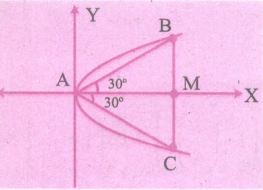
Since ABC is an equilateral triangle,
∠BAM = ∠MAC = 30o
In MBM, cos 30°= \(\frac{AM}{l}\)
⇒ AM = l cos 30° = l\(\left( \frac { \sqrt { 3 } }{ 2 } \right) \)
sin 30o = \(\frac { BM }{ AM } \)
⇒ sin 30o = \(\frac { BM }{ l } \)
⇒ BM = l sin 30o = l\(\left( \frac { 1 }{ 2 } \right) \)
ஃ Co-ordinates of B are (AM, BM) ⇒ \(B\left( \frac { \sqrt { 3 } l }{ 2 } ,\frac { 1 }{ 2 } \right) \)
Also B lies on (1)
\({ \left( \frac { l }{ 2 } \right) }^{ 2 }=4a\left( \frac { \sqrt { 3 } l }{ 2 } \right) \)
⇒ \(\frac { { l }^{ 2 } }{ 4 } =4a\left( \frac { \sqrt { 3 } l }{ 2 } \right) \)
\(\frac { { l }^{ 2 } }{ 4 } =2\sqrt { 3 } al\)
\(\frac { l }{ 4 } =2\sqrt { 3 } \) a ⇒ 1 = 8 \(a\sqrt { 3 } \)
Length of the side of the equilateral triangle is 8 \(a\sqrt { 3 } \) units.
15.
LHS =\({ tan }^{ -1 }\left( \frac { 1-x }{ 1+x } \right) -{ tan }^{ -1 }\left( \frac { 1-y }{ 1+y } \right) \)
= tan-1(1) - tan-1 (x) - (tan-1(1) - tan-1(y)
\(\left[ \because { tan }^{ -1 }(\frac { x-y }{ 1+xy } )={ tan }^{ -1 }x-{ tan }^{ -1 }y \right] \)
= tan-1(1) - tan-1 (x) - tan-1(1) + tan-1(y)
= tan-1(y) - tan-1(x)
= \({ tan }^{ -1 }\left( \frac { y-x }{ 1+xy } \right) \)
= \({ sin }^{ -1 }\left( \frac { y-x }{ \sqrt { 1+\left( yx \right) ^{ 2 }+\left( y-x \right) ^{ 2 } } } \right) \)
= \({ sin }^{ -1 }\left( \frac { y-x }{ \sqrt { (1+{ x }^{ 2 })(1+{ x }^{ 2 }) } } \right) \)
RHS
16.
\({ sin }^{ -1 }\left( \frac { sinx+cosx }{ \sqrt { 2 } } \right)\)
\(\begin{aligned}
& =\sin ^{-1}\left(\frac{1}{\sqrt{2}} \sin x+\frac{1}{\sqrt{2}} \cos x\right) \\
& =\sin ^{-1}\left(\sin x \cos \frac{\pi}{4}+\cos x \sin \frac{\pi}{4}\right) \\
& =\sin ^{-1}\left(\sin \left(x+\frac{\pi}{4}\right)\right)=\pi+\frac{\pi}{4}
\end{aligned}\)
17.
Given \(\overset { \rightarrow }{ OA } =2\overset { \wedge }{ i } -\overset { \wedge }{ j } +\overset { \wedge }{ k } ,\overset { \rightarrow }{ OB } =\overset { \wedge }{ i } -3\overset { \wedge }{ j } -5\overset { \wedge }{ k } ,\) and \(\overset { \rightarrow }{ OC } =3\overset { \wedge }{ i } -4\overset { \wedge }{ j } +4\overset { \wedge }{ k } \)
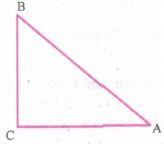
\(\therefore \overset { \rightarrow }{ AB } =\overset { \rightarrow }{ OB } -\overset { \rightarrow }{ OA } =-\overset { \wedge }{ i } -2\overset { \wedge }{ j } -6\overset { \wedge }{ k } \)
\(\overset { \rightarrow }{ BC } =\overset { \rightarrow }{ OC } -\overset { \rightarrow }{ OB } =2\overset { \wedge }{ i } -\overset { \wedge }{ j } +\overset { \wedge }{ k } \)
\(\overset { \rightarrow }{ CA } =\overset { \rightarrow }{ OA } -\overset { \rightarrow }{ OC } =\overset { \wedge }{ -i } +3\overset { \wedge }{ j } +5\overset { \wedge }{ k } \)
\(\overset { \rightarrow }{ AB } +\overset { \rightarrow }{ BC } +\overset { \rightarrow }{ CA } =\overset { \rightarrow }{ 0 } \)
Also, \(\overset { \rightarrow }{ BC } \). \(\overset { \rightarrow }{ CA } \)=\(\left( 2\overset { \wedge }{ i } -\overset { \wedge }{ j } +\overset { \wedge }{ k } \right) .\left( \overset { \wedge }{ -i } +3\overset { \wedge }{ j } +5\overset { \wedge }{ k } \right) \)
= -2 -3 + 5 = 0
\(\Rightarrow \overset { \rightarrow }{ BC } .\overset { \rightarrow }{ CA } \Rightarrow \angle BCA=\frac { \pi }{ 2 } \)
Hence, ABC is a right angled triangle.
\(\cos { A } =\frac { \overset { \rightarrow }{ AB } .\overset { \rightarrow }{ AC } }{ \left| \overset { \rightarrow }{ AB } \right| \left| \overset { \rightarrow }{ AC } \right| } \)
\(=\frac { \left( -\overset { \wedge }{ i } -2\overset { \wedge }{ j } -6\overset { \wedge }{ k } \right) .\left( \overset { \wedge }{ -i } -3\overset { \wedge }{ j } -5\overset { \wedge }{ k } \right) }{ \sqrt { 1+4+36 } .\sqrt { 1+9+25 } } \)
\(=\frac { 35 }{ \sqrt { 41 } .\sqrt { 35 } } =\sqrt { \frac { 35 }{ 41 } } =A={ Cos }^{ -1 }\left( \sqrt { \frac { 35 }{ 41 } } \right) \)
\(\cos { B } =\frac { \overset { \rightarrow }{ BA. } \overset { \rightarrow }{ BC } }{ \left| \overset { \rightarrow }{ BA } \right| \left| \overset { \rightarrow }{ BC } \right| } =\frac { \left( \overset { \wedge }{ i } +2\overset { \wedge }{ j } +6\overset { \wedge }{ k } \right) .\left( 2\overset { \wedge }{ i } -\overset { \wedge }{ j } +\overset { \wedge }{ k } \right) }{ \sqrt { 1+4+36 } +\sqrt { 4+1+1 } } \)
\(=\sqrt { \frac { 6 }{ 41 } } \Rightarrow B={ Cos }^{ -1 }\left( \sqrt { \frac { 6 }{ 41 } } \right) \)
18.
The augmented matrix [A|B] is \(\left[ \begin{matrix} 2 & -3 & 5 \\ 3 & 1 & \lambda \\ 1 & -7 & 8 \end{matrix}|\begin{matrix} 12 \\ \mu \\ 17 \end{matrix} \right] \)
\(\overset { { R }_{ 1 }\leftrightarrow { R }_{ 3 } }{ \longrightarrow } \left[ \begin{matrix} 1 & -7 & 8 \\ 3 & 1 & \lambda \\ 2 & -3 & 5 \end{matrix}|\begin{matrix} 17 \\ \mu \\ 12 \end{matrix} \right] \)
\(\overset { { R }_{ 2 }\rightarrow { R }_{ 2 }-{ R }_{ 1 }\\ { R }_{ 3 }\rightarrow { R }_{ 3 }-2R_{ 1 } }{ \longrightarrow } \left[ \begin{matrix} 1 & -7 & 8 \\ 0 & 22 & \lambda -51 \\ 0 & 11 & -11 \end{matrix}|\begin{matrix} 17 \\ \mu -51 \\ -22 \end{matrix} \right] \)
\(\overset { { R }_{ 2 }\rightarrow { R }_{ 2 }-2{ R }_{ 3 }\\ { R }_{ 3 }\rightarrow { R }_{ 3 }\div 11 }{ \longrightarrow } \left[ \begin{matrix} 1 & -7 & 8 \\ 0 & 0 & \lambda -2 \\ 0 & 1 & -1 \end{matrix}|\begin{matrix} 17 \\ \mu -7 \\ -2 \end{matrix} \right] \)
\(\overset { { R }_{ 2 }\leftrightarrow { R }_{ 3 } }{ \longrightarrow } \left[ \begin{matrix} 1 & -7 & 8 \\ 0 & 1 & -1 \\ 0 & 0 & \lambda -2 \end{matrix}|\begin{matrix} 17 \\ -2 \\ \mu -7 \end{matrix} \right] \)
Case (i) : when λ ≠ 2,
\(\rho\) ([A|B]) = 3 and \(\rho\)(A) = 3
∴ \(\rho\)([AIB])= \(\rho\)(A) = 3 = the number of unknowns
∴ The system has unique solution
Case (ii) : when λ = 2, μ =7
\(\left[ \begin{matrix} 1 & -7 & 8 \\ 0 & 1 & -1 \\ 0 & 0 & 0 \end{matrix}|\begin{matrix} 17 \\ -2 \\ 0 \end{matrix} \right] \)
Here \(\rho\)(A) = 2 and \(\rho\)([A|B]) = 2
∴ \(\rho\)(A) = \(\rho\)([A|B]) = 2 < number of unknowns
Thus the system is consistent with infinitely many solutions.
Case (iii) : When λ= 2 and μ ≠ 7
\(\rho\) (A) = 2 and \(\rho\) ([A|B]) = 3
∴ \(\rho\) (A) ≠ \(\rho\) ([A|B])
Thus, the given system of equations is inconsistent.
19.
Augmented matrix = [A|B] = \(\left[ \begin{matrix} 1 & 1 & 1 \\ 1 & 2 & 4 \\ 1 & 4 & 10 \end{matrix}|\begin{matrix} 1 \\ \lambda \\ { \lambda }^{ 2 } \end{matrix} \right] \)
[A|B] = \(\overset { { R }_{ 2 }\rightarrow { R }_{ 2 }-{ R }_{ 1 }\\ { R }_{ 3 }\rightarrow { R }_{ 3 }-{ R }_{ 1 } }{ \longrightarrow } \left[ \begin{matrix} 1 & 1 & 1 \\ 0 & 1 & 3 \\ 0 & 3 & 9 \end{matrix}|\begin{matrix} 1 \\ \lambda -1 \\ { \lambda }^{ 2 }-1 \end{matrix} \right] \)
\(\overset { { R }_{ 3 }\rightarrow { R }_{ 3 }-3{ R }_{ 2 } }{ \longrightarrow } \left[ \begin{matrix} 1 & 1 & 1 \\ 0 & 1 & 3 \\ 0 & 0 & 0 \end{matrix}|\begin{matrix} 1 \\ \lambda -1 \\ { \lambda }^{ 2 }-1-3\lambda +3 \end{matrix} \right] \)
⟶ \(\left[ \begin{matrix} 1 & 1 & 1 \\ 0 & 1 & 3 \\ 0 & 0 & 0 \end{matrix}|\begin{matrix} 1 \\ \lambda -1 \\ { \lambda }^{ 2 }-3\lambda +2 \end{matrix} \right] \)
Here \(\rho\)(A) = 2
The given system of equations is consistent only when \(\rho\)([AIB]) = 2
\(\rho\)([AIB]) = 2 only when λ2-3λ + 2 = 0
⇒ (λ-1) (λ-2) = 0 ⇒ λ = 1 or λ = 2
∴ The given system is consistent when the values of A are 1 and 2.
20.
Put \(\frac { 1 }{ x } \) = a, \(\frac { 1 }{ y } \) = b, \(\frac { 1 }{ z } \) = c
∴ 2a + 3b + 10c = 4 ....(1)
4a- 6b - 5c = 1 .....(2)
6a + 9b -20c = 2 ...(3)
Δ = \(\left| \begin{matrix} 2 & 3 & 10 \\ 4 & -6 & 5 \\ 6 & 9 & -20 \end{matrix} \right| \)
= \(2\left| \begin{matrix} -6 & 5 \\ 9 & -20 \end{matrix} \right| -3\left| \begin{matrix} 4 & 5 \\ 6 & -20 \end{matrix} \right| +10\left| \begin{matrix} 4 & -6 \\ 6 & 9 \end{matrix} \right| \)
= 2 (120 - 45) -3 (-80 - 30) + 10 (36 + 36)
= 150 + 330 + 720 = 1200
Δ1 = \(\left| \begin{matrix} 4 & 3 & 10 \\ 1 & -6 & 5 \\ 2 & 9 & -20 \end{matrix} \right| \)
= \(4\left| \begin{matrix} -6 & 5 \\ 9 & -20 \end{matrix} \right| -3\left| \begin{matrix} 1 & 5 \\ 2 & -20 \end{matrix} \right| +10\left| \begin{matrix} 1 & -6 \\ 2 & 9 \end{matrix} \right| \)
= 4 (120 - 45) -3 (-20 - 10) + 10 (9 + 12)
= 300 + 90 + 120 = 600
Δ2 = \(\left| \begin{matrix} 2 & 4 & 10 \\ 4 & 1 & 5 \\ 6 & 2 & -20 \end{matrix} \right| =2\left| \begin{matrix} 1 & 5 \\ 2 & -20 \end{matrix} \right| -4\left| \begin{matrix} 4 & 5 \\ 6 & -20 \end{matrix} \right| +10\left| \begin{matrix} 4 & 1 \\ 6 & 2 \end{matrix} \right| \)
= 2 (-2 - 10) - 4 (-80 - 30) + 10 (8 - 6)
= -60 + 440 + 20 = 400
Δ3 = \(\left| \begin{matrix} 2 & 3 & 4 \\ 4 & -6 & 1 \\ 6 & 9 & 2 \end{matrix} \right| 2\left| \begin{matrix} -6 & 1 \\ 9 & 2 \end{matrix} \right| -3\left| \begin{matrix} 4 & 1 \\ 6 & 2 \end{matrix} \right| +10\left| \begin{matrix} 4 & -6 \\ 6 & 9 \end{matrix} \right| \)
= 2 (-12 - 9) -3 (8 - 6) + 4 (36 + 36)
= - 42 - 6 + 288 = 240
∴ a = \(\frac { { \triangle }_{ 1 } }{ \triangle } =\frac { 600 }{ 1200 } =\frac { 1 }{ 2 } \Rightarrow \frac { 1 }{ x } =\frac { 1 }{ 2 } \) ⇒ x = 2
∴ b = \(\frac { { \triangle }_{ 2 } }{ \triangle } =\frac { 400 }{ 1200 } =\frac { 1 }{ 3 } \Rightarrow \frac { 1 }{ y } =\frac { 1 }{ 3 } \) ⇒ y = 1
∴ c = \(\frac { { \triangle }_{ 3 } }{ \triangle } =\frac { 240 }{ 1200 } =\frac { 1 }{ 5 } \Rightarrow \frac { 1 }{ z } =\frac { 1 }{ 5 } \) ⇒ z = 5
∴ Solution set is {2, 3, 5}
21.
Let ∝, β be the roots x2+ bx + ca = 0
∝ +β = -b, ∝β = ca
and a, ૪ be the roots of x2 + cx + ab = 0
∝+૪ = -c, ∝૪ = ab
Then, a2 + b∝ + ca = 0 and
∝2+ c∝ + ab = 0
⇒ (b-c)∝+a(c-b) = 0 ⇒ ∝ = a
Also ∝β = ca and ∝૪ = ab
∴ β = c and ૪ = c
since ∝ = a is a root of x2 + bx + ca = 0,
we get a2 + ba + ca = 0 ⇒ a + b + c = 0
Thus, β+૪ = b + c = -a and β૪ = bc
Hence β, ૪ are the roots of the equation
x2 + ax + bc = 0
22.
Given equation is (a2+b2+c2) p2-2
(ab+bc+cd) p+(b2+c2+d2) ≤ 0...(1)
(1) can be rewritten as
(a2p2 - 2abp + b2) + (b2p2 - 2bcp + c2) + (c2p2 - 2cdp + d2) ≤ 0
Since a, b, c, d, p∈ R
(ap-b)2 ≥ 0, (bp-c)2 ≥ 0 and (cp-d)2 ≥ 0
∴ (2) will be satisfied only if
ap - b = 0, bp - c = 0, cp - d = 0
\(\Rightarrow \frac { b }{ a } =\frac { c }{ b } =\frac { d }{ c } =p\)
⇒ a, b, c, d are in G.P and ad = bc

12th Standard Syllabus & Materials
12th Standard
TN 12th Computer Applications வலையமைப்பு வடமிடல் Sample Question Papers Study Material - QB365 Set A
NEW12th Standard
TN 12th Computer Applications களப்பெயர் முறைமை (DNS) Sample Question Papers Study Material - QB365 Set A
NEW12th Standard
TN 12th Computer Applications வலையமைப்பு எடுத்துக்காட்டுகள் மற்றும் நெறிமுறைகள் Sample Question Papers Study Material - QB365 Set A
NEW12th Standard
TN 12th Computer Applications கணினி வலையமைப்பு ஓர் அறிமுகம் Sample Question Papers Study Material - QB365 Set A



Tamilnadu Stateboard 12th Standard Subjects
Maths

Chemistry

Physics

Biology

Computer Science

Business Maths and Statistics

Economics

Commerce

Accountancy

History

Computer Applications
Biology
Computer Technology
Computer Applications
Computer Science
Business Maths and Statistics
Commerce
Economics
Maths
Chemistry
Physics
Computer Technology
History
Accountancy

Tamil

English

French
Tamilnadu Stateboard Standards



