
 100% FREE ACCESS
12th Standard Syllabus & Materials
12th Standard
TN 12th Maths Applications of Matrices and Determinants Sample Question Papers Study Material - QB365 Set A
NEW12th Standard
TN 12th Computer Applications மின்னணு தரவு பரிமாற்றம் Sample Question Papers Study Material - QB365 Set A
NEW12th Standard
TN 12th Computer Applications மின் - வணிக பாதுகாப்பு அமைப்புகள் Sample Question Papers Study Material - QB365 Set A
NEW12th Standard
TN 12th Computer Applications மின்னணு செலுத்தல் முறைகள் Sample Question Papers Study Material - QB365 Set A
NEW12th Standard
TN 12th Computer Applications மின் - வணிகம் Sample Question Papers Study Material - QB365 Set A
NEW12th Standard
TN 12th Computer Applications திறந்த மூல கருத்துருக்கள் Sample Question Papers Study Material - QB365 Set A

Published on: 19/06/2021
QB365 provides detailed and simple solution for every Creative Questions in class 12 Maths Subject. It will helps to get more idea about question pattern in every Creative questions with solution.
Download Tamil Nadu 12th Standard Maths question papers, model tests, one-mark questions, important questions, and public exam papers in PDF format. Free study materials and answer keys for TN State Board students.
Questions + Answers key
Take MCQ Maths Test1.
Find the area bounded by the curve xy2=a2(a-x) and the y-axis
2.
Find the area bounded by the curve y=xex and y=xe-x and the line x=1.
3.
Find the area bounded by x=at2,y=2at between the ordinates corresponding to t = 1 and t = 2.
4.
Find the local maximum and local minimum values of f(x)=x4-3x+3x2-x.
5.
Find the points of inflection and determine the intervals of concavity of \(y={ e }^{ -{ x }^{ 2 } }\)
6.
Gas is escaping from a spherical balloon at the rate of 900 cm3/sec. How fast is the surface area and radius of the balloon shrinking when the radius of the balloon is 30 cm?
7.
Show that the curves 4x = y2 and 4xy = k cut at right angles if k2 = 512.
8.
If f(x) = a log x + bx2+ x has entreme values at x = - 1 and x = 2, then find a and b.
9.
If Rolle's theorem holds for f (x) = x3 + bx2 + ax + 5 on [1,3] with c = \(\left( 2+\frac { 1 }{ \sqrt { 3 } } \right) \) find the values of a and b.
10.
Find the shortest distance between the following pairs of lines \(\frac { x-3 }{ 3 } =\frac { y-8 }{ -1 } =\frac { z-3 }{ 1 } \)and \(\frac { x+3 }{ -3 } =\frac { y+7 }{ 2 } =\frac { z-6 }{ 4 } \)
11.
Find all the roots \((2-2i)^{ \frac { 1 }{ 3 } }\) and also find the product of its roots.
12.
Verify that arg(1+i) + arg(1-i) = arg[(1+i) (1-i)]
13.
A kho-kho player In a practice session while running realises that the sum of tne distances from the two kho-kho poles from him is always 8m. Find the equation of the path traced by him of the distance between the poles is 6m.
14.
An arch is in the form of a parabola with its axis vertical. The arch is 10 m high and 5 m wide at the base. How wide is it 2 m from the vertex of the parabola?
15.
If \({ tan }^{ -1 }\left( \frac { \sqrt { 1+{ x }^{ 2 } } -\sqrt { 1-{ x }^{ 2 } } }{ \sqrt { 1+{ x }^{ 2 } } +\sqrt { 1-{ x }^{ 2 } } } \right) =a\) than prove that x2 = sin 2a
16.
Write the function \(f(x)=\tan ^{-1} \sqrt{\frac{a-x}{a+x}}-a<x<a \)
17.
ABCD is a quadrilateral with \(\overset { \rightarrow }{ AB } =\overset { \rightarrow }{ \alpha } \) and \(\overset { \rightarrow }{ AD } =\overset { \rightarrow }{ \beta } \) and \(\overset { \rightarrow }{ AC } =2\overset { \rightarrow }{ \alpha } +3\overset { \rightarrow }{ \beta } \). If the area of the quadrilateral is λ times the area of the parallelogram with \(\overset { \rightarrow }{ AB } \) and \(\overset { \rightarrow }{ AD } \) as adjacent sides, then prove that \(\lambda =\frac { 5 }{ 2 } \)
18.
Show that the equations -2x + y + z = a, x - 2y + z = b, x + y -2z = c are consistent only if a + b + c = 0.
19.
Solve: (2x2 - 3x + 1) (2x2 + 5x + 1) = 9x2.
20.
If c ≠ 0 and \(\frac { p }{ 2x } =\frac { a }{ x+x } +\frac { b }{ x-c } \) has two equal roots, then find p.
1.
πa2
2.
\(\frac { 2 }{ e } \)
3.
\(\frac { { 56a }^{ 2 } }{ 3 } \)
4.
local min value = \(\frac { 27 }{ 256 } \)
No local maximum
5.
\(\left( -\frac { 1 }{ \sqrt { 2 } } ,{ e }^{ -\frac { 1 }{ 2 } } \right) ,\left( \frac { 1 }{ \sqrt { 2 } } ,e^{ -\frac { 1 }{ 2 } } \right) \)
6.
\(\frac { ds }{ dt } ={ 60cm }^{ 2 }/sec\frac { dt }{ dr } =\frac { 1 }{ 4\pi } cm/sec\)
7.
Given curves are 4x = y2 ....(1)
⇒ 4xy = k....(2)
Substituting (1) in (2) we get
y3 = k ⇒ y = \(k^{ \frac { 1 }{ 3 } }\)
∴ (1) becomes, 4x = \(\left( { k }^{ \frac { 1 }{ 3 } } \right) ^{ 2 }=k^{ \frac { 2 }{ 3 } }\)
⇒ x = \(\frac { { k }^{ \frac { 2 }{ 3 } } }{ 4 } \)
∴ The point of intersection of the given curves is \(\left( \frac { k^{ \frac { 2 }{ 3 } } }{ 4 } ,{ k }^{ \frac { 1 }{ 3 } } \right) \)
Differentiating 4x = y2
4 = 2y\(\frac { dy }{ dx } \)
⇒ \(\frac { dy }{ dx } =\frac { 2 }{ y } \)
m1 = \(\frac { 2 }{ { k }^{ \frac { 1 }{ 3 } } } \)
Differentiating 4xy = k,
4x\(\frac { dy }{ dx } \)+4y = 0
⇒ \(\frac { dy }{ dx } =\frac { -y }{ x } \)
∴ m2 = \(\frac { { -k }^{ \frac { 1 }{ 3 } } }{ { k }^{ \frac { 2 }{ 3 } } } \)(4)
Since the given curves cut at right angles, m1m2 = -1.
∴ \(\left( \frac { 2 }{ { k }^{ \frac { 1 }{ 3 } } } \right) \left( \frac { -4.k^{ \frac { 1 }{ 3 } } }{ k^{ \frac { 2 }{ 3 } } } \right) \) = 1
⇒ \(\frac { 8 }{ { k }^{ \frac { 2 }{ 3 } } } \) = 1 ⇒ \({ k }^{ \frac { 2 }{ 3 } }\) = 8
⇒ \(\left( { k }^{ \frac { 2 }{ 3 } } \right) ^{ 3 }\) = 83
⇒ k2 = 512.
8.
f(x) = a log x + bx2 + x
f'(x) = \(\frac { a }{ x } \) + 2bx +1
Since f (x) has extreme values at x = -1 and x = 2,
f'(-1) = 0 and f'(2) = 0
f'(-1) = 0
⇒ -a - 2b + 1 = 0.....(1)
f'(2) = 0
⇒ \(\frac { a }{ 2 } \) + 4b + 1 = 0
⇒ a + 8b + 2 = 0....(2)
(1) + (2) ⟶
6b + 3 = 0
⇒ b = \(\frac { -1 }{ 2 } \)
Substituting b = \(\frac { -1 }{ 2 } \) in (1) ⇒ -a - 2\(\left( -\frac { 1 }{ 2 } \right) \)+1 = 0
⇒ -a + 1 + 1 = 0
⇒ a = 2
∴ a = 2, b = \(\frac { -1 }{ 2 } \)
9.
Given f(x) = x3 + bx2 + ax + b
Given that Rolle's theorem holds for c = \(2+\frac { 1 }{ \sqrt { 3 } } \)
⇒ f'(c) = 0
⇒ 3c2+ 2bc+ a = 0
⇒ c = \(\frac { -2b\pm \sqrt { 4b^{ 2 }-4(3)a } }{ 6 } \)
= \(\frac { -2b\pm \sqrt { 4b^{ 2 }-12a } }{ 6 } \)
⇒ \(2+\frac { 1 }{ \sqrt { 3 } } =2\left( \frac { (-b)\pm \sqrt { { b }^{ 2 }-3a } }{ 6 } \right) \)
= \(\frac { -b\pm \sqrt { { b }^{ 2 }-3a } }{ 3 } \)
= \(\left( \frac { -b }{ 3 } \right) \pm \frac { \sqrt { { b }^{ 2 }-3a } }{ 3 } \)
⇒ \(\frac { -b }{ 3 } \) = -2 ⇒ -b = 6 ⇒ b = -6
Also, \(\frac { \sqrt { { b }^{ 2 }-3a } }{ 3 } =\frac { 1 }{ \sqrt { 3 } } \)
⇒ \(\frac { { b }^{ 2 }-3a }{ 9 } =\frac { 1 }{ 3 } \)
⇒ b2-3a = 3
⇒ (-6)2-3a = 3
⇒ 36-3 = 3a
⇒ 33 = 3a
⇒ a = 11
∴ a = 11, b = -6
10.
From the line \(\frac { x-3 }{ 3 } =\frac { y-8 }{ -1 } =\frac { z-3 }{ 1 } \), we get
\(\overset { \rightarrow }{ a } =3\overset { \wedge }{ i } +8\overset { \wedge }{ j } +3\overset { \wedge }{ k } \), \(\overset { \rightarrow }{ b } =3\overset { \wedge }{ i } -\overset { \wedge }{ j } +\overset { \wedge }{ k } \)
From the line \(\frac { x+3 }{ -3 } =\frac { y+7 }{ 2 } =\frac { z-6 }{ 4 } \) we get
\(\overset { \rightarrow }{ c } =-3\overset { \wedge }{ i } -7\overset { \wedge }{ j } +6\overset { \wedge }{ k } \) and \(\overset { \rightarrow }{ d } =-3\overset { \wedge }{ i } +2\overset { \wedge }{ j } +4\overset { \wedge }{ k } \)
Since the given lines are not parallel, the shortest distance between the line is
\(d=\left| \frac { \left( \overset { \rightarrow }{ c } -\overset { \rightarrow }{ a } \right) .\left( \overset { \rightarrow }{ b } \times \overset { \rightarrow }{ d } \right) }{ \left| \overset { \rightarrow }{ b } \times \overset { \rightarrow }{ d } \right| } \right| \)
\(\overset { \rightarrow }{ c } -\overset { \rightarrow }{ a } =-6\overset { \wedge }{ i } -15\overset { \wedge }{ j } +3\overset { \wedge }{ k } \)
\(\overset { \rightarrow }{ b } \times \overset { \rightarrow }{ d } =\left| \begin{matrix} \overset { \wedge }{ i } \\ 3 \\ -3 \end{matrix}\begin{matrix} \overset { \wedge }{ j } \\ -1 \\ 2 \end{matrix}\begin{matrix} \overset { \wedge }{ k } \\ 1 \\ 4 \end{matrix} \right| \)
\(=\overset { \wedge }{ i } (-4-2)-\overset { \wedge }{ j } (12+3)+\overset { \wedge }{ k } (6-3)\\ \)
\(=-6\overset { \wedge }{ i } -15\overset { \wedge }{ j } +3\overset { \wedge }{ k } \)
\(\therefore \left| \overset { \rightarrow }{ b } \times \overset { \rightarrow }{ d } \right| =\sqrt { 36+225+9 } \)
\(=\sqrt { 270 } \)
\(\therefore \left( \overset { \rightarrow }{ c } -\overset { \rightarrow }{ a } \right) .\left( \overset { \rightarrow }{ b } \times \overset { \rightarrow }{ d } \right) =\left( -6\overset { \wedge }{ i } -15\overset { \wedge }{ j } +3\overset { \wedge }{ k } \right) .\left( -6\overset { \wedge }{ i } -15\overset { \wedge }{ j } +3\overset { \wedge }{ k } \right) \)
= -6 (-6) + 15 _(15) + 3(3)
= 270 ≠ 0
Since the given lines are neither intersecting, nor parallel they are skew lines
\(\therefore d=\frac { 270 }{ \sqrt { 270 } } =\sqrt { 270 } units\)
11.
Let 2-2i = r(cosθ + isinθ)
r =\(\sqrt { { 2 }^{ 2 }+(-2)^{ 2 } } =\sqrt { 4+4 } =\sqrt { 8 } =2\sqrt { 2 } \)
The principal value α =tan-1\(\left| \frac { y }{ x } \right| =tan^{ -1 }\left| \frac { -z }{ z } \right| |\)
= tan-1(1) = \(\frac { \pi }{ 4 } \)
Since the complex number 2 - 2i lies in the quadrant
θ = -α = -\(\frac { \pi }{ 4 } \)
∴ 2-2i = \(2\sqrt { 2 } \left[ cos\left( -\frac { \pi }{ 4 } \right) +isin\left( \frac { \pi }{ 4 } \right) \right] ^{ \frac { 1 }{ 3 } }\)
∴ \((2\sqrt { 2 } )^{ \frac { 1 }{ 3 } }\left[ cos\left( -\frac { \pi }{ 4 } \right) +isin\left( \frac { \pi }{ 4 } \right) \right] ^{ \frac { 1 }{ 3 } }\)
= \(8^{ \frac { 1 }{ 6 } }\left[ cos\frac { 1 }{ 3 } \left( 2k\pi -\frac { \pi }{ 4 } \right) +isin\frac { 1 }{ 3 } \left( 2k\pi -\frac { \pi }{ 4 } \right) \right] \)
k = 0, 1, 2
The roots are
∴ When k = 0, \(8^{ \frac { 1 }{ 6 } }cis\left( -\frac { \pi }{ 12 } \right) \)
when k = 1, \(8^{ \frac { 1 }{ 6 } }cis\left( \frac { 7\pi }{ 12 } \right) \)
when k = 2, \(8^{ \frac { 1 }{ 6 } }cis\left( \frac { 15\pi }{ 12 } \right) \)
∴ The product of the root
= \(8^{ \frac { 1 }{ 6 } }cis\left( -\frac { \pi }{ 12 } +\frac { 7\pi }{ 12 } +\frac { 15\pi }{ 12 } \right) \)
= \(8^{ \frac { 1 }{ 6 } }cis\left( \frac { 21\pi }{ 12 } \right) =8^{ \frac { 1 }{ 6 } }cis\left( \frac { 7\pi }{ 12 } \right) \)
= \(8^{ \frac { 1 }{ 6 } }cis\left( 2\pi -\frac { \pi }{ 4 } \right) =8^{ \frac { 1 }{ 6 } }cis\left( -\frac { \pi }{ 4 } \right) \)
= \(8^{ \frac { 1 }{ 6 } }\left[ cos\left( -\frac { \pi }{ 4 } \right) +isin\left( -\frac { \pi }{ 4 } \right) \right] \)
= \(8^{ \frac { 1 }{ 6 } }\left[ cos\left( \frac { \pi }{ 4 } \right) +isin\left( \frac { \pi }{ 4 } \right) \right] \)
= \(8^{ \frac { 1 }{ 6 } }\left[ \frac { 1 }{ \sqrt { 2 } } -\frac { i }{ \sqrt { 2 } } \right] =2^{ 3\times \frac { 1 }{ 6 } }\left( \frac { 1-i }{ \sqrt { 2 } } \right) =2^{ 1/2 }\left( \frac { 1-i }{ \sqrt { 2 } } \right) \)
= 1-i
12.
arg(1+i) + arg(1-i) = arg[(1+i) (1-i)]
LHS = arg (1+i) + arg(1-i)
1+i = \(\sqrt { 2 } \left( \frac { 1 }{ \sqrt { 2 } } +\frac { i }{ \sqrt { 2 } } \right) \)
= \(\sqrt { 2 } \left( cos\frac { \pi }{ 4 } +isin\frac { \pi }{ 4 } \right) \)
∴ arg (1+i) = π/4
-1+i =\(\sqrt { 2 } \left( \frac { -1 }{ \sqrt { 2 } } +\frac { i }{ \sqrt { 2 } } \right) \)
= \(\sqrt { 2 } \left( cos3\frac { \pi }{ 4 } +isin3\frac { \pi }{ 4 } \right) \)
∴ (-1+i) = 3\(\frac { \pi }{ 4 } \)
∴ LHS = \(\frac { \pi }{ 4 } +\frac { 3\pi }{ 4 } =\frac { 4\pi }{ 4 } =\pi \)
RHS = arg[(1+i) (-1+i)]
= arg[-1-i + i + i2]
= (-1-i + i-1) = arg(-2)
= arg(2) - (1) = 2 arg(-1)
= 2 (cos π + isin π) = π
∴ LHS = RHS
13.
Given F1P + F2P = 8
By the focal property of ellipse
F1P + F2P = 2a
∴ 2a = 8 ⇒ a = 4
and distance between the foci = F1F2 = 6
2ae = 6 ⇒ ae = 3
∴ 4(e) = 3 ⇒ e \(\frac34\)
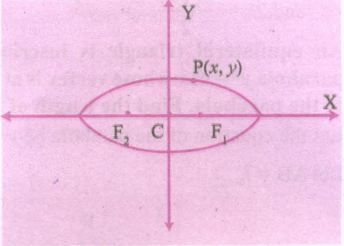
∴ b2 = a2(1- e2)
= \(16\left( { 1-\left( \frac { 3 }{ 4 } \right) }^{ 2 } \right) =16\left( 1-\frac { 9 }{ 10 } \right) =16\left( \frac { 7 }{ 16 } \right) =7\)
∴ The path traced by him is an ellipse and its equation is \(\frac { { x }^{ 2 } }{ { a }^{ 2 } } +\frac { { y }^{ 2 } }{ { b }^{ 2 } } =1\)
⇒ \(\frac { { x }^{ 2 } }{ 16 } -\frac { { y }^{ 2 } }{ 7 } \) = 1
14.
Since the axis of the parabola is vertical, it is open upward.
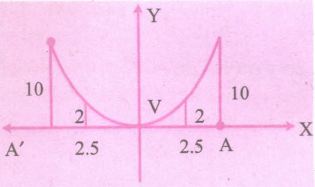
Its equation is x2 = 4ay .....(1)
Since the base of the parabola is 5 m
VA = 2.5 m and the height of the arch is 10 m
A(2.5, 10) lies on the parabola
(2.5)2 = 4a(10)
⇒ 6.25 = 40a ⇒ a = \(\frac{625}{4000}=\frac{5}{32}\)
Substituting a = \(\frac{5}{32}\) in (1) we get,
x2 = 4\(\left( \frac { 5 }{ 32 } \right) \) y ⇒ x2 = \(\frac58\)y
Let x be the width of the arch, when the height is 2m.
∴ (x, 2) is a point on the parabola
∴ x2 = \(\frac58\)(2) = \(\frac{5}{4}\)
∴ x = \(\frac{\sqrt5}{2}\)
and 2x = \(\frac{2\sqrt5}{2}\) = \(\sqrt5\)
15.
Given \({ tan }^{ -1 }\left( \frac { \sqrt { 1+{ x }^{ 2 } } -\sqrt { 1-{ x }^{ 2 } } }{ \sqrt { 1+{ x }^{ 2 } } +\sqrt { 1-{ x }^{ 2 } } } \right) =a\)
\(\Rightarrow \frac { \left( \sqrt { 1+{ x }^{ 2 } } -\sqrt { 1-{ x }^{ 2 } } \right) \left( \sqrt { 1+{ x }^{ 2 } } +\sqrt { 1-{ x }^{ 2 } } \right) }{ \left( \sqrt { 1+{ x }^{ 3 } } -\sqrt { 1-{ x }^{ 2 } } \right) \left( \sqrt { 1+{ x }^{ 2 } } +\sqrt { 1-{ x }^{ 2 } } \right) } \)
= \(\frac { tan\alpha +1 }{ tan\alpha -1 } \)
\(\Rightarrow \frac { 2\sqrt { 1+{ x }^{ 2 } } }{ -2\sqrt { 1-{ x }^{ 2 } } } =\frac { tan\alpha +1 }{ tan\alpha -1 } \)
\(\Rightarrow \sqrt { \frac { 1-{ x }^{ 2 } }{ 1+{ x }^{ 2 } } } =\frac { 1-tan\alpha }{ 1+tan\alpha } \)
\(\Rightarrow \sqrt { \frac { 1-{ x }^{ 2 } }{ 1+{ x }^{ 2 } } } =\frac { cos\alpha -sin\alpha }{ cos\alpha +sin\alpha } \)
\(\Rightarrow \frac { 1-{ x }^{ 2 } }{ 1+{ x }^{ 2 } } \left( \frac { cos\alpha -sin\alpha }{ cos\alpha +sin\alpha } \right) ^{ 2 }\)
\(\Rightarrow \frac { 1-{ x }^{ 2 } }{ 1+{ x }^{ 2 } } =\frac { 1-sin2\alpha }{ 1+sin2\alpha } \Rightarrow { x }^{ 2 }=sin2\alpha \)
16.
Put \(x=a\ cos\theta\)
\(f(x)={ tan }^{ -1 }\sqrt { \frac { a-acos\theta }{ a+acos\theta } } ={ tan }^{ -1 }\sqrt { \frac { 1-cos\theta }{ 1+cos\theta } }\)
= \({ tan }^{ -1 }\sqrt { \frac { 2{ sin }^{ 2 }\frac { \theta }{ 2 } }{ 2{ cos }^{ 2 }\frac { \theta }{ 2 } } } =tan|tan\frac { \theta }{ 2 } |={ tan }^{ -1 }\left( tan\frac { \theta }{ 2 } \right)\)
= \(\frac { \theta }{ 2 }\) \(\left.\Rightarrow 0<\frac{\theta}{2}<\frac{\pi}{2} \therefore\left|\tan \frac{\theta}{2}\right|=\tan \frac{\theta}{2}\right]\)
\(\frac { 1 }{ 2 } .{ cos }^{ -1 }\left( \frac { x }{ a } \right)\)
17.
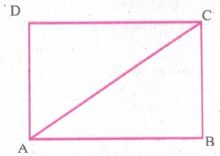
Given \(\overset { \rightarrow }{ AB } =\overset { \rightarrow }{ \alpha } \), \(\overset { \rightarrow }{ AD } =\overset { \rightarrow }{ \beta } \) and \(\overset { \rightarrow }{ AC } =2\overset { \rightarrow }{ \alpha } +3\overset { \rightarrow }{ \beta } \)
Area of the quadrilateral ABCD
∴ = are of ∆ ABC + area of ∆ ACD
\(=\frac { 1 }{ 2 } \left| \overset { \rightarrow }{ AB } \times \overset { \rightarrow }{ AC } \right| +\frac { 1 }{ 2 } \left| \overset { \rightarrow }{ AC } \times \overset { \rightarrow }{ AD } \right| \)
\(=\frac { 1 }{ 2 } \left| \overset { \rightarrow }{ \alpha } \times \left( 2\overset { \rightarrow }{ \alpha } +3\overset { \rightarrow }{ \beta } \right) \right| +\frac { 1 }{ 2 } \left| \left( 2\overset { \rightarrow }{ \alpha } +3\overset { \rightarrow }{ \beta } \right) \times \overset { \rightarrow }{ \beta } \right| \)
\(=\frac { 1 }{ 2 } \left| 2\left( \overset { \rightarrow }{ \alpha } \times \overset { \rightarrow }{ \alpha } \right) +3\left( \overset { \rightarrow }{ \alpha } \times \overset { \rightarrow }{ \beta } \right) \right| +\frac { 1 }{ 2 } \left| 2\left( \overset { \rightarrow }{ \alpha } \times \overset { \rightarrow }{ \beta } \right) +3\left( \overset { \rightarrow }{ \beta } \times \overset { \rightarrow }{ \beta } \right) \right| \)
\(=\frac { 1 }{ 2 } \left| 3\left( \overset { \rightarrow }{ \alpha } \times \overset { \rightarrow }{ \beta } \right) \right| +\frac { 1 }{ 2 } \left| 2\left( \overset { \rightarrow }{ \alpha } \times \overset { \rightarrow }{ \beta } \right) \right| \quad \quad \quad \left[ \because \overset { \rightarrow }{ \alpha } \times \overset { \rightarrow }{ \alpha } =\overset { \rightarrow }{ \beta } \times \overset { \rightarrow }{ \beta } =0 \right] \)
\(=\left( \frac { 3 }{ 2 } +\frac { 2 }{ 2 } \right) \left( \overset { \rightarrow }{ \alpha } \times \overset { \rightarrow }{ \beta } \right) =\left( \frac { 5 }{ 2 } \right) \left| \overset { \rightarrow }{ \alpha } \times \overset { \rightarrow }{ \beta } \right| \quad \quad (1)\)
Now, Area of the parallelogram with \(\overset { \rightarrow }{ AB } \) and \(\overset { \rightarrow }{ AD } \) as
adjacent sides = \(\left| \overset { \rightarrow }{ AB } \times \overset { \rightarrow }{ AD } \right| =\left| \overset { \rightarrow }{ \alpha } \times \overset { \rightarrow }{ \beta } \right| .... (2)\)
From (1) & (2), \(\frac { 5 }{ 2 } \left| \overset { \rightarrow }{ \alpha } \times \overset { \rightarrow }{ \beta } \right| =\lambda \left| \overset { \rightarrow }{ \alpha } \times \overset { \rightarrow }{ \beta } \right| \) [Given]
\(\lambda =\frac { 5 }{ 2 } \)
18.
Augmented matrix [A|B] is \(\left[ \begin{matrix} -2 & 1 & 1 \\ 1 & -2 & 1 \\ 1 & 1 & -2 \end{matrix}|\begin{matrix} a \\ b \\ c \end{matrix} \right] \)
[A|B]\(\overset { { R }_{ 1 }\leftrightarrow { R }_{ 2 } }{ \longrightarrow } \left[ \begin{matrix} 1 & -2 & 1 \\ -2 & 1 & 1 \\ 1 & 1 & -2 \end{matrix}|\begin{matrix} b \\ a \\ c \end{matrix} \right] \)
\(\overset { { R }_{ 2 }\rightarrow { R }_{ 2 }+2{ R }_{ 1 }\\ { R }_{ 3 }\rightarrow { R }_{ 3 }+{ R }_{ 1 } }{ \longrightarrow } \left[ \begin{matrix} 1 & -2 & 1 \\ 0 & -3 & 3 \\ 0 & 3 & -3 \end{matrix}|\begin{matrix} b \\ a+2b \\ c-b \end{matrix} \right] \)
\(\overset { { R }_{ 3 }\rightarrow { R }_{ 3 }+{ R }_{ 2 } }{ \longrightarrow } \left[ \begin{matrix} 1 & -2 & 1 \\ 0 & -3 & 3 \\ 0 & 0 & 0 \end{matrix}|\begin{matrix} b \\ c+2b \\ a+b+c \end{matrix} \right] \)
Here \(\rho\) (A) = 2
The given system is consistent only when \(\rho\)([A|B]) = 2\(\rho\)([A|B]) = 2 only if a + b + c = 0 Hence proved.
19.
Given equation is
(2x2 - 3x + 1) (2x2 + 5x + 1) = 9x2 ....(1)
Clearly x = 0 does not satisfy (1),
∴ (1) can be rewritten as
\(\left( 2x+\frac { 1 }{ x } -3 \right) \left( 2x+\frac { 1 }{ x } +5 \right) =9...(2)\)
put \(2x+\frac { 1 }{ x } =y\)
∴ (2)⇒ (y - 3) (y + 5) = 9
⇒ y2+ 2y-15 = 9
or y2+ 2y - 24 = 0
⇒ (y + 6) (y - 4) = 0
⇒ y = -6, -4
Case (i)
When \(y=-6,2x+\frac { 1 }{ x } =-6\)
2x2+6x+1 = 0
\(\Rightarrow =\frac { -6\pm \sqrt { 36-8 } }{ 4 } \)
\(x=-3\pm \frac { \sqrt { 7 } }{ 2 } \)
Case(ii)
When \(y=4,2x+\frac { 1 }{ x } =4\)
⇒ 2x2- 4x+1 = 0
\(x=\frac{4 \pm \sqrt{16-8}}{4}\)
\(x=\frac { 2\pm \sqrt { 2 } }{ 2 } \)
This, the roots are
\(\\ \frac { -3+\sqrt { 7 } }{ 2 } ,\frac { -3-\sqrt { 7 } }{ 2 } ,\frac { 2+\sqrt { 2 } }{ 2 } ,\frac { 2-\sqrt { 2 } }{ 2 } \)
20.
Given \(\frac { p }{ 2x } =\frac { a }{ x+x } +\frac { b }{ x-c } \)
\(\frac { p }{ 2x } =\frac { (a+b)x+c(-a) }{ { x }^{ 2 }-{ c }^{ 2 } } \)
⇒ P (x2 - c2) = 2 (a + b) x2 - 2c(a-b)x
⇒ (2a + 2b - p)x2 - 2c (a - b)x +pc2 = 0
This equation has equal roots
if b2-4ac = 0
⇒ c2(a-b)2 - pc2 (2a + 2b - b) = 0
⇒ (a - b)2 - 2p (a + b) +p2 = 0 [∵ c2 ≠ 0]
⇒ [p - (a + b)]2 = (a + b)2 - (a - b)2 = 4ab
⇒ p-(a+b) = 土2\(\sqrt{ab}\)
⇒ p-(a+b)土2\(\sqrt{ab}\) = (\(\sqrt{a}\) 土\(\sqrt{b}\))2

12th Standard Syllabus & Materials
12th Standard
TN 12th Computer Applications வலையமைப்பு வடமிடல் Sample Question Papers Study Material - QB365 Set A
NEW12th Standard
TN 12th Computer Applications களப்பெயர் முறைமை (DNS) Sample Question Papers Study Material - QB365 Set A
NEW12th Standard
TN 12th Computer Applications வலையமைப்பு எடுத்துக்காட்டுகள் மற்றும் நெறிமுறைகள் Sample Question Papers Study Material - QB365 Set A
NEW12th Standard
TN 12th Computer Applications கணினி வலையமைப்பு ஓர் அறிமுகம் Sample Question Papers Study Material - QB365 Set A



Tamilnadu Stateboard 12th Standard Subjects
Maths

Chemistry

Physics

Biology

Computer Science

Business Maths and Statistics

Economics

Commerce

Accountancy

History

Computer Applications
Biology
Computer Technology
Computer Applications
Computer Science
Business Maths and Statistics
Commerce
Economics
Maths
Chemistry
Physics
Computer Technology
History
Accountancy

Tamil

English

French
Tamilnadu Stateboard Standards



