
 100% FREE ACCESS
12th Standard Syllabus & Materials
12th Standard
TN 12th Computer Applications மின்னணு தரவு பரிமாற்றம் Sample Question Papers Study Material - QB365 Set A
NEW12th Standard
TN 12th Computer Applications மின் - வணிக பாதுகாப்பு அமைப்புகள் Sample Question Papers Study Material - QB365 Set A
NEW12th Standard
TN 12th Computer Applications மின்னணு செலுத்தல் முறைகள் Sample Question Papers Study Material - QB365 Set A
NEW12th Standard
TN 12th Computer Applications மின் - வணிகம் Sample Question Papers Study Material - QB365 Set A
NEW12th Standard
TN 12th Computer Applications திறந்த மூல கருத்துருக்கள் Sample Question Papers Study Material - QB365 Set A
NEW12th Standard
TN 12th Computer Applications வலையமைப்பு வடமிடல் Sample Question Papers Study Material - QB365 Set A

Published on: 01/06/2021
QB365 provides detailed and simple solution for every book back questions in class 12 Maths subject.It will helps to get more idea about question pattern in every book back questions with solution.
Download Tamil Nadu 12th Standard Maths question papers, model tests, one-mark questions, important questions, and public exam papers in PDF format. Free study materials and answer keys for TN State Board students.
Questions + Answers key
Take MCQ Maths Test1.
Solve the following differential equations:
\(sin\frac { dy }{ dx } =a,y(0)=1\)
2.
Find the differential equation of the family of all ellipses having foci on the x -axis and centre at the origin.
3.
Show that y = ae-3x + b, where a and b are arbitary constants, is a solution of the differential equation\(\frac { { d }^{ 2 }y }{ { dx }^{ 2 } } +3\frac { dy }{ dx } =0\)
4.
Find the differential equation corresponding to the family of curves represented by the equation y = Ae8x + Be-8x, where A and B are arbitrary constants.
5.
Find the differential equation of the family of parabolas with vertex at (0, −1) and having axis along the y-axis.
6.
Find the differential equation of the curve represented by xy = aex + be−x + x2.
7.
The engine of a motor boat moving at 10 m/s is shut off. Given that the retardation at any subsequent time (after shutting off the engine) equal to the velocity at that time. Find the velocity after 2 seconds of switching off the engine.
8.
Solve the Linear differential equation:
\(x\frac { dy }{ dx } +2y-x^2logx=0\)
9.
Solve the following differential equations:
tan y\(\frac{dy}{dx}\) = cos(x+y)+cos(x-y)
10.
Solve the following differential equations:
(ey+1) cos x dx + ey sin x dy = 0
1.
\(sin\left( \frac { dy }{ dx } \right) =a\)
\(\Rightarrow \frac { dy }{ dx } ={ sin }^{ -1 }(a)\)
\(\Rightarrow dy={ sin }^{ -1 }(a)dx\)
\(\Rightarrow \int { dy } ={ sin }^{ -1 }(a)\int { dx } \)
Taking Integration on both sides, we get
\(\Rightarrow \int { dy } ={ sin }^{ -1 }(a)\int { dx } \)
\(\Rightarrow y={ sin }^{ -1 }(a)x+c ...(1)\)
Initial condition:
Since y(0) = 1 we get,
1 = sin-1(a)(0) +C
0 + C ⇒ C = 1
equation (1) ⇒ y = sin-1(a) x + 1
y-1 = sin-1(a) + x
\(\Rightarrow \frac { y-1 }{ x } =sin(a)\Rightarrow sin\left( \frac { y-1 }{ x } \right) =a\)
2.
The equation of the family of all ellipses having foci on the x -axis and centre at the origin is given by \(\frac { { x }^{ 2 } }{ { a }^{ 2 } } +\frac { { y }^{ 2 } }{ { b }^{ 2 } } =1,a>b\).
where a and b are arbitrary constants.
Differentiating equation (1) with respect to x, we get
\(\frac { 2x }{ { a }^{ 2 } } +\frac { 2y }{ { b }^{ 2 } } \frac { dy }{ dx } =0\quad \Rightarrow \frac { x }{ { a }^{ 2 } } +\frac { y }{ { b }^{ 2 } } \frac { dy }{ dx } =0\)
Differentiating equation (2) with respect to x, we get
\(\frac { 1 }{ { a }^{ 2 } } +\frac { 1 }{ { b }^{ 2 } } \left[ y\frac { { d }^{ 2 }y }{ { dx }^{ 2 } } +{ \left( \frac { dy }{ dx } \right) }^{ 2 } \right] =0\Rightarrow \frac { 1 }{ { a }^{ 2 } } +\frac { 1 }{ { b }^{ 2 } } \left[ y\frac { { d }^{ 2 }y }{ { dx }^{ 2 } } +{ \left( \frac { dy }{ dx } \right) }^{ 2 } \right] \)
Substituting the value of \(\frac{1}{a^2}\) in equation (2) and simplifying, we get \(-\frac { 1 }{ { b }^{ 2 } } \left[ y\frac { { d }^{ 2 }y }{ { dx }^{ 2 } } +{ \left( \frac { dy }{ dx } \right) }^{ 2 } \right] x+\frac { v }{ { b }^{ 2 } } \frac { dy }{ dx } =0\Rightarrow xy\frac { { d }^{ 2 }y }{ { dx }^{ 2 } } +{ \left( \frac { dy }{ dx } \right) }^{ 2 }-y\frac { dy }{ dx } =0\) which is the required differential equation
3.
Given y = ae-3x+ b ........(1)
Differentiating cquation (1) w.r.t 'x', we get
\(\frac { d y }{ d x } =ae^{ -3x }(-3)+0\)
\(\frac { d y }{ d{ x } } =ae^{ -3x }(-3) \)
Again differentiating, we get
\(\Rightarrow \frac { d^{ 2 }y }{ d{ x }^{ 2 } } ={ ae^{-3 x } }(+9)\)
\(\Rightarrow \frac { d^{ 2 }y }{ d{ x }^{ 2 } } =-\frac{1}{3}\frac{dy}{dx}\times 9\)
\(\Rightarrow \frac { d^{ 2 }y }{ d{ x }^{ 2 } } = {-3}\frac{dy}{dx} \)
\(\Rightarrow \frac { d^{ 2 }y }{ d{ x }^{ 2 } } +3\frac{dy}{dx} \) = 0
Therefore, y = ae-3x + b is a solution of the given differential equation.
4.
given equation of family of curves is
y = Ae8x + Be-8x ..(1)
where A & B are arbitrary constants. Differentiating cquation (1) twice successively (because we have two arbitrary constant), we get
Differentiating with respect to 'x' we get,
\(\frac { dy }{ dx } \\ \\ \) = 8Ae8x + 8Be-8x
Differentiating again with respect to 'x' we get,
\(\frac { d^{ 2 }y }{ dx^{ 2 } } \) = 64Ae8x + 64Be-8x
= 64(Ae8x + Be-8x)
\(\frac { d^{ 2 }y }{ dx^{ 2 } } \) = 64 y [using (1)]
\(\frac { d^{ 2 }y }{ dx^{ 2 } } \) - 64 y = 0
Which is the required differential equation.
5.
Equation of family of parabolas with axis as y axis is given by,
(x-0) = 4a(y-k) .... (1)
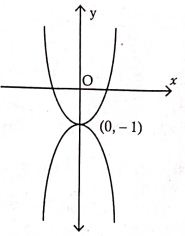
Given: Vertex at (0, - 1).
Putting k = -1 in (1), we get
⇒ x2 = \(\pm\)4a(y + 1) ....(2)
Differentiating with respect to 'x'
2x = \(\pm\)4a\(\left( \frac { dy }{ dx } \right) \) ....(3)
⇒ 4a = \(\frac { 2x }{ \frac { dy }{ dx } } \)
\(\frac{x^2}{2x} = \frac{y+1}{\frac{dt}{dx}}\)
ie) \(x \frac{dy}{dx}-2(y+1) =0\)
This is the required differential equation.
6.
Given equation of curve is
xy = aex + be−x + x2 ...(1)
where a &b are aribitrary constant. differentiate equation (1) twice successively, because we have two arbitray constant.
\(x \frac{d y}{d x}+y(1)=a \mathrm{e}^{x}-\mathrm{be}^{-x}+2 x\) ...(2)
\(
x \frac{d^{2} y}{d x^{2}}+\frac{d y}{d x}(1)+\frac{d y}{d x}=\mathrm{ae}^{x}+\mathrm{be}^{-x}+2
\)
\( x \frac{d^{2} y}{d x^{2}}+\frac{2 d y}{d x}=\mathrm{ae}^{x}+\mathrm{be}^{-x}+2
\) ...(3)
From (1), we get \(x y-x^{2}=\mathrm{ae}^{x}+\mathrm{be}^{-x}\) ...(4)
Substituting equation (a) in (3), we get
\(\therefore x \frac{d^{2} y}{d x^{2}}+\frac{2 d y}{d x}-x y+x^{2}-2=0\) which is the required differential equaiton.
7.
Let V be the velocity and the retardation (negative acceleration) be -\(\frac{dv}{dt}\)
Given \(\frac{dv}{dt}\) = -V
Separating the variables,
\(\frac{dv}{v}=-dt\)
\(\Rightarrow \int { \frac { dv }{ v } } =-\int { dt } \)
\(\Rightarrow log\quad v=-t+logC\)
\(\Rightarrow logv-logC=-t\)
\(\Rightarrow log\left( \frac { v }{ { C }_{ v } } \right) =-t\)
\(\Rightarrow ={ e }^{ -t }\)
\(\Rightarrow \frac { v }{ { C }_{ v } } ={ Ce }^{ -t }...(1)\)
Given when t = 0, v = m/sec
\(\therefore\) (1) become 10 = Ce0 \(\Rightarrow\) C = 10
\(\therefore\) (1) v = 10e-t
When t = 2, v = 10e-2
\(\Rightarrow v=\frac { 10 }{ { e }^{ 2 } } \)
8.
\(x\frac { dy }{ dx } +2y=x^2logx\)
Dividing by x we get,
\(\frac { dy }{ dx } +\frac { 2 }{ x } y=xlogx\)
This is a linear differential equation
\(\therefore P=\frac { 2 }{ x } ;Q=logx\)
\(\int { pdx } =\int { \frac { 2 }{ x } } dx=2logx=logx^2\)
\(\therefore I.F={ e }^{ \int { pdx } }={ e }^{ log\ x ^2}=x ^2\)
\(\therefore\) The solution is \({ e }^{ \int { u\ dv} }=uv-\int { vdu}\)
\(u=log\ x;dv=x^3\)
\(du=\frac { 1 }{ x }dx;v=\frac { { x }^{ 4} }{ 4} \)
\({ ye }^{ \int { pdx } }=\int { Q{ e }^{ \int { pdx } }dx+c } \)
\(\Rightarrow { yx }^{ 2 }=\int { xlogx.({ x }^{ 2 })dx } \)
\(\Rightarrow { x }^{ 2 }y=\int { { x }^{ 3 } } log\quad xdx\)
\(\Rightarrow { x }^{ 2 }y=\frac { { x }^{ 4 } }{ 4 } logx-\int { \frac { { x }^{ 4 } }{ 4 } .\frac { 1 }{ x } } dx\)
\(\Rightarrow { x }^{ 2 }y=\frac { { x }^{ 4 } }{ 4 } logx-\frac { 1 }{ 4 } \int { { x }^{ 3 }dx } \)
\(\Rightarrow { x }^{ 2 }y=\frac { { x }^{ 4 } }{ 4 } logx-\frac { { x }^{ 4 } }{ 16 } +c\)
9.
⇒ tan y\(\frac{dy}{dx}\) = cos (x+y) + cos (x-y)
⇒ tan y\(\frac{dy}{dx}\) = cos x cos y- sin x sin y + cos x cos y + sin x siny
[∵ cos (A+B) = cos A cos B- sin A sin B cos (A- B) = cos Acos B + sin A sin B]
= 2 cosx cosy
\(\Rightarrow \frac { tan\ y }{ cos\ y } dy=2\ cos\ x\ dx\)
Taking integration on both sides, we get
\(\Rightarrow \int { tan\ y\ sec\ y\ dy=2\int { cos\ x\ dx } } \)
\(\\ \\ \Rightarrow \ sec\ y=2sin\ x+c\)
10.
⇒ (ey+1) cos x dx + ey sin x dy = 0
\(\frac{\cos x d x}{\sin x} =-\frac{e^y}{e^y+1} d y \)
\(-\frac{e^y d y}{e^y+1} =\cot x \mathrm{~d} x \)
Take \( \mathrm{t} =\mathrm{e}^y+1 \)
\(\mathrm{dt} =\mathrm{e}^y \mathrm{dy}\)
Taking integration on both sides and substitute t and dt value, we get
\(-\int \frac{d t}{t}=\int \cot x d x\)
-log t = log sin x + C1
-log (ey+1) = log(sin x) + C1
log (sin x) = log(ey+1) = log C
log (sin x) + log(ey+1) = -C1 = log C
log sin x(ey+1) = log C
sin x (ey+1) = C

12th Standard Syllabus & Materials
12th Standard
TN 12th Computer Applications களப்பெயர் முறைமை (DNS) Sample Question Papers Study Material - QB365 Set A
NEW12th Standard
TN 12th Computer Applications வலையமைப்பு எடுத்துக்காட்டுகள் மற்றும் நெறிமுறைகள் Sample Question Papers Study Material - QB365 Set A
NEW12th Standard
TN 12th Computer Applications கணினி வலையமைப்பு ஓர் அறிமுகம் Sample Question Papers Study Material - QB365 Set A
NEW12th Standard
TN 12th Computer Applications PHP-உடன் MySQL-ஐ இணைத்தல் Sample Question Papers Study Material - QB365 Set A



Tamilnadu Stateboard 12th Standard Subjects
Maths

Chemistry

Physics

Biology

Computer Science

Business Maths and Statistics

Economics

Commerce

Accountancy

History

Computer Applications
Biology
Computer Technology
Computer Applications
Computer Science
Business Maths and Statistics
Commerce
Economics
Maths
Chemistry
Physics
Computer Technology
History
Accountancy

Tamil

English

French
Tamilnadu Stateboard Standards



