
 100% FREE ACCESS
12th Standard Syllabus & Materials
12th Standard
TN 12th Computer Applications மின்னணு தரவு பரிமாற்றம் Sample Question Papers Study Material - QB365 Set A
NEW12th Standard
TN 12th Computer Applications மின் - வணிக பாதுகாப்பு அமைப்புகள் Sample Question Papers Study Material - QB365 Set A
NEW12th Standard
TN 12th Computer Applications மின்னணு செலுத்தல் முறைகள் Sample Question Papers Study Material - QB365 Set A
NEW12th Standard
TN 12th Computer Applications மின் - வணிகம் Sample Question Papers Study Material - QB365 Set A
NEW12th Standard
TN 12th Computer Applications திறந்த மூல கருத்துருக்கள் Sample Question Papers Study Material - QB365 Set A
NEW12th Standard
TN 12th Computer Applications வலையமைப்பு வடமிடல் Sample Question Papers Study Material - QB365 Set A

Published on: 01/06/2021
QB365 provides detailed and simple solution for every book back questions in class 12 Maths subject.It will helps to get more idea about question pattern in every book back questions with solution.
Download Tamil Nadu 12th Standard Maths question papers, model tests, one-mark questions, important questions, and public exam papers in PDF format. Free study materials and answer keys for TN State Board students.
Questions + Answers key
Take MCQ Maths Test1.
The slope of the tangent to the curve at any point is the reciprocal of four times the ordinate at that point. The curve passes through (2, 5). Find the equation of the curve.
2.
Find the differential equation corresponding to the family of curves represented by the equation y = Ae8x + Be-8x, where A and B are arbitrary constants.
3.
Find the differential equation of the family of circles passing through the origin and having their centres on the x -axis.
4.
Solve \(\frac { dy }{ dx } +2y={ e }^{ -x }\)
5.
Form the differential equation by eliminating the arbitrary constants A and B from y = A cos x + B sin x.
6.
A radioactive isotope has an initial mass 200mg, which two years later is 50mg. Find the expression for the amount of the isotope remaining at any time. What is its half-life? (half-life means the time taken for the radioactivity of a specified isotope to fall to half its original value).
7.
Solve the Linear differential equation:
\(x\frac { dy }{ dx } +y=xlogx\)
8.
Solve the following differential equations:
tan y\(\frac{dy}{dx}\) = cos(x+y)+cos(x-y)
9.
Solve the following differential equations:
ydx + (1 +x2) tan-1 xdy = 0
10.
Solve : \(\frac { dy }{ dx } =\sqrt { 4x+2y-1 } \)
1.
The slope of the tangent to the curve at any point = \(\frac { 1 }{ 4(odinate\ at\ the\ point) } \)
\(\Rightarrow \frac { dy }{ dx } =\frac { 1 }{ 4y } \)
The equation can be written as
\(\Rightarrow 4ydy\ =\ dx\) ....(1)
Integrating equation (1) on both sides, we get
\(4\int { y\quad dy } =\int { dx } \)
\(\Rightarrow 4.\frac { { y }^{ 2 } }{ 2 } =x+c\)
\(\Rightarrow { 2y }^{ 2 }=x+c\) ...(2)
Since the curve passes through (2, 5), we get
2(5)2 = 2 + c
⇒ 50 - 2 = c
⇒ c = 48
Substituting the value of cincquation (2), we get
2y2 = x + 48 which is the requaired equation of the curve.
2.
given equation of family of curves is
y = Ae8x + Be-8x ..(1)
where A & B are arbitrary constants. Differentiating cquation (1) twice successively (because we have two arbitrary constant), we get
Differentiating with respect to 'x' we get,
\(\frac { dy }{ dx } \\ \\ \) = 8Ae8x + 8Be-8x
Differentiating again with respect to 'x' we get,
\(\frac { d^{ 2 }y }{ dx^{ 2 } } \) = 64Ae8x + 64Be-8x
= 64(Ae8x + Be-8x)
\(\frac { d^{ 2 }y }{ dx^{ 2 } } \) = 64 y [using (1)]
\(\frac { d^{ 2 }y }{ dx^{ 2 } } \) - 64 y = 0
Which is the required differential equation.
3.
Given the circles centre on r-axis & the circle is passing through the origin.
Let it be (r, 0) & its radius r.
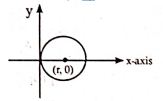
Equation of the circle is
(x - a)2 + (y - b)2 = r2
(x - r)2 + (y - 0)2 = r2
⇒ x2 - 2xr + r2 + y2 = r2
⇒ x2 - 2xr + y2 = 0 ...(1)
defferentiating equation (1) with respect to 'x' we get
⇒ 2x - 2r + 2y \(\frac { dy }{ dx } =0\)
⇒ 2x + 2y \(\frac { dy }{ dx } =2r\)
⇒ x + y \(\frac { dy }{ dx } =r\) ...(2)
Substituting r value in equation (1), we get
x2 - 2x \(\left( x+y\frac { dy }{ dx } \right) +{ y }^{ 2 }=0\)
\(\Rightarrow \ { x }^{ 2 }-{ 2x }^{ 2 }-2xy\frac { dy }{ dx } +{ y }^{ 2 }=0\)
\(\Rightarrow \ { -x }^{ 2 }{ -2x }y\left( \frac { dy }{ dx } \right) { +y }^{ 2 }\)
Multiply by '-', we get
\(\Rightarrow \ { x }^{ 2 }{ +2x }y\left( \frac { dy }{ dx } \right) { -y }^{ 2 }\) which is the required differential equation.
4.
Given that \(\frac{dy}{dx}+2y\) = e-x
This is a linear differential equation
Here P = 2 ; Q = e−x.
\(\int { pdx } =\int { 2dx } =2x\)
Thus, I.F.\(={ e }^{ \int { pdx } }={ e }^{ 2x }\)
Hence the solution of (1) is \({ ye }^{ \int { pdx } }=\int { { Qe }^{ \int { Pdx } }dx+C } \)
That is, \({ ye }^{ 2x }=\int { { e }^{ -x }{ e }^{ 2x }dx+C } or\quad { ye }^{ 2x }={ e }^{ x }+C\quad or\quad y={ e }^{ -x }+{ Xe }^{ -2x }\) required solution
5.
y = Acos x + Bsin x ... (1)
Differentiating (1) twice successively, we get
\(\frac{dy}{dx}\)= −Asin x + Bcos x. ...(2)
\(\frac{d^2y}{dx^2}\) = -Acos x − Bsin x = −(A cos x + B sin x). ...(3)
Substituting (1) in (3), we get \(\frac{d^2y}{dx^2}\) + = 0 as the required differential equation
6.
Let A be the mass of the isotope remaining after t years, and let −k be the constant of proportionality, where k > 0. Then the rate of decomposition is modeled by \(\frac{da}{dt}=-kA,\) where the minus sign indicates that the mass is decreasing. It is a separable equation. Separating the variables,we get\(\frac{da}{dt}=-kdt\).
Integrating on both sides, we get log |A| = −kt + log |C| or A = Ce−kt.
Given that the initial mass is 200mg. That is, A = 200 when t = 0 and thus, C = 200.
Thus, we get A = − 200e-kt.
Also, A =150when t = 2 and therefore, k = \(\frac{1}{2}log(\frac{4}{3})\)
Hence, A(t) = 200e\(\frac{1}{2}log(\frac{4}{3})\) is the mass of isotope remaining after t years.
The half-life th is the time corresponding to A = 100 mg
Thus, \({ t }_{ k }=\frac { 2log\left( \frac { 1 }{ 2 } \right) }{ log\left( \frac { 3 }{ 4 } \right) } \).
7.
Dividing by x we get,
\(\frac { dy }{ dx } +\frac { 1 }{ x } y=xlogx\)
This is a linear differential equation
\(\therefore P=\frac { 1 }{ x } ;Q=logx\)
\(\int { pdx } =\int { \frac { 1 }{ x } } dx=logx\)
\(I.F={ e }^{ \int { pdx } }={ e }^{ log\quad x }=x\)
\(\therefore\) The solution is \({ e }^{ \int { pdx } }=\int { Q{ e }^{ \int { pdx } }=dx+c } \)
\(u=cos\quad x;dv=x\)
\(du=\frac { 1 }{ x } ,v=\frac { { x }^{ 2 } }{ x } \)
\(\int { udv } =uv-\int { vdu } \)
\(yx=\int { xlogxdx+c } \)
\(\Rightarrow xy=\frac { { x }^{ 2 } }{ x } logx-\int { \frac { { x }^{ 2 } }{ 2 } } .\frac { 1 }{ x } dx\)
\(\Rightarrow xy=\frac { { x }^{ 2 } }{ x } logx-\frac { 1 }{ 2 } \int { xdx } \)
\(\Rightarrow xy=\frac { { x }^{ 2 } }{ x } logx-\frac { 1 }{ 2 } .\frac { { x }^{ 2 } }{ 2 } +c\)
\(\Rightarrow xy=\frac { { 2x }^{ 2 }logx-{ x }^{ 2 }+4c }{ 4 } \)
\(\Rightarrow 4xy=2{ x }^{ 2 }logx-{ x }^{ 2 }+4c\)
8.
⇒ tan y\(\frac{dy}{dx}\) = cos (x+y) + cos (x-y)
⇒ tan y\(\frac{dy}{dx}\) = cos x cos y- sin x sin y + cos x cos y + sin x siny
[∵ cos (A+B) = cos A cos B- sin A sin B cos (A- B) = cos Acos B + sin A sin B]
= 2 cosx cosy
\(\Rightarrow \frac { tan\ y }{ cos\ y } dy=2\ cos\ x\ dx\)
Taking integration on both sides, we get
\(\Rightarrow \int { tan\ y\ sec\ y\ dy=2\int { cos\ x\ dx } } \)
\(\\ \\ \Rightarrow \ sec\ y=2sin\ x+c\)
9.
ydx + (1 + x2) tan-1 xdy = 0
\(\mathrm{yd} x=-\left(1+x^2\right) \tan ^{-1} x \mathrm{dy}
\)
\(\frac{d x}{\left(1+x^2\right) \tan ^{-1} x}=-\frac{d y}{y}
\)
Take \(\mathrm{t}=\tan ^{-1} x
\)
\(\mathrm{dt}=\frac{1}{1+x^2} d x\)
The equation can be written as
\(\frac{d t}{t}=-\frac{d y}{y}\)
Taking Integration on both sides, we get
\(\int \frac{d t}{t}=-\int \frac{d y}{y}\)
log t = - log y + log C
log (tan-1 x) = -log y+ log C
log (tan-1 x) + log y = log C
log y(tan-1 x) = log c
y tan-1 x = c
10.
By putting z = 4x + 2y −1, we have
z' = 4+2y' = 4+2\(\sqrt z\)
hence \(\frac { dz }{ 4+2\sqrt { z } } =dx\).
Integrating, \(\int { \frac { dz }{ 4+2\sqrt { 2 } } =x+C } \)
Putting z = u2 , we have
\(\int { \frac { dz }{ 4+2\sqrt { 2 } } =\frac { udu }{ u+2 } =u-2|u+2|+C } \)
or \(\sqrt z\) - 2 In(\(\sqrt z\) + 2) = x+C
from which on substituting z = 4x + 2y −1, we have the general solution
\(\sqrt { 4x+2y-1 } -2\quad In(\sqrt { 4x+2y-1 } +2)=x+C\)

12th Standard Syllabus & Materials
12th Standard
TN 12th Computer Applications களப்பெயர் முறைமை (DNS) Sample Question Papers Study Material - QB365 Set A
NEW12th Standard
TN 12th Computer Applications வலையமைப்பு எடுத்துக்காட்டுகள் மற்றும் நெறிமுறைகள் Sample Question Papers Study Material - QB365 Set A
NEW12th Standard
TN 12th Computer Applications கணினி வலையமைப்பு ஓர் அறிமுகம் Sample Question Papers Study Material - QB365 Set A
NEW12th Standard
TN 12th Computer Applications PHP-உடன் MySQL-ஐ இணைத்தல் Sample Question Papers Study Material - QB365 Set A



Tamilnadu Stateboard 12th Standard Subjects
Maths

Chemistry

Physics

Biology

Computer Science

Business Maths and Statistics

Economics

Commerce

Accountancy

History

Computer Applications
Biology
Computer Technology
Computer Applications
Computer Science
Business Maths and Statistics
Commerce
Economics
Maths
Chemistry
Physics
Computer Technology
History
Accountancy

Tamil

English

French
Tamilnadu Stateboard Standards



