
 100% FREE ACCESS
12th Standard Syllabus & Materials
12th Standard
TN 12th Computer Applications மின்னணு தரவு பரிமாற்றம் Sample Question Papers Study Material - QB365 Set A
NEW12th Standard
TN 12th Computer Applications மின் - வணிக பாதுகாப்பு அமைப்புகள் Sample Question Papers Study Material - QB365 Set A
NEW12th Standard
TN 12th Computer Applications மின்னணு செலுத்தல் முறைகள் Sample Question Papers Study Material - QB365 Set A
NEW12th Standard
TN 12th Computer Applications மின் - வணிகம் Sample Question Papers Study Material - QB365 Set A
NEW12th Standard
TN 12th Computer Applications திறந்த மூல கருத்துருக்கள் Sample Question Papers Study Material - QB365 Set A
NEW12th Standard
TN 12th Computer Applications வலையமைப்பு வடமிடல் Sample Question Papers Study Material - QB365 Set A

Published on: 01/06/2021
QB365 provides detailed and simple solution for every book back questions in class 12 Maths subject.It will helps to get more idea about question pattern in every book back questions with solution.
Download Tamil Nadu 12th Standard Maths question papers, model tests, one-mark questions, important questions, and public exam papers in PDF format. Free study materials and answer keys for TN State Board students.
Questions + Answers key
Take MCQ Maths Test1.
A pair of fair dice is rolled once. Find the probability mass function to get the number of fours.
2.
For the random variable X with the given probability mass function as below, find the mean and variance.
\(f(x)=\begin{cases} \begin{matrix} \cfrac { 1 }{ 2 } e^{ -\frac { x }{ 2 } } & for\quad x>0 \end{matrix} \\ \begin{matrix} 0 & otherwise \end{matrix} \end{cases}\)
3.
If X is the random variable with distribution function F(x) given by,
\(F(x)=\begin{cases} \begin{matrix} 0 & x<0 \end{matrix} \\ \begin{matrix} x & 0\le x<1 \end{matrix} \\ \begin{matrix} 1 & 1\le x \end{matrix} \end{cases}\)
then find
(i) the probability density function f(x)
(ii) P(0.2 ≤ X ≤ 0.7)
4.
Two fair coins are tossed simultaneously (equivalent to a fair coin is tossed twice). Find the probability mass function for number of heads occurred.
5.
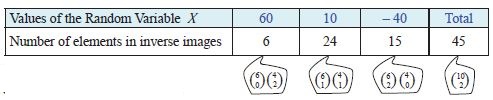
Two balls are chosen randomly from an urn containing 6 white and 4 black balls. Suppose that we win Rs. 30 for each black ball selected and we lose Rs. 20 for each white ball selected. If X denotes the winning amount, then find the values of X and number of points in its inverse images.
6.
An urn contains 2 white balls and 3 red balls. A sample of 3 balls are chosen at random from the urn. If X denotes the number of red balls chosen, find the values taken by the random variable X and its number of inverse images
7.
If X~ B(n, p) such that 4P(X = 4) = P(X = 2) and n = 6. Find the distribution, mean and standard deviation of X.
8.
Find the mean and variance of a random variable X , whose probability density function is \(f(x)=\begin{cases} \begin{matrix} { \lambda e }^{ -2x } & for\ge 0 \end{matrix} \\ \begin{matrix} 0 & otherwise \end{matrix} \end{cases}\)
9.
Find the probability mass function f(x) of the discrete random variable X whose cumulative distribution function F(x) is given by
\(F(x)=\left\{\begin{array}{lc}
0 & -\infty<x<-2 \\
0.25 & -2 \leq x<-1 \\
0.60 & -1 \leq x<0 \\
0.90 & 0 \leq x<1 \\
1 & 1 \leq x<\infty
\end{array}\right.\)
Also find
(i) P(X < 0) and
(ii) P(\(X \geq-1)\)
10.
If the probability mass function f(x) of a random variable X is
| x | 1 | 2 | 3 | 4 |
| f (x) | \(\cfrac { 1 }{ 12 } \) | \(\cfrac { 5 }{ 12 } \) | \(\cfrac { 5 }{ 12 } \) | \(\cfrac { 1 }{ 12 } \) |
find (i) its cumulative distribution function, hence find
(ii) P(X ≤ 3) and,
(iii) P(X ≥ 2)
1.
\(S=\left|\begin{array}{l} (1,1),(1,2),(1,3),(1,4),(1,5),(1,6) \\ (2,1),(2,2),(2,3),(2,4),(2,5),(2,6) \\ (3,1),(3,2),(3,3),(3,4),(3,5),(3,6) \\ (4,1),(4,2),(4,3),(4,4),(4,5),(4,6) \\ (5,1),(5,2),(5,3),(5,4),(5,5),(5,6) \\ (6,1),(6,2),(6,3),(6,4),(6,5),(6,6) \end{array}\right|\)
Let X be a random variable whose values x are the number of fours.
The sample space S is given in the table.
It can also be written as
S = {(i, j)} , where i = 1, 2, 3, 6 and j = 1, 2, 3, 6
Therefore X takes on the values of 0, 1 and 2.
We observe that
(i) X = 0, if (i, j) for i ≠ 4, j≠ 4,
(ii) X = 1, if (1, 4), (2, 4), (3, 4), (5, 4), (6, 4), (4, 1), (4, 2), (4, 3), (4, 5), (4, 6)
(iii) X = 2, if (4, 4) ,
Therefore,
| Values of the Random Variable X | 0 | 1 | 2 | Toatal |
| Number of elements in inverse images | 25 | 10 | 1 | 36 |
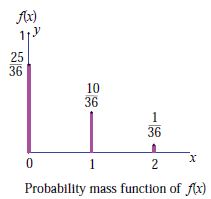
The probabilities are
\(f(0)=P(X=0)\cfrac { 25 }{ 36 } \)
\(f(1)=P(X=1)=\cfrac { 10 }{ 36 } \)
and \(f(20=P(X=2)=\cfrac { 1 }{ 36 } \)
Clearly the function f(x) satisfies the conditions
(i) f (x) ≥ 0, for x = 0, 1, 2 and
(ii) \(\underset { x }{ \Sigma } f(x)=\sum _{ x=0 }^{ x=-2 }{ f(x) } =f(0)+f(1)+f(2)=1\)
\(=\frac{25}{36}+\frac{10}{36}+\frac{1}{36}=1\)
The probability mass function is presented as
| x | 0 | 1 | 2 |
| f(x) | \(\frac { 25 }{ 36 } \) | \(\frac { 10 }{ 36 } \) | \(\frac { 1 }{ 36 } \) |
(or)
\(f(x)=\begin{cases} \begin{matrix} \frac { 25 }{ 36 } & for \ x=0 \end{matrix} \\ \begin{matrix} \frac { 10 }{ 36 } & for \ x=1 \end{matrix} \\ \begin{matrix} \frac { 1 }{ 36 } & for \ x=2 \end{matrix} \end{cases}\)
2.
\(f(x)=\begin{cases} \begin{matrix} \frac { 1 }{ 2 } e^{ -\frac { x }{ 2 } } & for\quad x>0 \end{matrix} \\ \begin{matrix} 0 & otherwise \end{matrix} \end{cases}\)
\(\int _{ 0 }^{ \infty }{ x.f(x)dx } =\frac { 1 }{ 2 } \int _{ 0 }^{ \infty }{ x.{ e }^{ \frac { -x }{ 2 } } } dx\)
\(\left[ \int _{ 0 }^{ \infty }{ { e }^{ -ax }.{ x }^{ n }dx=\cfrac { n! }{ { a }^{ n+1 } } } \right] \)
= \(\frac { 1 }{ 2 } \times \frac { 1! }{ \left( \frac { 1 }{ 2 } \right) ^{ 2 } } =\frac { 1 }{ 2 } \times \frac { 1 }{ \frac { 1 }{ 4 } } \)
= \(\frac { 1 }{ 2 } \times \frac { 4 }{ 1 } =2\)
\(E({ X }^{ 2 })=\int _{ 0 }^{ \infty }{ { x }^{ 2 }.f(x) } dx\)
= \(\int _{ 0 }^{ \infty }{ { x }^{ 2 }.\frac { 1 }{ 2 } { e }^{ -\frac { x }{ 2 } } } dx\)
= \(\frac { 1 }{ 2 } \int { { x }^{ 2 }.{ e }^{ -\frac { x }{ 2 } }dx } \)
= \(\frac { 1 }{ 2 } \times \frac { 2! }{ \left( \frac { 1 }{ 3 } \right) ^{ 3 } } =\frac { 1 }{ 2 } \times \frac { 2 }{ \frac { 1 }{ 8 } } \)
= \(\frac { 1 }{ 2 } \times 2\times 8=8\)
ஃVar(X)=E(X2) - [E(x)]2
= 8-22
= 8 - 4 = 4
3.
(i) Differentiating F(x) with respect to x at continuity points of f(x), we get
\(f(x)={ F }^{ 1 }(x)=\begin{cases} \begin{matrix} 0 & x<0 \end{matrix} \\ \begin{matrix} 1 & 0\le x<1 \end{matrix} \\ \begin{matrix} 0 & x\ge 1 \end{matrix} \end{cases}\)
The pdf f(x) is not continuous at x = 0, or at x = 1. We can define f(0) and f(1) in any manner. Choosing f(0) = 1, and f(1) = 0 .
Therefore the probability density function f(x) is
\(f(x)=\begin{cases} \begin{matrix} 1 & 0\le x<1 \end{matrix} \\ \begin{matrix} 0 & otherwise \end{matrix} \end{cases}\)
(ii) P(0.2 ≤ X ≤ 0.7) = F(0.7) − F(0.2)
= 0.7-0.2 = 0.5
\(P(0.2\le X\le 0.7)=\int _{ 0.2 }^{ 0.7 }{ f(x) } dx=\int _{ 0.2 }^{ 0.7 }{ 1dx } =0.5\)
4.
The sample space S = {H,T} \(\times\) {H,T}
That is S = {TT, TH, HT, HH}
Let X be the random variable denoting the number of heads.
Therefore
X (TT ) = 0 , X (TH ) = 1,
X (HT) = 1, and X (HH) = 2 .
Then the random variable X takes on the values 0, 1 and 2
| Values of the Random Variable | 0 | 1 | 2 | Total |
| Number of elements in inverse images | 1 | 2 | 1 | 4 |
The probabilities are given by
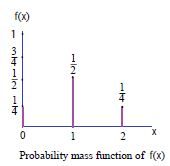
\(f(0)=P(X=0)=\cfrac { 1 }{ 4 } \)
\(f(1)=P(X=1)=\cfrac { 1 }{ 2 } \)
and \(f(2)=P(X=2)=\cfrac { 1 }{ 4 } \)
The function f (x) satisfies the conditions
(i) f (x) ≥ 0 , for x = 0, 1, 2
(ii) \(\underset { x }{ \Sigma } f(x)=\sum _{ x=0 }^{ x=2 }{ f(x) } =f(0)+f(1)+f(2)\)
= \(\cfrac { 1 }{ 4 } +{ \cfrac { 1 }{ 2 } +\cfrac { 1 }{ 4 } =1 }\)
Therefore f (x) is a probability mass function.
The probability mass function is given by
| x | 0 | 1 | 2 |
| f(x) | \(\cfrac { 1 }{ 4 } \) | \(\cfrac { 1 }{ 2 } \) | \(\cfrac { 1 }{ 4 } \) |
(or)
\(f(x)\begin{cases} \begin{matrix} \frac { 1 }{ 4 } & forx=0 \end{matrix} \\ \begin{matrix} \frac { 1 }{ 2 } & forx=1 \end{matrix} \\ \begin{matrix} \frac { 1 }{ 4 } & forx=2 \end{matrix} \end{cases}\)
5.
The possible events of selection are
(i) both balls may be black, or
(ii) one white and one black or
(iii) both are white.
Therefore X is a random variable that take the values,
X (both are black balls) = Rs. 2(30) = Rs. 60
X (one black and one white ball) = Rs. 30 − Rs. 20 = Rs. 10
X (both are white balls) = Rs. 2( − 20) = - Rs. 40
Therefore X takes on the values 60,10, and − 40.
6.
Let us denote white and red balls as w1, w2, r1, r2 and r3
The sample space consists of 5C3 = 10 different samples of size 3.
That is S = \(\left\{w_{1} w_{2} r_{1}, w_{1} w_{2} r_{2}, w_{1} w_{2} r_{3}, w_{1} r_{1} r_{2}, w_{1} r_{2} r_{3}, w_{1} r_{1} r_{3}, w_{2} r_{1} r_{2}, w_{2} r_{2} r_{3}, w_{2} r_{1} r_{3}, r_{1} r_{2} r_{3}\right\} .\)
The random variable X takes on the values 1, 2, and 3.
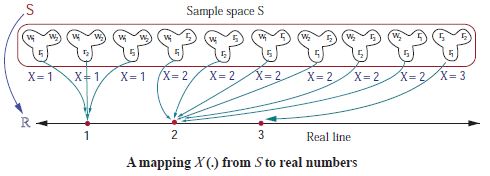
| Values of the Random Variable X | 1 | 2 | 3 | Total |
| Number of elements in inverse images | 3 | 6 | 1 | 10 |
7.
X B(n, p)
Given 4P(X = 4) = P(X = 2) and n = 6.
4. [6C4p4 (1 - p)2] = 6C2p2 q4
⇒ 4p2 = q2
⇒ 4(1-q2) = q2
4(1-2q+q2) = q2
⇒ 3q2 - 8q +4 = 0
⇒ (q - 2)(3q - 2) = 0
\( -q=\frac { 2 }{ 3 } \ \ \ (q\neq2)\)
\(p = 1- q=\cfrac { 1 }{ 3 } \)
Distribution
P(X = x) = nCxpx (1- p)n-x, x = 0, 1,2, ... n
(i) \(P(X=x)= ^6C_{ x }\left( \frac { 1 }{ 3 } \right) ^{ x }\left( \frac { 2 }{ 3 } \right) ^{ 6-x }\) , x = 0,1,2..n
(ii) \(mean=np=6\times \frac { 1 }{ 3 } =2\)
(iii) standard deviation = \(\sqrt { npq } =\sqrt { 2 \times \frac {2}{ 3 } } \)
= \( { \frac { 2 }{ \sqrt 3 } } \)
8.
Observe that the given distribution is continuous
By definition \(\mu =E(X)=\int _{ -\infty }^{ \infty }{ xf(x) } dx\) (We can also use integration by parts or Bernoulli’s formula)
= \(\int _{ -\infty }^{ 0 }{ 0\left( \lambda { e }^{ -2x } \right) dx } +\int _{ 0 }^{ \infty }{ x\left( { \lambda e }^{ -\lambda x } \right) } dx\)
= \(0+\lambda \int _{ 0 }^{ \infty }{ x\left( { e }^{ -\lambda x } \right) dx } \)
= \(0+\lambda \left( \frac { 1 }{ { \lambda }^{ 2 } } \right) \) (using Gamma integral for positive integer n,\(\int _{ 0 }^{ \infty }{ { x }^{ n } } { e }^{ -ax }dx=\cfrac { n }{ { a }^{ n+1 } } \))
= \(\frac { 1 }{ \lambda } \)
Variance :
By definition,\(E\left( { X }^{ 2 } \right) =\int _{ -\infty }^{ \infty }{ { x }^{ 2 }f(x) } dx\) (We can also use integration by parts or Bernoulli’s formula)
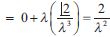
= \(\int _{ -\infty }^{ 0 }{ 0\left( \lambda { e }^{ -\lambda x } \right) } dx+\int _{ 0 }^{ \infty }{ { x }^{ 2 }\left( \lambda { e }^{ -2x } \right) } dx\)
= \(0+\lambda \int _{ 0 }^{ \infty }{ { x }^{ 2 }\left( { e }^{ -2x } \right) dx } \)
 (using Gamma integral for positive integer)
Therefore Var(X ) = E(X2 )- E(X )2
= \(\frac { 2 }{ { \lambda }^{ 2 } } -\left( \frac { 1 }{ \lambda } \right) ^{ 2 }=\frac { 1 }{ { \lambda }^{ 2 } } \)
Hence the mean and variance are respectively \(\frac { 1 }{ \lambda } \) and \(\frac { 1 }{ { \lambda }^{ 2 } } \)
9.
Since X is a discrete random variable, from the given data, X takes on the values
−2, −1, 0, and 1.
For discrete random variable X, by definition, we have f (x) = P(X = x)
Therefore left hand limit of f(x) at x = -2 is F(− 2− )
f (−2) = P(X =-2 ) = F(-2 ) - F(- 2- )= 0.25-0 = 0.25
Similarly for other jump points, we have
f (−1) = P(X = -1) = F(-1) - F(-2) = 0.60 - 0.25 = 0.35.
f (0) = P(X ) 0) = F(0) - F(-1) = 0.90 - 0.60 = 0.30 ,
f (1) = P(X =1) = F(1) - F(0) 1- 0.90 = 0.10 .
Therefore the probability mass function is
| x | -2 | -1 | 0 | 1 |
| f(x) | 0.25 | 0.35 | 0.30 | 0.10 |
The distribution function F(x) has jumps at x = -2, -1, 0, and 1. The jumps are respectively 0.25, 0.35, 0.30, and 0.1 is shown in the figure given below.
These jumps determine the probability mass function

(i) \(P(X<0)=\sum _{ -\infty }^{ -1 }{ P(X=x)=P(X=-1)=0.25+0.35 } =0.60\)
(ii) \(P(X\ge -1)=\sum _{ -1 }^{ 1 }{ P(X=x)=P(x=-1) } +P(X=0)+P(X=1)=0.35+030+0.10=0.75\)
10.
By definition the cumulative distribution function for discrete random variable is
\(F(x)P\left( X\le x \right) =\underset { { x }_{ 1 }\le x }{ \Sigma } P(X={ x }_{ 1 })\)
\(P(X<1)=0\) for -∞
\(F(1)=P\left( X\le 1 \right) =\underset { { x }_{ 1 }\le x }{ \Sigma } P(X={ x }_{ i })=\sum _{ -\infty }^{ 1 }{ P(X=x) } =P\left( X<1 \right) +P\left( X=1 \right) =0+\frac { 1 }{ 12 } =\frac { 1 }{ 12 }\)
\(F(2)=P\left( X\le 2 \right) =\sum _{ -\infty }^{ 2 }{ P\left( X=x \right) } =P\left( X\le 1 \right) +P\left( X=1 \right) +P\left( X=2 \right)\)
= \(0+\frac { 1 }{ 12 } +\frac { 5 }{ 12 } =\frac { 1 }{ 2 }\)
\(F(3)=P\left( X\le 3 \right) =\sum _{ -\infty }^{ 3 }{ P(X=x) } =P\left( X<1 \right) +P\left( X=1 \right) +P\left( X=2 \right) +P\left( X=3 \right)\)
= \(0+\frac { 1 }{ 2 } +\frac { 5 }{ 12 } +\frac { 5 }{ 12 } =\frac { 11 }{ 12 }\)
\(F(4)=P\left( X\le 4 \right) =\sum _{ -\infty }^{ 4 }{ P\left( X=x \right) } =P\left( X=1 \right) +P\left( X=2 \right) +P\left( X=3 \right) +P(X=4)\)
= \(0+\frac { 1 }{ 12 } +\frac { 5 }{ 12 } +\frac { 5 }{ 12 } +\frac { 1 }{ 12 } =1\)
\(F(x)=\{0, \quad-\infty \ldots\)

(ii) \(P(X\le 3)=F(3)\frac { 11 }{ 12 }\)
(iii) \(P(X\ge 2)=1-P\left( X<2 \right) =1-P(X\le 1)=1-F(1)=1-\frac { 1 }{ 12 } =\frac { 11 }{ 12 }\)

12th Standard Syllabus & Materials
12th Standard
TN 12th Computer Applications களப்பெயர் முறைமை (DNS) Sample Question Papers Study Material - QB365 Set A
NEW12th Standard
TN 12th Computer Applications வலையமைப்பு எடுத்துக்காட்டுகள் மற்றும் நெறிமுறைகள் Sample Question Papers Study Material - QB365 Set A
NEW12th Standard
TN 12th Computer Applications கணினி வலையமைப்பு ஓர் அறிமுகம் Sample Question Papers Study Material - QB365 Set A
NEW12th Standard
TN 12th Computer Applications PHP-உடன் MySQL-ஐ இணைத்தல் Sample Question Papers Study Material - QB365 Set A



Tamilnadu Stateboard 12th Standard Subjects
Maths

Chemistry

Physics

Biology

Computer Science

Business Maths and Statistics

Economics

Commerce

Accountancy

History

Computer Applications
Biology
Computer Technology
Computer Applications
Computer Science
Business Maths and Statistics
Commerce
Economics
Maths
Chemistry
Physics
Computer Technology
History
Accountancy

Tamil

English

French
Tamilnadu Stateboard Standards



