
 100% FREE ACCESS
12th Standard Syllabus & Materials
12th Standard
TN 12th Computer Applications மின்னணு தரவு பரிமாற்றம் Sample Question Papers Study Material - QB365 Set A
NEW12th Standard
TN 12th Computer Applications மின் - வணிக பாதுகாப்பு அமைப்புகள் Sample Question Papers Study Material - QB365 Set A
NEW12th Standard
TN 12th Computer Applications மின்னணு செலுத்தல் முறைகள் Sample Question Papers Study Material - QB365 Set A
NEW12th Standard
TN 12th Computer Applications மின் - வணிகம் Sample Question Papers Study Material - QB365 Set A
NEW12th Standard
TN 12th Computer Applications திறந்த மூல கருத்துருக்கள் Sample Question Papers Study Material - QB365 Set A
NEW12th Standard
TN 12th Computer Applications வலையமைப்பு வடமிடல் Sample Question Papers Study Material - QB365 Set A

Published on: 13/05/2022
QB365 provides detailed and simple solution for every book back questions in class 12 Maths subject.It will helps to get more idea about question pattern in every book back questions with solution.
latest Book back QuestionsDownload Tamil Nadu 12th Standard Maths question papers, model tests, one-mark questions, important questions, and public exam papers in PDF format. Free study materials and answer keys for TN State Board students.
Questions + Answers key
Take MCQ Maths Test1.
The mean and standard deviation of a binomial variate X are respectively 6 and 2.
Find
(i) the probability mass function
(ii) P(X = 3)
(iii) P(X\(\ge \)2).
2.
If X is the random variable with distribution function F(x) given by,
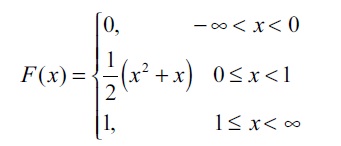
then find (i) the probability density function f(x)
(ii) P(0.3 ≤ X ≤ 0.6)
3.
If X is the random variable with probability density function f(x) given by,
\(f(x)=\begin{cases} \begin{matrix} x+1 & -1\le x<0 \end{matrix} \\ \begin{matrix} -x+1 & 0\le x<1 \end{matrix} \\ \begin{matrix} 0 & otherwise \end{matrix} \end{cases}\)
then find
(i) the distribution function F(x)
(ii) P( -0.5 ≤X ≤ 0.5)
4.
Suppose the amount of milk sold daily at a milk booth is distributed with a minimum of 200 Iitres and a maximum of 600 litres with probability density function
\(\begin{cases} \begin{matrix} k & 200\le x\le 600 \end{matrix} \\ \begin{matrix} 0 & otherwise \end{matrix} \end{cases}\)
Find
(i) the value of k
(ii) the distribution function
(iii) the probability that daily sales will fall between 300 litres and 500 litres?
5.
A retailer purchases a certain kind of electronic device from a manufacturer. The manufacturer, indicates that the defective rate of the device is 5%. The inspector of the retailer randomly picks 10 items from a shipment. What is the probability that there will be
(i) at least one defective item
(ii) exactly two defective items.
1.
X~ B(n, p)
Given mean np = 6
\(S.D=\sqrt { npq } =2\)
\(\Rightarrow npq=4\)
\( \rightarrow \frac { npq }{ np } =\frac { 4 }{ 6 } =\frac { 2 }{ 3 } \)
\(\Rightarrow q=\frac { 2 }{ 3 } \)
\(\Rightarrow 1-P=\frac { 2 }{ 3 } \)
\(\Rightarrow 1-\frac { 2 }{ 3 } =P\)
\(\therefore P=\frac { 1 }{ 3 } \)
\(n\times \frac { 1 }{ 3 } =6\Rightarrow n=18\)
(i) The probability mass function
P(X = x) nCx px (1 - p )n-x,
X = 0,1,2, ... , n
\(\therefore P(X=x)=\ ^{18}{ C }_{ x }\left( \frac { 1 }{ 3 } \right) ^{ x }\left( \frac { 2 }{ 3 } \right) ^{ 18-x }\)
x=0,1,2...,8
(ii) \(P(X=3)=\ ^{ 18}{C }_{ 3 }\left( \frac { 1 }{ 3 } \right) ^{ 3 }\left( \frac { 2 }{ 3 } \right) ^{ 18-3 }\)
= \(^{ 18}{C }_{ 3 }\left( \frac { 1 }{ 3 } \right) ^{ 3 }\left( \frac { 2 }{ 3 } \right) ^{ 15 }\)
(iii) P(X ≥ 2)
P(X ≥ 2) 1 -P(X < 2)
= 1 - [P(X = 0) + P(X = 1)]
= \(1-\left[ ^{18}{ C }_{ 0 }\left( \frac { 1 }{ 3 } \right) ^{ 0 }\left( \frac { 2 }{ 3 } \right) ^{ 18 }+^{ 18}{C }_{ 1 }\left( \frac { 1 }{ 3 } \right) ^{ 1 }\left( \frac { 2 }{ 3 } \right) ^{ 17 } \right] \)
= \(1-\left[ \left( \frac { 2 }{ 3 } \right) ^{ 18 }+6\left( \frac { 2 }{ 3 } \right) ^{ 17 } \right] \)
= \(1-\left( \frac { 2 }{ 3 } \right) ^{ 17 }\left[ \frac { 2 }{ 3 } +6 \right] \)
= \(1-\left( \frac { 2 }{ 3 } \right) ^{ 17 }\left( \frac { 20 }{ 3 } \right) \)
= \(1-\frac { 20 }{ 3 } \left( \frac { 2 }{ 3 } \right) ^{ 17 }\)
2.
Given
(i) The probability density function. Differentiating F(x) with respect to 'x' at continuity points of F(x), we get
\(F(x)=\begin{cases} \begin{matrix} 0 & x<0 \end{matrix} \\ \begin{matrix} \frac { 1 }{ 2 } ({ 2x }+1) & 0\le x<1 \end{matrix} \\ \begin{matrix} 1 & x\ge 1 \end{matrix} \end{cases}\)
(ii) \(p(0.3\le X\le 0.6)=\int _{ 0.3 }^{ 0.6 }{ f(x)dx } \)
= \(\int _{ 0.3 }^{ 0.6 }{ \frac { 1 }{ 2 } \left( 2x+1 \right) dx } =\frac { 1 }{ 2 } \left[ \frac { { 2x }^{ 2 } }{ 2 } +x \right] _{ 0.3 }^{ 0.6 }\)
= \(\frac { 1 }{ 2 } \left( { x }^{ 2 }+x \right) _{ 0.3 }^{ 0.6 }=\frac { 1 }{ 2 } \left[ \left( { 0.6 }^{ 2 }+0.6 \right) -\left( { 0.3 }^{ 2 }+0.3 \right) \right] \)
= \(\frac { 1 }{ 2 } \left[ \left( .36.6 \right) \right] -\left( .09+0.3 \right) ]\)
= \(\frac { 1 }{ 2 } \left[ 0.96-.39 \right] =\frac { 0.57 }{ 2 } =0.285\)
= 0.285
3.
\(f(x)=\begin{cases} \begin{matrix} x+1 & -1\le x<0 \end{matrix} \\ \begin{matrix} -x+1 & 0\le x<1 \end{matrix} \\ \begin{matrix} 0 & otherwise \end{matrix} \end{cases}\)
(i) Distribution function
Case 1 : x < -1
F(x) = \(\int _{ -\infty }^{ x }{ f(u)du } \) = 0
Case 2 : -1 ≤ x < 0
\(\int _{ -\infty }^{ x }{ f(u)du } \)
= \(\int _{ -\infty }^{ x }{ f(x) } dx=\left[ \frac { { x }^{ 2 } }{ 2 } +x \right] _{ -1 }\)
= \(\left( \frac { {u }^{ 2 } }{ 2 } +u \right)=\frac{x^2}{2}+x -\left( \frac { 1 }{ 2 } +1 \right) \)
= \(\frac { { x }^{ 2 } }{ 2 } +x+\frac { 1 }{ 2 } \)
Case 3 : 0 ≤ x < 1,
\(F(X)=\int _{ 0 }^{ x }{ (-x+1)dx } =\left[ -\frac { { x }^{ 2 } }{ 2 } +x \right] _{ 0 }^{ x }\)
= \(\left( -\frac { { x }^{ 2 } }{ 2 } +x \right) -\left( 0 \right) =\frac { { x }^{ 2 } }{ 2 } +x\)
When 1 ≤ x,
\(F(x)=\int _{ 1 }^{ x }{ f(x)dx } =\int _{ 1 }^{ x }{ 0dx } \)
= \(\therefore F(X)=\begin{cases} \begin{matrix} \frac { { x }^{ 2 } }{ 2 } +x+\frac { 1 }{ 2 } & -1\le x<0 \end{matrix} \\ \begin{matrix} -\frac { { x }^{ 2 } }{ 2 } +x & 0\le x<1 \end{matrix} \\ \begin{matrix} 0 & otherwise \end{matrix} \end{cases}\)
(ii) p(0.5 ≤ X ≤ 0.5)
= \(\int _{ -0.5 }^{ 0.5 }{ f(x)dx } =\int _{ 0.5 }^{ 0 }{ f(x)dx+\int _{ 0 }^{ 0.5 }{ f(x)dx } } \)
= \(\int _{ -0.5 }^{ 0 }{ (x+1) } dx+\int _{ 0 }^{ 0.5 }{ \left( -x+1 \right) } dx\)
= \(\left[ \frac { { x }^{ 2 } }{ 2 } +x \right] _{ -0.5 }^{ 0 }+\left[ \frac { -{ x }^{ 2 } }{ 2 } +x \right] _{ 0 }^{ 0.5 }\)
= \(0-\left( \frac { { 0.5 }^{ 2 } }{ 2 } -0.5 \right) +\left( -\frac { \left( 0.5 \right) ^{ 2 } }{ 2 } +0.5 \right) -0\)
= \(-\left( \frac { .25 }{ 2 } -0.5 \right) +\left( \frac { -0.25 }{ 2 } +0.5 \right) \)
= \(\frac { .25 }{ 2 } +0.5-\frac { 0.25 }{ 2 } +0.5=0.25+1\)
= 0.75
4.
Given \(\begin{cases} \begin{matrix} k & 200\le x\le 600 \end{matrix} \\ \begin{matrix} 0 & otherwise \end{matrix} \end{cases}\)
(i) Since f{x) is a probability density function
\(\int _{ -\infty }^{ \infty }{ f(x)d=1\Rightarrow \int _{ 200 }^{ 600 }{ kda } =1 } \)
\(\Rightarrow k[x]_{ 200 }^{ 600 }=1\Rightarrow k(600-200)=1\)
400 k = 1
\(\Rightarrow k=\frac { 1 }{ 400 } \)
(ii) The distribution function
= \(\int _{ -\infty }^{ x }{ f(u) } du\)
Case 1: x < 200
\(F(x) =\int _{ -\infty }^{ u }{ du } =0\)
Case 1: x < 200 ≤ x ≤ 600
\(\int _{ -\infty }^{ x }{ f(u) } du\)
\(F(x)=\int _{ -\infty }^{ 200 }{ f(u)du } =+\int _{ 200 }^{ x }{ f(u)du } \)
= \( =\frac { 1 }{ 400 }(x-200) =\frac { x }{ 400 } =\frac { 1 }{ 2 } \)
Case 3: x > 600
\(F(x) =\int _{ -\infty }^{ u }{ du } =0\)
\(f(x)= \begin{cases}0, & x<200 \\ \frac{x}{400}-\frac{1}{2}, & 200 \leq x \leq 600 \\ 0, & x>600\end{cases}\)
(iii) P(300 < x < 500)
= \(\int _{ 300 }^{ 500 }{ kdx=\frac { 1 }{ 400 } \left[ x \right] _{ 300 }^{ 500 } } \)
= \(\frac { 1 }{ 400 } \left[ 500-300 \right] =\frac { 200 }{ 400 } =\frac { 1 }{ 2 } \)
5.
Let p be the probability that indicates the defective rate of an electronic device
n = 10
\(P=5\%=0.05 \)
q = 1 - p
n = 10, p = 0.05, X ~ B(n, p)
P(X = x) = nCx px qn-x, x = 0, 1,2, .., n
(i) Atleast 1 defective item
P(X ≥ 1) = 1 - P(X < 1)
= 1-P(X = 0)
= 1-10C0 (0.05)0 (0.95)10
P(X ≥1) = 1 - (0.95)10
(ii) Exactly two defective items
P(X = 2) =10C2(0.05)2 (0.95)8

12th Standard Syllabus & Materials
12th Standard
TN 12th Computer Applications களப்பெயர் முறைமை (DNS) Sample Question Papers Study Material - QB365 Set A
NEW12th Standard
TN 12th Computer Applications வலையமைப்பு எடுத்துக்காட்டுகள் மற்றும் நெறிமுறைகள் Sample Question Papers Study Material - QB365 Set A
NEW12th Standard
TN 12th Computer Applications கணினி வலையமைப்பு ஓர் அறிமுகம் Sample Question Papers Study Material - QB365 Set A
NEW12th Standard
TN 12th Computer Applications PHP-உடன் MySQL-ஐ இணைத்தல் Sample Question Papers Study Material - QB365 Set A



Tamilnadu Stateboard 12th Standard Subjects
Maths

Chemistry

Physics

Biology

Computer Science

Business Maths and Statistics

Economics

Commerce

Accountancy

History

Computer Applications
Biology
Computer Technology
Computer Applications
Computer Science
Business Maths and Statistics
Commerce
Economics
Maths
Chemistry
Physics
Computer Technology
History
Accountancy

Tamil

English

French
Tamilnadu Stateboard Standards



