
 100% FREE ACCESS
12th Standard Syllabus & Materials
12th Standard
TN 12th Maths Applications of Matrices and Determinants Sample Question Papers Study Material - QB365 Set A
NEW12th Standard
TN 12th Computer Applications மின்னணு தரவு பரிமாற்றம் Sample Question Papers Study Material - QB365 Set A
NEW12th Standard
TN 12th Computer Applications மின் - வணிக பாதுகாப்பு அமைப்புகள் Sample Question Papers Study Material - QB365 Set A
NEW12th Standard
TN 12th Computer Applications மின்னணு செலுத்தல் முறைகள் Sample Question Papers Study Material - QB365 Set A
NEW12th Standard
TN 12th Computer Applications மின் - வணிகம் Sample Question Papers Study Material - QB365 Set A
NEW12th Standard
TN 12th Computer Applications திறந்த மூல கருத்துருக்கள் Sample Question Papers Study Material - QB365 Set A

Published on: 01/03/2021
12th Standard English Medium Economics Syllabus Three Mark Important Questions with Answer key - 2021(Public Exam )
Download Tamil Nadu 12th Standard Economics question papers, model tests, one-mark questions, important questions, and public exam papers in PDF format. Free study materials and answer keys for TN State Board students.
Questions + Answers key
Take MCQ Economics Test
1.
Compare and contrast different measures of GDP calculations.
2.
What are the functions of NITI Aayog?
3.
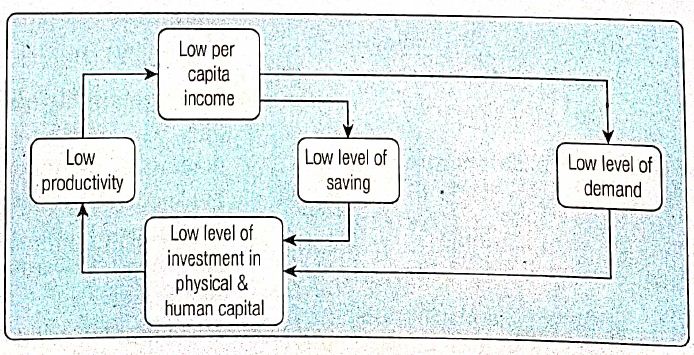
Elucidate major causes of vicious circle of poverty with diagram
4.
Write a note on
a) Climate change and
b) Acid rain
5.
State the meaning of e-waste.
6.
Mention any three methods of redemption of public debt.
7.
State briefly the functions of SAARC.
8.
State the objectives of Foreign Direct Investment.
9.
Distinguish between Balance of Trade and Balance of Payments.
10.
Describe the subject matter of International Economics.
11.
Specify the functions of IFCI.
12.
What are the functions of NABARD?
13.
Write the mechanism of credit creation by commercial banks.
14.
Explain disinflation.
15.
16.
Write a note on metallic money.
17.
Specify the limitations of the multiplier.
18.
19.
Write any five differences between classicism and Keynesianism.
20.
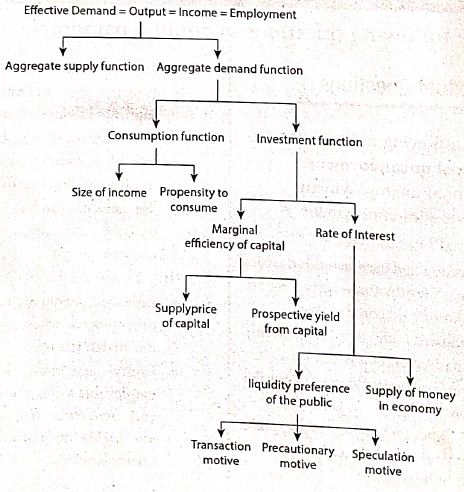
Explain Keynes’ theory.
21.
According to classical theory of employment, how wage reduction solve the problem of unemployment diagramatically explain.
22.
List out the uses of national income.
23.
What is the solution to the problem of double counting in the estimation of national income?
24.
Indicate the demerits of socialism.
25.
State the importance of Macro Economics.
1.
| GDP (Expenditure) | GDP (Factor Incomes) | GDP (Value of Output) |
|---|---|---|
| 1. Consumption 2. Government 3. Spending 4. Investment spending 5. Change in value of stocks 6. Exports 7. Imports 8. GDP (Known as aggregate demand) |
(i) Income from People in jobs and in self employment (eg. wages and Salaries) (ii) Profit of private sector business (iii) Rent income from the ownership of land |
(i) Value added from each of the main economic sectors (ii) These sectors are (iii) Primary (iv) Secondary (v) Manufacturing (vi) Quaternary |
| Government spending | Profits of private sector business |
2.
1. Co-operative and competitive federalism to enable the States to have active participation.
2. Shared national agenda for development priorities and strategies.
3. Decentralized planning to restructure the planning process into a bottom up model.
4. Vision and scenario planning to design medium and long-term plans.
5. Network of expertise
6. Harmonization of actions across different layers of government.
7. Conflict resolution for mutual consensus to intersectoral, inter departmental, inter state and centre state issues.
8. Coordinating interface with the world to harness global expertise and resources.
9. Internal consultancy to central and State governments on policy and programmes.
10. Capacity building and technology up-gradation and providing managerial and technical know how.
11. Monitoring and evaluation of policies and progammes.
3.
(i) The cause for vicious circle of poverty is demand and supply.
(ii) On the supply side, the low level of real income leads to low level of saving and investment and to deficiency of capital.
(iii) Deficiency of capital leads to low productivity and back to low income.
(iv) On the demand-side, low level of real income leads to low demand so investment is less, therefore deficiency of capital, low productivity and low income.
4.
a) Climate change
(i) Climate change refers to seasonal changes over a long period with respect to the growing accumulation of greenhouse gases in the atmosphere.
(ii) Industrial revolution has increased the concentration of carbon dioxide in the atmosphere by 40 %.
(iii) Several parts of the world have experienced warming of coastal waters, high temperatures, a marked change in rainfall patterns and an increased intensity and frequency of storms.
(iv) Sea levels and temperatures are expected to be rising.
b) Acid rain
(i) Acid rain is one of the results of air pollution.
5.
(i) Electronic waste is the new by product of the Info Tech society.
(ii) It includes a growing range of electronic devices from household appliances, such as refrigerators, air conditioners, cell phones, computers.
(iii) e-waste can be defined as the result when consumer, business and household devices are sent for re-cycling (e.g., television, computers, audio-equipments, VCR, DVD, telephone, Fax, Xerox machines, wireless devices, video games).
6.
Introduction:
(i) The process of repaying a public debt is called redemption.
(a) Sinking Fund
(i) The Government establishes a separate fund into which every year a fixed amount of money is credited.
(ii) By the time the debt matures, the fund accumulates enough amount to pay off the principal along with interest.
(a) Conversion
(i) An old loan is converted into a new loan.
(ii) A high interest public debt is converted into a low interest public debt.
(c) Budgetary Surplus
(i) When the Government has a surplus budget, it can be used for repaying the debt.
7.
The main functions of SAARC are as follows.
1) Maintenance of the cooperation in the region.
2) Prevention of common problems associated with the member nations.
3) Ensuring strong relationship among the member nations.
4) Removal of the poverty through various packages of programmes.
5) Prevention of terrorism in the region.
8.
FDI has the following objectives.
(i) Sales Expansion
(ii) Acquisition of resources
(iii) Diversification
(iv) Minimization of competitive risk
9.
| S.No |
Balance of Trade |
Balance of Payments |
|---|---|---|
| 1 | Only export and import of commodities are included in BoT |
Export and import of commodities and services are included in BoP |
| 2 | i.e. Movement of goods or visible trade | Trade in both visible and non visible items. |
10.
Pure Theory of Trade
(i) This component explains the causes for foreign trade, composition, direction and volume of trade, determination of the terms of trade and exchange rate, issues related to balance of trade and balance of payments.
Policy Issues
(i) Policy issues such as free trade vs. protection, methods of regulating trade, capital and technology flows, use of taxation, subsidies and dumping, exchange control and convertibility, foreign aid, external borrowings and foreign direct investment, measures of correcting disequilibrium in BoP are covered.
International Cartels and Trade Blocs
(i) Economic integration, cartels, customs unions, monetary unions, trade blocs, economic unions and multinational corporation are covered
International Financial and Trade Regulatory Institutions
(i) Financial institutions like IMF, IBRD, WTO are part of International Economics.
11.
The IFCI does the following functions
(i) Providing long-term loans in rupees and foreign currencies.
(ii) Underwriting of equity, preference and debenture issues.
(iii) Subscribing to equity, preference and debenture issues.
(iv) Guaranteeing the deferred payments for machinery imported from abroad or purchased in India
(v) Guaranteeing of loans raised in foreign currency from foreign financial institutions.
12.
1) NABARD acts as a refinancing institution for all kinds of production and investment credit to agriculture, small-scale industries, cottage and village industries, handicrafts, rural crafts and real artisans to promote integrated rural development.
2) It provides short-term, medium term and long-term credit to state co-operative Banks, RRBs, LDBs and other financial institutions approved by RBI.
3) NABARD gives long-term loans (20 Years) to State Government to enable them to subscribe to the share capital of co-operative credit societies.
4). It gives long-term loans to any institution approved by the Central Government or contribute to the share capital or invests in securities of any institution concerned with agriculture and rural development.
5) NABARD co-ordinates the activities of Central and State Governments, Planning Commission and all India and State level institutions entrusted with the development of small scale industries, village and cottage industries, rural crafts, industries in the tiny and decentralized sectors
6) It has the responsibility to inspect RRBs and CO-operative banks, other than primary co-operative societies.
7) It maintains a Research and Development Fund to promote research in agriculture and rural development
13.
1. Credit Creation means the multiplicátion of loans and advances.
2. Every loan creates its own deposits.
3. It is assumed that all banks are obliged to keep the ratio between cash and its deposits at a minimum of 20 %.
4. The banks do not keep any excess reserves.
5. There are no drains in the supply of money.
6. Now, when a customer deposits Rs.1000 in a bank, the bank creates a deposit of Rs.1000 in his favour.
7. Bank deposits have increased by Rs.1000.
8. It is required to keep only a cash reserve of 20 %, i.e. Rs.800 is excess cash reserve.
9. The bank lends out this Rs.800 to the public.
10. The debtor deposits this money with another bank B.
11. Bank B is creating a deposit of Rs.800.
12. Bank B has also excess cash reserve of Rs.640.
13. It could in turn, lend out Rs.640.
14. The total deposits will now grow into Rs.1000 + 800 + 640 +........ till ultimately the excess cash reserve ends.
15. When this stage is reached, the total of the above will be Rs.5000.
16. Money Multiplier \( \frac{1}{20 \%}=\frac{1}{20} \times 100=5\)
Credit creation = 1000 x 5 = Rs.5000
14.
(i) It is the slowing down the rate of inflation by controlling the amount of credit (bank loan, hire purchase) available to consumers without causing more unemployment.
(ii) It is defined as the process of reversing inflation without creating unemployment or reducing output in the company.
15.
16.
(i) After the barter system and commodity money system, modern money systems evolved.
(ii) Metallic standard is the premier one.
(iii) Some kind of metal, gold or silver is used to determine the standard value of the money and currency.
(iv) Standard coins made out of the metal are the principal coins used under the metallic standard.
(v) These Standard coins are full bodied or full weighted legal tender.
(vi) Their face value is equal to their intrinsic metal value.
17.
(i) Payment towards past debts
(ii) Purchase of existing wealth
(iii) Import of goods and services
(iv) Non availability of consumer goods
(v) Full employment situation
18.
19.
| S. No: | Keynesianism | Classicism |
| 1. | Short-run equilibrium | Long-run equilibrium |
| 2. | Saving is a vice | Saving is a social virtue. |
| 3. | Money functions as medium of exchange and store of value | Money acts as a medium of exchange |
| 4. | Macro approach to national problems | Micro approach to macro problems |
| 5. | State intervention is advocated | Favoured laissez-faire policy |
20.
21.
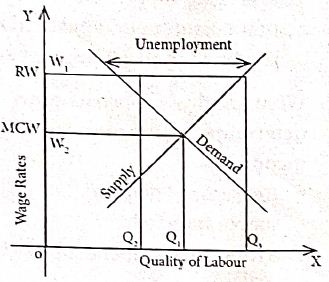
(i) Classical unemployment occurs when real wages are kept above the market clearing wage rate, leading to a surplus of labour supplied.
(ii) Classical unemployment is also called real wage unemployment.
(iii) Unemployment occurs when the worker is willing to accept (Real Wages)(RW) is in excess of those an employer is willing to pay (Market Clearing Wage)(MCW).
(iv) Real wage may be above the equilibrium level because of minimum wage policies or union bargaining.
(v) classical unemployment of Q1-Q2 can be solved by a wage cut.
(vi) If wages are allowed to fall to the market clearing level, unemployment is solved
22.
(i) National income is of great importance for the economy of a country.
(ii) National income helps us to know the relative importance and contribution of each sector. We could find how income is produced, how it is distributed, how much is spent, saved or taxed.
(iii) National income data is used to build economic models in short run and long run.
(iv) Data regarding gross income, output, saving & consumption is used in economic planning.
(v) National income data is used to build economic models in short run and long run.
(vi) It is used to make international comparison, inter - regional comparison and inter - temporal comparison of growth of the economy during different periods.
(vii) If income is equally distributed, the per capita income will reflect the economic welfare of the country.
23.
(i) To avoid double counting, either the value of the final output should be taken into the estimate of GNP or the sum of values added should be taken.
(ii) The value of the final product is derived by the summation of all the values added in the productive process.
(iii) Any commodity which is either raw material or intermediate good should not be included.
(iv) For example, value of cotton enters value of yarn as cost, and value of yarn in cloth and that of cloth in garments.
(v) At every stage only the value which is added should be considered.
24.
(i) Red tapism and bureaucracy since, approval of many officials is needed.
(ii) Absence of incentive and so productivity is less.
(iii) Limited freedom of choice in the consumption of goods and services.
(iv) The state takes all major decisions. There is concentration and misuse of power.
25.
(i) Macro economics helps to understand the functioning of the economy at the aggregate level, to evolve strategies to solve the basic problems.
(ii) To understand the future problems, needs and challenges.
(iii) To provide opportunities to use scientific investigation to understand reality.
(iv) To make meaningful comparison and analysis of economic indicators. To predict the future and formulate suitable policies to avoid economic crises.

12th Standard Syllabus & Materials
12th Standard
TN 12th Computer Applications வலையமைப்பு வடமிடல் Sample Question Papers Study Material - QB365 Set A
NEW12th Standard
TN 12th Computer Applications களப்பெயர் முறைமை (DNS) Sample Question Papers Study Material - QB365 Set A
NEW12th Standard
TN 12th Computer Applications வலையமைப்பு எடுத்துக்காட்டுகள் மற்றும் நெறிமுறைகள் Sample Question Papers Study Material - QB365 Set A
NEW12th Standard
TN 12th Computer Applications கணினி வலையமைப்பு ஓர் அறிமுகம் Sample Question Papers Study Material - QB365 Set A



Tamilnadu Stateboard 12th Standard Subjects

Maths

Chemistry

Physics

Biology

Computer Science

Business Maths and Statistics
Economics

Commerce

Accountancy

History

Computer Applications
Biology
Computer Technology
Computer Applications
Computer Science
Business Maths and Statistics
Commerce
Economics
Maths
Chemistry
Physics
Computer Technology
History
Accountancy

Tamil

English

French
Tamilnadu Stateboard Standards
