
 100% FREE ACCESS
12th Standard Syllabus & Materials
12th Standard
TN 12th Maths Applications of Matrices and Determinants Sample Question Papers Study Material - QB365 Set A
NEW12th Standard
TN 12th Computer Applications மின்னணு தரவு பரிமாற்றம் Sample Question Papers Study Material - QB365 Set A
NEW12th Standard
TN 12th Computer Applications மின் - வணிக பாதுகாப்பு அமைப்புகள் Sample Question Papers Study Material - QB365 Set A
NEW12th Standard
TN 12th Computer Applications மின்னணு செலுத்தல் முறைகள் Sample Question Papers Study Material - QB365 Set A
NEW12th Standard
TN 12th Computer Applications மின் - வணிகம் Sample Question Papers Study Material - QB365 Set A
NEW12th Standard
TN 12th Computer Applications திறந்த மூல கருத்துருக்கள் Sample Question Papers Study Material - QB365 Set A

Published on: 27/02/2021
12th Standard English Medium Physics Reduced syllabus Annual Exam Model Question Paper with Answer key - 2021
Download Tamil Nadu 12th Standard Physics question papers, model tests, one-mark questions, important questions, and public exam papers in PDF format. Free study materials and answer keys for TN State Board students.
Questions + Answers key
Take MCQ Physics Test1.
The variation of frequency of carrier wave with respect to the amplitude of the modulating signal is called ______.
Amplitude modulation
Frequency modulation
Phase modulation
Pulse width modulation
2.
If the input to the NOT gate is A = 1011, its output is ______.
0100
1000
1100
0011
3.
The mass of a 37Li nucleus is 0.042 u less than the sum of the masses of all its nucleons. The binding energy per nucleon of 37Li nucleus is nearly _____.
46 MeV
5.6 MeV
3.9 MeV
23 MeV
4.
The threshold wavelength for a metal surface whose photoelectric work function is 3.313 eV is _____.
4125 \(\mathring { A } \)
3750\(\mathring { A } \)
6000\(\mathring { A } \)
2062.5\(\mathring { A } \)
5.
In a Young’s double-slit experiment, the slit separation is doubled. To maintain the same fringe spacing on the screen, the screen-to-slit distance D must be changed to, _____.
2D
\(\frac{D}{2}\)
\(\sqrt{2}\)D
\(\frac{D}{\sqrt2}\)
6.
An air bubble in glass slab of refractive index 1.5 (near normal incidence) is 5 cm deep when viewed from one surface and 3 cm deep when viewed from the opposite face. The thickness of the slab is ______.
8 cm
10 cm
12 cm
16 cm
7.
The relative permittivity of water is _______.
εr = 70
εr = 75
εr = 80
εr = 85
8.
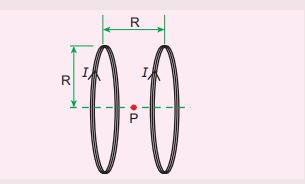
Two identical coils, each with N turns and radius R are placed coaxially at a distance R as shown in the figure. If I is the current passing through the loops in the same direction, then the magnetic field at a point P at a distance of R/2 from the centre of each coil is _____.
\(\frac { 8N{ \mu }_{ ° }I }{ \sqrt { 5 } R } \)
\(\frac { 8N{ \mu }_{ ° }I }{ { 5 }^{ 3/2 }R } \)
\(\frac { 8N{ \mu }_{ ° }I }{ { 5 }R } \)
\(\frac { 4N{ \mu }_{ ° }I }{ \sqrt { 5 } R } \)
9.
A thin semi-circular conducting ring (PQR) of radius r is falling with its plane vertical in a horizontal magnetic field B, as shown in the figure.
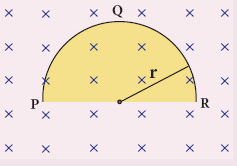
The potential difference developed across the ring when its speed v, is
Zero
\(\frac { { Bv\pi { r }^{ 2 } } }{ 2 } \) and P is at higher potential
πrBv and R is at higher potential
2rBv and R is at higher potential
10.
Which of the following is an electromagnetic wave?
α - rays
β - rays
\(\gamma\) - rays
all of them
11.
An electric field \(\vec { E } =10x\hat { i } \) exists in a certain region of space. Then the potential difference V = Vo – VA, where Vo is the potential at the origin and VA is the potential at x = 2 m is _____.
10 V
-20 V
+20 V
-10 V
12.
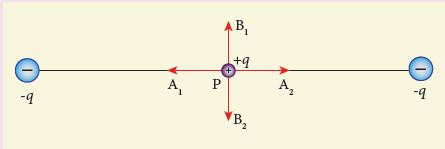
Two identical point charges of magnitude –q are fixed as shown in the figure below. A third charge +q is placed midway between the two charges at the point P. Suppose this charge +q is displaced a small distance from the point P in the directions indicated by the arrows, in which direction(s) will +q be stable with respect to the displacement?
A1 and A2
B1 and B2
both directions
No stable
13.
The temperature coefficient of resistance of a wire is 0.00125 per °C. At 20°C, its resistance is 1 Ω. The resistance of the wire will be 2 Ω at ______.
800 °C
700 °C
850 °C
820 °C
14.
In a large building, there are 15 bulbs of 40 W, 5 bulbs of 100 W, 5 fans of 80 W and 1 heater of 1 kW are connected. The voltage of electric mains is 220 V. The maximum capacity of the main fuse of the building will be ______.
14 A
8 A
10 A
12 A
15.
A toaster operating at 240 V has a resistance of 120 Ω. The power is ______.
400 W
2 W
480 W
240 W
16.
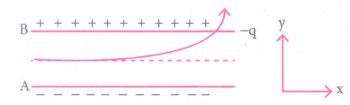
A particle of mass m and charge (-q) enters the region between the two charged plates initrally moving along X-axis with speed Vx as shown in figure. The length of plate is L and an uniform electric field E is maintained between the plates. S.T. vertical deflection of the particle at the far edge of the plate is \(\frac { q{ EL }^{ 2 } }{ 2m{ V }_{ x }^{ 2 } } \).
17.
Two isolated metal spheres A & B have radii R & 2R respectively and same charge q. Find which of the two spheres have greater energy density just outside the surface of the sphere.
18.
Define resistance.
19.
Why are household appliances connected in parallel?
20.
An electric dipole is held in a uniform electric field.
(i) Straight the net force acting on it is zero.
(ii) The dipole is alignment parallel to the field. find the work done in rotating it through the angle of 180o.
21.
When does a dielectric said to be polarized?
22.
Suppose a cyclotron is operated to accelerate protons with a magnetic field of strength 1 T. Calculate the frequency in which the electric field between two Dees could be reversed.
23.
What is the magnetic field at the centre of the loop shown in figure?
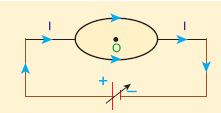
24.
Write the drawbacks of Nicol prism.
25.
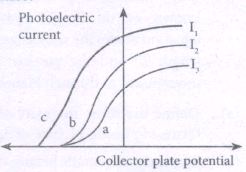
The figure shows a plot of three curves a, b, c showing the variation of photocurrent vs. Collector plate potential for three different intensities I1, I2, and I3 having frequencies v1, v2 and v3 respective incident on a photosensitive surface.
The figure shows a plot of three curves a, b, c showing the variation of photocurrent vs. Collector plate potential for three different intensities I1, I2, and I3 having frequencies v1,v2, and v3 respective incident on a photosensitive surface.
26.
Derive an expression for De Broglie wave length.
27.
What is electronics?
28.
What is the diameter of H2 atom?
29.
Identify the following Electromagnetic radiations
(a) 109 Hz
(b) 1011 Hz. Give one application of each.
30.
A bar magnet is placed in a uniform magnetic field whose strength is 0.8 T. If the bar magnet is oriented at an angle 30o with the external field experiences a torque of 0.2 Nm. Calculate
(i) the magnetic moment of the magnet
(ii) the work done by the applied force in moving it from most stable configuration to the most unstable configuration and also compute the work done by the applied magnetic field in this case.
31.
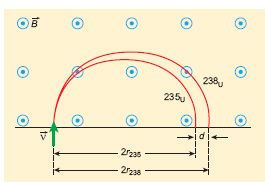
Two singly ionized isotopes of uranium \(_{ 92 }^{ 235 }{ U \ and \ _{ 92 }^{ 238 }{ U } }\) (isotopes have same atomic number but different mass number) are sent with velocity 1.00 x 10⁵ m s–1 into a magnetic field of strength 0.500 T normally. Compute the distance between the two isotopes after they complete a semi-circle. Also, compute the time taken by each isotope to complete one semi-circular path. (Given: masses of the isotopes: m235 = 3.90 x 10⁻²⁵ kg and m238 = 3.95 x 10⁻²⁵ kg)
32.
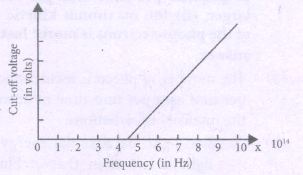
For photo electronic effect in sodium, the figure shows the plot of cut-off voltage versus frequency of incident radiation. Calculate
(i) threshold frequency
(ii) work function for sodium.
33.
An electron and a proton, each have de Broglie wavelength of 1.00 nm.
(a) Find the ratio of their momenta.
(b) Compare the kinetic energy of the proton with that of the electron.
34.
When an electron in hydrogen atom jumps from the third excited state to the ground state how would the de Broglie wavelength associated with the electron change? Justify your answer.
35.
The two lines A and B in figure show the plot of de Broglie wavelength λ as a function of \(\frac{1}{\sqrt V}\) for two particles having the same charge. V is the accelerating potential. Which of the two represents the particle of heavier mass?
36.
Monochromatic light of frequency 6 x 10¹⁴ Hz is produced by a laser. The power emitted is 2.0 x 10⁻³ W. How many photons per second on an average are emitted by the source?
37.
An electron in a hydrogen atom is moving with a speed of 2.3 x 10⁶ ms-1 in an orbit of radius 0.53 Å. Calculate the magnetic moment of the revoling electron.
1.
(b)
Frequency modulation
2.
\(y=\overline{A}=\overline{1011}=0100\)
The Boolean expression for NOT gate, \(y=\bar{A}\)
3.
\(\frac{BE}{A}=\frac{\Delta\times931MeV}{V}=\frac{0.042 \times931}{7}\)
= 5.586 = 5.6 MeV
4.
\(\lambda_0 =\frac{h c}{\phi} \)
\(=\frac{6.626 \times 10^{-34} \times 3 \times 10^8}{3.313 \times 1.6 \times 10^{-19}} \)
\( =\frac{19.8782400}{5.3} \times 10^{-7} \)
\(\lambda_0 =3.750 \times 10^{-7} \simeq 3750 \stackrel{o}A\)
5.
d' = 2d, β' = β, D' = ?
W.K.T, Fringe width
\(\beta = \frac{D\lambda}{d} \Rightarrow D' = \frac{Dd'}{d}\)
\(D' = \frac{D2d}{d}=2D\)
6.
Apparent depth = 3 + 5 = 8 cm
Real depth = thickness of the slab = t
n = 1.5
\(n=\frac{Real \ depth}{Apparent \ depth}\)
\(\therefore 1.5=\frac{t}{8}\)
t = 1.5 x 8
t = 12 cm
7.
(c)
εr = 80
8.
\(B=\frac { { \mu }_{ ° }NI a^2}{ { 2(a^2+x^2)}^{ \frac { 3 }{ 2 } } } \)
put a = R
and x = R/2, we get,
\(B=\frac { 8N{ \mu }_{ ° }I }{ { 5 }^{ 3 / 2 }R } \)
9.
(d)
2rBv and R is at higher potential
10.
(c)
\(\gamma\) - rays
11.
\(\vec {E}\) = 10x\(\hat{i},\) when x = 2 m
\(\vec {E}\) = 10 x 2 x \(\hat{i}\) = 20\(\hat{i}\)
Since, \(E=\frac{-dV}{dx}\therefore V=+20 V\)
12.
The charge + q will be stable between B1 and B2 with respect to the displacement.
13.
Rt = Ro [1 + α(T2 - T1)
2 = 1[1 + 0.00125(T2 - 293)
I = 5/4 x 10-3 (T2 - 293)
T2 = 1093 K
T2 = 820 oC
14.
Total power = 15 x 40 + 5 x 100 + 5 x 80 + 1000
= 600 + 500 + 400 + 1000
= 2500 W
P = VI, V = 220 V
\(I=\frac{P}{V}=\frac{2500}{220}=11.363 \ A\)
≃ 12 A
15.
\(P=\frac{V^2}{R}=\frac{240 \times 240}{120}=480 \ W\)
16.
Force on particle towards upper plate B, F-y = qE
Vertical acceleration of particle ay=\(\frac{qE}{m}\)
Initial vertical velocity Vy = 0
Time taken by particle between the plates t = \(\frac{L}{V_x}\)
From equation of motion s = ut + \(\frac{1}{2}\) at2
Vertical deflection y = 0 + \(\frac{1}{2}\) ayt2
\(=0+\frac { 1 }{ 2 } \left( \frac { qE }{ m } \right) { \left( \frac { L }{ { V }_{ x } } \right) }^{ 2 }\)
\(y=\frac { q{ EL }^{ 2 } }{ 2m{ V }_{ x }^{ 2 } } \)
17.
Energy density U\(=\frac { 1 }{ 2 } { \varepsilon }_{ 0 }{ E }_{ 2 }\)
But \(E=\frac { \sigma }{ { \varepsilon }_{ 0 } } =\frac { Q }{ { A\varepsilon }_{ 0 } } \)
\(\therefore U=\frac { 1 }{ 2 } .\frac { { \varepsilon }_{ 0 }{ Q }_{ 2 } }{ { A }^{ 2 }{ \varepsilon }_{ 0 } } \Rightarrow U=\frac { { Q }_{ 2 } }{ 2A^{ 2 } } \)
\(U\alpha \frac { 1 }{ { A }^{ 2 } } \Rightarrow { U }_{ A }>{ U }_{ B }\)
18.
The resistanct is defined as the ratio of potential difference across the given conductor to the current passing through the conductor.
\(R=\cfrac { V }{ I } \)
19.
House hold appliances are always connected in parallel so that even if one is switched off, the other devices could function properly.
20.
(i) The dipole moment of dipole \(|\overset { \rightarrow }{ P } |=q\times 2a\)
Force on -q at A = -q \(\overset { \rightarrow }{ E } \)
Force on + q at B = +q\(\overset { \rightarrow }{ E } \)
Net force on the dipole = q\(\overset { \rightarrow }{ E } \)- q\(\overset { \rightarrow }{ E } \) = 0
(ii) Work done on dipole when it is rotated through 180°
W = ∆U = pE (cos θ1 - cos θ2)
= pE (cos 0° - cos180o)
= pE(1 - (-1)
W = 2pE
21.
When an external electric field is applied, the centers of positive and negative charges are separated by a small distance which induces dipole moment in the direction of the external electric field. Then the dielectric is said to be polarized by an external electric field.
22.
Magnetic field B = 1 T
Mass of the proton, mp = 1.67 x 10⁻²⁷kg
Charge of the proton, q = 1.60 x 10⁻¹⁹C
\(f=\frac { qB }{ { { 2\pi m }_{ p } } } =\frac { \left( 1.60\times { 10 }^{ -19 } \right) \left( 1 \right) }{ 2\left( 3.14 \right) \left( 1.67\times { 10 }^{ -27 } \right) } \)
= 15.3 x 10⁶ Hz = 15.3 MHz
23.
The magnetic field due to current in the upper semicircle and lower semicircle of the circular coil are equal in magnitude but opposite in direction. Hence, the net magnetic field at the center of the loop (at point O) is zero \(\overset { \rightarrow }{ B } =\overset { \rightarrow }{ 0 } \).
24.
(i) Its cost is very high due to scarity of large and flawless calcite crystals
(ii) Due to extraordinary ray passing obliquely through it the emergent ray is always displaced a little to one side.
(iii) The effective field of view is quite limited
(iv) Light emerging out of it is not uniformly plane polarised.
25.
Curves a and b have different intensities but the same stopping potential, so curves 'a' and 'b' have the same frequency but different intensities.
26.
i) The momentum of photon of frequency v is given by,
\(p=\frac { hv }{ c } =\frac { h }{ \lambda } \)
ii) The wavelength of a photon in terms of its momentum is,
\(\lambda =\frac { h }{ p } \)
iii) According to de Broglie, the above equation is completely a general one and this is applicable to material particles as well. Therefore, for a particle of mass m traveling with speed u, the wavelength is given by,
\(\lambda =\frac { h }{ mv } =\frac { h }{ p } \)
iv) This wavelength of the matter waves is known as de Broglie wavelength. This equation relates the wave character (the wavelength \(\lambda\)) and the particle character (the momentum p) through Planck's constant.
27.
(i) It is the branch of physics incorporated with technology towards the design of circuits using transistors and microchips.
(ii) It depicts the behavior and movement of electrons in a semiconductor, vacuum, or gas.
(iii) Electronics deals with electrical circuits that involve active components such as transistors, diodes, integrated circuits, and sensors, associated with the passive components like resistors, inductors, capacitors, and transformers.
28.
The radius of the nth orbit
\({ r }_{ n }=\frac { { n }^{ 2 }{ h }^{ 2 }{ \epsilon }_{ 0 } }{ \pi m{ Ze }^{ 2 } } \)
r1 = 0.53Å
∴ The diameter of H2 = 2 x r1
= 0.53 x 2 = 1.06Å
29.
(a) 109 Hz - Radiowaves
Application: For radio & television communication.
(b) 1011 Hz - microwaves
Application: used in Radar for aircraft navigation, (microwave oven for cooking).
30.
Uniform magnetic field B = 0.8 T
Angle of orientation θ = 30°
Torque, ፒ = 0.2 Nm.
(i) We know that torque ፒ = PmB sinθ
\(0.2=p_\mathrm{m} \times 0.8 \times \sin 30^{\circ} \)
\(0.2=p_\mathrm{m} \times 0.8 \times \frac{1}{2} \)
0.2 = 0.4 pm
\(p_m=\frac{0.2}{0.4}=0.5 \mathrm{Am}^{2}\)
(ii) Work done by the applied force to move the magnet from stable to unstable position.
\(\mathrm{W} =-p_\mathrm{m}B\left[\cos \theta_{2}-\cos \theta_{1}\right] \)
\(\mathrm{W} =-p_\mathrm{m}B\left(\cos 180^{\circ}-\cos 0^{\circ}\right) \)
\(\mathrm{W} =-p_\mathrm{m}B(-1-1)=2 \mathrm{p_mB} \)
\(\mathrm{W} =2 \times 0.5 \times 0.8=\mathbf{0 . 8} \mathbf{J} \)
Work done by the applied magnetic field are in opposite direction
\(\mathbf{W}_{\text {mag }}=-0.8 \mathrm{J}\)
31.
Since isotopes are singly ionized, they have equal charge which is equal to the charge of an electron, q = - 1.6 x 10⁻¹⁹ C. Mass of uranium \(_{ 92 }^{ 235 }{ U and _{ 92 }^{ 238 }{ U } }\) are 3.90 x 10⁻²⁵ kg and 3.95 x 10⁻²⁵ kg respectively. Magnetic field applied, B = 0.500 T. Velocity of the electron is 1.00 x 10⁵ m s-1, then
(a) the radius of the path of \(_{ 92 }^{ 235 }{ U }\) is r235
\({ r }_{ 235 }=\frac { { m }_{ 235 }v }{ \left| q \right| B } =\frac { 3.90\times { 10 }^{ -25 }\times 1.00\times { 10 }^{ 5 } }{ 1.6\times { 10 }^{ -19 }\times 0.500 } =48.8\times { 10 }^{ -2 }m\)
r235 = 48.8cm
The diameter of the semi-circle due to \(_{ 92 }^{ 235 }{ U\ \ is \ \ { d }_{ 235 }=2{ r }_{ 235 } }\) = 97.6 cm
The radius of the path of \(_{ 92 }^{ 238 }{ U\ is\ 2{ r }_{ 238 }\ then}\)
\({ r }_{ 238 }=\frac { { m }_{ 238 }v }{ \left| q \right| B } =\frac { 3.90\times { 10 }^{ -25 }\times 1.00\times { 10 }^{ 5 } }{ 1.6\times { 10 }^{ -19 }\times 0.500 } =49.4\times { 10 }^{ -2 }m\)
r238 = 49.4 cm
The diameter of the semi-circle due to \(^{ 238 }_{92}{ U\ is \ 2{ r }_{ 238 } \ =98.8 \ cm}\)
Therefore the separation distance between the isotopes is \(\triangle d={ d }_{ 238 }-{ d }_{ 235 }=1.2 \ cm\)
(b) The time taken by each isotope to complete one semi-circular path are
\({ t }_{ 235 }=\frac { \text{ magnitude of the displacement} }{ velocity } \)
\(=\frac { 97.6\times { 10 }^{ -2 } }{ 1.00\times { 10 }^{ 5 } } =9.76\times { 10 }^{ -6 }s=9.76\mu s\)
\({ t }_{ 238 }=\frac { \text{magnitude of the displacement }}{ velocity } \)
\(=\frac { 98.8\times { 10 }^{ -2 } }{ 1.00\times { 10 }^{ 5 } } =9.88\times { 10 }^{ -6 }s=9.88\mu s\)
32.
(i) The threshold frequency is the frequency of incident light at which kinetic energy of ejected photoelectron is zero.
∴ From fig. threshold frequency,
v0 = 4.5 x 10¹⁴ Hz
(ii) Work function, W = hv0
= 6.6 x 10-34 x 4.5 x 1014 joule
= \(\frac { 6.6\times { 10 }^{ -34 }\times 4.5\times 10^{ 14 } }{ 1.6\times { 10 }^{ -19 } } \) eV
= 1.85 eV
33.
(a) λe =\(\frac { h }{ { p }_{ e } } \) and λp=\(\frac { h }{ { p }_{ p } } \), λe = λp =1.00 nm.
So, \(\frac { { \lambda }_{ e } }{ { \lambda }_{ p } } =\frac { { p }_{ p } }{ { p }_{ e } } =\frac { 1 }{ 1 } \Rightarrow \frac { { p }_{ p } }{ { p }_{ e } } =\frac { 1 }{ 1 } \) = 1:1
(b) From relation K=\(\frac { 1 }{ 2 } mv^{ 2 }=\frac { { p }^{ 2 } }{ 2m } \)
Ke = \(\\ \frac { { p }_{ e }^{ 2 } }{ 2me } \) and Kp = \(\frac { { p }_{ e }^{ 2 } }{ 2m_{ p } } \)
\(\frac { { K }_{ p } }{ { K }_{ e } } =\frac { { p }_{ p }^{ 2 } }{ 2{ m }_{ p } } \times \frac { 2{ m }_{ e } }{ { p }_{ e }^{ 2 } } =\frac { { m }_{ e } }{ { m }_{ p } } \)
Since me <<< mp, So Kp <<< Ke
\(\frac { { K }_{ p } }{ { K }_{ e } } =\frac { 9.1\times { 10 }^{ -31 } }{ 1.67\times 10^{ -27 } } \)
= 5.4 x 10⁻⁴
34.
de Broglie wavelength associated with a moving charge particle having a KE. 'K can be given as
λ =\(\frac { h }{ p } =\frac { h }{ \sqrt { 2mK } } \) ...(1)
\(\left[ K=\frac { 1 }{ 2 } { mv }^{ 2 }=\frac { { p }^{ 2 } }{ 2m } \right] \)
The kinetic energy of the electron in any orbit of a hydrogen atom can be given as
K = -E = -\(\left( \frac { 13.6 }{ n^{ 2 } } eV \right) =\frac { 13.6 }{ { n }^{ 2 } } \) ......(2)
Let K1 and K4 be the KE of the electron in ground state and third excited state, where n1 = 1
showground state and n2 = 4 shows the third excited state.
Using the concept of equations (1) & (2), we have
\(\frac { { \lambda }_{ 1 } }{ { \lambda }_{ 4 } } =\sqrt { \frac { { K }_{ 4 } }{ { K }_{ 1 } } } =\sqrt { \frac { { n }_{ 1 }^{ 2 } }{ { n }_{ 2 }^{ 2 } } } \)
\(\frac { { \lambda }_{ 1 } }{ { \lambda }_{ 4 } } =\sqrt { \frac { { 1 }^{ 2 } }{ { 4 }^{ 2 } } } =\frac { 1 }{ 4 } \) ⇒ λ1 = \(\frac { { \lambda }_{ 4 } }{ 4 } \).
i.e. the wavelength in the ground state will decrease.
35.
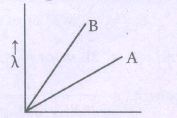
\(\frac { 1 }{ \sqrt { V } } \)
\(\lambda =\frac { h }{ \sqrt { 2mqV } } =\frac { h }{ \sqrt { 2mq } } .\frac { 1 }{ \sqrt { V } } \)
This equation represents a straight line of slope \(\frac { h }{ \sqrt { 2mq } } \)
Clearly, the slope is inversely proportional to \(\sqrt{m}\). Since the slope of line A is less than the slope of line B therefore the line. A represents the particle of heavier mass.
36.
Power of radiation, P =\(\frac { nhv }{ l } \) = Nhv, where N is a number of photons per sec.
or N =\(\frac { P }{ m } \)
= \(\frac { 2.0\times { 10 }^{ -3 } }{ 6.63\times 10^{ -34 }\times 6\times { 10 }^{ 14 } } \)
= 5 x 10¹⁵ photons per second.
37.
v = 2.3 x 10⁶ m/s
r = 0.53Å = 0.53 x 10⁻¹⁰m
Current, i = \(\frac { e }{ T } =\frac { e }{ \left( \frac { 2\pi r }{ v } \right) } =\frac { ev }{ 2\pi r } \)
i = \(\frac { 1.6\times 10^{ -16 }\times 2.3\times 10^{ 6 } }{ 2\times 3.14\times 0.53\times 10^{ -10 } } \)
∴ Magnetic moment, M = IA
M = I(πr2)
= 1.105 x 10-3 x 3.14 x (0.53 x 10-10)2
= 9.75 x 10⁻²⁴ Am-2

12th Standard Syllabus & Materials
12th Standard
TN 12th Computer Applications வலையமைப்பு வடமிடல் Sample Question Papers Study Material - QB365 Set A
NEW12th Standard
TN 12th Computer Applications களப்பெயர் முறைமை (DNS) Sample Question Papers Study Material - QB365 Set A
NEW12th Standard
TN 12th Computer Applications வலையமைப்பு எடுத்துக்காட்டுகள் மற்றும் நெறிமுறைகள் Sample Question Papers Study Material - QB365 Set A
NEW12th Standard
TN 12th Computer Applications கணினி வலையமைப்பு ஓர் அறிமுகம் Sample Question Papers Study Material - QB365 Set A



Tamilnadu Stateboard 12th Standard Subjects

Maths

Chemistry
Physics

Biology

Computer Science

Business Maths and Statistics

Economics

Commerce

Accountancy

History

Computer Applications
Biology
Computer Technology
Computer Applications
Computer Science
Business Maths and Statistics
Commerce
Economics
Maths
Chemistry
Physics
Computer Technology
History
Accountancy

Tamil

English

French
Tamilnadu Stateboard Standards

