
 100% FREE ACCESS
12th Standard Syllabus & Materials
12th Standard
TN 12th Maths Applications of Matrices and Determinants Sample Question Papers Study Material - QB365 Set A
NEW12th Standard
TN 12th Computer Applications மின்னணு தரவு பரிமாற்றம் Sample Question Papers Study Material - QB365 Set A
NEW12th Standard
TN 12th Computer Applications மின் - வணிக பாதுகாப்பு அமைப்புகள் Sample Question Papers Study Material - QB365 Set A
NEW12th Standard
TN 12th Computer Applications மின்னணு செலுத்தல் முறைகள் Sample Question Papers Study Material - QB365 Set A
NEW12th Standard
TN 12th Computer Applications மின் - வணிகம் Sample Question Papers Study Material - QB365 Set A
NEW12th Standard
TN 12th Computer Applications திறந்த மூல கருத்துருக்கள் Sample Question Papers Study Material - QB365 Set A

Published on: 27/02/2021
12th Standard English Medium Physics Reduced syllabus Creative Five mark Question with Answerkey - 2021(Public Exam )
Download Tamil Nadu 12th Standard Physics question papers, model tests, one-mark questions, important questions, and public exam papers in PDF format. Free study materials and answer keys for TN State Board students.
Questions + Answers key
Take MCQ Physics Test1.
Derive an expression for electrostatic potential due to a point charge.
2.
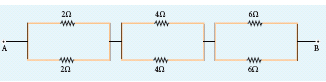
Calculate the equivalent resistance between A and B in the given circuit.
3.
The gravitational waves were theoretically proposed by _____.
Conrad Rontgen
Marie Curie
Albert Einstein
Edward Purcell
4.
The particle size of ZnO material is 30 nm. Based on the dimension it is classified as _____.
Bulk material
Nanomaterial
Soft material
Magnetic material
5.
The principle based on which a solar cell operates is______.
Diffusion
Recombination
Photovoltaic action
Carrier flow
6.
Atomic number of H-like atom with ionization potential 122.4 V for n = 1 is _____.
1
2
3
4
7.
8.
Light transmitted by Nicol prism is, _____.
partially polarised
unpolarised
plane polarised
elliptically polarised
9.
A simple pendulum with charged bob is oscillating with time period T and lets θ be the angular displacement. If the uniform magnetic field switched ON in a direction perpendicular to the plane of oscillation then ___________.
time period will decrease but θ will remain constant
time period remain constant but θ will decrease
both T and θ will remain the same
both T and θ will decrease
10.
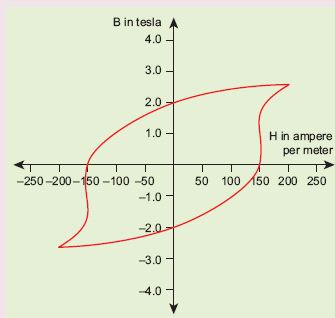
The BH curve for a ferromagnetic material is shown in the figure. The material is placed inside a long solenoid which contains 1000 turns/cm. The current that should be passed in the solenoid to demagnetize the ferromagnet completely is _____.
1.00 m A
1.25 mA
1.50 mA
1.75 mA
11.
A particle having mass m and charge q accelerated through a potential difference V. Find the force experienced when it is kept under perpendicular magnetic field \(\vec { B } \).
\(\sqrt { \frac { 2{ q }^{ 3 }BV }{ m } } \)
\(\sqrt { \frac { { q }^{ 3 }{ B }^{ 2 }V }{ 2m } } \)
\(\sqrt { \frac { 2{ q }^{ 3 }{ B }^{ 2 }V }{ m } } \)
\(\sqrt { \frac { { 2q }^{ 3 }BV }{ { m }^{ 3 } } } \)
12.
The instantaneous values of alternating current and voltage in a circuit are \(i=\frac { 1 }{ \sqrt { 2 } } \sin\left( 100\pi t \right) \) A and v \(=\frac { 1 }{ \sqrt { 2 } } \sin\left( 100\pi t+\frac { \pi }{ 3 } \right) V.\)The average power in watts consumed in the circuit is
\(\frac{1}{4}\)
\(\frac{\sqrt3}{4}\)
\(\frac{1}{2}\)
\(\frac{1}{8}\)
13.
When the current changes from +2A to −2A in 0.05 s, an emf of 8 V is induced in a coil. The co-efficient of self-induction of the coil is
0.2H
0.4H
0.8H
0.1H
14.
A radiation of energy E falls normally on a perfectly reflecting surface. Th e momentum transferred to the surface __________________.
\(\frac{E}{c}\)
2\(\frac{E}{c}\)
Ec
\(\frac { E }{ { c }^{ 2 } } \)
15.
An electric field \(\vec { E } =10x\hat { i } \) exists in a certain region of space. Then the potential difference V = Vo – VA, where Vo is the potential at the origin and VA is the potential at x = 2 m is _____.
10 V
-20 V
+20 V
-10 V
16.
A piece of copper and another of germanium are cooled from room temperature to 80 K. The resistance of ______.
each of them increases
each of them decreases
copper increases and germanium decreases
copper decreases and germanium increases
17.
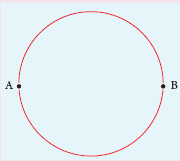
A wire of resistance 2 ohms per meter is bent to form a circle of radius 1m. The equivalent resistance between its two diametrically opposite points, A and B as shown in the figure is
\(\pi \Omega\)
\(\frac{\pi}{2}\Omega\)
2\(\pi \Omega\)
\(\frac{\pi}{4}\Omega\)
18.
Light of wavelength 600 nm that falls on a pair of slits producing interference pattern on a screen in which the bright fringes are separated by 7.2 mm. What must be the wavelength of another light which produces bright fringes separated by 8.1 mm with the same apparatus?
19.
What are carrier waves?
20.
What is Breakdown voltage?
21.
What is called logical variables?
22.
Explain knee voltage
23.
Define Zener effect
24.
What is rectification?
25.
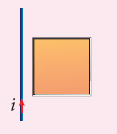
If the current i flowing in the straight conducting wire as shown in the figure decreases, find out the direction of induced current in the metallic square loop placed near it.
26.
Calculate the magnetic flux coming out from closed surface containing magnetic dipole (say, a bar magnet) as shown in figure.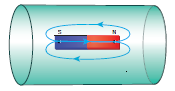
27.
A telescope has an objective of diameter 60 cm. The focal lengths of the objective and eyepiece are 2.0 m and 1.0 cm respectively. The telescope is directed to view two distant almost point sources of light, (e.g., two stars of a binary). The sources are roughly at the same distance = 104 light years along the line of sight but are separated transversely to the line of sight by a distance of 1010 m. Will the telescope resolve the two objects i.e. will it see two distant stars?
28.
Two polaroids are set in crossed positions. A third polaroid is placed between the two making an angle e with the pass axis of the first polaroid. Write the expression for the intensity of light transmitted from the second polaroid. In what orientations will the transmitted intensity be
(i) minimum and
(ii) maximum.
29.
If the focal lengths of the objective and eyepiece of a microscope are 2 cm and 5 cm and 5 cm respectively and the distance between them is 20 cm, what is the distance of the object from the objective when the image seen by the eye is 25 cm from eyepiece? Also find the magnifying power.
30.
For a BJT, the common - base current gain α = 0.98 and the collector base junction reverse bias saturation ICU = 0.6μA. This BJT is connected in the common emitter mode and operated in the active region with a base drive current ID= 20 μA. The collector current IC for this mode of operating is
31.
Calculate the magnetic field inside and outside of the long solenoid using Ampere’s circuital law.
32.
1.
Electric potential due to a point charge:
Consider a positive charge q kept fixed at the origin. Let P be a point at distance r from the charge q. This is shown in Figure.
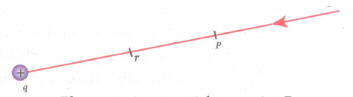
Electrostatic potential at a point P
The electric potential at the point P is
\(V=\int _{ \infty }^{ r }{ \left( -\vec { E } \right) d\vec { r } } =-\int _{ \infty }^{ r }{ \vec { E } } .d\vec { r } \) ...(1)
Electric field due to positive point charge q is
\(\vec { E } =\frac { 1 }{ 4\pi { \varepsilon }_{ 0 } } \frac { q }{ { r }^{ 2 } } \hat { r } \)
\(V=\frac { -1 }{ 4\pi { \varepsilon }_{ 0 } } \int _{ \infty }^{ r }{ \frac { q }{ { r }^{ 2 } } \hat { r } .d\vec { r } } \)
The infinitesimal displacement vector, \(d\vec { r } =dr\hat { r } \) and using \(\hat { r } \).\(\hat { r } \) = 1, we have
\(V=\frac { 1 }{ 4\pi { \varepsilon }_{ 0 } } \int _{ \infty }^{ r }{ \frac { q }{ { r }^{ 2 } } \hat { r } .dr\hat { r } =\frac { 1 }{ 4\pi { \varepsilon }_{ 0 } } \int _{ \infty }^{ r }{ \frac { q }{ { r }^{ 2 } } dr } } \)
After the integration,
\(V=-\frac { 1 }{ 4\pi { \varepsilon }_{ 0 } } q{ \left\{ -\frac { 1 }{ r } \right\} }_{ \infty }^{ r }=\frac { 1 }{ 4\pi { \varepsilon }_{ 0 } } \frac { q }{ r } \)
Hence, the electric potential due to a point charge q at a distance r is
\(V=\frac { 1 }{ 4\pi { \varepsilon }_{ 0 } } \frac { q }{ r } \) ....(2)
2.
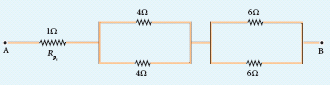
In all the sections, the resistors are connected in parallel.
Section I
\(\frac { 1 }{ { R }_{ { P }_{ 1 } } } =\frac { 1 }{ { R }_{ 1 } } +\frac { 1 }{ { R }_{ 2 } } \)
\(\frac { 1 }{ { R }_{ { P }_{ 1 } } } =\frac { 1 }{ 2 } +\frac { 1 }{ 2 } =\frac { 2 }{ 2 } \quad { R }_{ { p }_{ 1 } }=1\Omega \)
Section II
\(\frac { 1 }{ { R }_{ { P }_{ 1 } } } =\frac { 1 }{ 4 } +\frac { 1 }{ 4 } =\frac { 2 }{ 4 } ,\quad \frac { 1 }{ { R }_{ { P }_{ 2 } } } =\frac { 1 }{ 2 } ,{ R }_{ { p }_{ 2 } }=2\Omega \)
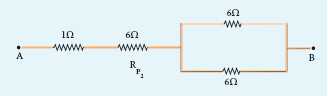
Section III
\(\frac { 1 }{ { R }_{ { P }_{ 3 } } } =\frac { 1 }{ 6 } +\frac { 1 }{ 6 } =\frac { 2 }{ 6 } \)
\(\frac { 1 }{ { R }_{ { P }_{ 3 } } } =\frac { 1 }{ 3 } ,{ R }_{ { p }_{ 3 } }=3\Omega \)
Equivalent resistance is given by
R = Rp1 + Rp2 + Rp3
R = 1 Ω + 2 Ω + 3 Ω = 6 Ω
The circuit became,
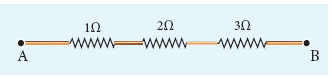
Equivalent resistance between A and B is
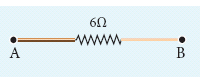
3.
Albert Einstein theoretically proposed the existence of gravitational waves in the year 1915.
4.
Size of the particle is between
1-100 nm - Nano.
Size of the particle is greater
than-100 nm - Bulk.
5.
(c)
Photovoltaic action
6.
\(V_{ionisation}=\frac{13.6}{n^2}Z^2 volt\)
\(Z=\sqrt\frac{V\times n^2}{13.6}=\sqrt\frac{122.4 \times I^2}{13.6}=\sqrt{9}=3\)
7.
(b)
8.
(c)
plane polarised
9.
(c)
both T and θ will remain the same
10.
(c)
1.50 mA
11.
Lorentz force F = Bqv
Energy w = qV
Energy is equal to kinetic energy,
\(qV=\frac{1}{2}mv^2\)
\(v=\sqrt { \frac {2qV }{ m } } \)
\(\therefore Lorentz \ force \ F= Bq\times \sqrt \frac{2qV}{m}=\sqrt { \frac { 2{ B }^{ 2 }{ q }^{ 3 }V }{ m } } \)
12.
Pav = \(\frac{1}{2}\)V0I0cosΦ
\(= \frac{1}{2}\times\frac{1}{\sqrt{2}}\times\frac{1}{\sqrt{2}}cos\times\frac{\pi}{3}\times \frac{1}{2}\times\frac{1}{2}\times\frac{1}{2}=\frac{1}{8}\)
13.
\(\text {emf } e=8 \mathrm{~V} \)
\(d I=I_1-I_0=2-(-2)=4 \mathrm{~A} \)
\(\text {dt }=0.05 \mathrm{~s} \)
\(L=\frac{-e}{d I / d t}=\frac{-8}{4 / 0.05} \)
\(=\frac{-8 \times 0.05}{4}=\frac{-0.40}{4} \)
=-0.1 H
-ve sign indicates that self-induced emf always opposes the current w.r.t. time.
14.
(b)
2\(\frac{E}{c}\)
15.
\(\vec {E}\) = 10x\(\hat{i},\) when x = 2 m
\(\vec {E}\) = 10 x 2 x \(\hat{i}\) = 20\(\hat{i}\)
Since, \(E=\frac{-dV}{dx}\therefore V=+20 V\)
16.
Resistivity ∝ temperature for conductor. so, copper → decreases
Resistivity ∝\(\frac{1}{\text {temperature for semiconductor}}\)
so, germanium → increases.
17.
Total length = 2πr = 2π
∴ Resistance of each segment = 2π/2 = π Ω
18.
ß1 = 7.2 mm, ß2 = 8.1 mm, λ1 = 600 nm, λ2 =?
Dividing, we get \(\beta = \frac{D\lambda}{d}(or)\beta∝\lambda\)
\(\frac{\beta_1}{\beta_2}=\frac{\lambda_1}{\lambda_2}\)
\(\therefore, { \lambda }_{ 2 }=\frac{\beta_2\times \lambda_1}{\beta_1}=\cfrac { 8.1\times10^{-3} \times 600 \times10^{-9}}{ 7.2 \times10^{-3}}
\)
\(=\cfrac { 9 \times 600\times10^{-9} }{ 8 }
=675\times 10^{-9 }\Rightarrow\lambda_2= 675nm\)
19.
Waves of high frequency are called carrier waves. If an audio signal (low frequency) is transmitted as such, it does out after traversing some distance. To reach up larger distance, it is superimposed an high frequency waves called carrier wave
20.
The voltage at which the diode breaks down is called the breakdown voltage
21.
Digital electronics deals with logical operations. The variables are called logical variables
22.
At room temperature, a potential difference equal to the barrier potential is required before a reasonable forward current starts flowing across the diode. This voltage is known as threshold voltage or cut-in voltage or knee voltage.
23.
Electric field is strong enough to break (or) rep tune the covalent bonds in the lattice and there by generating electron - hole pairs. This effect is called Zener effect.
24.
The process in which alternating voltage or alternating current is converted direct voltage or direct current is called rectification.
25.
From right hand rule, the magnetic field by the straight wire is directed into the plane of the square loop perpendicularly and its magnetic flux is decreasing. The decrease in flux is opposed by the current induced in the loop by producing a magnetic field in the same direction as the magnetic field of the wire. Again from right hand rule, for this inward magnetic field, the direction of the induced current in the loop is clockwise.
26.
The total flux emanating from the closed surface S enclosing the dipole is zero. So,
\({ \Phi }_{ B }=\oint { \overset { \rightarrow }{ B } .d\overset { \rightarrow }{ A } } =0\)
Here the integral is taken over closed surface. Since no isolated magnetic pole (called magnetic monopole) exists, this integral is always zero,
\(\oint { \overset { \rightarrow }{ B } .d\overset { \rightarrow }{ A } } =0\)
This is similar to Gauss’s law in electrostatics.
27.
Data on focal lengths is not required, The limit of resolution of the telescope is given by
\(\theta =\cfrac { 1.22\lambda }{ D } =\cfrac { 1.22\times 6\times { 10 }^{ -7 } }{ 0.60 } rad=1.22\times { 10 }^{ -6 }\)
Here, the value chosen corresponds roughly to the wavelength of yellow light. The transverse separation between the two sources subtends an angle equal to
\(\cfrac { { 10 }^{ 10 }m }{ 9.46\times { 10 }^{ 19 } } ={ 10 }^{ -10 }red\)
Here, we have used 1 light-year = 9.46 x 10¹⁵ m This angle is much too small compared to e above. The two stars of the binary cannot be resolved by the given telescope.
28.
Let polaroids P1 and P3 be in a crossed positions.
Let the polaroid P2 make an angle e with the pass axis of polaroid Pr
Let I1 be the intensity of polarised light emerging our of P1 Then intensity of light after passing through P2 will I2 = I1cos2θ
Since P3 and P, are in crossed position, therefore, the angle made by P2 with P3 is \(\left( \cfrac { \pi }{ 2 } -\theta \right) \)
∴ The intensity of light coming out of P3 is
\({ I }_{ 3 }={ I }_{ 2 }{ cos }^{ 2 }\left( \cfrac { \pi }{ 2 } -\theta \right) \)
or \({ I }_{ 3 }={ I }_{ 2 }{ cos }^{ 2 }{ sin }^{ 2 }\theta =\theta ={ I }_{ 1 }\left( \cfrac { 1 }{ 2 } sin20 \right) ^{ 2 }\)
If I0 is the intensity of the unpolarised light falling on PI' then \({ I }_{ 1 }=\cfrac { { I }_{ o } }{ 2 } \)
\(\therefore { I }_{ 3 }=\cfrac { { I }_{ o } }{ 2 } \left( \cfrac { 1 }{ 2 } sin20 \right) ^{ 2 }\)
(i) Minimum outcoming intensity is zero.
(ii) Maximum outcoming intensity is received
when \(\theta =\cfrac { \pi }{ 4 } \)
\(\therefore \left( { I }_{ 3 } \right) _{ max }=\cfrac { { I }_{ o } }{ 2 } \left( \cfrac { 1 }{ 2 } \right) ^{ 2 }=\cfrac { { I }_{ o } }{ 8 } \)
29.
\(\cfrac { 1 }{ -25 } -\cfrac { 1 }{ { u }_{ e } } =\cfrac { 1 }{ 5 } \)
or \({ u }_{ e }=-\cfrac { 25 }{ 6 } cm\)
\({ v }_{ o }=20-\cfrac { 25 }{ 6 } =\cfrac { 95 }{ 6 } cm\)
\(\cfrac { 1 }{ { v }_{ 0 } } =\cfrac { 1 }{ { u }_{ 0 } } =\cfrac { 1 }{ { f }_{ 0 } } \)
\(\cfrac { 6 }{ 95 } -\cfrac { 1 }{ { u }_{ 0 } } =\cfrac { 1 }{ 2 } ,{ u }_{ 0 }=2.29cm\)
\(m=-\cfrac { 95/6 }{ 190/83 } \left( 1+\cfrac { 25 }{ 5 } \right) =-41.5\)
30.
α = 0.98
ICu = 0.6 μA
\(\alpha =\frac { \beta }{ 1+\beta } \)
(or)
\(0.98=\frac { 1 }{ \frac { 1 }{ \beta } +1 } \)
β = 49
ICEO = (1 + β)ICBO
= (1 + 49) x 0.6μA
ICEO = 30 μA
= (1 + 49) x 0.6 μA
ICEO = 30 μA
IC = βIB+ ICEO
= 49 x 20 μA + 30 μA
IC = 1.01 mA
31.
Consider a solenoid of length L having N turns. The diameter of the solenoid is assumed to be much smaller when compared to its length and the coil is wound very closely.
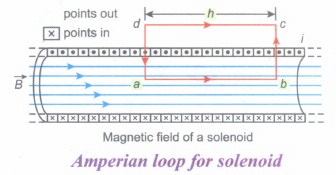
Consider a rectangular loop abcd. Then from Ampere's circuital law,
\(\oint _{ C }^{ }{ \vec { B } .\vec { dl } } \) = μ0 Ienclosed = μ0 x (total current enclosed by Amperian loop)
The left hand side of the equation is
\(\oint _{ C }^{ }{ \vec { B } .\vec { dl } } =\int _{ a }^{ b }{ \vec { B } .\vec { dl } } +\int _{ b }^{ c }{ \vec { B } .\vec { dl } } +\int _{ c }^{ d }{ \vec { B } .\vec { dl } } +\int _{ d }^{ a }{ \vec { B } .\vec { dl } } \)
Elemental lengths bc and da are perpendicular to magnetic field.
\(\therefore \int _{ b }^{ c }{ \vec { B } .\vec { dl } } =\int _{ b }^{ c }{ |\vec { B } ||\vec { dl } | } cos 90^o = 0\)
similarly,
\(\int _{ d }^{ a }{ \vec { B } .\vec { dl } } = 0\)
Since the magnetic field outside the solenoid is zero,
\(\int _{ c }^{ d }{ \vec { B } .\vec { dl } } =0\) and
\(\int _{ a }^{ b }{ \vec { B } .\vec { dl } } =BL \quad \quad (\because \theta =0^o)\)
Let I be the current passing through the solenoid of N turns, then
\(\int _{ a }^{ b }{ \vec { B } .\vec { dl } } = BL = μ_o NI ⇒ B = μ_o\frac {NI}{L}\)
The number of turns per unit length is given by \(\frac { N }{ L } \) = n, Then
B = \(\mu_o \frac { nLI }{ L } \) = μ0nI
Since n is a constant for a given solenoid and μ0 is also constant. For a fixed current I, the magnetic field inside the solenoid is also a constant.
32.

12th Standard Syllabus & Materials
12th Standard
TN 12th Computer Applications வலையமைப்பு வடமிடல் Sample Question Papers Study Material - QB365 Set A
NEW12th Standard
TN 12th Computer Applications களப்பெயர் முறைமை (DNS) Sample Question Papers Study Material - QB365 Set A
NEW12th Standard
TN 12th Computer Applications வலையமைப்பு எடுத்துக்காட்டுகள் மற்றும் நெறிமுறைகள் Sample Question Papers Study Material - QB365 Set A
NEW12th Standard
TN 12th Computer Applications கணினி வலையமைப்பு ஓர் அறிமுகம் Sample Question Papers Study Material - QB365 Set A



Tamilnadu Stateboard 12th Standard Subjects

Maths

Chemistry
Physics

Biology

Computer Science

Business Maths and Statistics

Economics

Commerce

Accountancy

History

Computer Applications
Biology
Computer Technology
Computer Applications
Computer Science
Business Maths and Statistics
Commerce
Economics
Maths
Chemistry
Physics
Computer Technology
History
Accountancy

Tamil

English

French
Tamilnadu Stateboard Standards

