
 100% FREE ACCESS
12th Standard Syllabus & Materials
12th Standard
TN 12th Computer Applications மின்னணு தரவு பரிமாற்றம் Sample Question Papers Study Material - QB365 Set A
NEW12th Standard
TN 12th Computer Applications மின் - வணிக பாதுகாப்பு அமைப்புகள் Sample Question Papers Study Material - QB365 Set A
NEW12th Standard
TN 12th Computer Applications மின்னணு செலுத்தல் முறைகள் Sample Question Papers Study Material - QB365 Set A
NEW12th Standard
TN 12th Computer Applications மின் - வணிகம் Sample Question Papers Study Material - QB365 Set A
NEW12th Standard
TN 12th Computer Applications திறந்த மூல கருத்துருக்கள் Sample Question Papers Study Material - QB365 Set A
NEW12th Standard
TN 12th Computer Applications வலையமைப்பு வடமிடல் Sample Question Papers Study Material - QB365 Set A

Published on: 27/02/2021
12th Standard English Medium Physics Reduced syllabus Creative Three mark Question with Answerkey - 2021(Public Exam )
Download Tamil Nadu 12th Standard Physics question papers, model tests, one-mark questions, important questions, and public exam papers in PDF format. Free study materials and answer keys for TN State Board students.
Questions + Answers key
Take MCQ Physics Test1.
Write the difference between paraxial rays and marginal rays.
2.
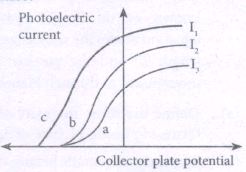
The figure shows a plot of three curves a, b, c showing the variation of photocurrent vs. Collector plate potential for three different intensities I1, I2, and I3 having frequencies v1, v2 and v3 respective incident on a photosensitive surface.
The figure shows a plot of three curves a, b, c showing the variation of photocurrent vs. Collector plate potential for three different intensities I1, I2, and I3 having frequencies v1,v2, and v3 respective incident on a photosensitive surface.
3.
The graph shows the variation of stopping potential with frequency of incident radiation for two photosensitive metals A and B. Which one of the two has higher value of workfunction? Justify your answer.
4.
List out the laws of photoelectric effect. (or) Write any three Laws of Photoelectric Effect
5.
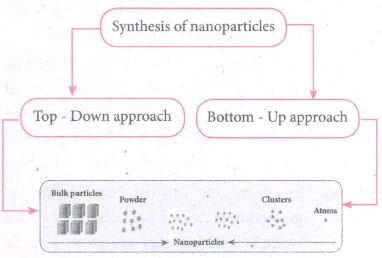
Write the two ways of preparing the nano materials.
6.
Why ground wave cannot be used for long distance communication using high frequency?
7.
Why space wave propagation is limited upto small distance over earth's surface?
8.
Write the limitations of FM.
9.
What is electronics?
10.
With respect to power generation, what are the relative advantages and disadvantages of fusion type and Fission type reactors?
11.
Digine atomic mass unit. Find its energy equivalent in MeV
12.
What is the diameter of H2 atom?
13.
How does Ampere - Maxwell law expalain the flux of current trough a capacitor when it is being charged by a battery? write the expression for the displacement current in terms of the rate of change of electric flux.
14.
Write the uses of Infrared radiation
15.
A given galvanometer is to be converted into
(i) an ammeter
(ii) a voltmeter.
In which case will the required resistance be
(i) least
(ii) highest and why?
16.
Write the expression in a vector form for the
(i) Lorentz magnetic force \(\vec { F } \) due to a charge moving with velocity \(\vec { v } \) in a magnetic field \(\vec { B } \) What is the direction of force?
(ii) If the magnetic force \(\vec { F } \) acting it is non-zero would the particle gain any energy?
17.
Mention the properties of Magnetic field lines?
18.
What are the types of magnets? Give example.
19.
What is impedance? When does LCR circuit have minimum impedance?
20.
Give and explain the mechanical analogy of LC oscillations by qualitative treatment.
21.
Find the expression for the equivalent emf & internal resistance of the series combination of cells.
22.
(a) Distinguish between electric cells and batteries.
(b) Explain its function.
23.
What is dielectrics or insulators.
24.
Derive an expression for electric flus in a non uniform electric field and an arbitrarily shaped area.
25.
Define potential difference and derive.
1.
|
Paraxial Rays |
Marginal Rays |
|---|---|
| The rays traveling very close to the principal axis and make small angles with it are called paraxial rays. | the rays traveling far away from the principal axis and fall on the mirror far away from the pole are called marginal rays. |
2.
Curves a and b have different intensities but the same stopping potential, so curves 'a' and 'b' have the same frequency but different intensities.
3.
Metal A
Since work function W = hvo
and vo > Vo so work function of metal A is more.
Aliter :
On stopping potential axis \(-\frac { { W }_{ o }^{ ' } }{ e } >-\frac { { W }_{ o } }{ e } \)
Hence work function W'o of metal A is more.
4.
Laws of photoelectric effect:
(i) For a given surface, the emission of photoelectrons takes place only if the frequency of incident light is greater than a certain minimum frequency called the threshold frequency.
(ii) For a given frequency of incident light, the number of photoelectrons emitted is directly proportional to the intensity of the incident light. The saturation current is also directly proportional to the intensity of incident light.
(iii) Maximum kinetic energy of the photoelectrons is independent of the intensity of the incident light.
(iv) Maximum kinetic energy of the photoelectrons from a given metal is directly proportional to the frequency of incident light.
(v) There is no time lag between the incidence of light and the ejection of photoelectrons.
5.
There are two ways of preparing the nanomateials, top down and bottom up approaches
6.
The maximum range of propagation in this mode depends on
(i) transmitted power and
(ii) frequency (less than a few MHz) of high frequencies the rate of energy dissipation of the signal increases and the signal gets attenuated over a short distance.
7.
(i) Because the transmission of signal directly from the transmitting antenna to receiving antenna called a line of sight communication.
(ii) The waves traveling directly from the transmitting antenna to the receiving antenna get blocked due to curvature of the earth.
(iii) It limits both the maximum line of sight distance between the two antennas arid also the maximum distance up to which transmission can be received.
8.
i) FM requires a much wider channel.
ii) FM transmitters and receivers are more complex and costly.
iii) In FM reception, less area is covered compared to AM.
9.
(i) It is the branch of physics incorporated with technology towards the design of circuits using transistors and microchips.
(ii) It depicts the behavior and movement of electrons in a semiconductor, vacuum, or gas.
(iii) Electronics deals with electrical circuits that involve active components such as transistors, diodes, integrated circuits, and sensors, associated with the passive components like resistors, inductors, capacitors, and transformers.
10.
(i) Fusion requires high temperature controlled reaction is not yet obtained. Highly sophisticated technology will be required.
(ii) However, the fuel is easily available, cheap and causes very less pollution.
(iii) There is no problem of waste management.
(iv) Fission controlled chain reaction is possible. The technology is well developed and established.
(v) There also exists the problem of waste management.
11.
Atomic mass unit is defined as \(\frac{1}{12}\) th of the mass of one \(_{ 6 }^{ 12 }{ C }\) atom.
E = mc2
= 1.66 x 10-27 x 3 X 108 x 3 x 108 J
= 1.66 x 9 x 10-11 J
= \(\frac { 1.66\times 9\times { 10 }^{ -11 } }{ 1.6\times { 10 }^{ -13 } } \) MeV = 931 MeV.
12.
The radius of the nth orbit
\({ r }_{ n }=\frac { { n }^{ 2 }{ h }^{ 2 }{ \epsilon }_{ 0 } }{ \pi m{ Ze }^{ 2 } } \)
r1 = 0.53Å
∴ The diameter of H2 = 2 x r1
= 0.53 x 2 = 1.06Å
13.
During charging, the electric flux between the plates capacitor keeps on changing. This results in the production of displacement current between the plates.
\({ I }_{ d }=\varepsilon _{ 0 }\left( \frac { d{ \phi }_{ E } }{ dt } \right) \)
14.
It provides electrical energy to satellites by means of solar cells. It is used to produce dehydrated fruits, in green houses to keep the plants warm, heat therapy for muscular pain or sprain, TV remote as a signal carrier, to look through haze fog or mist and used in night vision or infrared photography.
15.
The required resistance has the least value for ammeter and maximum value in the case of a voltmeter.
(i) The shunt resistance required to convert a galvanometer to an ammeter has the value
S = \(\frac { { I }_{ g } }{ I-{ I }_{ g } } \) x G
The shunt required for the milliammeter be a higher value.
(ii) Similarly, The voltmeter should have high resistance, the value of the required resistance should be highest in the case of the voltmeter. This is connected in series with the coil of the galvanometer.
16.
If the magnetic force \(\vec { F } =q(\vec { v } \times \vec { B } )\)
(i) The force on a charged particles is perpendicular to both \(\vec { v } \) and magnetic field \(\vec { B } \).
(ii) No, This is since the charged particle moves on a circular path.
\(\vec { F } =q(\vec { v } \times \vec { B } )\)
The particle does not gain energy.
17.
(i) Magnetic field lines are continuous closed curves. The direction of magnetic field lines is from the North pole to the South pole outside the magnet and South pole to the North pole inside the magnet.
(ii) The direction of a magnetic field at any point on the curve is known by drawing a tangent to the magnetic line of force at that point.
(iii) Magnetic field lines never intersect each other.
(iv) The degree of closeness of the field lines determines the relative strength of the magnetic field. The magnetic field is strong where magnetic field lines crowd and weak where magnetic field lines thin out.
18.
(i) Magnets are classified into natural magnets and artificial magnets.
(ii) For example, iron, cobalt, nickel, etc. are natural magnets.
(iii) Strengths of natural magnets are very weak and the shapes of the magnet are irregular.
(iv) Artificial magnets are made by us in order to have desired shape and strength.
(v) If the magnet is in the form of rectangular shape or cylindrical shape, then it is known as bar magnet.
19.
(i) The total resistance offered to the flow of current due to resistance R, inductive resistance XL, and capacitive reactance Xc in a circuit is called impedance.
It is given by \(z=\sqrt { { R }^{ 2 }+({ { X }_{ L }-{ X }_{ C }) }^{ 2 } } \)
(ii) At resonance, when XL= XC
20.
(i) The electromagnetic oscillations of LC system can be compared with the mechanical oscillations of a spring-mass system.
(ii) There are two forms of energy involved in LC oscillations. One is electrical energy of the charged capacitor; the other magnetic energy of the inductor carrying current.
(iii) Likewise, the mechanical energy of the spring-mass system exists in two forms; the potential energy of the compressed or extended spring and the kinetic energy of the mass. The Table lists these two pairs of energy.
(iv) By examining, the analogies between the various quantities can be understood and these correspondences.
(v) The angular frequency of oscillations of a spring-mass is given by equation
\(\omega =\sqrt { \frac { k }{ m } } \)
k ⟶ \(\frac { 1 }{ C } \) and m ⟶ L. Therefore, the angular frequency of LC oscillations is given by
ω = \(\frac { 1 }{ \sqrt { LC } } \)
21.
(i) Suppose n cells, each of emf \(\xi \) volts and internal resistance r ohms are connected in series with an external resistance R.
(ii) The total emf of the battery = \(n\xi \) The total resistance in the circuit = nr + R By Ohm's law, the current in the circuit is
\(I=\cfrac { totalemf }{ taoal\ resistance } =\cfrac { n\xi }{ nr+R } \)
\(I=\cfrac { n\xi }{ R } =n{ l }_{ 1 }\)
(iii) where II is the current due to a single cell
\(\left( { I }_{ 1 }=\cfrac { \xi }{ R } \right) \)
Thus, if r is negligible when compared to R the current supplied by the battery is n times that supplied by a single cell.
Case (b) If r >> R,\(I=\cfrac { n\xi }{ nr } =\cfrac { \xi }{ r } \)
(iv) It is the current due to a single cell. That is, current due to the whole battery is the same as that due to a single cell and hence there is no advantage in connecting several cells.
(v) Thus series connection of cells is advantageous only when the effective internal resistance of the cells is negligibly small compared with R.
22.
(a) An electric cell converts chemical energy into electrical energy to produce electricity. It contains two electrodes immersed in an electrolyte as shown Several electric cells connected together form a battery.
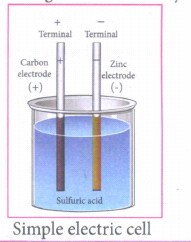
(b) When a cell or battery is connected to a circuit, electrons flow from the negative terminal to the positive terminal through the circuit. By using chemical reactions, a battery produces potential differences across its terminals. This potential difference provides the energy to move the electrons through the circuit.
23.
(i) A dielectric is a non-conducting material and has no free electrons. The electrons in a dielectric are bound within the atoms. Ebonite, glass and mica are some examples of dielectrics.
(ii) When an external electric field is applied, the electrons are not free to move anywhere but they are realigned in a specific way. A dielectric is made up of either polar molecules or non-polar molecules.
24.
(i) Suppose the electric field is not uniform and the area A is not flat (Figure), then the entire area is divided into n small area segments \(\Delta { \overset { \rightarrow }{ A } }_{ 1 },\Delta { \overset { \rightarrow }{ A } }_{ 2 },\Delta { \overset { \rightarrow }{ A } }_{ 3 }.....\Delta { \overset { \rightarrow }{ A } }_{ n },\) such that each area element is almost flat and the electric field through each area element is considered to be uniform.
(ii) The electric flux for the entire area A is approximately written as
\({ \Phi }_{ E }={ \overset { \rightarrow }{ E } }_{ 1 }.\Delta { \overset { \rightarrow }{ A } }_{ 1 },{ \overset { \rightarrow }{ E } }_{ 2 }.\Delta { \overset { \rightarrow }{ A } }_{ 2 },{ \overset { \rightarrow }{ E } }_{ 3 }.\Delta { \overset { \rightarrow }{ A } }_{ 3 }.....{ \overset { \rightarrow }{ E } }_{ n }.\Delta { \overset { \rightarrow }{ A } }_{ n },\)
\(\sum _{ i=1 }^{ n }{ { \overset { \rightarrow }{ E } }_{ 1 }.\Delta { \overset { \rightarrow }{ A } }_{ 1 } } \quad \quad \quad ....(1)\)
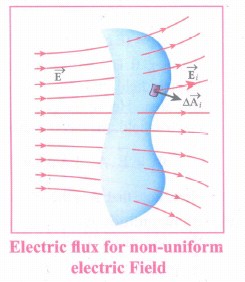
(iii) By taking the limit \({ \overset { \rightarrow }{ A } }_{ 1 }\rightarrow 0\) (for all i) the summation in equation (1) becomes integration. The total electric flux for the entire area is given by
\({ \Phi }_{ E }=\int { { \overset { \rightarrow }{ E } } } .d\overset { \rightarrow }{ A } \quad\quad ....(2)\)
(iv) From Equation (2), it is clear that the electric flux for a given surface depends on both the electric field pattern on the surface area and orientation of the surface with respect to the electric field.
25.
(i) The potential energy difference per unit charge is given by
\(\frac { \Delta U }{ q' } =\frac { q'\int _{ R }^{ P }{ (-\overset { \rightarrow }{ E } ) } .d\overset { \rightarrow }{ r } }{ q' } =\int _{ R }^{ P }{ \overset { \rightarrow }{ E } } .d\overset { \rightarrow }{ r } \quad ...(1)\)
(ii) The above equation (1) is independent of q'. The quantity \(\frac { \Delta U }{ q' } =\int _{ R }^{ P }{ \overset { \rightarrow }{ E } } .d\overset { \rightarrow }{ r } \) is called electric potential difference between P and R and is denoted as VP - VR = ∆V.
(iii) In other words the electric potential difference is also defined as the work done by an external force to bring unit positive charge from point R to point P.
\({ V }_{ p }-{ V }_{ R }=\Delta V=\int _{ R }^{ P }{ \overset { \rightarrow }{ E } } .d\overset { \rightarrow }{ r } \)
(iv) The electric potential energy difference can be written as ∆U = q' ∆V.

12th Standard Syllabus & Materials
12th Standard
TN 12th Computer Applications களப்பெயர் முறைமை (DNS) Sample Question Papers Study Material - QB365 Set A
NEW12th Standard
TN 12th Computer Applications வலையமைப்பு எடுத்துக்காட்டுகள் மற்றும் நெறிமுறைகள் Sample Question Papers Study Material - QB365 Set A
NEW12th Standard
TN 12th Computer Applications கணினி வலையமைப்பு ஓர் அறிமுகம் Sample Question Papers Study Material - QB365 Set A
NEW12th Standard
TN 12th Computer Applications PHP-உடன் MySQL-ஐ இணைத்தல் Sample Question Papers Study Material - QB365 Set A



Tamilnadu Stateboard 12th Standard Subjects

Maths

Chemistry
Physics

Biology

Computer Science

Business Maths and Statistics

Economics

Commerce

Accountancy

History

Computer Applications
Biology
Computer Technology
Computer Applications
Computer Science
Business Maths and Statistics
Commerce
Economics
Maths
Chemistry
Physics
Computer Technology
History
Accountancy

Tamil

English

French
Tamilnadu Stateboard Standards

