
 100% FREE ACCESS
12th Standard Syllabus & Materials
12th Standard
TN 12th Computer Applications மின்னணு தரவு பரிமாற்றம் Sample Question Papers Study Material - QB365 Set A
NEW12th Standard
TN 12th Computer Applications மின் - வணிக பாதுகாப்பு அமைப்புகள் Sample Question Papers Study Material - QB365 Set A
NEW12th Standard
TN 12th Computer Applications மின்னணு செலுத்தல் முறைகள் Sample Question Papers Study Material - QB365 Set A
NEW12th Standard
TN 12th Computer Applications மின் - வணிகம் Sample Question Papers Study Material - QB365 Set A
NEW12th Standard
TN 12th Computer Applications திறந்த மூல கருத்துருக்கள் Sample Question Papers Study Material - QB365 Set A
NEW12th Standard
TN 12th Computer Applications வலையமைப்பு வடமிடல் Sample Question Papers Study Material - QB365 Set A

Published on: 27/02/2021
12th Standard English Medium Physics Reduced syllabus Five mark important Questions - 2021(Public Exam )
Download Tamil Nadu 12th Standard Physics question papers, model tests, one-mark questions, important questions, and public exam papers in PDF format. Free study materials and answer keys for TN State Board students.
Questions + Answers key
Take MCQ Physics Test1.
A diffraction grating consists of 4000 slits per centimeter. It is illuminated by a monochromatic light. The second order diffraction maximum is produced at an angle of 30°. What is the wavelength of the light used?
2.
Calculate the amount of energy released when 1 kg of \(_{ 92 }^{ 235 }{ U }\) undergoes fission reaction.
3.
Consider a parallel plate capacitor whose plates are closely spaced. Let R be the radius of the plates and the current in the wire connected to the plates is 5 A, calculate the displacement current through the surface passing between the plates by directly calculating the rate of change of flux of electric field through the surface.
4.
For the given capacitor configuration
(a) Find the charges on each capacitor
(b) potential difference across them
(c) energy stored in each capacitor
5.
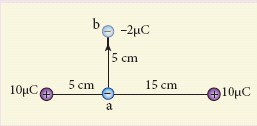
A point charge of +10 μC is placed at a distance of 20 cm from another identical point charge of +10 μC. A point charge of -2 μC is moved from point a to b as shown in the figure. Calculate the change in potential energy of the system? Interpret your result.
6.
Find the heat energy produced in a resistance of 10 Ω when 5 A current flows through it for 5 minutes.
7.
A water molecule has an electric dipole moment of 6.3 x 10⁻³⁰ Cm. A sample contains 1022 water molecules, with all the dipole moments aligned parallel to the external electric field of magnitude 3 x 10⁵ NC-1. How much work is required to rotate all the water molecules from θ = 0° to 90°?
8.
A radioactive sample has 2.6μg of pure \(_{ 7 }^{ 13 }{ N }\) which has a half-life of 10 minutes.
(a) How many nuclei are present initially?
(b) What is the activity initially?
(c) What is the activity after 2 hours? (d) Calculate mean life of this sample.
9.
On your birthday, you measure the activity of the sample 210Bi which has a half-life of 5.01 days. The initial activity that you measure is 1µCi.
(a) What is the approximate activity of the sample on your next birthday? Calculate
(b) the decay constant
(c) the mean life
(d) initial number of atoms.
10.
Half lives of two radioactive elements A and B are 20 minutes and 40 minutes respectively. Initially, the samples have equal number of nuclei. Calculate the ratio of decayed numbers of A and B nuclei after 80 minutes.
11.
The coil of a moving coil galvanometer has 5 turns and each turn has an effective area of 2 x 10⁻² m2. It is suspended in a magnetic field whose strength is 4 x 10⁻² Wb m–2. If the torsional constant K of the suspension fibre is 4 x 10⁻⁹ N m deg–1.
(a) Find its current sensitivity in division per microampere.
(b) Calculate the voltage sensitivity of the galvanometer for it to have full scale deflection of 50 divisions for 25 mV.
(c) Compute the resistance of the galvanometer
12.
A long solenoid having 400 turns per cm carries a current 2A. A 100 turn coil of cross-sectional area 4 cm2 is placed co-axially inside the solenoid so that the coil is in the field produced by the solenoid. Find the emf induced in the coil if the current through the solenoid reverses its direction in 0.04 sec.
13.
Calculate the magnetic field inside a solenoid, when
(a) the length of the solenoid becomes twice with fixed number of turns
(b) both the length of the solenoid and number of turns are doubled
(c) the number of turns becomes twice for the fixed length of the solenoid.
Compare the results.
14.
The equation for an alternating current is given by i = 77 sin 314t. Find the peak current, frequency, time period and instantaneous value of current at t = 2 ms.
15.
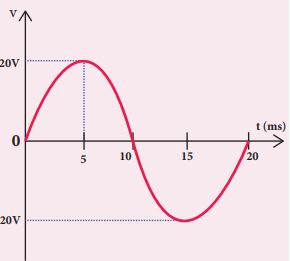
Write down the equation for a sinusoidal voltage of 50 Hz and its peak value is 20 V. Draw the corresponding voltage versus time graph.
16.
An inverter is common electrical device which we use in our homes. When there is no power in our house, inverter gives AC power to run a few electronic appliances like fan or light. An inverter has inbuilt step-up transformer which converts 12 V AC to 240 V AC. The primary coil has 100 turns and the inverter delivers 50 mA to the external circuit. Find the number of turns in the secondary and the primary current.
17.
Suppose a charge +q on Earth’s surface and another +q charge is placed on the surface of the Moon.
(a) Calculate the value of q required to balance the gravitational attraction between Earth and Moon.
(b) Suppose the distance between the Moon and Earth is halved, would the charge q change?
(Take mE = 5.9 x 1024 kg, mM = 7.9 x 10²² kg)
18.
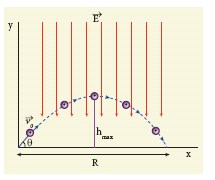
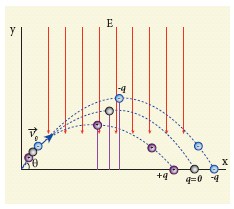
A small ball of conducting material having a charge +q and mass m is thrown upward at an angle θ to horizontal surface with an initial speed vo as shown in the figure. There exists an uniform electric field E downward along with the gravitational field g. Calculate the range, maximum height and time of flight in the motion of this charged ball. Neglect the effect of air and treat the ball as a point mass.
19.
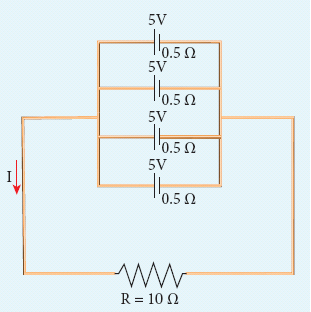
For the given circuit
Find
i) Equivalent emf
ii) Equivalent internal resistance
iii) Total current (I)
iv) Potential difference across each cell
v) Current from each cell
20.
Explain the mechanical analogy of LC oscillations by quantitative treatment.
21.
An aluminium wire of diameter 0.24 cm is connected in series to a copper wire of diameter 0.16 cm. The wires carry an electric current of 10 A. Determine the current density in aluminium wire.
22.
The electric potential in region is represented as V = 2x + 3y - z. Obtain an expression for electric field strength.
23.
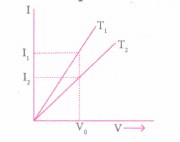
I - V graph for a metallic wire at two different temperatures T1 & T2 as shown in figure. Which of the two temperature is lower. Why?
24.
A copper slab of mass 2g contains 2 x 10²² atoms. The charge on the nucleus of each atom is 29 e. What fraction of the electrons must be removed from the sphere to give it a charge of +2μC?
25.
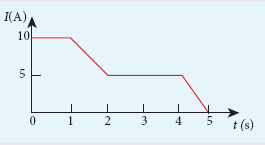
The current through an element is shown in the figure. Determine the total charge that pass through the element at a) t = 0 s, b) t = 2 s, c) t = 5s
1.
Number of lines per cm = 4000 cm-1; m = 2; θ = 30°; λ = ?
Number of lines per unit length
\(N=\cfrac { 4000 }{ 1\times { 10 }^{ -2 } } =4\times { 10 }^{ 5 }\)
Equation for diffraction maximum in grating is, sinθ = Nmλ
After Rewriting, \(\lambda =\cfrac { sin\theta }{ Nm } \)
Substituting,
\(\lambda =\cfrac { { \sin30 }^{ o } }{ 4\times { 10 }^{ 5 }\times 2 } =\cfrac { 0.5 }{ 4\times { 10 }^{ 5 }\times 2 } \)
= \(\cfrac { 1 }{ 2\times 4\times { 10 }^{ 5 }\times 2 } =\cfrac { 1 }{ 16 \times 10^5} \)
λ = 6250 x 10-10 m = 6205 Å
2.
235 g of \(_{ 92 }^{ 235 }{ U }\) has 6.02 x 10²³ atoms. In one gram of \(_{ 92 }^{ 235 }{ U }\), the number of atoms is equal to \(\frac { 6.02\times { 10 }^{ 23 } }{ 235 } =2.56\times { 10 }^{ 21 }\)
So the number of atoms in 1 kg of \(_{ 92 }^{ 235 }{ U }\) = 2.56 x 1021 x 1000 = 2.56 x 1024
Each \(_{ 92 }^{ 235 }{ U }\) nucleus releases 200 MeV of energy during the fission. The total energy released by 1kg of \(_{ 92 }^{ 235 }{ U }\) is
Q = 2.56 x 1024 x 200MeV = 5.12 x 1026 MeV
In terms of joules,
Q = 5.12 x 1026 x 1.6 x 10-13 J = 8.192 x 10¹³ J
In terms of Kilowatt hour,
Q = \(\frac { 8.192\times { 10 }^{ 13 } }{ 3.6\times { 10 }^{ 6 } } =2.27\times { 10 }^{ 7 }\) kWh
3.
Area of the capacitor = A
Radius = R
Current in the wire connected to the plates I = 5 A
The electric field, between the plates of a parallel plate capacitor,
\(E=\frac{\sigma}{\varepsilon_0} \)
\(E=\frac{Q}{A \varepsilon_0}\)
Q is the charge accumulated at the positive plate.
The flux of this field, \(\phi_E=\frac{Q}{A \varepsilon_0} \times A=\frac{Q}{\varepsilon_0}\)
Displacement current \(i_d=\varepsilon_0 \frac{d \phi_E}{d t}\)
\(=\varepsilon_0 \frac{d}{d t}\left(\frac{Q}{\varepsilon_0}\right)=i_c\)
\(\therefore \mathrm{i}_{\mathrm{d}}=5 \mathrm{~A} \quad\left(\because\right.\) The current through the capacitor ic = 5 A)
Displacement current = 5 A
4.
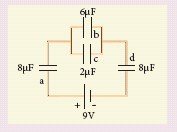
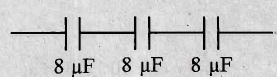
Cp = Cb + Cc
\(C_{P}=6+2=8 \mu \mathrm{F} \)
\(\frac{1}{C_{s}}=\frac{1}{C_a}+\frac{1}{C_p}=\frac{1}{C_d} \)
\(C_{s}=\frac{1}{8}+\frac{1}{8}+\frac{1}{8}=\frac{3}{8} \)
\(\therefore C_{s}=\frac{8}{3} \mu \mathrm{F} \)
Total capacitance \(C_{s}=\frac{8}{3} \times 10^{-6} \mathrm{~F} \)
Total Charge, \(Q=C_{s} V=\frac{8}{3} \times 10^{-6} \times 9 \)
\(Q_{a}=24 \mu C\)
(a) Charge on capacity \(Q_{a}=24 \mu C\) .....(1)
Charge on capacitor \(Q_{b}=24 \times \frac{6}{8}=18 \mu \mathrm{C} \) ..............(2)
Charge on capacitor \(Q_{c}=24 \times \frac{2}{8}=6 \mu \mathrm{C} \) ..............(3)
Charge on capacitor \(Q_{d}=24 \times \frac{8}{8}=24 \mu \mathrm{C} \) ..............(4)
(b) Potential difference across \(C_{a} \ is\ V_{a}=\frac{Q_{a}}{C_{a}} \)
\(=\frac{24}{8}=3 \mathrm{~V} \) ...(5)
Potential difference across \(C_{b}\ is \ V_{b}=\frac{Q_{b}}{C_{b}} \)
\(=\frac{18}{6}=3 \mathbf{V}\) ........(6)
Potential difference across \(C_{c}\ is \ V_{c}=\frac{Q_{c}}{C_{c}}=\frac{6}{2}=3 \mathrm{~V} \) ......(7)
Potential difference across \(C_{d}\ is \ V_{d}=\frac{Q_{d}}{C_{d}} \)
\(=\frac{24}{8}=3 \mathbf{V} \) ....(8)
(c) Energy stored in each capacitor \(U=\frac{1}{2} C V^{2}\)
Energy stored in \(\mathrm{C}_{\mathrm{a}} \text { is } U_{a}=\frac{1}{2} C_{a} V_{a}^{2}\)
\(U_{\mathrm{a}}=\frac{1}{2} \times 8 \times 10^{-6} \times 3 \times 3=36 \mu \mathrm{J}\) ....(9)
Energy stored in \(C_{b}\ is \ U_{b}=\frac{1}{2} C_{b} V_{b}^{2} \)
\(U=\frac{1}{2} \times 6 \times 10^{-6} \times 3 \times 3 \)
\(=27 \mu \mathrm{J} \) ........(10)
Energy stored in Ce is \(U_{c} =\frac{1}{2} C_{c} V_{c}^{2} \)
\(=\frac{1}{2} \times 2 \times 10^{-6} \times 3 \times 3=9 \mu \mathrm{J} \) ......(11)
Energy stored in Cd is \(U_{d} =\frac{1}{2} C_{d} V_{d}^{2} \)
\(U_d=\frac{1}{2} \times 8 \times 10^{-6} \times 3 \times 3 \)
\(=36 \times 10^{-6} \mathrm{~J}=36 \mu \mathrm{J} \) .........(12)
5.
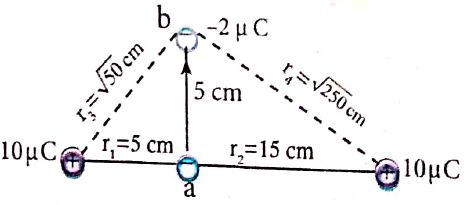
\(W =\left(V_{b}-V_{a}\right) q\left[where\ V=\frac{K Q}{r}\right] \)
To find Vb :
\(V_b=\frac{kQ}{r_3}+\frac{kQ}{r_4}\)
\(V_{b} =\frac{K \times 10 \times 10^{-6}}{\sqrt{50 \times 10^{-4}}}+\frac{K \times 10 \times 10^{-6}}{\sqrt{250 \times 10^{-4}}} \)
\(V_{b} =\frac{K \times 10^{-5}}{\sqrt{50} \times 10^{-2}}+\frac{K \times 10^{-5}}{\sqrt{250} \times 10^{-2}} \)
\(=K \times 10^{-3}\left[\frac{1}{\sqrt{50}}+\frac{1}{\sqrt{250}}\right] \)
\(=9 \times 10^{9} \times 10^{-3}\left[\frac{1}{\sqrt{50}}+\frac{1}{\sqrt{250}}\right] \)
Vb = 1842002 V
To find Va :
\(V_a=\frac{kQ}{r_1}+\frac{kQ}{r_2}\)
\(V_{a} =\frac{K \times 10 \times 10^{-6}}{\sqrt{5 \times 10^{-2}}}+\frac{K \times 10 \times 10^{-6}}{\sqrt{15 \times 10^{-2}}} \)
Va = 2400000 V
\(\therefore W_{D} =\left(V_{b}-V_{a}\right) q=(1842002-2400000)( -2 \times 10^{-6} )\)
W = +1.12J
Positive sign implies that to move the charge - 2 μC external work is required.
6.
R = 10 Ω, I = 5 A, t = 5 minutes = 5 x 60 s
H = I2 R t
= 52 x 10 x 5 x 60
= 25 x 10 x 300
= 25 x 3000
= 75000 J (or) 75 kJ
7.
When the water molecules are aligned in the direction of the electric field, it has minimum potential energy. The work done to rotate the dipole from θ = 0° to 90° is equal to the potential energy difference between these two configurations.
W = ΔU = U(90°) - U(0°)
From the equation U =−pE cosθ = −\(\hat p.\hat E\) ,
we write U = − pE cosθ, Next, we calculate the work done to rotate one water molecule from θ = 0° to 90°.
For one water molecule
W = - pE cos90o + pE cos0o = pE
W= 6.3 x 10-30 x 3 x 105 = 18.9 x 10⁻²⁵J
For 1022 water molecules, the total work done is
Wtot = 18.9 x 10-25 x 1022 = 18.9 x 10⁻³J
8.
(a) To find N0, we have to find the number of \(_{ 7 }^{ 13 }{ N }\) atoms in 2.6μg. The atomic mass of nitrogen is 13. Therefore, 13 g of \(_{ 7 }^{ 13 }{ N }\) contains Avogadro number (6.02 x 10²³) of atoms.
In 1 g, the number of \(_{ 7 }^{ 13 }{ N }\) atoms present is equal to \(\frac { 6.02\times { 10 }^{ 23 } }{ 13 } \). So the number of \(_{ 7 }^{ 13 }{ N }\) atoms present in 2.6μg is
\({ N }_{ 0 }=\frac { 6.02\times { 10 }^{ 23 } }{ 13 } \times 2.6\times { 10 }^{ -6 }=12.04\times { 10 }^{ 16 }\) atoms
(b) To find the initial activity R0, we have to evaluate decay constant λ
\(\lambda =\frac { 0.6931 }{ { T }_{ 1/2 } } =\frac { 0.6931 }{ 10\times 60 } =1.155\times { 10 }^{ -3 }{ s }^{ -1 }\)
Therefore
R0 = λN0 = 1.155 x 10-3 x 12.04 x 1016
= 13.90 x 10 13 decays/s
= 13.90 x 10 13 Bq
In terms of a curie,
\({ R }_{ 0 }=\frac { 13.90\times { 10 }^{ 13 } }{ 3.7\times { 10 }^{ 10 } } =3.75\times { 10 }^{ 3 }Ci\)
since 1Ci = 3.7 x 10¹⁰Bq
(c) Activity after 2 hours can be calculated in two different ways:
Method 1: R = R0 e–λt
At t = 2 hr = 7200 s
R = 3.75 x 10³ x e-7200 x 1.155 x 10–3
R = 3.75 x 103 x 2.4 x 10–4 = 0.9 Ci
Method 2: \(R={ \left( \frac { 1 }{ 2 } \right) }^{ n }{ R }_{ 0 }\)
Here \(n=\frac { 120min }{ 10min } =12\)
\(R={ \left( \frac { 1 }{ 2 } \right) }^{ 12 }\times 3.75\times { 10 }^{ 3 }\) ≈ 0.9 Ci
(d) mean life ፒ = \(\frac{T_{1/2}}{0.6931}=\frac{10\times60}{0.6931}\)
= 865.67 s
9.
\(\mathrm{T}_{\frac{1}{2}}=5.01 \text { days} \), \(\mathrm{R}_{o}=1 μ \mathrm{Ci}=3.7 \times 10^{10} \times 10^{-6} \) decays per second
\(if\ \mathrm{t}=1\ year\ \mathrm{R}= ? \), \(\tau=? \), \(\lambda=? \), \(\mathrm{~N}_{o}=? \)
a) \(\mathrm{R}=\mathrm{R}_{o} \mathrm{e}^{-\lambda t} \)
\(\mathrm{R}=\mathrm{R}_{o} \mathrm{e}^{-\frac{0.6931}{\mathrm{~T}_{1 / 2} }t} \)
\(\mathrm{R}=\mathrm{R}_{o} \mathrm{e}^{-\frac{0.6931}{5.01} \times 365} \)
\(\mathrm{R}=\mathrm{R}_{o} \mathrm{e}^{-50.5}=\mathrm{R}_{o} \times 1.17 \times 10^{-22} \)
\(\mathrm{R}=1 \mu \mathrm{Ci} \times 1.17 \times 10^{-22}=1.17 \times 10^{-22} \mu \mathrm{Ci} \)
\(\mathrm{R}=1.17 \times 10^{-22} \mu \mathrm{Ci} \)
b) \(\lambda=\frac{0.6931}{T_{\frac{1}{2}}}=\frac{0.6931}{5.01}=0.1383 \text { day }^{-1} \)
\(\lambda=\frac{0.6931}{T_{\frac{1}{2}}}=\frac{0.6931}{5.01 \times 24 \times 60 \times 60}=1.6 \times 10^{-6} \mathrm{~s}^{-1} \)
\(\lambda=1.6 \times 10^{-6} \mathrm{~s}^{-1} \)
c) \(\tau=\frac{1}{\lambda}=\frac{1}{0.1383}=7.23 \text { days } \)
\(\tau=7.23 \text { days } \)
\(R_{o}=\lambda N_{o} \)
\(N_{o}=\frac{R_{o}}{\lambda}=\frac{3.7 \times 10^{10} \times 10^{-6}}{1.6 \times 10^{-6}}=2.3 \times 10^{10} \)
\(N_{o}=2.3 \times 10^{10} \)
10.
For A, Half life of \(, \mathrm{T}_{\mathrm{A}} \) = 20 minutes, n = 4
For B, Half life of \(, T_{B}\) = 40 minutes, n = 2
\(\mathrm{N}_{01}=\mathrm{N}_{02}=\mathrm{N}_{0}\)
sample left A, \(\frac{N_{1}}{N_{0}}=\left(\frac{1}{2}\right)^{n}=\left(\frac{1}{2}\right)^{4}=\frac{1}{16}\)
A-sample decayed \(=1-\frac{N_{1}}{N_{0}}=1-\frac{1}{16}=\frac{15}{16}\)
sample Ieft B, \(\frac{N_{1}}{N_{0}}=\left(\frac{1}{2}\right)^{n}=\left(\frac{1}{2}\right)^{2}=\frac{1}{4}\)
B-sample decayed \(=1-\frac{N_{2}}{N_{0}}=1-\frac{1}{4}=\frac{3}{4}\)
Ratio of decayed number of A and B \(=\frac{\frac{15}{16}}{\frac{1}{4}}=\frac{15}{16} \times \frac{4}{3}=\frac{5}{4}\)
Ratio of decayed number of A and |B = 5:4
11.
N = 5 turns
A = 2 x 10⁻² m2
B = 4 x 10⁻² Wb m-2
K = 4 x 10⁻⁹ N m deg-1
(a) Current sensitivity
\({ I }_{ s }=\frac { NAB }{ K } =\frac { 5\times 2\times { 10 }^{ -2 }\times 4\times { 10 }^{ -2 } }{ 4\times 10^{ -9 } } \)
= 106 divisions per ampere
\(I\mu A=\) 1microambire =10-6ampere
Therefore,
\({ I }_{ s }={ 10 }^{ 6 }\frac { div }{ A } =1\frac { div }{ { 10 }^{ -6 }A } =1\frac { div }{ \mu A } \)
\({ I }_{ s }=1div{ \left( \mu A \right) }^{ -1 }\)
(b) Voltage sensitivity
\({ V }_{ s }=\frac { \theta }{ V } =\frac { 50div }{ 25mv } =2\times { 10 }^{ 3 }{ div \ V }^{ -1 }\)
(c) The resistance of the galvanometer is
\({ R }_{ g }=\frac { { I }_{ s } }{ { v }_{ s } } =\frac { { 10 }^{ 6 }\frac { div }{ A } }{ { 2\times }10^{ 6 }\frac { div }{ V } } =0.5\times { 10 }^{ 3 }\frac { V }{ A } =0.5k\Omega \)
12.
\(N_1 =4 \times 10^4, \mathrm{~N}_2=100, \mathrm{I}=2 \mathrm{~A}, \mathrm{~A}=4 \times 10^{-4} \mathrm{~m}^2 \)
\(\mathrm{t} =0.04 \mathrm{~s}, \mathrm{e}=? \)
\(\mathrm{~B} =\mu_0 \mathrm{n}_1 \mathrm{I}=\frac{\mu_0 \mathrm{~N}_1 \mathrm{I}}{l}=\frac{4 \pi \times 10^{-7} \times 4 \times 10^4 \times 2}{1} \)
\(\mathrm{~B} =100.48 \times 10^{-3} \mathrm{~T} \)
\(\phi =\mathrm{BA}=100.48 \times 10^{-3} \times 4 \times 10^{-4} \)
\(\therefore \phi_1 =\phi_2=\phi=401.92 \times 10^{-7} \mathrm{wb} \)
\(\mathrm{d} \phi =\phi_1-\left(-\phi_2\right)=2 \phi=2 \times 401.92 \times 10^{-7} \)
\(\therefore \mathrm{d} \phi =803.84 \times 10^{-7} \mathrm{wb}\)
EMF induced in the coil,
\(e=-N_2 \frac{d \phi}{d t} \)
\(e=\frac{-100 \times 803.84 \times 10^{-7}}{0.04}=-200.96 \times 10^{-3} \mathrm{~V}\)
\(e=-0.2 \mathrm{~V}\)
13.
The magnetic field of a solenoid (inside) is
\({ B }_{ L,N }=\mu _{ ° }\frac { NI }{ L } \)
(a) length of the solenoid becomes twice and fixed number of turns
L → 2L (length becomes twice)
N → N (number of turns remains constatnt)
The magnetic field is
\({ B }_{ L,N }=\mu _{ ° }\frac { NI }{ 2L } =\frac { 1 }{ 2 } { B }_{ L,N }\)
(b) both the length of the solenoid and number of turns are doubled
L → 2L (length becomes twice)
N → 2N (number of turns becomes twice)
The magnetic field is
\({ B }_{2 L,2N }=\mu _{ ° }\frac { 2NI }{ 2L } ={ B }_{ L,N }\)
(c) the number of turns becomes twice but the fixed length of the solenoid
L → L (length is fixed)
N → 2N (number of turns becomes twice)
The magnetic field is
\({ B }_{ L,2N }=\mu _{ ° }\frac { 2NI }{ L } ={ 2B }_{ L,N }\)
From the above results,
\({ B }_{ L,2N }>{ B }_{ 2L,2N }>{ B }_{ 2L,N }\)
Thus, strength of the magnetic field is increased when we pack more loops into the same length for a given current.
14.
i = 77 sin 314t ; t = 2 ms = 2 x 10⁻³ s
The general equation of an alternating current is i = Im sinωt. On comparison,
(i) Peak current, Im = 77A
(ii) Frequency, \(f=\frac { \omega }{ 2\pi } =\frac { 314 }{ 2\times 3.14 } =50Hz\)
(iii) Time period, \(T-\frac { 1 }{ f } =\frac { 1 }{ 50 } =0.02s\)
(iv) At t = 2 m s, Instantaneous current, i = 77sin(314 x 2 x 10−3)
\( =77 \sin \left(314 \times 2 \times 10^{-3} \times \frac{180^{\circ}}{3.14}\right) \)
\(=77 \sin 36^{\circ}=77 \times 0.5878 \)
= 45.26 A
15.
f = 50Hz ; Vm = 20V
Instantaneous voltage, υ = Vm sinωt
= Vm sin2πvt
= 20sin(2π x 50)t = 20sin(100 x 3.14)t
υ = 20sin 314t
Time for one cycle, \(T=\frac { 1 }{ f } =\frac { 1 }{ 50 } =0.02s\)
= 20 x 10−3 s = 20ms
The wave form is given below
16.
Vp = 12 V; Vs = 240 V
Is = 50 mA; Np = 100 turns
\(\frac { { V }_{ s } }{ { V }_{ P } } =\frac { { N }_{ s } }{ { N }_{ p } } =\frac { { I }_{ P } }{ { I }_{ S } } =K\)
Transformation ratio, K = \(\frac{240}{12}=20\)
The number of turns in the secondary
NS = NP x K = 100 x 20 = 2000
Primary current,
IP = K x Is = 20 x 50 mA = 1 A
17.
G = 6.67 x 10⁻¹¹ Nm2kg-2
Mass of Earth mE = 5.9 x 1024 kg
Mass of Moon mm = 7.9 x 10²² kg
Gravitational force \(F_{g}=\frac{G m_{E} \times m_{M}}{r^{2}}\); Electro static force \(F_e=k\frac{q \times q}{r^2}\)
By equating the forces, \( k\frac{q \times q}{r^{2}}=G \cdot \frac{m_{E} \times m_{M}}{r^{2}} \)
\(\because k=\frac{1}{4 \pi \varepsilon_{0}}=9 \times 10^{9} \)
\( 4 \pi \varepsilon_{0} =0.11 \times 10^{-9} \)
\(q =\sqrt{4 \pi \varepsilon_{0} G m_{E} \cdot m_{M}} \) ....(1)
\(=\sqrt{0.11 \times 10^{-9} \times 6.67 \times 10^{-11} \times 5.9 \times 10^{24} \times 7.9 \times 10^{22}}\)
\( q =\sqrt{34.2 \times 10^{26}} \)
q ≈ 5.85 x 10¹³ C
b) Suppose the distance (r) between Moon and Earth is halved, there is no change in the value of charge (q). Because from equation (1), q is independent of distance (r).
18.
If the conductor has no net charge, then its motion is the same as usual projectile motion of a mass m which we studied in Kinematics (unit 2, vol-1 XI physics). Here, in this problem, in addition to downward gravitational force, the charge also will experience a downward uniform electrostatic force.
The acceleration of the charged ball due to gravity = -g\(\hat { j } \)
The acceleration of the charged ball due to uniform electric field =\(-\frac { qE }{ m } \hat { j } \)
The total acceleration of charged ball in downward direction \(\vec { a } =-\left( g+\frac { qE }{ m } \right) \vec { j } \)
It is important here to note that the acceleration depends on the mass of the object. Galileo’s conclusion that all objects fall at the same rate towards the Earth is true only in a uniform gravitational field. When a uniform electric field is included, the acceleration of a charged object depends on both mass and charge.
But still the acceleration a = \(\left( g+\frac { qE }{ m } \right) \) is constant throughout the motion. Hence we use kinematic equations to calculate the range, maximum height and time of flight. In fact we can simply replace g by \(g+\frac { qE }{ m } \) in the usual expressions of range, maximum height and time of flight of a projectile.
| Without charge | With the charge +q | |
| Time of flight T | \(\frac { 2v_{ 0 }sin\theta }{ g } \) | \(\frac { 2{ v }_{ 0 }sin\theta }{ \left( g+\frac { qE }{ m } \right) } \) |
| Maximum height hmax | \(\frac { { v }_{ 0 }^{ 2 }sin^{ 2 }\theta }{ 2g } \) | \(\frac { { v }_{ 0 }^{ 2 }sin^{ 2 }\theta }{ 2\left( g+\frac { qE }{ m } \right) } \) |
| Range R | \(\frac { { v }_{ 0 }^{ 2 }sin2\theta }{ g } \) | \(\frac { { v }_{ 0 }^{ 2 }sin2\theta }{ \left( g+\frac { qE }{ m } \right) } \) |
Note that the time of flight, maximum height, range are all inversely proportional to the acceleration of the object. Since \(\left( g+\frac { qE }{ m } \right) \) >g for charge +q, the quantities T, hmax, and R will decrease when compared to the motion of an object of mass m and zero net charge. Suppose the charge is –q, then \(\left( g-\frac { qE }{ m } \right) \)
19.
i) Equivalent emf ξeq = 5 V
ii) Equivalent internal resistance,
\({ R }_{ eq }=\frac { r }{ n } =\frac { 0.5 }{ 4 } =0.125\Omega \)
iii) total current, \(I=\frac { \xi }{ { R }_{ 5 }+\frac { r }{ n } } \)
\(I=\frac { 5 }{ 10+0.125 } =\frac { 5 }{ 10.125 } \)
I ≈ 0.5 A
iv) Potential difference across each cell
V = IR = 0.5 x 10 = 5 V
v) Current from each cell, \(I'=\frac { I }{ n } \)
\(I'=\frac { 0.5 }{ 4 } =0.125A\)
20.
(i) The energy E remains constant for varying values of x and v. Differentiating E with respect to time, we get \(\frac { dE }{ dt } =\frac { 1 }{ 2 } \left( 2v\frac { dv }{ dt } \right) +\frac { 1 }{ 2 } k\left( \frac { dx }{ dt } \right) =0\)
or m \(\frac { { d }^{ 2 }x }{ { dt }^{ 2 } } +kx=0\)
since \(\frac { dx }{ dt } =\nu \) and \(\frac { dv }{ dt } =\frac { { d }^{ 2 }x }{ d{ t }^{ 2 } } \)
(ii) This is the differential equation of the oscillations of the spring-mass system. The general solution of an equation is of the form
x(t) = Xm cos (ωt + Φ)
where X is the maximum value of x(t), ω the angular frequency, and Φ the phase constant.
(iii) Similarly, the electromagnetic energy of the LC system is given by
\(U=\frac { 1 }{ 2 } { Li }^{ 2 }+\frac { 1 }{ 2 } \left( \frac { 1 }{ C } \right) { q }^{ 2 }\) = constant
Differentiating U with respect to time, we get
\(\frac { dU }{ dt } =\frac { 1 }{ 2 } L\left( 2i\frac { di }{ dt } \right) +\frac { 1 }{ 2C } \left( 2q\frac { dq }{ dt } \right) =0\)
(or) \(\frac { { d }^{ 2 }q }{ { dt }^{ 2 } } +\frac { 1 }{ C } q=0\) ....(1)
since \(i=\frac { dq }{ dt } \frac { di }{ dt } =\frac { { d }^{ 2 }q }{ d{ t }^{ 2 } } \)
(iv) The general solution of equation (1) is of the form
q(t) = Qm cos (ωt + Φ)
(v) where Qm is the maximum value of q(t), ω the angular frequency, and Φ the phase constant.
21.
Diameter d 0.24 cm = 0.24 x 10⁻² m
radius \(r=\cfrac { d }{ 2 } =0.12\times { 1 }^{ -2 }m\)
Current, I = 10A
Current density \(J=\cfrac { 1 }{ A } =\cfrac { 1 }{ { \pi r }^{ 2 } } \)
= \(\cfrac { 10 }{ 3.14\times \left( 0.12\times { 10 }^{ -2 } \right) ^{ 2 } } \)
= 2.2 x 10⁶ Am-2
22.
\(E=-\left[ \frac { \partial V }{ \partial x } \hat { i } +\frac { \partial V }{ \partial y } \hat { j } +\frac { \partial V }{ \partial z } \hat { k } \right] \)
\(\frac { \partial V }{ \partial x } =\frac { \partial }{ \partial x } (2x+3y-z)=2\)
\(\frac { \partial V }{ \partial y } =3;\frac { \partial V }{ \partial z } =-1\)
∴ Electric field, E \(\\ =-2\hat { i } -3\hat { j } +1\hat { k } \)
23.
For the same potential V0
The resistor at T1,\({ R }_{ 1 }=\cfrac { { V }_{ 0 } }{ { I }_{ 1 } } \)
The resistor at T2, \({ R }_{ 2 }=\cfrac { { V }_{ 0 } }{ { I }_{ 2 } } \)
I1>I2 (from the graph) \(\therefore { R }_{ 1 }<{ R }_{ 2 }\) Since the resistor of a metal increases with temperature \(\therefore { T }_{ 1 }<{ T }_{ 2 }\)
24.
Given:
Total number of electrons in the slab,
N = 29 x e = 29 x 2 x 1022
Number g electrons remvoed, n \(=\frac{q}{e}\)
\(n=\frac { 2\times { 10 }^{ -6 } }{ 1.6\times { 10 }^{ -19 } } \)
n 1.25 x 10¹³
∴ fraction of electrons removed
\(=\frac{No.of\ electrons\ removed\ (n)}{Total\ No.of \ electrons(N)}\)
\(\\ =\frac { 29\times 2\times { 10 }^{ 22 } }{ 1.25\times { 10 }^{ 13 } } =2.16\times { 10 }^{ -11 }\)
25.
Charge Q = Current x Time interval
= I x t
At t = 0 s,
dq = dI x t
= 5 x 0
dq = 0 C
At t = 2 s,
dg = dI x t
=5 x 2
dq = 10 C
At t = 5 s,
dg = dl x t
=0 x 5
dq = 0 C
At t= 0 s, dg = 0 C; At t = 2 s, dg = 10 C; At t= 5 s, dg = 0 C.

12th Standard Syllabus & Materials
12th Standard
TN 12th Computer Applications களப்பெயர் முறைமை (DNS) Sample Question Papers Study Material - QB365 Set A
NEW12th Standard
TN 12th Computer Applications வலையமைப்பு எடுத்துக்காட்டுகள் மற்றும் நெறிமுறைகள் Sample Question Papers Study Material - QB365 Set A
NEW12th Standard
TN 12th Computer Applications கணினி வலையமைப்பு ஓர் அறிமுகம் Sample Question Papers Study Material - QB365 Set A
NEW12th Standard
TN 12th Computer Applications PHP-உடன் MySQL-ஐ இணைத்தல் Sample Question Papers Study Material - QB365 Set A



Tamilnadu Stateboard 12th Standard Subjects

Maths

Chemistry
Physics

Biology

Computer Science

Business Maths and Statistics

Economics

Commerce

Accountancy

History

Computer Applications
Biology
Computer Technology
Computer Applications
Computer Science
Business Maths and Statistics
Commerce
Economics
Maths
Chemistry
Physics
Computer Technology
History
Accountancy

Tamil

English

French
Tamilnadu Stateboard Standards

