
 100% FREE ACCESS
12th Standard Syllabus & Materials
12th Standard
TN 12th Maths Applications of Matrices and Determinants Sample Question Papers Study Material - QB365 Set A
NEW12th Standard
TN 12th Computer Applications மின்னணு தரவு பரிமாற்றம் Sample Question Papers Study Material - QB365 Set A
NEW12th Standard
TN 12th Computer Applications மின் - வணிக பாதுகாப்பு அமைப்புகள் Sample Question Papers Study Material - QB365 Set A
NEW12th Standard
TN 12th Computer Applications மின்னணு செலுத்தல் முறைகள் Sample Question Papers Study Material - QB365 Set A
NEW12th Standard
TN 12th Computer Applications மின் - வணிகம் Sample Question Papers Study Material - QB365 Set A
NEW12th Standard
TN 12th Computer Applications திறந்த மூல கருத்துருக்கள் Sample Question Papers Study Material - QB365 Set A

Published on: 27/02/2021
12th Standard English Medium Physics Reduced syllabus Five mark important Questions with Answer key - 2021(Public Exam )
Download Tamil Nadu 12th Standard Physics question papers, model tests, one-mark questions, important questions, and public exam papers in PDF format. Free study materials and answer keys for TN State Board students.
Questions + Answers key
Take MCQ Physics Test1.
When a 6000Å light falls on the cathode of a photo cell, photoemission takes place. If a potential of 0.8 V is required to stop emission of electron, then determine the
(i) frequency of the light
(ii) energy of the incident photon
(iii) work function of the cathode material
(iv) threshold frequency and
(v) net energy of the electron after it leaves the surface.
2.
A 150 W lamp emits light of mean wavelength of 5500 Å. If the efficiency is 12%, find out the number of photons emitted by the lamp in one second.
3.
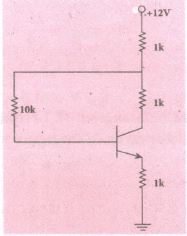
A transistor having α = 0.99 and VBE = 0.7V, is connected in the common-cmiitter configuration as shown in figure. If the transister is in saturation region, find the value of the collector current.
4.
In Young's double-slit experiment, the slits are 2 mm apart and are illuminated with a mixture of two-wavelength λ0 = 750 nm and λ = 900mm. What is the minimum distance from the common central bright fringe on a screen 2 m from the slits where a bright fringe from one interference pattern coincides with a . bright fringe from the other?
5.
A small bulb is placed at the bottom of a tank containing water to a depth of 80 cm, What is the area of the surface of water through which light from the bulb can emerge out? Refractive index of water is 1.33. (Consider the bulb to be a point source.)
6.
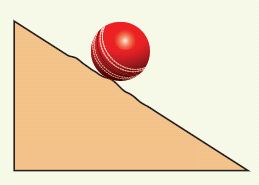
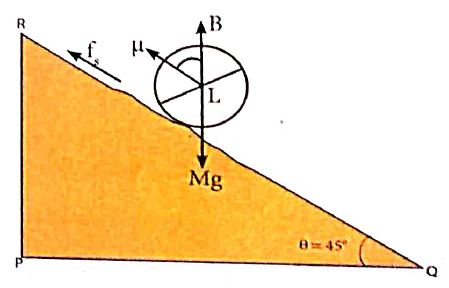
A non - conducting sphere has a mass of 100 g and radius 20 cm. A flat compact coil of wire with turns 5 is wrapped tightly around it with each turns concentric with the sphere. This sphere is placed on an inclined plane such that plane of coil is parallel to the inclined plane. A uniform magnetic field of 0.5 T exists in the region in vertically upward direction. Compute the current I required to rest the sphere in equilibrium.
7.
A proton moves in a uniform magnetic field of strength 0.500 T magnetic field is directed along the x - axis. At initial time, t = 0s, the proton has velocity
\(\hat { v } =(1.95\times { 10 }^{ -5 }\hat { i } +2.00\times { 10 }^{ 5 }\hat { k } )m{ s }^{ -1 }\). Find
(a) At initial time, what is the acceleration of the proton.
(b) Is the path circular or helical? If helical, calculate the radius of helical trajectory and also calculate the pitch of the helix (Note: Pitch of the helix is the distance travelled along the helix axis per revolution).
8.
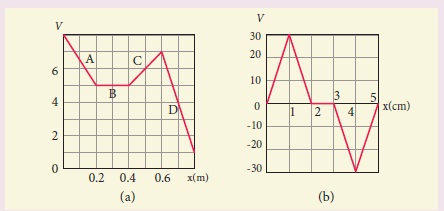
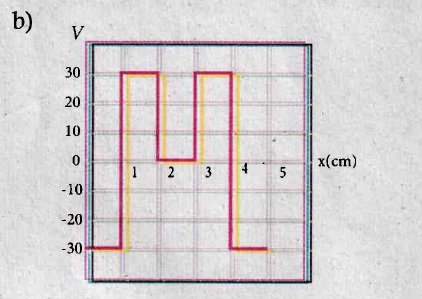
The electrostatic potential is given as a function of x in figure (i) and (ii). (a) Calculate the corresponding electric fields in regions A, B, C and D for the Figure (i). (b) Plot the electric field as a function of x for the figure (ii).
9.
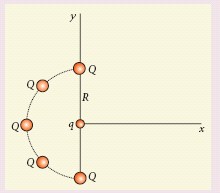
Five identical charges Q are placed equidistant on a semicircle as shown in the figure. Another point charge q is kept at the center of the circle of radius R. Calculate the electrostatic force experienced by the charge q.
10.
11.
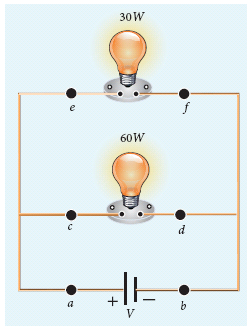
A battery of voltage V is connected to 30 W bulb and 60 W bulb as shown in the figure.
(a) Identify brightest bulb
(b) which bulb has greater resistance?
(c) Suppose the two bulbs are connected in series, which bulb will glow brighter?
12.
How many photons per second emanate from a 50 mW laser of 640 nm?
13.
Show that the mass of radium \((_{ 88 }^{ 226 }{ Ra })\) with an activity of 1 curie is almost a gram. Given T1/2 = 1600 years.
14.
A circular coil with cross-sectional area 0.1 cm2 is kept in a uniform magnetic field of strength 0.2 T. If the current passing in the coil is 3 A and plane of the loop is perpendicular to the direction of magnetic field. Calculate
(a) total torque on the coil
(b) total force on the coil
(c) average force on each electron in the coil due to the magnetic field. (The free electron density for the material of the wire is 1028 m–3).
15.
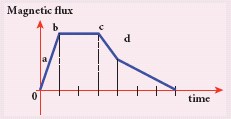
A graph between the magnitude of the magnetic flux linked with a closed loop and time is given in the figure. Arrange the regions of the graph in ascending order of the magnitude of induced emf in the loop.
16.
A coil of 200 turns carries a current of 4 A. If the magnetic flux through the coil is 6 × 10⁻⁵ Wb, find the magnetic energy stored in the medium surrounding the coil.
17.
A particle of charge q moves with velocity\(\vec { v } \) along positive y-direction in a magnetic field \(\vec { B } \) .Compute the Lorentz force experienced by the particle
(a) when magnetic field is along positive y - direction
(b) when magnetic field points in positive z - direction
(c) when magnetic field is in zy - plane and making an angle θ with velocity of the particle. Mark the direction of magnetic force in each case
18.
The rod given in the figure is made up of two different materials.
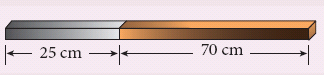
Both have square cross sections of 3 mm side. The resistivity of the first material is 4 x 10⁻³ Ωm and that of second material has resistivity of 5 x 10⁻³ Ωm. What is the resistance of rod between its ends?
19.
A copper wire of 10-6 m2 area of cross section, carries a current of 2 A. If the number of free electrons per cubic meter in the wire is 8\(\times\)1028, Calculate the current density and average drift velocity of electrons.
20.
Dielectric strength of air is 3 x 10⁶ V m-1. Suppose the radius of a hollow sphere in the Van de Graff generator is R = 0.5 m, calculate the maximum potential difference created by this Van de Graaff generator.
21.
The focal length of an equiconvex lens is equal to the radius of curvature of either face. What is the value of refractive index of the material of the lens?
22.
What is meant by satellite communication? Give its applications.
23.
A 3.0m wire carrying a current of 10A is placed inside a solenoid perpendicular to its axis. The magnetic field inside the solenoid is given to the 0.277. What is the magnetic force on the wire?
24.
A wheel with 10 metallic spokes each 0.5m long is rotated with a speed of 120 rev/min in a plane normal to the horizontal component of the earth's magnetic field HE at a place if HE = 0.4 G at the place what is the induced emf between the a x k and the rim of the wheel? Take 1 gauss (G) = 10-4T.
1.
\(\lambda=6000Å=6000 \times 10^{-10} \mathrm{~m} ; \mathrm{V}=0.8 \mathrm{v} \)
\(\mathrm{k} \cdot \mathrm{E}=\mathrm{hv}-\phi \)
\(\mathrm{eV}_o=\mathrm{hv}-\phi=\frac{\mathrm{hc}}{\lambda}-\phi \)
\((i) v=\frac{c}{\lambda}=\frac{3 \times 10^{8}}{6000 \times 10^{-10}}=5 \times 10^{14} \mathrm{~Hz} \)
\((ii)\ \mathrm{E}=\frac{\mathrm{hc}}{\lambda}=\frac{6.626 \times 10^{-34} \times 3 \times 10^{8}}{6000 \times 10^{-10}}=3.313 \times 10^{-19} J\)
\(\mathrm{E}=\frac{3.313 \times 10^{-19}}{1.6 \times 10^{-19}}=2.07 \mathrm{eV} \)
\((iii) \ \mathrm{E}=\mathrm{hv}-\mathrm{W}\Rightarrow\mathrm{W}=\mathrm{h} v-\mathrm{E} \)
\(\mathrm{E}=\mathrm{eV_o}=1.6 \times 10^{-19} \times 0.8=1.2 8 \times10^{-19}J\)
\(\mathrm{hv}=6.626 \times 10^{-34} \times 5 \times 10^{14}=3.313 \times 10^{-19}J \)
\(\mathrm{~W}=\frac{(3.313-1.28) \times 10^{-19}}{1.6 \times 10^{-19}}=1.270 \mathrm{eV} \)
W = 1.27 eV
\((iv) \ \mathrm{W}=\mathrm{h} \mathrm{v}_{0} \)
\(v_{0}=\frac{W}{h}=\frac{2.033 \times 10^{-19}}{6.626 \times 10^{-34}}=3.07 \times 10^{14} \mathrm{~Hz} \)
\((v)\ \mathrm{E}=\mathrm{eV}_o=\frac{0.8 \times 1.6 \times 10^{-19}}{1.6 \times 10^{-19}}=\mathbf{0 . 8} \mathrm{eV}\)
2.
λ = 5500 x 10-10 m; P =150 W; Efficiency =12%
\({ E }=\cfrac { hc }{ { \lambda } } =\cfrac { 6.626\times { 10 }^{ -34 }\times 3 \times { 10 }^{ 8 } }{ 5500\times { 10 }^{ -10 } }=3.614 \times 10^{-19} J \)
\(n=\frac{E}{hv}=\cfrac { 150 }{ 3.614\times { 10 }^{ -19 } } =4.15 \times 10^{20}\times\frac{12}{100}\)
n = 4.98 x 10¹⁹s-1
3.
\(\mathrm{V}_{\mathrm{cc}}=12 \mathrm{~V}, \mathrm{R}_{\mathrm{B}}=10 \mathrm{k} \Omega, \mathrm{R}_{\mathrm{E}}=1 \mathrm{k} \Omega, \mathrm{R}_{\mathrm{c}}=1+1=2 \mathrm{k} \Omega, \alpha=0.99, \mathrm{~V}_{\mathrm{BE}}=0.7 \mathrm{~V}, \mathrm{I}_{\mathrm{c}}=?\)
\(\beta=\alpha /(1-\alpha)=0.99 /(1-0.99)=99\)
\(\mathrm{I}_{\mathrm{B}}=\mathrm{I}_{\mathrm{C}} / \beta=\mathrm{I}_{\mathrm{c}} / 99\)
Applying Kirchoff's Voltage law,
\(I_C R_C+I_n R_n+I_E R_E+V_{u t}=V\)
\(2 \times 10^3 \mathrm{I}_{\mathrm{C}}+10 \times 10^3\left(\mathrm{I}_{\mathrm{C}} / 99\right)+1 \times 10^3\left(\mathrm{I}_{\mathrm{C}}+\mathrm{I}_{\mathrm{C}} / 99\right)+0.7=12 \quad\left(\because \mathrm{I}_{\mathrm{E}}=\mathrm{I}_{\mathrm{n}}+\mathrm{I}_{\mathrm{C}}\right)\)
\(\therefore \mathrm{I}_{\mathrm{C}}=\frac{11.3 \times 10^{-3} \times 99}{298}\)
\(\mathrm{I}_{\mathrm{C}}=3.7 \times 10^{-3} \mathrm{~A}=3.7 \mathrm{~mA}\)
4.
Given data:
λ = 900 nm = 900 x 10-9 m
λ 2 = 750 nm = 750 x 10-9 m
D = 2 m d = 2 nm = 2 x 10⁻³ m
Let nth order bright fringe of λ1,
Coincides with (n + 1)th order bright fringe of λ 2
\(y_{n}=\frac{n \lambda_{1} D}{d}, Y_{n+1}=\frac{(n+1) \lambda_{2} D}{d} \)
\(\frac{n \lambda_{1} D}{d}=\frac{(n+1) \lambda_{2} D}{d} \)
\(n \lambda_{1}=(n+1) \lambda_{2} \)
\(\frac{n+1}{n}=\frac{\lambda_{1}}{\lambda_{2}}=\frac{900 \times 10^{-9}}{750 \times 10^{-9}}=\frac{18}{15}=\frac{6}{5} \)
\(1+\frac{1}{n} =\frac{6}{5} \)
\(\frac{1}{n} =\frac{6}{5}-1=\frac{6-5}{5} \)
\(\frac{1}{n} =\frac{1}{5} \)
n = 5
n + 1 = 6
5th bright fringe of λ 1 coincides with 6th bright fringe of λ 2 in the least distance of y
\(y =\frac{n \lambda_{1} D}{d}=\frac{5 \times 900 \times 10^{-9} \times 2}{2 \times 10^{-3}} \)
\(=4500 \times 10^{-6}=4.5 \times 10^{-3} \)
y = 4.5 mm
5.
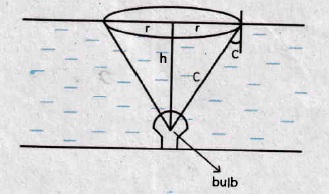
r - Radius of surface of water
h - Depth of the water
\(\sin c=\frac{1}{n} \)
\(n=\frac{4}{3} \)
h = 80 cm = 0.80 m
\(\sin c =\frac{1}{\frac{4}{3}}=\frac{3}{4} n=\frac{1}{\sin c} \)
\(\tan c =\frac{\sin c}{\cos c} \)
\(=\frac{\sin c}{\sqrt{1-\sin ^{2} c}} \)
\(=\frac{1}{n \sqrt{1-\frac{1}{n^{2}}}} \)
\(\tan c =\frac{1}{\sqrt{n^{2}-1}} \)
\(\frac{r}{h} =\frac{1}{\sqrt{n^{2}-1}} ; r=\frac{h}{\sqrt{n^{2}-1}} \)
\(=\frac{0.80}{\sqrt{\left(\frac{4}{3}\right)^{2}}-1} \)
\(=\frac{0.80}{\sqrt{\frac{16}{9}-1}}=\frac{0.80 \times 3}{\sqrt{7}} \)
\(=\pi r^{2}=\frac{22}{7} \times \frac{0.80 \times 3}{\sqrt{7}} \times \frac{0.80 \times 3}{\sqrt{7}} \)
\(=\frac{22}{49} \times 2.4 \times 2.4 \)
\(=\frac{22 \times 5.76}{49}=\frac{126.72}{49}=2.586 \)
A = 2.6 m2
6.
M = 100 g = 100 x 10-3 kg
M = 0.1 kg
g = 10 m/s2
N = 5
B = 0.5 T
R = 20 cm = 20 x 10-2 m
When, the sphere is in translational equilibrium
\(\mathrm{f}_{\mathrm{s}}-\mathrm{Mg} \sin \theta =0 \ldots(1) \)
\(\mathrm{f}_{\mathrm{s}} =\mathrm{Mg} \sin \theta \)
When, the sphere is in rotational equilibrium,
Torque ፒ = μB sin θ
For Equilibrium, fsR - ፒ = 0
\(f_{s} R-\mu B \sin \theta=0 \ldots(2)\)
eqn (1) subs. eqn (2)
\(M g \sin \theta R-\mu B \sin \theta =0 \)
\(\sin \theta(M g R-\mu B) =0 \)
\(M g R =\mu B \)
\(\text { Now } \mu =N I \pi R^{2} \)
\(\therefore \operatorname{MgR} =N I \pi R^{2} B \)
\(\therefore I =\frac{M g}{N \pi R B} \)
\(I =\frac{0.1 \times 10}{5 \times \pi \times 20 \times 10^{-2}\times 0.5 }\)
\(=\frac{1}{\pi \times 50 \times 10^{-2}}=\frac{1 \times 10^{2}}{\pi \times 50}=\frac{100}{\pi \times 50}\)
\(\mathbf{I} =2 / \pi \mathrm{A} \)
7.
Magnetic field \(\overset { \rightarrow }{ B } ={ 0.500\hat { i } T } \)
Velocity of the particle
\(\hat { v } \) = (1.95 x 10⁵\(\hat { i } \) + 2.00 x 10⁵\(\hat { k } \)) ms-1
Charge of the proton q = 1.67 x 10⁻¹⁹ C
Mass of the proton m = 1.67 x 10⁻²⁷kg
(a) The force experienced by the proton is \(\overset { \rightarrow }{ F } \) = q(\(\overset { \rightarrow }{ v } \) x \(\overset { \rightarrow }{ B } \) )
= 160 x 10-19 x ((1.95 x 10⁵\(\hat { i } \) + 2.00 x 10⁵\(\hat { k } \)) x (0.500 \(\hat { i } \)))
\(\overset { \rightarrow }{ F } \)= 1.60 x 10⁻¹⁴ \(\hat { j } \) N
Therefore, from Newton’s second law,
\(\overset { \rightarrow }{ a } =\frac { 1 }{ m } \overset { \rightarrow }{ F } =\frac { 1 }{ 1.67\times { 10 }^{ -27 } } (1.60\times { 10 }^{ -14 })\hat j\)
\(=9.58\times { 10 }^{ 12 }\hat jm{ s }^{ -2 }\)
(b) Trajectory is helical Radius of helical path is
\(R=\frac { { mv }_{ z } }{ \left| q \right| B } =\frac { 1.67\times { 10 }^{ -27 }\times 2.00\times { 10 }^{ 5 } }{ 1.60\times { 10 }^{ -19 }\times 0.500 } \)
= 4.175 x 10⁻³m = 4.18mm
Pitch of the helix is the distance travelled along x-axis in a time T, which is P = vx T
But time, \(T=\frac { 2\pi }{ \omega } =\frac { 2\pi m }{ \left| q \right| B } =\frac { 2\times 3.14\times 1.67\times { 10 }^{ -27 } }{ 1.60\times 1{ 0 }^{ -19 }\times 0.500 } =13.1\times { 10 }^{ -8 }s\)
Hence, pitch of the helix is
\(p={ v }_{ x }T=(1.95\times { 10 }^{ 5 })(13.1\times { 10 }^{ -8 })=25.5\times { 10 }^{ -3 }m=25.5mm\)
The proton experiences appreciable acceleration in the magnetic field, hence the pitch of the helix is almost six times greater than the radius of the helix.
8.
(i) Electric field is given by \(|E|=\frac{d V}{d x}\)
(a) For region A,
dV = 8 - 5 = 3V, dx - (0.2 - 0) = 0.2m
\(\therefore E_{x}=\frac{d V}{d x}=\frac{3}{0.2}=15 \mathrm{Vm}^{-1}\)
(b) For region B,
dv = 0, Ex = 0
(c) For region C
dV = (7 - 5) = 2V, dx = (0.6 - 0.4) = 0.2 m
\(\therefore E_{x}=\frac{d V}{d x}=\frac{2}{0.2}=10 \mathrm{Vm}^{-1}\)
(d) For region D
dV = (7 - 1)=6V, dx = (0.8 - 0.6) = 0.2 m
\(\therefore E_{x}=\frac{d V}{d x}=\frac{6}{0.2}=30 \mathrm{Vm}^{-1}\)
(ii) Electric field as a function of x for Figure (ii).
9.
From the figure F1 = F5 but opposite in direction. So cancel each other
Also, F2 sin 45o = F4 sin 45o but opposite in direction. So cancel each other.
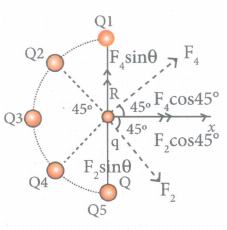
\( \mathrm{F}_{\mathrm{tot}} =\mathrm{F}_{3}+\mathrm{F}_{2} \cos 45^{\circ}+\mathrm{F}_{4} \cos 45^{\circ} \)
\(\mathrm{F}_{\mathrm{tot}} =\frac{k q Q}{R^{2}}+\frac{k q Q}{R^{2}} \frac{1}{\sqrt{2}}+\frac{k q Q}{R^{2}} \frac{1}{\sqrt{2}} \)
\(\mathrm{~F}_{\mathrm{tot}} =\frac{k q Q}{R^{2}}+2 \frac{k q Q}{R^{2}} \frac{1}{\sqrt{2}} \)
\(=\frac{k q Q}{R^{2}}+\sqrt{2} \sqrt{2} \frac{k q Q}{R^{2}} \frac{1}{\sqrt{2}} \)
\(\vec{F}_{\text {tot }} =\frac{k q Q}{R^{2}}[1+\sqrt{2}] \hat{i} N\)
\(\vec{F} =\frac{1}{4 \pi \varepsilon_{o}} \frac{q Q}{R^{2}}(1+\sqrt{2}) \hat{i N}\)
10.
11.
(a) The power delivered by the battery P = VI. Since the bulbs are connected in parallel, the voltage drop across each bulb is the same. If the voltage is kept fixed, then the power is directly proportional to current (P ∝ I). So 60 W bulb draws twice as much as current as 30 W and it will glow brighter than 30 W bulb.
(b) To calculate the resistance of the bulbs, we use the relation \(P=\frac { { v }^{ 2 } }{ R } \) In both the bulbs, the voltage drop is the same, so the power is inversely proportional to the resistance or resistance is inversely proportional to the power \(\left( R∝ \frac { 1 }{ P } \right) \). It implies that, the 30W has twice as much as resistance as 60 W bulb.
(c) When these two bulbs are connected in series, the current passing through each bulb is the same. It is equivalent to two resistors connected in series. The bulb which has higher resistance has higher voltage drop. So 30W bulb will glow brighter than 60W bulb. So the higher power rating does not always imply more brightness and it depends whether bulbs are connected in series or parallel.
12.
P = 50 mW; λ = 640nm = 640 x 10-9 m
P = 50 x 10-3W
\(n=\cfrac { hc }{ \lambda } = \frac{6.626 \times10^{-34} \times 3 \times 10^8}{640 \times 10{-9}}=3.106 \times 10^{-19}J\)
\(n=\frac{E}{hv}=\cfrac { 50\times { 10 }^{ -3 } }{ 3.106\times { 10 }^{ -19 } } = 1.61\times 10^{17} s^{-1}\)
n = 1.61 x 10¹⁷ s-I
13.
\(T_{1 / 2}=1600 \text { years }=1600 \times 365 \times 24 \times 60 \times 60 s\)
R = 1 curie = 3.7 x 10¹⁰ Bq, Show that m = 1g
R = λN
Number of atoms Present, N = \(\frac{\mathrm{R}}{\lambda}=\frac{\mathrm{R}}{0.6931} \mathrm{~T}_{1 / 2}\)
Mass of 6.023 x 10²³ atoms of \({ }_{88}^{226} R a=226 g\)
Mass of 1 atom of \({ }_{88}^{226} \mathrm{Ra}=\frac{226}{6.023 \times 10^{23}} \mathrm{~g}\)
Mass of N atoms of \({ }_{88}^{{ }{266}} \mathrm{Ra}=\frac{226}{6.023 \times 10^{23}} \times \mathrm{Ng}\)
Mass of N atoms of \({ }_{88}^{226} \mathrm{Ra}(\mathrm{m})=\frac{226}{6.023 \times 10^{23}} \times \frac{\mathrm{R}}{0.6931} \mathrm{~T}_{1 / 2} \mathrm{~g}\)
\(\mathrm{m}=\frac{226}{6.023 \times 10^{23}} \times \frac{3.7 \times 10^{10}}{0.6931} \times 1600 \times 365 \times 24 \times 60 \times 60 \mathrm{~g}\)
m = 1.01 g
14.
Magnetic field B = 0.2 T
Current flowing through the coil I = 3A
Cross sectional area of a circular coil A = 0.1 cm2
∴ A = 0.1 x 10⁻⁴ m2
(a) Total torque on the coil:
\(\tau=\text { IBA } \cos \theta\)
Here, the plane of the loop is perpendicular to the direction of magnetic field
\(\therefore \theta=90^{\circ} \)
\(\therefore \tau=\text { IBA } \cos 90^{\circ} \) (∵ cos90o = 0)
= 3 x 0.2 x 0.1 x 10-4 x 0
= zero
∴ Total Torque on the coil = zero
(b) Total force on the coil \(F=B q v \sin \theta \)
\(Here\ \theta=0 \)
\(\therefore F=0.2 \times \mathrm{qv} \times \sin \theta=\text { zero } \)
Total force on the coil = zero
c) Average force: F = Bqv
Charge density \(=\sigma=\frac{q}{A} \)
∴ Charge \(q =\sigma A \)
\(=10^{28} \times 0.1 \times 10^{-4} \)
\(q=10^{23} \mathrm{C} \)
Force = Bll and I = 1 m
F = 0.2 x 3 x 1 = 0.6 N
∴ Average force on each electron
\(=\frac{F}{q}=\frac{0.6}{10^{23}} \)
\(F =0.6 \times 10^{-23} \mathrm{~N} \)
15.
Magnitude of induced \(\mathrm{emf}|\mathrm{e}|=\left|-\frac{d \phi}{d t}\right|\)
\(\therefore c=\frac{d \phi}{d t}\)
(i) In the region ab,
\(c_1=\frac{d \phi_1}{d t}=\frac{4-0}{1-0}=\frac{4}{1}=4 \mathrm{~V}\)
(ii) In the region bc,
\(c_2=\frac{d \phi_2}{d t}=\frac{4-4}{3-1}=\frac{0}{2}=0 \mathrm{~V}\)
(iii) In the region cd,
\(e_3=\frac{d \phi_2}{d t}=\frac{4-2}{4-3}=\frac{2}{1}=2 \mathrm{~V}\)
(iv) In the region de,
Hence,
\(e_4=\frac{d \phi_4}{d t}=\frac{2-0}{7-4}=\frac{2}{3}=0.66 V \)
\(\mathrm{e}_2<\mathrm{e}_4<\mathrm{e}_3<\mathrm{e}_1\)
In the ascending order of the magnitude of induced emf
Region bc < Region de < Region cd < Region ab.
16.
Current, I = 4 A, Magnetic flux, \(\phi=6 \times 10^{-5} \mathrm{~Wb}\), Number of turns, N = 200
Self inductance, \(L=\frac{N \phi}{I}\)
\(\therefore L =\frac{200 \times 6 \times 10^{-5}}{4} \)
\(L =300 \times 10^{-5} \mathrm{H}=3 \times 10^{-3} \mathrm{H}\)
∴ Magnetic energy, \(U_s=\frac{1}{2} L I^2\)
\(U_s =\frac{1}{2} \times 3 \times 10^{-3} \times(4)^2 \)
\(=\frac{1}{2} \times 3 \times 10^{-3} \times 16 \)
\(=24 \times 10^{-3} \mathrm{~J}=0.024 \mathrm{~J}\)
Magnetic energy = 0.024 J
17.
Velocity of the particle is \(\vec { v } =v\hat { j } \)
(a) Magnetic field is along positive y-direction, this implies \(\vec B=B\hat { j } \)
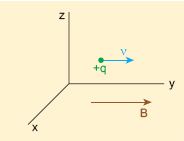
From Lorentz force, \( {\vec F } _{ m }=q(v\hat { j } \times B\hat { j } )=\vec 0\)
So, no force acts on the particle when it moves along the direction of magnetic field.
(b) Since the magnetic field points in positive z - direction, this implies, \(\vec { B } =B\hat { k } \)
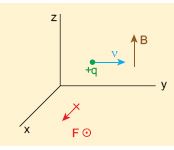
From Lorentz force, \( {\vec F } _{ m }=q(v\hat { j } \times B\hat { k } )=qvB\vec i \)
Therefore, the magnitude of the Lorentz force is qvB and direction is along positive x - direction.
(c) Magnetic field is in zy - plane and making an angle θ with the velocity of the particle, which implies \( {\vec B } =Bcos\theta \hat { j } +Bsin\theta \hat { k } \)
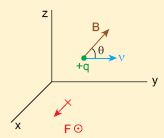
From Lorentz force,
\({ \vec F }_{ m }=q(v\hat { j } )\times (Bcos\theta \hat { j } +Bsin\theta \hat k)\)
\(=qvBsin\theta \hat { i } \)
18.
Resistivity of the first material \({ \rho }_{ 1 }=4\times { 10 }^{ -3 }\Omega m\)
Length of the first material, l1 = 25 x 102 m 
Area of cross section of the first material, A1 = 3 x 3 x 10-6
= 9 x 10⁻⁶ m2
Resistivity of second material, \({ \rho }_{ 2}=5\times { 10 }^{ -3 }\Omega m\)
Length of second material, \(l_{ 2 }=70\times { 10 }^{ -2 } m\)
Area of cross section second material, A2 = 3 x 3 x 10-6
= 9 x 10⁻⁶ m2
Resistivity of first material, \(\rho_{1}= R_{1} \times \frac {A_{1}}{l_{1}}\)
Resistance first material, \(R_{1} = \frac {\rho_{1}l_1}{A_{1}}\)
\(\therefore R_1=\frac{4 \times 10^{-3} \times 25\times 10^{-2}}{9 \times10^{-6}}\)
\(R_1=\frac{100}{9}\times10^{-5+6}=\frac{1000}{9}\Omega\)
Resistivity of second material, \(\rho_{2}=\frac{R_{2} A_{2}}{l_{2}} \)
∴ Resistance of second material, \(R_{2}=\frac{\rho_{2} l_{2}}{A_{2}} \)
\(\therefore R_{2} =\frac{5 \times 10^{-3} \times 70 \times 10^{-2}}{9 \times 10^{-6}} \)
\(R_2=\frac{350 \times 10^{-5}}{9 \times 10^{-6}}=\frac{350}{9} \times 10 \)
\(R_2=\frac{3500}{9} \Omega \)
Total resistance \(R_{t} =\frac{1000}{9}+\frac{3500}{9} \)
\(=\frac{4500}{9}=500 \Omega \)
\(\therefore\) Total resistance = 500 \(\Omega\)
19.
Area of cross section A = 10-6 m2 Current I = 2A
Number of electrons per cubic metre, n = 8 \(\times\)1028
Current I = nAevd
∴ Drift Velocity \(v_{d}=\frac{I}{n A e}\)
\(v_{d} =\frac{2}{8 \times 10^{28} \times 10^{-6} \times 1.6 \times 10^{-19}} \)
\(=\frac{2}{8 \times 10^{3} \times 1.6} \)
\(=\frac{20}{128} \times 10^{-3}=15.6 \times 10^{-5} \mathrm{~ms}^{-1} \)
Current density J = l / A.
\(J=\frac{2}{10^{-6}}\)
J = 2 x 10⁶ Am-2
20.
The electric field on the surface of the sphere(by Gauss law) is given by
E = \(\frac { 1 }{ 4\pi { \varepsilon }_{ 0 } } \frac { Q }{ { R }^{ 2 } } \)
The potential on the surface of the hollow metallic sphere is given by
V = \(\frac { 1 }{ 4\pi { \varepsilon }_{ 0 } } \frac { Q }{ { R } } \) = ER
Since Vmax = EmaxR
Here Emax = 3 x 10⁶ Vm-1. So the maximum potential difference created is given by
Vmax = 3 x 106 x 0.5
= 1.5 x 10⁶V (or) 1.5 million volt.
21.
\(\cfrac { 1 }{ f } =\left( \mu -1 \right) \left( \cfrac { 1 }{ { R }_{ 1 } } -\cfrac { 1 }{ { R }_{ 2 } } \right) \)
\(\cfrac { 1 }{ f } =\left( \mu -1 \right) \left( \cfrac { 2 }{ f } \right) \)
\(\cfrac { 1 }{ 2 } =\left( \mu -1 \right) \)
\(\mu =1.5\)
22.
(i) The satellite communication is a mode of transmission of signal between transmitter and receiver via satellite.
(ii) The message signal from the Earth station is transmitted to the satellite on board via an uplink (frequency band 6 GHz), amplified by a transponder and then retransmitted to another earth station via a downlink (frequency band 4 GHz).
Applications:
Satellites are classified into different types based on their applications.
(i) Weather Satellites:
They are used to monitor the weather and climate of Earth. By measuring cloud mass, these satellites enable us to predict rain and dangerous storms like hurricanes, cyclones etc.
(ii) Communication satellites:
They are used to transmit television, radio, internet signals etc. Multiple satellites are used for long distance communication
(iii) Navigation satellites:
These are employed to determine the geographic location of ships, aircraft or any other object.
23.
Magnetic force on the wire,
F BIl sinθ
= BIl sin90° (∵ θ = 900)
= 0.27 x 10 x 3 x 10-2
F = 8.1 x 10⁻² N
24.
Given:
Induced emf, e = Blv (or) e = \(\frac12\) Bl2ω [where, v = rω, 1 = 2R]
Also, ω=2ㅠf = 2π x \(\frac{120}{60}\)
ω = 4ㅠ
Solution:
emf, e = \(\frac12\) x 4ㅠ x 0.4 x 10-4 (0.5)2
= 6.28 x 10⁻⁵V
The number of spokes is immaterial because the emf's across the spokes are in parallel

12th Standard Syllabus & Materials
12th Standard
TN 12th Computer Applications வலையமைப்பு வடமிடல் Sample Question Papers Study Material - QB365 Set A
NEW12th Standard
TN 12th Computer Applications களப்பெயர் முறைமை (DNS) Sample Question Papers Study Material - QB365 Set A
NEW12th Standard
TN 12th Computer Applications வலையமைப்பு எடுத்துக்காட்டுகள் மற்றும் நெறிமுறைகள் Sample Question Papers Study Material - QB365 Set A
NEW12th Standard
TN 12th Computer Applications கணினி வலையமைப்பு ஓர் அறிமுகம் Sample Question Papers Study Material - QB365 Set A



Tamilnadu Stateboard 12th Standard Subjects

Maths

Chemistry
Physics

Biology

Computer Science

Business Maths and Statistics

Economics

Commerce

Accountancy

History

Computer Applications
Biology
Computer Technology
Computer Applications
Computer Science
Business Maths and Statistics
Commerce
Economics
Maths
Chemistry
Physics
Computer Technology
History
Accountancy

Tamil

English

French
Tamilnadu Stateboard Standards

