
 100% FREE ACCESS
12th Standard Syllabus & Materials
12th Standard
TN 12th Maths Applications of Matrices and Determinants Sample Question Papers Study Material - QB365 Set A
NEW12th Standard
TN 12th Computer Applications மின்னணு தரவு பரிமாற்றம் Sample Question Papers Study Material - QB365 Set A
NEW12th Standard
TN 12th Computer Applications மின் - வணிக பாதுகாப்பு அமைப்புகள் Sample Question Papers Study Material - QB365 Set A
NEW12th Standard
TN 12th Computer Applications மின்னணு செலுத்தல் முறைகள் Sample Question Papers Study Material - QB365 Set A
NEW12th Standard
TN 12th Computer Applications மின் - வணிகம் Sample Question Papers Study Material - QB365 Set A
NEW12th Standard
TN 12th Computer Applications திறந்த மூல கருத்துருக்கள் Sample Question Papers Study Material - QB365 Set A

Published on: 27/02/2021
12th Standard English Medium Physics Reduced syllabus Public Exam Model Question Paper - 2021
Download Tamil Nadu 12th Standard Physics question papers, model tests, one-mark questions, important questions, and public exam papers in PDF format. Free study materials and answer keys for TN State Board students.
Questions + Answers key
Take MCQ Physics Test1.
A capacitor of capacitance \(\frac { { 10 }^{ -4 } }{ \pi } F\), an inductor of inductance \(\frac { 2 }{ \pi } H\) and a resistor of resistance 100 Ω are connected to form a series RLC circuit. When an AC supply of 220 V, 50 Hz is applied to the circuit, determine
(i) the impedance of the circuit
(ii) the peak value of current flowing in the circuit
(iii) the power factor of the circuit and
(iv) the power factor of the circuit at resonance.
2.
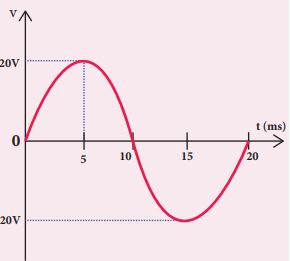
Write down the equation for a sinusoidal voltage of 50 Hz and its peak value is 20 V. Draw the corresponding voltage versus time graph.
3.
An inverter is common electrical device which we use in our homes. When there is no power in our house, inverter gives AC power to run a few electronic appliances like fan or light. An inverter has inbuilt step-up transformer which converts 12 V AC to 240 V AC. The primary coil has 100 turns and the inverter delivers 50 mA to the external circuit. Find the number of turns in the secondary and the primary current.
4.
Derive an expression for electrostatic potential energy of the dipole in a uniform electric field.
5.
Two conducting spheres of radius r1 = 8 cm and r2 = 2 cm are separated by a distance much larger than 8 cm and are connected by a thin conducting wire as shown in the figure. A total charge of Q = +100 nC is placed on one of the spheres. After a fraction of a second, the charge Q is redistributed and both the spheres attain electrostatic equilibrium.
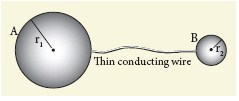
(a) Calculate the charge and surface charge density on each sphere.
(b) Calculate the potential at the surface of each sphere.
6.
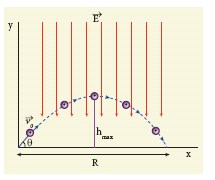
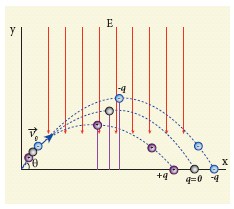
A small ball of conducting material having a charge +q and mass m is thrown upward at an angle θ to horizontal surface with an initial speed vo as shown in the figure. There exists an uniform electric field E downward along with the gravitational field g. Calculate the range, maximum height and time of flight in the motion of this charged ball. Neglect the effect of air and treat the ball as a point mass.
7.
Calculate the electrostatic force and gravitational force between the proton and the electron in a hydrogen atom. They are separated by a distance of 5.3 x 10⁻¹¹ m. The magnitude of charges on the electron and proton are 1.6 x 10⁻¹⁹ C. Mass of the electron is me = 9.1 x 10⁻³¹ kg and mass of proton is mp = 1.6 x 10⁻²⁷ kg.
8.
Define tesla?
9.
State Right hand thumb rule.
10.
What are the causes for earth's magnetic field according to Gover?
11.
What is meant by AC vollage?
12.
Two wires A & B are of the same metal of the same length have area of the cross-section in the ratio of 2: 1. If the same potential difference is applied across each wire. What will be the retro of the circuit flowing in A & B?
13.
How does the conductivity of a semiconductor change with rise in temperature? Explain.
14.
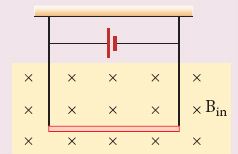
A conductor of linear mass density 0.2 g m–1 suspended by two flexible wire as shown in figure. Suppose the tension in the supporting wires is zero when it is kept inside the magnetic field of 1 T whose direction is into the page. Compute the current inside the conductor and also the direction of the current. Assume g = 10 m s–2
15.
A closely wound circular coil of radius 0.02 m is placed perpendicular to the magnetic field. When the magnetic field is changed from 8000 T to 2000 T in 6 s, an emf of 44 V is induced in it. Calculate the number of turns in the coil. (Take π = \(\frac { 22 }{ 7 } \) )
16.
A straight metal wire crosses a magnetic field of flux 4 mWb in a time 0.4 s. Find the magnitude of the emf induced in the wire.
17.
Let E be the electric field of magnitude 6.0 x 10⁶ N C–1 and B be the magnetic field magnitude 0.83 T. Suppose an electron is accelerated with a potential of 200 V, will it show zero deflection?. If not, at what potential will it show zero deflection.
18.
The repulsive force between two magnetic poles in air is 9 x 10⁻³ N. If the two poles are equal in strength and are separated by a distance of 10 cm, calculate the pole strength of each pole.
19.
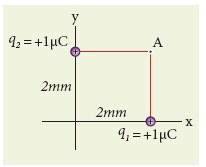
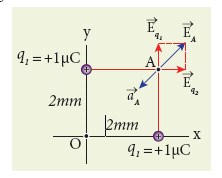
Consider the charge configuration as shown in the figure. Calculate the electric field at point A. If an electron is placed at points A, what is the acceleration experienced by this electron? (mass of the electron = 9.1 x 10⁻³¹ kg and charge of electron = −1.6 x 10⁻¹⁹ C)
20.
Determine the number of electrons flowing per second through a conductor, when a current of 32 A flows through it.
21.
The charge of cathode rays particle is _____.
Positive
negative
neutral
not defined
22.
The ratio between the radius of first three orbits of hydrogen atom is _____.
1:2:3
2:4:6
1:4:9
1:3:5
23.
If C is the capacitance of an air filled capacitor and C is the capacitance of dielectric filled capacitor, then
C'εrC'
\(C'=\frac { C }{ { \varepsilon }_{ r } } \)
\(C'=\frac { { \varepsilon }_{ r } }{ C } \)
\(C'={ \varepsilon }_{ 0 }{ \varepsilon }_{ r }\)
24.
The direction of electric field at a point the equatorial line due to an electric dipole is
along the equatorial line towards the dipole.
along the equatorial line away from the dipole
parallel to the axis of the dipole and opposite to the direction of dipole moment
parallel to the axis of the dipole and in the direction of dipole moment.
25.
At Infinity (i.e r = ∞), the electrostatic potential (V) is
∞
maximum
minimum
Zero
26.
The electric potential V as a function of distance x (metres) is given by V = ( 5x2 + 10x -9) volt. The value of electric field at a point x = 1m is __________
20 Vm-1
6 Vm-1
11 Vm-1
-23 Vm-1
27.
_______ and Coulomb's law form fundamental principles of electrostatics
Newton's law of gravitation
superposition principle
ohm's law
Kepler's law
28.
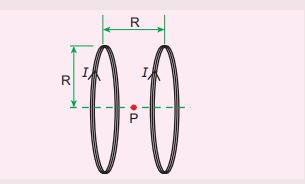
Two identical coils, each with N turns and radius R are placed coaxially at a distance R as shown in the figure. If I is the current passing through the loops in the same direction, then the magnetic field at a point P at a distance of R/2 from the centre of each coil is _____.
\(\frac { 8N{ \mu }_{ ° }I }{ \sqrt { 5 } R } \)
\(\frac { 8N{ \mu }_{ ° }I }{ { 5 }^{ 3/2 }R } \)
\(\frac { 8N{ \mu }_{ ° }I }{ { 5 }R } \)
\(\frac { 4N{ \mu }_{ ° }I }{ \sqrt { 5 } R } \)
29.
In an electrical circuit, R, L, C, and AC voltage source are all connected in series. When L is removed from the circuit, the phase difference between the voltage and current in the circuit is \(\frac{\pi}{3}\). Instead, if C is removed from the circuit, the phase difference is again \(\frac{\pi}{3}\). The power factor of the circuit is
1/2
1/\(\sqrt2\)
1
\(\sqrt3\)/2
30.
Two metallic spheres of radii 1 cm and 3 cm are given charges of -1 \(\times\) 10-2 C and 5 \(\times\) 10-2 C respectively. If these are connected by a conducting wire, the final charge on the bigger sphere is
3 \(\times\) 10-2 C
4 \(\times\) 10-2 C
1 \(\times\) 10-2 C
2 \(\times\) 10-2 C
31.
32.
33.
A piece of copper and another of germanium are cooled from room temperature to 80 K. The resistance of ______.
each of them increases
each of them decreases
copper increases and germanium decreases
copper decreases and germanium increases
34.
A wire connected to a power supply of 230 V has power dissipation P1. Suppose the wire is cut into two equal pieces and connected parallel to the same power supply. In this case power dissipation is P2. The ratio \(\frac{P_2}{P_1}\) is ______.
1
2
3
4
35.
Two wires of A and B with circular cross section made up of the same material with equal lengths. Suppose RA = 3 RB, then what is the ratio of radius of wire A to that of B?
3
\(\sqrt3\)
\(\frac{1}{\sqrt3}\)
\(\frac{1}{3}\)
36.
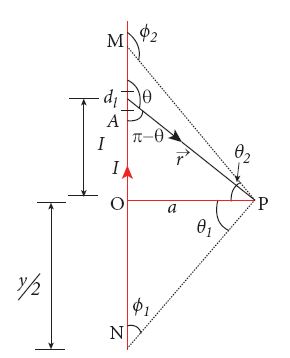
Show that for a straight conductor, the magnetic field
\(\overset { \rightarrow }{ B } =\frac { { \mu }_{ ° }I }{ 4\pi a } (cos\varphi _{ 1 }-cos\varphi _{ 2 })\hat { n } \)
\(=\frac { { \mu }_{ ° }I }{ 4\pi a } (sin{ \theta }_{ 1 }+sin{ \theta }_{ 2 })\hat { n } \)
37.
Obtain the condition for bridge balance in Wheatstone’s bridge.
1.
L = \(\frac { 2 }{ \pi } \)H; C = \(\frac { { 10 }^{ -4 } }{ \pi } F\); R = 100Ω
VRMS = 220 V; f = 50Hz
XL= 2πfl = 2π x 50 x \(\frac { 2 }{ \pi } \) = 200Ω
Xc = \(\frac { 1 }{ 2\pi fC } =\frac { 1 }{ 2\pi \times 50\times \frac { 10^{ -4 } }{ \pi } } 100 \Omega\)
(i) Impedance, Z = \(\sqrt { { R }^{ 2 }+({ X }_{ L }-{ X }_{ C })^2 } \)
=\(\sqrt { 100^{ 2 }+(200-100)^{ 2 } } \) = 141.4Ω
(ii) Peak value of current,
Im = \(\frac { { v }_{ m } }{ Z } =\frac { \sqrt { 2 } V_{ RMS } }{ Z } \)
= \(\frac { \sqrt { 2 } \times 220 }{ 141.4 } \) = 2.2 A
(iii) Power factor of the circuit
\(cos\phi =\frac { R }{ Z } =\frac { 100 }{ 141.4 } \)= 0.707
(iv) Power factor at resonance
\(cos\phi =\frac { R }{ Z } =\frac { R }{ R } \) = 1
2.
f = 50Hz ; Vm = 20V
Instantaneous voltage, υ = Vm sinωt
= Vm sin2πvt
= 20sin(2π x 50)t = 20sin(100 x 3.14)t
υ = 20sin 314t
Time for one cycle, \(T=\frac { 1 }{ f } =\frac { 1 }{ 50 } =0.02s\)
= 20 x 10−3 s = 20ms
The wave form is given below
3.
Vp = 12 V; Vs = 240 V
Is = 50 mA; Np = 100 turns
\(\frac { { V }_{ s } }{ { V }_{ P } } =\frac { { N }_{ s } }{ { N }_{ p } } =\frac { { I }_{ P } }{ { I }_{ S } } =K\)
Transformation ratio, K = \(\frac{240}{12}=20\)
The number of turns in the secondary
NS = NP x K = 100 x 20 = 2000
Primary current,
IP = K x Is = 20 x 50 mA = 1 A
4.
(i) Consider a dipole placed in the uniform electric field \(\vec { E } \). A dipole experiences a torque when kept in an uniform electric field \(\vec { E } \).(ii) To rotate the dipole (at constant angular velocity) from its initial angle θ' to another angle θ against the torque exerted by the electric field, an equal and opposite external torque must be applied on the dipole.
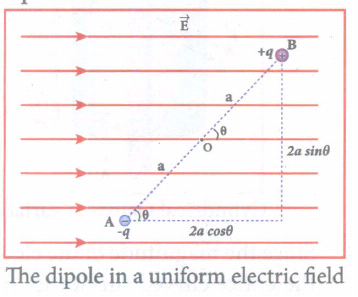
(iii) The work done by the external torque to rotate the dipole from angle θ' to θ at constant angular velocity is
\(W=\int _{ \theta ' }^{ \theta }{ { \tau }_{ ext }d\theta } \quad ...(1)\)
(iv) Since \({ \vec { \tau } }_{ ext }\) is equal and opposite to \({ \vec { \tau } }_{ E }=\vec { p } \times \vec { E } \), We have
\(|{ \vec { \tau } }_{ ext }|={ |\vec { \tau } }_{ E }|=|\vec { p } \times \vec { E } |\quad \quad \quad ...(2)\)
Substituting equation (2) in equation (1), we get
\(W=\int _{ \theta ' }^{ \theta }{ pEsin\theta d\theta } \)
\(W=pE(cos\theta '-cos\theta )\)
(v) This work done is equal to the potential energy difference between the angular positions θ to θ'.
U(θ) - U(θ') = ∆U= - pE cosθ + pE cosθ'
If the initial angle is θ' = 90o and is take as reference point, then U(θ') = pE cos 90o = 0. The potential energy stored in the system of dipole kept in the uniform electric field is given by
\(U=-pEcos\theta =-\vec { p } .\vec { E } \) ....(3)
In addition to p and E, the potential energy also depends on the orientation θ of the electric dipole with respect to the external electric field.
(vi) The potential energy is a) maximum when the dipole is aligned anti-parallel (θ = π) to the external electric field
b) minimum when the dipole is aligned parallel (θ = 0) to the external electric field.
5.
(a) The electrostatic potential on the surface of the sphere A is VA = \(\frac { 1 }{ 4\pi { \epsilon }_{ 0 } } \frac { { q }_{ 1 } }{ { r }_{ 1 } } \)
The electrostatic potential on the surface of the sphere A is VB = \(\frac { 1 }{ 4\pi { \epsilon }_{ 0 } } \frac { { q }_{ 2 } }{ { r }_{ 2 } } \)
Since VA = VB. We have
\(\frac { { q }_{ 1 } }{ { r }_{ 1 } } =\frac { { q }_{ 2 } }{ { r }_{ 2 } } \Rightarrow { q }_{ 1 }=\left( \frac { { r }_{ 1 } }{ { r }_{ 2 } } \right) { q }_{ 2 }\)
But from the conservation of total charge, Q = q1 + q2, we get q1 = Q – q2. By substituting this in the above equation,
Q - q2 = \(\left( \frac { { r }_{ 1 } }{ { r }_{ 2 } } \right) { q }_{ 2 }\)
so that q2 = Q\(\left( \frac { { r }_{ 2 } }{ { r }_{ 1 }+{ r }_{ 2 } } \right) \)
Therefore,
q2 = 100 x 10-9 x \(\left( \frac { 2 }{ 10 } \right) \) = 20nC and q1 = Q - q2 = 80nC
The electric charge density for sphere A is σ1 = \(\frac { { q }_{ 1 } }{ 4\pi { r }_{ 1 }^{ 2 } } \)
The electric charge density for sphere B is σ2 = \(\frac { { q }_{ 2 } }{ 4\pi { r }_{ 2 }^{ 2 } } \)
Therefore,
σ1 = \(\frac { 80\times 10^{ -9 } }{ 4 \pi \times 64\times 10^{ -4 } } \) = 0.99 x 10⁻⁶ Cm-2 and
σ2 =\(\frac { 20\times 10^{ -9 } }{ 4\pi \times 4\times 10^{ -4 } } \) = 3.9 x 10⁻⁶ Cm-2
Note that the surface charge density is greater on the smaller sphere compared to the larger sphere (σ2 ≈ 4σ1) which confirms the result \(\frac { { \sigma }_{ 1 } }{ \sigma _{ 2 } } =\frac { { r }_{ 2 } }{ { r }_{ 1 } } \)
The potential on both spheres is the same. So we can calculate the potential on any one of the spheres
VA=\(\frac { 1 }{ 4\pi { \varepsilon }_{ 0 } } \frac { { q }_{ 1 } }{ { r }_{ 1 } } =\frac { 9\times 10^{ 9 }\times 80\times { 10 }^{ -9 } }{ 8\times 10^{ -2 } } \) = 9kV
6.
If the conductor has no net charge, then its motion is the same as usual projectile motion of a mass m which we studied in Kinematics (unit 2, vol-1 XI physics). Here, in this problem, in addition to downward gravitational force, the charge also will experience a downward uniform electrostatic force.
The acceleration of the charged ball due to gravity = -g\(\hat { j } \)
The acceleration of the charged ball due to uniform electric field =\(-\frac { qE }{ m } \hat { j } \)
The total acceleration of charged ball in downward direction \(\vec { a } =-\left( g+\frac { qE }{ m } \right) \vec { j } \)
It is important here to note that the acceleration depends on the mass of the object. Galileo’s conclusion that all objects fall at the same rate towards the Earth is true only in a uniform gravitational field. When a uniform electric field is included, the acceleration of a charged object depends on both mass and charge.
But still the acceleration a = \(\left( g+\frac { qE }{ m } \right) \) is constant throughout the motion. Hence we use kinematic equations to calculate the range, maximum height and time of flight. In fact we can simply replace g by \(g+\frac { qE }{ m } \) in the usual expressions of range, maximum height and time of flight of a projectile.
| Without charge | With the charge +q | |
| Time of flight T | \(\frac { 2v_{ 0 }sin\theta }{ g } \) | \(\frac { 2{ v }_{ 0 }sin\theta }{ \left( g+\frac { qE }{ m } \right) } \) |
| Maximum height hmax | \(\frac { { v }_{ 0 }^{ 2 }sin^{ 2 }\theta }{ 2g } \) | \(\frac { { v }_{ 0 }^{ 2 }sin^{ 2 }\theta }{ 2\left( g+\frac { qE }{ m } \right) } \) |
| Range R | \(\frac { { v }_{ 0 }^{ 2 }sin2\theta }{ g } \) | \(\frac { { v }_{ 0 }^{ 2 }sin2\theta }{ \left( g+\frac { qE }{ m } \right) } \) |
Note that the time of flight, maximum height, range are all inversely proportional to the acceleration of the object. Since \(\left( g+\frac { qE }{ m } \right) \) >g for charge +q, the quantities T, hmax, and R will decrease when compared to the motion of an object of mass m and zero net charge. Suppose the charge is –q, then \(\left( g-\frac { qE }{ m } \right) \)
7.
The proton and the electron attract each other. The magnitude of the electrostatic force between these two particles is given by
\(F_e=\frac { ke^{ 2 } }{ { r }^{ 2 } } =\frac { 9\times 10^{ 9 }\times (1.6\times 10^{ -19 })^{ 2 } }{ (5.3\times 10^{ -11 })^{ 2 } } \)
=\(\frac { 9\times 2.56 }{ 28.09 } \) x 10-7 = 8.2 x 10⁻⁸ N
The gravitational force between the proton and the electron is attractive. The magnitude of the gravitational force between these particles is
FG = \(\frac { G{ m }_{ e }{ m }_{ p } }{ { r }^{ 2 } } \)
= \(\frac { 6.67\times 10^{ -11 }\times 9.1\times 10^{ -31 }\times 1.6\times 10^{ -27 } }{ (5.3\times 10^{ -11 })^{ 2 } } \)
= \(\frac { 97.11 }{ 28.09 } \) x 10-47 = 3.4 x 10-47N
The ratio of the two forces \(\frac { { F }_{ e } }{ F_{ G } } =\frac { 8.2\times 10^{ -8 } }{ 3.4\times 10^{ -47 } } \)
= 2.41 x 1039
Note that Fe ≈ 1039 FG
The electrostatic force between a proton and an electron is enormously greater than the gravitational force between them. Thus the gravitational force is negligible when compared with the electrostatic force in many situations such as for small size objects and in the atomic domain. This is the reason why a charged comb attracts an uncharged piece of paper with greater force even though the piece of paper is attracted downward by the Earth. This given figure is shown in below.
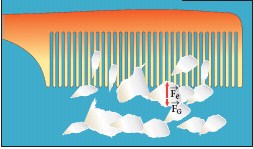
Electrostatic attraction between a comb and pieces of papers
8.
The strength of the magnetic field is one tesla if the unit charge moving in it with unit velocity experiences unit force.
IT = \(\frac { 1Ns }{ Cm } =1\frac { N }{ Am } \) = 1NA-1m-1
9.
If we hold the current carrying conductor in our right hand such that the thumb points in the direction of current flow, then the fingers encircling the wire points in the direction of the magnetic field lines produced.
10.
Gover suggested that the Earth's magnetic field is due to hot rays coming out from the Sun. These rays will heat up the air near equatorial region. Once air becomes hotter, it rises above and will move towards northern and southern hemispheres and get electrified. This may be responsible to magnetize the ferromagnetic materials near the Earth's surface.
11.
An alternating voltage is the voltage which changes polarity at regular intervals of time and the direction of the resulting alternating current also changes accordingly.
12.
The area of cross - section of two wires = 2:1
\(R\alpha \cfrac { \rho l }{ A } oi.eR\alpha \cfrac { 1 }{ R } \)
According to ohm's law
\(I\alpha \cfrac { V }{ R } i.eI\alpha \cfrac { 1 }{ R } \)
The current in the two wires 2 : 1 when the same potential difference is applied across the two wires. When the temperature of a conductor is increased, the amplitude of vibrate of the positive ions in the conductor increases. Consequently, the free electrons collide more frequently with the vibrating ions. This decreases relaxation time \(\tau .\rho \alpha \cfrac { 1 }{ \tau } \). So resistantly increases
13.
The conductivity of a semiconductor increases with rise in temperature. When temperature increases, a large number of covalent bondsbreak. This produces a larger number of charge carriers. So current increases.
14.
Linear mass density of the conductor is = 0.2 g/m
Mass per unit length \(\frac{M}{l}=0.2 \times 10^{-3} \mathrm{~kg} / \mathrm{m}\)
Magnetic field B = 1T.
Acceleration due to gravity, g = 10 ms-2
Force \(=\frac{m}{l} \times g\)
= 0.2 x 10-3 x 10 = 0.2 x 10⁻²
F = 2 x 10⁻³ N ....(1)
If the coil is placed in the magnetic field then the force acting on the coil is
F= BIl ....(2)
From the equation (1) and (2) we get
BIl = 2 x 10⁻³
∴ 1 x L x I = 2 x 10⁻³
∴ I = 2 x 10⁻³ A [∴ l = 1m]
∴ I = 2mA
15.
Change in magnetic field, dB = (8000 - 2000) = 6000 Wb
Change in time, dt = 6s
Radius of the coil, r = 2 x 10⁻² m
Induced emf, e = 44 V,
Area of the coil A =πr2 = \(\frac { 22 }{ 7 } \) x (2 x 10⁻²)2
= 12.56 x 10⁻⁴ m2
∴ Number of turns in the coil,
\(N=\frac { e }{ A\frac {dB}{dt }} \frac{44}{12.56\times10^{-4} \times(6000/6)}\)
\(N=\frac { 44 \times10 }{12.56 }=3.503\times10=35 \)
∴ Number of turns in the coil = 35
16.
Change in magnetic flux, dф = 4 x 10⁻³ Wb
Change in time, dt = 0.4 s
Magnitude of Induced emf \(= |\frac { -d\Phi }{ dt }|=\frac { d\Phi }{ dt }\)
\(=\frac { 4\times 10^{ -3 } }{ 0.4 } \) = 10 x 10-3 V = 10 mv
∴ Magnitude of induced emf =10 mV
17.
Electric field, E = 6.0 x 10⁶ N C-1 and magnetic field, B = 0.83 T.
Then.
\(v=\frac { E }{ B } =\frac { { 6.0\times 10 }^{ 6 } }{ 0.83 } =7.23\times { 10 }^{ 6 }{ ms }^{ -1 }\)
When an electron goes with this velocity, it shows null deflection. Since the accelerating potential is 200 V, the electron acquires kinetic energy because of this accelerating potential. Hence,
\(\frac { 1 }{ 2 } mv^{ 2 }=eV \)
\(v=\sqrt { \frac { 2eV }{ m } }\)
Since the mass of the electron, m = 9.1 x 10⁻³¹kg and charge of an electron, \(\left| q \right| =e=1.6\times { 10 }^{ -19 }C.\) The velocity acquired by the electron due to accelerating potential 200 V is
\({ v }_{ 200 }=\sqrt { \frac { 2\left( 1.6\times { 10 }^{ -19 } \right) \left( 200 \right) }{ \left( 9.1\times { 10 }^{ -31 } \right) } } =8.39\times { 10 }^{ 6 }m{ s }^{ -1 }\)
Since the speed v200 > v, the electron is deflected towards direction of Lorentz force. So, in order to have null deflection, the potential, we have to supply is
\(v=\frac { { 1mv }^{ 2 } }{ 2\quad e } =\frac { \left( 9.1\times { 10 }^{ -31 } \right) \times \left( 7.23\times { 10 }^{ 6 } \right) ^{ 2 } }{ 2\times \left( 1.6\times { 10 }^{ -19 } \right) } \)
V = 148.65 V
18.
The magnitude of the force between two poles is given by
\( F =k\frac { { q }_{ m_A }{ q }_{ { m }_{ B } } }{ { r }^{ 2 } } \)
(Given : F = 9 × 10⁻³ N, r = 10 cm = 10 × 10–2 m
Since qmA = qmB = qm, we have
9 x 10-3 = 10-7 x \(\frac { { q }_{ m }^{ 2 } }{ { \left( 10\times { 10 }^{ -2 } \right) }^{ 2 } } \Rightarrow { q }_{ m }\) = 30NT-1
19.
By using superposition principle, the net electric field at point A is
\(\vec { E_{ A } } =\frac { 1 }{ 4\pi { \varepsilon }_{ 0 } } \frac { { q }_{ 1 } }{ { r }_{ 1A }^{ 2 } } \hat { { r }_{ 1A } } +\frac { 1 }{ 4\pi { \varepsilon }_{ 0 } } \frac { { q }_{ 1 } }{ { r }_{ 2A }^{ 2 } } \hat { { r }_{ 2A } } \)
where r1A and r2A are the distances of point A from the two charges respectively
\(\vec { E_{ A } } =\frac { 9\times 10^{ 4 }\times 1\times { 10 }^{ -6 } }{ (2\times { 10 }^{ -3 })^{ 2 } } (\hat { j } )+\frac { 9\times 10^{ 9 }\times 1\times { 10 }^{ -6 } }{ (2\times 10^{ -3 })^{ 2 } } (\hat { i } )\)\(\)
= 2.25 x 10⁹\(\hat { j } \) + 2.25 x 10⁹\(\hat { i } \) = 2.25 x 10⁹ (\((\hat { i } +\hat { j } )\)
The magnitude of electric field
\(|\vec { { E }_{ A } } |=\sqrt { (2.25\times { 10 }^{ 9 })^{ 2 }+(2.25\times 10^{ 9 })^{ 2 } } \)
= 2.25 x \(\sqrt { 2 } \) x 109 NC-1
The direction of \(\vec { { E }_{ A } } \) is given by \(\frac { \vec { { E }_{ A } } }{ |\vec { { E }_{ A } } | } =\frac { 2.25\times 10^{ 9 }(\hat { i } +\hat { j } ) }{ 2.25\times \sqrt { 2 } \times { 10 }^{ 9 } } =\frac { (\hat { i } +\hat { j } ) }{ \sqrt { 2 } } \), which is the unit vector along OA as shown in the figure.
The acceleration experienced by an electron placed at point A is
\(\vec { a_{ A } } =\frac { \vec { F } }{ m } =\frac { q\vec { { E }_{ A } } }{ m } \)
=\(\frac { (-1.6\times 10^{ -19 })\times (2.25\times 10^{ 9 })(\hat { i } +\hat { j } ) }{ 9.1\times { 10 }^{ -31 } } \)
= -3.95 x 10²⁰ \((\hat { i } +\hat { j } )\)Nkg-1
The electron is accelerated in a direction exactly opposite to \(\vec { { E }_{ A } } \).
20.
I = 32 A , t = 1 s
Charge of an electron, e = 1.6 x 10⁻¹⁹ C
The number of electrons flowing per second, n = ?
\(I=\frac { q }{ t } =\frac { ne }{ t } \)
\(n=\frac { It }{ e } \)
\(n=\frac { 32\times 1 }{ 1.6\times { 10 }^{ -19 }C } \)
n = 20 x 1019 = 2 x 10²⁰ electrons
21.
Cathode rays are stream of negatively charged electron.
22.
rn ∞ n2
r1: r2: r3 = 1: 4: 9
23.
(a)
C'εrC'
24.
(c)
parallel to the axis of the dipole and opposite to the direction of dipole moment
25.
(d)
Zero
26.
(a)
20 Vm-1
27.
(b)
superposition principle
28.
\(B=\frac { { \mu }_{ ° }NI a^2}{ { 2(a^2+x^2)}^{ \frac { 3 }{ 2 } } } \)
put a = R
and x = R/2, we get,
\(B=\frac { 8N{ \mu }_{ ° }I }{ { 5 }^{ 3 / 2 }R } \)
29.
\(\Phi = \frac{\pi}{3}-\frac{\pi}{3}=0 \)
Power factor = cosФ = cos 0 = 1
30.
Q = q1 + q2 = 4 x 10⁻²C
\(q_{2f}=Q[\frac{r_2}{r_1+r_2}]\)
= 4 x 10⁻² \([\frac{3}{4}]\)
q2f = 3 x 10⁻² C
31.
(b)
32.
(a)
33.
Resistivity ∝ temperature for conductor. so, copper → decreases
Resistivity ∝\(\frac{1}{\text {temperature for semiconductor}}\)
so, germanium → increases.
34.
\(\mathrm{V}=230 \mathrm{~V} \)
\(P=\frac{V^2}{R} \text { since } \mathrm{V} \text { is same } \mathrm{P} \propto \frac{1}{R} \)
\(\frac{1}{R_2}=\frac{1}{\frac{R_1}{2}}+\frac{1}{\frac{R_1}{2}}=\frac{2}{R_1}+\frac{2}{R_1}=\frac{2+2}{R_1} \)
\(\frac{1}{R_2}=\frac{4}{R_1} \)
\(\therefore R_2=\frac{R_1}{4} \)
\(R_1=4 R_2 \)
\(\therefore \frac{P_2}{P_1}=\frac{R_1}{R_2}=\frac{4 R_2}{R_2}=4\)
35.
\(R \propto \frac{1}{A}, R \propto \frac{1}{r^2} \)
\(R_A \propto \frac{1}{r_A^2}, R_B \propto \frac{1}{r_B^2} \)
\(\frac{r_A}{r_B}=\left(\frac{R_B}{R_A}\right)^{1 / 2}=\left(\frac{R_B}{3 R_B}\right)^{1 / 2}=\frac{1}{3^{\frac{1}{2}}}=\frac{1}{\sqrt{3}}\)
36.
In a right angle triangle OPN let the angle \(\angle\)OPN = \(\theta \)1 which implies, \({ \varphi }_{ 1 }=\frac { \pi }{ 2 } -{ \theta }_{ 1 }\) and also in a right angle triangle OPM,
\(\angle\)OPN = \(\theta \)2 which implies, \({ \varphi }_{ 2 }=\frac { \pi }{ 2 } +{ \theta }_{ 2 }\)
Hence,
\(\overset { \rightarrow }{ B } =\frac { { \mu }_{ ° }I }{ 4\pi a } \left( cos\left( \frac { \pi }{ 2 } -{ \theta }_{ 1 } \right) -cos\left( \frac { \pi }{ 2 } +{ \theta }_{ 2 } \right) \right) \hat { n } \)
\(=\frac { { \mu }_{ ° }I }{ 4\pi a } (si{ n }_{ 1 }+{ sin }_{ 2 })\hat { n } \)
37.
Wheatstone's bridge:
i) An important application of Kirchhoff's rule is Wheatstone's bridge. It is used to compare Resistances and also helps in determining the unknown resistance in electrical network. The bridge consists of four resistances P, Q, R and S connected as shown in Figure.
ii) A galvanometer G is connected between the points B and D. The battery is connected between the points A and C. The current through the galvanometer is IG and its resistance is G.
Applying Kirchhoff's current rule to junction B
I1 - IG - I3 = 0 ..(1)
Applying Kirchhoff's current rule to junction D,
I2 + IG - I4 = 0 ...(2)
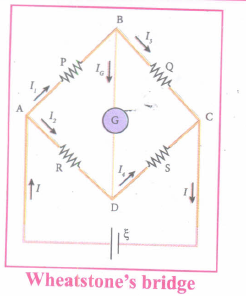
Applying Kirchhoff's voltage rule to loop ABDA,
I1P + IGG - I2R = 0 ...(3)
Applying Kirchhoff's voltage rule to loop ABCDA,
I1P + I3Q - I4S - I2R = 0 ...(4)
(iii) When the points B and D are at the same potential, the bridge is said to be balanced. As there is no potential difference between B and D, no current flows through galvanometer (IG = 0). Substituting IG = 0 in equation (1), (2) and (3), we get
I1 = I3 ..(5)
I2 = I4 ..(6)
I1P = I2R ..(7)
Substituting the equation (7) in equation (4),
I3Q = I4S .....(8)
Dividing equation (7) by equation (8), we get
\(\cfrac { P }{ Q } =\cfrac { R }{ S } \) .....(9)
(iv) This is the bridge balance condition. Only under this condition, galvanometer shows null deflection.

12th Standard Syllabus & Materials
12th Standard
TN 12th Computer Applications வலையமைப்பு வடமிடல் Sample Question Papers Study Material - QB365 Set A
NEW12th Standard
TN 12th Computer Applications களப்பெயர் முறைமை (DNS) Sample Question Papers Study Material - QB365 Set A
NEW12th Standard
TN 12th Computer Applications வலையமைப்பு எடுத்துக்காட்டுகள் மற்றும் நெறிமுறைகள் Sample Question Papers Study Material - QB365 Set A
NEW12th Standard
TN 12th Computer Applications கணினி வலையமைப்பு ஓர் அறிமுகம் Sample Question Papers Study Material - QB365 Set A



Tamilnadu Stateboard 12th Standard Subjects

Maths

Chemistry
Physics

Biology

Computer Science

Business Maths and Statistics

Economics

Commerce

Accountancy

History

Computer Applications
Biology
Computer Technology
Computer Applications
Computer Science
Business Maths and Statistics
Commerce
Economics
Maths
Chemistry
Physics
Computer Technology
History
Accountancy

Tamil

English

French
Tamilnadu Stateboard Standards

