
 100% FREE ACCESS
12th Standard Syllabus & Materials
12th Standard
TN 12th Maths Applications of Matrices and Determinants Sample Question Papers Study Material - QB365 Set A
NEW12th Standard
TN 12th Computer Applications மின்னணு தரவு பரிமாற்றம் Sample Question Papers Study Material - QB365 Set A
NEW12th Standard
TN 12th Computer Applications மின் - வணிக பாதுகாப்பு அமைப்புகள் Sample Question Papers Study Material - QB365 Set A
NEW12th Standard
TN 12th Computer Applications மின்னணு செலுத்தல் முறைகள் Sample Question Papers Study Material - QB365 Set A
NEW12th Standard
TN 12th Computer Applications மின் - வணிகம் Sample Question Papers Study Material - QB365 Set A
NEW12th Standard
TN 12th Computer Applications திறந்த மூல கருத்துருக்கள் Sample Question Papers Study Material - QB365 Set A

Published on: 27/02/2021
12th Standard English Medium Physics Reduced syllabus Three mark important Questions - 2021(Public Exam )
Download Tamil Nadu 12th Standard Physics question papers, model tests, one-mark questions, important questions, and public exam papers in PDF format. Free study materials and answer keys for TN State Board students.
Questions + Answers key
Take MCQ Physics Test1.
If the focal length is 150 cm for a lens, what is the power of the lens?
2.
Light travelling through transparent oil enters in to glass of refractive index 1.5. If the refractive index of glass with respect to the oil is 1.25, what is the refractive index of the oil?
3.
A cylindrical bar magnet is kept along the axis of a circular solenoid. If the magnet is rotated about its axis, find out whether an electric current is induced in the coil.
4.
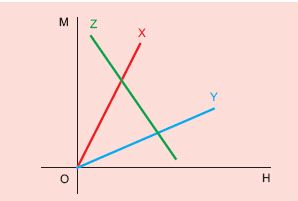
The following figure shows the variation of intensity of magnetisation with the applied magnetic field intensity for three magnetic materials X, Y and Z. Identify the materials X, Y and Z.
5.
Let the magnetic moment of a bar magnet be \(\overset { \rightarrow }{ { p }_{ m } } \) whose magnetic length is d = 2l and pole strength is qm. Compute the magnetic moment of the bar magnet when it is cut into two pieces
(a) along its length
(b) perpendicular to its length.
6.
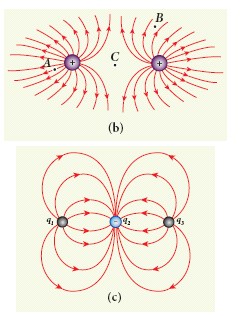
The following pictures depict electric field lines for various charge configurations.
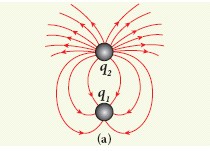
(i) In figure (a) identify the signs of two charges and find the ratio \(\left| \frac { { q }_{ 1 } }{ { q }_{ 2 } } \right| \)
(ii) In figure (b), calculate the ratio of two positive charges and identify the strength of the electric field at three points A, B, and C
(iii) Figure (c) represents the electric field lines for three charges. If q2 = -20 nC, then calculate the values of q1 and q3.
7.
A potential difference across 24 Ω resistor is 12 V. What is the current through the resistor?
8.
A copper wire of cross-sectional area 0.5 mm2 carries a current of 0.2 A. If the free electron density of copper is 8.4 x 1028 m-3 then compute the drift velocity of free electrons.
9.
Compute the current in the wire if a charge of 120 C is flowing through a copper wire in 1 minute.
10.
Calculate the number of electrons in one coulomb of negative charge.
11.
Light of wavelength 390 nm is directed at a metal electrode. To find the energy of electrons ejected, an opposing potential difference is established between it and another electrode. The current of photoelectrons from one to the other is stopped completely when the potential difference is 1.10 V. Determine i) the work function of the metal and ii) the maximum wavelength of light that can eject electrons from this metal.
12.
What is the radius of the illumination when seen above from inside a swimming pool from a depth of 10 m on a sunny day? What is the total angle of view? [Given, refractive index of water is 4/3]
13.
A solenoid of 500 turns is wound on an iron core of relative permeability 800. The length and radius of the solenoid are 40 cm and 3 cm respectively. Calculate the average emf induced in the solenoid if the current in it changes from 0 to 3 A in 0.4 second.
14.
Obtain an expression for potential energy due to a collection of three point charges which are separated by finite distances.
15.
Define ‘Electric field’ and discuss its various aspects.
16.
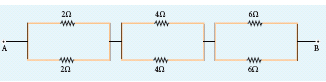
Calculate the equivalent resistance between A and B in the given circuit.
17.
Calculate the electrostatic force and gravitational force between the proton and the electron in a hydrogen atom. They are separated by a distance of 5.3 x 10⁻¹¹ m. The magnitude of charges on the electron and proton are 1.6 x 10⁻¹⁹ C. Mass of the electron is me = 9.1 x 10⁻³¹ kg and mass of proton is mp = 1.6 x 10⁻²⁷ kg.
18.
Briefly explain the principle and working of electron microscope.
19.
What are the possible harmful effects of usage of Nanoparticles? Why?
20.
Discuss the process of nuclear fusion and how energy is generated in stars?
21.
Explain the principle and working of a moving coil galvanometer.
22.
Show that the mutual inductance between a pair of coils is same (M12 = M21). (or) Derive the equation for inductance of a solenoid. Assume that the length of the solenoid is greater than its diameter.
23.
Explain the Maxwell’s modification of Ampere’s circuital law.
24.
Obtain the expression for electric field due to an charged infinite plane sheet.
1.
Given, focal length, f = 150 cm = 1.5 m
Equation for power of lens is, \(p=\cfrac { 1 }{ f } \)
Substituting the values,
\(p=\cfrac { 1 }{ 1.5 } =0.67 D\)
As the power is positive, it is a converging lens.
2.
Given, ngo = 1.25 and ng = 1.5
Refractive index of glass with respect to oil,
\({ n }_{ go }=\cfrac { { n }_{ g } }{ { n }_{ 0 } } \)
Rewriting for refractive index of oil,
\({ n }_{ p }=\cfrac { { n }_{ g } }{ { n }_{ go } } =\cfrac { 1.5 }{ 1.25 } =1.2\)
The refractive index of oil is, no = 1.2
3.
The magnetic field of a cylindrical magnet is symmetrical about its axis. As the magnet is rotated along the axis of the solenoid, there is no induced current in the solenoid because the flux linked with the solenoid does not change due to the rotation of the magnet.
4.
The slope of M-H graph measures the magnetic susceptibility, which is given by
\({ x }_{ m }=\frac { M }{ H } \)
Material X : Slope is positive and larger value. So, it is a ferromagnetic material.
Material Y : Slope is positive and lesser value than X. So, it could be a paramagnetic material.
Material Z : Slope is negative and hence, it is a diamagnetic material.
5.
(a) a bar magnet cut into two pieces along its length:
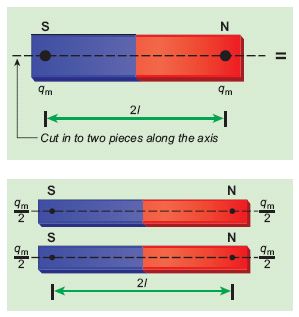
When the bar magnet is cut along the axis into two pieces, new magnetic pole strength is \({ q }_{ m }^{ ' }=\frac { { q }_{ m } }{ 2 } \) but magnetic length does not change. So, the magnetic moment is
\({ p }_{ m }^{ ' }={ q' }_{ m }2l\)
\({ p }_{ m }^{ ' }=\frac { { q }_{ m } }{ 2 } 2l=\frac { 1 }{ 2 } ({ q }_{ m }2l)=\frac { 1 }{ 2 }p_ m\)
In vector notation, \(\vec{p}'_m=\frac{1}{2}\vec{p}_m\)
(b) a bar magnet cut into two pieces perpendicular to the axis:
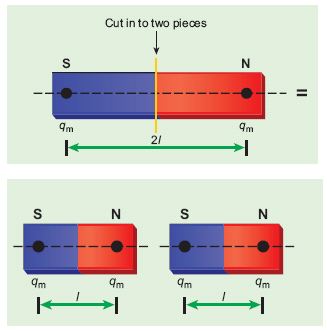
When the bar magnet is cut perpendicular to the axis into two pieces, magnetic pole strength will not change but magnetic length will be halved. So the magnetic moment is
\({ p }_{ m }^{ ' }={ q }_{ m }\times \frac { 1 }{ 2 } (2l)=\frac { 1 }{ 2 } ({ q }_{ m }.2l)=\frac { 1 }{ 2 } { p }_{ m }\)
In vector notation, \(\vec{p}'_m=\frac{1}{2}\vec{p}_m\)
6.
(i) The electric field lines start at q2 and end at q1. In figure (a), q2 is positive and q1 is negative. The number of lines starting from q2 is 18 and number of the lines ending at q1 is 6. So q2 has greater magnitude. The ratio of \(\left| \frac { { q }_{ 1 } }{ { q }_{ 2 } } \right| =\frac { { N }_{ 1 } }{ { N }_{ 2 } } =\frac { 6 }{ 18 } =\frac { 1 }{ 3 } \). It implies that |q2| = 3|q1|.
(ii) In figure (b), the number of field lines emanating from both positive charges are equal (N = 18). So the charges are equal. At point A, the electric field lines are denser compared to the lines at point B. So the electric field at point A is greater in magnitude compared to the field at point B. Further, no electric field line passes through C, which implies that the resultant electric field at C due to these two charges is zero.
(iii) In the figure (c), the electric field lines start at q1 and q3 and end at q2. This implies that q1 and q3 are positive charges. The ratio of the number of field lines is \(\left| \frac { { q }_{ 1 } }{ { q }_{ 2 } } \right| =\frac { 8 }{ 16 } =\left| \frac { { q }_{ 3 } }{ { q }_{ 2 } } \right| =\frac { 1 }{ 2 } \), implying that q1 and q3 are half of the magnitude of q2. So q1 = q3 = +10 nc.
7.
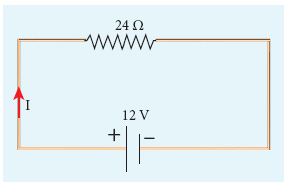
V = 12 V and R = 24 Ω
Current, I = ?
From Ohm’s law, \(I=\frac{V}{R}=\frac{12}{24}=0.5A\)
8.
The relation between drift velocity of electrons and current in a wire of cross- sectional area A is
\({ v }_{ d }=\frac { I }{ neA } =\frac { 0.2 }{ 8.4\times { 10 }^{ 28 }\times 1.6\times { 10 }^{ -19 }\times 0.5\times { 10 }^{ -6 } }\)
vd = 0.03 x 10⁻³ m s-1
9.
The current (rate of flow of charge) in the wire is
\(I=\frac { Q }{ t } =\frac { 120 }{ 60 } =2A\)
10.
According to the quantisation of charge
q = ne
Here q = 1C. So the number of electrons in 1 coulomb of charge is
n = \(\frac { q }{ e } =\frac { 1C }{ 1.6\times 10^{ -19 } } \) = 6.25 x 10¹⁸ electrons
11.
i) The work function is given by
ϕ0 = hv - Kmax = \(\frac { hc }{ \lambda } \) - eV0
since Kmax = eV0
\(=\left[ \frac { 6.626\times { 10 }^{ -34 }\times 3\times { 10 }^{ 8 } }{ 390\times 10^{ -9 } } \right] \) - [1.6 x 10-19 x 1.10]
= 5.10 x 10⁻¹⁹ - 1.76 x 10-19 = 3.34 x 10⁻¹⁹ J
= 2.09 eV
ii) The threshold wavelength is
\(\lambda_{0}=\frac{h c}{\phi_o}=\frac{6.626 \times 10^{-34} \times 3 \times 10^{8}}{3.34 \times 10^{-19}}\)
= 5.951 x 10⁻⁷ m = 5951 \(\mathring { A }\).
12.
Given, n = 4/3, d = 10 m.
Radius of illumination, \(R=\cfrac { d }{ \sqrt { { n }^{ 2 }-1 } } \)
\(R=\cfrac { 10 }{ \sqrt { \left( 4/3 \right) ^{ 2 }- } 1 } =\cfrac { 10\times 3 }{ \sqrt { 16-9 } } \)
\(R=\cfrac { 30 }{ \sqrt { 7 } } =11.32cm\)
To find the critical angle,
\({ i }_{ c }={ sin }^{ -1 }\left( \cfrac { 1 }{ n } \right) \)
\({ i }_{ c }={ sin }^{ -1 }\left( \cfrac { 1 }{ 4/3 } \right) ={ sin }^{ -1 }\left( \cfrac { 3 }{ 4 } \right) =48.6^{ o }\)
The total angle of view of the cone is, \({ 2i }_{ c }=2\times { 48.6 }^{ 0 }={ 97.2 }^{ 0 }\)
13.
N = 500 turns; μr = 800;
l = 40 cm = 0.4 m; r = 3 cm = 0.03 m;
di = 3 – 0 = 3 A; dt = 0.4 s
Self inductance,
\(L=\mu { n }^{ 2 }Al\left( \because \mu ={ \mu }_{ o }{ \mu }_{ r };A={ \pi r }^{ 2 };n=\frac { N }{ l } \right) \)
\(=\frac { { \mu }_{ 0 }{ \mu }_{ r }{ N }^{ 2 }\pi { r }^{ 2 } }{ l } \)
\(=\frac { 4\times 3.14\times { 10 }^{ -7 }\times 800\times { 500 }^{ 2 }\times 3.14\times { (3\times 10 }^{ -2 }{ ) }^{ 2 } }{ 0.4 } \)
L=1.77H
Induced emf, ε = -L\(\frac{di}{dt}\)
\(=\frac{1.77\times3}{0.4}\)
ε = -13.275V
14.
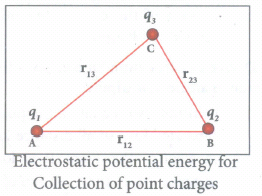
To calculate the total electrostatic potential energy, we use the following procedure. We bring all the charges one by one and arrange them according to the configuration as shown in Figure.
a) Bringing a charge q1 from infinity to the point A requires no work, because there are no other charges already present in the vicinity of charge q1.
b) To bring the second charge q2 to the point B, work must be done against the electric field created by the charge q1. So the work done on the charge q2 is W = q2 V1B. Here V1B is the electrostatic potential due to the charge q1 at point B.
\(U_I=\frac{1}{4\piε_o}\frac{q_1q_2}{r_{12}}\) .....(1)
Note that the expression is same when q2 is brought first and then q1 later.
c) Similarly to bring the charge q3 to the point C, work has to be done against the total electric field due to both the charges q1 and q2. So the work done to bring the charge q3 = q3 (V1C + V2C). Here V1C is the electrostatic potential due to charge q1 at point C and V2C is the electrostatic potential due to charge q2 at point C.
The electrostatic potential is
\(U_{II}=\frac{1}{4\piε_o}(\frac{q_1q_2}{r_{13}}+\frac{q_2q_3}{r_{23}})\) .....(2)
d) Adding equations (1) and (3), the total electrostatic potential energy for the system of three charges q1, q2 and q3 is
U = UI + UII
\(U=\frac{1}{4\piε_o}(\frac{q_1q_2}{r_{12}}+\frac{q_2q_3}{r_{13}}+\frac{q_2q_3}{r_{23}})\) ....(3)
15.
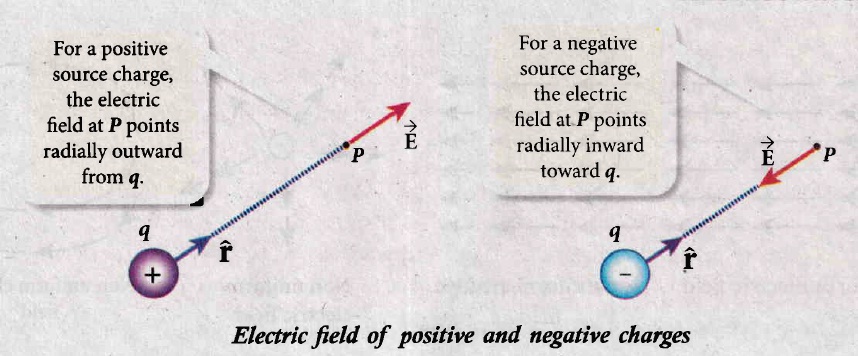
The electric field at the point P at a distance r from the point charge q is defined as the force that would be experienced by a unit positive charge placed at that point and is given by,
\(\vec{E}=\frac{\vec{F}}{q_{0}}=\frac{k q}{r^{2}} \hat{r}=\frac{1}{4 \pi \varepsilon_{0}} \frac{q}{r^{2}} \hat{r}\) ....(1)
where \(\hat{r}\) is the unit vector pointing from q to the point of interest P.
Important aspect of the Electric field:
(i) If the charge q is positive then the electric field points away from the source charge and if q is negative, the electric field points towards the source charge q. This is shown in the Figure
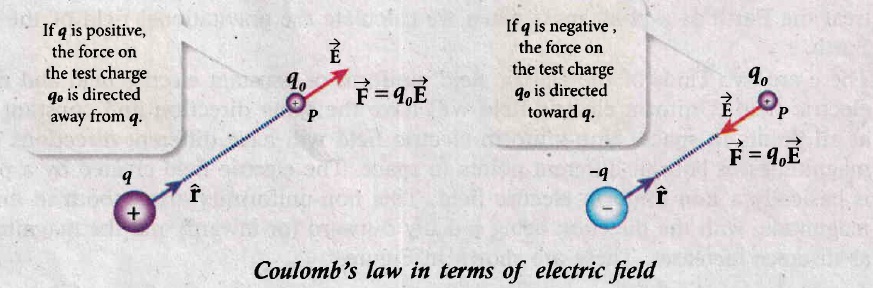
(ii) If the electric field at a point P is \(\vec{E},\) then the force experienced by the test charge qo placed at the point P is \(\vec { F } ={ q }_{ 0 }\vec { E } \)
This is Coulomb's law in terms of electric field. This is shown in Figure
(iii) The equation (1) implies that the electric field is independent of the test charge qo and it depends only on the source charge q.
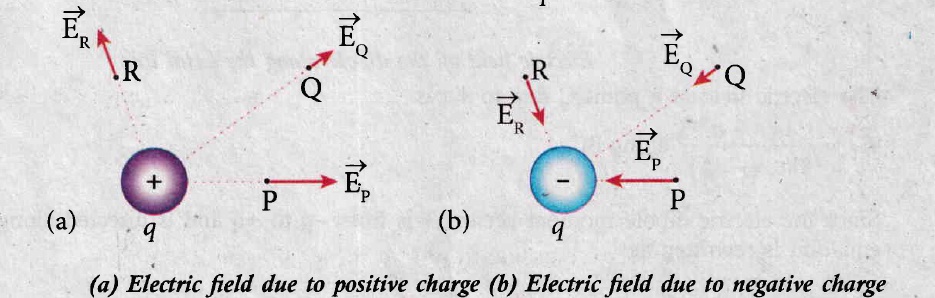
(iv) Since the electric field is a vector quantity, at every point in space, this field has unique direction and magnitude, as shown in Figures (a) and (b). From equation (1), we can infer that as distance increases, the electric field decreases in magnitude. Note that in Figures (a) and (b) the length of the electric field vector is shown for three different points. The strength or magnitude of the electric field at point P is stronger than at the points Q and R because the point P is closer to the source charge.
(v) In the definition of electric field, it is assumed that the test charge (q0) is taken sufficiently small, so that bringing this test charge will not move the source charge. In other words, the test charge is made sufficiently small such that it will not modify the electric field of the source charge.
(vi) The expression (1) is valid only for point charges. For continuous and finite size charge distributions, integration techniques must be used. These will be explained later in the same section. However, this expression can be used as an approximation for a finite-sized charge if the test point is very far away from the finite sized source charge. Note that we similarly treat the Earth as a point mass when we calculate the gravitational field of the Sun on the Earth.
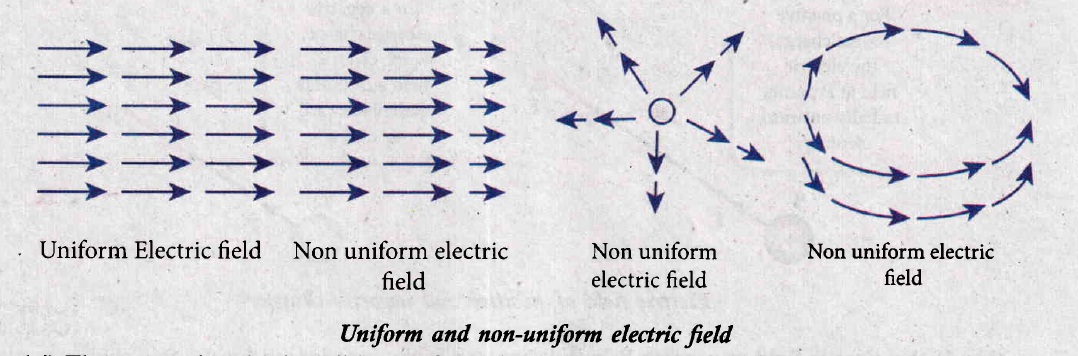
(vii) There are two kinds of the electric field : uniform or constant electric field and non-uniform electric field. Uniform electric field will have the same direction and constant magnitude at all points in space. Non-uniform electric field will have different directions or different magnitudes or both at different points in space. The electric field created by a point charge is basically a non uniform electric field. This non-uniformity arises, both in direction and magnitude, with the direction being radially outward (or inward) and the magnitude changes as distance increases. These are shown in Figure.
16.
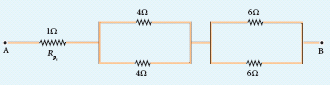
In all the sections, the resistors are connected in parallel.
Section I
\(\frac { 1 }{ { R }_{ { P }_{ 1 } } } =\frac { 1 }{ { R }_{ 1 } } +\frac { 1 }{ { R }_{ 2 } } \)
\(\frac { 1 }{ { R }_{ { P }_{ 1 } } } =\frac { 1 }{ 2 } +\frac { 1 }{ 2 } =\frac { 2 }{ 2 } \quad { R }_{ { p }_{ 1 } }=1\Omega \)
Section II
\(\frac { 1 }{ { R }_{ { P }_{ 1 } } } =\frac { 1 }{ 4 } +\frac { 1 }{ 4 } =\frac { 2 }{ 4 } ,\quad \frac { 1 }{ { R }_{ { P }_{ 2 } } } =\frac { 1 }{ 2 } ,{ R }_{ { p }_{ 2 } }=2\Omega \)
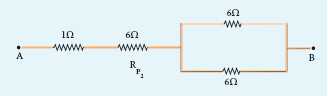
Section III
\(\frac { 1 }{ { R }_{ { P }_{ 3 } } } =\frac { 1 }{ 6 } +\frac { 1 }{ 6 } =\frac { 2 }{ 6 } \)
\(\frac { 1 }{ { R }_{ { P }_{ 3 } } } =\frac { 1 }{ 3 } ,{ R }_{ { p }_{ 3 } }=3\Omega \)
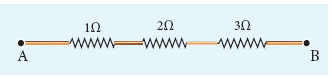
Equivalent resistance is given by
R = Rp1 + Rp2 + Rp3
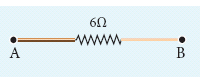
R = 1 Ω + 2 Ω + 3 Ω = 6 Ω
The circuit became,
Equivalent resistance between A and B is
17.
The proton and the electron attract each other. The magnitude of the electrostatic force between these two particles is given by
\(F_e=\frac { ke^{ 2 } }{ { r }^{ 2 } } =\frac { 9\times 10^{ 9 }\times (1.6\times 10^{ -19 })^{ 2 } }{ (5.3\times 10^{ -11 })^{ 2 } } \)
=\(\frac { 9\times 2.56 }{ 28.09 } \) x 10-7 = 8.2 x 10⁻⁸ N
The gravitational force between the proton and the electron is attractive. The magnitude of the gravitational force between these particles is
FG = \(\frac { G{ m }_{ e }{ m }_{ p } }{ { r }^{ 2 } } \)
= \(\frac { 6.67\times 10^{ -11 }\times 9.1\times 10^{ -31 }\times 1.6\times 10^{ -27 } }{ (5.3\times 10^{ -11 })^{ 2 } } \)
= \(\frac { 97.11 }{ 28.09 } \) x 10-47 = 3.4 x 10-47N
The ratio of the two forces \(\frac { { F }_{ e } }{ F_{ G } } =\frac { 8.2\times 10^{ -8 } }{ 3.4\times 10^{ -47 } } \)
= 2.41 x 1039
Note that Fe ≈ 1039 FG
The electrostatic force between a proton and an electron is enormously greater than the gravitational force between them. Thus the gravitational force is negligible when compared with the electrostatic force in many situations such as for small size objects and in the atomic domain. This is the reason why a charged comb attracts an uncharged piece of paper with greater force even though the piece of paper is attracted downward by the Earth. This given figure is shown in below.
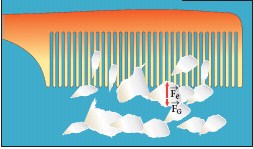
Electrostatic attraction between a comb and pieces of papers
18.
Principle:
(i) The wave nature of the electron is used in the construction of microscope called electron microscope.
(ii)The resolving power of a microscope is inversely proportional to the wavelength of the radiation used for illuminating the object under study.
(iii) Higher magnification as well as higher resolving power can be obtained by employing the waves of shorter wavelengths.
(iv) De Broglie's wavelength of electron is very much less than (a few thousand less) that of the visible light being used in optical microscopes.
(v) As a result, the microscopes employing de Broglie waves of electrons have very much higher resolving power than optical microscope.
(vi) Electron microscopes giving magnification more than 2,00,000 times are common in research laboratories.
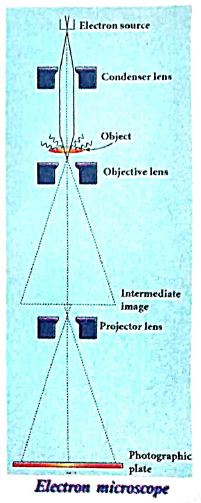
Working:
(i) The construction and working of an electron microscope is similar to that of an optical microscope except that in electron microscope focussing of electron beam is done by the electrostatic or magnetic lenses.
(ii) The electron beam passing across a suitably arranged either electric or magnetic fields undergoes divergence or convergence thereby focussing of the beam is done.
(iii) The electrons emitted from the source are accelerated by high potentials.
(iv) The beam is made parallel by magnetic condenser lens; When the beam passes through the sample whose magnified image is needed, the beam carries the image of the sample.
(v) With the help of magnetic objective lens and magnetic projector lens system, the magnified image is obtained on the screen. These electron microscopes are being used in almost all brands of science.
19.
Possible harmful effects of nanoparticles:
(i) They may easily get absorbed onto the surface of living organisms as dimensions of the nano particles are the same as that of biological molecules such as proteins.
(ii) They readily enter the tissues and fluids of the body and distort their functions
(iii) Nano particles can also cross cell membranes so that, interaction with living systems is affected
(iv) It is also possible for the inhaled nanoparticles to reach the blood, to reach other sites such as the liver, heart or blood cells.
20.
(i) Nuclear fusion is the reaction in which two or more light nuclei (A < 20) combine to form a heavier nucleus.
(ii) In the nuclear fusion, the mass of the resultant nucleus is less than the sum of the masses of original light nuclei. This mass difference appears as energy.
(iii) At room temperature if two light nuclei come closer, is strongly repelled by the coulomb repulsive force.
(iv) If the temperature is increased in order of 107 K, the light nuclei have enough kinetic energy to move closer such that the nuclear force becomes effective.
(v) Then lighter nuclei start fusing to form heavier nuclei.
(vi) So it is called thermonuclear fusion reaction.
Energy generation in stars:
(i) Then natural place where nuclear fusion occurs is the core of the stars.
(ii) The energy of star is due to thermonuclear fusion.
(iii) Most of the stars including our Sun fuse hydrogen into helium and some stars even fuse helium into heavier elements.
(iv) The early stage of a star is in the form of cloud and dust.
(v) Due to their own gravitational pull, these clouds fall inward.
(vi) As a result, its gravitational potential energy is converted to kinetic energy and finally into heat.
(vii) When the temperature is high enough to initiate the thermonuclear fusion, they start to release enormous energy which tends to stabilize the star and prevents it from further collapse.
(viii) The sun's interior temperature is around 1.5 x 10⁷ K.
(ix) The sun is converting 6 x 10¹¹kg hydrogen into helium every second
(x) When the hydrogen is burnt out, the sun will enter into new phase called red giant where helium will fuse to become carbon.
(xi) During this stage, sun will expand greatly in size and all its planets will be engulfed in it.
(xii) The energy source of sun is proton-proton cycle of fusion reaction.
This cycle consists of three steps and the first two steps are as follows:
\(_{ 1 }^{ 1 }{ H+ }_{ 1 }^{ 1 }{ H }\rightarrow _{ 1 }^{ 2 }{ H }+{ e }^{ + }+v\)
\(_{ 1 }^{ 1 }{ H+ }_{ 1 }^{ 2 }{ H }\rightarrow _{ 2 }^{ 3 }{ He }+\gamma \)
A number of reactions are possible in the third step. But the dominant one is
\(_{ 2 }^{ 3 }{ He+ }_{ 2 }^{ 3 }{ He }\rightarrow _{ 2 }^{ 4 }{ He }+_{ 1 }^{ 1 }{ H+ }_{ 1 }^{ 1 }{ H }\)
(xiii) The overall energy production in the above reactions is about 27 MeV. The radiation energy we received from the sun is due to these fusion reactions.
21.
Principle : When a current carrying loop is placed in a uniform magnetic field it experiences a torque.
Construction : A moving coil galvanometer consists of a rectangular coil PQRS of insulated thin copper wire. The coil contains a large number of turns wound over a light metallic frame. A cylindrical soft-iron core is placed symmetrically inside the coil as shown in Figure. The rectangular coil is suspended freely between two pole pieces of a horse-shoe magnet.
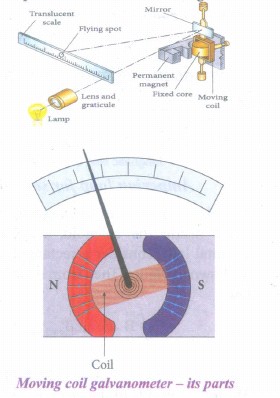
The upper end of the rectangular coil is attached to one end of fine strip of phosphor bronze and the lower end of the coil is connected to a hair spring which is also made up of phosphor bronze. In a fine suspension strip, a small plane mirror is attached in order to measure the deflection of the coil with the help of lamp and scale arrangement. The other end of the mirror is connected to a torsion head. In order to pass electric current through the galvanometer, the suspension strip and the spring S are connected to terminals.
Working : Consider a single turn of the rectangular coil PQRS whose length be l and breadth b. PQ = RS = l and QR = SP = b.
Let I be the electric current flowing through the rectangular coil PQRS as shown in Figure. The horse-shoe magnet has hemi - spherical magnetic poles which produces a radial magnetic field. Due to this radial field, the sides QR and SP are always parallel to the magnetic field B and experience no force. The sides PQ and RS are always parallel to the magnetic field and experience force in opposite directions. Due to this, torque is produced.
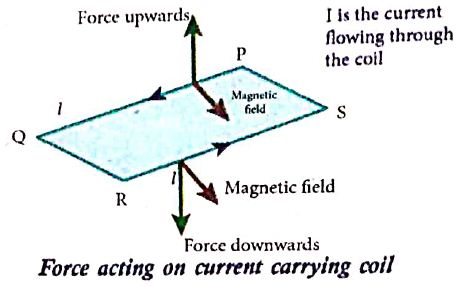
For single turn, the deflection torque is,
て = bF = bBIl = (lb)BI
て = ABI
since, area of the coil A = lb
For coil with N turns, we get
て = NABI ........(1)
Due to this deflecting torque, the coil gets twisted and restoring torque (also known as restoring couple) is developed. Hence the moment of restoring couple is proportional to the amount of twist θ. Thus
て = Kθ ............(2)
where K is the restoring couple per unit twist or torsional constant of the spring.
At equilibrium, the deflection couple is equal to the restoring couple. Therefore by comparing equations (1) and (2), we get,
NABI = Kθ
⇒ I =\(\frac { K }{ NAB } \) θ ...........(3)
(or) I = Gθ
where G = \(\frac { K }{ NAB } \) is called galvanometer constant or current reduction factor of the galvanometer.
Since, suspended moving coil galvanometer is very sensitive, we have to handle with high care while doing experiments. Most of the galvanometer we use are pointer type moving coil galvanometer.
22.
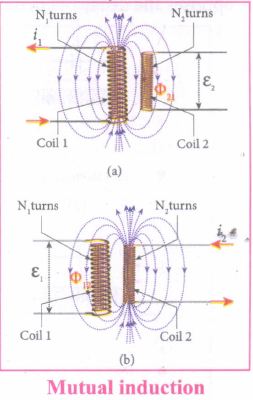
Consider two coils which are placed close to each other. If an electric current il is sent through coil 1, the magnetic field produced by it is also linked with coil 2 as shown in Figure (a). If Φ21 be the magnetic flux linked with each turn of the coil 2 of N2 turns due to current in coil 1, then the total flux linked with coil 2 (N2Φ21) is proportional to the current i1 in the coil 1.
N2Φ21 ∝ i1
N2Φ21 = M21 i1
(or) M21 = \(\frac { { N }_{ 2 }{ \Phi }_{ 21 } }{ { i }_{ 1 } } \)
The constant of proportionality M21 is the mutual inductance (or) co-efficient of mutual induction. If i1 = 1A then M21 = \({ N }_{ 2 }{ \Phi }_{ 21 }\).Therefore, the mutual inductance M21 is defined as the flux linkage of the coil 2 when 1A current flows through coil 1 of the coil 2 with respect to coil 1.
When the current i1 changes with time, an emf ε2 is induced in coil 2. From Faraday's law of electromagnetic induction, this mutually induced emf ε2 is given by
|
\({ \varepsilon }_{ 2 }=\frac { { d(N }_{ 2 }{ \Phi }_{ 21 }) }{ dt } =-\frac { d({ M }_{ 21 }{ i }_{ 1 }) }{ dt } \) |
The negative sign in the above equation shows that the mutually induced emf always opposes the change in current i1 with respect to time. If \(\frac { { di }_{ 1 } }{ dt } \) = 1 As-1, then M21= -ε2·
Mutual inductance M21 is also defined as the opposing emf induced in the coil 2 when the rate of change of current through the coil 1 is 1 As-1.
Similarly, if an electric current i2 through coil 2 changes with time, then emf ε1 is induced in coil 1. Therefore,
\({ M }_{ 12 }=\frac { {N }_{ 1 }{ \Phi }_{ 12 } }{ { i }_{ 2 } } \) and \({ M }_{ 12 }=\frac { -\varepsilon }{ \frac { { di }_{ 2 } }{ dt } } \)
where M12 is the mutual inductance of the coil 1 with respect to coil 2. It can be shown that for a given pair of coils, the mutual inductance is same.
i.e., M21= M12 = M
23.
(i) We have stated Ampere's law as \(\oint \vec{B} \cdot \overrightarrow{d l}=\mu_oi\)
(ii) Where, i is the electric current crossing a surface bounded by a closed curve and the line integral of \(\vec{B}\) is calculated along that closed curve. This equation is valid only when the electric field at the surface does not change with time.
(iii) Maxwell strongly believed that when the time varying magnetic field produces an electric field, the time varying electric field must produce a magnetic field.
(iv) To understand how a varying electric field produces magnetic field, let us consider a situation of charging a parallel plate capacitor.
.JPG)
(v) Let ic be the conduction current. To calculate the magnetic field at P (fig. 1 ) an amperian loop. S1 is drawn. Applying Ampere circuital law for the surface S1, we get
\(\oint \vec{B} \cdot \overrightarrow{d l}=\mu_0 i_c\) Where, \(\mu_0\) is permeability of free space.
(vi) Applying the same for the surface S2, we get \(\oint \vec{B} \cdot \overrightarrow{d l}=0.\)
Because the surface S2 nowhere touches the wire carrying conduction current. Therefore for the point P at one surface (S1) it has some value and at another surface (S2) it has zero value.
(vii) So, Maxwell believed that there must be a current associated with the changing electric field in between the capacitor and he called that current as displacement current.
(viii) Applying Gauss law to the electric flux between the plates of the capacitor \(\phi_E=\oint \vec{E} \cdot \overrightarrow{\mathrm{dA}}=E A=\frac{q}{\varepsilon_0}\) where, A is the area of the plate.
The change in electric flux is \(\frac{d \phi_F}{d t}=\frac{1}{\varepsilon_0} \frac{d q}{d t} (or) \frac{\mathrm{dq}}{\mathrm{dt}}=\mathrm{i}_{\mathrm{d}}=\varepsilon_0 \frac{\mathrm{d} \phi_{\mathrm{E}}}{\mathrm{dt}}\), where id is the displacement current.
(ix) The displacement current can be defined as the current which comes into play in the region in which the electric field and electric flux are changing with time.
(x) So, Maxwell modified Ampere's law \(\oint_{l} \vec{B} \cdot d \vec{l}=\mu_{0} i_c+\mu_{0}-i_d\) which means the total current enclosed by the surface is sum of conduction current and displacement current.
24.
Electric field due to charged infinite plane sheet:
(i) Consider an infinite plane sheet of charges with uniform surface charge density σ. (Charge per unit area). Let P be a point at a distance of r from the sheet as shown in the Figure.
(ii) Since the plane is infinitely large, the electric field should be same at all points equidistant from the plane and radially directed outward at all points. A cylindrical-shaped Gaussian surface of length 2r and two flat surfaces is chosen such that the infinite plane sheet passes perpendicularly through the middle part of the Gaussian surface.
Total electric flux linked with the cylindrical surface,
\({ \phi }_{ E }=\int { \vec { E } .d\vec { A } } \)
\(=\int _{ Curved\ surface }^{ }{ \vec { E } .d\vec { A } } +\int _{ P }^{ }{ \vec { E } .d\vec { A } + } \int _{ P^{'} }^{ }{ \vec { E } .d\vec { A } } =\frac { { Q }_{ encl } }{ { \varepsilon }_{ 0 } } \quad ...(1)\)
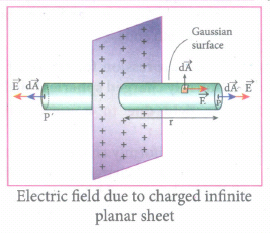
(iii) The electric field is perpendicular to the area element at all points on the curved surface and is parallel to the surface areas at P and P ' (Figure). Then, applying Gauss's law.
\({ \phi }_{ E }=\int _{ p }^{ }{ EdA+ } \int _{ p' }^{ }{ EdA= } \frac { { Q }_{ encl } }{ { \varepsilon }_{ 0 } } \quad ...(2)\)
Since the magnitude of the electric field at these two equal flat surfaces is uniform, E is taken out of the integration and Qncel is given by Qencl = σA, we get
\(2E\int _{ p }^{ }{ dA=\frac { \sigma A }{ { \varepsilon }_{ 0 } } } \)
The total area of surface either at P or P'
\(\int _{ p }^{ }{ dA=A } \)
Hence \(2EA=\frac { \sigma A }{ { \varepsilon }_{ 0 } }\) or \(E=\frac { \sigma }{ 2{ \varepsilon }_{ 0 } } \quad \quad \quad \quad ...(3)\)
In vector \(\vec { E } =\frac { \sigma }{ 2{ \varepsilon }_{ 0 } } \hat { n } \quad \quad \quad \quad ...(4)\)
(iv) Here \(\hat { n } \) is the outward unit vector normal to the plane. Note that the electric field due to an infinite plane sheet of charge depends on the surface charge density and is independent of the distance r.
(v) The electric field will be the same at any point farther away from the charged plane.
(vi) Equation (4) implies that if σ > 0 the electric field at any point P is outward perpendicular \(\hat { n } \) to the plane and if σ < 0 the electric field points inward perpendicularly (\(-\hat { n } \)) to the plane.

12th Standard Syllabus & Materials
12th Standard
TN 12th Computer Applications வலையமைப்பு வடமிடல் Sample Question Papers Study Material - QB365 Set A
NEW12th Standard
TN 12th Computer Applications களப்பெயர் முறைமை (DNS) Sample Question Papers Study Material - QB365 Set A
NEW12th Standard
TN 12th Computer Applications வலையமைப்பு எடுத்துக்காட்டுகள் மற்றும் நெறிமுறைகள் Sample Question Papers Study Material - QB365 Set A
NEW12th Standard
TN 12th Computer Applications கணினி வலையமைப்பு ஓர் அறிமுகம் Sample Question Papers Study Material - QB365 Set A



Tamilnadu Stateboard 12th Standard Subjects

Maths

Chemistry
Physics

Biology

Computer Science

Business Maths and Statistics

Economics

Commerce

Accountancy

History

Computer Applications
Biology
Computer Technology
Computer Applications
Computer Science
Business Maths and Statistics
Commerce
Economics
Maths
Chemistry
Physics
Computer Technology
History
Accountancy

Tamil

English

French
Tamilnadu Stateboard Standards

