
 100% FREE ACCESS
12th Standard Syllabus & Materials
12th Standard
TN 12th Maths Applications of Matrices and Determinants Sample Question Papers Study Material - QB365 Set A
NEW12th Standard
TN 12th Computer Applications மின்னணு தரவு பரிமாற்றம் Sample Question Papers Study Material - QB365 Set A
NEW12th Standard
TN 12th Computer Applications மின் - வணிக பாதுகாப்பு அமைப்புகள் Sample Question Papers Study Material - QB365 Set A
NEW12th Standard
TN 12th Computer Applications மின்னணு செலுத்தல் முறைகள் Sample Question Papers Study Material - QB365 Set A
NEW12th Standard
TN 12th Computer Applications மின் - வணிகம் Sample Question Papers Study Material - QB365 Set A
NEW12th Standard
TN 12th Computer Applications திறந்த மூல கருத்துருக்கள் Sample Question Papers Study Material - QB365 Set A

Published on: 27/02/2021
12th Standard English Medium Physics Reduced syllabus Two mark important Questions - 2021(Public Exam )
Download Tamil Nadu 12th Standard Physics question papers, model tests, one-mark questions, important questions, and public exam papers in PDF format. Free study materials and answer keys for TN State Board students.
Questions + Answers key
Take MCQ Physics Test1.
Images formed by totally reflected light are brighter than the images formed by ordinary reflected light. Why?
2.
For the same angle of incidence, the angles of refraction in media P, Q and R are 35°, 25°, 15° respectively. In which medium will the velocity of light be minimum?
3.
What will be the effect on interference fringes if red light is replaced by blue light?
4.
Define interference of light.
5.
What is known as constructive interference?
6.
If the potential difference used to accelerate electrons is tripled, by what factor does the de Broglie wavelength of the electron beam change?
7.
Ultraviolet light is incident on two photosensitive materials having work functions W1 and W2 (W1 > W2). In which case will the kinetic energy of the emitted electrons be greater? Why?
8.
What is photo voltaic cell?
9.
What is surface barrier?
10.
What is Cosmology?
11.
Who invented Unimate?
12.
What is the role of nanostructure in the morpho butterfly wings?
13.
Explain knee voltage
14.
What is meant by biasing? Mention its types.
15.
Mention any three LED application.
16.
What is a reactor core?
17.
Classify the neutrons according to their kinetic energy.
18.
What is meant by nuclear fission?
19.
A fusion reaction is more energetic than a fission reaction. Why?
20.
Which ray has high ionising power? Why?
21.
A proton and an electron have same kinetic energy. Which one has greater de Broglie wavelength. Justify.
22.
Mention the types of optically active crystals with example.
23.
What is mean life of a radio active nucleus? Give the expression.
24.
Discuss polarisation by selective absorption.
25.
What is call 'grating element'?
26.
27.
Write the uses of Micro waves.
28.
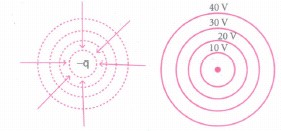
Body placed at the centre are shown. Identify the polarity of the charge & draw the electric field lines due to it
29.
The graph shows the variation of voltage 'v' across the plates of two capacitors A & B versus increase of charge 'Q' stored on them. Which of the two capacitors has higher capacitance?
Give reason.
30.
State the elements of Earth's magnetic field.
31.
What is meant by Sinusoidal alternating voltage and current? Give its expression.
32.
What is meant by power transmission?
33.
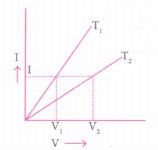
The current-voltage graphs for a given metallic at two different temperatures T1 & T2 are shown in figure. The temperature. T2 is greater than temperature T1. State whether statement is true or false. Given reason.
34.
What is the effective resistance of resistors connected in series?
35.
Two isolated metal spheres A & B have radii R & 2R respectively and same charge q. Find which of the two spheres have greater energy density just outside the surface of the sphere.
36.
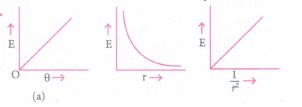
Represent the variation of electric field due to point charge Q with
a) magnitude of charge Q
b) r and
c) \(\frac{1}{r^2}\) where r is the distance of the observation point from the charge graphically.
37.
What are free electrons?
38.
A charge Q μC is placed at the centre of a cube what would be the
(i) flux through one face?
(ii) flux passing through two opposite faces of the cube?
Electric flux through whole cube \(\frac { Q }{ { \varepsilon }_{ 0 } } \)
39.
(i) Two insulated charged copper spheres A & B of identical size have charges qn and -3qA respectively. When they are brought in contact with each other and then separated. What are the new charges on them?
(ii) When third sphere of some size but uncharged is brought in contact with first and then second and finally removed? What are the new charges.
40.
What is magnetic permeability?
41.
Define magnetic dipole moment.
42.
Write down the integral form of modified Ampere’s circuital law.
43.
Define ‘electric field’
44.
What is meant by quantisation of charges?
45.
Define current density.
46.
Define electrical resistivity.
47.
State microscopic form of Ohm’s law.
48.
What are the advantages and disadvantages of a reflecting telescope?
49.
Derive the relation between f and R for a spherical mirror.
50.
State the laws of reflection.
1.
This is because, in total internal reflection, 100% of incident light gets reflected. On the other hand, in ordinary reflection. 20%-30% of incident light is lost. So, images formed in the first case are brighter than the images formed in the second case.
2.
\(\\ \mu =\cfrac { c }{ v } =\cfrac { sini }{ sinr } \)
It follows that: v of sin r Since r is minimum in medium R, therefore, sin r and hence the velocity of light is minimum in medium R.
3.
\(\beta =\cfrac { D\lambda }{ d } ,i.e\beta \propto \lambda \) the wavelength of blue light is less than that of red light, hence if red light is replaced by blue light, the fringe width decreases, i.e., fringes come closer.
4.
The phenomenon of addition or superposition of two light waves which produces increase in intensity at some points and decrease in intensity at some other points is called interference of light.
5.
(i) If the crest of one wave meets the crest of the other wave or the trough of one wave meets the trough of the other wave, the waves are in-phase.
(ii) At these point, the displacement is maximum and these points appear bright. This is known as constructive interference.
6.
\(\lambda =\frac { h }{ \sqrt { 2mqV } } ;\lambda '=\frac { h }{ \sqrt { 3\times 2meV } } \)
\(\frac { \lambda ' }{ \lambda } =\frac { 1 }{ \sqrt { 3 } } \quad \frac { \lambda }{ \sqrt { 3 } } \)
7.
From Einstein's photoelectric equation hv = W + Ek
Ek = hv - W
Clearly, the smaller the work function, the greater is the K.E. As W1 > W2 K.E for metal of work function W2 will be greater.
8.
Sensitive element made of semiconductor is used which generates voltage proportional to the intensity of light or other radiations.
9.
The potential barrier which prevents free electrons from leaving the metallic surface is called surface barrier.
10.
Cosmology is the branch that involves the origin and evolution of the universe. It deals with formation of stars, galaxy etc.
11.
(I) In 1954, George Devol invented the first digitally operated programmable robot called Unimate. George Devol and Joseph Engelberger, the father of the modern robotics industry formed the world's first robot company in 1956.
(ii) In 1961, Unimate, was operated in a General Motors automobile factory for moving car parts around in New Jersey.
12.
The scales on the wings of a morpho butterfly contain nanostructures that change the way light waves interact with each other, giving the wings brilliant metallic blue and green hues.
13.
At room temperature, a potential difference equal to the barrier potential is required before a reasonable forward current starts flowing across the diode. This voltage is known as threshold voltage or cut-in voltage or knee voltage.
14.
The application of suitable DC voltages across the transistor terminals is called biasing
Types: i) Forward bias ii) Reverse bias
15.
(i) Seven-segments displays
(ii) Indicator lamps on the front panel of the scientific and laboratory equipments.
(iii) Traffic signals, exit signs, emergency vehicle lighting etc
16.
The fuel bundles which consist of tiny pellets of uranium oxide are placed in calandria reactor vessel. The part of the reactor vessel which contains the fuel rod is known as reactor core.
17.
Neutrons are classified according to their kinetic energy as
(i) slow neutrons (0 to 1000 eV)
(ii) fast neutrons (0.5 MeV to 10 MeV).
18.
The process of breaking up of the nucleus of a heavy atom into two fragments with the release of large amount of energy is known as nuclear fission.
19.
In nuclear fusion reaction, the energy liberated per unit mass of the nuclei taking part in the reaction is many times larger than the energy liberated in a fission reaction.
20.
(i) Alpha ray has high ionizing power.
(ii) α - particle has a large mass and large nuclear cross-section. So it has high ionizing power.
21.
The de Broglie wavelength associated with the kinetic energy K is \(\lambda=\frac{h}{\sqrt{2 m k}}\)
Where m is the mass of the particle
Since proton and electron have same KE, the wavelength is inversely proportional to square root of the mass \(\lambda \alpha \frac{1}{\sqrt{m}}\)
Mass of proton is 1840 times greater them that of electron. Therefore, de Broglie's wavelength of electron is greater than the proton.
22.
i) Uniaxial crystals (only one optic axes)
eg: calcite qrartz, ice, tourmaline
ii) Biaxial crystals. (two optic axes)
eg: Mica, topaz, selenite
23.
The mean life time of the nucleus is the ratio of sum or integration of life times of all nuclei to the total number nuclei present initially.
\(\tau =\frac { 1 }{ \lambda } \)
24.
Polarisation by selective absorption
Selective absorption is the property of a material which transmits waves whose electric fields vibrate in a plane parallel to a certain direction of orientation and absorbs all other waves.
25.
(i) In Grating, the combined width of a ruling and a slit is called 'grating element' (1.e.) e = a + b.
26.
27.
It is used in radar systems for aircraft navigation, speed of the vehicle, microwave oven for cooking, and very long-distance wireless communication through satellites.
28.
For a single charge the potential V \(=\frac { { q } }{ 4\pi { \varepsilon }_{ 0 }^{ }r } \)
This shows that V is constant if 'r' is constant. Greater the radius smaller will be the potential. In the given figure potential is increasing. This shows that the polarity of charge is positive. The direction of electric field will be radially inward. The field lines are directed from here to lower potential.
29.
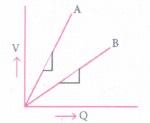
\(C=\frac { Q }{ V } =\frac { 1 }{ slope } \)
As slope of A is smaller capacitance of A is higher.
30.
There are three quantities required to specify the magnetic field of the earth on its surface, which are often called as the elements of the earth's magnetic field. they are
(a) Magnetic declination (D)
(b) Magnetic dip or inclination (I)
(c) the horizontal component of the Earth's magnetic field (BH)
31.
If the waveform of alternating voltage is a sine wave, then it is known as sinusoidal alternating voltage which is given by the relation.
v = Vm sin ωt
where v is the instantaneous value of alternating voltage; Vm is the maximum value (amplitude) and w is the angular frequency of the alternating voltage.
i = Im sin ωt
where Im is the maximum value (amplitude) of the alternating current. The direction of sinusoidal voltage or current is reversed after every half-cycle and its magnitude is also changing continuously.
32.
Most of the power stations are located in remote places. Hence the electric power generated is transmitted over long distances through transmission lines to reach towns or cities where it is actually consumed. This process is called power transmission.
33.
The given statement is true. It is deal from the figure that the resistance of metallic wire is larger at temperature T2 then at temperature T21. So it implies that T2>T1
34.
When several resistances are connected in series, the total or equivalent resistance is the sum of the individual resistances
R5 = R1 + R2 + .........+ Rn.
35.
Energy density U\(=\frac { 1 }{ 2 } { \varepsilon }_{ 0 }{ E }_{ 2 }\)
But \(E=\frac { \sigma }{ { \varepsilon }_{ 0 } } =\frac { Q }{ { A\varepsilon }_{ 0 } } \)
\(\therefore U=\frac { 1 }{ 2 } .\frac { { \varepsilon }_{ 0 }{ Q }_{ 2 } }{ { A }^{ 2 }{ \varepsilon }_{ 0 } } \Rightarrow U=\frac { { Q }_{ 2 } }{ 2A^{ 2 } } \)
\(U\alpha \frac { 1 }{ { A }^{ 2 } } \Rightarrow { U }_{ A }>{ U }_{ B }\)
36.
37.
Atoms in metals have one or more electrons which are loosely bound to the nucleus. These electrons are called free electrons and can be easily detached from the atoms by applying small energy.
38.
(i) Electric flux through one face \(=\frac { 1 }{ 6 } .\frac { Q }{ { \varepsilon }_{ 0 } } \mu { V }_{ m }\)
(ii) By symmetry the flux through each of the six faces of cube will be same when charge is placed at the centre.
\(\\ \therefore { \phi }_{ E }=\frac { 1 }{ 6 } .\frac { Q }{ { \varepsilon }_{ 0 } } \)
Thus electric flux passing through two opposite faces of the cube
\(=2\times \frac { 1 }{ 6 } .\frac { Q }{ { \varepsilon }_{ 0 } } \)
\(\phi =\frac { 1 }{ 3 } .\frac { Q }{ { \varepsilon }_{ 0 } } \)
39.
(i) Charge on each sphere \(=\frac { { q }_{ A }-{ 3q }_{ A } }{ 2 } =-{ q }_{ A }\)
(ii)New charge on A is \(\frac { { q }_{ A } }{ 2 } \)
New charge on B is \(\frac { { q }_{ A }(2{ q }_{ B }) }{ 4 } \)
\(\because \frac { \frac { { q }_{ A } }{ 2 } +{ q }_{ B } }{ 2 } =\frac { { q }_{ A } }{ 4 } +\frac { q_{ B } }{ 2 } =\frac { { q }_{ A }+2{ q }_{ B } }{ 4 } \)
qB = -3qA
∵ qB = -3qA
∴ New charge on B1 is \(\frac { { q }_{ A }-{ 6q }_{ A } }{ 4 } \)
New charge on B \(-\frac { 5 }{ 4 } { q }_{ A }\)
40.
Magnetic permeability is the measure of ability of the material to allow the passage of magnetic field lines through it.
41.
Magnetic dipote moment \(\vec { p }_{ m } \) is defined as the product of its pole strength and magnetic length. It is a vector quantity denoted by \(\vec { p }_{ m } \)
\(\vec { p }_{ m } ={ q }_{ m }\vec { d } \)
42.
\(\oint _l\vec{B} \cdot \overrightarrow{d l}=\mu_{o} i_{\text {c }}+\mu_{o} \varepsilon_{o} \frac{d}{d t} \oint _s \vec{E} \cdot \overrightarrow{d A}\)
43.
Electric field at the point P at a distance r from the point charge q is the force experienced by a unit positive placed at that point P and is given by
\(\vec { E } =\frac { \vec { F } }{ q_{ 0 } } =\frac { kq }{ { r }^{ 2 } } \hat { r } =\frac { 1 }{ 4\pi { \varepsilon }_{ 0 } } \frac { q }{ { r }^{ 2 } } \hat { r } \)
where \(\hat{r}\) is the unit vector pointing from q to the point of interest P.
44.
The charge of an electron is the elementary charge in nature. Therefore, charge on any body is the integral multiple of an electron. The charge on any body can be expressed by the formula,
q = ne; where, n is the number of electrons, e is the charge on one electron.
n = 0, ±1, ±2, ±3, ±4, ...
This is called quantization of charge.
45.
Current density is J in a conductor is defined as the current flowing per unit area of cross-section of the conductor
\(\therefore J=\cfrac { I }{ A } \)
Where I - current
A - area of cross section
46.
Electrical resistivity of a material is defined as the resistance offered to current flow by a conductor of unit length having unit area of cross section.
47.
Microscopic form of ohm's law is
\(\vec{J}=\sigma\vec {E}\)
\(J=\frac{ne^2\tau}{m}\vec{E}\)
\(\frac{e \tau}{m} \rightarrow Drift \ velocity \ v_d\)
where \(\vec{J} \) - current density
\(\sigma \) - conductivity
\(\vec{E} \) - Electric field
48.
Advantages:
Only one surface it to be polished and maintained. Support can be given from the entire back of the miror rather than only at the rim for lens. Mirrors weigh much less compared to lens.
Disadvantages:
The objective mirror would focus the light inside the telescope tube.
49.
Relation between f and R:
C ⇒ Center of curvature
F ⇒ Principal focus
i ⇒ Angle of incidence
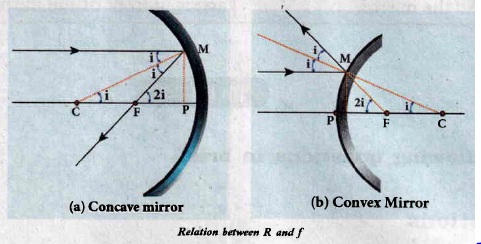
The angles
\(\tan i=\frac{P M}{P C} \text { and } \tan 2 i=\frac{P M}{P F}\)
As the angles are small, tan i = i and tan 2i = 2i.
\(\mathrm{i}=\frac{\mathrm{PM}}{\mathrm{PC}} \text { and } 2 \mathrm{i}=\frac{\mathrm{PM}}{\mathrm{PF}}\)
Simplifying further,
\(2 \frac{\mathrm{PM}}{\mathrm{PC}}=\frac{\mathrm{PM}}{\mathrm{PF}} ; 2 \mathrm{PF}=\mathrm{PC}, \mathrm{R}=2 \mathrm{f}\)
PF is focal length f and PC is the radius of curvature R.
R = 2f (or) f = R/2
50.
The law of reflection states that the incident ray, the reflected ray, and the normal to the surface of the mirror all lie in the same plane. The angle of reflection is equal to the angle of incidence.

12th Standard Syllabus & Materials
12th Standard
TN 12th Computer Applications வலையமைப்பு வடமிடல் Sample Question Papers Study Material - QB365 Set A
NEW12th Standard
TN 12th Computer Applications களப்பெயர் முறைமை (DNS) Sample Question Papers Study Material - QB365 Set A
NEW12th Standard
TN 12th Computer Applications வலையமைப்பு எடுத்துக்காட்டுகள் மற்றும் நெறிமுறைகள் Sample Question Papers Study Material - QB365 Set A
NEW12th Standard
TN 12th Computer Applications கணினி வலையமைப்பு ஓர் அறிமுகம் Sample Question Papers Study Material - QB365 Set A



Tamilnadu Stateboard 12th Standard Subjects

Maths

Chemistry
Physics

Biology

Computer Science

Business Maths and Statistics

Economics

Commerce

Accountancy

History

Computer Applications
Biology
Computer Technology
Computer Applications
Computer Science
Business Maths and Statistics
Commerce
Economics
Maths
Chemistry
Physics
Computer Technology
History
Accountancy

Tamil

English

French
Tamilnadu Stateboard Standards

