
 100% FREE ACCESS
12th Standard Syllabus & Materials
12th Standard
TN 12th Maths Applications of Matrices and Determinants Sample Question Papers Study Material - QB365 Set A
NEW12th Standard
TN 12th Computer Applications மின்னணு தரவு பரிமாற்றம் Sample Question Papers Study Material - QB365 Set A
NEW12th Standard
TN 12th Computer Applications மின் - வணிக பாதுகாப்பு அமைப்புகள் Sample Question Papers Study Material - QB365 Set A
NEW12th Standard
TN 12th Computer Applications மின்னணு செலுத்தல் முறைகள் Sample Question Papers Study Material - QB365 Set A
NEW12th Standard
TN 12th Computer Applications மின் - வணிகம் Sample Question Papers Study Material - QB365 Set A
NEW12th Standard
TN 12th Computer Applications திறந்த மூல கருத்துருக்கள் Sample Question Papers Study Material - QB365 Set A

Published on: 27/02/2021
12th Standard English Medium Physics Reduced syllabus Two mark important Questions with Answer key - 2021(Public Exam )
Download Tamil Nadu 12th Standard Physics question papers, model tests, one-mark questions, important questions, and public exam papers in PDF format. Free study materials and answer keys for TN State Board students.
Questions + Answers key
Take MCQ Physics Test1.
How is a galvanometer converted into (i) an ammeter and (ii) a voltmeter?
2.
Explain the concept of velocity selector.
3.
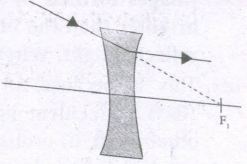
A ray of light incident on a concave lens becomes parallel to the principal axis after refraction. Show this situation with the help of a ray diagram.
4.
Which of the following waves can be polarized
(i) Heat waves
(ii) Sound waves? Give reason to support your answer.
5.
What is total internal reflection?
6.
What is meant by focal plane?
7.
A proton and a deuteron have the same velocity, what is the ratio of their de Broglie wavelengths?
8.
What kind of blueprint does the natural structure provide?
9.
What is modulated wave?
10.
What is barrier potential?
11.
Classify the neutrons according to their kinetic energy.
12.
What is a photo cell? Mention the different types of photocells.
13.
Distinguish between Nanoscience and Nanotechnology.
14.
What is call 'grating element'?
15.
Write a general notation of nucleus of element X. What does each term denote?
16.
What is distance of closest approach?
17.
What is meant by excitation energy?
18.
Discuss the special cases on first minimum in Fraunhofer diffraction.
19.
State Huygens’ principle.
20.
What is the significance of electromagnetic wave theory of light?
21.
What are primary focus and secondary focus of a lens?
22.
Write a note on optical fibre.
23.
What is relative refractive index?
24.
What is angle of deviation due to refraction?
25.
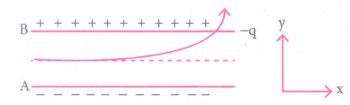
A particle of mass m and charge (-q) enters the region between the two charged plates initrally moving along X-axis with speed Vx as shown in figure. The length of plate is L and an uniform electric field E is maintained between the plates. S.T. vertical deflection of the particle at the far edge of the plate is \(\frac { q{ EL }^{ 2 } }{ 2m{ V }_{ x }^{ 2 } } \).
26.
27.
State Right hand thumb rule.
28.
What is meant by
(i) Geographic axis
(ii) Geographic meridian &
(iii) Geographic equator?
29.
What is waltless current?
30.
When does the phenomenon of resonance is possibble in the circuit?
31.
What is meant by Sinusoidal alternating voltage and current? Give its expression.
32.
Why are resistors connected in series and in parallel
(i) To increase the resistor of the circuit
(ii) The resistors are connected in series.
33.
What do you mean by end resistance? How can it be rectified?
34.
What is the electric flux through a cube of side 1 cm which encloses on electric dipole?
35.
What is meant by dielectric breakdown?
36.
What are Non-polar molecules? State examples.
37.
Define magnetic dipole moment.
38.
How will you define Q-factor?
39.
Define electric resonance.
40.
How is Eddy current produced? How do they flow in a conductor?
41.
42.
Write down the integral form of modified Ampere’s circuital law.
43.
What are electromagnetic waves?
44.
Define ‘electrostatic potential energy’.
45.
What is electric power and electric energy?
46.
Why current is a scalar?
47.
Name an experiment that shows the wave nature of the electron. Which phenomenon was observed in this experiment using an electron beam?
48.
What are plane polarised, unpolarized and partially polarised light?
49.
State Maxwell's right hand cork screw rule?
50.
Explain the working principle of a solar cell. Mention its applications.
1.
(i) A galvanometer is converted into an ammeter by connecting a low resistance in parallel with the galvanometer.
(ii) A galvanometer is converted into a volmeter by connecting high resistance Rs in series with the galvanometer.
2.
It is an arrangement of eletric field (E) and magnetic field (B) perpendicular to each other. When charged particles enter that region, particles with a certain velocity can pass through that region.
v = E/B
The speed is independent of charge and mass.
3.
In the ray diagram, the incident ray is directed towards the first principal focus of the concave lens. After refraction, this ray becomes parallel to the principal axis.
4.
Heat waves are transverse or electromagnetic in nature whereas sound wave are not. Polarisation is possible only for transverse waves.
5.
The entire light is reflected back into the denser medium itself. This phenomenon is called total internal reflection.
6.
The plane through the focus and perpendicular to the principal axis is called the focal plane of the mirror.
7.
de Broglie wavelength \(\lambda =\frac { P }{ m } \propto \frac { 1 }{ m } \) for the same velocity v.
\(\frac { { \lambda }_{ p } }{ { \lambda }_{ d } } =\frac { { m }_{ d } }{ { m }_{ p } } =\frac { 2{ m }_{ p } }{ { m }_{ p } } =\frac { 2 }{ 1 } \) = 2.1
8.
The natural structure provides a blueprint for creating ultra-durable synthetic materials that could be useful for mechanical components in electronics, and in other devices that undergo repetitive movement, abrasion and contact stress.
9.
The signal wave that results on superimposing the modulating wave on the carrier wave is called modulated wave.
10.
The internal repulsion of the depletion layer stops further diffusion of free electrons across the junction. This difference in potential across the depletion layer is called barrier potential.
11.
Neutrons are classified according to their kinetic energy as
(i) slow neutrons (0 to 1000 eV)
(ii) fast neutrons (0.5 MeV to 10 MeV).
12.
Photo cell is a device which converts light energy into electrical energy. It works on the principle of photo electric effect. When light is incident on photosensitive materials, their electric properties will get affected, based on which Photo cells are classified into three types. They are
(i) Photo emissive cell
(ii) Photo voltaic cell
(iii) Photo conductive cell
13.
(i) Nano science is the science of objects with typical sizes of 1 - 100 nm. It deals with the study of property change when a matter is divided into nano particles.
(ii) Nanotechnology is a technology involving the design, production, characterisation and applications of nano structured materials.
14.
(i) In Grating, the combined width of a ruling and a slit is called 'grating element' (1.e.) e = a + b.
15.
General Notation -\(_{ Z }^{ A }{ X }\)
A - Mass number of nucleus - the total number of neutrons and protons in the nucleus
Z - atomic number of nucleus - the total number of protons in the nucleus
X - chemical symbol of the element.
16.
The minimum distance between the centre of the nucleus and the alpha particle just before it gets reflected back through 1800 is defined as the distance of closest approach ro (also known as contact distance).
17.
The energy required to excite an electron from lower energy state to any higher energy state is known as excitation energy.
18.
The equation for first minimum in single slit diffraction is, a sin θ = λ.
\(sin\theta =\cfrac { \lambda }{ a } \)
Cases:
(i) When a < λ, the diffraction is not possible, because sin θ > 1.
(ii) When a ≥ λ, the diffraction is possible.
For a = λ, sin θ = 1 i.e, θ = 90°. That means the first minimum is at 90°.
For a >> λ, sin θ << 1 i.e, the first minimum fall within the width space of the slit itself.
(iii) When a > λ and also comparable, say a = 2λ, \(sin\theta =\cfrac { 1 }{ 2 } \), then θ = 30°. These are practical cases where diffraction could be observed effectively.
19.
According to Huygens's principle, each point of the wavefront is the source of secondary wavelets emanating from these points spreading out in all directions with the speed of the wave. These are called as secondary wavelets.
20.
Electromagnetic wave theory of light:
Light is an electromagnetic wave which is transverse in nature carrying electromagnetic energy. No medium is necessary for the propagation of electromagnetic waves. All the phenomenon of light could be successfully explained by this theory.
21.
Primary focus:
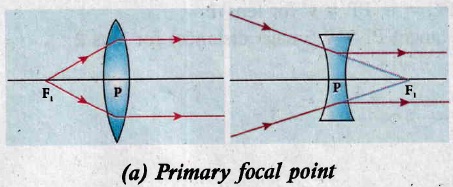
(i) The primary focus FI is defined as a point where an object should be placed to give parallel emergent rays to the principal axis after passing through lens.
Secondary focus:
.jpg)
(ii) The secondary focus F2 is defined as a point where all the parallel rays travelling close to the principal axis converge to form an image on the principal axis after passing through lens.
22.
(i) Optical fibers consist of the inner part called core and the outer part called cladding (or) sleeving. The refractive index of core is higher than that of cladding.
(ii) Signal in the form of light is made to incident inside the core-cladding boundary at an angle greater than the critical angle. So, that total internal reflection happens without undergoing any refraction. The light travels without appreciable loss of intensity.
23.
\(\cfrac { sini }{ sinr } =\cfrac { { n }_{ 1 } }{ { n }_{ 2 } } \) (Snell's law)
The term \(\left( \cfrac { { n }_{ 2 } }{ { n }_{ 1 } } \right) \) is called relative refractive index of second medium with respect to the first medium \(n_{21}=\left( \cfrac { { n }_{ 2 } }{ { n }_{ 1 } } \right) \)
(i) Inverse rule: \(n_{21}=\frac{1}{n_{21}}(or)\cfrac { { n }_{ 1 } }{ { n }_{ 2 } }=\frac{1}{(n_2/n_1)}\)
(ii) Chain rule: \(n_{32}=n_{31} \times n_{21}(or)\frac{n_3}{n_2}=\frac{n_3}{n_1}\times\frac{n_1}{n_2}\)
24.
The angle between the incident and deviated light is called Angle of deviation due to refraction. When light travels from
(i) rarer to denser medium, d = i - r
(ii) denser to rarer medium, d = r - i
25.
Force on particle towards upper plate B, F-y = qE
Vertical acceleration of particle ay=\(\frac{qE}{m}\)
Initial vertical velocity Vy = 0
Time taken by particle between the plates t = \(\frac{L}{V_x}\)
From equation of motion s = ut + \(\frac{1}{2}\) at2
Vertical deflection y = 0 + \(\frac{1}{2}\) ayt2
\(=0+\frac { 1 }{ 2 } \left( \frac { qE }{ m } \right) { \left( \frac { L }{ { V }_{ x } } \right) }^{ 2 }\)
\(y=\frac { q{ EL }^{ 2 } }{ 2m{ V }_{ x }^{ 2 } } \)
26.
27.
If we hold the current carrying conductor in our right hand such that the thumb points in the direction of current flow, then the fingers encircling the wire points in the direction of the magnetic field lines produced.
28.
Day and night occur because Earth spins about an axis called geographic axis. A vertical plane passing through the geographic axis is called geographic meridian and a great circle perpendicular to Earth's geographic axis is called geographic equator.
29.
The current in an a.c circuit is waltless if the average power consumed in the circuit is zero.
30.
The phenomenon of electrical resonance is possible when the circuit contains both L and C. Only then does the voltage across L and C cancels one another when VL and VC are 1800 out of phase and the circuit becomes purely resistive. This implies that resonance will not occur in RL and RC circuits.
31.
If the waveform of alternating voltage is a sine wave, then it is known as sinusoidal alternating voltage which is given by the relation.
v = Vm sin ωt
where v is the instantaneous value of alternating voltage; Vm is the maximum value (amplitude) and w is the angular frequency of the alternating voltage.
i = Im sin ωt
where Im is the maximum value (amplitude) of the alternating current. The direction of sinusoidal voltage or current is reversed after every half-cycle and its magnitude is also changing continuously.
32.
(i) To increase the resistance of the circuit the resistor are connected in series.
(ii) When they are connected in parallel resistance of the circuit is decreased
33.
The bridge wire is soldered at the ends of the copper strips. Due to imperfect contact, some resistance, might be introduced at the contact. These are called end resistances. This error can be eliminated, if another set of readings are taken with P and Q interchanged and the average value of P is found.
34.
Net electric flux is zero because
(i) It is independent to the shape and size
(ii) Net charge of the electric dipole is zero.
35.
When the external electric field applied to a dielectric is very large, it tears the atoms apart so that the bound charges become free charges. Then the dielectric starts to conduct electricity. This is called dielectric breakdown.
36.
(i) A non-polar molecule is one in which centers of positive and negative charges coincide. As a result, it has no permanent dipole moment.
(ii) Examples of non-polar molecules are hydrogen (H2), oxygen (O2), and carbon di oxide (CO2).
37.
Magnetic dipote moment \(\vec { p }_{ m } \) is defined as the product of its pole strength and magnetic length. It is a vector quantity denoted by \(\vec { p }_{ m } \)
\(\vec { p }_{ m } ={ q }_{ m }\vec { d } \)
38.
Q factor is defined as the ratio of voltage across L or C to resonance to the applied voltage
Q - factor = \(\frac{Voltage \ across \ L \ or \ C \ resonance }{Applied \ voltage}\)
\(Q-factor=\frac{X_{L}}{R}=\frac{1}{R}\sqrt\frac{{L}}{C}\)
39.
When the frequency of the applied alternating source (ωr) is equal to the natural frequency \(\left[\frac{1}{\sqrt{L C}}\right]\) of the RLC circuit, the current in the circuit reaches its maximum value. Then, the circuit is said to be in electrical resonance.
40.
Even for a conductor in the form of a sheet or plate, an emf is induced when magnetic flux linked with it changes. But the difference is that there is no definite loop or path for induced current to flow away. As a result, the induced currents flow in concentric circular paths. As these electric currents resemble eddies of water, these are known as Eddy currents. They are also called Foucault currents.
41.
42.
\(\oint _l\vec{B} \cdot \overrightarrow{d l}=\mu_{o} i_{\text {c }}+\mu_{o} \varepsilon_{o} \frac{d}{d t} \oint _s \vec{E} \cdot \overrightarrow{d A}\)
43.
An electromagnetic waves are the waves that are radiated by an accelerated charge which propagates through space as coupled electric and magnetic fields, oscillating perpendicular to each other and to the direction of propagation of the wave.
44.
Electrostatic potential energy is the work done to assemble the charges at the given locations brought from infinity. If q1 and q2 are the charges to be assembled with a separation of distance r, the electric potential energy is, \(U=\frac{1}{4\piε_o}\frac{q_1q_2}{r}\)
45.
Electric power:
(i) The electric power P is the rate at which the electrical potential energy is delivered.
(ii) The electric power P is the rate at which the work is done.
\( P= \frac{d U}{d t} (or)= \frac{d W}{d t} (or)=VI(or)\frac{V^2}{R}\)
Unit: watt (W)
Electric energy:
(i) The electric energy is the product of power (P) and duration of the time (t) when electric energy is delivered.
(ii) E = Pt
Unit: watt-hour (Wh)
46.
Current is defined as the ratio of the net (i.e. amount of) charge (Q) passing through any cross section of a conductor to time.
\(I=\frac{Q}{t}\)
Since current is the ratio of two scalar quantities, it is a scalar. In addition current I is defined as the scalar product of the current density and area vector at which the charges cross.
I = \(\vec{J}.\vec{A}\)
47.
(i) Davisson - Germer experiment
(ii) Diffraction phenomenon
48.
Plane Polarised Light:
In plane polarised light the intensity varies from maximum to zero for every rotation of 90° of the analyser.
Partially Polarised Light:
If the intensity of light varies between maximum and minimum for every rotation of 90° of the analyser, the light is said to be partially polarised light.
Unpolarise Light:
The light is coming out from the source before entering a polarised is called unpolarized light.
49.
If we rotate aright-handed screw by ascrew driver, then the direction of current is same as the direction in which screw advances and the direction of rotation of the screw gives the direction of the magnetic field.
50.
A solar cell, also known as photovoltaic cell, works on the principle of photovoltaic effect Accordingly, the p-n junction of the solar cell generates emf when solar radiation falls on it. The construction details and cross-sectional view are shown in Figure.
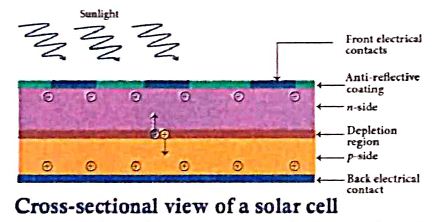
(i) In a solar cell, electron-hole pairs are generated due to the absorption of light near the junction.
(ii) Then the charge carriers are separated due to the electric field of the depletion region.
(iii) Electrons move towards n-type Silicon and holes move towards p-type Silicon layer.
(iv) The electrons reaching the n-side are collected by the front contact and holes reaching p-side are collected by the back electrical contact. Thus a potential difference is developed across solar cell.
(v) When an external load is connected to the solar cell, photocurrent flows through the load.
(vi) Many solar cells are connected together either in series or in parallel combination to form solar panel.
(vii) Many solar panels are connected with each other to form solar arrays.
(viii) For high power applications, solar panels and solar arrays are used.
Applications:
(i) Solar cells are widely used in calculators, watches, toys, portable power supplies, etc.
(ii) Solar cells are used in satellites and space applications.
(iii) Solar panels are used for commercial production of electricity.

12th Standard Syllabus & Materials
12th Standard
TN 12th Computer Applications வலையமைப்பு வடமிடல் Sample Question Papers Study Material - QB365 Set A
NEW12th Standard
TN 12th Computer Applications களப்பெயர் முறைமை (DNS) Sample Question Papers Study Material - QB365 Set A
NEW12th Standard
TN 12th Computer Applications வலையமைப்பு எடுத்துக்காட்டுகள் மற்றும் நெறிமுறைகள் Sample Question Papers Study Material - QB365 Set A
NEW12th Standard
TN 12th Computer Applications கணினி வலையமைப்பு ஓர் அறிமுகம் Sample Question Papers Study Material - QB365 Set A



Tamilnadu Stateboard 12th Standard Subjects

Maths

Chemistry
Physics

Biology

Computer Science

Business Maths and Statistics

Economics

Commerce

Accountancy

History

Computer Applications
Biology
Computer Technology
Computer Applications
Computer Science
Business Maths and Statistics
Commerce
Economics
Maths
Chemistry
Physics
Computer Technology
History
Accountancy

Tamil

English

French
Tamilnadu Stateboard Standards

