
 100% FREE ACCESS
12th Standard Syllabus & Materials
12th Standard
TN 12th Maths Applications of Matrices and Determinants Sample Question Papers Study Material - QB365 Set A
NEW12th Standard
TN 12th Computer Applications மின்னணு தரவு பரிமாற்றம் Sample Question Papers Study Material - QB365 Set A
NEW12th Standard
TN 12th Computer Applications மின் - வணிக பாதுகாப்பு அமைப்புகள் Sample Question Papers Study Material - QB365 Set A
NEW12th Standard
TN 12th Computer Applications மின்னணு செலுத்தல் முறைகள் Sample Question Papers Study Material - QB365 Set A
NEW12th Standard
TN 12th Computer Applications மின் - வணிகம் Sample Question Papers Study Material - QB365 Set A
NEW12th Standard
TN 12th Computer Applications திறந்த மூல கருத்துருக்கள் Sample Question Papers Study Material - QB365 Set A

Published on: 13/05/2022
QB365 provides detailed and simple solution for every Book back Questions in class 12 Physics Subject. It will helps to get more idea about question pattern in every book back questions with solution.
latest Book back QuestionsDownload Tamil Nadu 12th Standard Physics question papers, model tests, one-mark questions, important questions, and public exam papers in PDF format. Free study materials and answer keys for TN State Board students.
Questions + Answers key
Take MCQ Physics Test1.
Obtain the law of radioactivity.
2.
Discuss the spectral series of hydrogen atom.
3.
Discuss the Millikan’s oil drop experiment to determine the charge of an electron.
4.
Discuss the beta decay process with examples.
5.
Explain in detail the nuclear force.
1.
(i) At any instant t, the number of decays per unit time, called rate of decay \(\left( \frac { dN }{ dt } \right) \) is proportional to the number of nuclei (N) at the same instant.
\(\left( \frac { dN }{ dt } \right) \propto N\)
\(\frac { dN }{ dt } =-\lambda N\) ...(1)
(ii) Here, proportionality constant \( \lambda\) is called decay constant which is different for different radioactive sample and the negative sign in the equation implies that the N is decreasing with time. From (1)
\(\frac{\mathrm{dN}}{\mathrm{N}}=-\lambda \mathrm{dt}\) ...(2)
(iii) Here, dN represents number of nuclei decaying in the time interval dt.
(iv) Let us assume that at time t = 0 s, the number of nuclei present in the radioactive sample is No.
(v) By integrating the equation (2), we can calculate the number of undecayed nuclei N at any time t.
\(\int_{N_{0}}^{N} \frac{d N}{N}=-\int_{0}^{t} \lambda d t \)
\({[\ln N]_{N_{0}}^{N}=-\lambda t} \)
\(\ln \left[\frac{N}{N_{0}}\right]=-\lambda t \)
Taking exponential on both sides, we get
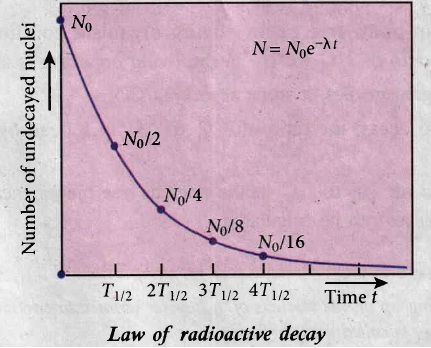
\(\mathrm{N}=\mathrm{N}_{0} \mathrm{e}^{-\lambda t}\) .....(3)
(vi) Equation (3) is called the law of radioactive decay.
(vii) Here N denotes the number of undecayed nuclei present at any time t and No denotes the number of nuclei present initially time t = 0.
(viii) From equation (3) the number of atoms is decreasing exponentially over the time. This implies that the time taken for all the radioactive nuclei to decay will be infinite.
2.
When electron jumps from higher energy stationary orbit (m) to lower energy stationary orbit (n), emit radiation.
Wave number (or) Wave length of the emitted radiation is given by,
\(\frac{1}{\lambda}=R\left[\frac{1}{n^{2}}-\frac{1}{m^{2}}\right]=\bar{v}\)
V - Ware number; R- Rydberg constant = 1.09737 x 10⁷ m-1
m > n (where m, n are integers)
(a) Lyman series:
When electron jumps from any outer orbit to first orbit, (n = 1 and m = 2,3,4.......) the wave number or wavelength of spectral lines lies in ultra-violet region is
\(\bar{v}=\frac{1}{\lambda}=\mathrm{R}\left[\frac{1}{1^{2}}-\frac{1}{\mathrm{~m}^{2}}\right]\)
(b) Balmer series:
Wher electron jumps from any outer orbit to second orbit, (n = 2 and m = 3, 4, 5.......) the wave number or wavelength of spectral lines lies in visible region is,
\(\bar{v}=\frac{1}{\lambda}=R\left[\frac{1}{2^{2}}-\frac{1}{m^{2}}\right]\)
(c) Paschen series:
When electron jumps from any outer orbit to third orbit, (n = 3 and m = 4, 5, 6.......) the wave number or wavelength of spectral lines lies in infra red (Near IR) region is
\(\bar{v}=\frac{1}{\lambda}=R\left[\frac{1}{3^{2}}-\frac{1}{m^{2}}\right]\)
(d) Bracket series:
When electron jumps from any outer orbit to fourth orbit, (n = 4 and m = 5, 6, 7.......) the wave number or wavelength of spectral lines lies in infra red (Middle IR) region is
\(\bar{v}=\frac{1}{\lambda}=R\left[\frac{1}{4^{2}}-\frac{1}{m^{2}}\right]\)
(e) Pfund series:
When electron jumps from any outer orbit to fifth orbit, (n - 5 and m = 6, 7, 8.......) the wave number or wavelength of spectral lines lies in infra red (far IR) region is
\(\bar{v}=\frac{1}{\lambda}=R\left[\frac{1}{5^{2}}-\frac{1}{m^{2}}\right]\)
3.
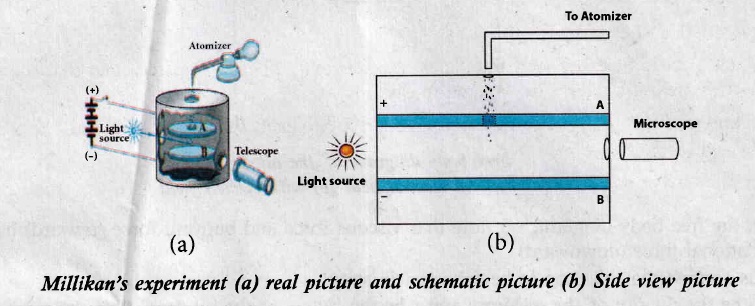
The motion of oil drop inside the chamber can be controlled by adjusting electric field. The oil drop can be moved up or down or even kept balanced in the field of view for sufficiently long time.
Construction:
(i) The apparatus consists of two horizontal circular metal plates A and B each with diameter around 20 cm and are separated by a small distance 1.5 cm.
(ii) These two parallel plates are enclosed in a chamber with glass walls.
(iii) Plates A and B are given a high potential difference around 10 kV such that electric field acts vertically downward
(iv) A small hole is made at the center of the upper plate A.
(v) Atomizer is kept above the hole to spray the liquid.
Working:
(i) When a fine droplet of highly viscous liquid (like glycerine) is sprayed using atomizer, it falls freely downward through the hole under the influence of gravity alone.
(ii) Few oil drops in the chamber can acquire electric charge (negative charge) because of friction with air or passage of x-rays in between the parallel plates.
(iii) The chamber is illuminated by light and oil drops can be seen clearly using microscope.
(iv) These drops can move either upwards or downward.
(v) Let m be the mass of the oil drop and q be its charge. Then the forces acting on the droplet are
(a) gravitational force Fg = mg
(b) electric force Fe = qE
(c) buoyant force Fb
(d) viscous force Fv
(a) Determination of radius of the droplet:
(i) When the electric field is switched off, the oil drop accelerates downwards. Due to presence of air drag forces, the oil drops attain its terminal velocity and moves with constant velocity.
(ii) This velocity can be measured by finding the time taken by the oil drop to fall through a predetermined distance.
.jpg)
(iii) From the free body diagram, we note that viscous force and buoyant force (upward) balance the gravitational force (downward).
(iv) Let us assume that oil drop to be spherical in shape.
(v) Let p be the density of the oil drop, and r be the radius of the oil drop, then the mass of the oil drop, the oil drop can be expressed in terms of its density as, \( \rho=m/v \Rightarrow m=\left(\frac{4}{3} \pi r^{3}\right) \rho\)
∵ (Volume of the sphere, V = \(\frac{4}{3} \pi r^{3})\)
Then gravitational force \(\mathrm{F}_{\mathrm{g}}=\mathrm{mg}=\left(\frac{4}{3} \pi \mathrm{r}^{3}\right) \rho g\)
(vi) Let σ be the density of air, the upthrust force experienced by the oil drop due to displaced air is \(F_{b}=\left(\frac{4}{3} \pi r^{3}\right) σ g\)
(vii) Once the oil drop attains a terminal velocity v, the net downward force acting on the oil drop is equal to the viscous force acting opposite to the direction of motion of the oil drop. From Stokes law, the viscous force on the oil drop is
\(\mathrm{F}_{\mathrm{v}}=6 \pi \eta \mathrm{rv}\)
(ix) From free body diagram, the force balancing equation is,
\(F_{g}=F_{b}+F_{v} \)
\(\left(\frac{4}{3} \pi r^{3}\right) \rho g=\left(\frac{4}{3} \pi r^{3}\right) \sigma g+6 \pi \eta r v \)
\(\frac{4}{3} \pi r^{3}(\rho-\sigma) g=6 \pi \eta r v \)
\(\frac{2}{3} r^{2}(\rho-\sigma) g=3 \eta v \)
Hence radius of the oil drop is \(r=\left[\frac{9 \eta v}{2(\rho-\sigma) g}\right]^{\frac{1}{2}} \ldots\) ........(1)
(b) Determination of electric charge:
(i) Now switch on the electric field.
(ii) Upward electric force on charged oil drops is qE.
(iii) Choose any one drop in the field of view of microscope.
(iv) Strength of the electric field is adjusted to make that particular drop to be stationary.
(v) Being oil drop is at rest, the viscous force acting on the oil drop is zero.
(vi) Then, from the free body diagram.
\(F_{g}=F_{b}+F_{v} \)
\(\left(\frac{4}{3} \pi r^{3}\right) \rho g=\left(\frac{4}{3} \pi r^{3}\right) \sigma g+q E \)
\(\frac{4}{3} \pi r^{3}(\rho-\sigma) g=q E \)
\(q=\frac{4}{3 E} \pi r^{3}(\rho-\sigma) g \ldots \ldots \ldots \ldots \ldots \) (2)
Substituting (1) in (2)
\(q=\frac{18 \pi}{E}\left(\frac{\eta^{3} v^{3}}{2(\rho-\sigma) g}\right)^{\frac{1}{2}}\)
(vii) Millikan repeated this experiment several times and computed the charges on oil drops. He found that the charge of any oil drop can be written as integral multiple of a basic value, -1.6 x 10⁻¹⁹ C which is nothing but the charge of an electron.
4.
(i) In beta decay, a radioactive nucleus emits either electron or positron. If electron (e-) is emitted, it is called β- decay and if positron (e+) is emitted, it is called β- decay
(ii) The positron is an anti-particle of an electron whose mass is same as that of electron and charge is opposite to that of electron - that is, +e. Both positron and electron are referred to as beta particles.
β- decay:
(iii) β- decay: In β- decay, the atomic number of the nucleus increases by one but mass number remains the same. This decay is represented by
\(_{ Z }^{ A }{ X }\rightarrow _{ Z+1 }^{ A }{ Y+ }{ e }^{ - }+\bar { v } \) ...(1)
(iv) It implies that the element X becomes Y by giving out an electron and antineutrino (⊽).
(v) In other words, In each β- decay, one neutron (n) in the nucleus of X is converted into a proton(p) by emitting an electron (e-) and antineutrino(⊽). It is given by
\(n\rightarrow p+{ e }^{ - }+\bar { v } \)
Example :
\(_{ 6 }^{ 14 }{ C }\rightarrow _{ 7 }^{ 14 }{ N+ }{ e }^{ - }+\overline { v } \)
β+ decay:
(vi) In β+ decay, the atomic number is decreased by one and the mass number remains the same. This decay is represented by
\(_{ Z }^{ A }{ X }\rightarrow _{ Z-1 }^{ A }{ Y+ }{ e }^{ + }+v\)
(vii) It implies that the element X becomes Y by giving out an positron (e+) and neutrino (v),
In otherwords, in each β+ decay, one proton(p) in the nucleus of X is converted into a neutron by emitting a positron (e+) and a neutrino. It is given by
\(p\rightarrow n+{ e }^{ +}+{ v } \)
Example:
\(_{ 11 }^{ 22 }{ Na }\rightarrow _{ 10 }^{ 22 }{ Ne }+{ e }^{ + }+v\)
(viii) However a single proton (not inside any nucleus) cannot have β+ decay due to energy conservation, because neutron mass is larger than proton mass.
(ix) But a single neutron (not inside any nucleus) can have β- decay.
(x) It is important to note that the electron or positron which comes out from nuclei during beta decay never present inside the nuclei rather they are produced during the conversion of neutron into proton or proton into neutron inside the nucleus.
5.
(i) The strong nuclear force is of very short range, acting only up to a distance of a few Fermi. But inside the nucleus, the repulsive Coulomb force or attractive gravitational forces between two protons are much weaker than the strong nuclear force .between two protons. Similarly, the gravitational force between two neurons is. also much weaker than strong nuclear force between the neutrons. So nuclear force is the strongest force in nature.
(ii) The strong nuclear force is attractive and acts with an equal strength between proton-proton, proton-neutron, and neutron-neutron.
(iii) Nuclear force does not act on the electrons. So it does not alter the chemical properties of the atom.

12th Standard Syllabus & Materials
12th Standard
TN 12th Computer Applications வலையமைப்பு வடமிடல் Sample Question Papers Study Material - QB365 Set A
NEW12th Standard
TN 12th Computer Applications களப்பெயர் முறைமை (DNS) Sample Question Papers Study Material - QB365 Set A
NEW12th Standard
TN 12th Computer Applications வலையமைப்பு எடுத்துக்காட்டுகள் மற்றும் நெறிமுறைகள் Sample Question Papers Study Material - QB365 Set A
NEW12th Standard
TN 12th Computer Applications கணினி வலையமைப்பு ஓர் அறிமுகம் Sample Question Papers Study Material - QB365 Set A



Tamilnadu Stateboard 12th Standard Subjects

Maths

Chemistry
Physics

Biology

Computer Science

Business Maths and Statistics

Economics

Commerce

Accountancy

History

Computer Applications
Biology
Computer Technology
Computer Applications
Computer Science
Business Maths and Statistics
Commerce
Economics
Maths
Chemistry
Physics
Computer Technology
History
Accountancy

Tamil

English

French
Tamilnadu Stateboard Standards



