
 100% FREE ACCESS
12th Standard Syllabus & Materials
12th Standard
TN 12th Maths Applications of Matrices and Determinants Sample Question Papers Study Material - QB365 Set A
NEW12th Standard
TN 12th Computer Applications மின்னணு தரவு பரிமாற்றம் Sample Question Papers Study Material - QB365 Set A
NEW12th Standard
TN 12th Computer Applications மின் - வணிக பாதுகாப்பு அமைப்புகள் Sample Question Papers Study Material - QB365 Set A
NEW12th Standard
TN 12th Computer Applications மின்னணு செலுத்தல் முறைகள் Sample Question Papers Study Material - QB365 Set A
NEW12th Standard
TN 12th Computer Applications மின் - வணிகம் Sample Question Papers Study Material - QB365 Set A
NEW12th Standard
TN 12th Computer Applications திறந்த மூல கருத்துருக்கள் Sample Question Papers Study Material - QB365 Set A

Published on: 13/05/2022
QB365 provides detailed and simple solution for every Book back Questions in class 12 Physics Subject. It will helps to get more idea about question pattern in every book back questions with solution.
latest Book back QuestionsDownload Tamil Nadu 12th Standard Physics question papers, model tests, one-mark questions, important questions, and public exam papers in PDF format. Free study materials and answer keys for TN State Board students.
Questions + Answers key
Take MCQ Physics Test1.
The Bohr atom model is derived with the assumption that the nucleus of the atom is stationary and only electrons revolve around the nucleus. Suppose the nucleus is also in motion, then calculate the energy of this new system.
2.
3.
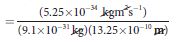
Briefly explain the elementary particles present in nature.
4.
Calculate the density of the nucleus with mass number A.
5.
Calculate the average atomic mass of chlorine if no distinction is made between its different isotopes?
1.
Let the mass of the electron be m and mass of the nucleus be M. Since there is no external force acting on the system, the centre of mass of hydrogen atom remains at rest. Hence, both nucleus and electron move about the centre of mass as shown in figure.
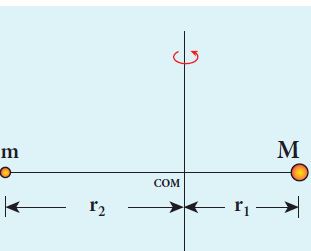
Let V be the velocity of the nuclear motion and υ be the velocity of electron motion. Since the total linear momentum of the system is zero,
−mሀ + Mሀ = 0 or
Mሀ = mሀ = p
\(\vec { { p }_{ e } } +\vec { { p }_{ n } } =\vec { 0 } \) or
\(|\vec { { p }_{ e } } |=|\vec { { p }_{ n } } |=p\)
Hence, the kinetic energy of the system is
KE = \(\frac { { { p }^{ 2 } }_{ n } }{ 2M } +\frac { { { p }^{ 2 } }_{ e } }{ 2m } =\frac { { p }^{ 2 } }{ 2 } \left( \frac { 1 }{ M } +\frac { 1 }{ m } \right) \)
Let \(\frac { 1 }{ M } +\frac { 1 }{ m } =\frac { 1 }{ { \mu }_{ m } } \). Here the reduced mass is
\({ \mu }_{ m }=\frac { mM }{ M+m } \)
Therefore, the kinetic energy of the system now is
\(KE=\frac { { p }^{ 2 } }{ { 2\mu }_{ m } } \)
Since the potential energy of the system is same, the total energy of the hydrogen can be expressed by replacing mass by reduced mass, which is
\({ E }_{ n }=-\frac { { \mu }_{ m }{ e }_{ 4 } }{ 8{ \epsilon ^{ 2 } }_{ 0 }{ h }^{ 2 } } \frac { 1 }{ { n }^{ 2 } } \)
Since the nucleus is very heavy compared to the electron, the reduced mass is closer to the mass of the electron.
2.
3.
(i) An atom has a nucleus surrounded by electrons
(ii) Nucleus is made up of protons and neutrons.
(iii) Till 1960s, it was thought that protons, neutrons and electrons are fundamental building blocks of matter.
(iv) In 1964, physicists Murray Gellman and George Zweig theoretically proposed that protons and neutrons are not fundamental particles in fact they are made up of quarks.
(v) These quarks are now considered elementary particles of nature.
(vi) Electrons are fundamental or elementary particles because they are not made up of anything.
(vii) In the year 1968, the quarks were discovered experimentally by Stanford Linear Accelerator Center (SLAC), USA.
(viii) There are six quarks namely, up, down, charm, strange, top and bottom and their antiparticles.
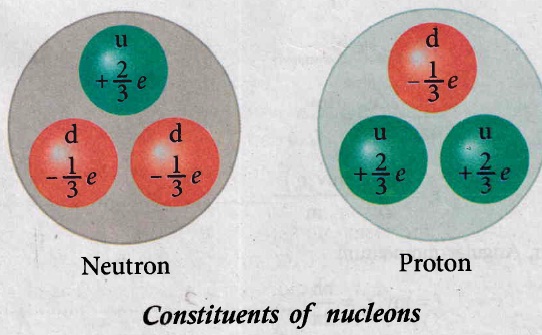
(ix) All these quarks have fractional charges. For example, charge of up quark is + \(\frac23\) e and that of down quark is \(\frac13\) e.
(x) According to quark model, proton is made up of two up quarks and one down quark and neutron is made up of one up quark and two down quarks.
4.
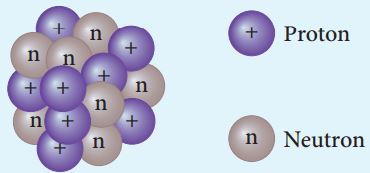
From equation (9.19), the radius of the nuclecus, R = R0 \(A^\frac13\). Then the volume of the nucleus
\(V=\frac { 4 }{ 3 } \pi { R }^{ 3 }=\frac { 4 }{ 3 } { \pi { R }_{ 0 } }^{ 3 }A\)
By ignoring the mass difference between the proton and neutron, the total mass of the nucleus having mass number A is equal to A.m where m is mass of the proton and is equal to 1.6726 x 10⁻²⁷ kg.
Nuclear density.
5.
The element chlorine is a mixture of 75.77% of \(_{ 17 }^{ 35 }{ Cl }\) and 24.23% of \(_{ 17 }^{ 37 }{ Cl }\). So the average atomic mass will be
\(\frac { 75.77 }{ 100 } \times 34.96885u+\frac { 24.23 }{ 100 } \times 36.96593u\)
= 35.453 u
In fact, the chemist uses the average atomic mass or simply called chemical atomic weight (35.453 u for chlorine) of an element. So it must be remembered that the atomic mass which is mentioned in the periodic table is basically averaged atomic mass.

12th Standard Syllabus & Materials
12th Standard
TN 12th Computer Applications வலையமைப்பு வடமிடல் Sample Question Papers Study Material - QB365 Set A
NEW12th Standard
TN 12th Computer Applications களப்பெயர் முறைமை (DNS) Sample Question Papers Study Material - QB365 Set A
NEW12th Standard
TN 12th Computer Applications வலையமைப்பு எடுத்துக்காட்டுகள் மற்றும் நெறிமுறைகள் Sample Question Papers Study Material - QB365 Set A
NEW12th Standard
TN 12th Computer Applications கணினி வலையமைப்பு ஓர் அறிமுகம் Sample Question Papers Study Material - QB365 Set A



Tamilnadu Stateboard 12th Standard Subjects

Maths

Chemistry
Physics

Biology

Computer Science

Business Maths and Statistics

Economics

Commerce

Accountancy

History

Computer Applications
Biology
Computer Technology
Computer Applications
Computer Science
Business Maths and Statistics
Commerce
Economics
Maths
Chemistry
Physics
Computer Technology
History
Accountancy

Tamil

English

French
Tamilnadu Stateboard Standards



