
 100% FREE ACCESS
12th Standard Syllabus & Materials
12th Standard
TN 12th Maths Applications of Matrices and Determinants Sample Question Papers Study Material - QB365 Set A
NEW12th Standard
TN 12th Computer Applications மின்னணு தரவு பரிமாற்றம் Sample Question Papers Study Material - QB365 Set A
NEW12th Standard
TN 12th Computer Applications மின் - வணிக பாதுகாப்பு அமைப்புகள் Sample Question Papers Study Material - QB365 Set A
NEW12th Standard
TN 12th Computer Applications மின்னணு செலுத்தல் முறைகள் Sample Question Papers Study Material - QB365 Set A
NEW12th Standard
TN 12th Computer Applications மின் - வணிகம் Sample Question Papers Study Material - QB365 Set A
NEW12th Standard
TN 12th Computer Applications திறந்த மூல கருத்துருக்கள் Sample Question Papers Study Material - QB365 Set A

Published on: 13/05/2022
QB365 provides detailed and simple solution for every Book back Questions in class 12 Physics Subject. It will helps to get more idea about question pattern in every book back questions with solution.
latest Book back QuestionsDownload Tamil Nadu 12th Standard Physics question papers, model tests, one-mark questions, important questions, and public exam papers in PDF format. Free study materials and answer keys for TN State Board students.
Questions + Answers key
Take MCQ Physics Test1.
State Fleming's left hand rule.
2.
Is there any difference between coloured light obtained from prism and colours of soap bubble?
3.
How will you define threshold frequency?
4.
In alpha decay, why the unstable nucleus emits \(_{ 2 }^{ 4 }{ He }\) nucleus? Why it does not emit four separate nucleons?
5.
Define the ionization energy and ionization potential.
6.
How does an endoscope work?
7.
State Biot-Savart’s law.
8.
What are phasors?
9.
State Fleming’s right hand rule.
10.
What are electromagnetic waves?
11.
What is dielectric strength?
12.
The electric field lines never intersect. Justify.
13.
What is Thomson effect?
14.
Define electrical resistivity.
15.
Obtain the equation for apparent depth.
1.
(i) Stretch out forefinger, the middle finger and the thumb of the left hand such that they are in three mutually perpendicular directions.
(ii) If the forefinger points in the direction of magnetic field, the middle finger in the direction of the electric current, then thumb will point in the direction of the force experienced by the conductor.
2.
Yes, there is a difference between coloured light obtained from prism and soap bubble Dispenion takes place in prism. Interference takes place in soap bubbles.
3.
For a given metallic Surface, the emission of photo electrons takes place only if the frequency of incident light is greater than a certain minimum frequency called the threshold frequency.
4.
If \({ }_{92}^{238} \mathrm{U}\) nucleus decays into \({ }_{90}^{234} \mathrm{Th}\) by emitting four separate nucleons (two protons and two neutrons), then the disintegration energy Q is negative. It implies that the total mass of products is greater than that of parent \(\left({ }_{92}^{238} \bigcup\right)\) nucleus. This kind of process cannot occur in nature because it would violate conservation of energy. In any decay process, it must obey the law of conservation of energy, law of conservation of linear momentum and law of conservation of angular momentum.
5.
(i) Minimum energy required to remove an electron from an atom in the ground state is known as binding energy or ionization energy.
(ii) Ionization potential is defined as ionization energy per unit charge.
6.
An endoscope is an instrument used by doctors which has a bundle of optical fibres that are used to see inside a patient's body. Endoscopes work on the phenomenon of total internal reflection. The optical fibres are inserted in to the body through mouth, nose or a special hole made in the body.
7.
Biot-Savart's law states that, the magnitude of magnetic field \(d\vec { B } \) at a point P at a distance of r from the small elemental length taken on a conductor carrying current varies
(i) directly as the strength of the current I
(ii) directly as the magnitude of the length of element \(\vec { dl } \)
(iii) directly as the sine of the angle θ between \(\vec { dl } \) and \(\hat { r } \).
(iv) inversely as the square of the distance r between the point P and length of element \(\vec { dl } \).
\(d\vec { B } =\frac { { \mu }_{ 0 } }{ 4\pi } \frac { I\vec { dl } \times \hat { r } }{ { r }^{ 2 } } \)
8.
A sinusoidal alternating voltage (or current) can be represented by a vector which rotates about the origin in anti-clockwise; direction at a constant angular velocity ω. Such a rotating vector is called a phasor.
9.
The thumb, index finger and middle finger of right hand are stretched out in mutually perpendicular directions. If the index finger points the direction of the magnetic field and the thumb indicates the direction of motion of the conductor, then the middle finger will indicate the direction of the induced current.
10.
An electromagnetic waves are the waves that are radiated by an accelerated charge which propagates through space as coupled electric and magnetic fields, oscillating perpendicular to each other and to the direction of propagation of the wave.
11.
i) When the external electric field applied to the dielectric is very large, the bound charges (electrons) become free charges. This is called dielectric breakdown.
ii) The maximum electric field the dielectric can withstand before it breaksdown is called dielectric strength.
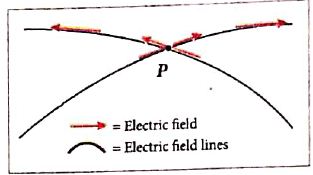
12.
(i) No two electric field lines intersect each other. lf two lines cross at a point, then there will be two different electric field vectors at the same point.
(ii) As a consequence, if some charge is placed in the intersection point, then it has to move in two different directions at the same time, which is physically impossible. Hence electric field lines do not intersect.
13.
Thomson showed that, if two points in a conductor are at different temperatures, the density of electrons at these points will differ and as a result the potential difference is created between these points.
14.
Electrical resistivity of a material is defined as the resistance offered to current flow by a conductor of unit length having unit area of cross section.
15.
(i) Light from the object O at the bottom of the tank passes from denser medium (water) to rarer medium (air) to reach our eyes for viewing the object.
(ii) It deviates away from the normal in the rarer medium at the point of incidence B as shown in Figure.
(iii) The refractive index of the denser medium is n1 and that of rarer medium is n2. Here, n1 > n2.
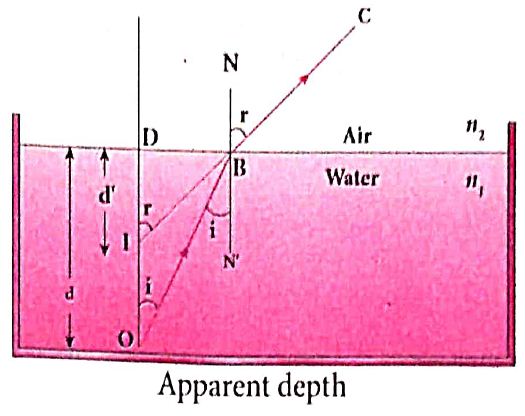
The angle of incidence in the denser medium is i and the angle of refraction in the rarer medium is r. The lines NN'and OD are parallel. Thus, the angle ∠DIB is also r. The angles i and r are very small as the diverging light from O entering the eye is very narrow. The Snell's law in product form for this refraction from equation is,
n1 sin i = n2 sin r
As the angles i and r are small, we can approximate, sin i = tan i and sin r tan r.
n1 tan i = n2 tan r
In triangles ∆DOB and ∆DIB,
\(tan \ i=\frac{DB}{DO}and \ tan \ r=\frac{DB}{DI}\)
\(n_1\frac{DB}{DO}=n_2\frac{DB}{DI}\)
DB is cancelled both sides. Now, DO is the actual depth d and DI is the apparent depth d'.
\(n_1\frac{1}{d}=n_2\frac{1}{d'}\)
After rearranging, \(\frac{d'}{d}=\frac{n_2}{n_1}\)
Rewriting the above equation for the apparent depth d', d' = \(=\frac{n_2}{n_1}d\)
As the rarer medium is air, its refractive index n, can be taken as 1, (n2 = 1) and the refractive index n1 of denser medium could then be taken as n itself, (n1 = n). Now, the equation for apparent depth becomes,
\(d'=\frac{d}{n}\)
The bottom appears to be elevated by d-d',
\(d-d'=d-\frac{d}{n}(or)d-d'=d(1-\frac{1}{n})\)

12th Standard Syllabus & Materials
12th Standard
TN 12th Computer Applications வலையமைப்பு வடமிடல் Sample Question Papers Study Material - QB365 Set A
NEW12th Standard
TN 12th Computer Applications களப்பெயர் முறைமை (DNS) Sample Question Papers Study Material - QB365 Set A
NEW12th Standard
TN 12th Computer Applications வலையமைப்பு எடுத்துக்காட்டுகள் மற்றும் நெறிமுறைகள் Sample Question Papers Study Material - QB365 Set A
NEW12th Standard
TN 12th Computer Applications கணினி வலையமைப்பு ஓர் அறிமுகம் Sample Question Papers Study Material - QB365 Set A



Tamilnadu Stateboard 12th Standard Subjects

Maths

Chemistry
Physics

Biology

Computer Science

Business Maths and Statistics

Economics

Commerce

Accountancy

History

Computer Applications
Biology
Computer Technology
Computer Applications
Computer Science
Business Maths and Statistics
Commerce
Economics
Maths
Chemistry
Physics
Computer Technology
History
Accountancy

Tamil

English

French
Tamilnadu Stateboard Standards



