
 100% FREE ACCESS
12th Standard Syllabus & Materials
12th Standard
TN 12th Computer Applications மின்னணு தரவு பரிமாற்றம் Sample Question Papers Study Material - QB365 Set A
NEW12th Standard
TN 12th Computer Applications மின் - வணிக பாதுகாப்பு அமைப்புகள் Sample Question Papers Study Material - QB365 Set A
NEW12th Standard
TN 12th Computer Applications மின்னணு செலுத்தல் முறைகள் Sample Question Papers Study Material - QB365 Set A
NEW12th Standard
TN 12th Computer Applications மின் - வணிகம் Sample Question Papers Study Material - QB365 Set A
NEW12th Standard
TN 12th Computer Applications திறந்த மூல கருத்துருக்கள் Sample Question Papers Study Material - QB365 Set A
NEW12th Standard
TN 12th Computer Applications வலையமைப்பு வடமிடல் Sample Question Papers Study Material - QB365 Set A

Published on: 13/05/2022
QB365 provides detailed and simple solution for every Book back Questions in class 12 Physics Subject. It will helps to get more idea about question pattern in every book back questions with solution.
latest Book back QuestionsDownload Tamil Nadu 12th Standard Physics question papers, model tests, one-mark questions, important questions, and public exam papers in PDF format. Free study materials and answer keys for TN State Board students.
Questions + Answers key
Take MCQ Physics Test1.
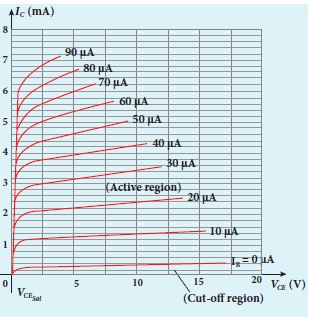
The output characteristics of a transistor connected in common emitter mode is shown in the figure. Determine the value of IC when VCE = 15 V. Also determine the value of IC when VCE is changed to 10 V
2.
(a) Show that the ratio of velocity of an electron in the first Bohr orbit to the speed of light c is a dimensionless number.
(b) Compute the velocity of electrons in ground state, first excited state and second excited state in Bohr atom model for hydrogen atom.
3.
Calculate the electrostatic force and gravitational force between the proton and the electron in a hydrogen atom. They are separated by a distance of 5.3 x 10⁻¹¹ m. The magnitude of charges on the electron and proton are 1.6 x 10⁻¹⁹ C. Mass of the electron is me = 9.1 x 10⁻³¹ kg and mass of proton is mp = 1.6 x 10⁻²⁷ kg.
4.
Pure water has refractive index 1.33. What is the speed of light through it?
5.
The current flowing in the first coil changes from 2 A to 10 A in 0.4 s. Find the mutual inductance between two coils if an emf of 60 mV is induced in the second coil. Also determine the magnitude of induced emf in the second coil if the current in the first coil is changed from 4 A to 16 A in 0.03 s. Consider only the magnitude of induced emf.
6.
A straight conducting wire is dropped horizontally from a certain height with its length along east-west direction. Will an emf be induced in it? Justify your answer.
7.
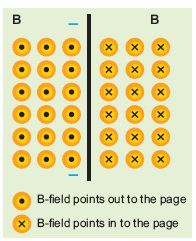
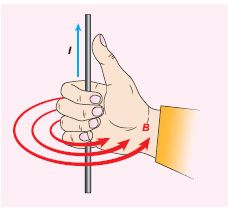
The magnetic field shown in the figure is due to the current carrying wire. In which direction does the current flow in the wire?
8.
The repulsive force between two magnetic poles in air is 9 x 10⁻³ N. If the two poles are equal in strength and are separated by a distance of 10 cm, calculate the pole strength of each pole.
9.
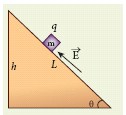
A block of mass m carrying a positive charge q is placed on an insulated frictionless inclined plane as shown in the figure. A uniform electric field E is applied parallel to the inclined surface such that the block is at rest. Calculate the magnitude of the electric field E.
10.
Explain experimentally observed facts of photoelectric effect with the help of Einstein’s explanation.
11.
Discuss about the simple microscope and obtain the equations for magnification for near point focusing and normal focusing.
12.
Deduce the relation for the magnetic field at a point due to an infinitely long straight conductor carrying current using Biot-Savart law.
13.
Give the advantage of AC in long distance power transmission with an illustration.
14.
Discuss the various properties of conductors in electrostatic equilibrium.
15.
Describe the microscopic model of current and obtain general form of Ohm’s law.
1.
When VCE = 15 V, IC = 1.5 μA
When VCE is changed to 10 V, IC = 1.4 μA
2.
(a) The velocity of an electron in nth orbit is
\(\upsilon _{ n }=\frac { h }{ 2\pi m{ a }_{ 0 } } \frac { Z }{ n } \)
Where \({ a }_{ 0 }=\frac { { \epsilon }_{ 0 }{ h }^{ 2 } }{ \pi { me }^{ 2 } } \) = Bohr radius. Substituting for a0 in ሀn,
\({ \upsilon }_{ n }=\frac { { e }^{ 2 } }{ 2{ \epsilon }_{ 0 }h } \frac { Z }{ n } =c\left( \frac { { e }^{ 2 } }{ 2{ \epsilon }_{ 0 }hc } \right) \frac { Z }{ n } =\frac { \alpha cZ }{ n } \)
where c is the speed of light in free space or vacuum and its value is c = 3 x 10⁸ m s–1 and α is called fine structure constant.
For a hydrogen atom, Z = 1 and for the first orbit, n = 1, the ratio of velocity of electron in first orbit to the speed of light in vacuum or free space is
\(\frac { { \upsilon }_{ 1 } }{ c } =\alpha =\frac { { e }^{ 2 } }{ 2{ \epsilon }_{ 0 }hc } \)
\(\alpha =\frac { { (1.6\times { 10 }^{ -19 }C })^{ 2 } }{ 2\times (8.854\times { 10 }^{ -12 }{ C }^{ 2 }{ N }^{ -1 }{ m }^{ -2 }) } \) x \(\frac { 1 }{ (6.6\times { 10 }^{ -34 }{ Nms)\times (3\times { 10 }^{ 8 } }{ ms }^{ -1 }) } \)
≈ \(\frac{1}{136.9}=\frac{1}{137}\) which is a dimensionless number
⇒ α = \(\frac{1}{137}\)
(b) Using fine structure constant, the velocity of electron can be written as vn = \(\frac{αcZ}{n}\)
For hydrogen atom (Z = 1) the velocity of electron in nth orbit is vn = \(\frac{c}{137}\frac{1}{n}=(2.19\times10^6)\frac{1}{n}ms^{-1}\)
For the first orbit (ground state), the velocity of electron is v1 = 2.19 x 10⁶ms−1
For the second orbit (first excited state), the velocity of electron is v2 = 1.095 x 10⁶ms−1
For the third orbit (second excited state), the velocity of electron is v3 = 0.73 x 10⁶ms−1
Here, v1 > v2 > v3
3.
The proton and the electron attract each other. The magnitude of the electrostatic force between these two particles is given by
\(F_e=\frac { ke^{ 2 } }{ { r }^{ 2 } } =\frac { 9\times 10^{ 9 }\times (1.6\times 10^{ -19 })^{ 2 } }{ (5.3\times 10^{ -11 })^{ 2 } } \)
=\(\frac { 9\times 2.56 }{ 28.09 } \) x 10-7 = 8.2 x 10⁻⁸ N
The gravitational force between the proton and the electron is attractive. The magnitude of the gravitational force between these particles is
FG = \(\frac { G{ m }_{ e }{ m }_{ p } }{ { r }^{ 2 } } \)
= \(\frac { 6.67\times 10^{ -11 }\times 9.1\times 10^{ -31 }\times 1.6\times 10^{ -27 } }{ (5.3\times 10^{ -11 })^{ 2 } } \)
= \(\frac { 97.11 }{ 28.09 } \) x 10-47 = 3.4 x 10-47N
The ratio of the two forces \(\frac { { F }_{ e } }{ F_{ G } } =\frac { 8.2\times 10^{ -8 } }{ 3.4\times 10^{ -47 } } \)
= 2.41 x 1039
Note that Fe ≈ 1039 FG
The electrostatic force between a proton and an electron is enormously greater than the gravitational force between them. Thus the gravitational force is negligible when compared with the electrostatic force in many situations such as for small size objects and in the atomic domain. This is the reason why a charged comb attracts an uncharged piece of paper with greater force even though the piece of paper is attracted downward by the Earth. This given figure is shown in below.
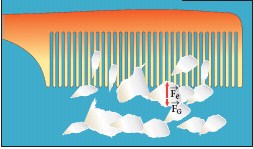
Electrostatic attraction between a comb and pieces of papers
4.
\(n=\cfrac { c }{ v } ;\quad v=\cfrac { c }{ n } \)
\(v=\cfrac { 3\times { 10 }^{ 8 } }{ 1.33 } =2.26\times { 10 }^{ 8 }{ ms }^{ -1 }\)
Light travels with a speed of 2.26 x 10⁸ m s-1 through pure water.
5.
Case (i):
di1 = 10 – 2 = 8 A; dt = 0.4 s;
ε2 = 60 x 10-3V
Case(ii):
di1 = 16 – 4 = 12 A; dt = 0.03 s
(i) Mutual inductance between the coils.
\({ M }=\frac { { \epsilon }_{ 2 } }{ \frac { { di }_{ 1 } }{ dt } } \)
\(=\frac { 60\times { 10 }^{ -3 }\times 0.4 }{ 8 } \)
\({ M }=3\times { 10 }^{ -3 }H\)
(ii) Induced emf in the second coil due to the rate of change of current in the first coil is
\({ \epsilon }_{ 2 }={ M }=\frac { { di }_{ 1 } }{ dt } \)
\(=\frac { 3\times { 10 }^{ -3 }\times 12 }{ 0.03 } \)
ε2 = 1.2V
6.
Yes! An emf will be induced in the wire because it moves perpendicular to the horizontal component of Earth’s magnetic field and hence it cuts the magnetic lines of Earth's magnetic field.
7.
Using right hand rule, current flows upwards.
8.
The magnitude of the force between two poles is given by
\( F =k\frac { { q }_{ m_A }{ q }_{ { m }_{ B } } }{ { r }^{ 2 } } \)
(Given : F = 9 × 10⁻³ N, r = 10 cm = 10 × 10–2 m
Since qmA = qmB = qm, we have
9 x 10-3 = 10-7 x \(\frac { { q }_{ m }^{ 2 } }{ { \left( 10\times { 10 }^{ -2 } \right) }^{ 2 } } \Rightarrow { q }_{ m }\) = 30NT-1
9.
Note: A similar problem is solved in XIth Physics volume I, unit 3 section 3.3.2. There are three forces that acts on the mass m:
(i) The downward gravitational force exerted by the Earth (mg)
(ii) The normal force exerted by the inclined surface (N)
(iii) The Coulomb force given by uniform electric field (qE) The free body diagram for the mass m is drawn below.
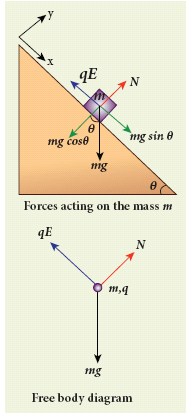
A convenient inertial coordinate system is located in the inclined surface as shown in the figure. The mass m has zero net acceleration both in x and y-direction.
Along x-direction, applying Newton’s second law, we have
mg sinθ\(\hat { i } \) - qE\(\hat { i } \) = 0
mg sinθ - q E = 0
or, E = \(\\ \frac { mgsin\theta }{ q } \)
Note that the magnitude of the electric field is directly proportional to the mass m and inversely proportional to the charge q. It implies that, if the mass is increased by keeping the charge constant, then a strong electric field is required to stop the object from sliding. If the charge is increased by keeping the mass constant, then a weak electric field is sufficient to stop the mass from sliding down the plane.
The electric field also can be expressed in terms of height and the length of the inclined surface of the plane.
E = \(\frac { mgh }{ qL } \).
10.
Explanation for the photoelectric effect:
The experimentally observed facts of photoelectric effect can be explained with the help of Einstein's photoelectric equation.
(i) As each incident photon liberates one electron, then the increase of intensity of the light (the number of photons per unit area per unit time) increases the number of electrons emitted thereby increasing the photocurrent. The same has been experimentally observed.
(ii) From Kmax = hv - Φ0, it is evident that Kmax is proportional to the frequency of the light and is independent of intensity of the light.
(iii) As given in equation \({ hv }_{ o }+\cfrac { 1 }{ 2 } { mv }^{ 2 }\) , there must be minimum energy (equal to the work function of the metal) for incident photons to liberate electrons from the metal surface. Below which, emission of electrons is not possible. Correspondingly, there exists minimum frequency called threshold frequency below which there is no photoelectric emission.
(iv) According to quantum concept, the transfer of photon energy to the electrons is instantaneous so that there is no time lag between incidence of photons and ejection of electrons.
Thus, the photoelectric effect is explained on the basis of quantum concept of light.
11.
(i) A simple microscope is a single magnifying (converging) lens of small focal length. To get an erect, magnified and virtual image of the object.
(ii) For this the object is placed between the focal length Fand P on one side of the lens and viewed from other side of the lens. There are two magnifications to be discussed for two kinds of focusing.
(a) Near point focusing:
The eye is least strained when image is formed at near point,i.e. 25 cm. The near point is also called as least distance of distinct vision. This is shown in Figure.
.JPG)
Magnification in near point focusing:
(i) Object distance u is less than f
(ii) The image distance is the near point D. The magnification m is given by the relation,
\(m=\cfrac { v }{ u } \) ...............(1)
Substituting, V = - D and u= - u, as both the distances are measured to the left of the lens. Hence,
\(m=\cfrac { -D }{ -u }\)
\(m=\cfrac { D }{ u } \) ...............(2)
Using lens equation, W.K.T, m = 1 - (v/f)
Substiuting v = -D gives, \(\\ m=1+\cfrac { D }{ f } \) ..................(3)
This is the magnification for near point focusing.
(b) Normal focusing :
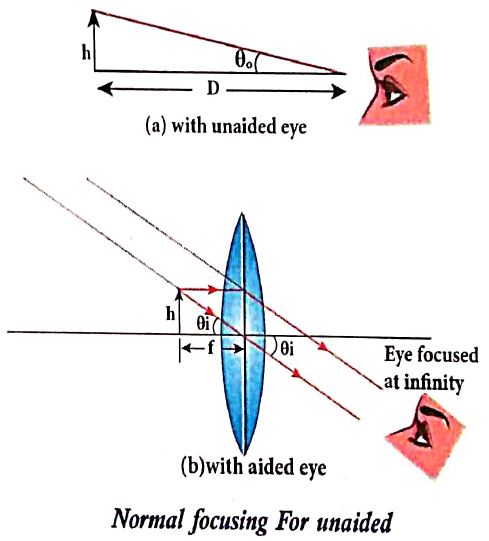
(i) The eye is most relaxed when the image is formed at infinity. The focusing is called normal focusing when the image is formed at infinity. This is shown in Figure (b).
Magnification in normal focusing (angular magnification):
(ii) The angular magnification is defined as the ratio of angle θ1 subtended by the image with aided eye to the angle θ0 subtended by the object with unaided eye.
\(m=\cfrac { { \theta }_{ 1 } }{ { \theta }_{ 0 } } \) .........(2)
For unaided eye shown in Figure (a),
\(tan\theta _{ 0 }\approx { \theta }_{ 1 }=\cfrac { h }{ D } \) ................(3)
For aided eye shown in Figure(b).
\(tan\theta _{ i }={ \theta }_{ i }=\cfrac { h }{ f } \) ...................(4)
The angular magnification is,
\(m=\cfrac { { \theta }_{ i } }{ { \theta }_{ o } } =\cfrac { h/f }{ h/D } \)
\(m=\cfrac { D }{ f } \) ..............(5)
This is the magnification for normal focusing.
12.
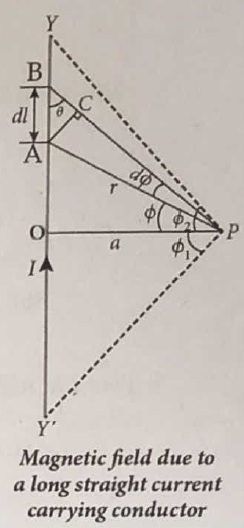
Let YY' be an infinitely long straight conductor carry current I. In order to calculate magnetic field at a point P which is at a distance a from the wire, let us consider a small line element dl (segment AB).
According to Biot Savart law, the magnetic field at a point P due to current element Idl is,
\({ d \vec B } =\frac { { \mu }_{ 0 } }{ 4\pi } \frac { { Idl sin \theta} }{ { r }^{ 2 } }\hat n \).
To apply trigonometry, draw a perpendicular AC to the line BP as shown in Figure.
In triangle ΔABC, \(\sin \theta=\frac{\mathrm{AC}}{\mathrm{AB}}\)
∴ AC = AB sinθ
\(\text { But, } A B =d l \Rightarrow A C=d l \sin \theta\)
Let dΦ be the angle subtended between AP and BP
ie., \(\angle \mathrm{APB}=\angle \mathrm{APC}=d \phi\)
In a triangle \(\triangle \mathrm{APC}, \sin (d \phi) \simeq A C / A P\)
Since, dΦ is very small, \(\sin (d \phi) \simeq d \phi\)
But, \(\mathrm{AP} =r \Rightarrow A C=r d \phi \)
\(\therefore \mathrm{AC} =d l \sin \theta=r d \phi \)
\(\therefore d \vec{B} =\frac{\mu_0}{4 \pi} \frac{I}{r^2}(r d \phi) \hat{n}=\frac{\mu_0}{4 \pi} \frac{I d \phi}{r} \hat{n}\)
Let Φ be the angle between AP and OP
\(\text {In a } \triangle \mathrm{OPA}, \cos \phi =\frac{\mathrm{OP}}{\mathrm{AP}}=\frac{\mathrm{a}}{\mathrm{r}} \)
\(r =\frac{a}{\cos \phi} \)
\(\text {Now, } d \vec{B} =\frac{\mu_0}{4 \pi} \frac{I}{a / \cos \phi} d \phi . \hat{n} \)
\(d \vec{B} =\frac{\mu_0 I}{4 \pi a} \cos \phi d \phi \hat{n}\)
The total magnetic field at P due to the conductor YY' is
\(\vec { B } = \int _{- \Phi _{ 1 } }^{ { \Phi }_{ 2} }d\vec B =\int _{ -\Phi _{ 1 } }^{ { \Phi }_{ 2 } }\frac { { \mu }_{ 0 }I }{ 4\pi a }{ cos\phi d\phi } \hat { n }\)
\(=\frac { { \mu }_{ 0 }I }{ 4\pi a }[{ sin\phi ]^{\phi_2} _{\phi_-1}} \hat { n }\)
\( \vec{B}=\frac { { \mu }_{ 0 }I }{ 4\pi a } (sin{ \Phi }_{ 1 }+sin{ \Phi }_{ 2 })\hat { n } \)
For infinitely long conductor, Φ1 = Φ2 = 90o
\(\therefore \vec{B}=\frac { { \mu }_{ 0 }I }{ 4\pi a } \times 2\hat{n}\Rightarrow\vec { B } =\frac { { \mu }_{ 0 }I }{ 2\pi a } \hat { n } \)
13.
(i) There is a difficulty during power transmission. A sizable fraction of electric power is lost due to Joule heating (FR) in the transmission lines which are hundreds of kilometer long. This power loss can be tackled either by reducing current I or by reducing resistance R of the transmission lines. The resistance R can be reduced with thick wires of copper or aluminium. But this increases the cost of production of transmission lines and other related expenses. So this way of reducing power loss is not economically viable.
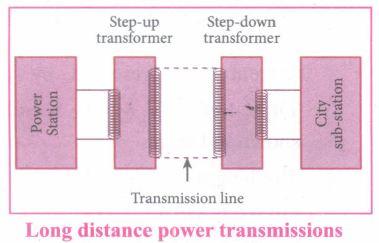
(ii) Since power produced is alternating in nature, there is a way out. The most important property of alternating voltage that it can be stepped up and stepped down by using transformers could be exploited in reducing current and thereby reducing power losses to a greater extent.
(iii) At the transmitting point, the voltage is increased and the corresponding current is decreased by using step-up transformer.
(iv) Then it is transmitted through transmission lines. This reduced current at high voltage reaches the destination without any appreciable loss.
Illustration:
An electric power of 2 MW is transmitted to a place through transmission lines of total resistance, say R = 40 Ω, at two different voltages. One is lower voltage (10 kV) and the other is higher (100 kV). Let us now calculate and compare power losses in these two cases.
Case (i):
\(P=2 \mathrm{MW} ; R=40 \Omega ; V=10 \mathrm{kV}\)
Power, P = V I
∴ Current, \(I=\frac{P}{V}=\frac{2 \times 10^6}{10 \times 10^3}=200 \mathrm{~A}\)
Power loss = Heat produced \(=\mathrm{I}^2 \mathrm{R}=(200)^2 \times 40=1.6 \times 10^6 \mathrm{~W}\)
\(% of power loss =\frac{1.6 \times 10^6}{2 \times 10^6} \times 100 \%\)\(\% of \ power \ loss =\frac{1.6 \times 10^6}{2 \times 10^6} \times 100 \%\)
\(=0.8 \times 100 \%=80 \%\)
Case (ii):
\(P=2 \mathrm{MW} ; R=40 \Omega ; V=100 \mathrm{kV} \)
\(\therefore \text {Current, } I=\frac{P}{V}=\frac{2 \times 10^5}{100 \times 10^3}=20 \mathrm{~A}\)
Power loss = PR= (20)2 x 40 = 0.016 x 10⁶ W
\(\% of \ power \ loss =\frac{0.01.6 \times 10^6}{2 \times 10^6} \times 100 \%\times 0.008 \%\times 100 \%=0.8\%\)
Thus, it is clear that when an electric power is transmitted at higher voltage, the power loss is reduced to a large extent.
14.
A conductor at electrostatic equilibrium has the following properties:
(i) The electric field is zero everywhere inside the conductor. This is true regardless of whether the conductor is solid or hollow:
(a) This is an experimental fact. Suppose the electric field is not zero inside the metal, then there will be a force on the mobile charge carriers due to this electric field.
(b) As a result, there will be a net motion of the mobile charges, which contradicts the conductors being in electrostatic equilibrium. Thus the electric field is zero everywhere inside the conductor. We can also understand this fact by applying an external uniform electric field on the conductor.
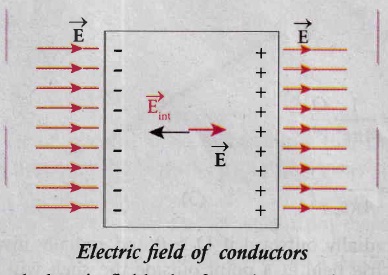
(c) Before applying the external electric field, the free electrons in the conductor are uniformly distributed in the conductor. When an electric field is applied, the free electrons accelerate to the left causing the left plate to be negatively charged and the right plate to be positively charged as shown in Figure.
(d) Due to this realignment of free electrons, there will be an internal electric field created inside the conductor which increases until it nullifies the external electric field.
(e) Once the external electric field is nullified the conductor is said to be in electrostatic equilibrium. The time taken by a conductor to reach electrostatic equilibrium is in the order of 10-16 s, which can be taken as almost instantaneous.
(ii) There is no net charge inside the conductors. The charges must reside only on the surface of the conductors:
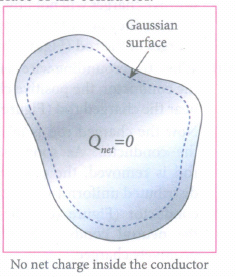
(a) We can prove this property using Gauss law. Consider an arbitrarily shaped conductor as shown in Figure. A Gaussian surface is drawn the conductor such that it is very close to the surface of the conductor.
(b) Since the electric field is zero everywhere inside the conductor, the net electric flux is also zero over this Gaussian surface. From Gauss's law, this implies that there is no net charge inside the conductor.
(c) Even if some charge is introduced inside the conductor, it immediately reaches the surface of the conductor.
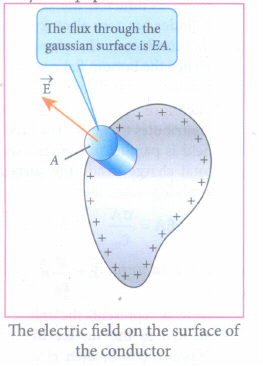
(iii) The electric field outside the conductor is perpendicular to the surface of the conductor and has a magnitude of \(\frac { \sigma }{ { \varepsilon }_{ 0 } } \) is the surface charge density at that point:
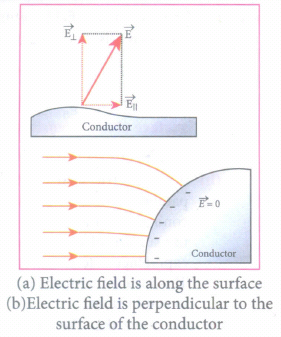
(a) If the electric field has components parallel to the surface of the conductor, then free electrons on the surface of the conductor would experience acceleration (Figure a).
(b) This means that the conductor is not in equilibrium. Therefore at electrostatic equilibrium, the electric field must be perpendicular to the surface of the conductor. This is shown in Figure (b).
(c) We now prove that the electric field has magnitude \(\frac { \sigma }{ { \varepsilon }_{ 0 } } \) just outside the conductor's surface.
(d) Consider a small cylindrical Gaussian surface, as shown in the Figure. One-half of this cylinder is embedded inside the conductor.
(e) Since electric field is normal to the surface of the conductor, the curved part of the cylinder has zero electric flux.
(f) Also inside the conductor, the electric field is zero. Hence the bottom flat part of the Gaussian surface has no electric flux.
(g) Therefore the top flat surface alone contributes to the electric flux. The electric field is parallel to the area vector and the total charge inside the surface is σA. By applying Gaus's law,
\(EA=\frac { \sigma A }{ { \varepsilon }_{ 0 } } \)
In vector form, \(\vec { E } =\frac { \sigma }{ { \varepsilon }_{ 0 } } \hat { n } \) ....(1)
(h) Where \(\hat { n } \) represents the unit vector outward normal to the surface of the conductor. Suppose \(\sigma\) < 0, then electric field points inward perpendicular to the surface.
(iv) The electrostatic potential has the same value on the surface and inside of the conductor :
(a) We know that the conductor has no parallel electric component on the surface which means that charges can be moved on the surface without doing any work.
(b) This is possible only if the electrostatic potential is constant at all points on the surface and there is no potential difference between any two points on the surface.
(c) Since the electric field is zero inside the conductor, the potential is the same as the surface of the conductor. Thus at electrostatic equilibrium, the conductor is always at equipotential.
15.
(i) XY is a conductor of area cross section A. \(\vec { E } \)is the applied electric field. n is the number of electrons per unit volume with same drift velocity (Vd) .
(ii) Let electrons move through a distance dx in time interval dt.
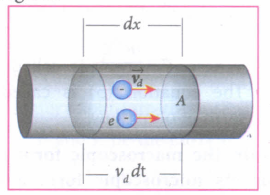
(iii) The drift velocity of the electrons = vd
(iv) If the electrons move through a distance dx within a small interval of time dt,
\({ v }_{ d }=\cfrac { dx }{ dt } ;dx={ v }_{ d }dt\) ..(i)
(v) Since A is the area of cross section of the conductor, the electrons available in the volume of length dx is
= volume x number of electrons per unit volume = A dx x n ...(2)
(vi) Substituting for dx from equation (1) in (2)
= (A vd dt) n
(vii) Total charge in volume element dQ =(charge) x (number of electrons in the volume element)
dQ = (e) (Avddt)n
Hence the current \(I=\cfrac { dQ }{ dt } =\cfrac { ne{ Av }_{ d }dt }{ dt } \)
\(I=ne{ Av }_d\) ..........(3)
Current density (J):
(viii) The current density (J) is defined as the current per unit area of cross section of the conductor.
\(J=\cfrac { I }{ A } \)
(ix) The S.I unit of current density is \({ Am }^{ -2 }\)
\(J=\cfrac { neAv_{ d } }{ A } \) (∵I = nAeVd)
\(J={ nev }_{ d }\) .........(4)
(x) The above expression holds only when the direction of the current is perpendicular to the area A.
In general, the current density is a vector quantity and it is given by,
\(\vec { J } =ne\vec { v_{ d } } \)
Substituting \(\vec { v_{ d } } \) from equation
\(\vec { v_{ d } } =\cfrac { e\tau }{ m } \vec { E } \)
\(\vec { J } =\cfrac { n.{ e }^{ 2 }\tau }{ m } \vec { E } \) ...(5)
\(\vec { J } =\sigma \vec { E } \) ....(6)
(xi) But conventionally, we take the direction of (conventional) current density as the direction of electric field. So, the above equation becomes,
\(\vec { J } =\sigma \vec { E } \) .....(7)
(xii) Where, \(\sigma =\cfrac { { ne }^{ 2 }\tau }{ m } \) is called conductivity. The equation (7) is called microscopic form of ohm's law.

12th Standard Syllabus & Materials
12th Standard
TN 12th Computer Applications களப்பெயர் முறைமை (DNS) Sample Question Papers Study Material - QB365 Set A
NEW12th Standard
TN 12th Computer Applications வலையமைப்பு எடுத்துக்காட்டுகள் மற்றும் நெறிமுறைகள் Sample Question Papers Study Material - QB365 Set A
NEW12th Standard
TN 12th Computer Applications கணினி வலையமைப்பு ஓர் அறிமுகம் Sample Question Papers Study Material - QB365 Set A
NEW12th Standard
TN 12th Computer Applications PHP-உடன் MySQL-ஐ இணைத்தல் Sample Question Papers Study Material - QB365 Set A



Tamilnadu Stateboard 12th Standard Subjects

Maths

Chemistry
Physics

Biology

Computer Science

Business Maths and Statistics

Economics

Commerce

Accountancy

History

Computer Applications
Biology
Computer Technology
Computer Applications
Computer Science
Business Maths and Statistics
Commerce
Economics
Maths
Chemistry
Physics
Computer Technology
History
Accountancy

Tamil

English

French
Tamilnadu Stateboard Standards



