
 100% FREE ACCESS
12th Standard Syllabus & Materials
12th Standard
TN 12th Computer Applications மின்னணு தரவு பரிமாற்றம் Sample Question Papers Study Material - QB365 Set A
NEW12th Standard
TN 12th Computer Applications மின் - வணிக பாதுகாப்பு அமைப்புகள் Sample Question Papers Study Material - QB365 Set A
NEW12th Standard
TN 12th Computer Applications மின்னணு செலுத்தல் முறைகள் Sample Question Papers Study Material - QB365 Set A
NEW12th Standard
TN 12th Computer Applications மின் - வணிகம் Sample Question Papers Study Material - QB365 Set A
NEW12th Standard
TN 12th Computer Applications திறந்த மூல கருத்துருக்கள் Sample Question Papers Study Material - QB365 Set A
NEW12th Standard
TN 12th Computer Applications வலையமைப்பு வடமிடல் Sample Question Papers Study Material - QB365 Set A

Published on: 01/06/2021
QB365 provides detailed and simple solution for every Book back Questions in class 12 Physics Subject. It will helps to get more idea about question pattern in every book back questions with solution.
Download Tamil Nadu 12th Standard Physics question papers, model tests, one-mark questions, important questions, and public exam papers in PDF format. Free study materials and answer keys for TN State Board students.
Questions + Answers key
Take MCQ Physics Test1.
Consider a point charge +q placed at the origin and another point charge -2q placed at a distance of 9 m from the charge +q. Determine the point between the two charges at which electric potential is zero.
2.
Lights of two wavelengths 560 nm and 420 nm are used in Young’s double slit experiment. Find the least distance from the central fringe where the bright fringes of the two wavelengths coincide. Given D = 1 m and d = 3 mm.
3.
In Young's double slit experiment, 62 fringes are seen in visible region for sodium light of wavelength 5893 Å. If violet light of wavelengtlt 4359 Å is used in place of sodium light, then what is the number of fringes seen?
4.
Calculate the radius of the earth if the density of the earth is equal to the density of the nucleus.[mass of earth 5.97 x 1024 kg].
5.
Two air core solenoids have the same length of 80 cm and same cross-sectional area 5 cm2. Find the mutual inductance between them if the number of turns in the first coil is 1200 turns and that in the second coil is 400 turns.
6.
A pulse of light of duration 10−6 s is absorbed completely by a small object initially at rest. If the power of the pulse is 60\(\times\) 10−3 W. Calculate the final momentum of the object.
7.
A rectangular coil of area 70 cm2 having 600 turns rotates about an axis perpendicular to a magnetic field of 0.4 Wb m–2. If the coil completes 500 revolutions in a minute, calculate the instantaneous emf when the plane of the coil is
(i) perpendicular to the field
(ii) parallel to the field and
(iii) inclined at 60o with the field.
8.
A magnetron in a microwave oven emits electromagnetic waves (em waves) with frequency f = 2450 MHz. What magnetic field strength is required for electrons to move in circular paths with this frequency?
9.
Two electric bulbs marked 20 W – 220 V and 100 W – 220 V are connected in series to 440 V supply. Which bulb will get fused?
10.
A 3310 Å photon liberates an electron from a material with energy 3 x10-19 J while another 5000 Å photon ejects an electron with energy 0.972 x 10⁻¹⁹ J from the same material. Determine the value of Planck’s constant and the threshold wavelength of the material.
11.
Calculate the maximum kinetic energy and maximum velocity of the photoelectrons emitted when the stopping potential is 81 V for the photoelectric emission experiment.
12.
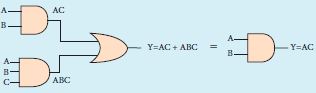
Prove the Boolean identity AC + ABC = AC and give its circuit description.
13.
Compute the binding energy per nucleon of \(_{ 2 }^{ 4 }{ He }\) nucleus.
14.
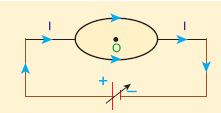
What is the magnetic field at the centre of the loop shown in figure?
15.
A 400 mH coil of negligible resistance is connected to an AC circuit in which an effective current of 6 mA is flowing. Find out the voltage across the coil if the frequency is 1000 Hz.
1.
According to the superposition principle, the total electric potential at a point is equal to the sum of the potentials due to each charge at that point.
Consider the point at which the total potential zero is located at a distance x from the charge +q as shown in the figure.
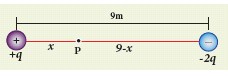
The total electric potential at P is zero.
Vtot = \(\frac { 1 }{ 4\pi { \varepsilon }_{ 0 } } \left( \frac { q }{ x } -\frac { 2q }{ (9-x) } \right) \)=0
Which gives \(\frac { q }{ x } -\frac { 2q }{ (9-x) } \)
or \(\frac { 1 }{ x } =\frac { 2 }{ (9-x) } \)
Hence, x = 3m
2.
λ1 = 560 nm = 560 x 10-9m;
λ1 = 420 nm = 420 x 10-9m;
D = 1 m; d = 3 mm = 3 x 10⁻³m
Here, n and λ are inversely proportional for a given y.
Here, nth order bright fringe of longer wavelength λ1 coincides with (n+1)th order bright fringe of shorter wavelength λ2.
Equation for nth bright fringe is, \({ y }_{ n }=n\cfrac { \lambda D }{ d } \)
Here, \(n\cfrac { { \lambda }_{ 1 }D }{ d } =(n+1)\cfrac { { \lambda }_{ 2 }D }{ d } \) (as λ1>λ2)
\({ n\lambda }_{ 1 }=\left( n+1 \right) { \lambda }_{ 2 }\) (or) \(\cfrac { { \lambda }_{ 1 } }{ { \lambda }_{ 2 } } =\cfrac { (n+1) }{ n } ;1+\frac{1}{n}=\frac{\lambda_1}{\lambda_2}\)
\(1+\cfrac { 1 }{ n } =\cfrac { 560\times { 10 }^{ -9 } }{ 420\times { 10 }^{ -9 } } \) (or) \(1+\cfrac { 1 }{ n } =\cfrac { 4 }{ 3 } \)
\(\frac{1}{n}=\frac{1}{3}\) (or) n = 3
Thus, the 3rd bright fringe of λ1 and the 4th bright fringe of λ2 coincide at the least distance y.
The least distance from the central fringe where the bright fringes of the two wavelengths coincide is, \(y_{n}=n \frac{\lambda D}{d}\)
\(y_{n}=3 \times \frac{560 \times 10^{-9} \times 1}{3 \times 10^{-3}}=560 \times 10^{-6} \mathrm{~m}\)
\(y_{n}=0.560 \times 10^{-3} \mathrm{~m}=0.560 \mathrm{~mm}\)
3.
\(\mathrm{n}_{1} \lambda_{1}=\mathrm{n}_{2} \lambda_{2} \)
\(\mathrm{n}_{1}=62 \text { fringes } \)
\(\lambda_{1}=5893 \mathrm{~A}^{0} \)
\(\lambda_{2}=4359 \mathrm{~A}^{0} \)
\(\mathrm{n}_{2}=? \)
\(\mathrm{n}_{2}=\frac{\mathrm{n}_{1} \lambda_{1}}{\lambda_{2}} \)
\(=\frac{5893 \times 62}{4359} \)
= 83.81 = 84 fringes.
4.
Density \(\rho=2.3 \times 10^{17} \mathrm{kgm}^{-3}\), Mass M = 5.97 x 1024 kg
\(\rho=\frac{M}{V}=\frac{M}{\frac{4}{3}\pi R^3}\)
\(R=\left[\frac{M}{\frac{4}{3} \pi \rho}\right]^{\frac{1}{3}}=\left[\frac{3 \mathrm{M}}{4 \pi \rho}\right]^{\frac{1}{3}}=\left[\frac{3 \times 5.97 \times 10^{24}}{4 \times 3.14 \times 2.3 \times 10^{17}}\right]^{\frac{1}{3}}=\left[0.62 \times 10^{7}\right]^{\frac{1}{3}}\)
R = 183.7 m
R ≈180 m
5.
μr = 1 (air core)
Length of two solenoids, \(l_1=l_2=80 \times 10^{-2} \mathrm{~m}\)
Cross-sectional area of two solenoids, \(A_1=A_2=5 \times 10^{-4} \mathrm{~m}^2\)
Number of turns in the first coll, N1=1200 turns
Number of turns in the second coil, N2 = 400 turns
\(n_1=\frac{N_1}{l}=\frac{1200}{80 \times 10^{-2}}=15 \times 10^{-2}=1500 \)
\(n_2=\frac{N_2}{l}=\frac{400}{80 \times 10^{-2}}=500\)
Mutual inductance, \(M= μ_0μ_r n_1 n_2 A_2 l\)
\(M =4 \times 3.14 \times 10^{-7} \times 1 \times 1500 \times 500 \times 5 \times 10^{-4} \times 80 \times 10^{-2} \)
\(=12.56 \times 10^{-7} \times 75 \times 10^4 \times 5 \times 10^{-4} \times 80 \times 10^{-2} \)
\(=3.76,800 \times 10^{-9}=0.376 \times 10^{-3} \mathrm{H}=0.376 \mathrm{mH} \)
\(=0.38 \mathrm{mH} \)
\(\therefore \text {Mutual inductance } =0.38 \mathrm{mH}\)
6.
Power of the pulse P = 60 x 10-3 W
Time internal t = 10-6 S
Energy U = Power x time
U = p x t
= 60 x 10-3 x 10-6
U = 60 x 10-9 J
Lineral momentum, \(\mathrm{P}=\frac{\text { Energy }}{\text { speed }}=\frac{U}{C} \ \)
\(\mathrm{P}=\frac{60 \times 10^{-9}}{3 \times 10^{8}} \)
P = 20 x 10-17 kg ms-1
7.
A = 70 x 10-4m2; N = 600 turns
B = 0.4 Wbm-2; f = 500 rpm
The instantaneous emf is
ε = εmsinωt
since \({ \epsilon }_{ m }=N{ \Phi }_{ m }\omega =N(BA)(2\pi f)\)
ε = NBA x 2\(\pi\)f x sinωt
(i) When ωt = 0o,
ε = εm sin0 = 0
(ii) When ωt = 90o,
ε = εmsin90o = NBA x 2\(\pi\)f x 1
= 600 x 0.4 x 70 x 10-4 x 2 x \(\frac{22}{7}\times(\frac{500}{60})\)
= 88V
(iii) When ωt = 90° – 60° = 30°,
ε = εm sin30o = 88 x \(\frac{1}{2}\) = 44V
8.
Frequency of the electromagnetic waves given, f = 2450 MHz
The corresponding angular frequency is
ω = 2πf = 2 x 3.14 x 2450 x 106
= 15,386 x 106 Hz
= 1.54 x 10¹⁰ s-1
The required magnetic field, B = \(\frac { { m }_{ e }\omega }{ |q| } \)
Mass of the electron, me = 9.11 x 10⁻³¹ kg
Charge of the electron,
q = -1.60 x 10⁻¹⁹C
⇒ |q| = 1.60 x 10⁻¹⁹ C
B = \(\frac { (9.11\times { 10 }^{ -31 })(1.54\times 10^{ 10 }) }{ (1.60\times 10^{ -19 }) } \) = 8.7683 x 10⁻²T
B = 0.08768 T
This magnetic field can be easily produced with a permanent magnet. So, electromagnetic waves of frequency 2450 MHz can be used for heating and cooking food because they are strongly absorbed by water molecules.
9.
To check which bulb will be fused, the voltage drop across each bulb has to be calculated.
The resistance of a bulb,
\(R=\frac { V^{ 2 } }{ P } =\frac { { (Ratedvoltage) }^{ 2 } }{ Ratedpower } \)
For 20W - 220V bulb,
\({ R }_{ 1 }=\frac { { \left( 220 \right) }^{ 2 } }{ 20 } \Omega =2420\Omega \)
For 100W - 220V bulb,
\({ R }_{ 2 }=\frac { { \left( 220 \right) }^{ 2 } }{ 20 } \Omega =484\Omega \)
Both the bulbs are connected in series. So same current will pass through both the bulbs. The current that passes through the circuit, \(I=\frac { V }{ { R }_{ tot } } \)
Rtot (R1 + R2)
Rtot = (484 + 2420) \(\Omega\) = 2904 \(\Omega\)
\(I=\frac { 440V }{ 2904\Omega } \approx 0.151A\)
The voltage drop across the 20W bulb is
\(V_1=IR_1=\frac { 440V }{ 2904 }\times2420 \approx 366.6V\)
The voltage drop across the 100W bulb is
\({ V }_{ 2 }=I{ R }_{ 2 }=\frac { 440 }{ 2904 } 484\approx 73.3A\)
The 20 W bulb will get fused because the voltage across it is more than the voltage rating.
10.
\(\lambda_{1}=3310 Å=3310 \times 10^{-10} \mathrm{~m} ; \mathrm{E}_{1}=3 \times 10^{-19} \mathrm{~J} \)
\(\lambda_{2}=5000 Å=5000 \times 10^{-10} \mathrm{~m} ; \mathrm{E}_{2}=0.972 \times 10^{-19} \mathrm{~J} \)
\(\mathrm{E}=\mathrm{E}_{1}-\mathrm{E}_{2}=2.028 \times 10^{-19} J\)
\(\mathrm{hc}\left(\frac{1}{\lambda_{1}}-\frac{1}{\lambda_{2}}\right)=\mathrm{E}_{1}-\mathrm{E}_{2} \)
\(\frac{\mathrm{h} \times 3 \times 10^{8}}{10^{-10}}\left(\frac{1}{3310}-\frac{1}{5000}\right)=2.028 \times 10^{-19} \)
\(\mathrm{~h}=\frac{2.028 \times 10^{-19} \times 10^{-10} \times 3310 \times 5000}{3 \times 10^{8} \times 1690}=6.62 \times 10^{-34} \mathrm{Js} \)
\(\phi_{0} =\frac{\mathrm{hc}}{\lambda}-\mathrm{E}=\frac{6.62 \times 10^{-34} \times 3 \times 10^{8}}{3310 \times 10^{-10}}-3 \times 10^{-19} \)
\(=(6-3) \times 10^{-19}=3 \times 10^{-19} \mathrm{~J} \)
\(\phi_{0} =3 \times 10^{-19} \mathrm{~J} \)
Threshold Wavelength,
\(\lambda_{0}=\frac{\mathrm{hc}}{\phi_{0}}=\frac{6.626 \times 10^{-34} \times 3 \times 10^{8}}{3 \times 10^{-19}}=6.62 \times 10^{-7} \mathrm{~m} \)
\(\lambda_{0}=6620 \stackrel {o}{A}\)
11.
V = 81 V
∴ K = eV = 1.6 x 10-19 x 81 = 1.296 x 10-17 = 1.3 x 10⁻¹⁷ J
\({ V }=\sqrt \frac {2K}{m}\sqrt { \cfrac { 2\times 1.3\times { 10 }^{ -17 } }{ 9.1\times { 10 }^{ -31 } } } =5.345 \times 10^6 ms^{-1} \)
v = 5.345 x 10⁶ m s-1, K = 1.3 x 10⁻¹⁷ J
12.
Step 1: AC (1 + B) = AC.1 [OR law-2]
Step 2: AC . 1 = AC [AND law – 2]
Therefore, AC + ABC = AC
Thus the Boolean identity is proved.
Circuit Description
13.
From example, we found that the BE of \(_{ 2 }^{ 4 }{ He }\) = 28.33 Mev
Binding energy per nucleon = \(\overline{B \cdot E}\) = \(28.33 \mathrm{MeV} / 4 \simeq 7 \mathrm{MeV}\).
14.
The magnetic field due to current in the upper semicircle and lower semicircle of the circular coil are equal in magnitude but opposite in direction. Hence, the net magnetic field at the center of the loop (at point O) is zero \(\overset { \rightarrow }{ B } =\overset { \rightarrow }{ 0 } \).
15.
L = 400 x 10-3 H; Ieff = 6 x 10⁻³A
f = 1000 Hz
Inductive reactance, XL= L\(\omega\) = L x 2\(\pi\)f
= 2 x 3.14 x 1000 x 0.4
= 2512 Ω
Voltage across L,
V = I X L = 6 x 10-3 x 2512
V = 15.072 V (RMS)

12th Standard Syllabus & Materials
12th Standard
TN 12th Computer Applications களப்பெயர் முறைமை (DNS) Sample Question Papers Study Material - QB365 Set A
NEW12th Standard
TN 12th Computer Applications வலையமைப்பு எடுத்துக்காட்டுகள் மற்றும் நெறிமுறைகள் Sample Question Papers Study Material - QB365 Set A
NEW12th Standard
TN 12th Computer Applications கணினி வலையமைப்பு ஓர் அறிமுகம் Sample Question Papers Study Material - QB365 Set A
NEW12th Standard
TN 12th Computer Applications PHP-உடன் MySQL-ஐ இணைத்தல் Sample Question Papers Study Material - QB365 Set A



Tamilnadu Stateboard 12th Standard Subjects

Maths

Chemistry
Physics

Biology

Computer Science

Business Maths and Statistics

Economics

Commerce

Accountancy

History

Computer Applications
Biology
Computer Technology
Computer Applications
Computer Science
Business Maths and Statistics
Commerce
Economics
Maths
Chemistry
Physics
Computer Technology
History
Accountancy

Tamil

English

French
Tamilnadu Stateboard Standards



